
Psalms 119:143

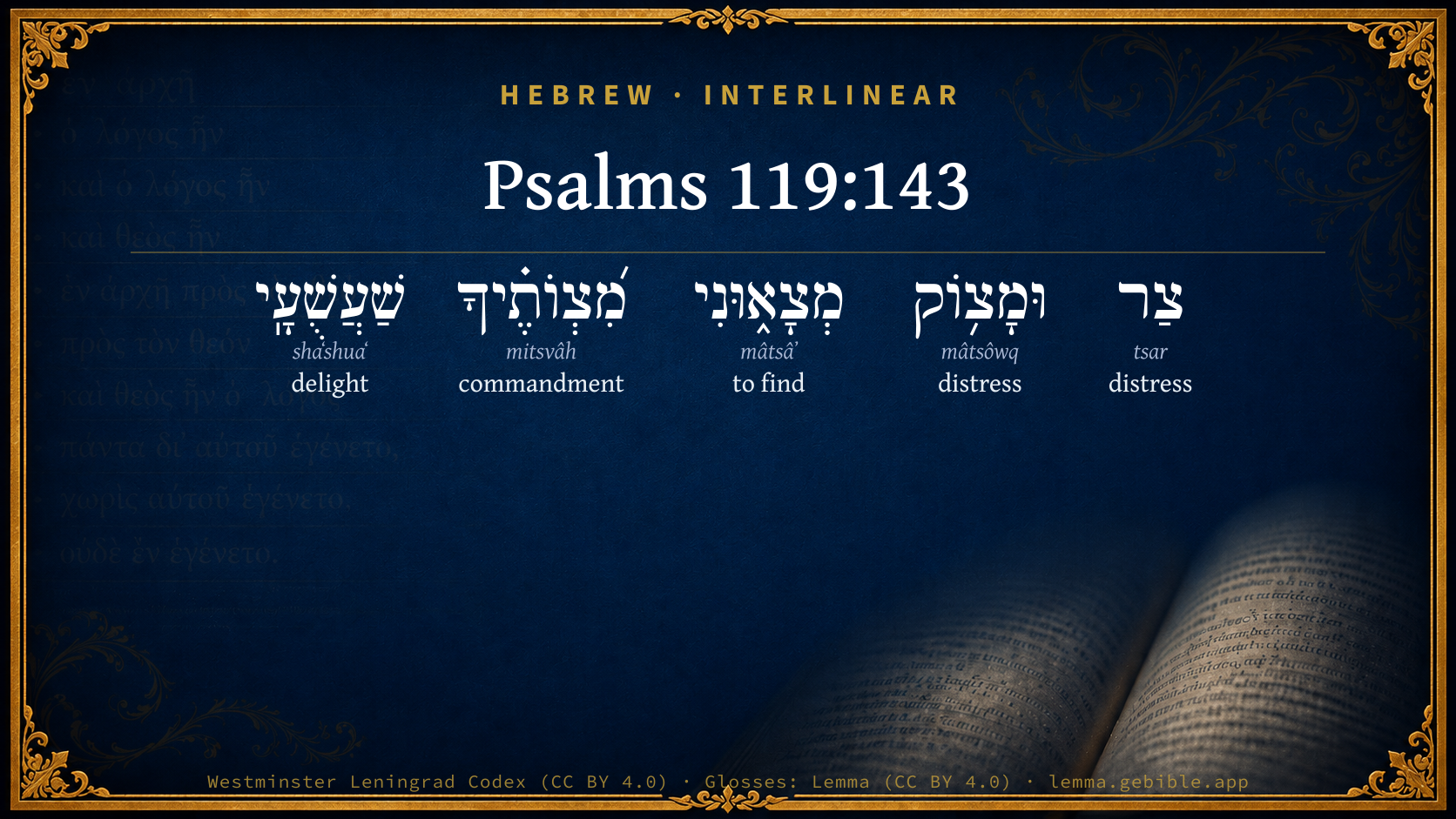
Hebrew (Westminster Leningrad Codex) Psalms 119:143 appears in the Hebrew Old Testament. The text above is from the Westminster Leningrad Codex. Each word links to its Strong’s number, a concise gloss, and parsing drawn from the Open Scriptures Hebrew Bible morphology. Click any word for its full Brown-Driver-Briggs (BDB) entry.
Download image
Cite this verse

Psalms 119:143 (World English Bible). Public Domain. Lemma interlinear Bible study tool, https://lemma.gebible.app/v/psalms/119/143.

Show BibTeX & RIS
BibTeX
RIS
English Translation
Trouble and anguish have taken hold of me. Your commandments are my delight.
World English Bible · Public Domain
Download a study sheet

One document with this verse’s original text, its word-by-word gloss line, the meaning frame, cross-references with their text, attributed commentary, and full source and license credits — printable, and it pastes into notes with its structure intact.

This verse Autodidact and up

Study sheet (.html) Plain text (.txt)

A passage Seminary Student

Up to 50 verses in one chapter. A passage sheet keeps up to 6 commentary sources and 12 cross-references per verse, in the order this page ranks them, and says so on the sheet whenever that leaves anything out. Ask for a single verse and you get the Autodidact verse sheet above.

Everything on this page stays free to read, with no account — the sheet is a download of what is already on screen, not access to it.

Want to remove ads? Support Godless Engineer
Compare translations 3

The same verse in 3 English versions, stacked beneath the original-language interlinear above. Click any original word for its lexicon entry.

Each is an independent rendering of the whole verse — the interlinear is not word-aligned to these translations.

Highlighted words mark where these versions differ — a whole-verse word diff, not a word-by-word alignment.

  • World English Bible Public Domain
    Trouble and anguish have taken hold of me. Your commandments are my delight.
  • King James Version Public Domain
    Trouble and anguish have taken hold on me: yet thy commandments are my delights.
  • unfoldingWord Literal Text CC BY-SA 4.0
    Narrow and distress have found me; your commandments my delight.

unfoldingWord Literal Text — © unfoldingWord, licensed CC BY-SA 4.0. Word-aligned USFM3 via Door43 (git.door43.org/unfoldingWord/en_ult).

Versions to compare (up to 4)

3 of 4 selected

Show all 17 translations

Every available English version of this verse, each an independent rendering of the whole verse.

  • World English Bible Public Domain
    Trouble and anguish have taken hold of me. Your commandments are my delight.
  • Berean Standard Bible Public Domain
    Trouble and distress have found me, but Your commandments are my delight.
  • Majority Standard Bible Public Domain
    Trouble and distress have found me, but Your commandments are my delight.
  • King James Version Public Domain
    Trouble and anguish have taken hold on me: yet thy commandments are my delights.
  • American Standard Version (1901) Public Domain
    Trouble and anguish have taken hold on me; `Yet' thy commandments are my delight.
  • Revised Version (1885) Public Domain
    Trouble and anguish have taken hold on me: yet thy commandments are my delight.
  • Geneva Bible (1599) Public Domain
    Trouble and anguish are come vpon me: yet are thy commandements my delite.
  • Young's Literal Translation Public Domain
    Adversity and distress have found me, Thy commands `are' my delights.
  • Literal Standard Version CC BY-SA 4.0
    Adversity and distress have found me, || Your commands [are] my delights.
  • Unlocked Literal Bible CC BY-SA 4.0
    Though distress and anguish have found me, your commandments are still my delight.
  • unfoldingWord Literal Text CC BY-SA 4.0
    Narrow and distress have found me; your commandments my delight.
  • Darby Bible Public Domain
    Trouble and anguish have taken hold upon me: thy commandments are my delights.
  • World Messianic Bible Public Domain
    Trouble and anguish have taken hold of me. Your commandments are my delight.
  • Webster's Bible Public Domain
    Trouble and anguish have taken hold on me: yet thy commandments are my delights.
  • Free Bible Version CC BY-SA 4.0
    When I have problems and sadness, your commands make me happy.
  • Bible in Basic English Public Domain
    Pain and trouble have overcome me: but your teachings are my delight.
  • JPS Tanakh (1917) Public Domain
    Trouble and anguish have overtaken me; yet Thy commandments are my delight.

Literal Standard Version (2020), Covenant Press — licensed CC BY-SA 4.0. Text via the HelloAO Bible API (eBible.org). Unlocked Literal Bible (unfoldingWord) — licensed CC BY-SA 4.0. Text via the HelloAO Bible API (eBible.org). unfoldingWord Literal Text — © unfoldingWord, licensed CC BY-SA 4.0. Word-aligned USFM3 via Door43 (git.door43.org/unfoldingWord/en_ult). Free Bible Version, Dr. Jonathan Gallagher — licensed CC BY-SA 4.0. Text via the HelloAO Bible API (eBible.org).

Word by word

More ways to search: Search by grammar → Find every occurrence → Compare this word →

Practice this passage: Drill this verse → Learn its vocabulary →

About this verse

These counts appear in no published source. They are computed here, from the morphology-tagged text and Lemma’s own curated glosses. What Lemma adds →

5
words
5
distinct lemmas
Wisdom
section

Notable vocabulary

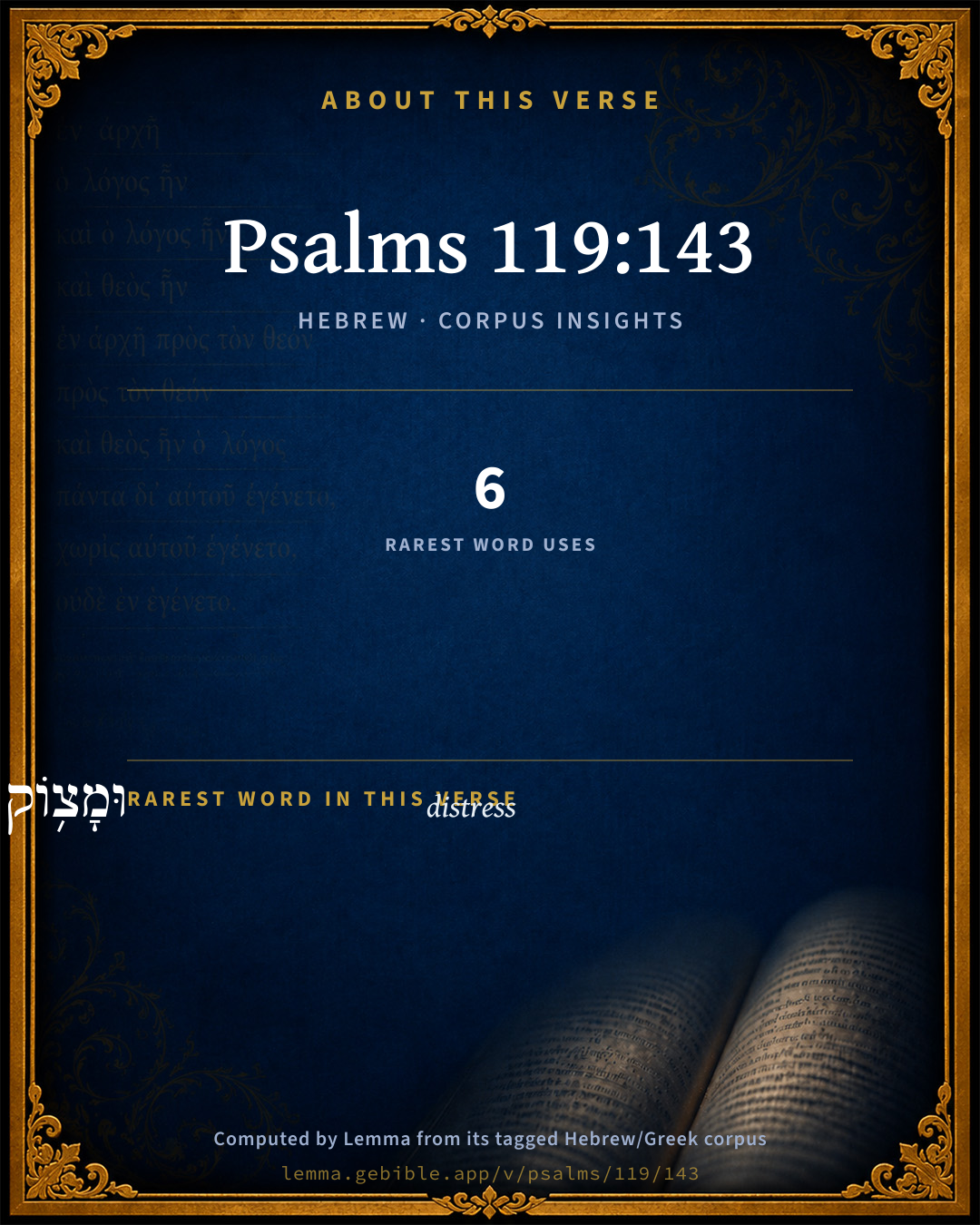
The rarest word here is וּמָצ֥וֹק distress H4689 — appearing just 6 times in the whole Hebrew Bible.

Shared distinctive vocabulary

וּמָצ֥וֹק distress H4689 occurs in 6 verses of the Hebrew Bible. Also found in:

Grammatical profile

  • 1 verb
  • 3 nouns
  • 1 adjective

Verb forms

  • מְצָא֑וּנִי Qal · Perfect

Hebrew & Septuagint length

In English translation the verse runs 13 words from the Hebrew and 11 from the Septuagint (LXX English) — closely comparable.

A rough comparison of the two English renderings, which tokenize alike — not a word-level alignment.

Word counts can differ between the Hebrew and the Greek without any difference in meaning — e.g. the Hebrew direct-object marker אֵת has no separate Greek word, and Greek often adds the article ὁ.

Cross-references

11

Topical passages linked to Psalms 119:143 in the Treasury of Scripture Knowledge — connected by theme and wording, ordered by reader-vote popularity; previews shown in the World English Bible.

  • Job 23:12 I haven't gone back from the commandment of his lips. I have treasured up the words of his mouth more than my necessary food.
  • Psalms 119:107 I am afflicted very much. Revive me, Yahweh, according to your word.
  • Psalms 18:4–5 The cords of death surrounded me. The floods of ungodliness made me afraid.
  • Psalms 88:3–18 For my soul is full of troubles. My life draws near to Sheol.
  • Psalms 116:3 The cords of death surrounded me, The pains of Sheol got a hold of me. I found trouble and sorrow.
  • Psalms 119:16 I will delight myself in your statutes. I will not forget your word.
  • Psalms 119:47 I will delight myself in your commandments, Because I love them.
  • Psalms 119:77 Let your tender mercies come to me, that I may live; For your law is my delight.
  • Psalms 130:1 Out of the depths I have cried to you, Yahweh.
  • Mark 14:33–34 He took with him Peter, James, and John, and began to be greatly troubled and distressed.
  • John 4:34 Jesus said to them, "My food is to do the will of him who sent me, and to accomplish his work.

Cross-references courtesy of OpenBible.info (CC BY 4.0).

Hebrew and Greek witnesses Masoretic Hebrew ↔ Greek Septuagint

The same verse in the two great witnesses to the Old Testament, shown verse-for-verse.

You’re reading Greek Psalm 118 (Hebrew Psalm 119). The Septuagint counts the superscription, so verse numbers can differ from the Hebrew — chapter-level alignment, not verse-by-verse. Numbering follows Rahlfs.

These are two independent witnesses, not word-aligned to each other, and the Septuagint is shown in lemma (dictionary) form.

Hebrew Psalms 119:143 Masoretic · Westminster Leningrad Codex

צַר וּמָצ֥וֹק מְצָא֑וּנִי מִ֝צְוֺתֶ֗יךָ שַׁעֲשֻׁעָֽי

Trouble and anguish have taken hold of me. Your commandments are my delight.

World English Bible · Public Domain

Greek LXX Greek Psalm 118:143 Septuagint · lemma form

θλῖψις καί ἀνάγκη εὑρίσκω ἐγώ ὁ ἐντολή σύ μελέτη ἐγώ

Afflictions and distresses found me: but your commandments were my meditation.

LXX2012 (modern English Septuagint) · Public Domain

Hebrew: Westminster Leningrad Codex (CC BY 4.0). Greek: Septuagint (public domain); English from LXX2012 (modern English Septuagint) (Public Domain). How the Septuagint differs from the Hebrew →

Commentary

Notes on Psalms 119:143 from classic Christian and Jewish commentators (each source and its license shown beneath its notes). The classic Christian expositions comment on the surrounding passage and are grouped to its opening verse, so a note may address several verses; the Jewish commentaries on the Tanakh (Rashi and others) are per-verse, so they appear only where the commentator wrote on this verse.

Lemma curates 59 commentaries, every one of them public domain or Creative Commons licensed, each selected and text-cleaned for this edition rather than reprinted as found. About our sources →

Trapp's Complete Commentary

John Trapp

Psa 119:143 Trouble and anguish have taken hold on me: [yet] thy commandments [are] my delights.

Ver. 143. Trouble and anguish have taken hold of me] Heb. have found me. Those (as we say of foul weather) come before they are sent for; yet are they not without the Lord. It is he that putteth his under the black rod.

Yet thy commandments, &c.] God and his word are never so sweet to the saints as in adversity.

John Trapp, A Commentary or Exposition upon All the Books of the Old and New Testament (1647–1656) — public domain. Text from a community e-Sword module.

J. A. Alexander on Psalms

Joseph Addison Alexander

143. (Psa 119:143) Distress and anguish seize (or seized) me; thy commandments (are) my delight. Even in the midst of suffering, thy commandments not only solace me but make me happy. Seize, literally find, as in Psa 116:3. Delight, literally delights, a succedaneum for all other pleasures. See above, on Psa 119:24.

Joseph Addison Alexander, The Psalms Translated and Explained (1850) — public domain. Text from a community e-Sword module.

Matthew Henry's Commentary

These two verses are almost a repetition of the two foregoing verses, but with improvement. 1. David again professes his constant adherence to God and his duty, notwithstanding the many difficulties and discouragements he met with. He had said (Psa 119:14), I am small and despised, and yet adhere to my duty. Here he finds himself not only mean, but miserable, as far as this world could make him so: Trouble and anguish have taken hold on me - trouble without, anguish within; they surprised him, they seized him, they held him. Sorrows are often the lot of saints in this vale of tears; they are in heaviness through manifold temptations. There he had said, Yet do I not forget thy precepts; here he carries his constancy much higher: Yet thy commandments are my delights. All this trouble and anguish did not put his mouth out of taste for the comforts of the word of God, but he could still relish them and find that peace and pleasure in them which all the calamities of this present time could not deprive him of. There are delights, variety of delights, in the word of God, which the saints have often the sweetest enjoyment of when they are in trouble and anguish, Co2 1:5. 2. He again acknowledges the everlasting righteousness of God's word as before (Psa 119:142): The righteousness of thy testimonies is everlasting and cannot be altered; and, when it is admitted in its power into a soul, it is there an abiding principle, a well of living water, Joh 4:14. We ought to meditate much and often upon the equity and the eternity of the word of God. Here he adds, by way of inference, (1.) His prayer for grace: Give me understanding. Those that know much of the word of God should still covet to know more; for there is more to be known. He does not say, "Give me a further revelation," but, Give me a further understanding; what is revealed we should desire to understand, and what we know to know better; and we must go to God for a heart to know. (2.) His hope of glory: "Give me this renewed understanding, and then I shall live, shall live for ever, shall be eternally happy, and shall be comforted, for the present, in the prospect of it." This is life eternal, to know God, Joh 17:3.

Matthew Henry's Commentary on the Whole Bible (1708–1710) — public domain (CC PDM 1.0). Text via the HelloAO Bible API.

Adam Clarke's Commentary

Verse 143. Trouble and anguish] I am exercised with various trials from men and devils.

Have taken hold on me] But still I cleave to my God, and am delighted with his law.

Adam Clarke's Commentary on the Bible (1810–1826) — public domain. Text from a community e-Sword/MySword module.

The Cambridge Bible for Schools and Colleges

gen. ed. J. J. S. Perowne

143. have taken hold on me] Have befallen me, lit. found me.

The Cambridge Bible for Schools and Colleges (gen. ed. J. J. S. Perowne; Cambridge University Press, 1878–1918) — public domain. Text from a community e-Sword module.

John Gill's Exposition

I prevented the dawning of the morning, and cried,.... That is, he awoke and got up, and prayed, before the day broke, the morning looked forth, or the sun arose: he was early as well as earnest in his supplications to God; see Psa 5:3; as Christ, his antitype, rose early in the morning, a great while before day, and went out to a solitary place, and prayed, Mar 1:35;

I hoped in thy word; which is a great encouragement to prayer, the grace of hope itself is, though a man can only put his mouth in the dust, if so be there may be hope; and especially when it is grounded on the word of promise, that God will hear and answer his people, when they call upon him in a time of trouble: and particularly hope in Christ, the essential Word, is a great encouragement; many encouraging arguments to prayer are taken from the person, office, advocacy, and mediation of Jesus Christ, Heb 4:14.

John Gill's Exposition of the Whole Bible (1746–1763) — public domain (CC PDM 1.0). Text via the HelloAO Bible API.

Albert Barnes' Notes on the Bible

Trouble and anguish - The word rendered “trouble” means affliction of any kind; the word rendered “anguish” would probably express that which results from being pressed, compressed, straitened. It properly refers to a situation where there is no room to move, and where we are pent up in a narrow place. The two words denote deep affliction.

Have taken hold on me - Margin, as in Hebrew, “found me.” That is, they were in pursuit of me, and have at last apprehended me. Trouble, anguish, death, are in pursuit of us all our lives, and are never very far in the rear of us. Often, when we least expect them, they come suddenly up to us, and make us their victims.

Yet thy commandments are my delights - Notwithstanding this trouble, and in this trouble - no matter what comes - I have the same unfailing source of comfort, the truth of God; and notwithstanding what may occur, I still make God and his law the source of my happiness. See the notes at Psa 119:24.

Albert Barnes' Notes on the Bible (1834–1885) — public domain. Text from a community e-Sword/MySword module.

Matthew Poole's English Annotations

Outward troubles and anguish of spirit, or great anguish or distress.

Matthew Poole's English Annotations on the Holy Bible (1683–1685) — public domain. Text from a community e-Sword/MySword module.

The Treasury of David

Charles H. Spurgeon

Ver. 143. Trouble and anguish have taken hold on me. This affliction may have arisen from his circumstances, or from the cruelty of his enemies, or from his own internal conflicts, but certain it is that he was the subject of much distress, a distress which apprehended him, and carried him away a captive to its power. His griefs, like fierce dogs, had taken hold upon him; he felt their teeth. He had double trouble: trouble without and anguish within, as the apostle Paul put it, "without were rightings and within were fears."

Yet thy commandments are my delights. Thus he became a riddle; troubled, and yet delighted; in anguish, and yet in pleasure. The child of God can understand this enigma, for well he knows that while he is cast down on account of what he sees within himself he is all the more lifted up by what he sees in the word. He is delighted with the commandments, although he is troubled because he cannot perfectly obey them. He finds abundant light in the commandments, and by the influence of that light he discovers and mourns over his own darkness. Only the man who is acquainted with the struggles of the spiritual life will understand the expression before us. Let the reader herein find a balance in which to weigh himself. Does he find even when he is begin with sorrow that it is a delightful thing to do the will of the Lord? Does he find more joy in being sanctified than sorrow in being chastised? Then the spot of God's children is upon him.

Ver. 143. Trouble and anguish have taken hold on me: yet thy commandments are my delights. This is strange, that in the midst of anguish David had delight: but indeed the sweetness of God's word is best perceived under the bitterness of the cross. The joy of Christ and the joy of the world cannot consist together. A heart delighted with worldly joy cannot feel the consolations of the Spirit; the one of these destroys the other: but in sanctified trouble, the comforts of God's word are felt and perceived in a most sensible manner. Many a time hath David protested this delight of his in the word of God; and truly it is a great argument of godliness, when men come not only to reverence it, but to love it, and delight in it. Let this be considered by those unhappy men who hear it of custom, and count it but a weariness. Abraham Wright.

Ver. 143. Trouble and anguish have taken hold on me, or "found me, "etc. We need not take pains, as many do, "to find trouble and anguish; "for they will, one day, "find us." In that day the revelations of God must be to us instead of all worldly "delights" and pleasures, which will then have forsaken us; and how forlorn and desolate will be our state if we should have no other delights, no other pleasures, to succeed them, and to accompany us into eternity. Let our study be then in the Scriptures, if we expect our comfort in them in time to come. George Horne.

Ver. 143. Trouble and anguish have taken hold on me. You may conceive a bold figure here, as if Trouble and Anguish were being sent out against the helpless sons of men. These, like enemies, were going round. Instead of seizing upon the wicked, they had found the righteous man. So it was by the ordering of God. I suppose many of us have remarked, that the believer is never long at ease. He is in the world; he is in the flesh; there is indwelling sin; there are enemies around; there is the great enemy; besides all this, the Lord, for wise purposes, hides his face. Then the believer is in trouble and anguish. John Stephen.

Ver. 143. Have taken hold on me. Hebrew, found me. Like dogs tracking out a wild beast hiding or fleeing. A.R. Fausset.

Ver. 143. Thy commandments are my delights. Delight in moral things (saith Aquinas) is the rule by which we may judge of men's goodness or badness. Delectatio est quies voluntatis in bono. Men are good and bad as the objects of their delight are: they are good who delight in good things, and they are evil who delight in evil things. Thomas Manton.

Ver. 143. Mingled emotions.

Ver. 143.

1. The dark cloud. Trouble, etc.

2. His silver lining. Yet, etc.

Ver. 143.

1. The Saint cast into prison.

(a) The jailers: "Trouble and anguish."

(b) Their proceeding: "take hold" and make him fast.

2. Songs in the night.

(a) Blessed theme: "thy commandments."

(b) Ecstatic melodies: "delights."

3. Let the prisoners hear them.

(a) Pain held, sin held, despair held.

(b) It is matter and melody to open prisons. W.B.H.

Ver. 143. Consider,

1. The excellency of the word, in that it gives delight when trouble and anguish oppress.

2. The great kindness of God in so framing his word that it can give delight at such a time, and under such circumstances.

3. The disposition of the believer to resort to the word for delight, when others give themselves over to vain grief and despondency.

4. The blessed position of the believer, in that he need never be without joy. J.F.

Psalms 119:144*

Charles H. Spurgeon's The Treasury of David (1869–1885) — public domain. Psalms only. Text from a community e-Sword/MySword module.

The Pulpit Commentary

Trouble and anguish have taken hold on me (comp. vers. 22, 23, 28, 50, 51, 61, 67, 69, etc.). Yet thy commandments are my delight. I am happy in the midst of my troubles, for the joy that I have in thy Word (see vers. 16, 35, 47, 77, 174).

The Pulpit Commentary (1880–1919), ed. H.D.M. Spence-Jones & Joseph S. Exell — public domain. Text from a community e-Sword module.

John Wesley's Explanatory Notes

Trouble - Outward troubles and anguish of spirit.

John Wesley, Explanatory Notes Upon the Whole Bible (1754–1765) — public domain. Text via the GEBible commentary corpus.

unfoldingWord translationNotes

Door43 World Missions Community

distress and anguish have found me

The psalmist speaks of distress and anguish as if they were people. AT: "I have become distressed and anguished" or "my body and my mind are suffering" (See: Personification)

translationWords

command

covenant

righteous

eternity

life

unfoldingWord translationNotes — © Distant Shores Media and the Door43 World Missions Community, licensed CC BY-SA 4.0. Source: git.door43.org/Door43/en_tn.

Lesson kit

Teaching starters — assembled from the data on this page, not authored interpretation. Every prompt links to the verse data it draws on. Edit before teaching.

Psalms, in the Wisdom, opens this verse with 5 words (5 distinct Hebrew lemmas). Its most distinctive word is mâtsôwq (“distress”). A historical commentator’s framing appears above. Read the whole chapter for the surrounding context.

Discussion questions

  1. The word mâtsôwq carries the sense “distress.” How does it shape the verse?
  2. How does Deuteronomy 28:53, which shares the word «distress», read alongside this verse?
  3. The translations on this page render this verse differently — a whole-verse word diff, not a word-by-word alignment. What might account for the different wordings?
  4. «מְצָא֑וּנִי» is a Qal Perfect verb. How does that grammatical form shape the action described?
  5. Compare how Trapp's Complete Commentary and J. A. Alexander on Psalms read this verse. Where do they agree or differ?

Things to notice

Reading settings

Reading text

Shown beneath each verse's original-language words.

Old Testament
Old Testament edition

Read the OT as the Masoretic Hebrew (MT) or the Greek Septuagint (LXX).

English shown for the Greek Septuagint (in the Hebrew ↔ Greek comparison).

Comparing translations? Open the Compare panel on any verse page to stack up to four side by side.