
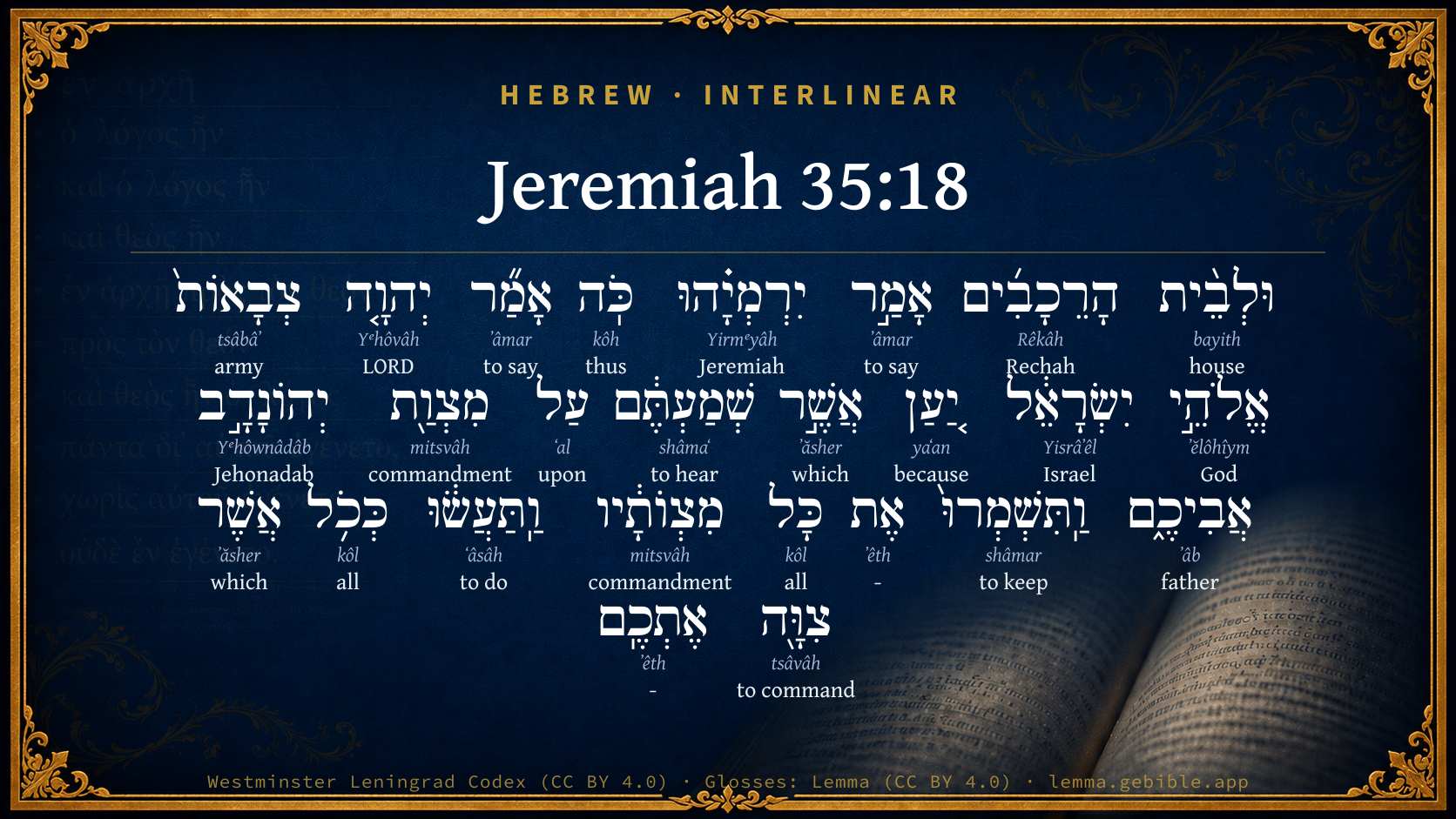
Jeremiah 35:18

Hebrew (Westminster Leningrad Codex) Jeremiah 35:18 appears in the Hebrew Old Testament. The text above is from the Westminster Leningrad Codex. Each word links to its Strong’s number, a concise gloss, and parsing drawn from the Open Scriptures Hebrew Bible morphology. Click any word for its full Brown-Driver-Briggs (BDB) entry.
Download image
Cite this verse

Jeremiah 35:18 (World English Bible). Public Domain. Lemma interlinear Bible study tool, https://lemma.gebible.app/v/jeremiah/35/18.

Show BibTeX & RIS
BibTeX
RIS
English Translation
Jeremiah said to the house of the Rechabites, Thus says Yahweh of Hosts, the God of Israel: Because you have obeyed the commandment of Jonadab your father, and kept all his precepts, and done according to all that he commanded you;
World English Bible · Public Domain
Download a study sheet

One document with this verse’s original text, its word-by-word gloss line, the meaning frame, cross-references with their text, attributed commentary, and full source and license credits — printable, and it pastes into notes with its structure intact.

This verse Autodidact and up

Study sheet (.html) Plain text (.txt)

A passage Seminary Student

Up to 50 verses in one chapter. A passage sheet keeps up to 6 commentary sources and 12 cross-references per verse, in the order this page ranks them, and says so on the sheet whenever that leaves anything out. Ask for a single verse and you get the Autodidact verse sheet above.

Everything on this page stays free to read, with no account — the sheet is a download of what is already on screen, not access to it.

Want to remove ads? Support Godless Engineer
Compare translations 3

The same verse in 3 English versions, stacked beneath the original-language interlinear above. Click any original word for its lexicon entry.

Each is an independent rendering of the whole verse — the interlinear is not word-aligned to these translations.

Highlighted words mark where these versions differ — a whole-verse word diff, not a word-by-word alignment.

  • World English Bible Public Domain
    Jeremiah said to the house of the Rechabites, Thus says Yahweh of Hosts, the God of Israel: Because you have obeyed the commandment of Jonadab your father, and kept all his precepts, and done according to all that he commanded you;
  • King James Version Public Domain
    And Jeremiah said unto the house of the Rechabites, Thus saith the LORD of hosts, the God of Israel; Because ye have obeyed the commandment of Jonadab your father, and kept all his precepts, and done according unto all that he hath commanded you:
  • unfoldingWord Literal Text CC BY-SA 4.0
    Jeremiah said to the family of the Rekabites, “Yahweh of hosts, God of Israel, says this: You have listened to the commands of Jonadab your ancestor and have kept them all—you have obeyed all that he commanded you to do—

unfoldingWord Literal Text — © unfoldingWord, licensed CC BY-SA 4.0. Word-aligned USFM3 via Door43 (git.door43.org/unfoldingWord/en_ult).

Versions to compare (up to 4)

3 of 4 selected

Show all 18 translations

Every available English version of this verse, each an independent rendering of the whole verse.

  • World English Bible Public Domain
    Jeremiah said to the house of the Rechabites, Thus says Yahweh of Hosts, the God of Israel: Because you have obeyed the commandment of Jonadab your father, and kept all his precepts, and done according to all that he commanded you;
  • Berean Standard Bible Public Domain
    Then Jeremiah said to the house of the Rechabites: “This is what the LORD of Hosts, the God of Israel, says: ‘Because you have obeyed the command of your forefather Jonadab and have kept all his commandments and have done all that he charged you to do,
  • Majority Standard Bible Public Domain
    Then Jeremiah said to the house of the Rechabites: “This is what the LORD of Hosts, the God of Israel, says: ‘Because you have obeyed the command of your forefather Jonadab and have kept all his commandments and have done all that he charged you to do,
  • King James Version Public Domain
    And Jeremiah said unto the house of the Rechabites, Thus saith the LORD of hosts, the God of Israel; Because ye have obeyed the commandment of Jonadab your father, and kept all his precepts, and done according unto all that he hath commanded you:
  • American Standard Version (1901) Public Domain
    And Jeremiah said unto the house of the Rechabites, Thus saith Jehovah of hosts, the God of Israel: Because ye have obeyed the commandment of Jonadab your father, and kept all his precepts, and done according unto all that he commanded you;
  • Revised Version (1885) Public Domain
    And Jeremiah said unto the house of the Rechabites, Thus saith the LORD of hosts, the God of Israel: Because ye have obeyed the commandment of Jonadab your father, and kept all his precepts, and done according unto all that he commanded you;
  • Geneva Bible (1599) Public Domain
    And Ieremiah said to the house of the Rechabites, Thus saith the Lord of hostes the God of Israel, Because ye haue obeyed the commandement of Ionadab your father, and kept all his precepts, and done according vnto all that hee hath commanded you,
  • Douay-Rheims (1899) Public Domain
    And Jeremias said to the house of the Rechabites: Thus saith the Lord of hosts the Cod of Israel: Because you have obeyed the commandment of Jonadab your father, and have kept all his precepts, and have done all that he commanded you:
  • Young's Literal Translation Public Domain
    And to the house of the Rechabites said Jeremiah: `Thus said Jehovah of Hosts, God of Israel, Because that ye have hearkened unto the command of Jonadab your father, and ye observe all his commands, and do according to all that he commanded you;
  • Literal Standard Version CC BY-SA 4.0
    And Jeremiah said to the house of the Rechabites: “Thus said YHWH of Hosts, God of Israel: Because that you have listened to the command of your father Jonadab, and you observe all his commands, and do according to all that he commanded you;
  • Unlocked Literal Bible CC BY-SA 4.0
    Jeremiah said to the family of the Rekabites, “Yahweh of hosts, God of Israel, says this: You have listened to the commands of Jonadab your ancestor and have kept them all—you have obeyed all that he commanded you to do—
  • unfoldingWord Literal Text CC BY-SA 4.0
    Jeremiah said to the family of the Rekabites, “Yahweh of hosts, God of Israel, says this: You have listened to the commands of Jonadab your ancestor and have kept them all—you have obeyed all that he commanded you to do—
  • Darby Bible Public Domain
    And Jeremiah said unto the house of the Rechabites, Thus saith Jehovah of hosts, the God of Israel: Because ye have obeyed the commandment of Jonadab your father, and kept all his injunctions, and have done according unto all that he hath commanded you;
  • World Messianic Bible Public Domain
    Jeremiah said to the house of the Rechabites, “The LORD of Hosts, the God of Israel, says: ‘Because you have obeyed the commandment of Jonadab your father, and kept all his precepts, and done according to all that he commanded you,’
  • Webster's Bible Public Domain
    And Jeremiah said to the house of the Rechabites, Thus saith the LORD of hosts, the God of Israel; Because ye have obeyed the commandment of Jonadab your father, and kept all his precepts, and done according to all that he hath commanded you:
  • Free Bible Version CC BY-SA 4.0
    Then Jeremiah told the Rechabites: This is what the Lord Almighty, the God of Israel, says: Because you have obeyed your forefather Jonadab's instructions and have followed his orders and have done everything he told you to do,
  • Bible in Basic English Public Domain
    But to the Rechabites Jeremiah said, This is what the Lord of armies, the God of Israel, has said: Because you have done the orders of Jonadab your father, and have kept his rules, and done everything as he gave you orders to do it;
  • JPS Tanakh (1917) Public Domain
    And unto the house of the Rechabites Jeremiah said: Thus saith the LORD of hosts, the God of Israel: Because ye have hearkened to the commandment of Jonadab your father, and kept all his precepts, and done according unto all that he commanded you;

Literal Standard Version (2020), Covenant Press — licensed CC BY-SA 4.0. Text via the HelloAO Bible API (eBible.org). Unlocked Literal Bible (unfoldingWord) — licensed CC BY-SA 4.0. Text via the HelloAO Bible API (eBible.org). unfoldingWord Literal Text — © unfoldingWord, licensed CC BY-SA 4.0. Word-aligned USFM3 via Door43 (git.door43.org/unfoldingWord/en_ult). Free Bible Version, Dr. Jonathan Gallagher — licensed CC BY-SA 4.0. Text via the HelloAO Bible API (eBible.org).

Word by word

More ways to search: Search by grammar → Find every occurrence → Compare this word →

Practice this passage: Drill this verse → Learn its vocabulary →

הָרֵכָבִ֜ים
Rêkâh
H7397
“the · Rechah”
Particle, Definite Article + Noun, Gentilic, Masculine, Singular, Absolute
Part of Speech
Particle + Noun
Type
Gentilic
Gender
Masculine
Number
Singular
State
Absolute
Full BDB Definition

Origin: probably fem. from H7401

TWOT: None

Rechah = "uttermost part" - a place in Judah - perhaps the village of 'Rashiah' 3 miles (5 kilometers) south of Jerusalem
  1. וּלְבֵ֨ית bayith H1004 “and · to/for · house of” Conjunction + Preposition + Noun, Common, Masculine, Singular, Construct
  2. אָמַ֣ר ʼâmar H559 “to say” Verb, Qal, Perfect, 3rd Person, Masculine, Singular
  3. יִרְמְיָ֗הוּ Yirmᵉyâh H3414 “Jeremiah” Noun, Proper
  4. כֹּֽה kôh H3541 “thus” Adverb
  5. אָמַ֞ר ʼâmar H559 “to say” Verb, Qal, Perfect, 3rd Person, Masculine, Singular
  6. יְהוָ֤ה Yᵉhôvâh H3068 “LORD” Noun, Proper
  7. צְבָאוֹת֙ tsâbâʼ H6635 “armies” Noun, Common, Both, Plural, Absolute
  8. אֱלֹהֵ֣י ʼĕlôhîym H430 “God(s) of” Noun, Common, Masculine, Plural, Construct
  9. יִשְׂרָאֵ֔ל Yisrâʼêl H3478 “Israel” Noun, Proper
  10. יַ֚עַן yaʻan H3282 “because” Conjunction
  11. אֲשֶׁ֣ר ʼăsher H834 “which” Particle, Relative
  12. שְׁמַעְתֶּ֔ם shâmaʻ H8085 “to hear” Verb, Qal, Perfect, 2nd Person, Masculine, Plural
  13. עַל ʻal H5921 “upon” Preposition
  14. מִצְוַ֖ת mitsvâh H4687 “commandment of” Noun, Common, Feminine, Singular, Construct
  15. יְהוֹנָדָ֣ב Yᵉhôwnâdâb H3082 “Jehonadab” Noun, Proper
  16. אֲבִיכֶ֑ם ʼâb H1 “father · your” Noun, Common, Masculine, Singular, Construct + Suffix, Personal, 2nd Person, Masculine, Plural
  17. וַֽתִּשְׁמְרוּ֙ shâmar H8104 “and · to keep” Conjunction + Verb, Qal, Sequential Imperfect, 2nd Person, Masculine, Plural
  18. אֶת ʼêth H853 “-” Particle, Direct Object
  19. כָּל kôl H3605 “all of” Noun, Common, Masculine, Singular, Construct
  20. מִצְוֺתָ֔יו mitsvâh H4687 “commandments · his” Noun, Common, Feminine, Plural, Construct + Suffix, Personal, 3rd Person, Masculine, Singular
  21. וַֽתַּעֲשׂ֔וּ ʻâsâh H6213 “and · to do” Conjunction + Verb, Qal, Sequential Imperfect, 2nd Person, Masculine, Plural
  22. כְּכֹ֥ל kôl H3605 “like/as · all” Preposition + Noun, Common, Masculine, Singular, Absolute
  23. אֲשֶׁר ʼăsher H834 “which” Particle, Relative
  24. צִוָּ֖ה tsâvâh H6680 “to command” Verb, Piel, Perfect, 3rd Person, Masculine, Singular
  25. אֶתְכֶֽם ʼêth H853 “- · you” Particle, Direct Object + Suffix, Personal, 2nd Person, Masculine, Plural

About this verse

These counts appear in no published source. They are computed here, from the morphology-tagged text and Lemma’s own curated glosses. What Lemma adds →

26
words
21
distinct lemmas
Prophets
section

Notable vocabulary

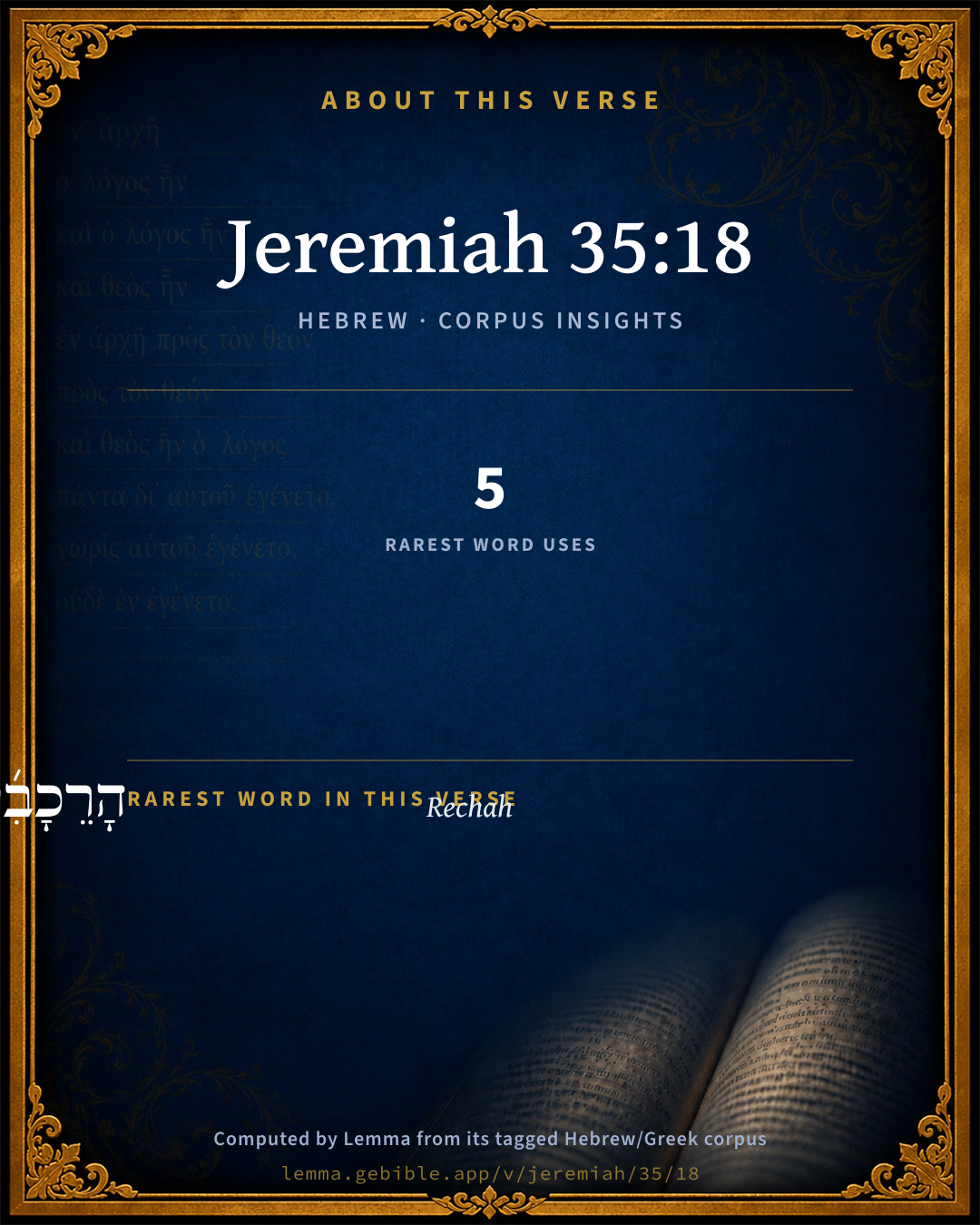
The rarest word here is הָרֵכָבִ֜ים Rechah H7397 — appearing just 5 times in the whole Hebrew Bible.

Shared distinctive vocabulary

הָרֵכָבִ֜ים Rechah H7397 occurs in 5 verses of the Hebrew Bible. Also found in:

Grammatical profile

  • 6 verbs
  • 13 nouns
  • 1 preposition
  • 1 conjunction
  • 1 adverb
  • 4 particles

Verb forms

  • אָמַ֣ר Qal · Perfect
  • אָמַ֞ר Qal · Perfect
  • שְׁמַעְתֶּ֔ם Qal · Perfect
  • וַֽתִּשְׁמְרוּ֙ Qal · Sequential Imperfect
  • וַֽתַּעֲשׂ֔וּ Qal · Sequential Imperfect
  • צִוָּ֖ה Piel · Perfect

Repetition

Words recur within this verse — often emphatic in Hebrew:

  • אָמַ֣ר to say H559 ×2
  • מִצְוַ֖ת commandment H4687 ×2
  • כָּל all H3605 ×2
  • אֲשֶׁ֣ר which H834 ×2

Cross-references

3

Topical passages linked to Jeremiah 35:18 in the Treasury of Scripture Knowledge — connected by theme and wording, ordered by reader-vote popularity; previews shown in the World English Bible.

  • Exodus 20:12 "Honor your father and your mother, that your days may be long in the land which Yahweh your God gives you.
  • Deuteronomy 5:16 "Honor your father and your mother, as Yahweh your God commanded you; that your days may be long, and that it may go well with you, in the land which Yahweh your God gives you.
  • Ephesians 6:1–3 Children, obey your parents in the Lord, for this is right.

Cross-references courtesy of OpenBible.info (CC BY 4.0).

Hebrew and Greek witnesses Masoretic Hebrew ↔ Greek Septuagint

The same verse in the two great witnesses to the Old Testament, shown verse-for-verse.

These are two independent witnesses, not word-aligned to each other, and the Septuagint is shown in lemma (dictionary) form.

Hebrew Jeremiah 35:18 Masoretic · Westminster Leningrad Codex

וּלְבֵ֨ית הָרֵכָבִ֜ים אָמַ֣ר יִרְמְיָ֗הוּ כֹּֽה אָמַ֞ר יְהוָ֤ה צְבָאוֹת֙ אֱלֹהֵ֣י יִשְׂרָאֵ֔ל יַ֚עַן אֲשֶׁ֣ר שְׁמַעְתֶּ֔ם עַל מִצְוַ֖ת יְהוֹנָדָ֣ב אֲבִיכֶ֑ם וַֽתִּשְׁמְרוּ֙ אֶת כָּל מִצְוֺתָ֔יו וַֽתַּעֲשׂ֔וּ כְּכֹ֥ל אֲשֶׁר צִוָּ֖ה אֶתְכֶֽם

Jeremiah said to the house of the Rechabites, Thus says Yahweh of Hosts, the God of Israel: Because you have obeyed the commandment of Jonadab your father, and kept all his precepts, and done according to all that he commanded you;

World English Bible · Public Domain

Greek LXX Structure differs

In the Septuagint, Jeremiah is about an eighth shorter than the Hebrew and arranges its material differently — the Oracles Against the Nations (Hebrew chapters 46–51) appear in the middle of the Greek book, after 25:13. Because the chapter and verse boundaries do not line up, a verse-for-verse comparison with the Hebrew is not shown.

A verse-for-verse comparison isn’t shown here because the chapters and verses don’t line up. Switch to the LXX edition with the MT / LXX toggle above to read the Greek directly.

On this verse, The Cambridge Bible for Schools and Colleges discusses the Septuagint’s reading. Read the note in Commentary ↓

Hebrew: Westminster Leningrad Codex (CC BY 4.0). Greek: Septuagint (public domain); English from a public-domain English Septuagint. How the Septuagint differs from the Hebrew →

Targum (Aramaic paraphrase)

1

The Targum is the ancient Jewish Aramaic paraphrase of the Hebrew Scriptures — an interpretive translation, not the Hebrew text itself. Onkelos (literal) and Pseudo-Jonathan (expansive) render the Torah, and Jonathan the Prophets. Coverage is partial: where no permissively-licensed English translation exists for a verse, only the Aramaic is shown. This is verse-level text, not a word-by-word alignment to the Hebrew.

  1. Targum Jonathan Prophets (Joshua–Malachi)
    וְלִבְנֵי בֵּית רֵכָב אֲמַר יִרְמְיָה כִּדְנַן אֲמַר יְיָ צְבָאוֹת אֱלָהָא דְיִשְׂרָאֵל חֲלַף דְקַבֵּילְתּוּן לְתַפְקִידַת יְהוֹנָדָב אֲבוּכוֹן וּנְטַרְתּוּן יַת כָּל פִּקוּדוֹהִי וַעֲבַדְתּוּן כְּכֹל דְפַקֵיד יַתְכוֹן:

    (no public-domain English translation for this verse)

    Targum Jonathan — Aramaic: “Mikraot Gedolot” (public domain). English: “Sefaria Community Translation” (CC0 1.0 (public-domain dedication)); “London "Chaldee Paraphrase," 1871” (public domain). Text via Sefaria.

Commentary

Notes on Jeremiah 35:18 from classic Christian and Jewish commentators (each source and its license shown beneath its notes). The classic Christian expositions comment on the surrounding passage and are grouped to its opening verse, so a note may address several verses; the Jewish commentaries on the Tanakh (Rashi and others) are per-verse, so they appear only where the commentator wrote on this verse.

Lemma curates 59 commentaries, every one of them public domain or Creative Commons licensed, each selected and text-cleaned for this edition rather than reprinted as found. About our sources →

Trapp's Complete Commentary

John Trapp

Jer 35:18 And Jeremiah said unto the house of the Rechabites, Thus saith the LORD of hosts, the God of Israel; Because ye have obeyed the commandment of Jonadab your father, and kept all his precepts, and done according unto all that he hath commanded you:

Ver. 18. Because ye have obeyed the commandment.] Obedience to parents hath an ample recompense of reward, as that which is good and acceptable before God and men. {1Ti 5:4}

John Trapp, A Commentary or Exposition upon All the Books of the Old and New Testament (1647–1656) — public domain. Text from a community e-Sword module.

Joseph Benson's Commentary

Jer 35:18-19. Jeremiah said unto the house of the Rechabites, &c. — Mercy is here promised to the family of the Rechabites for their steady and unanimous adherence to the laws of their house. Though it was only for the shaming of Israel that their constancy was tried, yet, being unshaken, God takes occasion from it to tell them that he had blessings in reserve for them. Jonadab shall not want a man to stand before me for ever — “The meaning of this promise,” says Blaney, “in its full extent, seems to be, not only that the race of Jonadab should never fail or be extinct, but that some of the family should ever be found among the worshippers of the true God. For to stand in the presence of a prince, implies an attendance, in some degree, upon his person and service. So the queen of Sheba, speaking of Solomon’s court, says, Happy are thy men, happy are these thy servants, which stand continually before thee, 1Ki 10:8; and therefore, to stand before God, must denote at least the privilege of treading his courts, and of worshipping him among the train of his chosen servants and people.”

Joseph Benson's Commentary on the Old and New Testaments (1811–1818) — public domain. Text from a community e-Sword module.

John Calvin's Commentaries

Here the Prophet, that he might affect the Jews more deeply, promises a reward to the sons of Jonadab, because they obeyed their father; and he promises them a blessing from God. Nor is it to be wondered at, for this commandment, as Paul says, is the first to which a promise is annexed. (Ephesians 6:2) God promises generally a reward to all who keep the Law, for every command has in general connected with it the hope of reward; but this is in a special manner added to the Fifth Commandment: “Honor thy father and thy mother, that thou mayest prolong thy life,” etc. It is, then, nothing strange that God promised a reward to the Rechabites, because they followed the command of their father, for he had promised that in the Law.

But what the Papists allege, that the obedience rendered to the Church is on the same account pleasing to God, may, as we have said, be easily confuted; for if the Rechabites had followed the command of their father in a thing unlawfill, they would have been worthy of punishment; but as this precept, as we have shewn, was not inconsistent with God’s Law, God approved of their obedience. But the laws which are made for the purpose of setting up fictitious modes of worship are altogether impious, for they introduce idolatry. God has prescribed how he would have us to worship him; whatever, therefore, men bring in of themselves is wholly impious, for it adulterates the pure worship of God; and further, when necessity is laid on consciences, it is, as we have said, a tyrannical bondage. Such was not the object of Jonadab; for what he commanded his posterity was useful, and referred only to things of this life; and it did not bind their consciences; for when it was necessary they moved to Jerusalem and dwelt as others in houses; for they did not erect tents at Jerusalem, but lived in hired dwellings; and yet they obeyed their father’s command, for his purpose in ordering them to dwell in tents, was, that they might remain unincumbered, so that they might be always ready to move. We hence see how foolishly the Papists pervert this passage in order to support their tyrannical laws.

And thus this truth may stand, that the obedience of the Rechabites pleased God, because nature itself requires that children should obey their parents; and we also know that God often rewards the shadows of virtues in order to shew that virtues themselves are pleasing to him. But there is no doubt but that this promise, as I have before said, was designedly given, in order to stimulate the Jews, according to what is said in the Song of Moses,

“I will provoke them by a foolish nation, because they have provoked me by those who are no gods; and I will take vengeance on them, for I will bring forth nations which were not before.” (Deuteronomy 32:21)

John Calvin's Commentaries (1540-1563) — public domain. Text from the Calvin Translation Society English edition (1840s-50s) via the Christian Classics Ethereal Library (ccel.org). Calvin's coverage is partial (roughly two-thirds of the Bible); uncommented books and verses are honest gaps, never fabricated. The 19th-century editor's footnotes and remarks are omitted so the notes are faithfully Calvin's own voice.

Ellicott's Commentary for English Readers

(18) Because ye have obeyed the commandment of Jonadab your father.—The words decide nothing as to the obligation of the commandment referred to upon others. The law which Jeremiah received as given by God laid down no such rule of life. A righteous life was possible without it (Jer_22:15; Mat_11:19). What he was taught to praise was the steadfastness and loyalty with which they adhered to a merely human precept, not at variance with the letter of any divine law, and designed, like the Nazarite vow, to carry the spirit of that law—the idea of a life-long consecration—to its highest point. The temper of faithfulness to any rule of life sanctioned by prescription, whether it be that of a school, a college, a guild, or a religious order, is in itself praiseworthy as compared with that of individual self-assertion and self-will.

A Bible Commentary for English Readers, edited by Charles John Ellicott (1878–1897) — public domain. Text from a community e-Sword module.

The Cambridge Bible for Schools and Colleges

gen. ed. J. J. S. Perowne

18. And Jeremiah said … Rechabites] The LXX, doubtless rightly, omit these words (see on Jer_35:12), and seem to have preserved the original form, “Therefore thus saith the Lord, Inasmuch as the sons of Jonadab the son of Rechab have obeyed the commandment of their father to do as their father commanded them,” while the MT. has been compelled by the insertion to change the 3rd person into the 2nd.

The Cambridge Bible for Schools and Colleges (gen. ed. J. J. S. Perowne; Cambridge University Press, 1878–1918) — public domain. Text from a community e-Sword module.

John Gill's Exposition

And Jeremiah said unto the house of the Rechabites,.... To the family of them, to those that were with him in the temple, and while they were there; and what he said to them, which is as follows, was by the order and direction of the Lord:

thus saith the Lord of hosts, the God of Israel; he uses the same titles, when speaking to them, as to the Jews, expressive of his sovereignty, power, and grace:

because ye have obeyed the commandment of Jonadab your father; that particular command concerning not drinking wine:

and kept all his precepts, and done according to all that he hath commanded you; all the rest, as well as that; though they were many, they took notice of them, and observed them; they kept them in their minds and memory, and made them the rule of their actions, and conformed to them in all respects.

John Gill's Exposition of the Whole Bible (1746–1763) — public domain (CC PDM 1.0). Text via the HelloAO Bible API.

The Pulpit Commentary

Vers. 18, 19. A promise to the Rechabites (perhaps removed from its original connection). The form of the promise is remarkable; it runs, Jonadab the son of Rechab shall not want a man to stand before me forever. The phrase is, as Dr. Plumptre remarks, "all but essentially liturgical. It is used of the Levites, (Deu_10:8 Deu_18:5, Deu_18:7) of the worship of the patriarchs, (Gen_19:27) of the priests, (2Ch_29:11 Neh_7:65) of prophets, (1Ki_18:15) of priests and Levites together." (Psa_134:1 Psa_135:2) It is, however, rash, perhaps, to maintain, with the same acute scholar, that the Rechabites were adopted into the tribe of Levi. The phrase may be simply chosen to indicate the singular favour with which Jehovah regarded the Rechabites a favour only to be compared to that accorded to his most honoured servants among the Israelites the patriarchs, the priests, and the prophets.

Vers. 18, 19. The blessing of the Rechabites.

I WHAT IT INCLUDED. It is very startling to find that their blessing is precisely that which is pronounced upon the spiritual Israel of the future. There are two factors in the blessing.

1. Continuity of the fatally.

2. Perpetuation of its religious standing and moral character: "To stand before me forever. It is said that descendants of the Rechabites have been discovered in Yocan, and that they still observe the strict regimen of their forefathers.

II WHY IT WAS BESTOWED. The reason given is simple enough, viz. their filial obedience; hut it hardly seems to account for the character of the blessing. It is manifest that the bestowal of such a blessing is not to be taken as implying that their conduct had attained to the highest moral standard. But it is significant that the fifth commandment, enjoining this very duty, should be the first with promise. Why is emphasis laid upon filial obedience in the Old and New Testaments? Is it not because the sentiment of filial affection and respect is a necessary antecedent and preparative for the love of God, which is the supreme and universal law of life? Of the latter it is the shadow and type. Secondary occasions for the solemn utterance of the blessing on this occasion were probably found in

(1) the fact that their conduct had furnished a signal reproof of the apostasy of the nation from its true, eternal Father;

(2) that they acted up to the light which they had; and

(3) that the principle of filial obedience, and the habits of temperance which in their case it had enjoined, were thereby more powerfully commended to the observance of men. M.

Vers. 18, 19. Rewards of filial piety.

We have an instance here. Literally, the promise annexed to the commandment, "Honour thy father," etc., was fulfilled; for their "days were long in the land which the Lord their God gave them." Now

I THERE ARE SUCH REWARDS.

1. Promised in God"s Word (cf. passim).

2. Visible in happy home life.

3. Perpetuated in prosperous communities, nations, etc.

4. Sanctioned by the laws of nature, of man, and of God.

II THEY ARE THE PRODUCTS AND PROOFS OF THE LOVE OF GOD TO MAN. Hence:

1. The heart of the parent is filled with love to his children.

2. This love leads to desire earnestly the child"s well being.

3. To secure this, God has given

a. a responsive love in the heart of the child towards its parent;

b. the instinct of trust;

c. the direct sanctions of his Word, his Spirit, his providence, to strengthen and maintain that filial piety which so ministers to the good of all.

III THE GREAT EXEMPLAR OF SUCH PIETY. Our Lord Jesus Christ. "I do always," he said, "those things which please my Father." As God is the realization of perfect fatherhood, so is the Lord Jesus Christ the embodiment of perfect sonship. That sonship was tested and tried as no human sonship ever can be, and it never failed, even under the pressure of the agony, the cross, the seeming abandonment. In him, therefore, we see our Model, and in his exaltation now our reward. C.

Vers. 18, 19. God"s recognition of the Rechabite obedience.

This is just in accordance with what we might expect. The Rechabites, when they have been used to put Israel to shame, are not allowed to go away without a sufficient stamp on their noble conduct. The Divine estimate of that conduct is sufficiently shown by the words Jeremiah is authorized to speak.

I GOD WILL ALWAYS RECOGNIZE A SPIRIT OF OBEDIENCE. Here we lay emphasis, not so much on actual obedience, as on a spirit of obedience. As to actual obedience, there may be dispute of claim and conflict as to authorities. But the spirit of obedience is one running through the whole of life. And God must have seen the spirit of obedience very strong in these Rechabites. Perhaps it is not too much to say that, if they had been in the place of Israel, it would have been a sore grief to them that they were not able properly to obey the commandments of Jehovah. Their obedience was tried, it must be remembered, not in the ordinary associations of life, but in extraordinary and difficult circumstances. They showed the stuff that martyrs are made of, and if God specially recognized their obedience in what was only a matter of external conduct, how sure we may be that he will recognize all obedience that goes deeper! The thing he would have us do is to find out the right Master, right Teacher, right Leader, and then follow him to the death.

II THE PARTICULAR PROMISE WHICH GOD MAKES HERE. Very likely, in a certain sense, it was literally fulfilled. We must take "forever" in the limited meaning so often found in the Scriptures, and then we shall have no difficulty in believing that the Rechabites for many generations had a special providence surrounding them. But recollecting the spiritual significance of prophecy, we may take "forever" in its largest sense. The essence of the promise is not fulfilled to sons of Jonadab according to the flesh. Promises to natural succession were only to serve a temporary purpose. As all who have a spirit of trust in them are reckoned children of Abraham, so all who have in them the spirit of obedience may be reckoned children of Jonadab. Where the spirit of obedience is, knowledge of God"s will becomes easy. Where the spirit of obedience is, actual obedience becomes easier and easier and more a matter of satisfaction. Y.

The Pulpit Commentary (1880–1919), ed. H.D.M. Spence-Jones & Joseph S. Exell — public domain. Text from a community e-Sword module.

Keil & Delitzsch

C. F. Keil & F. Delitzsch

The declaration concerning the Rechabites is introduced by the formula, "And to the house of the Rechabites Jeremiah said;" thereby, too, it is shown that the statement does not form an integral portion of the preceding address, but was uttered by Jeremiah perhaps at the close of his transactions with them (Jer 35:11). But it is not given till now, in order to signify to the people of Judah that even fidelity to paternal commands has its own rewards, to make the threat uttered against Judah all the more impressive. On the promise Jer 35:19, cf. Jer 33:18. Since עמד denotes the standing of a servant before his master, and in Jer 7:10 is used of the appearance of the people before the Lord in the temple, עמד לפני seems here also to express not merely the permanence of the family, but in addition, their continuance in the service of the Lord, without, of course, involving sacerdotal service; cf. on the other hand, Jer 33:18, where this service is more exactly described. The acknowledgment of the Lord on the part of the Rechabites is a necessary result of their connection with Israel.

(Note: According to the account of the Jewish missionary Wolff, there are still some Rechabites in Asia, in Mesopotamia and Yemen, who affirm that they are descended from Hobab the brother-in-law [A.V. "father-in-law;" but see Smith's Bible Dictionary, vol. i. Hobab] of Moses. Wolff points out that part of the desert of Yemen near Senaa as the special locality where these Rechabites live. Cf. Dr. Joseph Wolff, ein Wanderleben, von Dr. Sengelmann, Hamburg 1863, S. 65 u 196.)

Keil & Delitzsch — Biblical Commentary on the Old Testament (1861–1891) — public domain (CC PDM 1.0). Text via the HelloAO Bible API. (Old Testament only.)

unfoldingWord translationNotes

Door43 World Missions Community

Jeremiah said

It is not clear why Jeremiah is referring to himself by name here. You may translate using first person, as the UDB does. (See: First, Second, or Third Person)

Rekabites

This is the name of the people group. See how you translated this in Jeremiah 35:2.

Yahweh of hosts ... says this

Jeremiah often uses these words to introduce an important message from Yahweh. See how you translated this in Jeremiah 6:6.

Jonadab ... Rekab

These are the names of men. See how you translated these in Jeremiah 35:5.

translationWords

Jeremiah

family

descend

servant

unfoldingWord translationNotes — © Distant Shores Media and the Door43 World Missions Community, licensed CC BY-SA 4.0. Source: git.door43.org/Door43/en_tn.

Lesson kit

Teaching starters — assembled from the data on this page, not authored interpretation. Every prompt links to the verse data it draws on. Edit before teaching.

Jeremiah, in the Prophets, opens this verse with 26 words (21 distinct Hebrew lemmas). Its most distinctive word is Rêkâh (“Rechah”). A historical commentator’s framing appears above. Read the whole chapter for the surrounding context.

Discussion questions

  1. The word Rêkâh carries the sense “Rechah.” How does it shape the verse?
  2. 1 Chronicles 4:12 shares the word «Rechah» with this verse. How do the two illuminate each other?
  3. “to say” occurs 2× in this one verse. What is the effect of the repetition?
  4. These translations render this verse differently. What is at stake in choosing one wording over another?
  5. The verb «אָמַ֣ר» is Qal Perfect. How does its form color the action?
  6. Reading how Trapp's Complete Commentary and Joseph Benson's Commentary read this verse, where do the two commentators agree and where do they part?

Things to notice

Reading settings

Reading text

Shown beneath each verse's original-language words.

Old Testament
Old Testament edition

Read the OT as the Masoretic Hebrew (MT) or the Greek Septuagint (LXX).

English shown for the Greek Septuagint (in the Hebrew ↔ Greek comparison).

Comparing translations? Open the Compare panel on any verse page to stack up to four side by side.