2 Kings 17:19

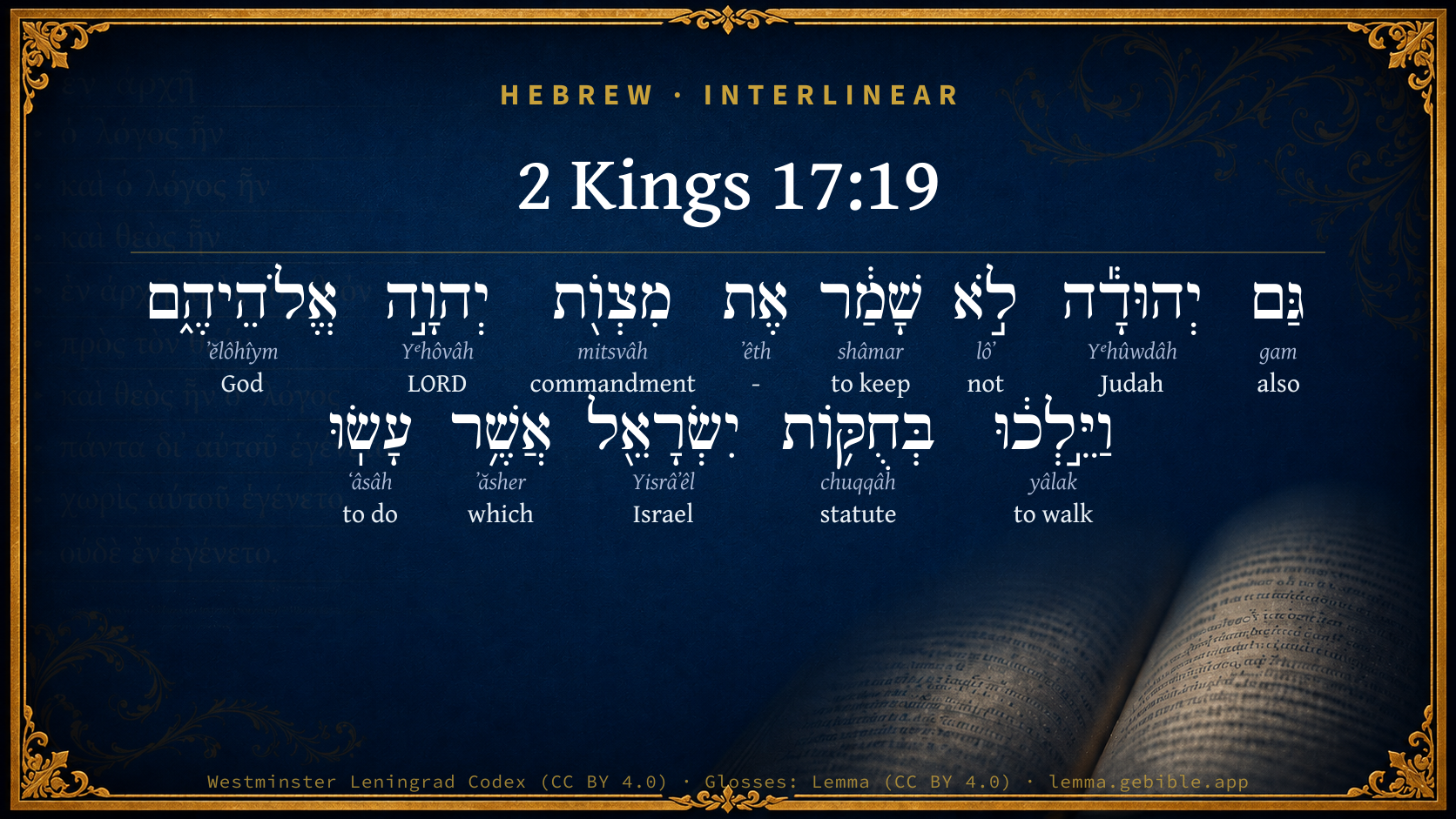
Hebrew (Westminster Leningrad Codex) 2 Kings 17:19 appears in the Hebrew Old Testament. The text above is from the Westminster Leningrad Codex. Each word links to its Strong’s number, a concise gloss, and parsing drawn from the Open Scriptures Hebrew Bible morphology. Click any word for its full Brown-Driver-Briggs (BDB) entry.
Download image
Cite this verse

2 Kings 17:19 (World English Bible). Public Domain. Lemma interlinear Bible study tool, https://lemma.gebible.app/v/2-kings/17/19.

Show BibTeX & RIS
BibTeX
RIS
English Translation
Also Judah didn't keep the commandments of Yahweh their God, but walked in the statutes of Israel which they made.
World English Bible · Public Domain
Download a study sheet

One document with this verse’s original text, its word-by-word gloss line, the meaning frame, cross-references with their text, attributed commentary, and full source and license credits — printable, and it pastes into notes with its structure intact.

This verse Autodidact and up

Study sheet (.html) Plain text (.txt)

A passage Seminary Student

Up to 50 verses in one chapter. A passage sheet keeps up to 6 commentary sources and 12 cross-references per verse, in the order this page ranks them, and says so on the sheet whenever that leaves anything out. Ask for a single verse and you get the Autodidact verse sheet above.

Everything on this page stays free to read, with no account — the sheet is a download of what is already on screen, not access to it.

Want to remove ads? Support Godless Engineer
Compare translations 3

The same verse in 3 English versions, stacked beneath the original-language interlinear above. Click any original word for its lexicon entry.

Each is an independent rendering of the whole verse — the interlinear is not word-aligned to these translations.

Highlighted words mark where these versions differ — a whole-verse word diff, not a word-by-word alignment.

  • World English Bible Public Domain
    Also Judah didn't keep the commandments of Yahweh their God, but walked in the statutes of Israel which they made.
  • King James Version Public Domain
    Also Judah kept not the commandments of the LORD their God, but walked in the statutes of Israel which they made.
  • unfoldingWord Literal Text CC BY-SA 4.0
    Even Judah did not keep the commandments of Yahweh their God. And they walked in the statutes of Israel that they did.

unfoldingWord Literal Text — © unfoldingWord, licensed CC BY-SA 4.0. Word-aligned USFM3 via Door43 (git.door43.org/unfoldingWord/en_ult).

Versions to compare (up to 4)

3 of 4 selected

Show all 18 translations

Every available English version of this verse, each an independent rendering of the whole verse.

  • World English Bible Public Domain
    Also Judah didn't keep the commandments of Yahweh their God, but walked in the statutes of Israel which they made.
  • Berean Standard Bible Public Domain
    and even Judah did not keep the commandments of the LORD their God, but lived according to the customs Israel had introduced.
  • Majority Standard Bible Public Domain
    and even Judah did not keep the commandments of the LORD their God, but lived according to the customs Israel had introduced.
  • King James Version Public Domain
    Also Judah kept not the commandments of the LORD their God, but walked in the statutes of Israel which they made.
  • American Standard Version (1901) Public Domain
    Also Judah kept not the commandments of Jehovah their God, but walked in the statutes of Israel which they made.
  • Revised Version (1885) Public Domain
    Also Judah kept not the commandments of the LORD their God, but walked in the statutes of Israel which they made.
  • Geneva Bible (1599) Public Domain
    Yet Iudah kept not the commandements of the Lord their God, but walked according to the facion of Israel, which they vsed.
  • Douay-Rheims (1899) Public Domain
    But neither did Juda itself keep the commandments of the Lord their God: but they walked in the errors of Israel, which they had wrought.
  • Young's Literal Translation Public Domain
    Also Judah hath not kept the commands of Jehovah their God, and they walk in the statutes of Israel that they had made.
  • Literal Standard Version CC BY-SA 4.0
    Also Judah has not kept the commands of their God YHWH, and they walk in the statutes of Israel that they had made.
  • Unlocked Literal Bible CC BY-SA 4.0
    Even Judah did not keep the commandments of Yahweh their God, and they followed the practices that Israel had done.
  • unfoldingWord Literal Text CC BY-SA 4.0
    Even Judah did not keep the commandments of Yahweh their God. And they walked in the statutes of Israel that they did.
  • Darby Bible Public Domain
    Also Judah kept not the commandments of Jehovah their God, but walked in the statutes of Israel which they had made.
  • World Messianic Bible Public Domain
    Also Judah didn’t keep the commandments of the LORD their God, but walked in the statutes of Israel which they made.
  • Webster's Bible Public Domain
    Also Judah kept not the commandments of the LORD their God, but walked in the statutes of Israel which they made.
  • Free Bible Version CC BY-SA 4.0
    but even Judah did not keep the commandments of the Lord their God, but followed the idolatry that Israel had introduced.
  • Bible in Basic English Public Domain
    (But even Judah did not keep the orders of the Lord their God, but were guided by the rules which Israel had made.
  • JPS Tanakh (1917) Public Domain
    Also Judah kept not the commandments of the LORD their God, but walked in the statutes of Israel which they practised.

Literal Standard Version (2020), Covenant Press — licensed CC BY-SA 4.0. Text via the HelloAO Bible API (eBible.org). Unlocked Literal Bible (unfoldingWord) — licensed CC BY-SA 4.0. Text via the HelloAO Bible API (eBible.org). unfoldingWord Literal Text — © unfoldingWord, licensed CC BY-SA 4.0. Word-aligned USFM3 via Door43 (git.door43.org/unfoldingWord/en_ult). Free Bible Version, Dr. Jonathan Gallagher — licensed CC BY-SA 4.0. Text via the HelloAO Bible API (eBible.org).

Word by word

More ways to search: Search by grammar → Find every occurrence → Compare this word →

Practice this passage: Drill this verse → Learn its vocabulary →

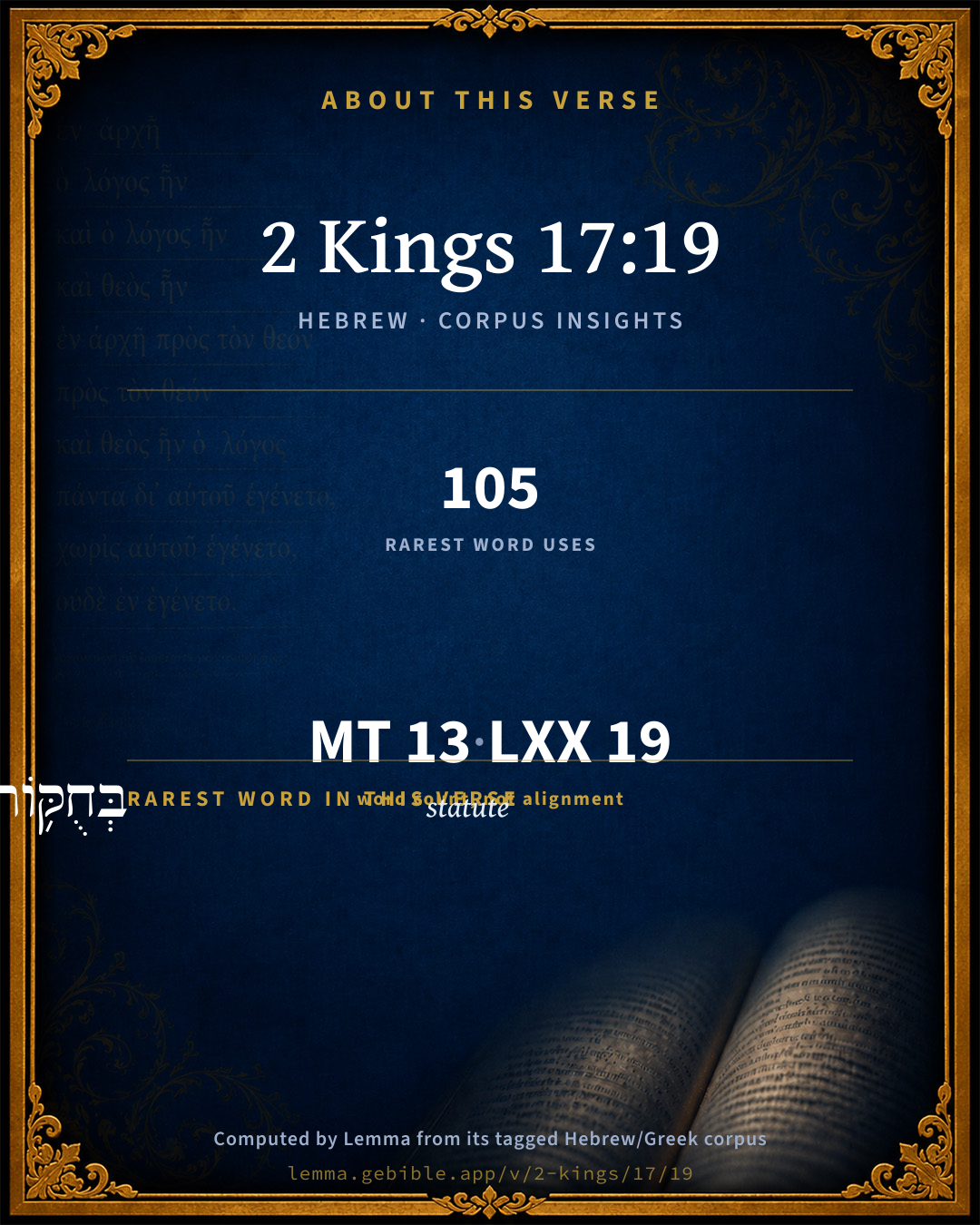
בְּחֻקּ֥וֹת
chuqqâh
H2708
“in/at · statutes of”
Preposition + Noun, Common, Both, Plural, Construct
Part of Speech
Preposition + Noun
Type
Common
Gender
Both
Number
Plural
State
Construct
Full BDB Definition

Origin: from H2706

TWOT: 728b

statute, ordinance, limit, enactment, something prescribed - statute
  1. גַּם gam H1571 “also” Particle, Accusative
  2. יְהוּדָ֕ה Yᵉhûwdâh H3063 “Judah” Noun, Proper
  3. לֹ֣א lôʼ H3808 “not” Particle, Negative
  4. שָׁמַ֔ר shâmar H8104 “to keep” Verb, Qal, Perfect, 3rd Person, Masculine, Singular
  5. אֶת ʼêth H853 “-” Particle, Direct Object
  6. מִצְוֺ֖ת mitsvâh H4687 “commandments of” Noun, Common, Feminine, Plural, Construct
  7. יְהוָ֣ה Yᵉhôvâh H3068 “LORD” Noun, Proper
  8. אֱלֹהֵיהֶ֑ם ʼĕlôhîym H430 “God(s) · their” Noun, Common, Masculine, Plural, Construct + Suffix, Personal, 3rd Person, Masculine, Plural
  9. וַיֵּ֣לְכ֔וּ yâlak H3212 “and · to walk” Conjunction + Verb, Qal, Sequential Imperfect, 3rd Person, Masculine, Plural
  10. יִשְׂרָאֵ֖ל Yisrâʼêl H3478 “Israel” Noun, Proper
  11. אֲשֶׁ֥ר ʼăsher H834 “which” Particle, Relative
  12. עָשֽׂוּ ʻâsâh H6213 “to do” Verb, Qal, Perfect, 3rd Person, Common, Plural

About this verse

These counts appear in no published source. They are computed here, from the morphology-tagged text and Lemma’s own curated glosses. What Lemma adds →

13
words
13
distinct lemmas
Historical
section

Grammatical profile

  • 3 verbs
  • 6 nouns
  • 4 particles

Verb forms

  • שָׁמַ֔ר Qal · Perfect
  • וַיֵּ֣לְכ֔וּ Qal · Sequential Imperfect
  • עָשֽׂוּ Qal · Perfect

Hebrew & Septuagint length

In English translation the verse runs 20 words from the Hebrew and 28 from the Septuagint (LXX English) — the Septuagint runs noticeably longer here. See the side-by-side →

A rough comparison of the two English renderings, which tokenize alike — not a word-level alignment.

Word counts can differ between the Hebrew and the Greek without any difference in meaning — e.g. the Hebrew direct-object marker אֵת has no separate Greek word, and Greek often adds the article ὁ.

In the original languages it is 13 Hebrew tokens and 19 Greek tokens — but the two are counted differently (Hebrew bundles its prefixes and suffixes into one token; the Greek is in lemma form), so that isn’t a like-for-like length.

Cross-references

11

Topical passages linked to 2 Kings 17:19 in the Treasury of Scripture Knowledge — connected by theme and wording, ordered by reader-vote popularity; previews shown in the World English Bible.

  • 1 Kings 14:22–23 Judah did that which was evil in the sight of Yahweh, and they provoked him to jealousy with their sins which they committed, above all that their fathers had done.
  • 2 Kings 16:3 But he walked in the way of the kings of Israel, yes, and made his son to pass through the fire, according to the abominations of the nations, whom Yahweh cast out from before the children of Israel.
  • 2 Chronicles 21:11 Moreover he made high places in the mountains of Judah, and made the inhabitants of Jerusalem to play the prostitute, and led Judah astray.
  • 2 Chronicles 21:13 but have walked in the way of the kings of Israel, and have made Judah and the inhabitants of Jerusalem to play the prostitute, like as the house of Ahab did, and also have slain your brothers of your father's house, who were better than yourself:
  • Jeremiah 3:8–11 I saw, when, for this very cause that backsliding Israel had committed adultery, I had put her away and given her a bill of divorce, yet treacherous Judah, her sister, didn't fear; but she also went and played the prostitute.
  • Ezekiel 16:51–52 Neither has Samaria committed half of your sins; but you have multiplied your abominations more than they, and have justified your sisters by all your abominations which you have done.
  • 2 Kings 8:18 He walked in the way of the kings of Israel, as did the house of Ahab: for he had the daughter of Ahab as wife; and he did that which was evil in the sight of Yahweh.
  • 2 Kings 8:27 He walked in the way of the house of Ahab, and did that which was evil in the sight of Yahweh, as did the house of Ahab; for he was the son-in-law of the house of Ahab.
  • Jeremiah 2:28 But where are your gods that you have made you? let them arise, if they can save you in the time of your trouble: for according to the number of your cities are your gods, Judah.
  • Ezekiel 22:2–16 You, son of man, will you judge, will you judge the bloody city? then cause her to know all her abominations.
  • Ezekiel 23:4–13 The names of them were Oholah the elder, and Oholibah her sister: and they became mine, and they bore sons and daughters. As for their names, Samaria is Oholah, and Jerusalem Oholibah.

Cross-references courtesy of OpenBible.info (CC BY 4.0).

Hebrew and Greek witnesses Masoretic Hebrew ↔ Greek Septuagint

The same verse in the two great witnesses to the Old Testament, shown verse-for-verse.

Here the Septuagint runs noticeably longer than the Hebrew — LXX2012 (modern English Septuagint) 28 words vs World English Bible 20. A rough length comparison of the two English translations, not a word-level alignment — read both below.

These are two independent witnesses, not word-aligned to each other, and the Septuagint is shown in lemma (dictionary) form.

Hebrew 2 Kings 17:19 Masoretic · Westminster Leningrad Codex

גַּם יְהוּדָ֕ה לֹ֣א שָׁמַ֔ר אֶת מִצְוֺ֖ת יְהוָ֣ה אֱלֹהֵיהֶ֑ם וַיֵּ֣לְכ֔וּ בְּחֻקּ֥וֹת יִשְׂרָאֵ֖ל אֲשֶׁ֥ר עָשֽׂוּ

Also Judah didn't keep the commandments of Yahweh their God, but walked in the statutes of Israel which they made.

World English Bible · Public Domain

Greek LXX 2 Kings 17:19 Septuagint · lemma form

καί γέ ἰούδας οὐ φυλάσσω ὁ ἐντολή κύριος ὁ θεός αὐτός καί πορεύομαι ἐν ὁ δικαίωμα ἰσραήλ ὅς ποιέω

Nay even Juda kept not the commandments of the Lord their God, but they walked according to the customs of Israel which they practised, and rejected the Lord.

LXX2012 (modern English Septuagint) · Public Domain

Hebrew: Westminster Leningrad Codex (CC BY 4.0). Greek: Septuagint (public domain); English from LXX2012 (modern English Septuagint) (Public Domain). How the Septuagint differs from the Hebrew →

Targum (Aramaic paraphrase)

1

The Targum is the ancient Jewish Aramaic paraphrase of the Hebrew Scriptures — an interpretive translation, not the Hebrew text itself. Onkelos (literal) and Pseudo-Jonathan (expansive) render the Torah, and Jonathan the Prophets. Coverage is partial: where no permissively-licensed English translation exists for a verse, only the Aramaic is shown. This is verse-level text, not a word-by-word alignment to the Hebrew.

  1. Targum Jonathan Prophets (Joshua–Malachi)
    אַף דְבֵית יְהוּדָה לָא נְטָרוּ יַת פִּקוּדַיָא דַייָ אֱלָהָהוֹן וַאֲזַלוּ בִּגְזֵירַת יִשְׂרָאֵל דַעֲבָדוּ:

    (no public-domain English translation for this verse)

    Targum Jonathan — Aramaic: “Mikraot Gedolot” (public domain). English: “Sefaria Community Translation” (CC0 1.0 (public-domain dedication)); “London "Chaldee Paraphrase," 1871” (public domain). Text via Sefaria.

Commentary

Notes on 2 Kings 17:19 from classic Christian and Jewish commentators (each source and its license shown beneath its notes). The classic Christian expositions comment on the surrounding passage and are grouped to its opening verse, so a note may address several verses; the Jewish commentaries on the Tanakh (Rashi and others) are per-verse, so they appear only where the commentator wrote on this verse.

Lemma curates 59 commentaries, every one of them public domain or Creative Commons licensed, each selected and text-cleaned for this edition rather than reprinted as found. About our sources →

Trapp's Complete Commentary

John Trapp

2Ki 17:19 Also Judah kept not the commandments of the LORD their God, but walked in the statutes of Israel which they made.

Ver. 19. Also Judah.] Being the worse for Israel’s ill neighbourhood, {Hos 4:14} and therefore the worse, because she should have been better by such a warning. {Jer 3:8}

John Trapp, A Commentary or Exposition upon All the Books of the Old and New Testament (1647–1656) — public domain. Text from a community e-Sword module.

Joseph Benson's Commentary

2Ki 17:19. Also Judah kept not, &c., but walked in the statutes of Israel — Followed the idolatrous devices of the ten tribes, which they did most notoriously in the reign of Ahaz. And though his son Hezekiah made a noble reformation, it lasted no longer than his time, so extremely corrupted was the nation. Judah’s idolatry and wickedness are here remembered as an aggravation of the sin of the Israelites, which was not only evil in itself, but mischievous to their neighbours, who by their examples were instructed in their wicked arts, and provoked to an imitation of them: see Hos 4:15; Mat 18:7. Those that bring sin into a country or family bring a plague into it, and will have to answer for all the mischief that follows.

Joseph Benson's Commentary on the Old and New Testaments (1811–1818) — public domain. Text from a community e-Sword module.

Ellicott's Commentary for English Readers

(19) Also Judah kept not . . .—Judah was no real or permanent exception to the sins and punishment of Israel; she imitated the apostasy of her sister-kingdom, and was visited with a similar penalty.

The statutes of Israel which they made.—See Note on 2Ki_17:8 supra, and comp. Mic_6:16, “the statutes of Omri.” According to 2Ki_8:27; 2Ki_16:3, Ahaziah and Ahaz especially favoured the idolatry practised in the northern kingdom. The example of her more powerful neighbour exercised a fatally powerful spell upon Judah.

A Bible Commentary for English Readers, edited by Charles John Ellicott (1878–1897) — public domain. Text from a community e-Sword module.

The Cambridge Bible for Schools and Colleges

gen. ed. J. J. S. Perowne

19. walked in the statutes of Israel] Which were not of God’s ordinance but of Israel’s own devising. This was specially the case when the son of Jehoshaphat intermarried with a daughter of Ahab, and so brought in Baal-worship and its attendant abominations. The calf-worship however seems never to have come across the border, but to have remained in Israel.

The Cambridge Bible for Schools and Colleges (gen. ed. J. J. S. Perowne; Cambridge University Press, 1878–1918) — public domain. Text from a community e-Sword module.

John Gill's Exposition

Also Judah kept not the commandments of the Lord their God,.... But were infected with the idolatry of the ten tribes, and drawn into it by their example, and persisted therein, notwithstanding what befell the ten tribes; which are aggravations of the sins of them both, see Jer 3:7,

but walked in the statutes of Israel which they made; worshipping the calves as they did, particularly in the times of Ahaz, he setting the example, see Kg2 16:3.

John Gill's Exposition of the Whole Bible (1746–1763) — public domain (CC PDM 1.0). Text via the HelloAO Bible API.

Albert Barnes' Notes on the Bible

This verse and the next are parenthetical. Here again, as in 2Ki 17:13, the writer is led on from his account of the sins and punishment of the Israelites to glance at the similar sins and similar punishment of the Jews.

It was the worst reproach which could be urged against any Jewish king, that he “walked in the way of the kings of Israel” 2Ki 8:18; 2Ki 16:3; 2Ch 21:6; 2Ch 28:2. The Baal worship is generally the special sin at which the phrase is leveled; but the meaning here seems to be wider. Compare Mic 6:16.

Albert Barnes' Notes on the Bible (1834–1885) — public domain. Text from a community e-Sword/MySword module.

Matthew Poole's English Annotations

Judah’s idolatry and wickedness is here remembered, as an aggravation of the sin of the Israelites, which was not only evil in itself but scandalous and mischievous to their neighbour, who by heir examples were instructed in their wicked arts, and provoked to an imitation of them: see Hos 4:15, and compare Mat 18:7.

Matthew Poole's English Annotations on the Holy Bible (1683–1685) — public domain. Text from a community e-Sword/MySword module.

Whedon's Commentary on the Bible

Daniel D. Whedon

19. Also Judah — This verse should be enclosed in a parenthesis, as it is merely a remark of the writer occasioned by the closing words of 2Ki_17:18; so that, says Thenius, “the parenthesis intimates that in truth Judah also was ripe for punishment.”

Daniel D. Whedon (gen. ed.), Commentary on the Old and New Testaments (1874–1909) — public domain. Text from a community e-Sword module.

The Pulpit Commentary

Also Judah kept not the commandments of the Lord their God. The sharp contrast which the writer has drawn between Israel and Judah in ver. 18 reminds him that the difference was only for a time. Judah followed in Israel"s sins, and ultimately shared in her punishment. This verso and the next are parenthetic. But walked in the statutes of Israel which they made; i.e. followed Israel in all her evil courses, first in her Baal-worship, under Jehoram, Ahaziah, and Athaliah; then in her other malpractices under Ahaz, (2Ki_16:3, 2Ki_16:4) Manasseh, (2Ki_21:2-9) and Amen. (2Ki_21:20-22) Of course, the calf-worship is excepted, Judah having no temptation to follow Israel in that.

The Pulpit Commentary (1880–1919), ed. H.D.M. Spence-Jones & Joseph S. Exell — public domain. Text from a community e-Sword module.

John Wesley's Explanatory Notes

Judah kept not - Judah's idolatry and wickedness are here remembered, as an aggravation of the sin of the Israelites, which was not only evil in itself, but mischievous to their neighbour, who by their examples were instructed in their wicked arts, and provoked to an imitation of them.

John Wesley, Explanatory Notes Upon the Whole Bible (1754–1765) — public domain. Text via the GEBible commentary corpus.

unfoldingWord translationNotes

Door43 World Missions Community

General Information:

The summary of Yahweh's judgment on Israel includes how Judah also fell into idolatry.

Judah

The location "Judah" is metonymy for the people that live there. AT: "the people of Judah" (See: Metonymy)

he afflicted them

"Yahweh punished the Israelites"

gave them into the hand of those who would take the possession as spoil

"Hand" is metonymy for control, power or authority. AT: "handed them over to those who robbed them of their property" (See: Metonymy)

until he had cast them out of his sight

"his sight" is metaphor for attention and caring. AT: "until he got rid of them all" or "until they were no longer in his presence" (See: Metaphor)

translationWords

command

Yahweh

pagan

kingdom of Israel

descend

afflicted

hand

possess

unfoldingWord translationNotes — © Distant Shores Media and the Door43 World Missions Community, licensed CC BY-SA 4.0. Source: git.door43.org/Door43/en_tn.

Lesson kit

Teaching starters — assembled from the data on this page, not authored interpretation. Every prompt links to the verse data it draws on. Edit before teaching.

2 Kings, in the Historical, opens this verse with 13 words (13 distinct Hebrew lemmas). Its most distinctive word is chuqqâh (“statute”). The Greek Septuagint runs longer here. A historical commentator’s framing appears above. Read the whole chapter for the surrounding context.

Discussion questions

  1. What does “statute” (chuqqâh) contribute to the verse as a whole?
  2. 1 Kings 14:22–23 shares this passage’s theme. How do the two illuminate each other?
  3. Compared with the Hebrew, the Septuagint runs longer here. What questions does that raise?
  4. These translations render this verse differently; the difference is in the English rendering, not the original. What questions does that raise?
  5. The verb «שָׁמַ֔ר» is Qal Perfect. How does its form color the action?
  6. Reading how Trapp's Complete Commentary and Joseph Benson's Commentary read this verse, where do the two commentators agree and where do they part?

Things to notice

Reading settings

Reading text

Shown beneath each verse's original-language words.

Old Testament
Old Testament edition

Read the OT as the Masoretic Hebrew (MT) or the Greek Septuagint (LXX).

English shown for the Greek Septuagint (in the Hebrew ↔ Greek comparison).

Comparing translations? Open the Compare panel on any verse page to stack up to four side by side.