
1 Kings 14:8

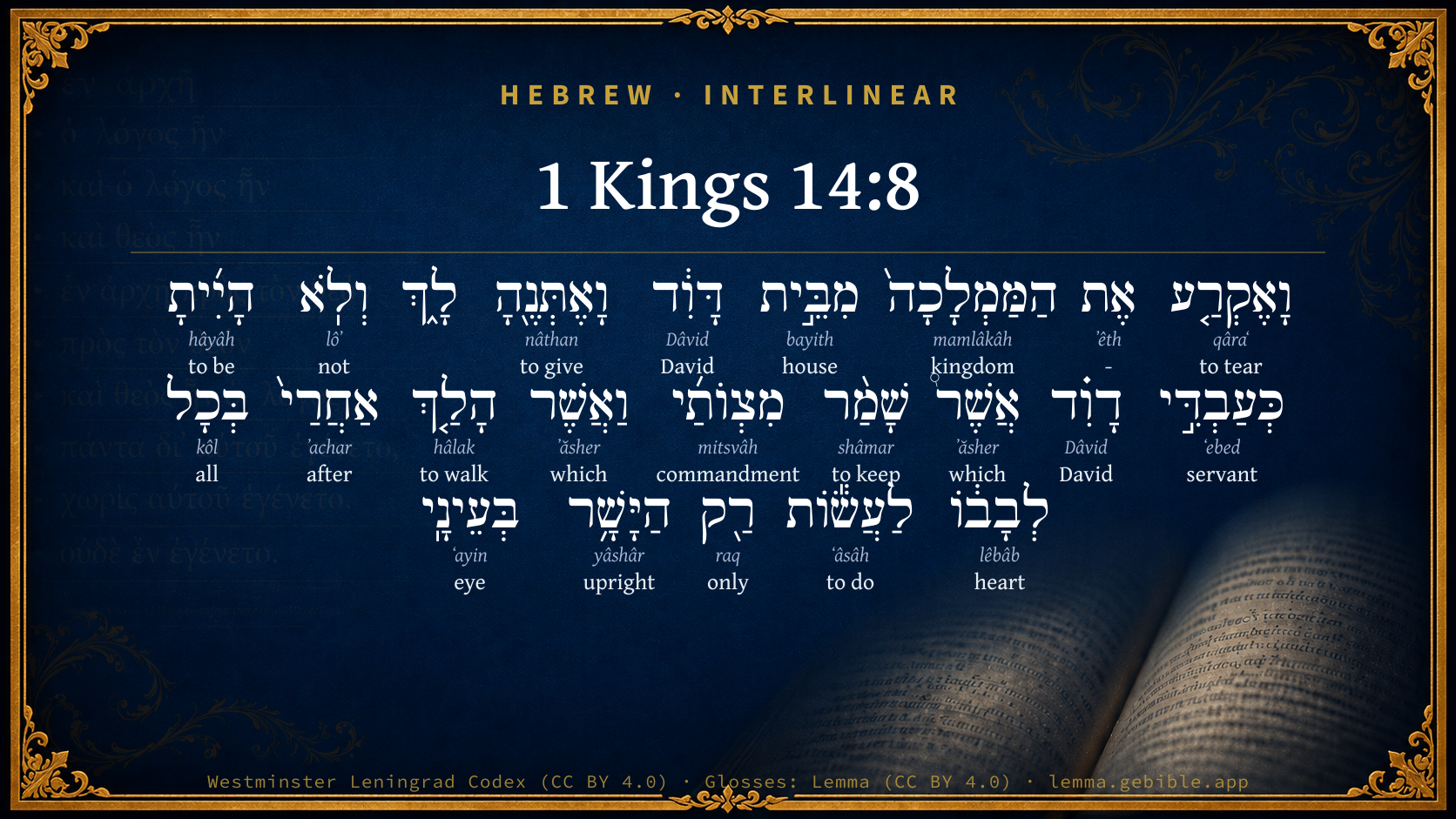
Hebrew (Westminster Leningrad Codex) 1 Kings 14:8 appears in the Hebrew Old Testament. The text above is from the Westminster Leningrad Codex. Each word links to its Strong’s number, a concise gloss, and parsing drawn from the Open Scriptures Hebrew Bible morphology. Click any word for its full Brown-Driver-Briggs (BDB) entry.
Download image
Cite this verse

1 Kings 14:8 (World English Bible). Public Domain. Lemma interlinear Bible study tool, https://lemma.gebible.app/v/1-kings/14/8.

Show BibTeX & RIS
BibTeX
RIS
English Translation
and tore the kingdom away from the house of David, and gave it you; and yet you have not been as my servant David, who kept my commandments, and who followed me with all his heart, to do that only which was right in my eyes,
World English Bible · Public Domain
Download a study sheet

One document with this verse’s original text, its word-by-word gloss line, the meaning frame, cross-references with their text, attributed commentary, and full source and license credits — printable, and it pastes into notes with its structure intact.

This verse Autodidact and up

Study sheet (.html) Plain text (.txt)

A passage Seminary Student

Up to 50 verses in one chapter. A passage sheet keeps up to 6 commentary sources and 12 cross-references per verse, in the order this page ranks them, and says so on the sheet whenever that leaves anything out. Ask for a single verse and you get the Autodidact verse sheet above.

Everything on this page stays free to read, with no account — the sheet is a download of what is already on screen, not access to it.

Want to remove ads? Support Godless Engineer
Compare translations 3

The same verse in 3 English versions, stacked beneath the original-language interlinear above. Click any original word for its lexicon entry.

Each is an independent rendering of the whole verse — the interlinear is not word-aligned to these translations.

Highlighted words mark where these versions differ — a whole-verse word diff, not a word-by-word alignment.

  • World English Bible Public Domain
    and tore the kingdom away from the house of David, and gave it you; and yet you have not been as my servant David, who kept my commandments, and who followed me with all his heart, to do that only which was right in my eyes,
  • King James Version Public Domain
    And rent the kingdom away from the house of David, and gave it thee: and yet thou hast not been as my servant David, who kept my commandments, and who followed me with all his heart, to do that only which was right in mine eyes;
  • unfoldingWord Literal Text CC BY-SA 4.0
    and I tore the kingdom away from the house of David and I gave it to you, but you are not like my servant David, who kept my commandments and who walked after me with all of his heart, to do only the right in my eyes,

unfoldingWord Literal Text — © unfoldingWord, licensed CC BY-SA 4.0. Word-aligned USFM3 via Door43 (git.door43.org/unfoldingWord/en_ult).

Versions to compare (up to 4)

3 of 4 selected

Show all 18 translations

Every available English version of this verse, each an independent rendering of the whole verse.

  • World English Bible Public Domain
    and tore the kingdom away from the house of David, and gave it you; and yet you have not been as my servant David, who kept my commandments, and who followed me with all his heart, to do that only which was right in my eyes,
  • Berean Standard Bible Public Domain
    I tore the kingdom away from the house of David and gave it to you. But you were not like My servant David, who kept My commandments and followed Me with all his heart, doing only what was right in My eyes.
  • Majority Standard Bible Public Domain
    I tore the kingdom away from the house of David and gave it to you. But you have not been like My servant David, who kept My commandments and followed Me with all his heart, doing only what was right in My eyes.
  • King James Version Public Domain
    And rent the kingdom away from the house of David, and gave it thee: and yet thou hast not been as my servant David, who kept my commandments, and who followed me with all his heart, to do that only which was right in mine eyes;
  • American Standard Version (1901) Public Domain
    and rent the kingdom away from the house of David, and gave it thee; and yet thou hast not been as my servant David, who kept my commandments, and who followed me with all his heart, to do that only which was right in mine eyes,
  • Revised Version (1885) Public Domain
    and rent the kingdom away from the house of David, and gave it thee: and yet thou hast not been as my servant David, who kept my commandments, and who followed me with all his heart, to do that only which was right in mine eyes;
  • Geneva Bible (1599) Public Domain
    And haue rent the kingdome away from the house of Dauid, and haue giuen it thee, and thou hast not bene as my seruant Dauid, which kept my commandements, and followed mee with all his heart, and did onely that which was right in mine eyes,
  • Douay-Rheims (1899) Public Domain
    And rent the kingdom away from the house of David, and gave it to thee, and thou hast not been as my servant David, who kept my commandments, and followed me with all his heart, doing that which was well pleasing in my sight:
  • Young's Literal Translation Public Domain
    and rend the kingdom from the house of David, and give it to thee, -- and thou hast not been as My servant David who kept My commands, and who walked after Me with all his heart, to do only that which `is' right in Mine eyes,
  • Literal Standard Version CC BY-SA 4.0
    and tear the kingdom from the house of David, and give it to you—and you have not been as My servant David who kept My commands, and who walked after Me with all his heart, to only do that which [is] right in My eyes,
  • Unlocked Literal Bible CC BY-SA 4.0
    I tore the kingdom away from the family of David and gave it to you, yet you have not been like my servant David, who kept my commandments and followed me with all his heart, to do only what was right in my eyes.
  • unfoldingWord Literal Text CC BY-SA 4.0
    and I tore the kingdom away from the house of David and I gave it to you, but you are not like my servant David, who kept my commandments and who walked after me with all of his heart, to do only the right in my eyes,
  • Darby Bible Public Domain
    and rent the kingdom away from the house of David, and gave it thee; and thou hast not been as my servant David, who kept my commandments, and who followed me with all his heart, to do only that which is right in my sight;
  • World Messianic Bible Public Domain
    and tore the kingdom away from David’s house, and gave it to you; and yet you have not been as my servant David, who kept my commandments, and who followed me with all his heart, to do that only which was right in my eyes,
  • Webster's Bible Public Domain
    And rent the kingdom away from the house of David, and gave it to thee: and yet thou hast not been as my servant David, who kept my commandments, and who followed me with all his heart, to do that only which was right in my eyes;
  • Free Bible Version CC BY-SA 4.0
    I took the kingdom from the house of David and gave it to you. But you were not like my servant David, who kept my commandments and was totally committed to following me, only doing what was right in my sight.
  • Bible in Basic English Public Domain
    And took the kingdom away by force from the seed of David and gave it to you, you have not been like my servant David, who kept my orders, and was true to me with all his heart, doing only what was right in my eyes.
  • JPS Tanakh (1917) Public Domain
    and rent the kingdom away from the house of David, and gave it thee; and yet thou hast not been as My servant David, who kept My commandments, and who followed Me with all his heart, to do that only which was right in Mine eyes;

Literal Standard Version (2020), Covenant Press — licensed CC BY-SA 4.0. Text via the HelloAO Bible API (eBible.org). Unlocked Literal Bible (unfoldingWord) — licensed CC BY-SA 4.0. Text via the HelloAO Bible API (eBible.org). unfoldingWord Literal Text — © unfoldingWord, licensed CC BY-SA 4.0. Word-aligned USFM3 via Door43 (git.door43.org/unfoldingWord/en_ult). Free Bible Version, Dr. Jonathan Gallagher — licensed CC BY-SA 4.0. Text via the HelloAO Bible API (eBible.org).

Word by word

More ways to search: Search by grammar → Find every occurrence → Compare this word →

Practice this passage: Drill this verse → Learn its vocabulary →

וָאֶקְרַ֤ע
qâraʻ
H7167
“and · to tear”
Conjunction + Verb, Qal, Sequential Imperfect, 1st Person, Common, Singular
Part of Speech
Conjunction + Verb
Stem
Qal
Form
Sequential Imperfect
Person
1st Person
Gender
Common
Number
Singular
Full BDB Definition

Origin: a primitive root

TWOT: 2074

to tear, tear in pieces - (Qal) - to tear, rend - to tear away or out - to tear, rend asunder - to make wide or large (of eyes) - to rend open (of heavens) - to tear, rend (of wild beasts) - (Niphal) to be rent, be split asunder
  1. אֶת ʼêth H853 “-” Particle, Direct Object
  2. הַמַּמְלָכָה֙ mamlâkâh H4467 “the · kingdom” Particle, Definite Article + Noun, Common, Feminine, Singular, Absolute
  3. מִבֵּ֣ית bayith H1004 “from · house of” Preposition + Noun, Common, Masculine, Singular, Construct
  4. דָּוִ֔ד Dâvid H1732 “David” Noun, Proper
  5. וָאֶתְּנֶ֖הָ nâthan H5414 “and · to give · her” Conjunction + Verb, Qal, Sequential Imperfect, 1st Person, Common, Singular + Suffix, Personal, 3rd Person, Feminine, Singular
  6. וְלֹֽא lôʼ H3808 “and · not” Conjunction + Particle, Negative
  7. הָיִ֜יתָ hâyâh H1961 “to be” Verb, Qal, Perfect, 2nd Person, Masculine, Singular
  8. כְּעַבְדִּ֣י ʻebed H5650 “like/as · servant · my” Preposition + Noun, Common, Masculine, Singular, Construct + Suffix, Personal, 1st Person, Common, Singular
  9. דָוִ֗ד Dâvid H1732 “David” Noun, Proper
  10. אֲשֶׁר֩ ʼăsher H834 “which” Particle, Relative
  11. שָׁמַ֨ר shâmar H8104 “to keep” Verb, Qal, Perfect, 3rd Person, Masculine, Singular
  12. מִצְוֺתַ֜י mitsvâh H4687 “commandments · my” Noun, Common, Feminine, Plural, Construct + Suffix, Personal, 1st Person, Common, Singular
  13. וַאֲשֶׁר ʼăsher H834 “and · which” Conjunction + Particle, Relative
  14. הָלַ֤ךְ hâlak H1980 “to walk” Verb, Qal, Perfect, 3rd Person, Masculine, Singular
  15. אַחֲרַי֙ ʼachar H310 “after · me” Preposition + Suffix, Personal, 1st Person, Common, Singular
  16. בְּכָל kôl H3605 “in/at · all of” Preposition + Noun, Common, Masculine, Singular, Construct
  17. לְבָב֔וֹ lêbâb H3824 “heart · his” Noun, Common, Masculine, Singular, Construct + Suffix, Personal, 3rd Person, Masculine, Singular
  18. לַעֲשׂ֕וֹת ʻâsâh H6213 “to do” Preposition + Verb, Qal, Infinitive Construct
  19. רַ֖ק raq H7535 “only” Particle, Accusative
  20. הַיָּשָׁ֥ר yâshâr H3477 “the · upright” Particle, Definite Article + Adjective, Adjective, Masculine, Singular, Absolute
  21. בְּעֵינָֽי ʻayin H5869 “in/at · eyes · my” Preposition + Noun, Common, Both, Dual, Construct + Suffix, Personal, 1st Person, Common, Singular

About this verse

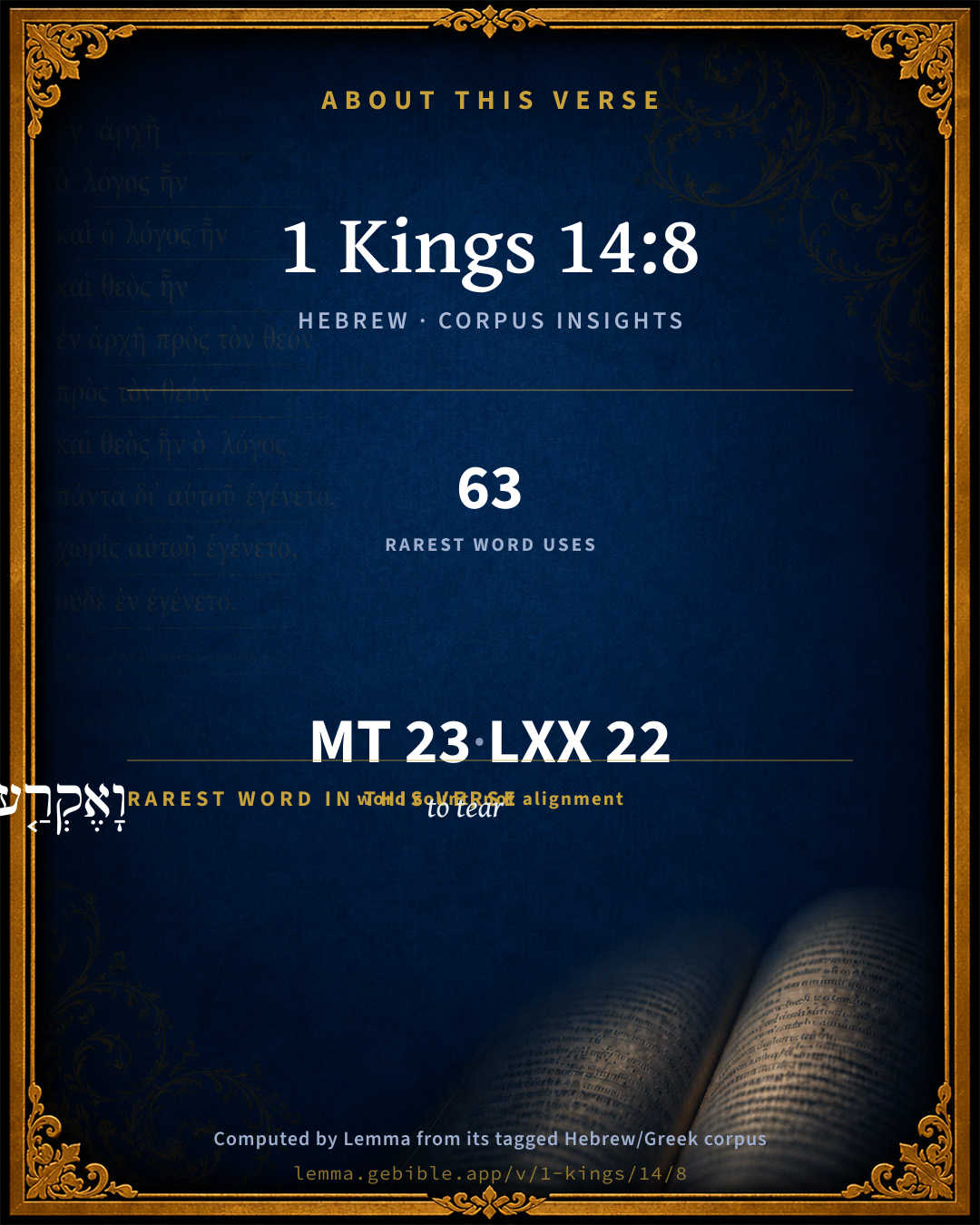
These counts appear in no published source. They are computed here, from the morphology-tagged text and Lemma’s own curated glosses. What Lemma adds →

23
words
20
distinct lemmas
Historical
section

Grammatical profile

  • 6 verbs
  • 9 nouns
  • 1 adjective
  • 2 prepositions
  • 5 particles

Verb forms

  • וָאֶקְרַ֤ע Qal · Sequential Imperfect
  • וָאֶתְּנֶ֖הָ Qal · Sequential Imperfect
  • הָיִ֜יתָ Qal · Perfect
  • שָׁמַ֨ר Qal · Perfect
  • הָלַ֤ךְ Qal · Perfect
  • לַעֲשׂ֕וֹת Qal · Infinitive Construct

Repetition

Words recur within this verse — often emphatic in Hebrew:

  • דָּוִ֔ד David H1732 ×2
  • אֲשֶׁר֩ which H834 ×2

Hebrew & Septuagint length

In the original languages it is 23 Hebrew tokens and 22 Greek tokens — but the two are counted differently (Hebrew bundles its prefixes and suffixes into one token; the Greek is in lemma form), so that isn’t a like-for-like length.

Cross-references

8

Topical passages linked to 1 Kings 14:8 in the Treasury of Scripture Knowledge — connected by theme and wording, ordered by reader-vote popularity; previews shown in the World English Bible.

  • 1 Kings 15:5 because David did that which was right in the eyes of Yahweh, and didn't turn aside from anything that he commanded him all the days of his life, except only in the matter of Uriah the Hittite.
  • 1 Kings 11:33–38 because that they have forsaken me, and have worshiped Ashtoreth the goddess of the Sidonians, Chemosh the god of Moab, and Milcom the god of the children of Ammon; and they have not walked in my ways, to do that which is right in my eyes, and [to keep] my statutes and my ordinances, as did David his father.
  • 2 Chronicles 28:1 Ahaz was twenty years old when he began to reign; and he reigned sixteen years in Jerusalem: and he didn't do that which was right in the eyes of Yahweh, like David his father;
  • Acts 13:22 When he had removed him, he raised up David to be their king, to whom he also testified, 'I have found David the son of Jesse, a man after my heart, who will do all my will.'
  • Acts 13:36 For David, after he had in his own generation served the counsel of God, fell asleep, and was laid with his fathers, and saw decay.
  • 1 Kings 3:14 If you will walk in my ways, to keep my statutes and my commandments, as your father David did walk, then I will lengthen your days.
  • 1 Kings 11:30–31 Ahijah laid hold of the new garment that was on him, and tore it in twelve pieces.
  • 2 Chronicles 17:3 Yahweh was with Jehoshaphat, because he walked in the first ways of his father David, and didn't seek the Baals,

Cross-references courtesy of OpenBible.info (CC BY 4.0).

Hebrew and Greek witnesses Masoretic Hebrew ↔ Greek Septuagint

The same verse in the two great witnesses to the Old Testament, shown verse-for-verse.

These are two independent witnesses, not word-aligned to each other, and the Septuagint is shown in lemma (dictionary) form.

Hebrew 1 Kings 14:8 Masoretic · Westminster Leningrad Codex

וָאֶקְרַ֤ע אֶת הַמַּמְלָכָה֙ מִבֵּ֣ית דָּוִ֔ד וָאֶתְּנֶ֖הָ לָ֑ךְ וְלֹֽא הָיִ֜יתָ כְּעַבְדִּ֣י דָוִ֗ד אֲשֶׁר֩ שָׁמַ֨ר מִצְוֺתַ֜י וַאֲשֶׁר הָלַ֤ךְ אַחֲרַי֙ בְּכָל לְבָב֔וֹ לַעֲשׂ֕וֹת רַ֖ק הַיָּשָׁ֥ר בְּעֵינָֽי

and tore the kingdom away from the house of David, and gave it you; and yet you have not been as my servant David, who kept my commandments, and who followed me with all his heart, to do that only which was right in my eyes,

World English Bible · Public Domain

Greek LXX 1 Kings 14:8 Septuagint · lemma form

καί γίγνομαι ὅτε εἰςπορεύομαι ὁ βασιλεύς εἰς οἶκος κύριος καί αἴρω αὐτός ὁ παρατρέχω καί ἀποἐρείδομαι αὐτός εἰς ὁ θεε ὁ παρατρέχω

No English rendering of this Greek verse — the small residue in the structurally divergent books.

Hebrew: Westminster Leningrad Codex (CC BY 4.0). Greek: Septuagint (public domain); English from a public-domain English Septuagint. How the Septuagint differs from the Hebrew →

Targum (Aramaic paraphrase)

1

The Targum is the ancient Jewish Aramaic paraphrase of the Hebrew Scriptures — an interpretive translation, not the Hebrew text itself. Onkelos (literal) and Pseudo-Jonathan (expansive) render the Torah, and Jonathan the Prophets. Coverage is partial: where no permissively-licensed English translation exists for a verse, only the Aramaic is shown. This is verse-level text, not a word-by-word alignment to the Hebrew.

  1. Targum Jonathan Prophets (Joshua–Malachi)
    וְאַעְדֵתִי יַת מַלְכוּתָא מִבֵּית דָוִד וִיהַבְתָּא לָךְ וְלָא הֲוֵיתָא כְּעַבְדִי דָוִד דִי נְטַר פִּקוּדַי וּדְהַלֵיךְ בָתַר פּוּלְחָנִי בְּכָל לִבֵּיהּ לְמֶעְבַד לְחוּד דְכָשַׁר קָדָמַי:

    (no public-domain English translation for this verse)

    Targum Jonathan — Aramaic: “Mikraot Gedolot” (public domain). English: “Sefaria Community Translation” (CC0 1.0 (public-domain dedication)); “London "Chaldee Paraphrase," 1871” (public domain). Text via Sefaria.

Commentary

Notes on 1 Kings 14:8 from classic Christian and Jewish commentators (each source and its license shown beneath its notes). The classic Christian expositions comment on the surrounding passage and are grouped to its opening verse, so a note may address several verses; the Jewish commentaries on the Tanakh (Rashi and others) are per-verse, so they appear only where the commentator wrote on this verse.

Lemma curates 59 commentaries, every one of them public domain or Creative Commons licensed, each selected and text-cleaned for this edition rather than reprinted as found. About our sources →

Trapp's Complete Commentary

John Trapp

1Ki 14:8 And rent the kingdom away from the house of David, and gave it thee: and [yet] thou hast not been as my servant David, who kept my commandments, and who followed me with all his heart, to do [that] only [which was] right in mine eyes;

Ver. 8. Who kept my commandments.] Did all my wills, {Act 13:22} in desire and endeavour at least; repenting heartily for his involuntary and unavoidable infirmities, which therefore were not imputed unto him.

To do that only which was right,] viz., In mine account and acceptation.

John Trapp, A Commentary or Exposition upon All the Books of the Old and New Testament (1647–1656) — public domain. Text from a community e-Sword module.

The Biblical Illustrator

Joseph S. Exell

1Ki_14:8-9

David kept my commandments . . . thou hast gone and made thee other gods.

Servitude or service-which?

The people of God had left their God, and He had left them, so that Shishak, the King of Egypt, came against them; and though the Lord had respect to their humble prayer, and would not suffer Shishak to destroy Jerusalem, yet He brought them into subjection to the Egyptian king. Our text tells us the reason for this servitude: They shall be his servants; that they may know My service, and the service of the kingdoms of the countries.

I. There are some who have already chosen the service of the kingdoms of the countless. We have many round about us who have deliberately chosen not to serve God, but to serve other masters.

1. Some choose to be the slaves of open sin.

2. There are many persons who are not the worshippers of vice, but they are the votaries of money-making. They are the slaves of the thirst for wealth.

3. There are some others who do not try to get much money, but they are lovers of fashion, lovers of society, admirers of the world.

4. Then there is another cult that has lately come up, which some have chosen, so that they have become the devotees of culture.

5. I will only refer to one more class of those who have chosen the service of the kingdoms; these are the seekers of self-righteousness. This is an old-fashioned and very respectable deity whom many still worship.

II. Some seem to be pining to give up the service of God, and to go to the service of the kingdoms. It is a strange thing; but this evil is always breaking out even among the people of God.

1. Some want to change out of sheer love of change.

2. Some want to be off to their idols, because of the outward aspect of the new thing.

3. Sometimes men turn aside because of their loss of joy in the service of God. They are not serving the Lord as they used to do; they are doing but little for Him.

4. Then there are many who are led to want a change from the service of God by the flagging of others.

5. There are some who turn aside because religion now has brought them to a point where it entails some extra self-sacrifice.

III. There is a great contrast between the service of God and any other service.

1. If you are about to engage in the service of God, there is nothing demanded of you that will harm you. There Is no commandment of God which, if you keep it, will injure either your body or your soul.

2. Next, notice that there is nothing denied you, in the service of God, that would be a blessing to you. The promise is, No good thing will He withhold from them that walk uprightly

3. Once more observe that in the service of God strength will always be given according to your day.

4. And all the while that you are the servant of God, you have a sweet peace in reflecting upon what you have done. As George Herbert said, when he helped a poor woman with her load, and men wondered that the parson of the parish should carry a poor womans basket for her, The memory of this will make the bells ring in my heart at night, so the service of God makes the bells ring in our hearts.

5. Lastly, there is above all this a hope of the eternal reward which is so soon to come. (C. H. Spurgeon.)

The Biblical Illustrator, edited by Joseph S. Exell (c. 1880s–1900s) — public domain. Text from a community e-Sword module.

Joseph Benson's Commentary

1Ki 14:8. Thou hast not been as my servant David — Who, though he fell into some sins, yet, 1st, He constantly persevered in the true worship of God; from which thou art revolted; 2d, He heartily repented of, and turned from all his sins, whereas thou art obstinate and incorrigible.

Joseph Benson's Commentary on the Old and New Testaments (1811–1818) — public domain. Text from a community e-Sword module.

Tyndale Open Study Notes

Tyndale Open Resources

14:8-9 Unlike David, who genuinely repented of his sins (2 Sam 12:13; Ps 51:2-4), Jeroboam exceeded his predecessors in doing evil. Despite clear evidence of God’s displeasure and coming judgment (1 Kgs 13:33), he failed to turn from his ways. His sin would bring grave consequences to his family and descendants (13:34; 14:10-11, 14) and, ultimately, to the whole northern kingdom (14:16). • gold calves: see 12:26-30.

Tyndale Open Study Notes — © Tyndale Open Resources, licensed CC BY-SA 4.0. Text via the HelloAO Bible API.

Jamieson, Fausset & Brown

Robert Jamieson, A. R. Fausset & David Brown

thou hast not been as my servant David--David, though he fell into grievous sins, repented and always maintained the pure worship of God as enjoined by the law.

Jamieson, Fausset & Brown — Commentary Critical and Explanatory on the Whole Bible (1871) — public domain (CC PDM 1.0). Text via the HelloAO Bible API.

Adam Clarke's Commentary

Verse 8. And rent the kingdom away from the house of David] That is, permitted it to be rent, because of the folly and insolence of Rehoboam.

Adam Clarke's Commentary on the Bible (1810–1826) — public domain. Text from a community e-Sword/MySword module.

John Gill's Exposition

But hast done evil above all that were before thee,.... Not only above David, but above Saul, who never gave into idolatry, yea, even above Solomon, who, though he connived at idolatry, and might be guilty of it in some instances, yet did not attempt to draw his people into it; and if this was the latter end of Jeroboam's reign, which is probable, Rehoboam and Abijam might be both dead; and though they were blameworthy in some things, yet not so bad as Jeroboam; though perhaps this may respect only such who had been kings of Israel before him:

for thou hast gone and made thee other gods, and molten images, to provoke me to anger; the two calves of gold; for however he might colour things over, and pretend he did not look upon these as gods, but as representations of God, and that he did not worship them, but God by them, yet the Lord considered it as idolatry, than which nothing is more provoking to him:

and hast cast me behind thy back; as unworthy of his regard; or my worship, as the Targum, which he neglected, and showed no concern for.

John Gill's Exposition of the Whole Bible (1746–1763) — public domain (CC PDM 1.0). Text via the HelloAO Bible API.

Matthew Poole's English Annotations

As my servant David; who though he fell into some sins, yet, first, he constantly persevered in the true worship of God, from which thou art revolted; secondly, he heartily repented of and turned from all his sins, whereas thou art obstinate and incorrigible.

Matthew Poole's English Annotations on the Holy Bible (1683–1685) — public domain. Text from a community e-Sword/MySword module.

The Pulpit Commentary

And rent same word as in the former prophecy of Ahijah, (1Ki_11:30, 1Ki_11:31) the kingdom away from the house of David, and gave it thee: and yet thou hast not been as my servant David who had been proposed to Jeroboam as his example, 1Ki_11:38. This name, as that of a prince of the rival house, would now be almost hateful to Jeroboam who kept my commandments, and who followed me with all his heart (cf., 1Ki_11:33, 38 15:5) to do that only which was right in mine eyes;

The Pulpit Commentary (1880–1919), ed. H.D.M. Spence-Jones & Joseph S. Exell — public domain. Text from a community e-Sword module.

Lesson kit

Teaching starters — assembled from the data on this page, not authored interpretation. Every prompt links to the verse data it draws on. Edit before teaching.

1 Kings, in the Historical, opens this verse with 23 words (20 distinct Hebrew lemmas). Its most distinctive word is qâraʻ (“to tear”). A historical commentator’s framing appears above. Read the whole chapter for the surrounding context.

Discussion questions

  1. What does “to tear” (qâraʻ) contribute to the verse as a whole?
  2. 1 Kings 15:5 shares this passage’s theme. How do the two illuminate each other?
  3. “David” occurs 2× in this one verse. What is the effect of the repetition?
  4. These translations render this verse differently. What is at stake in choosing one wording over another?
  5. The verb «וָאֶקְרַ֤ע» is Qal Sequential Imperfect. How does its form color the action?
  6. Reading how Trapp's Complete Commentary and The Biblical Illustrator read this verse, where do the two commentators agree and where do they part?

Things to notice

Reading settings

Reading text

Shown beneath each verse's original-language words.

Old Testament
Old Testament edition

Read the OT as the Masoretic Hebrew (MT) or the Greek Septuagint (LXX).

English shown for the Greek Septuagint (in the Hebrew ↔ Greek comparison).

Comparing translations? Open the Compare panel on any verse page to stack up to four side by side.