
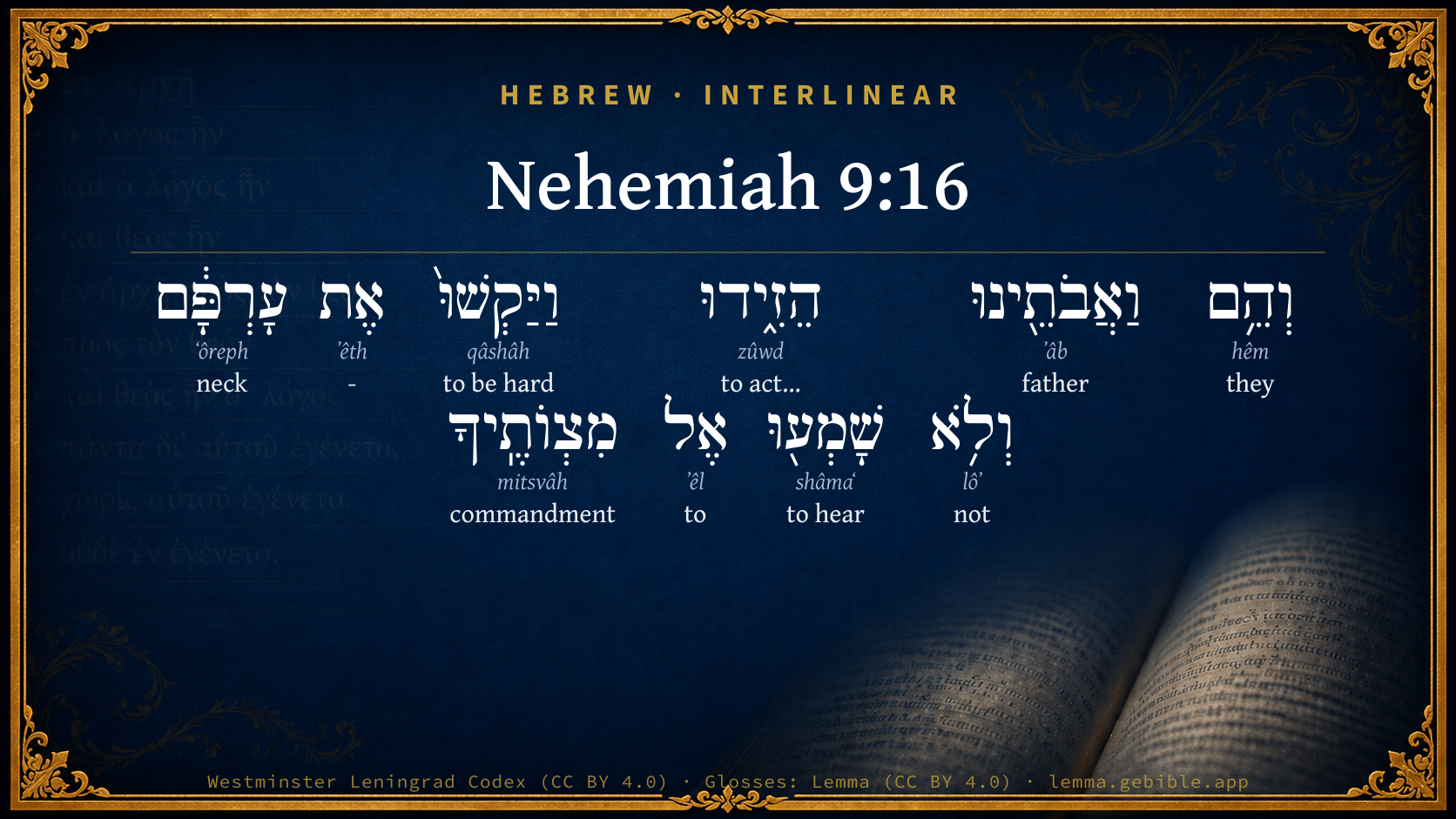
Nehemiah 9:16

Hebrew (Westminster Leningrad Codex) Nehemiah 9:16 appears in the Hebrew Old Testament. The text above is from the Westminster Leningrad Codex. Each word links to its Strong’s number, a concise gloss, and parsing drawn from the Open Scriptures Hebrew Bible morphology. Click any word for its full Brown-Driver-Briggs (BDB) entry.
Download image
Cite this verse

Nehemiah 9:16 (World English Bible). Public Domain. Lemma interlinear Bible study tool, https://lemma.gebible.app/v/nehemiah/9/16.

Show BibTeX & RIS
BibTeX
RIS
English Translation
But they and our fathers dealt proudly and hardened their neck, and didn't listen to your commandments,
World English Bible · Public Domain
Download a study sheet

One document with this verse’s original text, its word-by-word gloss line, the meaning frame, cross-references with their text, attributed commentary, and full source and license credits — printable, and it pastes into notes with its structure intact.

This verse Autodidact and up

Study sheet (.html) Plain text (.txt)

A passage Seminary Student

Up to 50 verses in one chapter. A passage sheet keeps up to 6 commentary sources and 12 cross-references per verse, in the order this page ranks them, and says so on the sheet whenever that leaves anything out. Ask for a single verse and you get the Autodidact verse sheet above.

Everything on this page stays free to read, with no account — the sheet is a download of what is already on screen, not access to it.

Want to remove ads? Support Godless Engineer
Compare translations 3

The same verse in 3 English versions, stacked beneath the original-language interlinear above. Click any original word for its lexicon entry.

Each is an independent rendering of the whole verse — the interlinear is not word-aligned to these translations.

Highlighted words mark where these versions differ — a whole-verse word diff, not a word-by-word alignment.

  • World English Bible Public Domain
    But they and our fathers dealt proudly and hardened their neck, and didn't listen to your commandments,
  • King James Version Public Domain
    But they and our fathers dealt proudly, and hardened their necks, and hearkened not to thy commandments,
  • unfoldingWord Literal Text CC BY-SA 4.0
    But they and our fathers, they acted presumptuously. And they stiffened their neck and did not listen to your commandments.

unfoldingWord Literal Text — © unfoldingWord, licensed CC BY-SA 4.0. Word-aligned USFM3 via Door43 (git.door43.org/unfoldingWord/en_ult).

Versions to compare (up to 4)

3 of 4 selected

Show all 18 translations

Every available English version of this verse, each an independent rendering of the whole verse.

  • World English Bible Public Domain
    But they and our fathers dealt proudly and hardened their neck, and didn't listen to your commandments,
  • Berean Standard Bible Public Domain
    But they and our fathers became arrogant and stiff-necked and did not obey Your commandments.
  • Majority Standard Bible Public Domain
    But they and our fathers became arrogant and stiff-necked and did not obey Your commandments.
  • King James Version Public Domain
    But they and our fathers dealt proudly, and hardened their necks, and hearkened not to thy commandments,
  • American Standard Version (1901) Public Domain
    But they and our fathers dealt proudly and hardened their neck, and hearkened not to thy commandments,
  • Revised Version (1885) Public Domain
    But they and our fathers dealt proudly, and hardened their neck, and hearkened not to thy commandments,
  • Geneva Bible (1599) Public Domain
    But they and our fathers behaued them selues proudely, and hardened their neck, so that they hearkened not vnto thy commandements,
  • Douay-Rheims (1899) Public Domain
    But they and our fathers dealt proudly, and hardened their necks and hearkened not to thy commandments.
  • Young's Literal Translation Public Domain
    `And they and our fathers have acted proudly, and harden their neck, and have not hearkened unto Thy commands,
  • Literal Standard Version CC BY-SA 4.0
    And they and our fathers have acted proudly, || And harden their neck, || And have not listened to Your commands,
  • Unlocked Literal Bible CC BY-SA 4.0
    But they and our ancestors acted disrespectfully, and they were stubborn, and did not listen to your commandments.
  • unfoldingWord Literal Text CC BY-SA 4.0
    But they and our fathers, they acted presumptuously. And they stiffened their neck and did not listen to your commandments.
  • Darby Bible Public Domain
    But they, our fathers, dealt proudly, and hardened their neck, and hearkened not to thy commandments,
  • World Messianic Bible Public Domain
    “But they and our fathers behaved proudly, hardened their neck, didn’t listen to your commandments,
  • Webster's Bible Public Domain
    But they and our fathers dealt proudly, and hardened their necks, and hearkened not to thy commandments,
  • Free Bible Version CC BY-SA 4.0
    But they and our forefathers acted arrogantly and became stubborn, and didn't pay attention to your commands.
  • Bible in Basic English Public Domain
    But they and our fathers, in their pride, made their necks stiff, and gave no attention to your orders,
  • JPS Tanakh (1917) Public Domain
    But they and our fathers dealt proudly, and hardened their neck, and hearkened not to Thy commandments,

Literal Standard Version (2020), Covenant Press — licensed CC BY-SA 4.0. Text via the HelloAO Bible API (eBible.org). Unlocked Literal Bible (unfoldingWord) — licensed CC BY-SA 4.0. Text via the HelloAO Bible API (eBible.org). unfoldingWord Literal Text — © unfoldingWord, licensed CC BY-SA 4.0. Word-aligned USFM3 via Door43 (git.door43.org/unfoldingWord/en_ult). Free Bible Version, Dr. Jonathan Gallagher — licensed CC BY-SA 4.0. Text via the HelloAO Bible API (eBible.org).

Word by word

More ways to search: Search by grammar → Find every occurrence → Compare this word →

Practice this passage: Drill this verse → Learn its vocabulary →

הֵזִ֑ידוּ
zûwd
H2102
“to act presumptuously”
Verb, Hiphil, Perfect, 3rd Person, Common, Plural
Part of Speech
Verb
Stem
Hiphil
Form
Perfect
Person
3rd Person
Gender
Common
Number
Plural
Full BDB Definition

Origin: a primitive root

TWOT: 547

to boil, boil up, seethe, act proudly, act presumptuously, act rebelliously, be presumptuous, be arrogant, be rebelliously proud - (Qal) - to act presumptuously - to deal arrogantly (with 'al') - to defy proudly (with 'el') - (Hiphil) - to boil, seethe, act proudly - to act presumptuously, act insolently
  1. וְהֵ֥ם hêm H1992 “and · they” Conjunction + Pronoun, Personal, 3rd Person, Masculine, Plural
  2. וַאֲבֹתֵ֖ינוּ ʼâb H1 “and · fathers · our” Conjunction + Noun, Common, Masculine, Plural, Construct + Suffix, Personal, 1st Person, Common, Plural
  3. וַיַּקְשׁוּ֙ qâshâh H7185 “and · to be hard” Conjunction + Verb, Hiphil, Sequential Imperfect, 3rd Person, Masculine, Plural
  4. אֶת ʼêth H853 “-” Particle, Direct Object
  5. עָרְפָּ֔ם ʻôreph H6203 “neck · their” Noun, Common, Masculine, Singular, Construct + Suffix, Personal, 3rd Person, Masculine, Plural
  6. וְלֹ֥א lôʼ H3808 “and · not” Conjunction + Particle, Negative
  7. שָׁמְע֖וּ shâmaʻ H8085 “to hear” Verb, Qal, Perfect, 3rd Person, Common, Plural
  8. אֶל ʼêl H413 “to” Preposition
  9. מִצְוֺתֶֽיךָ mitsvâh H4687 “commandments · your” Noun, Common, Feminine, Plural, Construct + Suffix, Personal, 2nd Person, Masculine, Singular

About this verse

These counts appear in no published source. They are computed here, from the morphology-tagged text and Lemma’s own curated glosses. What Lemma adds →

10
words
10
distinct lemmas
Historical
section

Notable vocabulary

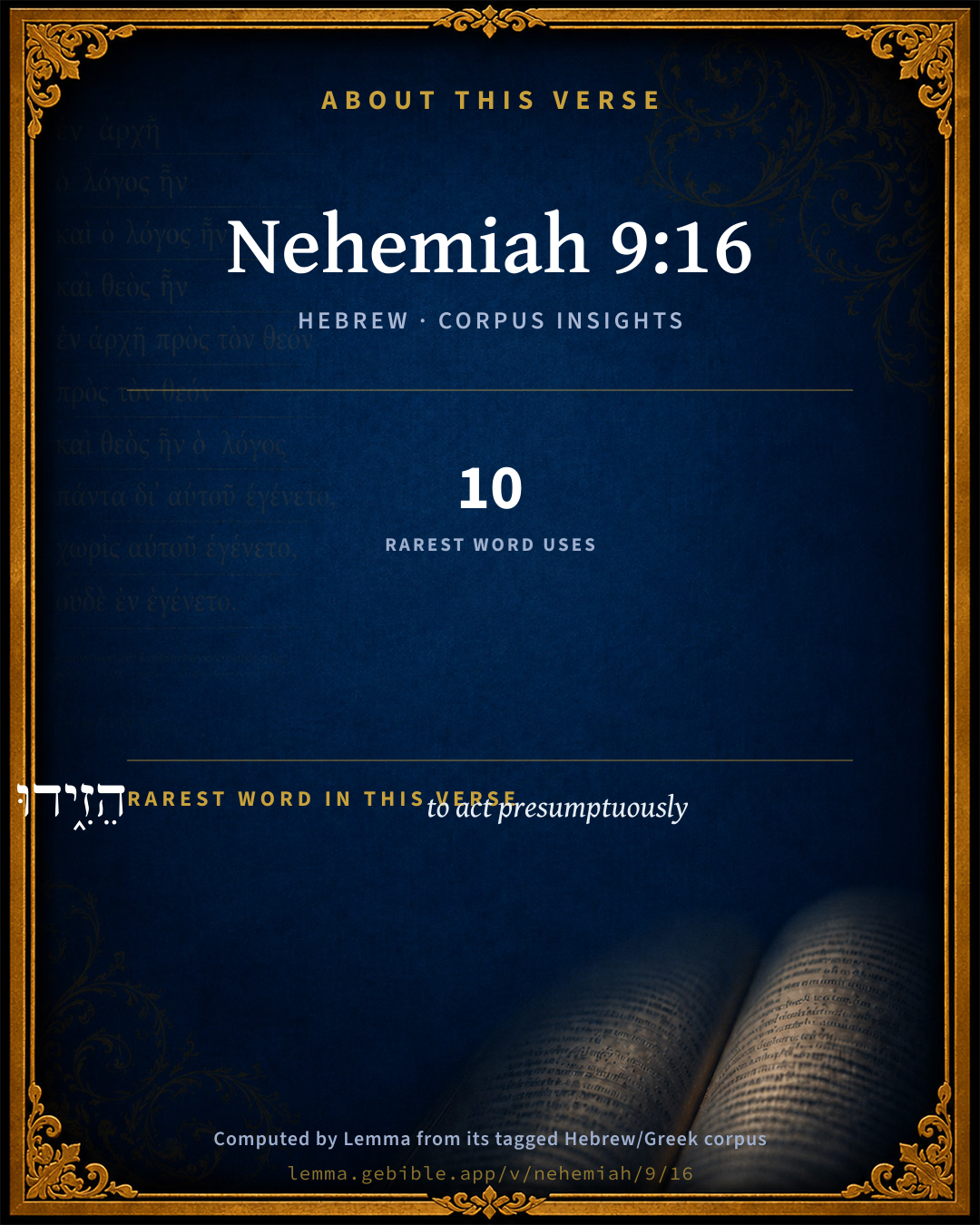
The rarest word here is הֵזִ֑ידוּ to act presumptuously H2102 — appearing just 10 times in the whole Hebrew Bible.

Shared distinctive vocabulary

הֵזִ֑ידוּ to act presumptuously H2102 occurs in 10 verses of the Hebrew Bible. Also found in:

Grammatical profile

  • 3 verbs
  • 3 nouns
  • 1 pronoun
  • 1 preposition
  • 2 particles

Verb forms

  • הֵזִ֑ידוּ Hiphil · Perfect
  • וַיַּקְשׁוּ֙ Hiphil · Sequential Imperfect
  • שָׁמְע֖וּ Qal · Perfect

Cross-references

30

Topical passages linked to Nehemiah 9:16 in the Treasury of Scripture Knowledge — connected by theme and wording, ordered by reader-vote popularity; previews shown in the World English Bible.

  • Nehemiah 9:29 and testified against them, that you might bring them again to your law. Yet they dealt proudly, and didn't listen to your commandments, but sinned against your ordinances, (which if a man do, he shall live in them), and withdrew the shoulder, and hardened their neck, and would not hear.
  • Psalms 81:11–14 But my people didn't listen to my voice. Israel desired none of me.
  • Deuteronomy 31:27 For I know your rebellion, and your stiff neck: behold, while I am yet alive with you this day, you have been rebellious against Yahweh; and how much more after my death?
  • Nehemiah 9:10 and shown signs and wonders on Pharaoh, and on all his servants, and on all the people of his land; for you knew that they dealt proudly against them, and did get you a name, as it is this day.
  • Romans 2:5 But according to your hardness and unrepentant heart you are treasuring up for yourself wrath in the day of wrath, revelation, and of the righteous judgment of God;
  • Hebrews 3:15 while it is said, "Today if you will hear his voice, Don't harden your hearts, as in the rebellion."
  • Exodus 15:26 and he said, "If you will diligently listen to the voice of Yahweh your God, and will do that which is right in his eyes, and will pay attention to his commandments, and keep all his statutes, I will put none of the diseases on you, which I have put on the Egyptians; for I am Yahweh who heals you."
  • Exodus 32:9 Yahweh said to Moses, "I have seen these people, and, behold, they are a stiff-necked people.
  • Deuteronomy 1:26–33 Yet you wouldn't go up, but rebelled against the commandment of Yahweh your God:
  • Deuteronomy 5:29 Oh that there were such a heart in them, that they would fear me, and keep all my commandments always, that it might be well with them, and with their children forever!
  • Deuteronomy 9:13 Furthermore Yahweh spoke to me, saying, I have seen this people, and, behold, it is a stiff-necked people:
  • Deuteronomy 9:23–24 When Yahweh sent you from Kadesh-barnea, saying, Go up and possess the land which I have given you; then you rebelled against the commandment of Yahweh your God, and you didn't believe him, nor listen to his voice.
  • Deuteronomy 9:27 Remember your servants, Abraham, Isaac, and Jacob; don't look to the stubbornness of this people, nor to their wickedness, nor to their sin,
  • Deuteronomy 32:15 But Jeshurun grew fat, and kicked: You have grown fat, you are grown thick, you are become sleek; Then he forsook God who made him, Lightly esteemed the Rock of his salvation.
  • 2 Kings 17:14 Notwithstanding, they would not hear, but hardened their neck, like the neck of their fathers, who didn't believe in Yahweh their God.
  • 2 Chronicles 30:8 Now don't you be stiff-necked, as your fathers were; but yield yourselves to Yahweh, and enter into his sanctuary, which he has sanctified forever, and serve Yahweh your God, that his fierce anger may turn away from you.
  • 2 Chronicles 36:13 He also rebelled against king Nebuchadnezzar, who had made him swear by God: but he stiffened his neck, and hardened his heart against turning to Yahweh, the God of Israel.
  • Psalms 78:8–72 And might not be as their fathers, A stubborn and rebellious generation, A generation that didn't make their hearts loyal, Whose spirit was not steadfast with God.
  • Psalms 81:8 "Hear, my people, and I will testify to you, Israel, if you would listen to me!
  • Psalms 95:8–10 Don't harden your heart, as at Meribah, As in the day of Massah in the wilderness,
  • Psalms 106:6 We have sinned with our fathers. We have committed iniquity. We have done wickedly.
  • Proverbs 29:1 He who is often rebuked and stiffens his neck Will be destroyed suddenly, with no remedy.
  • Isaiah 48:4 Because I knew that you are obstinate, and your neck is an iron sinew, and your brow brass;
  • Isaiah 48:18 Oh that you had listened to my commandments! then had your peace been as a river, and your righteousness as the waves of the sea:
  • Isaiah 63:10 But they rebelled, and grieved his holy Spirit: therefore he was turned to be their enemy, [and] himself fought against them.
  • Jeremiah 2:31 Generation, see the word of Yahweh. Have I been a wilderness to Israel? or a land of thick darkness? why say my people, We are broken loose; we will come no more to you?
  • Jeremiah 19:15 Thus says Yahweh of Hosts, the God of Israel, Behold, I will bring on this city and on all its towns all the evil that I have pronounced against it; because they have made their neck stiff, that they may not hear my words.
  • Acts 7:51 "You stiff-necked and uncircumcised in heart and ears, you always resist the Holy Spirit! As your fathers did, so you do.
  • Hebrews 3:13 but exhort one another day by day, so long as it is called "today;" lest any one of you be hardened by the deceitfulness of sin.
  • Deuteronomy 9:6 Know therefore, that Yahweh your God doesn't give you this good land to possess it for your righteousness; for you are a stiff-necked people.

Cross-references courtesy of OpenBible.info (CC BY 4.0).

Hebrew and Greek witnesses Masoretic Hebrew ↔ Greek Septuagint

The same verse in the two great witnesses to the Old Testament, shown verse-for-verse.

These are two independent witnesses, not word-aligned to each other, and the Septuagint is shown in lemma (dictionary) form.

Hebrew Nehemiah 9:16 Masoretic · Westminster Leningrad Codex

וְהֵ֥ם וַאֲבֹתֵ֖ינוּ הֵזִ֑ידוּ וַיַּקְשׁוּ֙ אֶת עָרְפָּ֔ם וְלֹ֥א שָׁמְע֖וּ אֶל מִצְוֺתֶֽיךָ

But they and our fathers dealt proudly and hardened their neck, and didn't listen to your commandments,

World English Bible · Public Domain

Greek LXX Structure differs

The Septuagint has no separate book of Nehemiah. Its Greek text is the second half of Esdras B (2 Esdras), chapters 11–23; Ezra is the first half (1–10).

A verse-for-verse comparison isn’t shown here because the chapters and verses don’t line up. Switch to the LXX edition with the MT / LXX toggle above to read the Greek directly.

On this verse, Keil & Delitzsch discusses the Septuagint’s reading. Read the note in Commentary ↓

Hebrew: Westminster Leningrad Codex (CC BY 4.0). Greek: Septuagint (public domain); English from a public-domain English Septuagint. How the Septuagint differs from the Hebrew →

Commentary

Notes on Nehemiah 9:16 from classic Christian and Jewish commentators (each source and its license shown beneath its notes). The classic Christian expositions comment on the surrounding passage and are grouped to its opening verse, so a note may address several verses; the Jewish commentaries on the Tanakh (Rashi and others) are per-verse, so they appear only where the commentator wrote on this verse.

Lemma curates 59 commentaries, every one of them public domain or Creative Commons licensed, each selected and text-cleaned for this edition rather than reprinted as found. About our sources →

Trapp's Complete Commentary

John Trapp

Neh 9:16 But they and our fathers dealt proudly, and hardened their necks, and hearkened not to thy commandments,

Ver. 16. But they and our fathers] God’s mercies have been hitherto mentioned, that their sins might thereby be aggravated; for good turns aggravate unkindness; and men’s sins are much increased by their obligations. It is charged upon Solomon as a foul fault, that he departed from the Lord, who had appeared unto him twice, 1Ki 11:9.

Dealt proudly] Pride is the master pock of the soul, and the root of rebellion against God, Psa 119:21.

And hardened their necks] As unruly beasts, that will not bear the yoke; lawless and aweless persons, that refuse to be reformed, hate to be healed.

And hearkened not to thy commandments] But rather to the devil’s whistle, calling them off from better practices.

John Trapp, A Commentary or Exposition upon All the Books of the Old and New Testament (1647–1656) — public domain. Text from a community e-Sword module.

The Biblical Illustrator

Joseph S. Exell

Neh_9:16

But they and our fathers dealt proudly, and hardened their necks.

Hardened by sin

Dr. Manton says: As a delicate constitution is more capable of pain than a robust and stubborn one, and the tender flesh of a child will sooner feel the lash than the thick skin of a slave, so the children of God, having a more serious apprehension of things, and a more tender spirit, soonest feel the burden of their Fathers displeasure, and do more lay it to heart than careless and stupid spirits, who laugh at their cross, or drink away their sorrows. Tenderness of heart is thus an attribute of the child of God, and a very precious attribute, too. Hard-hearted men are not men after Gods own heart. In proportion as feeling declines, life has declined. Spiritual men are sensitive men. Ossification of the heart is a fatal disease. Declensions in grace are a searing of the soul. When water is warmed by the summer sun, the smallest stone sinks into it; when it is frozen in the northern blast, a huge block will be borne up upon the surface of it, and will never penetrate to its depths. So, when the soul grows cold with distance from God, it will sustain an enormous weight of sin; but when grace returns, and the soul is in a fight spiritual condition, an ounce of sin will be more than the soul can bear. Oh, for more of this holy sensitiveness! (C. H. Spurgeon.)

The Biblical Illustrator, edited by Joseph S. Exell (c. 1880s–1900s) — public domain. Text from a community e-Sword module.

Joseph Benson's Commentary

Neh 9:16-17. But our fathers dealt proudly, &c. — Notwithstanding all thy singular and wonderful mercies, they sinned presumptuously, and with a high hand, scorning to submit their wills to thine. Having hitherto recounted God’s mercies toward them, with a view to aggravate their guilt, he now comes to confess their sins, in order that he might lead them to a sincere and ingenuous grief for them, not only on account of the sufferings which they had brought on themselves, but for the injury and indignity which they had offered to God; and refused to obey — Persisted in disobedience after many admonitions and invitations to repentance. And in their rebellion appointed a captain — That is, designed, purposed, and resolved to do so, (Num 14:4,) and therefore they are said to do it; as Abraham is said to have offered up Isaac, (Heb 11:17,) because he intended and attempted to do it.

Joseph Benson's Commentary on the Old and New Testaments (1811–1818) — public domain. Text from a community e-Sword module.

Keil & Delitzsch

C. F. Keil & F. Delitzsch

Even the fathers to whom God had shown such favour, repeatedly departed from and rebelled against Him; but God of His great mercy did not forsake them, but brought them into possession of the promised land.

Neh 9:16-17

"And they, even our fathers, dealt proudly, and hardened their necks, and hearkened not to Thy commandments. Neh 9:17 They refused to obey, and were not mindful of Thy wonders that Thou didst amongst them; and hardened their necks, and appointed a captain to return to their bondage. But Thou art a God ready to pardon, gracious and merciful, slow to anger, and of great kindness, and forsookest them not." In these verses the conduct of the children of Israel towards God is contrasted with His kindness towards this stiff-necked people, the historical confirmation following in Neh 9:18. והם is emphatic, and prefixed to contrast the conduct of the Israelites with the benefits bestowed on them. The contrast is enhanced by the ו explicative before אבתינוּ, even our fathers (which J. D. Michaelis would expunge, from a misconception of its meaning, but which Bertheau with good reason defends). Words are accumulated to describe the stiff-necked resistance of the people. הזידוּ as above, Neh 9:10. "They hardened their necks" refers to Exo 32:9; Exo 33:3; Exo 34:9, and therefore already alludes to the worship of the golden calf at Sinai, mentioned Neh 9:18; while in Neh 9:17, the second great rebellion of the people at Kadesh, on the borders of the promised land, Num 14, is contemplated. The repetition of the expression, "they hardened their hearts," shows that a second grievous transgression is already spoken of in Neh 9:17. This is made even clearer by the next clause, וגו ראשׁ ויּתּנוּ, which is taken almost verbally from Num 14:4 : "They said one to another, Let us make a captain (ראשׁ נתּנה), and return to Egypt;" the notion being merely enhanced here by the addition לעבדתם, to their bondage. The comparison with Num 14:4 also shows that בּמרים is a clerical error for בּמצרים, as the lxx read; for בּמרים, in their stubbornness, after לעבדתם, gives no appropriate sense. In spite, however, of their stiff-neckedness, God of His mercy and goodness did not forsake them. סליחות אלוהּ, a God of pardons; comp. Dan 9:9; Psa 130:4. וגו ורחוּם חנּוּן is a reminiscence of Exo 34:6. The ו before חסד came into the text by a clerical error.

Neh 9:18-21

"Yea, they even made them a molten calf, and said, This is thy god that brought thee up out of Egypt, and wrought great provocations. Neh 9:19 Yet Thou, in Thy manifold mercies, didst not forsake them in the wilderness; the pillar of the cloud departed not from them by day to lead them, and the pillar of fire by night to show them light in the way wherein they should go. Neh 9:20 Thou gavest also Thy good Spirit to instruct them, and withheldest not Thy manna from their mouth, and gavest them water for their thirst: Neh 9:21 And forty years didst Thou sustain them in the wilderness; they lacked nothing, their clothes waxed not old, and their feet swelled not." כּי אף, also (even this) = yea even. On the worship of the golden calf, see Exo 24:4. The words "they did (wrought) great provocations" involve a condemnation of the worship of the molten calf; nevertheless God did not withdraw His gracious presence, but continued to lead them by the pillar of cloud and fire. The passage Num 14:14, according to which the pillar of cloud and fire guided the march of the people through the wilderness after the departure from Sinai, i.e., after their transgression in the matter of the calf, is here alluded to. הענן עמּוּד is rhetorically enhanced by את: and with respect to the cloudy pillar, it departed not; so, too, in the second clause, האשׁ את־עמּוּד; comp. Ewald, 277, d. The words, Neh 9:20, "Thou gavest Thy good Spirit," etc., refer to the occurrence, Num 11:17, Num 11:25, where God endowed the seventy elders with the spirit of prophecy for the confirmation of Moses' authority. The definition "good Spirit" recalls Psa 143:10. The sending of manna is first mentioned Num 11:6-9, comp. Jos 5:12; the giving of water, Num 20:2-8. - In Neh 9:21, all that the Lord did for Israel is summed up in the assertion of Deu 2:7; Deu 8:4, חסרוּ לא; see the explanation of these passages.

Neh 9:22-25

The Lord also fulfilled His promise of giving the land of Canaan to the Israelites notwithstanding their rebelliousness. Neh 9:22 "And Thou gavest them kingdoms and nations, and didst divide them by boundaries; and they took possession of the land of Sihon, both the land of the king of Heshbon, and the land of Og king of Bashan. Neh 9:23 And Thou didst multiply their children as the stars of heaven, and bring them into the land which Thou hadst promised to their fathers, that they should go in to possess. Neh 9:24 And the children went in and possessed the land, and Thou subduedst before them the inhabitants of the land, the Canaanites, and gavest them into their hands, both their kings and the people of the land, to do with them according to their pleasure. Neh 9:25 And they took fortified cities, and a fat land, and took possession of houses filled with all kinds of goods, wells digged, vineyards and olive gardens, and fruit trees in abundance; and they ate and became fat, and delighted themselves in Thy great goodness." לפאה ותּחלקם is variously explained. Aben Ezra and others refer the suffix to the Canaanites, whom God scattered in multos angulos or varias mundi partes. Others refer it to the Israelites. According to this view, Ramb. says: fecisti eos per omnes terrae Cananaeae angulos habitare; and Gusset.: distribuisti eis terram usque ad angulum h. l. nulla vel minima regionum particula excepta. But חלק, Piel, generally means the dividing of things; and when used of persons, as in Gen 49:7; Lam 4:16, to divide, to scatter, sensu malo, which is here inapplicable to the Israelites. חלק signifies to divide, especially by lot, and is used chiefly concerning the partition of the land of Canaan, in Kal, Jos 14:5; Jos 18:2, and in Piel, Jos 13:7; Jos 18:10; Jos 19:51. The word פּאה also frequently occurs in Joshua, in the sense of a corner or side lying towards a certain quarter of the heavens, and of a boundary; comp. Jos 15:5; Jos 18:12, Jos 18:14-15, Jos 18:20. According to this, Bertheau rightly takes the words to say: Thou didst divide them (the kingdoms and nations, i.e., the land of these nations) according to sides or boundaries, i.e., according to certain definite limits. Sihon is the king of Heshbon (Deu 1:4), and the ו before ח את־ארץ מ is not to be expunged as a gloss, but regarded as explicative: and, indeed, both the land of the king of Heshbon and the land of Og. The conquest of these two kingdoms is named first, because it preceded the possession of Canaan (Num 21:21-35). The increase of the children of the Israelites is next mentioned, Neh 9:23; the fathers having fallen in the wilderness, and only their children coming into the land of Canaan. The numbering of the people in the plains of Moab (Num 26) is here alluded to, when the new generation was found to be twice as numerous as that which marched out of Egypt; while the words לרשׁת לבוא, here and in Neh 9:15, are similar to Deu 1:10. The taking possession of Canaan is spoken of in Neh 9:24. ותּכנע recalls Deu 9:3. כּרצונם, according to their pleasure, comp. Dan 8:4. Fortified cities, as Jericho and Ai.

Keil & Delitzsch — Biblical Commentary on the Old Testament (1861–1891) — public domain (CC PDM 1.0). Text via the HelloAO Bible API. (Old Testament only.)

Ellicott's Commentary for English Readers

(16) Dealt proudly.—Like the Egyptians themselves (Neh_9:10). It is remarkable that the same word is used as in the Hebrew of Exo_18:11 and Deu_1:43.

A Bible Commentary for English Readers, edited by Charles John Ellicott (1878–1897) — public domain. Text from a community e-Sword module.

The Cambridge Bible for Schools and Colleges

gen. ed. J. J. S. Perowne

16. But they and our fathers] The ‘and’ here seems not to be necessary. It is found, however, in all the MSS., and is represented in all the Versions, and must clearly be retained in the text. As the following Neh_9:17-22 continue to refer to the Mosaic generation, no distinction of meaning can be drawn between ‘they’ and ‘our fathers.’ It seems best therefore to regard the ‘and’ as an instance of the explanatory or exegetical copula. ‘They and (= that is to say) our fathers.’ Cf. Neh_9:22.

dealt proudly] Cf. Neh_9:10. In this verse and in Neh_9:29 the word is used with reference to the children of Israel, as in Deu_1:43, ‘ye rebelled … and were presumptuous.’ Deu_17:13, ‘all the people shall hear, and fear, and do no more presumptuously.’

hardened their necks] R.V. neck. Cf. Neh_9:17; Neh_9:29. For the phrase ‘a stiff-necked people’ cf. Exo_32:9; Exo_33:3; Exo_34:9; Deu_9:6; Deu_9:13. ‘To stiffen’ or ‘harden the neck’ is found in Deu_10:16, ‘Be no more stiff-necked,’ 2Ki_17:14, ‘they would not hear, but hardened their neck, like to the neck of their fathers.’ Cf. Job_9:4.

The Cambridge Bible for Schools and Colleges (gen. ed. J. J. S. Perowne; Cambridge University Press, 1878–1918) — public domain. Text from a community e-Sword module.

John Gill's Exposition

But they and our fathers dealt proudly,.... Behaved in a haughty manner towards God, their kind benefactor:

and hardened their necks; refused to take the yoke of his law, as refractory oxen, that withdraw their necks from the yoke:

and hearkened not to thy commandments; to do them, though they promised they would, Exo 24:7.

John Gill's Exposition of the Whole Bible (1746–1763) — public domain (CC PDM 1.0). Text via the HelloAO Bible API.

Matthew Poole's English Annotations

Notwithstanding all these singular and wonderful mercies; which he hitherto recounted to aggravate their sins, which he now comes to confess, and to lead them to a sincere and ingenuous grief and repentance for their sins, not only for the mischief which they brought upon themselves, but for the injury and indignity which they offered to God.

Dealt proudly, i.e. sinned presumptuously, and with contempt of God, as scorning to submit their wills to God’s.

Matthew Poole's English Annotations on the Holy Bible (1683–1685) — public domain. Text from a community e-Sword/MySword module.

Whedon's Commentary on the Bible

Daniel D. Whedon

16. They and our fathers — This should be rendered, and they, even our fathers.

Daniel D. Whedon (gen. ed.), Commentary on the Old and New Testaments (1874–1909) — public domain. Text from a community e-Sword module.

The Pulpit Commentary

They and our fathers. Rather, "they, our fathers." The vau is used exegetically. Dealt proudly. i.e. "acted insolently." Compare Deu_1:43, where the same verb is translated were presumptuous" ( marg.). Hardened their necks. So in 2Ki_17:14.

The Pulpit Commentary (1880–1919), ed. H.D.M. Spence-Jones & Joseph S. Exell — public domain. Text from a community e-Sword module.

unfoldingWord translationNotes

Door43 World Missions Community

Connecting Statement:

In these verses, the Levites continue to praise Yahweh in the presence of the people of Israel.

they and our ancestors

the Israelites at the time of Moses and the people of Israel after the time of Moses

they were stubborn ... became stubborn

The literal statement is "they hardened their necks." If your language has a different idiom for being stubborn, you may want to use it here. (See: Idiom)

the wonders that you had done among them

"the miracles that you had done among them"

they appointed a leader to return to their slavery

The Israelites would know that this referred to their ancestors wanting to return to Egypt. AT: "they appointed a leader to take them back to Egypt where they had been slaves" (See: Assumed Knowledge and Implicit Information)

who is full of forgiveness

The desire to forgive is spoken of as if it were a liquid that could fill a container. AT: "who is ready to forgive" (See: Metaphor)

abounding in steadfast love

Love is spoken of as if it were a food crop that Yahweh could share with people. AT: "loves his people very much" (See: Metaphor)

translationWords

command

miracle

rebel

appoint

servant

God

forgive

grace

compassion

anger

love

unfoldingWord translationNotes — © Distant Shores Media and the Door43 World Missions Community, licensed CC BY-SA 4.0. Source: git.door43.org/Door43/en_tn.

Lesson kit

Teaching starters — assembled from the data on this page, not authored interpretation. Every prompt links to the verse data it draws on. Edit before teaching.

Nehemiah, in the Historical, opens this verse with 10 words (10 distinct Hebrew lemmas). Its most distinctive word is zûwd (“to act presumptuously”). A historical commentator’s framing appears above. Read the whole chapter for the surrounding context.

Discussion questions

  1. How does “to act presumptuously” (zûwd) shape what this verse is saying?
  2. How does Genesis 25:29, which shares the word «to act presumptuously», read alongside this verse?
  3. These translations render this verse differently; the difference is in the English rendering, not the original. What questions does that raise?
  4. «הֵזִ֑ידוּ» is a Hiphil Perfect verb. How does that grammatical form shape the action described?
  5. Compare how Trapp's Complete Commentary and The Biblical Illustrator read this verse. Where do they agree or differ?

Things to notice

Reading settings

Reading text

Shown beneath each verse's original-language words.

Old Testament
Old Testament edition

Read the OT as the Masoretic Hebrew (MT) or the Greek Septuagint (LXX).

English shown for the Greek Septuagint (in the Hebrew ↔ Greek comparison).

Comparing translations? Open the Compare panel on any verse page to stack up to four side by side.