
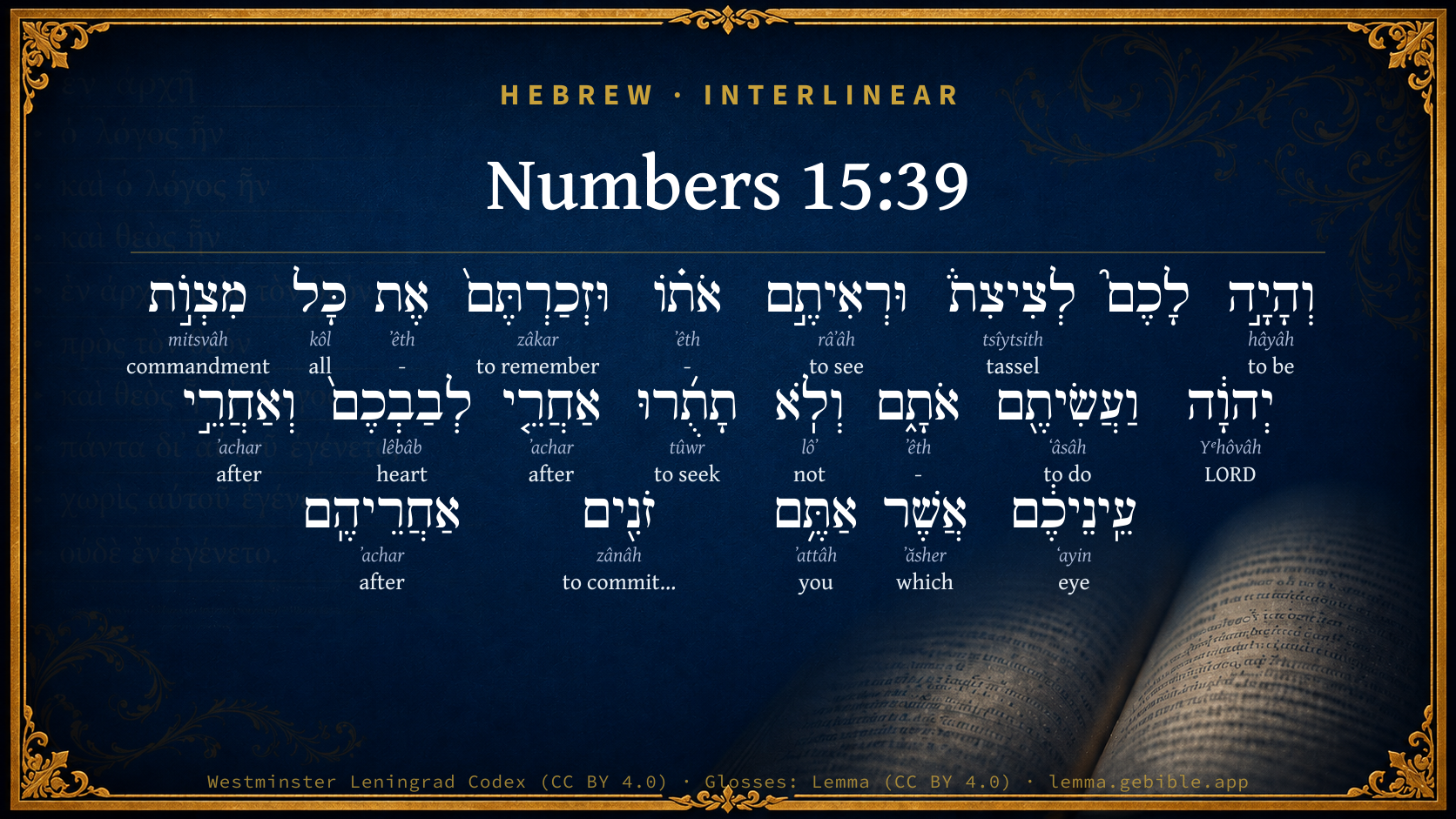
Numbers 15:39

Hebrew (Westminster Leningrad Codex) Numbers 15:39 appears in the Hebrew Old Testament. The text above is from the Westminster Leningrad Codex. Each word links to its Strong’s number, a concise gloss, and parsing drawn from the Open Scriptures Hebrew Bible morphology. Click any word for its full Brown-Driver-Briggs (BDB) entry.
Download image
Cite this verse

Numbers 15:39 (World English Bible). Public Domain. Lemma interlinear Bible study tool, https://lemma.gebible.app/v/numbers/15/39.

Show BibTeX & RIS
BibTeX
RIS
English Translation
and it shall be to you for a fringe, that you may look on it, and remember all the commandments of Yahweh, and do them; and that you not follow after your own heart and your own eyes, after which you use to play the prostitute;
World English Bible · Public Domain
Download a study sheet

One document with this verse’s original text, its word-by-word gloss line, the meaning frame, cross-references with their text, attributed commentary, and full source and license credits — printable, and it pastes into notes with its structure intact.

This verse Autodidact and up

Study sheet (.html) Plain text (.txt)

A passage Seminary Student

Up to 50 verses in one chapter. A passage sheet keeps up to 6 commentary sources and 12 cross-references per verse, in the order this page ranks them, and says so on the sheet whenever that leaves anything out. Ask for a single verse and you get the Autodidact verse sheet above.

Everything on this page stays free to read, with no account — the sheet is a download of what is already on screen, not access to it.

Want to remove ads? Support Godless Engineer
Compare translations 3

The same verse in 3 English versions, stacked beneath the original-language interlinear above. Click any original word for its lexicon entry.

Each is an independent rendering of the whole verse — the interlinear is not word-aligned to these translations.

Highlighted words mark where these versions differ — a whole-verse word diff, not a word-by-word alignment.

  • World English Bible Public Domain
    and it shall be to you for a fringe, that you may look on it, and remember all the commandments of Yahweh, and do them; and that you not follow after your own heart and your own eyes, after which you use to play the prostitute;
  • King James Version Public Domain
    And it shall be unto you for a fringe, that ye may look upon it, and remember all the commandments of the LORD, and do them; and that ye seek not after your own heart and your own eyes, after which ye use to go a whoring:
  • unfoldingWord Literal Text CC BY-SA 4.0
    and it shall be for you for a tassel, and you shall see it, and you shall remember all the commandments of Yahweh, and you shall do them, and you shall not explore after your heart and after your eyes, after which you are committing fornication,

unfoldingWord Literal Text — © unfoldingWord, licensed CC BY-SA 4.0. Word-aligned USFM3 via Door43 (git.door43.org/unfoldingWord/en_ult).

Versions to compare (up to 4)

3 of 4 selected

Show all 18 translations

Every available English version of this verse, each an independent rendering of the whole verse.

  • World English Bible Public Domain
    and it shall be to you for a fringe, that you may look on it, and remember all the commandments of Yahweh, and do them; and that you not follow after your own heart and your own eyes, after which you use to play the prostitute;
  • Berean Standard Bible Public Domain
    These will serve as tassels for you to look at, so that you may remember all the commandments of the LORD, that you may obey them and not prostitute yourselves by following your own heart and your own eyes.
  • Majority Standard Bible Public Domain
    These will serve as tassels for you to look at, so that you may remember all the commandments of the LORD, that you may obey them and not prostitute yourselves by following your own heart and your own eyes.
  • King James Version Public Domain
    And it shall be unto you for a fringe, that ye may look upon it, and remember all the commandments of the LORD, and do them; and that ye seek not after your own heart and your own eyes, after which ye use to go a whoring:
  • American Standard Version (1901) Public Domain
    and it shall be unto you for a fringe, that ye may look upon it, and remember all the commandments of Jehovah, and do them; and that ye follow not after your own heart and your own eyes, after which ye use to play the harlot;
  • Revised Version (1885) Public Domain
    and it shall be unto you for a fringe, that ye may look upon it, and remember all the commandments of the LORD, and do them; and that ye go not about after your own heart and your own eyes, after which ye use to go a whoring:
  • Geneva Bible (1599) Public Domain
    And ye shall haue the fringes, that when ye looke vpon them, ye may remember all the commandemets of the Lord, and do them: and that ye seeke not after your own heart, nor after your owne eyes, after the which ye go a whoring;
  • Douay-Rheims (1899) Public Domain
    That when they shall see them, they may remember all the commandments of the Lord, and not follow their own thoughts and eyes going astray after divers things,
  • Young's Literal Translation Public Domain
    and it hath been to you for a fringe, and ye have seen it, and have remembered all the commands of Jehovah, and have done them, and ye search not after your heart, and after your eyes, after which ye are going a-whoring;
  • Literal Standard Version CC BY-SA 4.0
    and it has been to you for a fringe, and you have seen it, and have remembered all the commands of YHWH, and have done them, and you do not search after your heart and after your eyes, after which you are going whoring,
  • Unlocked Literal Bible CC BY-SA 4.0
    It will be a special reminder to you, when you may look at it, of all my commandments, to carry them out so that you do not look to your own heart and your own eyes and prostitute yourselves to them.
  • unfoldingWord Literal Text CC BY-SA 4.0
    and it shall be for you for a tassel, and you shall see it, and you shall remember all the commandments of Yahweh, and you shall do them, and you shall not explore after your heart and after your eyes, after which you are committing fornication,
  • Darby Bible Public Domain
    and it shall be unto you for a tassel, that ye may look upon it, and remember all the commandments of Jehovah, and do them; and that ye seek not after [the lusts of] your own heart and your own eyes, after which ye go a whoring;
  • World Messianic Bible Public Domain
    It shall be to you for a fringe, that you may see it, and remember all the LORD’s commandments, and do them; and that you don’t follow your own heart and your own eyes, after which you used to play the prostitute;
  • Webster's Bible Public Domain
    And it shall be to you for a fringe, that ye may look upon it, and remember all the commandments of the LORD, and do them; and that ye seek not after your own heart and your own eyes, after which ye use to go astray:
  • Free Bible Version CC BY-SA 4.0
    When you look at these tassels you will be reminded to keep all the commandments of the Lord and not be unfaithful, following your own thoughts and desires.
  • Bible in Basic English Public Domain
    So that, looking on these ornaments, you may keep in mind the orders of the Lord and do them; and not be guided by the desires of your hearts and eyes, through which you have been untrue to me:
  • JPS Tanakh (1917) Public Domain
    And it shall be unto you for a fringe, that ye may look upon it, and remember all the commandments of the LORD, and do them; and that ye go not about after your own heart and your own eyes, after which ye use to go astray;

Literal Standard Version (2020), Covenant Press — licensed CC BY-SA 4.0. Text via the HelloAO Bible API (eBible.org). Unlocked Literal Bible (unfoldingWord) — licensed CC BY-SA 4.0. Text via the HelloAO Bible API (eBible.org). unfoldingWord Literal Text — © unfoldingWord, licensed CC BY-SA 4.0. Word-aligned USFM3 via Door43 (git.door43.org/unfoldingWord/en_ult). Free Bible Version, Dr. Jonathan Gallagher — licensed CC BY-SA 4.0. Text via the HelloAO Bible API (eBible.org).

Word by word

More ways to search: Search by grammar → Find every occurrence → Compare this word →

Practice this passage: Drill this verse → Learn its vocabulary →

לְצִיצִת֒
tsîytsith
H6734
“to/for · tassel”
Preposition + Noun, Common, Feminine, Singular, Absolute
Part of Speech
Preposition + Noun
Type
Common
Gender
Feminine
Number
Singular
State
Absolute
Full BDB Definition

Origin: from H6731

TWOT: 1912

fringe, tassel, lock
  1. וְהָיָ֣ה hâyâh H1961 “and · to be” Conjunction + Verb, Qal, Sequential Perfect, 3rd Person, Masculine, Singular
  2. וּרְאִיתֶ֣ם râʼâh H7200 “and · to see” Conjunction + Verb, Qal, Sequential Perfect, 2nd Person, Masculine, Plural
  3. אֹת֗וֹ ʼêth H853 “- · him” Particle, Direct Object + Suffix, Personal, 3rd Person, Masculine, Singular
  4. וּזְכַרְתֶּם֙ zâkar H2142 “and · to remember” Conjunction + Verb, Qal, Sequential Perfect, 2nd Person, Masculine, Plural
  5. אֶת ʼêth H853 “-” Particle, Direct Object
  6. כָּל kôl H3605 “all of” Noun, Common, Masculine, Singular, Construct
  7. מִצְוֺ֣ת mitsvâh H4687 “commandments of” Noun, Common, Feminine, Plural, Construct
  8. יְהוָ֔ה Yᵉhôvâh H3068 “LORD” Noun, Proper
  9. וַעֲשִׂיתֶ֖ם ʻâsâh H6213 “and · to do” Conjunction + Verb, Qal, Sequential Perfect, 2nd Person, Masculine, Plural
  10. אֹתָ֑ם ʼêth H853 “- · them” Particle, Direct Object + Suffix, Personal, 3rd Person, Masculine, Plural
  11. וְלֹֽא lôʼ H3808 “and · not” Conjunction + Particle, Negative
  12. תָתֻ֜רוּ tûwr H8446 “to seek” Verb, Qal, Imperfect, 2nd Person, Masculine, Plural
  13. אַחֲרֵ֤י ʼachar H310 “after” Preposition
  14. לְבַבְכֶם֙ lêbâb H3824 “heart · your” Noun, Common, Masculine, Singular, Construct + Suffix, Personal, 2nd Person, Masculine, Plural
  15. וְאַחֲרֵ֣י ʼachar H310 “and · after” Conjunction + Preposition
  16. עֵֽינֵיכֶ֔ם ʻayin H5869 “eyes · your” Noun, Common, Both, Dual, Construct + Suffix, Personal, 2nd Person, Masculine, Plural
  17. אֲשֶׁר ʼăsher H834 “which” Particle, Relative
  18. אַתֶּ֥ם ʼattâh H859 “you” Pronoun, Personal, 2nd Person, Masculine, Plural
  19. זֹנִ֖ים zânâh H2181 “committing fornication” Verb, Qal, Participle Active, Masculine, Plural, Absolute
  20. אַחֲרֵיהֶֽם ʼachar H310 “after · them” Preposition + Suffix, Personal, 3rd Person, Masculine, Plural

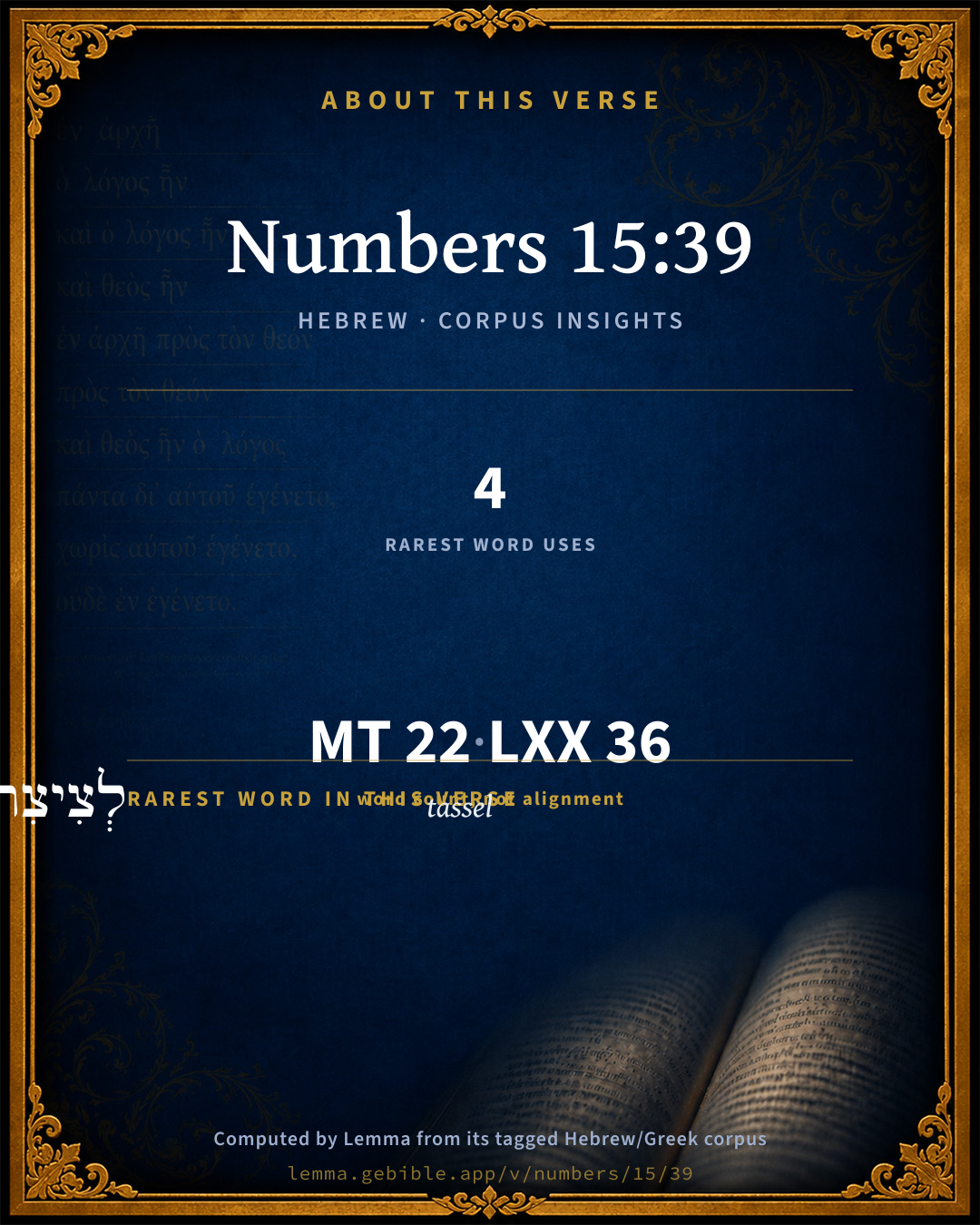
About this verse

These counts appear in no published source. They are computed here, from the morphology-tagged text and Lemma’s own curated glosses. What Lemma adds →

22
words
17
distinct lemmas
Pentateuch
section

Notable vocabulary

The rarest word here is לְצִיצִת֒ tassel H6734 — appearing just 4 times in the whole Hebrew Bible.

Shared distinctive vocabulary

לְצִיצִת֒ tassel H6734 occurs in 3 verses of the Hebrew Bible. Also found in:

Grammatical profile

  • 6 verbs
  • 6 nouns
  • 1 pronoun
  • 4 prepositions
  • 5 particles

Verb forms

  • וְהָיָ֣ה Qal · Sequential Perfect
  • וּרְאִיתֶ֣ם Qal · Sequential Perfect
  • וּזְכַרְתֶּם֙ Qal · Sequential Perfect
  • וַעֲשִׂיתֶ֖ם Qal · Sequential Perfect
  • תָתֻ֜רוּ Qal · Imperfect
  • זֹנִ֖ים Qal · Participle Active

Repetition

A word recurs within this verse — often emphatic in Hebrew:

  • אַחֲרֵ֤י after H310 ×3

Hebrew & Septuagint length

In English translation the verse runs 46 words from the Hebrew and 51 from the Septuagint (LXX English) — closely comparable.

A rough comparison of the two English renderings, which tokenize alike — not a word-level alignment.

Word counts can differ between the Hebrew and the Greek without any difference in meaning — e.g. the Hebrew direct-object marker אֵת has no separate Greek word, and Greek often adds the article ὁ.

In the original languages it is 22 Hebrew tokens and 36 Greek tokens — but the two are counted differently (Hebrew bundles its prefixes and suffixes into one token; the Greek is in lemma form), so that isn’t a like-for-like length.

Cross-references

18

Topical passages linked to Numbers 15:39 in the Treasury of Scripture Knowledge — connected by theme and wording, ordered by reader-vote popularity; previews shown in the World English Bible.

  • Psalms 73:27 For, behold, those who are far from you shall perish. You have destroyed all those who are unfaithful to you.
  • Psalms 106:39 Thus were they defiled with their works, And prostituted themselves in their deeds.
  • Proverbs 28:26 One who trusts in himself is a fool; But one who walks in wisdom, he is kept safe.
  • Ezekiel 6:9 Those of you that escape shall remember me among the nations where they shall be carried captive, how that I have been broken with their lewd heart, which has departed from me, and with they eyes, which play the prostitute after their idols: and they shall loathe themselves in their own sight for the evils which they have committed in all their abominations.
  • Exodus 13:9 It shall be for a sign to you on your hand, and for a memorial between your eyes, that the law of Yahweh may be in your mouth; for with a strong hand Yahweh has brought you out of Egypt.
  • Proverbs 3:1 My son, don't forget my teaching; But let your heart keep my commandments:
  • Deuteronomy 4:23 Take heed to yourselves, lest you forget the covenant of Yahweh your God, which he made with you, and make you an engraved image in the form of anything which Yahweh your God has forbidden you.
  • Deuteronomy 29:19 and it happen, when he hears the words of this curse, that he bless himself in his heart, saying, I shall have peace, though I walk in the stubbornness of my heart, to destroy the moist with the dry.
  • Job 31:7 If my step has turned out of the way, If my heart walked after my eyes, If any defilement has stuck to my hands,
  • Ecclesiastes 11:9 Rejoice, young man, in your youth, And let your heart cheer you in the days of your youth, And walk in the ways of your heart, And in the sight of your eyes; But know that for all these things God will bring you into judgment.
  • James 4:4 You adulterers and adulteresses, don't you know that friendship with the world is enmity with God? Whoever therefore wants to be a friend of the world makes himself an enemy of God.
  • Exodus 34:15–16 Don't make a covenant with the inhabitants of the land, lest they play the prostitute after their gods, and sacrifice to their gods, and one call you and you eat of his sacrifice;
  • Deuteronomy 6:6–9 These words, which I command you this day, shall be on your heart;
  • Deuteronomy 11:28–32 and the curse, if you shall not listen to the commandments of Yahweh your God, but turn aside out of the way which I command you this day, to go after other gods, which you have not known.
  • Jeremiah 9:14 but have walked after the stubbornness of their own heart, and after the Baals, which their fathers taught them;
  • Hosea 2:2 Contend with your mother! Contend, for she is not my wife, Neither am I her husband; And let her put away her prostitution from her face, And her adulteries from between her breasts;
  • Deuteronomy 6:12 then beware lest you forget Yahweh, who brought you forth out of the land of Egypt, out of the house of bondage.
  • Deuteronomy 11:18–21 Therefore shall you lay up these my words in your heart and in your soul; and you shall bind them for a sign on your hand, and they shall be for symbols between your eyes.

Cross-references courtesy of OpenBible.info (CC BY 4.0).

Hebrew and Greek witnesses Masoretic Hebrew ↔ Greek Septuagint

The same verse in the two great witnesses to the Old Testament, shown verse-for-verse.

These are two independent witnesses, not word-aligned to each other, and the Septuagint is shown in lemma (dictionary) form.

Hebrew Numbers 15:39 Masoretic · Westminster Leningrad Codex

וְהָיָ֣ה לָכֶם֮ לְצִיצִת֒ וּרְאִיתֶ֣ם אֹת֗וֹ וּזְכַרְתֶּם֙ אֶת כָּל מִצְוֺ֣ת יְהוָ֔ה וַעֲשִׂיתֶ֖ם אֹתָ֑ם וְלֹֽא תָתֻ֜רוּ אַחֲרֵ֤י לְבַבְכֶם֙ וְאַחֲרֵ֣י עֵֽינֵיכֶ֔ם אֲשֶׁר אַתֶּ֥ם זֹנִ֖ים אַחֲרֵיהֶֽם

and it shall be to you for a fringe, that you may look on it, and remember all the commandments of Yahweh, and do them; and that you not follow after your own heart and your own eyes, after which you use to play the prostitute;

World English Bible · Public Domain

Greek LXX Numbers 15:39 Septuagint · lemma form

καί εἰμί σύ ἐν ὁ κράσπεδον καί ὁράω αὐτός καί μιμνήσκω πᾶς ὁ ἐντολή κύριος καί ποιέω αὐτός καί οὐ διαστρέφω ὀπίσω ὁ διάνοια σύ καί ὀπίσω ὁ ὀφθαλμός σύ ἐν ὅς σύ ἐκπορνεύω ὀπίσω αὐτός

And it shall be on your fringes, and you⌃ shall look on them, and you⌃ shall remember all the commands of the Lord, and do them: and you⌃ shall not turn back after your imaginations, and after the sight of your eyes in the things after which you⌃ go a whoring;

LXX2012 (modern English Septuagint) · Public Domain

Hebrew: Westminster Leningrad Codex (CC BY 4.0). Greek: Septuagint (public domain); English from LXX2012 (modern English Septuagint) (Public Domain). How the Septuagint differs from the Hebrew →

Targum (Aramaic paraphrase)

2

The Targum is the ancient Jewish Aramaic paraphrase of the Hebrew Scriptures — an interpretive translation, not the Hebrew text itself. Onkelos (literal) and Pseudo-Jonathan (expansive) render the Torah, and Jonathan the Prophets. Coverage is partial: where no permissively-licensed English translation exists for a verse, only the Aramaic is shown. This is verse-level text, not a word-by-word alignment to the Hebrew.

  1. Targum Onkelos Torah (Genesis–Deuteronomy)
    וִיהוֹן לְכוֹן לִכְרוּסְפְּדִין וְתֶחֱזוּן יָתֵיהּ וְתִדְכְּרוּן יָת כָּל פִּקוּדַיָא דַיְיָ וְתַעְבְּדוּן יָתְהוֹן וְלָא תִטְעוּן בָּתַר הִרְהוּר לִבְּכוֹן וּבָתַר חֵיזוּ עֵינֵיכוֹן דִי אַתּוּן טָּעַן בַּתְרֵיהוֹן

    (no public-domain English translation for this verse)

    Targum Onkelos — Aramaic: “Onkelos Genesis” (public domain); “Onkelos Exodus” (public domain); “Onkelos Leviticus” (public domain); “Onkelos Numbers” (public domain); “Onkelos Deuteronomy” (public domain). English: “Sefaria Community Translation” (CC0 1.0 (public-domain dedication)); “J.W. Etheridge. The Targums of Onkelos and Jonathan Ben Uzziel on the Pentateuch. London: Longmans, Green, 1862” (public domain). Text via Sefaria.

  2. Targum Pseudo-Jonathan Torah (Genesis–Deuteronomy)
    וִיהֵי לְמִצְוָתָא דְצִיצְיַת וְתֶחֱמוּן יָתֵיהּ בִּזְמַן דְאַתּוּן מִתְעַטְפִין בְּהוֹן בִּימָמָא וְתִדְכְּרוּן יַת כָּל פִּקוּדַי וְתַעַבְדוּן יַתְהוֹן וְלָא תִסְטוּן לְמִטְעֵי בָּתַר הִרְהוּר לִבְּכוֹן וּבָתַר חֵיזוּ עֵינֵיכוֹן דְאַתּוּן טָעַן בַּתְרֵיהוֹן

    And this shall be to you a precept for fringes, that you may look upon them at the time when you dress yourselves daily, and remember all My commandments to do them, and not go aside to wander after the imaginations of your heart and the sight of your eyes, after which you have gone astray.

    Targum Pseudo-Jonathan — Aramaic: “Targum Jonathan on Genesis” (public domain); “Targum Jonathan on Exodus” (public domain); “Targum Jonathan on Leviticus” (public domain); “Targum Jonathan on Numbers” (public domain); “Targum Jonathan on Deuteronomy” (public domain). English: “The Targum of Jonathan ben Uzziel, trans. J. W. Etheridge, London, 1862” (public domain). Text via Sefaria.

Commentary

Notes on Numbers 15:39 from classic Christian and Jewish commentators (each source and its license shown beneath its notes). The classic Christian expositions comment on the surrounding passage and are grouped to its opening verse, so a note may address several verses; the Jewish commentaries on the Tanakh (Rashi and others) are per-verse, so they appear only where the commentator wrote on this verse.

Lemma curates 59 commentaries, every one of them public domain or Creative Commons licensed, each selected and text-cleaned for this edition rather than reprinted as found. About our sources →

Joseph Benson's Commentary

Num 15:39. That ye may remember — As circumcision in their persons, so this ornament in their garb was designed as a badge to distinguish them from all other nations; so that as often as they looked upon this mark, they might be put in mind of their being the worshippers of the true God, a holy people, and bound to the service of their Maker by peculiar laws and obligations. That ye seek not — Or, inquire not, for other rules and ways of serving me than I have prescribed you. Your own heart and eyes — Neither after the devices of your own hearts, as Nadab and Abihu did when they offered strange fire; nor after the examples of others which your eyes see, as you did when you were set upon worshipping a calf after the manner of Egypt.

Joseph Benson's Commentary on the Old and New Testaments (1811–1818) — public domain. Text from a community e-Sword module.

Geneva Bible (1599)

Geneva Bible translators

By leaving God’s commandments and following your own fantasies.

Geneva Bible (1599) marginal notes — public domain. Text via Bolls.life.

Ellicott's Commentary for English Readers

(39) That ye seek not after your own heart.—Or, That ye go not about, or search not out, &c.

A Bible Commentary for English Readers, edited by Charles John Ellicott (1878–1897) — public domain. Text from a community e-Sword module.

The Cambridge Bible for Schools and Colleges

gen. ed. J. J. S. Perowne

39. it shall be unto you for a tassel] The point of this appears to lie in a play on the words ẓîẓîth (‘tassel’) and ẓîẓ1 [Note: Used in Exo_28:36; Exo_39:30, Lev_8:9 of the diadem (R.V. ‘plate’) on the high priest’s forehead.] ‘a shining thing,’ ‘an ornament.’ The tassels are not to be superstitious charms but striking ornaments, which will constantly catch the wearer’s eye, and act as a religious reminder.

after which ye go a whoring] The Heb. has a participle, not an imperfect as R.V. suggests. The words apparently mean—Ye are still prone to follow the superstitious and illegitimate practices to which your heart and your eyes lead you. It is an obscure sentence, and perhaps something has been lost from the text. But there seems little doubt that the earlier superstitions connected with the tassels are referred to.

The Cambridge Bible for Schools and Colleges (gen. ed. J. J. S. Perowne; Cambridge University Press, 1878–1918) — public domain. Text from a community e-Sword module.

John Gill's Exposition

That ye may remember and do all my commandments,.... Which is repeated, that the end and use of these fringes might be particularly taken notice of, and attended to; that so they might not satisfy themselves with and rest in this ceremony of wearing the fringes, but be found in the observance of every moral precept, and of every religious ordinance and duty:

and be holy unto your God: as in his presence, according to his will, and for his honour and glory, by keeping his holy commands, and living an holy life and conversation, well pleasing in his sight.

John Gill's Exposition of the Whole Bible (1746–1763) — public domain (CC PDM 1.0). Text via the HelloAO Bible API.

Haydock's Catholic Bible Commentary

Astray, (fornicantes). The eyes being left without restraint, easily fix upon dangerous objects, which captivate the heart, and lead to idolatry and the contempt of God’s law. (Calmet) --- We are also admonished to meditate on the law, and not follow our own thoughts or interpretations, so as to render it of no effect, in the regulation of our morals. (Haydock)

George Leo Haydock (1774–1849), Haydock's Catholic Family Bible and Commentary, 1859 edition — public domain. Excludes Psalms (Douay-Rheims chapter numbering differs from Protestant) and Deuterocanonical books (Catholic canon only).

Matthew Poole's English Annotations

It, i.e. the riband,

shall be unto you, i.e. shall serve you

for the fringe, to wit, to render it more visible and notorious by its certain, and remarkable, and distinct colour, whereas the fringe without this was of the same piece and colour with the garment, and therefore less observable. Or, it, i.e. the riband, shall be in your fringes, or, put to your fringes, fastened to them, that by looking upon it you may remember, that your eye may affect your mind and heart.

That ye seek not, or, inquire not, for other rules or ways of serving me than I have prescribed you.

After your own heart, and your own eyes, i.e. neither after the devices and inventions of your own minds or hearts, as Nadab and Abihu did when they offered strange fire, and as you now did, when you pretended to serve and please me by going up the hill and towards Canaan without and against my command; nor after the examples or inventions of others which your eyes see, as you did when you were set upon worshipping a calf after the manner of Egypt. To go a whoring, i.e. to depart from me, and to prefer your own fancies before my commands, and to live only by present sight or sense, and not at all by faith in my promises.

Matthew Poole's English Annotations on the Holy Bible (1683–1685) — public domain. Text from a community e-Sword/MySword module.

Whedon's Commentary on the Bible

Daniel D. Whedon

39. Look upon it, and remember — There is nothing in a fringe resembling a precept; but when the former has been appointed to represent the latter the sign always suggests the thing signified, according to the laws of association which control the succession of ideas. Thus would Israel be deterred from lapsing into idolatry, which is here styled going a whoring, or spiritual fornication. See Num_14:33, note.

Daniel D. Whedon (gen. ed.), Commentary on the Old and New Testaments (1874–1909) — public domain. Text from a community e-Sword module.

The Pulpit Commentary

That ye may look upon it, and remember all the commandments. It was indeed a minute and apparently trivial distinction, and yet such an one as would most surely strike the eye, and through the eye the mind. It was like the facings on a uniform which recall the fame and exploits of a famous regiment. The tasseled Hebrew was a marked man in other eyes, and in his own; he could not pass himself off as one of the heathen; he was perpetually reminded of the special relation in which he stood to the Lord, whose livery (so to speak) or, to use another simile, whose colours he wore. No doubt the sky-blue string or thread which was so prominent was meant to remind him of heaven, and of the God of heaven. And that ye seek not after your own heart and your own eyes, after which ye use to go a whoring. The office of the tassels was to promote a recollected spirit. As it was, their fickle minds were always ready to stray away towards any heathen follies which their restless eyes might light upon. The trivial but striking peculiarity of their dress should recall them to the thought that they were a peculiar people, holy to the Lord.

HOMILIES BY D. YOUNG Vers. 39-36. The doom of the presumptuous illustrated by that of the Sabbath- breaker.

Disobedience to the commands of God is ranged under two classes. First, that which has just been considered, disobedience through ignorance; secondly, disobedience from presumption, a bold, conscious, reckless defiance of God and following out of the promptings of self. God indicates that such conduct must be met in a corresponding way. "That soul shall be cut off from among his people, utterly cut off." Notice that while God supposed the case of the whole people sinning ignorantly, he does not make a similar supposition with regard to presumptuous sin. Unanimity in an open and deliberate defiance of God seems to be impossible. It is only too possible, however, that single men should be guilty in this matter, and an illustration of presumptuous sin, from actual life, immediately follows. The people were to be left without excuse for saying that they were in any doubt as to this dangerous sin. Where death was the punishment, the offence could not be too clearly indicated. Let us consider then the doom of the presumptuous sinner, as illustrated by that of the Sabbath-breaker.

I THE COMMANDMENT WITH RESPECT TO THE SABBATH HAD BEEN PUT IN PECULIAR PROMINENCE. It stands among those ten solemn announcements of God"s will, with respect to which we may say that all other commandments existed for them. Surely to sin against any of these was to sin presumptuously. It is reckoned the business of all men to know all the laws under which they live ignorance is not allowed for a plea, but with respect to the ten commandments, special means had been taken to impress them on the minds and memories of the people. Even before the fourth commandment had been formally announced, the double provision of manna on the sixth day had helped to give a peculiar significance to the seventh. So it may be said, if we are disobedient in respect of those requirements mentioned repeatedly and held out prominently by Christ and his apostles, we are sinning presumptuously. Who can deny that continued unbelief in the face of pressing requirements for faith is a presumptuous sin? Who can deny that where love and unselfish service are kept back from God and men there is presumptuous sin? Such sins persisted in, against all light, instruction, warning, and appeal, will end in a cutting off from the people, a terrible exclusion from all those gracious rewards which come to the faithful and obedient. Presumptuous sins strike at the very foundation of the throne of God.

II THERE WAS EVERYTHING TO CALL THE ATTENTION OF THIS TRANSGRESSOR IN THE FACT THAT OTHERS WERE KEEPING THE SABBATH. None could come into the Israelite camp and mistake the Sabbath for some other day, just as none could enter an English town on the day of rest and mistake it for a working day. When the man went out gathering sticks, there was something fresh at every step he took to remind him that he was transgressing a commandment of God; a dozen steps from his own door was enough for this. He went into sin with his eyes open and his selfish will determined to disobey God. Thus also there is presumptuous sin in despising those requirements of Christ which are not only plainly and repeatedly stated by him and his apostles, but carded out, from a sincere heart, in the daily practice of many who rejoice to call themselves his servants. Every Christian who by his life and the results of it shows that in his judgment certain requirements of Christ are all important, becomes thereby a witness to convict others of presumptuous sin. To act on the principle that faith in Christ is not absolutely necessary to salvation, righteousness, and eternal life, is to run counter to the life and emphatic confession of many in all generations of the Christian era. Every life in which Christ is manifested ruling and guiding is a fresh repetition of his great requirements, a fresh evidence of presumptuous sin on the part of those who neglect these requirements.

III THE SIN APPEARS ALL THE GREATER FROM THE ACT ITSELF BEING SO TRIFLING. The first thought of many on reading the narrative may be, "What severity for such a little offense!" But the more it is looked at the greater the offence appears. There would have been more to say for the man if the temptation had come from some great thing. If a fortune or a kingdom had been in question, then there would have been some plausibly sufficient motive for a great transgression; but to break such a commandment, to run counter to the conduct of the whole camp for a handful of sticks, does it not show how proud-hearted the man was, how utterly careless of all and any of God"s regulations? Such a man would have turned to idolatry and profanity on the one hand, or to theft and even murder on the other, at very slight provocation. It was a little thing for Esau to crave a mess of pottage, but it deservedly lost him his birthright when he valued it so little. Thus have men sinned against their Saviour for the paltriest trifles. Peter moves our sympathy when he denies Jesus, for life is dear when closely threatened, and we consider ourselves lest we also he tempted; but when Judas sells his master, and such a master, for thirty pieces of silver, how abominable the act appears! Yet men are constantly turning from Jesus on considerations as paltry and sordid. They will not be religious, because such continual carefulness is required in little things. This man sinned a great and daring sin against God; he was dragged in shame before the whole congregation, and then stoned outside the comp. And what had he by way of set-off? A few sticks. If it was a little thing to do, it was just as little a thing to be left undone. Small as it was, it showed the state of the man"s heart, that corroding and hopeless leprosy within, which left no other course but to cut him off from the people.

IV THUS WE ARRIVE AT THE FULL MEASURE OF THE MAN"S INSULT TO THE MAJESTY OF GOD. We see in what way he reproaches the Lord and despises his word. If this man had gone before Moses, when with the tables in his hands he came fresh from Sinai, and if he had heaped contumely on the messenger, and spat upon the tables, he could not have done more then to show contempt than he did by the gathering of those few sticks on the day which God had claimed for his own. Human governments, with all their imperfections, look upon deliberate defiance of their authority as a thing to be punished severely; what, then, must be done where there is a deliberate defiance of the authority of God? A terrible doom awaits those who despise and ridicule God"s ordinances of right and wrong. Though it may not be swift and sudden, it will assuredly be certain and complete. Those who mourn their inability to keep the law of God are separated in his sight from those who contemn that law, far as the east is from the west. Be it ours to feel with David, "rivers of waters run down my eyes, because they keep not thy law", (Psa_119:136) and not as the fool who says in his heart, There is no God. Y. (Psa_53:1 Psa_19:12-14)

The Pulpit Commentary (1880–1919), ed. H.D.M. Spence-Jones & Joseph S. Exell — public domain. Text from a community e-Sword module.

John Wesley's Explanatory Notes

For a fringe - That is, the ribband, shall be unto you, shall serve you for a fringe, to render it more visible by its distinct colour, whereas the fringe without this was of the same piece and colour with the garment, and therefore less observeable. That ye seek not - Or, inquire not for other rules and ways of serving me than I have prescribed you. Your own heart, and eyes - Neither after the devices of your own hearts, as Nadab and Abihu did when they offered strange fire; nor after the examples of others which your eyes see, as you did when you were set upon worshipping a calf after the manner of Egypt. The phylacteries worn by the Pharisees in our Lord's time, were a different thing from these. Those were of their own invention: these were a divine institution.

John Wesley, Explanatory Notes Upon the Whole Bible (1754–1765) — public domain. Text via the GEBible commentary corpus.

Keil & Delitzsch

C. F. Keil & F. Delitzsch

"And it shall be to you for a tassel," i.e., the fastening of the tassel with the dark blue thread to the corners of your garments shall be to you a tassel, "that ye, when ye see it, may remember all the commandments of Jehovah, and do them; and ye shall not stray after your hearts and your eyes, after which ye go a whoring." The zizith on the sky-blue thread was to serve as a memorial sign to the Israelites, to remind them of the commandments of God, that they might have them constantly before their eyes and follow them, and not direct their heart and eyes to the things of this world, which turn away from the word of God, and lead astray to idolatry (cf. Pro 4:25-26). Another reason for these instructions, as is afterwards added in Num 15:40, was to remind Israel of all the commandments of the Lord, that they might do them and be holy to their God, and sanctify their daily life to Him who had brought them out of Egypt, to be their God, i.e., to show Himself as God to them.

Keil & Delitzsch — Biblical Commentary on the Old Testament (1861–1891) — public domain (CC PDM 1.0). Text via the HelloAO Bible API. (Old Testament only.)

Rashi

Rabbi Shlomo Yitzchaki (Rashi)

וזכרתם את כל מצות ה׳ AND YE SHALL REMEMBER ALL THE COMMANDMENTS OF THE LORD — The ציצית will remind one of all the commandments because the numerical value of the letters of the word ציצית is six hundred, and there are eight threads and five knots in the fringes, so that you have six hundred and thirteen, which is also the number of the commandments of the Torah.

ולא תתרו אחרי לבבכם — The verb has the same meaning as in (Numbers 13:25), “and they returned from searching (מתור) the land”. (The translation therefore is: AND YE SHALL NOT SEARCH AFTER YOUR OWN HEART). The heart and the eyes are the “spies” of the body — they act as its agents for sinning: the eye sees, the heart covets and the body commits the sin (Midrash Tanchuma, Sh'lach 15; cf. Talmud Yerushalmi Berakhot 1:8).

Rashi on the Tanakh — English translations: “The Judaica Press complete Tanach with Rashi, translated by A. J. Rosenberg” (CC BY 4.0); “Pentateuch with Rashi's commentary by M. Rosenbaum and A.M. Silbermann, 1929-1934” (public domain); “The Metsudah Tanach series, Lakewood, N.J” (CC BY 4.0); and “The Book of Joshua, Metsudah Publications, 1997” (CC BY 4.0). Text via Sefaria.

Ramban (Nachmanides)

Rabbi Moshe ben Nachman (Ramban / Nachmanides)

Scripture states, and that ye go not after your own heart, (All) is the all-inclusive attribute it therefore contains all the commandments of the Eternal, and hence the Rabbis have said that the commandment of Tzitzith is of equal importance to the total number of the commandments (Beiur Ha’lvush to Ricanti, quoting the text of Ramban). in order that one should take care concerning it and not err through it. It is for this reason that our Rabbis have interpreted: 115; Berachoth 12a. “After your own heart. This refers to scepticism. After which ye use to go astray. This refers to idolatry.” That is to say, through the t’cheileth he should not think [in his heart] of any scepticism or idolatry, but it shall all be unto you for ‘tzitzith’ — that ye may look upon it, and remember. The Rabbis have also said: 115; Berachoth 12a. “After your own eyes. This refers to immorality,” similar to that which is written, I am He that knoweth, and am witness, saith the Eternal. The student learned [in the mysteries of the Cabala] will understand.In the Midrash of Rabbi Nechunya the son of Hakanah it is stated with reference to the verse, and the profit of ‘eretz’ (earth) is ‘bakol’ (in all): “And what is the eretz? It is that from which the heavens were hewn, and it is the Throne of the Holy One, blessed be He, and it is ‘the precious stone,’ and ‘the sea of wisdom,’. — The Ma’or V’shamesh [a commentary by Shem Tob ben Gaon on the Cabalistic passages in Ramban’s commentary] continues, on this basis, to explain a basic law in the commandment of Tzitzith, namely, that it applies only at daytime and not at night. Thus he writes: “Hence [i.e., since the t’cheileth in the Fringes represents the all-inclusive attribute, and we are commanded to look upon it, and remember etc.] the commandment applies only at daytime and not at night, for at night physical features are indistinguishable and nothing can be seen in its entirety, while only at daytime the wholeness and perfect harmony of the t’cheileth can be seen and contemplated for its profound meaning].” and corresponding to it is the blue thread in a garment of Fringes, for Rabbi Meir has said: ‘Why was blue chosen? etc.’” [as quoted above].

Ramban (Nachmanides) on the Tanakh — English translation: “Commentary on the Torah by Ramban (Nachmanides). Translated and annotated by Charles B. Chavel. New York, Shilo Pub. House, 1971-1976” (CC BY 4.0). Text via Sefaria.

Ibn Ezra

Rabbi Abraham ibn Ezra

And it will be to you for fringes. Anyone who has a garment with four corners is commanded to always wear it during the day, and not take it off, so that he shall remember. Those that pray with a tallis [only] during the time of prayer do so because of the verses they read during the Shema: “Make for themselves, tzitzis-fringes” and “And it will be to you for fringes.” In my view, however, one has a greater obligation to wear tzitzis at other times than prayer, so that he will remember and not err, and not commit a transgression at any time. During prayer, however, he will likely not transgress.

And you will look upon it. It is a commandment for the tzitzis to be seen.

After [the desire of] your hearts. The eye sees and the heart desires. The tzitzis are a sign that a person should not chase after his desirous thoughts and anything his eyes seek.

Which cause you to go astray. Someone who follows after his desires is straying from the service of his God.

Ibn Ezra on the Tanakh — English translations: “Sefaria Community Translation” (CC0 1.0 (public-domain dedication)); “Yalkut, Sifsei Chachomim Chumash, Metsudah Publications, 2009” (CC BY 4.0); and “Commentary of Ibn Ezra on Isaiah - trans. by M. Friedlander, 1873” (public domain). Text via Sefaria.

Lesson kit

Teaching starters — assembled from the data on this page, not authored interpretation. Every prompt links to the verse data it draws on. Edit before teaching.

Numbers, in the Pentateuch, opens this verse with 22 words (17 distinct Hebrew lemmas). Its most distinctive word is tsîytsith (“tassel”). A historical commentator’s framing appears above. Read the whole chapter for the surrounding context.

Discussion questions

  1. The word tsîytsith carries the sense “tassel.” How does it shape the verse?
  2. Numbers 15:38 shares the word «tassel» with this verse. How do the two illuminate each other?
  3. “after” occurs 3× in this one verse. What is the effect of the repetition?
  4. These translations render this verse differently; the difference is in the English rendering, not the original. What questions does that raise?
  5. The verb «וְהָיָ֣ה» is Qal Sequential Perfect. How does its form color the action?
  6. Reading how Joseph Benson's Commentary and Geneva Bible (1599) read this verse, where do the two commentators agree and where do they part?

Things to notice

Reading settings

Reading text

Shown beneath each verse's original-language words.

Old Testament
Old Testament edition

Read the OT as the Masoretic Hebrew (MT) or the Greek Septuagint (LXX).

English shown for the Greek Septuagint (in the Hebrew ↔ Greek comparison).

Comparing translations? Open the Compare panel on any verse page to stack up to four side by side.