
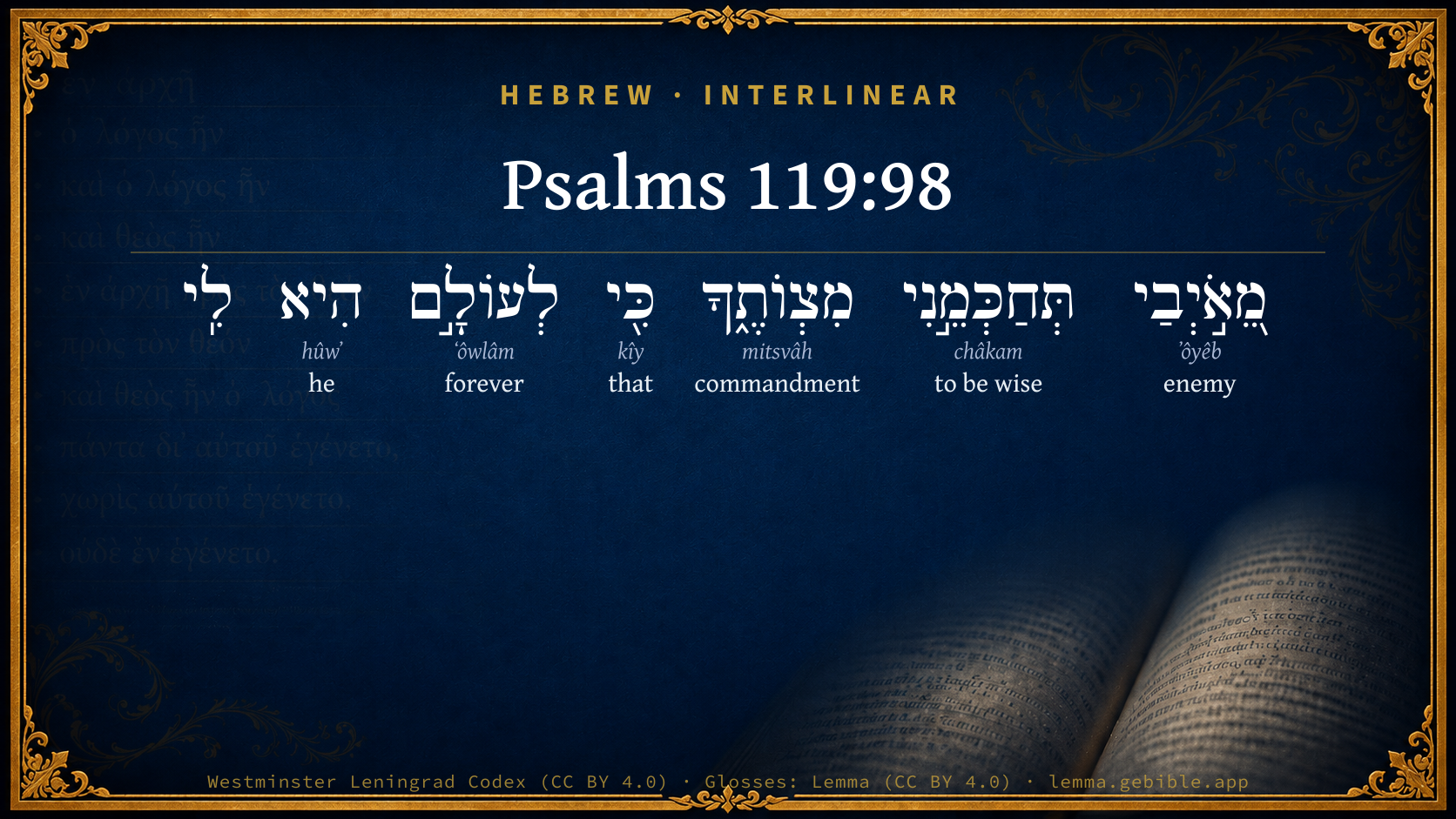
Psalms 119:98

Hebrew (Westminster Leningrad Codex) Psalms 119:98 appears in the Hebrew Old Testament. The text above is from the Westminster Leningrad Codex. Each word links to its Strong’s number, a concise gloss, and parsing drawn from the Open Scriptures Hebrew Bible morphology. Click any word for its full Brown-Driver-Briggs (BDB) entry.
Download image
Cite this verse

Psalms 119:98 (World English Bible). Public Domain. Lemma interlinear Bible study tool, https://lemma.gebible.app/v/psalms/119/98.

Show BibTeX & RIS
BibTeX
RIS
English Translation
Your commandments make me wiser than my enemies, For your commandments are always with me.
World English Bible · Public Domain
Download a study sheet

One document with this verse’s original text, its word-by-word gloss line, the meaning frame, cross-references with their text, attributed commentary, and full source and license credits — printable, and it pastes into notes with its structure intact.

This verse Autodidact and up

Study sheet (.html) Plain text (.txt)

A passage Seminary Student

Up to 50 verses in one chapter. A passage sheet keeps up to 6 commentary sources and 12 cross-references per verse, in the order this page ranks them, and says so on the sheet whenever that leaves anything out. Ask for a single verse and you get the Autodidact verse sheet above.

Everything on this page stays free to read, with no account — the sheet is a download of what is already on screen, not access to it.

Want to remove ads? Support Godless Engineer
Compare translations 3

The same verse in 3 English versions, stacked beneath the original-language interlinear above. Click any original word for its lexicon entry.

Each is an independent rendering of the whole verse — the interlinear is not word-aligned to these translations.

Highlighted words mark where these versions differ — a whole-verse word diff, not a word-by-word alignment.

  • World English Bible Public Domain
    Your commandments make me wiser than my enemies, For your commandments are always with me.
  • King James Version Public Domain
    Thou through thy commandments hast made me wiser than mine enemies: for they are ever with me.
  • unfoldingWord Literal Text CC BY-SA 4.0
    Your commandment makes me wiser than my enemies, for it is with me forever.

unfoldingWord Literal Text — © unfoldingWord, licensed CC BY-SA 4.0. Word-aligned USFM3 via Door43 (git.door43.org/unfoldingWord/en_ult).

Versions to compare (up to 4)

3 of 4 selected

Show all 17 translations

Every available English version of this verse, each an independent rendering of the whole verse.

  • World English Bible Public Domain
    Your commandments make me wiser than my enemies, For your commandments are always with me.
  • Berean Standard Bible Public Domain
    Your commandments make me wiser than my enemies, for they are always with me.
  • Majority Standard Bible Public Domain
    Your commandments make me wiser than my enemies, for they are always with me.
  • King James Version Public Domain
    Thou through thy commandments hast made me wiser than mine enemies: for they are ever with me.
  • American Standard Version (1901) Public Domain
    Thy commandments make me wiser than mine enemies; For they are ever with me.
  • Revised Version (1885) Public Domain
    Thy commandments make me wiser than mine enemies; for they are ever with me.
  • Geneva Bible (1599) Public Domain
    By thy commandements thou hast made mee wiser then mine enemies: for they are euer with mee.
  • Young's Literal Translation Public Domain
    Than mine enemies Thy command maketh me wiser, For it `is' before me to the age.
  • Literal Standard Version CC BY-SA 4.0
    Your command makes me wiser than my enemies, || For it [is] before me for all time.
  • Unlocked Literal Bible CC BY-SA 4.0
    Your commandments make me wiser than my enemies, for your commandments are always with me.
  • unfoldingWord Literal Text CC BY-SA 4.0
    Your commandment makes me wiser than my enemies, for it is with me forever.
  • Darby Bible Public Domain
    Thy commandments make me wiser than mine enemies; for they are ever with me.
  • World Messianic Bible Public Domain
    Your commandments make me wiser than my enemies, for your commandments are always with me.
  • Webster's Bible Public Domain
    Thou through thy commandments hast made me wiser than my enemies: for they are ever with me.
  • Free Bible Version CC BY-SA 4.0
    Your commands make me wiser than my enemies, for I'm always thinking about your instructions.
  • Bible in Basic English Public Domain
    Your teaching has made me wiser than my haters: for it is mine for ever.
  • JPS Tanakh (1917) Public Domain
    Thy commandments make me wiser than mine enemies: for they are ever with me.

Literal Standard Version (2020), Covenant Press — licensed CC BY-SA 4.0. Text via the HelloAO Bible API (eBible.org). Unlocked Literal Bible (unfoldingWord) — licensed CC BY-SA 4.0. Text via the HelloAO Bible API (eBible.org). unfoldingWord Literal Text — © unfoldingWord, licensed CC BY-SA 4.0. Word-aligned USFM3 via Door43 (git.door43.org/unfoldingWord/en_ult). Free Bible Version, Dr. Jonathan Gallagher — licensed CC BY-SA 4.0. Text via the HelloAO Bible API (eBible.org).

Word by word

More ways to search: Search by grammar → Find every occurrence → Compare this word →

Practice this passage: Drill this verse → Learn its vocabulary →

תְּחַכְּמֵ֣נִי
châkam
H2449
“to be wise · me”
Verb, Piel, Imperfect, 3rd Person, Feminine, Singular + Suffix, Personal, 1st Person, Common, Singular
Part of Speech
Verb
Stem
Piel
Form
Imperfect
Person
3rd Person
Gender
Feminine
Number
Singular
Full BDB Definition

Origin: a primitive root

TWOT: 647

to be wise - (Qal) to be or become wise, act wisely - (Piel) to make wise, teach wisdom, instruct - (Pual) to be made wise - (Hiphil) to make wise - (Hithpael) to show oneself wise, deceive, show one's wisdom
  1. מֵ֭אֹ֣יְבַי ʼôyêb H341 “from · enemy · me” Preposition + Verb, Qal, Participle Active, Masculine, Plural, Construct + Suffix, Personal, 1st Person, Common, Singular
  2. מִצְוֺתֶ֑ךָ mitsvâh H4687 “commandments · your” Noun, Common, Feminine, Plural, Construct + Suffix, Personal, 2nd Person, Masculine, Singular
  3. כִּ֖י kîy H3588 “that” Conjunction
  4. לְעוֹלָ֣ם ʻôwlâm H5769 “to/for · forever” Preposition + Noun, Common, Masculine, Singular, Absolute
  5. הִיא hûwʼ H1931 “he” Pronoun, Personal, 3rd Person, Feminine, Singular

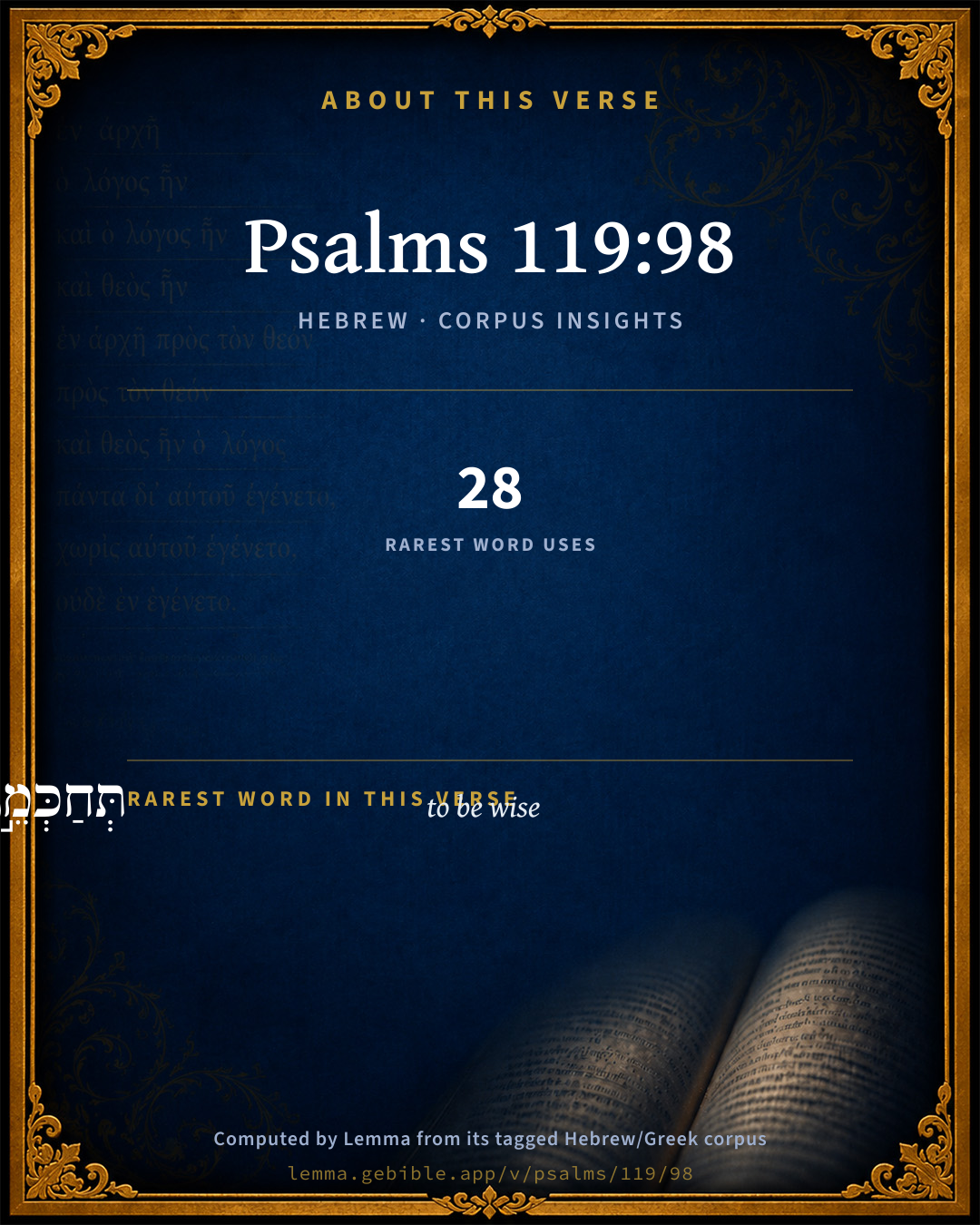
About this verse

These counts appear in no published source. They are computed here, from the morphology-tagged text and Lemma’s own curated glosses. What Lemma adds →

7
words
6
distinct lemmas
Wisdom
section

Shared distinctive vocabulary

תְּחַכְּמֵ֣נִי to be wise H2449 occurs in 26 verses of the Hebrew Bible. Also found in:

Grammatical profile

  • 2 verbs
  • 2 nouns
  • 1 pronoun
  • 1 preposition
  • 1 conjunction

Verb forms

  • מֵ֭אֹ֣יְבַי Qal · Participle Active
  • תְּחַכְּמֵ֣נִי Piel · Imperfect

Hebrew & Septuagint length

In English translation the verse runs 15 words from the Hebrew and 17 from the Septuagint (LXX English) — closely comparable.

A rough comparison of the two English renderings, which tokenize alike — not a word-level alignment.

Word counts can differ between the Hebrew and the Greek without any difference in meaning — e.g. the Hebrew direct-object marker אֵת has no separate Greek word, and Greek often adds the article ὁ.

Cross-references

11

Topical passages linked to Psalms 119:98 in the Treasury of Scripture Knowledge — connected by theme and wording, ordered by reader-vote popularity; previews shown in the World English Bible.

  • Proverbs 2:6 For Yahweh gives wisdom. Out of his mouth comes knowledge and understanding.
  • Psalms 119:104–105 Through your precepts, I get understanding; Therefore I hate every false way.
  • Colossians 3:16 Let the word of Christ dwell in you richly; in all wisdom teaching and admonishing one another with psalms, hymns, and spiritual songs, singing with grace in your heart to the Lord.
  • James 1:25 But he who looks into the perfect law, the law of freedom, and continues, not being a hearer who forgets but a doer of the work, this man will be blessed in what he does.
  • Deuteronomy 4:6 Keep therefore and do them; for this is your wisdom and your understanding in the sight of the peoples, who shall hear all these statutes, and say, Surely this great nation is a wise and understanding people.
  • Psalms 119:11 I have hidden your word in my heart, That I might not sin against you.
  • Deuteronomy 4:8 What great nation is there, that has statutes and ordinances so righteous as all this law, which I set before you this day?
  • Psalms 119:30 I have chosen the way of truth. I have set my heart on your law.
  • 1 Samuel 18:5 David went out wherever Saul sent him, [and] behaved himself wisely: and Saul set him over the men of war, and it was good in the sight of all the people, and also in the sight of Saul's servants.
  • 1 Samuel 18:14 David behaved himself wisely in all his ways; and Yahweh was with him.
  • 1 Samuel 18:30 Then the princes of the Philistines went forth: and it happened, as often as they went forth, that David behaved himself more wisely than all the servants of Saul; so that his name was much set by.

Cross-references courtesy of OpenBible.info (CC BY 4.0).

Hebrew and Greek witnesses Masoretic Hebrew ↔ Greek Septuagint

The same verse in the two great witnesses to the Old Testament, shown verse-for-verse.

You’re reading Greek Psalm 118 (Hebrew Psalm 119). The Septuagint counts the superscription, so verse numbers can differ from the Hebrew — chapter-level alignment, not verse-by-verse. Numbering follows Rahlfs.

These are two independent witnesses, not word-aligned to each other, and the Septuagint is shown in lemma (dictionary) form.

Hebrew Psalms 119:98 Masoretic · Westminster Leningrad Codex

מֵ֭אֹ֣יְבַי תְּחַכְּמֵ֣נִי מִצְוֺתֶ֑ךָ כִּ֖י לְעוֹלָ֣ם הִיא לִֽי

Your commandments make me wiser than my enemies, For your commandments are always with me.

World English Bible · Public Domain

Greek LXX Greek Psalm 118:98 Septuagint · lemma form

ὑπέρ ὁ ἐχθρός ἐγώ σοφίζω ἐγώ ὁ ἐντολή σύ ὅτι εἰς ὁ αἰών ἐγώ εἰμί

You have made me wiser than my enemies in your commandment; for it is mine for ever.

LXX2012 (modern English Septuagint) · Public Domain

Hebrew: Westminster Leningrad Codex (CC BY 4.0). Greek: Septuagint (public domain); English from LXX2012 (modern English Septuagint) (Public Domain). How the Septuagint differs from the Hebrew →

Commentary

Notes on Psalms 119:98 from classic Christian and Jewish commentators (each source and its license shown beneath its notes). The classic Christian expositions comment on the surrounding passage and are grouped to its opening verse, so a note may address several verses; the Jewish commentaries on the Tanakh (Rashi and others) are per-verse, so they appear only where the commentator wrote on this verse.

Lemma curates 59 commentaries, every one of them public domain or Creative Commons licensed, each selected and text-cleaned for this edition rather than reprinted as found. About our sources →

Trapp's Complete Commentary

John Trapp

Psa 119:98 Thou through thy commandments hast made me wiser than mine enemies: for they [are] ever with me.

Ver. 98. Thou through thy commandments hast made me wiser than my enemies] So that I outwit them; and my holy simplicity is too hard for their sinful subtlety. "Be wise as serpents."

For they are ever with me] Heb. It is ever with me, that is, every one of thy commandments; I am expert in them; or, It is mine, I have made them mine own by meditation; I have turned them in succum et sanguinem; I have incorporated them, as it were, into my soul.

John Trapp, A Commentary or Exposition upon All the Books of the Old and New Testament (1647–1656) — public domain. Text from a community e-Sword module.

The Treasury of David

Charles H. Spurgeon

Ver. 98. Thou through thy commandments hast made me wiser than mine enemies. The commands were his book, but God was his teacher. The letter can make us knowing, but only the divine Spirit can make us wise. Wisdom is knowledge put to practical use. Wisdom comes to us through obedience: "If any man will do his will he shall know of the doctrine." We learn not only from promise, and doctrine, and sacred history, but also from precept and command; in fact, from the commandments we gather the most practical wisdom and that which enables us best to cope with our adversaries. A holy life is the highest wisdom and the surest defence. Our enemies are renowned for subtlety, from the first father of them, the old serpent, down to the last cockatrice that has been hatched from the egg; and it would be vain for us to try to be a match with them in the craft and mystery of cunning, for the children of this world are in their generation wiser than the children of light. We must go to another school and learn of a different instructor, and then by uprightness we shall baffle fraud, by simple truth we shall vanquish deep laid scheming, and by open candour we shall defeat slander. A thoroughly straightforward man, devoid of all policy, is a terrible puzzle to diplomatists; they suspect him of a subtle duplicity through which they cannot see, while he, indifferent to their suspicions, holds on the even tenor of his way, and baffles all their arts. Yes, "honesty is the best policy." He who is taught of God has a practical wisdom such as malice cannot supply to the crafty; while harmless as a dove he also exhibits more than a serpent's wisdom.

For they are ever with me. He was always studying or obeying the commandments; they were his choice and constant companions. If we wish to become proficient we must be indefatigable. If we keep the wise law ever near us we shall become wise, and when our adversaries assail us we shall be prepared for them with that ready wit which lies in having the word of God at our fingers' ends. As a soldier in battle must never lay aside his shield, so must we never have the word of God out of our minds; it must be ever with us.

Ver. 98. Thou through thy commandments hast made me wiser than mine enemies. Now he praiseth the word for the singular profit and fruit which he reaped by it; to wit, that he learned wisdom by it. And this he amplifies, by comparing himself with three sorts of men; his enemies, his teachers, and the ancients. And this he doth, not of vain glory (for bragging is far from him who is governed by the Spirit of grace); but to commend the word of the Lord, and to allure others to love it, by declaring to them what manifold good he found in it.

Wiser than mine enemies. But how can this be, seeing that our Saviour saith that the men of this world are wiser in their own generation than the children of God? The answer is, our Saviour doth not call worldlings wise men simply; but wiser in their own generation; that is, wise in things pertaining to this life. Or as Jeremy calls them, "wise to do evil"; and when they have so done, wise to conceal and cloak it. All which in very deed is but folly; and therefore David, who by the light of God's word saw that it was so, could not be moved to follow their course. Well; there is a great controversy between the godly and the wicked: either of them in their judgment accounts the other to be fools; but it is the light of God's word which must decide it. William Cowper.

Ver. 98. Wiser than mine enemies. They are wiser than their enemies as to security against their attempts, and that enmity and opposition that they carry on against them; they are far more safe by walking under the convert of God's protection than their enemies can possibly be, who have all manner of worldly advantages. A godly wise man is careful to keep in with God: he is more prepared and furnished, can have a higher hope, more expectation of success, than others have; or, if not, he is well enough provided for, though all things fall out never so cross to his desires. As to success, who hath made wiser provision, think you, he that hath made God his friend, or he that is borne up with worldly props and dependencies? They that are guided by the Spirit of God, or they that are guided by Satan those that make it their business to walk with God step by step, or those that not only forsake him, but provoke him to his face? Those that break with men, and keep in with God, or those that break with God? Surely, a child of God hath more security by piety than his enemies can have by secular policy, whereby they think to overreach and ruin him. The safety of a child of God lieth in two things: 1. God is his friend. 2. As long as God hath work for him to do, he will maintain him, and bear him out in it. Thomas Manton.

Ver. 98. They are ever with me. The meaning of the last clause is not merely "it is ever with me, but it is for ever to me, "i.e, mine, my inalienable, indefeasible possession. Joseph Addison Alexander.

Ver. 98. They are ever with me. God gives knowledge to whom he pleaseth; but those that meditate most, thrive most. This may imply also that the word should be a ready help. Such as derive their wisdom from without cannot have their counsellors always with them to give advice. But, when a man hath gotten the word in his heart, he finds a ready help: he hath a seasonable word to direct him in all difficulties, in all straits, and in all temptations, to teach him what to do against the burden of the present exigence; to teach him what to do and what to hope for. Thomas Manton.

Ver. 98. They are ever with me. A good man, wherever he goes, carries his Bible along with him, if not in his hands, yet in his head and in his heart. Matthew Henry.

Ver. 98-100. Three sorts of men he mentions, "enemies, " "teachers, ""ancients"; the enemies excel in policy, teachers in doctrine, and ancients in counsel; and yet by the word was David made wiser than all these. Malice sharpens the wit of enemies, and teacheth them the arts of opposition; teachers are furnished with learning because of their office; and ancients grow wise by experience; yet David, by the study of the word, excelled all these. Thomas Manton.

Ver. 98. Constant communion with truth the student's road to proficiency.

Ver. 98-100. The truly wise man.

1. The source of his wisdom. The word of "the only wise God, "here described as

(a) Thy commandments.

(b) Thy testimonies.

(c) Thy precepts.

2. The increase of his wisdom. It arises from

(a) The abiding indwelling of the word: "ever with me, "

Ps 119:98.

(b) Meditation upon the word, Ps 119:99.

(c) Obedience to the word, Ps 119:100.

3. The measure of his wisdom.

(a) Wiser than his enemies, whose wisdom was "not from

above, but earthly, sensual, devilish."

(b) Wiser than his teachers, whose wisdom was "of this

world."

(c) Wiser than the ancients, whose wisdom was that of

unsanctified age and experience. W.H.J. Page, of Chelsea, 1882.

Psalms 119:99*

Charles H. Spurgeon's The Treasury of David (1869–1885) — public domain. Psalms only. Text from a community e-Sword/MySword module.

J. A. Alexander on Psalms

Joseph Addison Alexander

98. (Psa 119:98) (More) than my enemies do thy commandments make me wise; for to eternity it is mine (or to me). This is the construction of the first clause preferred by the latest interpreters, although it requires a singular verb to be construed with a plural noun. But as the same irregularity exists in the construction of the pronoun in the second clause, however the first may be explained, it is best to explain both anomalies alike, i.e. partly by the relative position of the words, and partly by the aggregate sense in which commandments is here used as equivalent to law, and which, agreeably to general usage, may sufficiently account for its construction with a verb and pronoun in the singular. As analogous cases have been cited, 2Sa 22:23 --"(as for) his statutes, I depart not from it"—and 2Ki 17:22—"the sins of Jeroboam which he did, they departed not from it." As the sins of Jeroboam were concentrated in one, so the statutes of Jehovah might be viewed as one great comprehensive precept. The meaning of the last clause is not merely, it is ever with me, but it is for ever to me, i.e. mine, my inalienable, indefeasible possession. See above, Psa 119:94.

Joseph Addison Alexander, The Psalms Translated and Explained (1850) — public domain. Text from a community e-Sword module.

Matthew Henry's Commentary

We have here an account of David's learning, not that of the Egyptians, but of the Israelites indeed.

I. The good method by which he got it. In his youth he minded business in the country as a shepherd; from his youth he minded business in the court and camp. Which way then could he get any great stock of learning? He tells us here how he came by it; he had it from God as the author: Thou hast made me wise. All true wisdom is from God. He had it by the word of God as the means, by his commandments and his testimonies. These are able to make us wise to salvation and to furnish the man of God for every good work. 1. These David took for his constant companions: "They are ever with me, ever in my mind, ever in my eye." A good man, wherever he goes, carries his Bible along with him, if not in his hands, yet in his head and in his heart. 2. These he took for the delightful subject of his thoughts; they were his meditation, not only as matters of speculation for his entertainment, as scholars meditate on their notions, but as matters of concern, for his right management, as men of business think of their business, that they may do it in the best manner. 3. These he took for the commanding rules of all his actions: I keep thy precepts, that is, I make conscience of doing my duty in every thing. The best way to improve in knowledge is to abide and abound in all the instances of serious godliness; for, if any man do his will, he shall know of the doctrine of Christ, shall know more and more of it, Joh 7:17. The love of the truth prepares for the light of it; the pure in heart shall see God here.

II. The great eminency he attained to in it. By studying and practising God's commandments, and making them his rule, he learnt to behave himself wisely in all his ways, Sa1 18:14. 2. He outwitted his enemies; God, by these means, made him wiser to baffle and defeat their designs against him than they were to lay them. Heavenly wisdom will carry the point, at last, against carnal policy. By keeping the commandments we secure God on our side and make him our friend, and therein are certainly wiser than those that make him their enemy. By keeping the commandments we preserve in ourselves that peace and quiet of mind which our enemies would rob us of, and so are wise for ourselves, wiser than they are for themselves, for this world as well as for the other. 2. He outstripped his teachers, and had more understanding than all of them. He means either those who would have been his teachers, who blamed his conduct and undertook to prescribe to him (by keeping God's commandments he managed his matters so that it appeared, in the event, he had taken the right measures and they had taken the wrong), or those who should have been his teachers, the priests and Levites, who sat in Moses's chair, and whose lips ought to have kept knowledge, but who neglected the study of the law, and minded their honours and revenues, and the formalities only of their religion; and so David, who conversed much with the scriptures, by that means became more intelligent than they. Or he may mean those who had been his teachers when he was young; he built so well upon the foundation which they had laid that, with the help of his Bible, he became able to teach them, to teach them all. He was not now a babe that needed milk, but had spiritual senses exercised, Heb 5:14. It is no reflection upon our teachers, but rather an honour to them, to improve so as really to excel them, and not to need them. By meditation we preach to ourselves, and so we come to understand more than our teachers, for we come to understand our own hearts, which they cannot. 3. He outdid the ancients, either those of his day (he was young, like Elihu, and they were very old, but his keeping God's precepts taught more wisdom than the multitude of their years, Job 32:7, Job 32:8) or those of former days; he himself quotes the proverb of the ancients (Sa1 24:13), but the word of God gave him to understand things better than he could do by tradition and all the learning that was handed down from preceding ages. In short, the written word is a surer guide to heaven than all the doctors and fathers, the teachers and ancients, of the church; and the sacred writings kept, and kept to, will teach us more wisdom than all their writings.

Matthew Henry's Commentary on the Whole Bible (1708–1710) — public domain (CC PDM 1.0). Text via the HelloAO Bible API.

Adam Clarke's Commentary

Verse 98. Wiser than mine enemies] Some have thought that this Psalm was composed by Daniel, and that he speaks of himself in these verses. Being instructed by God, he was found to have more knowledge than any of the Chaldeans, magicians, soothsayers, c., &c. and his wisdom soon appeared to the whole nation vastly superior to theirs.

Adam Clarke's Commentary on the Bible (1810–1826) — public domain. Text from a community e-Sword/MySword module.

John Calvin's Commentaries

98. Thou hast made me wiser than my adversaries He here declares, that he was more learned than his adversaries, his instructors, and the aged, because he was a scholar of God’s law. It is in a different sense that he describes himself as endued with understanding above his adversaries, from that in which he describes himself as wiser than his teachers. He surpassed his enemies, because their cunning and artifices availed them nothing when they employed these to the utmost to effect his destruction. The malice of the wicked is always goading them to do mischief; and as they are often artful and deceitful, we are afraid lest our simplicity should be imposed upon by their deceits, unless we use the same crafts and underhand dealings which they practice. Accordingly, the prophet glories, that he found in God’s law enough to enable him to escape all their snares. When he claims the credit of being superior in knowledge to his instructors, he does not mean to deny that they also had learned from the word of God what was useful to be known. But he gives God thanks for enabling him to surpass, in proficiency, those from whom he had learned the first elements of knowledge. Nor is it any new thing for the scholar to excel his master, according as God distributes to each man the measure of understanding. The faithful, it is true, are instructed by the pains and labor of men, but it is in such a way, as that God is still to be regarded as enlightening them. And it is owing to this that the scholar surpasses the master; for God means to show as it were, with the finger, that he uses the service of men in such a way as that he himself continues still the chief teacher. Let us therefore learn to commit ourselves to his tuition, that we may glory with David, that by his guidance we have proceeded farther than man’s instruction could lead us. He adds the same thing respecting the aged, for the more abundant confirmation of his statement. Age is of great avail in polishing, by long experience and practice, men who, by nature, are dull and rude. Now the prophet asserts, that he had acquired, by the Divine Law, more discretion than belongs to aged men. In short, he means to affirm, that whoever yields himself with docility to God, keeps his thoughts in subjection to his word, and exercises himself diligently in meditating upon the Law, will thence derive wisdom sufficient for enabling him to consult his own safety in opposition to the stratagems of his enemies, to exercise circumspection requisite for escaping their deceits; and, finally, to match with the most eminent masters through the whole course of his life. David, however, does not adduce his wisdom, that he may boast of it before the world; but, by his own example, he warns us, that nothing is better for us than to learn at God’s mouth, since those only are perfectly wise who are taught in his school. At the same time, sobriety is here enjoined upon the faithful, that they may not seek for wisdom elsewhere than from God’s word, and that ambition or curiosity may not incite them to vain boasting. In short, all are here recommended to behave themselves with modesty and humility, that no man may claim to himself such knowledge as elevates him above the Divine Law; but that all men, however intelligent, may willingly yield themselves to the lessons of heavenly wisdom revealed in the Divine Word. When he says, that he kept God’s statutes, he teaches us what kind of meditation it is of which we have spoken, to let us know that he did not coldly philosophies upon God’s precepts, but devoted himself to them with earnest affection.

John Calvin's Commentaries (1540-1563) — public domain. Text from the Calvin Translation Society English edition (1840s-50s) via the Christian Classics Ethereal Library (ccel.org). Calvin's coverage is partial (roughly two-thirds of the Bible); uncommented books and verses are honest gaps, never fabricated. The 19th-century editor's footnotes and remarks are omitted so the notes are faithfully Calvin's own voice.

Ellicott's Commentary for English Readers

MEM.

(98) Better, Thy commandments make me wiser than my enemies. The same correspondence of wisdom with loyal obedience to the Law is found in the Book of Proverbs.

A Bible Commentary for English Readers, edited by Charles John Ellicott (1878–1897) — public domain. Text from a community e-Sword module.

The Cambridge Bible for Schools and Colleges

gen. ed. J. J. S. Perowne

98. Thou through thy commandments hast made me wiser &c.] A scarcely possible rendering, though it has some support in the Ancient Versions. Better as R.V., Thy commandments make me wiser &c. For the sense cp. Deu_4:6.

for they are ever with me] Lit. For it is mine for ever. The use of the singular ‘it,’ as well as of the singular verb in the preceding line, implies the unity of God’s law, though it includes many commandments. This law is his possession. Cp. Psa_119:111.

The Cambridge Bible for Schools and Colleges (gen. ed. J. J. S. Perowne; Cambridge University Press, 1878–1918) — public domain. Text from a community e-Sword module.

John Gill's Exposition

I have not departed from thy judgments,.... From the precepts of the word, from the ways and worship and ordinances of God; he had not wickedly and on purpose departed from them; whenever he did, it was through inadvertency, the weakness of the flesh, and strength of temptation; nor from the doctrines of the word, which he held fast, knowing of whom he had learned them, as follows:

for thou hast taught me; the nature, excellency, and use of these judgments; he had taught him, by his Spirit, experimentally to understand the doctrines of the word, and practically to observe the precepts of it; and this preserved him from an apostasy from either of them.

John Gill's Exposition of the Whole Bible (1746–1763) — public domain (CC PDM 1.0). Text via the HelloAO Bible API.

Albert Barnes' Notes on the Bible

Thou, through thy commandments - By the teaching and power of thy law.

Hast made me wiser than mine enemies - I have a better understanding of thee, of thy law, of the duties of this life, and in regard to the life to come, than my enemies have - not because I am naturally better, or because I have higher endowments by nature, but because thou hast made me wiser than they are. The rendering of this first clause of the verse now most approved by interpreters is, “Thy commandments make me more wise than my enemies are,” though this requires a singular verb to be construed with a plural noun (Professor Alexander). So DeWette renders it.

For they are ever with me - Margin, as in Hebrew, “it is ever with me.” The reference is to the law or commandments of God. The meaning is, that that law was never out of his mind; that he was constantly thinking about it; and that it unfolded such wisdom to him as to make him superior to all his foes; to give him a better understanding of life, its design, its duties, and its obligations, than his enemies had. The best instructor in true wisdom is the revealed word of God - the Bible.

Albert Barnes' Notes on the Bible (1834–1885) — public domain. Text from a community e-Sword/MySword module.

Matthew Poole's English Annotations

Thou, through thy commandments, hast made me wiser than mine enemies, because by that means I have thy wisdom to guide me, and thy power engaged to protect and save me; which is a more certain and effectual way to obtain my desires and ends than all the policy and craft of mine enemies is to hinder them, as I have found by experience. They are ever with me; they are continually before mine eyes, as a rule by which to govern all my actions, whereby I am kept from splitting upon those rocks whereby others are ruined.

Matthew Poole's English Annotations on the Holy Bible (1683–1685) — public domain. Text from a community e-Sword/MySword module.

The Pulpit Commentary

Thou through thy command-meets but made me wiser than mine enemies. (comp. Deu_4:6, Deu_4:8) The knowledge of God"s Law gives a wisdom and an understanding infinitely above the cunning and craft of worldly men. If to the knowledge is added a faithful and habitual obedience, a wisdom is attained which can be reached in no other way (see ver. 100). For they are ever with me. Always present to my thoughts, as my rule of life.

The Pulpit Commentary (1880–1919), ed. H.D.M. Spence-Jones & Joseph S. Exell — public domain. Text from a community e-Sword module.

Rashi

Rabbi Shlomo Yitzchaki (Rashi)

Each of Your commandments makes me wiser than my enemies Concerning Doeg and Ahithophel they [the Rabbis] said that their final conclusions did not agree with adopted practice. The secret of the Torah is in my hands forever, for I gained understanding from all my teachers; I learned a little from this one and I learned a little from that one (after I learned from my distinguished teacher).

Rashi on the Tanakh — English translations: “The Judaica Press complete Tanach with Rashi, translated by A. J. Rosenberg” (CC BY 4.0); “Pentateuch with Rashi's commentary by M. Rosenbaum and A.M. Silbermann, 1929-1934” (public domain); “The Metsudah Tanach series, Lakewood, N.J” (CC BY 4.0); and “The Book of Joshua, Metsudah Publications, 1997” (CC BY 4.0). Text via Sefaria.

Lesson kit

Teaching starters — assembled from the data on this page, not authored interpretation. Every prompt links to the verse data it draws on. Edit before teaching.

Psalms, in the Wisdom, opens this verse with 7 words (6 distinct Hebrew lemmas). Its most distinctive word is châkam (“to be wise”). A historical commentator’s framing appears above. Read the whole chapter for the surrounding context.

Discussion questions

  1. The word châkam carries the sense “to be wise.” How does it shape the verse?
  2. Exodus 1:10 shares the word «to be wise» with this verse. How do the two illuminate each other?
  3. The translations on this page render this verse differently — a whole-verse word diff, not a word-by-word alignment. What might account for the different wordings?
  4. The verb «מֵ֭אֹ֣יְבַי» is Qal Participle Active. How does its form color the action?
  5. Reading how Trapp's Complete Commentary and The Treasury of David read this verse, where do the two commentators agree and where do they part?

Things to notice

Reading settings

Reading text

Shown beneath each verse's original-language words.

Old Testament
Old Testament edition

Read the OT as the Masoretic Hebrew (MT) or the Greek Septuagint (LXX).

English shown for the Greek Septuagint (in the Hebrew ↔ Greek comparison).

Comparing translations? Open the Compare panel on any verse page to stack up to four side by side.