Deuteronomy 26:18

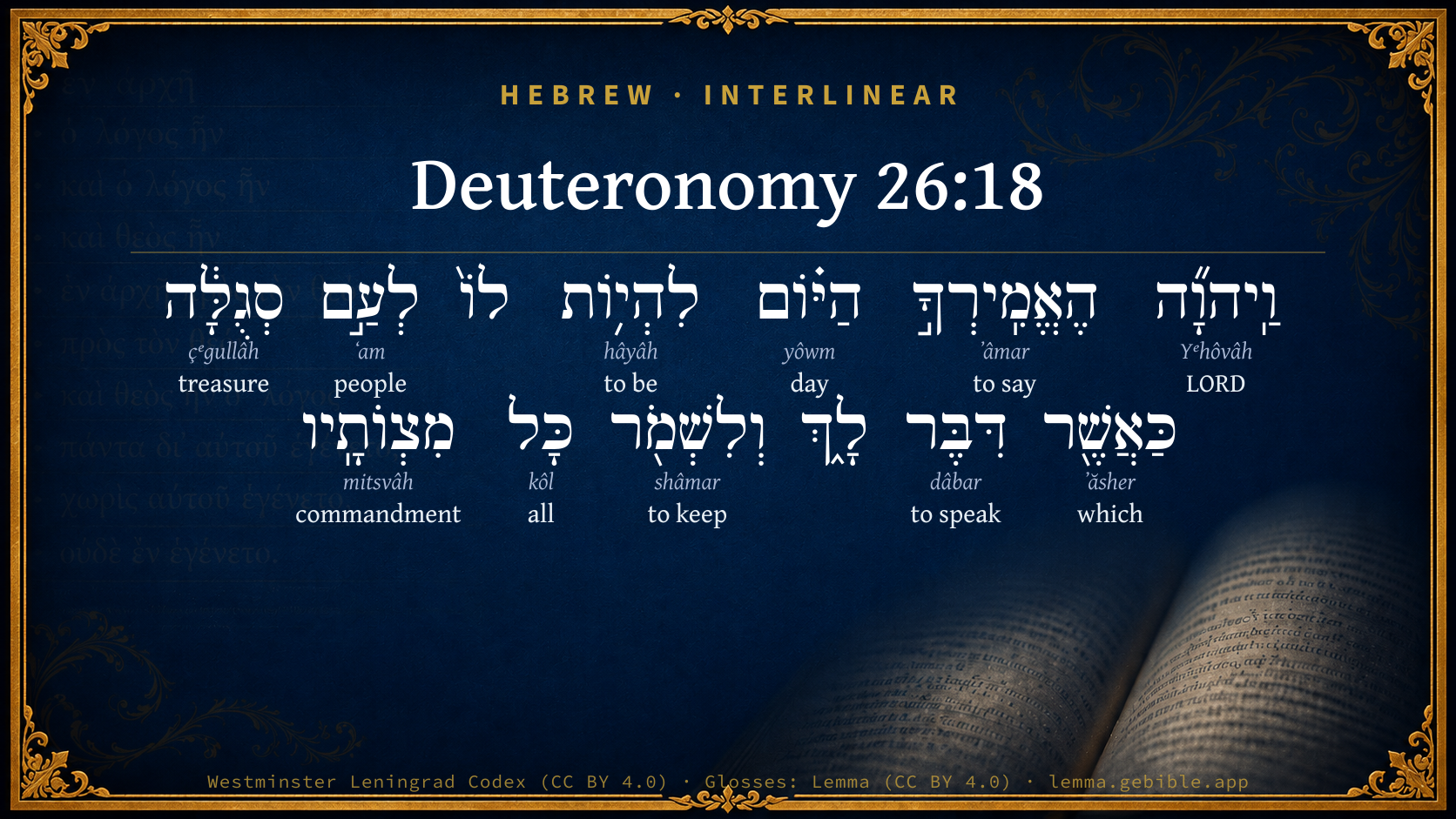
Hebrew (Westminster Leningrad Codex) Deuteronomy 26:18 appears in the Hebrew Old Testament. The text above is from the Westminster Leningrad Codex. Each word links to its Strong’s number, a concise gloss, and parsing drawn from the Open Scriptures Hebrew Bible morphology. Click any word for its full Brown-Driver-Briggs (BDB) entry.
Download image
Cite this verse

Deuteronomy 26:18 (World English Bible). Public Domain. Lemma interlinear Bible study tool, https://lemma.gebible.app/v/deuteronomy/26/18.

Show BibTeX & RIS
BibTeX
RIS
English Translation
and Yahweh has declared you this day to be a people for his own possession, as he has promised you, and that you should keep all his commandments;
World English Bible · Public Domain
Download a study sheet

One document with this verse’s original text, its word-by-word gloss line, the meaning frame, cross-references with their text, attributed commentary, and full source and license credits — printable, and it pastes into notes with its structure intact.

This verse Autodidact and up

Study sheet (.html) Plain text (.txt)

A passage Seminary Student

Up to 50 verses in one chapter. A passage sheet keeps up to 6 commentary sources and 12 cross-references per verse, in the order this page ranks them, and says so on the sheet whenever that leaves anything out. Ask for a single verse and you get the Autodidact verse sheet above.

Everything on this page stays free to read, with no account — the sheet is a download of what is already on screen, not access to it.

Want to remove ads? Support Godless Engineer
Compare translations 3

The same verse in 3 English versions, stacked beneath the original-language interlinear above. Click any original word for its lexicon entry.

Each is an independent rendering of the whole verse — the interlinear is not word-aligned to these translations.

Highlighted words mark where these versions differ — a whole-verse word diff, not a word-by-word alignment.

  • World English Bible Public Domain
    and Yahweh has declared you this day to be a people for his own possession, as he has promised you, and that you should keep all his commandments;
  • King James Version Public Domain
    And the LORD hath avouched thee this day to be his peculiar people, as he hath promised thee, and that thou shouldest keep all his commandments;
  • unfoldingWord Literal Text CC BY-SA 4.0
    Today Yahweh has declared that you are his, a people for a possession, as he had spoken to you, and to keep all his commandments,

unfoldingWord Literal Text — © unfoldingWord, licensed CC BY-SA 4.0. Word-aligned USFM3 via Door43 (git.door43.org/unfoldingWord/en_ult).

Versions to compare (up to 4)

3 of 4 selected

Show all 18 translations

Every available English version of this verse, each an independent rendering of the whole verse.

  • World English Bible Public Domain
    and Yahweh has declared you this day to be a people for his own possession, as he has promised you, and that you should keep all his commandments;
  • Berean Standard Bible Public Domain
    And today the LORD has proclaimed that you are His people and treasured possession as He promised, that you are to keep all His commandments,
  • Majority Standard Bible Public Domain
    And today the LORD has proclaimed that you are His people and treasured possession as He promised, that you are to keep all His commandments,
  • King James Version Public Domain
    And the LORD hath avouched thee this day to be his peculiar people, as he hath promised thee, and that thou shouldest keep all his commandments;
  • American Standard Version (1901) Public Domain
    and Jehovah hath avouched thee this day to be a people for his own possession, as he hath promised thee, and that thou shouldest keep all his commandments;
  • Revised Version (1885) Public Domain
    and the LORD hath avouched thee this day to be a peculiar people unto himself, as he hath promised thee, and that thou shouldest keep all his commandments;
  • Geneva Bible (1599) Public Domain
    And the Lord hath set thee vp this day, to be a precious people vnto him (as hee hath promised thee) and that thou shouldest keepe all his commandements,
  • Douay-Rheims (1899) Public Domain
    Thou hast chosen the Lord this day to be thy God, and to walk in his ways and keep his ceremonies, and precepts, end judgments, and obey his command.
  • Young's Literal Translation Public Domain
    `And Jehovah hath caused thee to promise to-day to become His people, a peculiar treasure, as He hath spoken to thee, and to keep all His commands;
  • Literal Standard Version CC BY-SA 4.0
    And today YHWH has proclaimed you to be to Him for a people, a peculiar treasure, as He has spoken to you, that [you are] to keep all His commands,
  • Unlocked Literal Bible CC BY-SA 4.0
    Today Yahweh has declared that you are a people who are his own possession, as he had promised you, and that you are to keep all his commandments,
  • unfoldingWord Literal Text CC BY-SA 4.0
    Today Yahweh has declared that you are his, a people for a possession, as he had spoken to you, and to keep all his commandments,
  • Darby Bible Public Domain
    and Jehovah hath accepted thee this day to be a people of possession to him, as he hath told thee, and that thou shouldest keep all his commandments,
  • World Messianic Bible Public Domain
    The LORD has declared today that you are a people for his own possession, as he has promised you, and that you should keep all his commandments.
  • Webster's Bible Public Domain
    And the LORD hath avouched thee this day to be his peculiar people, as he hath promised thee, and that thou shouldst keep all his commandments;
  • Free Bible Version CC BY-SA 4.0
    Today the Lord has announced that you are a special people who belong to him as he promised. He has announced that you are to keep all his commandments.
  • Bible in Basic English Public Domain
    And the Lord has made it clear this day that you are a special people to him, as he gave you his word; and that you are to keep all his orders;
  • JPS Tanakh (1917) Public Domain
    And the LORD hath avouched thee this day to be His own treasure, as He hath promised thee, and that thou shouldest keep all His commandments;

Literal Standard Version (2020), Covenant Press — licensed CC BY-SA 4.0. Text via the HelloAO Bible API (eBible.org). Unlocked Literal Bible (unfoldingWord) — licensed CC BY-SA 4.0. Text via the HelloAO Bible API (eBible.org). unfoldingWord Literal Text — © unfoldingWord, licensed CC BY-SA 4.0. Word-aligned USFM3 via Door43 (git.door43.org/unfoldingWord/en_ult). Free Bible Version, Dr. Jonathan Gallagher — licensed CC BY-SA 4.0. Text via the HelloAO Bible API (eBible.org).

Word by word

More ways to search: Search by grammar → Find every occurrence → Compare this word →

Practice this passage: Drill this verse → Learn its vocabulary →

סְגֻלָּ֔ה
çᵉgullâh
H5459
“treasure”
Noun, Common, Feminine, Singular, Absolute
Part of Speech
Noun
Type
Common
Gender
Feminine
Number
Singular
State
Absolute
Full BDB Definition

Origin: from an unused root meaning to shut up

TWOT: 1460a

possession, property - valued property, peculiar treasure - treasure
  1. וַֽיהוָ֞ה Yᵉhôvâh H3068 “and · LORD” Conjunction + Noun, Proper
  2. הֶאֱמִֽירְךָ֣ ʼâmar H559 “to say · you” Verb, Hiphil, Perfect, 3rd Person, Masculine, Singular + Suffix, Personal, 2nd Person, Masculine, Singular
  3. הַיּ֗וֹם yôwm H3117 “the · day” Particle, Definite Article + Noun, Common, Masculine, Singular, Absolute
  4. לִהְי֥וֹת hâyâh H1961 “to be” Preposition + Verb, Qal, Infinitive Construct
  5. לְעַ֣ם ʻam H5971 “to/for · people of” Preposition + Noun, Common, Masculine, Singular, Construct
  6. כַּאֲשֶׁ֖ר ʼăsher H834 “like/as · which” Preposition + Particle, Relative
  7. דִּבֶּר dâbar H1696 “to speak” Verb, Piel, Perfect, 3rd Person, Masculine, Singular
  8. וְלִשְׁמֹ֖ר shâmar H8104 “and · to keep” Conjunction + Preposition + Verb, Qal, Infinitive Construct
  9. כָּל kôl H3605 “all of” Noun, Common, Masculine, Singular, Construct
  10. מִצְוֺתָֽיו mitsvâh H4687 “commandments · his” Noun, Common, Feminine, Plural, Construct + Suffix, Personal, 3rd Person, Masculine, Singular

About this verse

These counts appear in no published source. They are computed here, from the morphology-tagged text and Lemma’s own curated glosses. What Lemma adds →

13
words
11
distinct lemmas
Pentateuch
section

Notable vocabulary

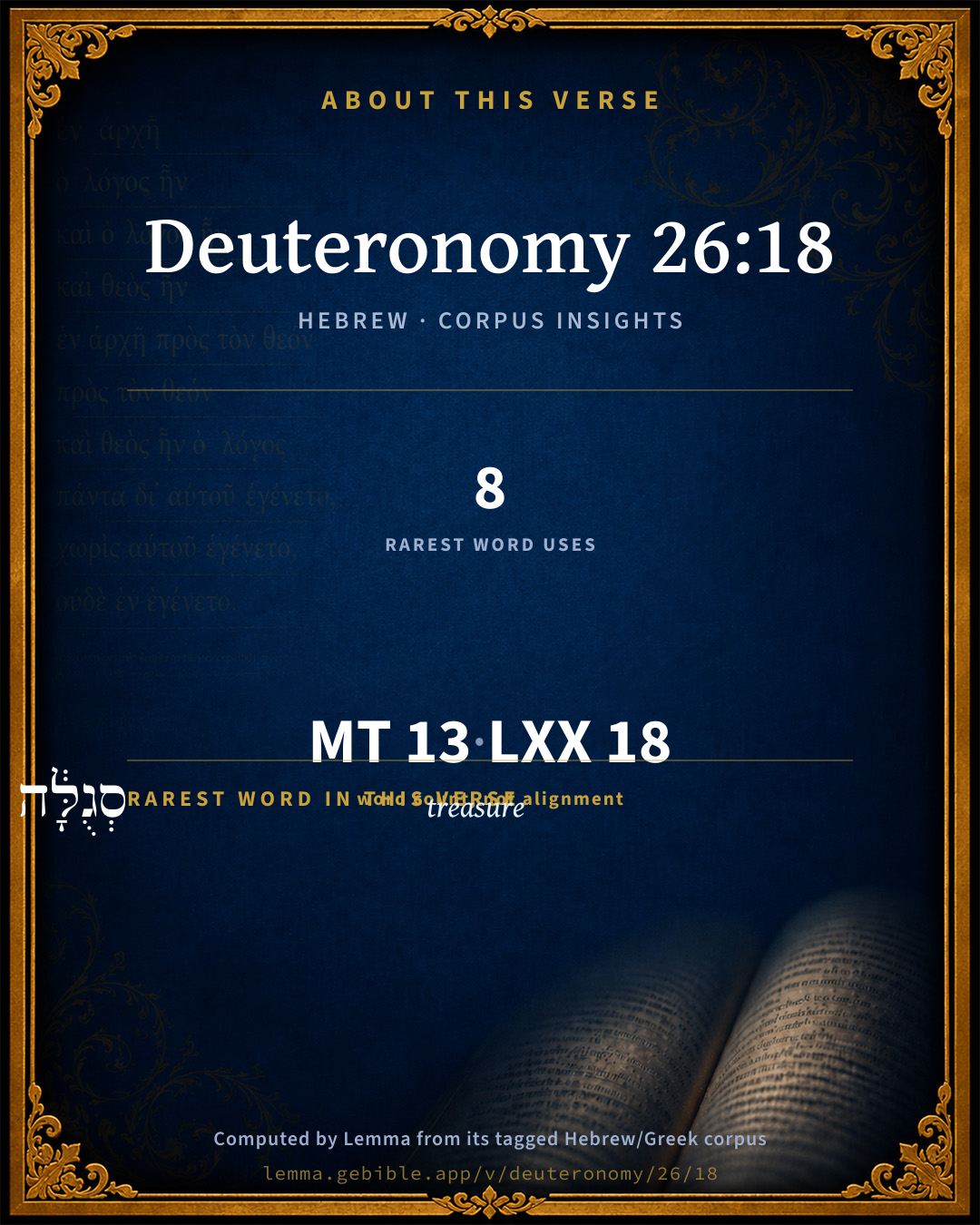
The rarest word here is סְגֻלָּ֔ה treasure H5459 — appearing just 8 times in the whole Hebrew Bible.

Shared distinctive vocabulary

סְגֻלָּ֔ה treasure H5459 occurs in 8 verses of the Hebrew Bible. Also found in:

Grammatical profile

  • 4 verbs
  • 6 nouns
  • 2 prepositions
  • 1 particle

Verb forms

  • הֶאֱמִֽירְךָ֣ Hiphil · Perfect
  • לִהְי֥וֹת Qal · Infinitive Construct
  • דִּבֶּר Piel · Perfect
  • וְלִשְׁמֹ֖ר Qal · Infinitive Construct

Hebrew & Septuagint length

In English translation the verse runs 28 words from the Hebrew and 24 from the Septuagint (LXX English) — closely comparable.

A rough comparison of the two English renderings, which tokenize alike — not a word-level alignment.

Word counts can differ between the Hebrew and the Greek without any difference in meaning — e.g. the Hebrew direct-object marker אֵת has no separate Greek word, and Greek often adds the article ὁ.

In the original languages it is 13 Hebrew tokens and 18 Greek tokens — but the two are counted differently (Hebrew bundles its prefixes and suffixes into one token; the Greek is in lemma form), so that isn’t a like-for-like length.

Cross-references

10

Topical passages linked to Deuteronomy 26:18 in the Treasury of Scripture Knowledge — connected by theme and wording, ordered by reader-vote popularity; previews shown in the World English Bible.

  • Deuteronomy 7:6 For you are a holy people to Yahweh your God: Yahweh your God has chosen you to be a people for his own possession, above all peoples who are on the face of the earth.
  • Deuteronomy 14:2 For you are a holy people to Yahweh your God, and Yahweh has chosen you to be a people for his own possession, above all peoples who are on the face of the earth.
  • Deuteronomy 28:9 Yahweh will establish you for a holy people to himself, as he has sworn to you; if you shall keep the commandments of Yahweh your God, and walk in his ways.
  • Titus 2:14 who gave himself for us, that he might redeem us from all iniquity, and purify for himself a people for his own possession, zealous for good works.
  • Exodus 6:7 and I will take you to me for a people, and I will be to you a God; and you shall know that I am Yahweh your God, who brings you out from under the burdens of the Egyptians.
  • Ezekiel 36:25–27 I will sprinkle clean water on you, and you shall be clean: from all your filthiness, and from all your idols, will I cleanse you.
  • Romans 16:26
  • Exodus 19:5–6 Now therefore, if you will indeed obey my voice, and keep my covenant, then you shall be my own possession from among all peoples; for all the earth is mine;
  • Psalms 119:6 Then I wouldn't be disappointed, When I consider all of your commandments.
  • Jeremiah 31:32–34 not according to the covenant that I made with their fathers in the day that I took them by the hand to bring them out of the land of Egypt; which my covenant they broke, although I was a husband to them, says Yahweh.

Cross-references courtesy of OpenBible.info (CC BY 4.0).

Hebrew and Greek witnesses Masoretic Hebrew ↔ Greek Septuagint

The same verse in the two great witnesses to the Old Testament, shown verse-for-verse.

These are two independent witnesses, not word-aligned to each other, and the Septuagint is shown in lemma (dictionary) form.

Hebrew Deuteronomy 26:18 Masoretic · Westminster Leningrad Codex

וַֽיהוָ֞ה הֶאֱמִֽירְךָ֣ הַיּ֗וֹם לִהְי֥וֹת לוֹ֙ לְעַ֣ם סְגֻלָּ֔ה כַּאֲשֶׁ֖ר דִּבֶּר לָ֑ךְ וְלִשְׁמֹ֖ר כָּל מִצְוֺתָֽיו

and Yahweh has declared you this day to be a people for his own possession, as he has promised you, and that you should keep all his commandments;

World English Bible · Public Domain

Greek LXX Deuteronomy 26:18 Septuagint · lemma form

καί κύριος αἱρέω σύ σήμερον γίγνομαι σύ αὐτός λαός περιούσιος καθάπερ εἶπον σύ φυλάσσω πᾶς ὁ ἐντολή αὐτός

And the Lord has chosen you this day that you should be to him a peculiar people, as he said, to keep his commands;

LXX2012 (modern English Septuagint) · Public Domain

Hebrew: Westminster Leningrad Codex (CC BY 4.0). Greek: Septuagint (public domain); English from LXX2012 (modern English Septuagint) (Public Domain). How the Septuagint differs from the Hebrew →

Targum (Aramaic paraphrase)

2

The Targum is the ancient Jewish Aramaic paraphrase of the Hebrew Scriptures — an interpretive translation, not the Hebrew text itself. Onkelos (literal) and Pseudo-Jonathan (expansive) render the Torah, and Jonathan the Prophets. Coverage is partial: where no permissively-licensed English translation exists for a verse, only the Aramaic is shown. This is verse-level text, not a word-by-word alignment to the Hebrew.

  1. Targum Onkelos Torah (Genesis–Deuteronomy)
    וַיְיָ חָטְבָךְ יוֹמָא דֵין לְמֶהֱוֵי לֵהּ לְעַם חַבִּיב כְּמָא דִי מַלִיל לָךְ וּלְמִטַר כָּל פִּקוּדוֹהִי

    (no public-domain English translation for this verse)

    Targum Onkelos — Aramaic: “Onkelos Genesis” (public domain); “Onkelos Exodus” (public domain); “Onkelos Leviticus” (public domain); “Onkelos Numbers” (public domain); “Onkelos Deuteronomy” (public domain). English: “Sefaria Community Translation” (CC0 1.0 (public-domain dedication)); “J.W. Etheridge. The Targums of Onkelos and Jonathan Ben Uzziel on the Pentateuch. London: Longmans, Green, 1862” (public domain). Text via Sefaria.

  2. Targum Pseudo-Jonathan Torah (Genesis–Deuteronomy)
    וּמֵימְרָא דַיְיָ חֲטִיב יַתְכוֹן חֲטִיבָא חֲדָא בְּעַלְמָא יוֹמָנָא דְהָכִין כְּתִיב מַאן כְּוַות עַמְךָ יִשְרָאֵל עַם יְחִידָאֵי בְּאַרְעָא מְטוֹל לְמֶהֱוֵי לֵיהּ לְעַם חָבִיב הֵיכְמָא דְמַלֵיל לְכוֹן וּלְמִנְטַר כָּל פִּקוּדוֹי

    And the Word of the Lord doth acknowledge (or honour) you with one acknowledgment in the world this day; as it is written, Who is as Thy people Israel, a peculiar people upon the earth, to be to Him a people beloved, as He hath said unto you, and that you may obey all His commandments?

    Targum Pseudo-Jonathan — Aramaic: “Targum Jonathan on Genesis” (public domain); “Targum Jonathan on Exodus” (public domain); “Targum Jonathan on Leviticus” (public domain); “Targum Jonathan on Numbers” (public domain); “Targum Jonathan on Deuteronomy” (public domain). English: “The Targum of Jonathan ben Uzziel, trans. J. W. Etheridge, London, 1862” (public domain). Text via Sefaria.

Commentary

Notes on Deuteronomy 26:18 from classic Christian and Jewish commentators (each source and its license shown beneath its notes). The classic Christian expositions comment on the surrounding passage and are grouped to its opening verse, so a note may address several verses; the Jewish commentaries on the Tanakh (Rashi and others) are per-verse, so they appear only where the commentator wrote on this verse.

Lemma curates 59 commentaries, every one of them public domain or Creative Commons licensed, each selected and text-cleaned for this edition rather than reprinted as found. About our sources →

Geneva Bible (1599)

Geneva Bible translators

Signifying that there is a mutual bond between God and his people.

Geneva Bible (1599) marginal notes — public domain. Text via Bolls.life.

Adam Clarke's Commentary

Verse 18. And the Lord hath avouched] Publicly declared, by the blessings he pours down upon them, that he has taken them to be his peculiar people. Thus the covenant is made and ratified between God and his followers.

Adam Clarke's Commentary on the Bible (1810–1826) — public domain. Text from a community e-Sword/MySword module.

The Cambridge Bible for Schools and Colleges

gen. ed. J. J. S. Perowne

18. and Jehovah hath caused thee to say this day that thou wilt be unto him a peculiar people … and wilt keep all his commandments] Elsewhere in D the singular relation of Israel to Jehovah is stated as His promise and act, Deu_7:6, q.v., Deu_14:2; cp. Deu_27:9, Deu_29:13 (12). Here is the converse, the people’s engagement to be such, as in 2Ki_11:17. Israel becomes His peculiar people by keeping all His commandments; that is the main thing! The phrase, as he hath said to thee, though unnecessary, is not the ‘senseless addition,’ which Steuern, alleges.

The Cambridge Bible for Schools and Colleges (gen. ed. J. J. S. Perowne; Cambridge University Press, 1878–1918) — public domain. Text from a community e-Sword module.

John Gill's Exposition

And the Lord hath avouched thee this day to be his peculiar people,.... Affirmed and declared them to be his special people, above all people on the face of the earth, and that they were looked upon and considered by him as his jewels, his peculiar treasure:

as he hath promised thee; on condition of their obedience to him, as he did in Exo 19:5,

and that thou shouldest keep all his commandments; at the same time declared this as his will, that they should observe all his precepts, to which they were laid under obligation by the special favour and peculiar privileges he bestowed upon them, Deu 7:6. The Targums interpret both these verses of the people of Israel choosing and making the Lord their King, and of his being made King over them; and so it respects their peculiar form of civil government, being a theocracy. The Lord's people in Christ are a peculiar people; they are distinct from all people, and are peculiarly regarded by him; they are the objects of his peculiar love, and receive peculiar favours from him; and whom having chosen and redeemed, he calls by his special grace, and witnesses their special relation to him by his Spirit; which grace obliges and excites them to a cheerful obedience to his commands.

John Gill's Exposition of the Whole Bible (1746–1763) — public domain (CC PDM 1.0). Text via the HelloAO Bible API.

Matthew Poole's English Annotations

Hath owned thee for such before all the world by eminent and glorious communications and manifestations of his power and grace and favour in time and for thee, by a solemn entering into covenant with thee, and giving peculiar laws, promises, and privileges to thee above all mankind. That thou shouldest keep all his commandments; which is here mentioned as an act of God’s, because though this be man’s duty, yet it is the work of’ God’s grace, that he will vouchsafe to give us such commands, that he doth require and will accept of our obedience to them, and that we have any power or will to obey them, Eze 36:26,27.

Matthew Poole's English Annotations on the Holy Bible (1683–1685) — public domain. Text from a community e-Sword/MySword module.

Whedon's Commentary on the Bible

Daniel D. Whedon

18. And the Lord hath avouched thee this day — And Jehovah hath promised you this day that you shall be his peculiar people.

Daniel D. Whedon (gen. ed.), Commentary on the Old and New Testaments (1874–1909) — public domain. Text from a community e-Sword module.

The Pulpit Commentary

So, on the other hand, God had given Israel occasion to say that they were his special people, his treasured possession, (cf. Exo_19:5, Exo_19:6) whose it was, as such, to keep all his commandments, and to whom he would be faithful to fulfill all that he had promised.

The Pulpit Commentary (1880–1919), ed. H.D.M. Spence-Jones & Joseph S. Exell — public domain. Text from a community e-Sword module.

John Wesley's Explanatory Notes

Avouched thee - Hath owned thee for such before all the world by eminent and glorious manifestations of his power and favour, by a solemn entering into covenant with thee, and giving peculiar laws, promises, and privileges to thee above all mankind.

John Wesley, Explanatory Notes Upon the Whole Bible (1754–1765) — public domain. Text via the GEBible commentary corpus.

unfoldingWord translationNotes

Door43 World Missions Community

General Information:

Moses speaks to the Israelites as if they were one man, so the words "you" and "your" here are singular. (See: Forms of You)

a people who are his own possession

"a people who belong to him"

he will set you high above

This is an idiom. AT: "he will make you more important than" or "he will make you greater than" (See: Idiom)

he will set you high above all the other nations that he has made, and you will receive praise, fame, and honor

Possible meanings are 1) "he will cause you to become greater than any other nation that he has established, and he will enable you to praise him and honor him" or 2) "he will have people praise you more than they praise every other nation that he has made; people will say that you are better than any other nation, and they will honor you."

You will be a people that is set apart to Yahweh your God

Yahweh choosing the people of Israel to belong to him in a special way is spoken of as if Yahweh set them apart from all other nations. This can be stated in active form. AT: "Yahweh your God will set you apart from other nations" (See: Metaphor and Active or Passive)

translationWords

acknowledge

people of God

possess

promise

command

nation

praise

honor

set apart

unfoldingWord translationNotes — © Distant Shores Media and the Door43 World Missions Community, licensed CC BY-SA 4.0. Source: git.door43.org/Door43/en_tn.

Rashi

Rabbi Shlomo Yitzchaki (Rashi)

כאשר דבר לך AS HE HATH PROMISED THEE — in the words (Exodus 19:5) “Ye shall be a select portion unto Me” (Mekhilta).

Rashi on the Tanakh — English translations: “The Judaica Press complete Tanach with Rashi, translated by A. J. Rosenberg” (CC BY 4.0); “Pentateuch with Rashi's commentary by M. Rosenbaum and A.M. Silbermann, 1929-1934” (public domain); “The Metsudah Tanach series, Lakewood, N.J” (CC BY 4.0); and “The Book of Joshua, Metsudah Publications, 1997” (CC BY 4.0). Text via Sefaria.

Ramban (Nachmanides)

Rabbi Moshe ben Nachman (Ramban / Nachmanides)

AND THE ETERNAL HATH AVOUCHED THEE. For this day is to you as the day of [the Revelation on] Sinai, and G-d exalted and magnified you by your acceptance of the Torah in order that you be His own treasure from among all peoples, and that thou shouldest keep all His commandments, for, to you alone He gave His Torah and commanded you with all the commandments that are desireable before Him and to no other nation. It is similar to what is written, He declareth His word unto Jacob, His statutes and His ordinances unto Israel. He hath not dealt so with any nation.

Ramban (Nachmanides) on the Tanakh — English translation: “Commentary on the Torah by Ramban (Nachmanides). Translated and annotated by Charles B. Chavel. New York, Shilo Pub. House, 1971-1976” (CC BY 4.0). Text via Sefaria.

Lesson kit

Teaching starters — assembled from the data on this page, not authored interpretation. Every prompt links to the verse data it draws on. Edit before teaching.

Deuteronomy, in the Pentateuch, opens this verse with 13 words (11 distinct Hebrew lemmas). Its most distinctive word is çᵉgullâh (“treasure”). A historical commentator’s framing appears above. Read the whole chapter for the surrounding context.

Discussion questions

  1. What does “treasure” (çᵉgullâh) contribute to the verse as a whole?
  2. Exodus 19:5 shares the word «treasure» with this verse. How do the two illuminate each other?
  3. The translations on this page render this verse differently — a whole-verse word diff, not a word-by-word alignment. What might account for the different wordings?
  4. The verb «הֶאֱמִֽירְךָ֣» is Hiphil Perfect. How does its form color the action?
  5. Reading how Geneva Bible (1599) and Adam Clarke's Commentary read this verse, where do the two commentators agree and where do they part?

Things to notice

Reading settings

Reading text

Shown beneath each verse's original-language words.

Old Testament
Old Testament edition

Read the OT as the Masoretic Hebrew (MT) or the Greek Septuagint (LXX).

English shown for the Greek Septuagint (in the Hebrew ↔ Greek comparison).

Comparing translations? Open the Compare panel on any verse page to stack up to four side by side.