Isaiah 36:21

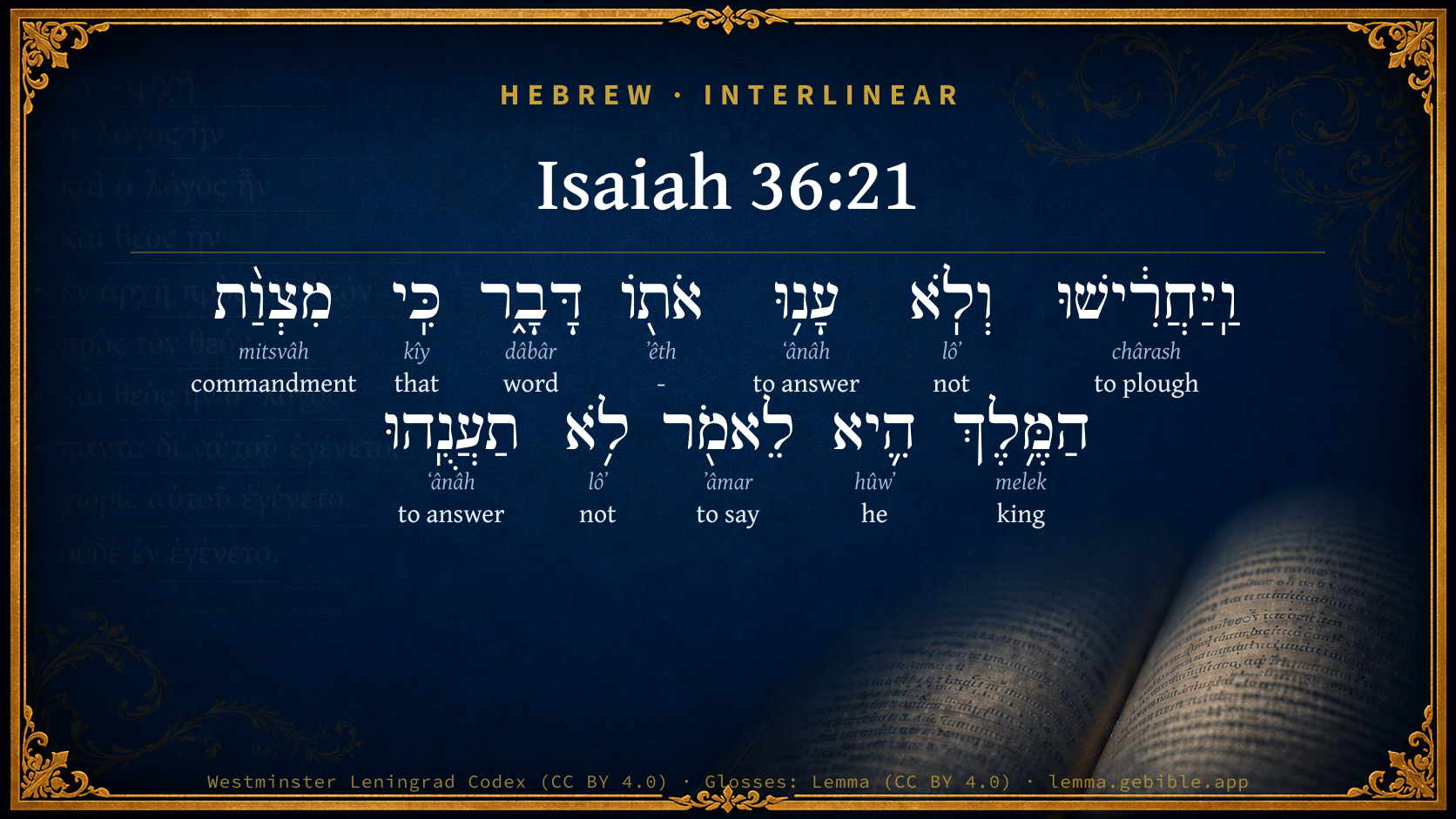
Hebrew (Westminster Leningrad Codex) Isaiah 36:21 appears in the Hebrew Old Testament. The text above is from the Westminster Leningrad Codex. Each word links to its Strong’s number, a concise gloss, and parsing drawn from the Open Scriptures Hebrew Bible morphology. Click any word for its full Brown-Driver-Briggs (BDB) entry.
Download image
Cite this verse

Isaiah 36:21 (World English Bible). Public Domain. Lemma interlinear Bible study tool, https://lemma.gebible.app/v/isaiah/36/21.

Show BibTeX & RIS
BibTeX
RIS
English Translation
But they held their peace, and answered him not a word; for the king's commandment was, saying, Don't answer him.
World English Bible · Public Domain
Download a study sheet

One document with this verse’s original text, its word-by-word gloss line, the meaning frame, cross-references with their text, attributed commentary, and full source and license credits — printable, and it pastes into notes with its structure intact.

This verse Autodidact and up

Study sheet (.html) Plain text (.txt)

A passage Seminary Student

Up to 50 verses in one chapter. A passage sheet keeps up to 6 commentary sources and 12 cross-references per verse, in the order this page ranks them, and says so on the sheet whenever that leaves anything out. Ask for a single verse and you get the Autodidact verse sheet above.

Everything on this page stays free to read, with no account — the sheet is a download of what is already on screen, not access to it.

Want to remove ads? Support Godless Engineer
Compare translations 3

The same verse in 3 English versions, stacked beneath the original-language interlinear above. Click any original word for its lexicon entry.

Each is an independent rendering of the whole verse — the interlinear is not word-aligned to these translations.

Highlighted words mark where these versions differ — a whole-verse word diff, not a word-by-word alignment.

  • World English Bible Public Domain
    But they held their peace, and answered him not a word; for the king's commandment was, saying, Don't answer him.
  • King James Version Public Domain
    But they held their peace, and answered him not a word: for the king's commandment was, saying, Answer him not.
  • unfoldingWord Literal Text CC BY-SA 4.0
    But they were silent and did not answer him a word, for it a commandment of the king, saying, “You shall not answer him.”

unfoldingWord Literal Text — © unfoldingWord, licensed CC BY-SA 4.0. Word-aligned USFM3 via Door43 (git.door43.org/unfoldingWord/en_ult).

Versions to compare (up to 4)

3 of 4 selected

Show all 18 translations

Every available English version of this verse, each an independent rendering of the whole verse.

  • World English Bible Public Domain
    But they held their peace, and answered him not a word; for the king's commandment was, saying, Don't answer him.
  • Berean Standard Bible Public Domain
    But the people remained silent and did not answer a word, for Hezekiah had commanded, “Do not answer him.”
  • Majority Standard Bible Public Domain
    But the people remained silent and did not answer a word, for Hezekiah had commanded, “Do not answer him.”
  • King James Version Public Domain
    But they held their peace, and answered him not a word: for the king's commandment was, saying, Answer him not.
  • American Standard Version (1901) Public Domain
    But they held their peace, and answered him not a word; for the king's commandment was, saying, Answer him not.
  • Revised Version (1885) Public Domain
    But they held their peace, and answered him not a word: for the king’s commandment was, saying, Answer him not.
  • Geneva Bible (1599) Public Domain
    Then they kept silence, and answered him not a worde: for the Kings commandement was, saying, Answere him not.
  • Douay-Rheims (1899) Public Domain
    And they held their peace, and answered him not a word. For the king had commanded, saying: answer him not.
  • Young's Literal Translation Public Domain
    And they keep silent, and have not answered him a word, for a command of the king is, saying, `Do not answer him.'
  • Literal Standard Version CC BY-SA 4.0
    And they keep silent, and have not answered him a word, for a command of the king is, saying, “Do not answer him.”
  • Unlocked Literal Bible CC BY-SA 4.0
    But the people remained silent and did not respond, for the king's order was, “Do not answer him.”
  • unfoldingWord Literal Text CC BY-SA 4.0
    But they were silent and did not answer him a word, for it a commandment of the king, saying, “You shall not answer him.”
  • Darby Bible Public Domain
    And they were silent, and answered him not a word; for the king's command was, saying, Answer him not.
  • World Messianic Bible Public Domain
    But they remained silent, and said nothing in reply, for the king’s commandment was, “Don’t answer him.”
  • Webster's Bible Public Domain
    But they held their peace, and answered him not a word: for the king's commandment was, saying, Answer him not.
  • Free Bible Version CC BY-SA 4.0
    But the people remained silent and didn't say anything, for Hezekiah had given the order, “Don't answer him.”
  • Bible in Basic English Public Domain
    But they kept quiet and gave him no answer: for the king's order was, Give him no answer.
  • JPS Tanakh (1917) Public Domain
    But they held their peace, and answered him not a word; for the king's commandment was, saying: 'Answer him not.'

Literal Standard Version (2020), Covenant Press — licensed CC BY-SA 4.0. Text via the HelloAO Bible API (eBible.org). Unlocked Literal Bible (unfoldingWord) — licensed CC BY-SA 4.0. Text via the HelloAO Bible API (eBible.org). unfoldingWord Literal Text — © unfoldingWord, licensed CC BY-SA 4.0. Word-aligned USFM3 via Door43 (git.door43.org/unfoldingWord/en_ult). Free Bible Version, Dr. Jonathan Gallagher — licensed CC BY-SA 4.0. Text via the HelloAO Bible API (eBible.org).

Word by word

More ways to search: Search by grammar → Find every occurrence → Compare this word →

Practice this passage: Drill this verse → Learn its vocabulary →

וַֽיַּחֲרִ֔ישׁוּ
chârash
H2790
“and · to plough”
Conjunction + Verb, Hiphil, Sequential Imperfect, 3rd Person, Masculine, Plural
Part of Speech
Conjunction + Verb
Stem
Hiphil
Form
Sequential Imperfect
Person
3rd Person
Gender
Masculine
Number
Plural
Full BDB Definition

Origin: a primitive root

TWOT: 760 , 761

to cut in, plough, engrave, devise - (Qal) - to cut in, engrave - to plough - to devise - (Niphal) to be ploughed - (Hiphil) to plot evil - to be silent, be dumb, be speechless, be deaf - (Qal) - to be silent - to be deaf - (Hiphil) - to be silent, keep quiet - to make silent - to be deaf, show deafness - (Hithpael) to remain silent
  1. וְלֹֽא lôʼ H3808 “and · not” Conjunction + Particle, Negative
  2. עָנ֥וּ ʻânâh H6030 “to answer” Verb, Qal, Perfect, 3rd Person, Common, Plural
  3. אֹת֖וֹ ʼêth H853 “- · him” Particle, Direct Object + Suffix, Personal, 3rd Person, Masculine, Singular
  4. דָּבָ֑ר dâbâr H1697 “word” Noun, Common, Masculine, Singular, Absolute
  5. כִּֽי kîy H3588 “that” Conjunction
  6. מִצְוַ֨ת mitsvâh H4687 “commandment of” Noun, Common, Feminine, Singular, Construct
  7. הַמֶּ֥לֶךְ melek H4428 “the · king” Particle, Definite Article + Noun, Common, Masculine, Singular, Absolute
  8. הִ֛יא hûwʼ H1931 “he” Pronoun, Personal, 3rd Person, Feminine, Singular
  9. לֵאמֹ֖ר ʼâmar H559 “to say” Preposition + Verb, Qal, Infinitive Construct
  10. לֹ֥א lôʼ H3808 “not” Particle, Negative
  11. תַעֲנֻֽהוּ ʻânâh H6030 “to answer · him” Verb, Qal, Imperfect, 2nd Person, Masculine, Plural + Suffix, Personal, 3rd Person, Masculine, Singular

About this verse

These counts appear in no published source. They are computed here, from the morphology-tagged text and Lemma’s own curated glosses. What Lemma adds →

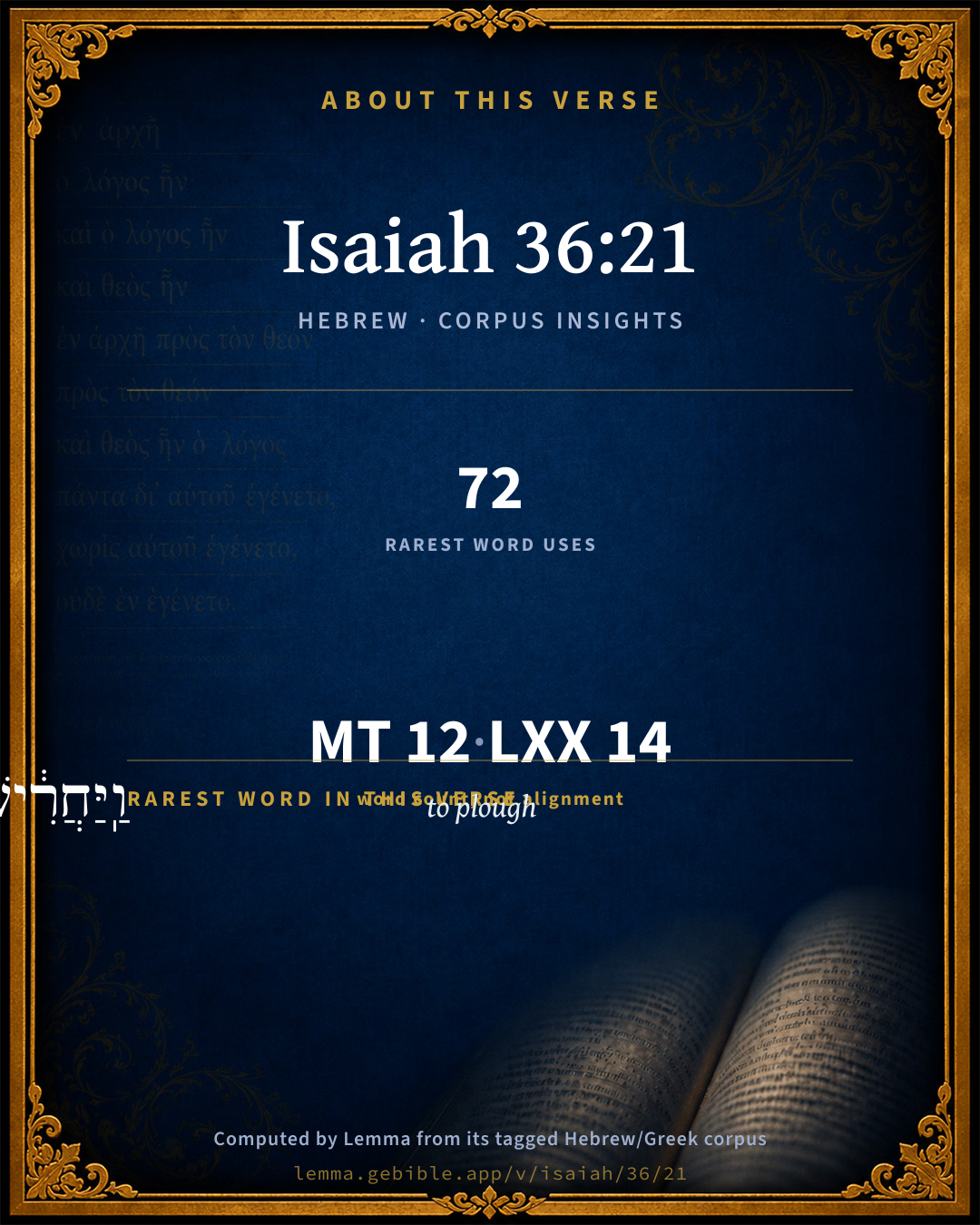
12
words
10
distinct lemmas
Prophets
section

Grammatical profile

  • 4 verbs
  • 3 nouns
  • 1 pronoun
  • 1 conjunction
  • 3 particles

Verb forms

  • וַֽיַּחֲרִ֔ישׁוּ Hiphil · Sequential Imperfect
  • עָנ֥וּ Qal · Perfect
  • לֵאמֹ֖ר Qal · Infinitive Construct
  • תַעֲנֻֽהוּ Qal · Imperfect

Repetition

Words recur within this verse — often emphatic in Hebrew:

  • עָנ֥וּ to answer H6030 ×2
  • וְלֹֽא not H3808 ×2

Hebrew & Septuagint length

In English translation the verse runs 20 words from the Hebrew and 19 from the Septuagint (LXX English) — closely comparable.

A rough comparison of the two English renderings, which tokenize alike — not a word-level alignment.

Word counts can differ between the Hebrew and the Greek without any difference in meaning — e.g. the Hebrew direct-object marker אֵת has no separate Greek word, and Greek often adds the article ὁ.

In the original languages it is 12 Hebrew tokens and 14 Greek tokens — but the two are counted differently (Hebrew bundles its prefixes and suffixes into one token; the Greek is in lemma form), so that isn’t a like-for-like length.

Cross-references

8

Topical passages linked to Isaiah 36:21 in the Treasury of Scripture Knowledge — connected by theme and wording, ordered by reader-vote popularity; previews shown in the World English Bible.

  • Proverbs 26:4 Don't answer a fool according to his folly, Lest you also be like him.
  • 2 Kings 18:26 Then said Eliakim the son of Hilkiah, and Shebnah, and Joah, to Rabshakeh, Please speak to your servants in the Syrian language; for we understand it: and don't speak with us in the Jews' language, in the ears of the people who are on the wall.
  • 2 Kings 18:37 Then came Eliakim the son of Hilkiah, who was over the household, and Shebna the scribe, and Joah the son of Asaph the recorder, to Hezekiah with their clothes torn, and told him the words of Rabshakeh.
  • Psalms 38:13–15 But I, as a deaf man, don't hear. I am as a mute man who doesn't open his mouth.
  • Psalms 39:1 I said, "I will watch my ways, so that I don't sin with my tongue. I will keep my mouth with a bridle while the wicked is before me."
  • Proverbs 9:7–8 He who corrects a mocker invites insult. He who reproves a wicked man invites abuse.
  • Amos 5:13 Therefore he who is prudent shall keep silence in such a time; For it is an evil time.
  • Matthew 7:6 "Don't give that which is holy to the dogs, neither throw your pearls before the pigs, lest perhaps they trample them under their feet, and turn and tear you to pieces.

Cross-references courtesy of OpenBible.info (CC BY 4.0).

Hebrew and Greek witnesses Masoretic Hebrew ↔ Greek Septuagint

The same verse in the two great witnesses to the Old Testament, shown verse-for-verse.

These are two independent witnesses, not word-aligned to each other, and the Septuagint is shown in lemma (dictionary) form.

Hebrew Isaiah 36:21 Masoretic · Westminster Leningrad Codex

וַֽיַּחֲרִ֔ישׁוּ וְלֹֽא עָנ֥וּ אֹת֖וֹ דָּבָ֑ר כִּֽי מִצְוַ֨ת הַמֶּ֥לֶךְ הִ֛יא לֵאמֹ֖ר לֹ֥א תַעֲנֻֽהוּ

But they held their peace, and answered him not a word; for the king's commandment was, saying, Don't answer him.

World English Bible · Public Domain

Greek LXX Isaiah 36:21 Septuagint · lemma form

καί σιωπάω καί οὐδείς ἀποκρίνω αὐτός λόγος διά ὁ προςτάσσω ὁ βασιλεύς μηδείς ἀποκρίνω

And they were silent, and none answered him a word; because the king had commanded that none should answer.

LXX2012 (modern English Septuagint) · Public Domain

Hebrew: Westminster Leningrad Codex (CC BY 4.0). Greek: Septuagint (public domain); English from LXX2012 (modern English Septuagint) (Public Domain). How the Septuagint differs from the Hebrew →

Targum (Aramaic paraphrase)

1

The Targum is the ancient Jewish Aramaic paraphrase of the Hebrew Scriptures — an interpretive translation, not the Hebrew text itself. Onkelos (literal) and Pseudo-Jonathan (expansive) render the Torah, and Jonathan the Prophets. Coverage is partial: where no permissively-licensed English translation exists for a verse, only the Aramaic is shown. This is verse-level text, not a word-by-word alignment to the Hebrew.

  1. Targum Jonathan Prophets (Joshua–Malachi)
    וּשְׁתִיקוּ וְלָא אָתִיבוּ יָתֵהּ פִּתְגָמָא אֲרֵי תַפְקִידַת מַלְכָּא הִיא לְמֵימָר לָא תֵתִיבוּנֵהּ:

    But they held their peace, and answered him not a word: for the king's commandment was, saying, Answer him not.

    Targum Jonathan — Aramaic: “Mikraot Gedolot” (public domain). English: “Sefaria Community Translation” (CC0 1.0 (public-domain dedication)); “London "Chaldee Paraphrase," 1871” (public domain). Text via Sefaria.

Commentary

Notes on Isaiah 36:21 from classic Christian and Jewish commentators (each source and its license shown beneath its notes). The classic Christian expositions comment on the surrounding passage and are grouped to its opening verse, so a note may address several verses; the Jewish commentaries on the Tanakh (Rashi and others) are per-verse, so they appear only where the commentator wrote on this verse.

Lemma curates 59 commentaries, every one of them public domain or Creative Commons licensed, each selected and text-cleaned for this edition rather than reprinted as found. About our sources →

The Preacher's Complete Homiletical Commentary

Joseph S. Exell (gen. ed.)

HEZEKIAH’S PRUDENT SILENCE

Isa_36:21. But they held their peace, &c.

Dr. Geikie says of Hezekiah, “Ready for war when necessary, and alike brave and skilful in its conduct, he was more inclined to the gentle arts of peace.” Among these “gentle arts” should be reckoned his cultivated gift of prudence. Prudence is undervalued by some, as not taking rank among the higher virtues, and even sometimes decried as essentially selfish. But prudence guards the life of the highest virtue, and thus becomes of almost equal importance with it. Prudence is short for “providence;” “the provident man,” as the phrase is used, shows prudence in one direction, and is praised for it. Greater praise is surely due to the all-round prudent man. Prudence in man is, in one aspect, but the counterpart of providence in God, and those who are given to esteem it lightly are not pious, like Hezekiah, but already doubters of, and disbelievers in, the general and special providence of God, or likely to become so (P. D. 2914).

It is prudent to be silent—

1. When the judgment, based upon the knowledge of available facts, dictates silence as sound policy. Silence may, and often does, imply something quite different from a wisely calculated policy; it may indicate abject fear, cowardice, indifference. All silence is not “golden;” sometimes the basest metal goes to its composition. The order to be silent, whether addressed by Hezekiah to his ambassadors, or to the people generally, or to both, may be conjectured to have sprung from the king’s desperate case. But even if we leave out this element, enough remains to justify the command, “Answer him not.” It may be presumed that the messenger of the “great king,” “dressed in a little brief authority,” conducted himself as Hezekiah foresaw he would, outdoing Sennacherib himself in blasphemy and all impiety. “A prudent man foreseeth the evil, and hideth himself.” Hezekiah did this in the most literal sense, and his command to all concerned was to hide the spirit of their mind behind a veil of silence. Such prudence, then, is more than foresight, it is foresight connecting itself with a certain course of action as the wisest or best possible in certain given circumstances (P.D. 3086, 3089). How rare is such prudence! Not from evil intent, but through want of thought, do many persist in running their heads against adamant. Available knowledge is neglected, and judgment, where there is any in such a case, is adrift and mistaken.

2. When the deepest feelings are agitated so as to be beyond immediate control. Hezekiah’s ambassadors obeyed their orders until Rabshakeh uttered words the effect of which upon the people there was good reason to dread (Isa_36:10); then they broke in, carried on a great wave of impulse (Isa_36:11); but only to make the blasphemer more arrogantly insolent. Feeling, like fire, is a good servant but a bad master; it is blind, and blindly seeks its own objects. Only in the most highly educated moral natures can it ever be expected to flow in proper channels; but in none should it be intrusted with the reins of government. “I will keep my mouth with a bridle,” said the Psalmist, “while the wicked is before me” (cf. Jas_1:19-20; Jas_1:26).

3. When wise counsel is at hand (Isa_37:1-2). “Hezekiah went into the house of the Lord;” “and he sent Eliakim unto Isaiah the prophet.” There is a kind of piety which disdains human aid, because each man may go direct to God. This may not have wrought so much harm in the world as the Romish doctrine of mediators, but it is equally mistaken. Blessed is the man who knows of a prophet—a brother-man of spiritual insight, moral integrity, and Christian courtesy—before whom he can lay his case! Thrice blessed he who, knowing such an one, can hold his peace until he has sought and obtained the Heaven—provided help! God may well hold us insincere if we go to Him and neglect His servants’ aid.

CONCLUSION.—Let us hear and understand the words of the preacher: “There is a time to keep silence,” as well as “a time to speak.” We are lacking in silence and reserve. Silence is a glorious temple, but in it there are few worshippers. Be it ours to wait and worship there!

The worshippers find the very walls translucent, the rays of heaven descend in unbroken brightness there. Silence is the birthplace of the world’s progress, and from the rays of truth that flash into it are born the grand visions of the prophets of God, and kingly purposes too; and from these are forged the weapons with which men shall sweep away the hindrances to all wisdom.—J. Macrae Simcock.

The Preacher's Complete Homiletical Commentary (gen. ed. Joseph S. Exell; Funk & Wagnalls, c. 1892) — public domain (pre-1929). A full-Bible homiletical/sermon-outline anthology covering 65 of 66 books (2 John is absent from the source module). Text from a community e-Sword module.

Geneva Bible (1599)

Geneva Bible translators

Not that they did not show by evident signs that they did detest his blasphemy: for they had now rent their clothes, but they knew it was in vain to use long reasoning with this infidel, whose rage they should have so much more provoked.

Geneva Bible (1599) marginal notes — public domain. Text via Bolls.life.

Jamieson, Fausset & Brown

Robert Jamieson, A. R. Fausset & David Brown

not a word--so as not to enter into a war of words with the blasphemer (Exo 14:14; Jde 1:9).

Jamieson, Fausset & Brown — Commentary Critical and Explanatory on the Whole Bible (1871) — public domain (CC PDM 1.0). Text via the HelloAO Bible API.

Adam Clarke's Commentary

Verse 21. But they held their peace - "But the people held their peace"] The word העם haam, the people, is supplied from the other copy, and is authorized by a MS. which inserts it after אתו otho.

Adam Clarke's Commentary on the Bible (1810–1826) — public domain. Text from a community e-Sword/MySword module.

Ellicott's Commentary for English Readers

(21) But they held their peace . . .—Hezekiah seems to have commanded silence, as if distrustful either of the wisdom of the ambassadors or of the effect which any chance words might have upon the garrison and people of Jerusalem. As it was, the only words they had spoken (Isa_36:11) had made matters infinitely worse.

A Bible Commentary for English Readers, edited by Charles John Ellicott (1878–1897) — public domain. Text from a community e-Sword module.

The Cambridge Bible for Schools and Colleges

gen. ed. J. J. S. Perowne

21. they held their peace] i.e. the people on the wall, as is expressed in 2Ki_18:36.

Isa_37:1-4. Hezekiah, thrown back at last on the policy of faith consistently advocated by Isaiah, sends an influential deputation to the prophet, entreating him to intercede for the nation in this extremity. (Cf. 2Ki_12:12-14; Jer_37:3) The king’s message could not fail to be interpreted as a public confession of the utter failure of the policy which had landed him in such a desperate situation.

The Cambridge Bible for Schools and Colleges (gen. ed. J. J. S. Perowne; Cambridge University Press, 1878–1918) — public domain. Text from a community e-Sword module.

John Gill's Exposition

But they held their peace, and answered him not a word,.... The three ministers of Hezekiah; not as confounded, and unable to return an answer: they were capable of saying many things in proof that the Lord God was greater than the gods of the nations, and in favour of their king, Hezekiah, whom he had treated in a scurrilous manner; and could have objected to him the king of Assyria's breach of faith and honour, but these things they waved, and said nothing of; no doubt they said something to him, had some conference with him, or otherwise what were they sent as commissioners about? but they made no answer to his blasphemies and menaces:

for the king's commandment was, saying, answer him not: with respect to the above things; when he sent them, he might be aware that he would behave in such a rude, insolent, and blaspheming manner, and therefore the king gave them instructions how to conduct themselves, should this be the case. Musculus thinks the king was on the wall, and heard all himself, and gave orders to his ministers to make no reply; but this does not seem likely; what is here said of the ministers is also said of the people, Kg2 18:36.

John Gill's Exposition of the Whole Bible (1746–1763) — public domain (CC PDM 1.0). Text via the HelloAO Bible API.

Albert Barnes' Notes on the Bible

But they held their peace - Hezekiah had commanded them not to answer. They were simply to hear what Rabshakeh had to propose, and to report to him, that he might decide on what course to pursue. It was a case also in which it was every way proper that they should be silent. There was so much insolence, self-confidence, blasphemy, the proposals were so degrading, and the claims were so arrogant, that it was not proper that they should enter into conference, or listen a moment to the terms proposed. Their minds also were so horror-stricken with the language of insolence and blasphemy, and their hearts so pained by the circumstances of the city, that they would not feel like replying to him. There are circumstances when it is proper to maintain a profound silence in the presence of revilers and blasphemers, and when we should withdraw from them, and go and spread the case before the Lord. This was done here Isa 37:1, and the result showed that this was the course of wisdom.

Albert Barnes' Notes on the Bible (1834–1885) — public domain. Text from a community e-Sword/MySword module.

The Pulpit Commentary

They (i.e. the people, as in 2Ki_18:36) held their peace. Rabshakeh"s attempt to shake their fidelity had, at any rate, no manifest effect. For the king"s commandment was, saying, Answer him not. Hezekiah can scarcely have anticipated that Rabshakeh would so far depart from ordinary usage as to make a speech to "the men on the wall." But he may have been in the immediate neighbourhood, and, when apprised of the envoy"s proceedings, may have sent the order. We are not to suppose that the Jewish king was at a loss for an answer. He did not choose to bandy words with an envoy who had behaved himself so outrageously.

Silence the best answer to many an argument.

"Speech is silvern," it has been said; "but silence is golden." "Answer not a fool according to his folly," says the wise king (Pro_26:4) an injunction no doubt balanced to some extent by the counter-phrase, "Answer a fool according to his folly which immediately follows. (Pro_26:5) into universal rule can be given. "There is a time to speak, and a time to keep silence"; (Ecc_3:7) and the wisdom of the wise is shown in few things more strikingly than in their faculty of discerning the right time for each. But the tendency to err is on the side of speech, and the practical want with most men is to know when they should refrain from uttering the words which rush so readily to their lips; and keep silence, "though it be pain and grief to them". (Psa_39:2, Prayer-book version) A few suggestions on this point may be serviceable.

I SILENCE IS TO BE PREFERRED TO SPEECH WHEN THE "FOOL" IS ALONE, AND IS EVIDENTLY AWARE OF THE WORTHLESSNESS OF HIS OWN ARGUMENTS. Great numbers of persons argue merely for the sake of arguing, having no care for truth, and no belief in the validity of their own reasonings. It is a waste of time to argue with such; they have no real convictions, no seriousness; and it is impossible to impress them, however clearly we prove them to be in the wrong.

II SILENCE IS TO RE PREFERRED TO SPEECH WHEN WE HAVE REASON TO BELIEVE THAT SPEECH ON OUR PART WILL ONLY DRAW FORTH IMPIETY AND BLASPHEMY FROM OUR OPPONENTS. The principle here is that involved in our Lord"s injunction: "Give not that which is holy unto the dogs, neither cast ye your pearls before swine". (Mat_7:6) The truth is desecrated by being put before persons wholly unfit for it, as avowed infidels and blasphemers. They are provoked by opposition to further sins, which are an offence to God, injurious to themselves, and shocking to others.

III SILENCE IS TO BE PREFERRED TO SPEECH WHEN WE FEEL OURSELVES ILL EQUIPPED FOR CONTROVERSY, AND KNOW THE GAINSAYER TO BE WELL EQUIPPED. It is difficult to estimate the injury done to the cause of truth by well-meaning persons, of little natural ability and less acquired learning, who attempt to answer the attacks of well-read and clever sceptics. The best cause may be not only injured, but lost, so far as the immediate occasion goes, by the unskilfulness of its advocates. Ordinary unlearned persons should decline to argue with educated unbelievers, and refer them to those skilled defenders of the truth, who have never been lacking in any age, and who are numerous in the present. In a court of justice a man is regarded as a fool who pleads his cause in person against a professional lawyer. He should equally decline to plead the cause of religion against a professional impugner of it.

The strength of silence.

"They held their peace, and answered him not a word." The readiest thing is to meet taunt with taunt, and rouse each other"s worst passions with mutual recriminations. The noblest thing is to meet undeserved and unworthy reproach and insult with the dignified silence which is born of trust in God as our Vindicator. But worthy silence must be carefully distinguished from the dumbness of the sulky temperament, which is a sign of the uncultured and ungoverned nature. We should never confuse the silence of stupidity with the silence of self-restraint. Matthew Henry quaintly and wisely says, "It is sometimes prudent" not to answer a fool according to his folly. "These Jews had reason enough on their side, but it would be hard to speak it to such an unreasonable adversary without a mixture of passion; and, if they should fall a-railing like him, Rabshakeh would be much too hard for them at that weapon." Fixing attention on the two facts that the people kept silence, and that they did so in obedience to Hezekiah, we get the following two points for illustration.

I SILENCE IN AN EVIL TIME INDICATES SELF-MASTERY. Remember what the Apostle James says of the unruliness of the tongue. Observe how readily we are excited to answer again. Recall the anxiety of the psalmist about keeping the door of his lips. Notice how speakers are carried to the utterance of imprudent things by the heat of discussion. Estimate the mischief done by careless, cruel, or passionate words. And see the sublime example of our Lord when on his trial. "He answered nothing" "He held his peace." This last expression suggests that silence is a sign of strength of will; the man who can keep silence is master of his actions, and master of himself Silence is oftentimes, in its effect, the truest and most powerful speech. It shames men; it quiets men; it reproaches men; it conquers the opposition of men; it shows the right to all bystanders and onlookers. It has been said that there is such a thing as a "Divine dumbness;" and Carlyle calls "speech silver, silence golden." The sublime self-mastery of Heaven is suggested in the declaration that "there was silence in heaven about the space of half an hour.

II SILENCE IN A PUBLIC EVIL TIME SHOWS POWER OF COMMAND OVER OTHERS. It was a great thing for Hezekiah to keep silence himself; anti it was a great thing also for him to command silence in the people. Only the man who can control himself can ever have the power to control others. Illustrations of the importance of this power of checking speech in others may be taken from family life and Church life. It is of special value in excited, irritating, quarrelsome times. R.T.

The Pulpit Commentary (1880–1919), ed. H.D.M. Spence-Jones & Joseph S. Exell — public domain. Text from a community e-Sword module.

Keil & Delitzsch

C. F. Keil & F. Delitzsch

The effect of Rabshakeh's words. "But they held their peace (K. and they, the people, held their peace), and answered him not a word; for it was the king's commandment, saying, Ye shall not answer him. Then came Eliakim son of Hilkiyahu (K. Hilkiyah), the house-minister, and Shebna the chancellor, and Joah son of Asaph, the recorder, to Hizkiyahu, with torn clothes, and told him the words of Rabshakeh." It is only a superficial observation that could commend the reading in Kings, "They, the people, held their peace," which Hitzig and Knobel prefer, but which Luzzatto very properly rejects. As the Assyrians wished to speak to the king himself (Kg2 18:18), who sent the three to them as his representatives, the command to hear, and to make no reply, can only have applied to them (and they had already made the matter worse by the one remark which they had made concerning the language); and the reading ויּחרישׁוּ in the text of Isaiah is the correct one. The three were silent, because the king had imposed the duty of silence upon them; and regarding themselves as dismissed, inasmuch as Rabshakeh had turned away from them to the people, they hastened to the king, rending their clothes, in despair and grief and the disgrace they had experienced.

Keil & Delitzsch — Biblical Commentary on the Old Testament (1861–1891) — public domain (CC PDM 1.0). Text via the HelloAO Bible API. (Old Testament only.)

J. A. Alexander on Isaiah

Joseph Addison Alexander

“And they held their peace, and did not answer him a word, for such was the commandment of the king, saying, Ye shall not answer him.” Then came Eliakim, Hilkiah’s son, who (was) over the house, and Shebna the scribe, and Joah, Asaph’s son, the recorder, unto Hezekiah, with their clothes rent (literally, rent of clothes), and told him the words of Rabshakeh. Some of the older writers understand the rending of their garments as a mere sign of their horror at Rabshakeh’s blasphemies: some of the moderns as a mere sign of despondency and alarm at the impending dangers; whereas both may naturally be included.

Joseph Addison Alexander, The Prophecies of Isaiah (1846–1847; New York: Scribner, 1870–1878) — public domain. Text from a community e-Sword module.

Kretzmann's Popular Commentary

Paul E. Kretzmann

Isaiah’s Prophecy and its Fulfillment

v. 21. Then, after Hezekiah had laid his matter before the Lord in prayer, Isaiah, the son of Amoz, sent unto Hezekiah, saying, Thus saith the Lord God of Israel, Whereas thou hast prayed to Me against Sennacherib, king of Assyria:

v. 22. this is the word which the Lord hath spoken concerning him, and therefore the plan which would be carried into effect: The virgin, the daughter of Zion, Jerusalem with its in habitants, as representing the Church of God, hath despised thee and laughed thee to scorn; the daughter of Jerusalem hath shaken her head at thee, namely, in derision, as she looked after the Assyrian, who was forced to retreat without having accomplished his object. The reason for this change of fortunes is now stated:

v. 23. Whom hast thou reproached and blasphemed, and against whom hast thou exalted thy voice, in boastful mockery, and lifted up thine eyes on high? in a gesture of supercilious contempt. Even against the Holy One of Israel. That is where Sennacherib had made his mistake, in directing his blasphemous scorn against the true God, who is jealous of His honor.

v. 24. By thy servants, Rabshakeh and his companions, hast thou reproached the Lord and hast said, By the multitude of my chariots am I come up to the height of the mountains, to the sides of Lebanon, thus relying entirely upon his own strength; and I will cut down the tall cedars thereof, the finest trees of the mighty forests, and the choice fir-trees thereof, the splendid cypresses to be found there; and I will enter into the height of his border, and the forest of his Carmel, the most luxuriant part of his forest. The reference, as has been repeatedly noted, is not only to the occupation of the Lebanon district by the Assyrian forces, but there is also a hint here of Sennacherib’s plan to conquer Jerusalem with its Temple, whose buildings were largely constructed of cedars and cypresses from Lebanon.

v. 25. I have digged and drunk water, so the boast of Sennacherib went on, and with the sole of my feet have I dried up all the rivers of the besieged places, that is, where water was lacking, he had his men provide it, and where streams hindered his progress, he had but to call upon the resources at his command and the waters were diverted. Over against this proud boasting of the Assyrian concerning his own might the prophet explains that he was but the tool in the hands of God.

v. 26. Hast thou not heard long ago how I have done it, the Lord Himself having planned this punishment for the purposes of His mercy, and of ancient times, that I have formed it? everything being ordered in accordance with His plans. Now have I brought it to pass that thou shouldest be to lay waste defensed cities into ruinous heaps, the Lord having decided upon their destruction in order to call their inhabitants to repentance, if possible.

v. 27. Therefore their inhabitants were of small power, helpless before the invaders; they were dismayed and confounded, rendered powerless by terror; they were as the grass of the field and as the green herb, as the grass on the housetops, with but a thin layer of soil, and as corn blasted before it be grown up, such vegetation being unable to withstand even a moderate amount of blasting winds. The prophecy now turns directly against Sennacherib.

v. 28. But I know thy abode, namely, when he is at home, and thy going out, and thy coming in, and thy rage against Me, the entire course of Sennacherib’s life being known to the Lord, also the preparations for the present campaign and its success hitherto.

v. 29. Because thy rage against Me and thy tumult, his proud self-confidence, is come up into Mine ears, therefore will I put My hook in thy nose, as one controls an unruly beast, and My bridle in thy lips, so that he must submit, though unwillingly, and I will turn thee back by the way by which thou camest. The prophet’s message now turns to Hezekiah:

v. 30. And this shall be a sign unto thee, a token whose fulfillment would assure him of the truth of the entire prophecy, Ye shall eat this year such as groweth of itself, volunteer grain; and the second year that which springeth of the same, for the Assyrian invasion had not only destroyed the harvest of the last year, but had also made it impossible to put out the new crop; and in the third year, that is, about one year after the present prophecy, sow ye, this being done in the fall of the year, and reap, and plant vineyards, and eat the fruit thereof, everything being restored to its usual order by that time.

v. 31. And the remnant that is escaped of the house of Judah, those who survived after Sennacherib’s invasion, shall again take root downward and bear fruit upward, be firmly settled once more, for the kingdom of Judah lasted for another century after this prophecy;

v. 32. for out of Jerusalem shall go forth a remnant, those who had found shelter in the city before the advance of the Assyrians, and they that escape out of Mount Zion. The zeal of the Lord of hosts shall do this. There is more than a hint here concerning the rejuvenation of the Messianic period. The Lord now abandons His figurative language and makes a direct statement.

v. 33. Therefore thus saith the Lord concerning the king of Assyria, He shall not come into this city, not subdue it, nor shoot an arrow there, he will not even begin his threatened siege of the city, nor come before it with shields, for the purpose of storming it, nor cast a bank against it, the usual trenches of siege warfare.

v. 34. By the way that he came, by the same shall he return, without accomplishing his object, and shall not come into this city, saith the Lord.

v. 35. For I will defend this city to save it for Mine own sake, to defend His own honor against the bragging of Sennacherib, and for My servant David’s sake, the establishment of whose kingdom was connected with the safety of his capital. Cf 2Ki 20:6.

v. 36. Then the Angel of the Lord, the Son of God, who bears this name throughout the Old Testament, went forth and smote in the camp of the Assyrians a hundred and fourscore and five thousand, the calamity being in the nature of a pestilence or some other similar visitation. And when they, the survivors, arose early in the morning, behold, they, the Assyrians, were all dead corpses, their army had been practically annihilated.

v. 37. So Sennacherib, king of Assyria, departed, he abandoned his campaign, and went and returned, and dwelt at Nineveh, the capital of his empire.

v. 38. And it came to pass, as he was worshiping in the house of Nisroch, his god, one of the chief idols of Assyria, an eagle-headed human figure, that Adrammelech and Sharezer, his sons, smote him with the sword, his own offspring becoming guilty of assassination; and they escaped into the land of Armenia, where they, according to some accounts, established kingdoms of their own. And Esarhaddon, his son, reigned in his stead, who is mentioned Ezr 4:2. "Such was the end of the haughty Sennacherib, who had dared to blaspheme the God of Israel. He who had boasted that no god or people could resist him must fall before the swords of his sons. He that regarded himself unconquerable by the help of his idols must suffer death in the temple, in the presence of his idol!" (Lange. ) Thus the Lord ever upholds the honor of His holy name.

Paul E. Kretzmann, Popular Commentary of the Bible (1921–1924) — public domain. Text from a community e-Sword module.

unfoldingWord translationNotes

Door43 World Missions Community

Eliakim ... Hilkiah ... Shebna ... Joah ... Asaph

Translate the names of these men the same as you did in Isaiah 36:03. (See: How to Translate Names)

over the household

This idiom means that he was in charge of the affairs of the palace household. AT: "in charge of the palace" (See: Idiom)

with their clothes torn

Hezekiah's officials tore their clothes as a sign of mourning and distress. The meaning of this can be made clear. AT: "with their clothes torn because they were extremely distressed" (See: Symbolic Action)

translationWords

king

household

scribe

Hezekiah

word

unfoldingWord translationNotes — © Distant Shores Media and the Door43 World Missions Community, licensed CC BY-SA 4.0. Source: git.door43.org/Door43/en_tn.

Lesson kit

Teaching starters — assembled from the data on this page, not authored interpretation. Every prompt links to the verse data it draws on. Edit before teaching.

Isaiah, in the Prophets, opens this verse with 12 words (10 distinct Hebrew lemmas). Its most distinctive word is chârash (“to plough”). A historical commentator’s framing appears above. Read the whole chapter for the surrounding context.

Discussion questions

  1. How does “to plough” (chârash) shape what this verse is saying?
  2. How does Proverbs 26:4, which shares this passage’s theme, read alongside this verse?
  3. What does the repetition of “to answer” (2× in this one verse) do in this verse?
  4. These translations render this verse differently. What is at stake in choosing one wording over another?
  5. «וַֽיַּחֲרִ֔ישׁוּ» is a Hiphil Sequential Imperfect verb. How does that grammatical form shape the action described?
  6. Compare how The Preacher's Complete Homiletical Commentary and Geneva Bible (1599) read this verse. Where do they agree or differ?

Things to notice

Reading settings

Reading text

Shown beneath each verse's original-language words.

Old Testament
Old Testament edition

Read the OT as the Masoretic Hebrew (MT) or the Greek Septuagint (LXX).

English shown for the Greek Septuagint (in the Hebrew ↔ Greek comparison).

Comparing translations? Open the Compare panel on any verse page to stack up to four side by side.