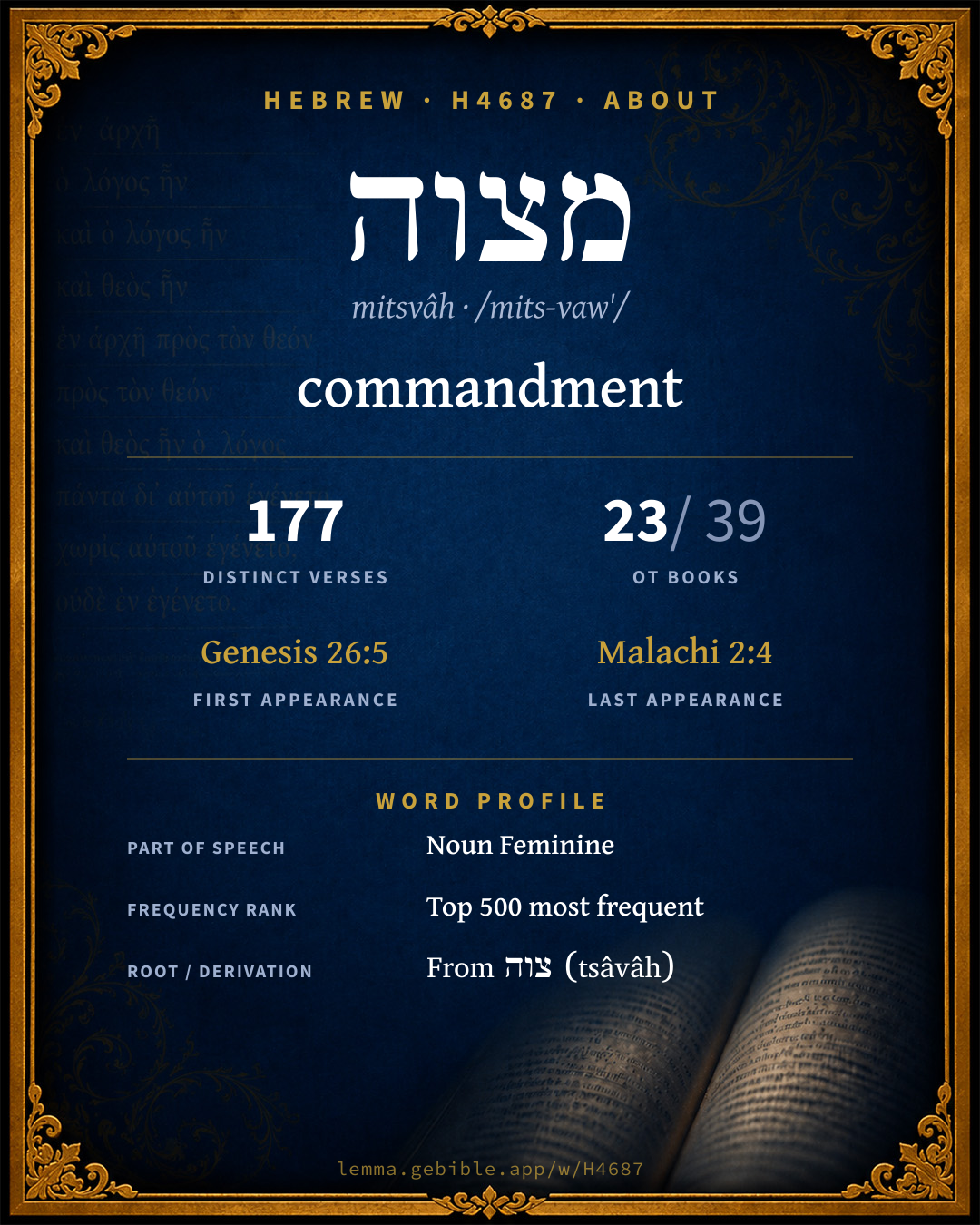
מִצְוָה
commandment
‘commandment’ is one of 4 main senses fuller range ↓
Full lexicon entry — Brown-Driver-Briggs (BDB)
From Brown-Driver-Briggs (BDB)
Where this word appears
See every Construct-state word in the Hebrew Bible →
Grammar key — what these labels mean
Part of speech
- Noun
- A naming word — a person, place, thing, or idea.
Noun type
- Common
- A common noun — a general class of person, place, or thing (“king,” “city,” “water”), not a specific name.
State
- Construct
- A noun bound to a following noun in a possessive / “of” relationship (the construct chain).
- Absolute
- The independent form of a noun, not bound to a following word.
Gender
- Feminine
- Grammatically feminine.
Number
- Plural
- More than one (in Hebrew, generally three or more).
- Singular
- One.
Every verse where H4687 appears in the Book of 2 Chronicles — 18 distinct verses. Click any verse to open its interlinear word-by-word view. Verse text shown in the World English Bible for context — . Each verse’s Hebrew form is shown with its reference; the English is not keyword-highlighted, since the data carries no word-level English alignment. Use “Compare translations” on any verse to read it across multiple English versions. This concordance covers the Hebrew Bible; Septuagint (Greek Old Testament) occurrences are not indexed here.
2 Chronicles
- 2 Chronicles 7:19 וּ/מִצְוֺתַ֔/י conj + n c fp cs + sfx pers 1cs But if you turn away, and forsake my statutes and my commandments which I have set before you, and shall go and serve other gods, and worship them;
- 2 Chronicles 8:13 כְּ/מִצְוַ֣ת prep + n c fs cs even as the duty of every day required, offering according to the commandment of Moses, on the Sabbaths, and on the new moons, and on the set feasts, three times in the year, [even] in the feast of unleavened bread, and in the feast of weeks, and in the feast of tents.
- 2 Chronicles 8:14 מִצְוַ֖ת n c fs cs He appointed, according to the ordinance of David his father, the divisions of the priests to their service, and the Levites to their offices, to praise, and to minister before the priests, as the duty of every day required; the doorkeepers also by their divisions at every gate: for so had David the man of God commanded.
- 2 Chronicles 8:15 מִצְוַ֨ת n c fs cs They didn't depart from the commandment of the king to the priests and Levites concerning any matter, or concerning the treasures.
- 2 Chronicles 14:4 וְ/הַ/מִּצְוָֽה conj + ptcl def.art + n c fs and commanded Judah to seek Yahweh, the God of their fathers, and to do the law and the commandment.
- 2 Chronicles 17:4 וּ/בְ/מִצְוֺתָ֖י/ו conj + prep + n c fp cs + sfx pers 3ms but sought to the God of his father, and walked in his commandments, and not after the doings of Israel.
- 2 Chronicles 19:10 לְ/מִצְוָה֮ prep + n c fs Whenever any controversy shall come to you from your brothers who dwell in their cities, between blood and blood, between law and commandment, statutes and ordinances, you shall warn them, that they not be guilty towards Yahweh, and so wrath come on you and on your brothers: this do, and you shall not be guilty.
- 2 Chronicles 24:20 מִצְוֺ֤ת n c fp cs The Spirit of God came on Zechariah the son of Jehoiada the priest; and he stood above the people, and said to them, Thus says God, Why disobey you the commandments of Yahweh, so that you can't prosper? because you have forsaken Yahweh, he has also forsaken you.
- 2 Chronicles 24:21 בְּ/מִצְוַ֣ת prep + n c fs cs They conspired against him, and stoned him with stones at the commandment of the king in the court of the house of Yahweh.
- 2 Chronicles 29:15 כְ/מִצְוַת prep + n c fs cs They gathered their brothers, and sanctified themselves, and went in, according to the commandment of the king by the words of Yahweh, to cleanse the house of Yahweh.
- 2 Chronicles 29:25 בְּ/מִצְוַ֥ת הַ/מִּצְוָ֖ה prep + n c fs cs ptcl def.art + n c fs He set the Levites in the house of Yahweh with cymbals, with psalteries, and with harps, according to the commandment of David, and of Gad the king's seer, and Nathan the prophet; for the commandment was of Yahweh by his prophets.
- 2 Chronicles 30:6 וּ/כְ/מִצְוַ֥ת conj + prep + n c fs cs So the posts went with the letters from the king and his princes throughout all Israel and Judah, and according to the commandment of the king, saying, You children of Israel, turn again to Yahweh, the God of Abraham, Isaac, and Israel, that he may return to the remnant that have escaped of you out of the hand of the kings of Assyria.
- 2 Chronicles 30:12 מִצְוַ֥ת n c fs cs Also on Judah came the hand of God to give them one heart, to do the commandment of the king and of the princes by the word of Yahweh.
- 2 Chronicles 31:21 וּ/בַ/מִּצְוָ֔ה conj + prep det + n c fs In every work that he began in the service of the house of God, and in the law, and in the commandments, to seek his God, he did it with all his heart, and prospered.
- 2 Chronicles 34:31 מִצְוֺתָי/ו֙ n c fp cs + sfx pers 3ms The king stood in his place, and made a covenant before Yahweh, to walk after Yahweh, and to keep his commandments, and his testimonies, and his statutes, with all his heart, and with all his soul, to perform the words of the covenant that were written in this book.
- 2 Chronicles 35:10 כְּ/מִצְוַ֥ת prep + n c fs cs So the service was prepared, and the priests stood in their place, and the Levites by their divisions, according to the king's commandment.
- 2 Chronicles 35:15 כְּ/מִצְוַ֤ת prep + n c fs cs The singers the sons of Asaph were in their place, according to the commandment of David, and Asaph, and Heman, and Jeduthun the king's seer; and the porters were at every gate: they didn't need to depart from their service; for their brothers the Levites prepared for them.
- 2 Chronicles 35:16 כְּ/מִצְוַ֖ת prep + n c fs cs So all the service of Yahweh was prepared the same day, to keep the Passover, and to offer burnt-offerings on the altar of Yahweh, according to the commandment of king Josiah.
About this entry
At a glance — auto-summarized from this page’s data, not written by a person. Every figure links to its source below. This summary describes the numbers; it doesn’t interpret them.
At its core, מצוה (mitsvâh) means “commandment.” Not a single-sense word: explore its full sense range. It appears 177 verses across 23 books of the Hebrew Bible, among its common vocabulary. Scripture first uses it in Genesis 26:5. It clusters with צוה, צו and צי under a shared root. Dig into 177-verse concordance and the renderings breakdown below.
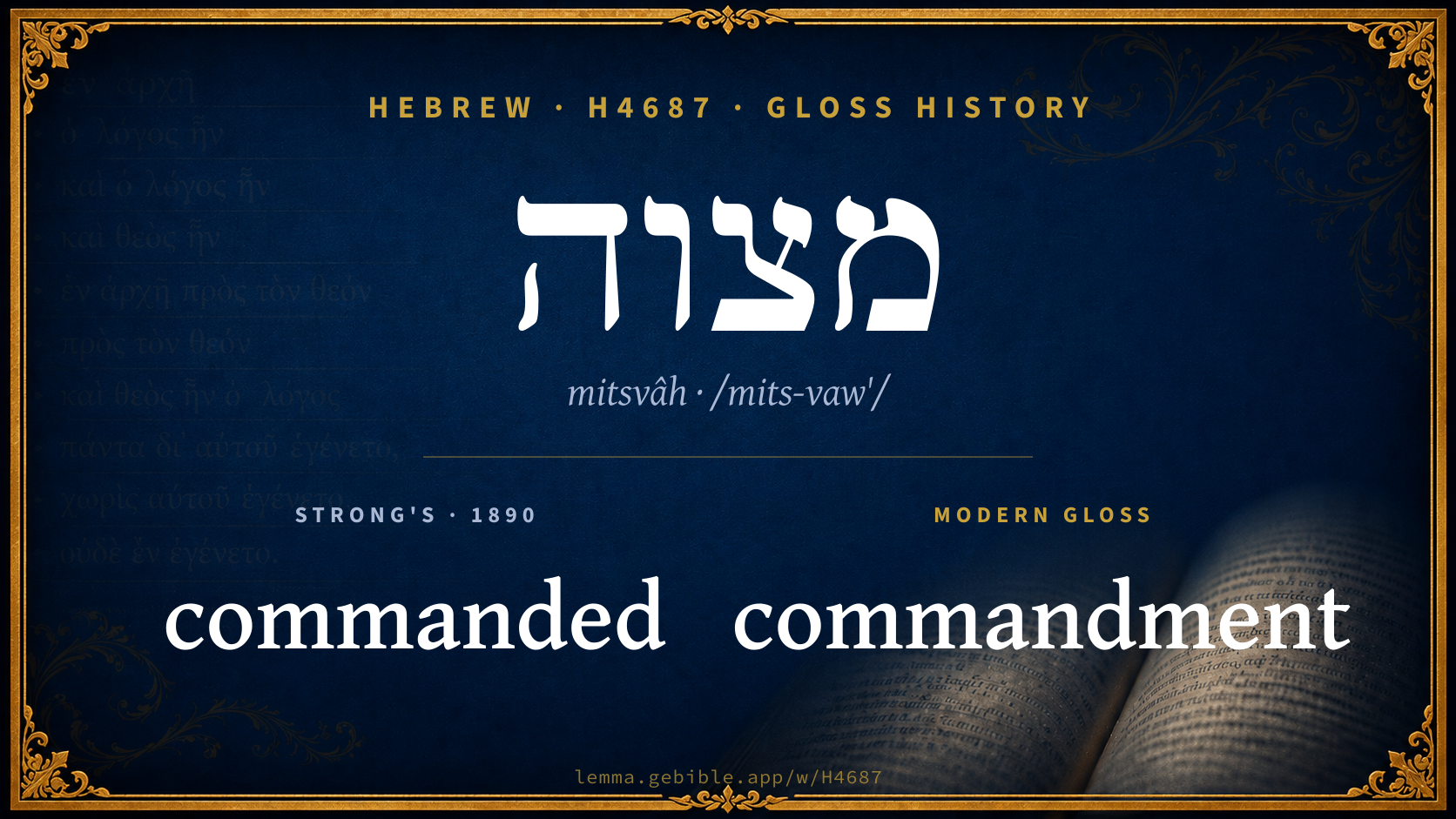
Gloss history
Strong's 1890 vs modern scholarship
About this word
Strong's H4687 catalogs a Hebrew word from the Hebrew Old Testament.
These counts are not copied from any lexicon or concordance. They are computed here, from the morphology-tagged Hebrew Old Testament. What Lemma adds →
- 177
- distinct verses
- The word appears in 177 distinct verses.
- 23 / 39
- OT books
- The word appears in 23 of 39 Old Testament books.
- #254
- by frequency
- Top 500 most frequent Hebrew words (rank 254 of 8,640 Hebrew words by occurrence).
View all 177 occurrences in the concordance →
Most concentrated in
- Deuteronomy 42 verses 24%
- Psalms 26 verses 15%
- 2 Chronicles 18 verses 10%
By section of the Old Testament
By traditional corpus
Conventional, traditional groupings — biblical authorship is debated, so this is a traditional corpus grouping, not an authorship claim. Each share is this word’s portion of its verses in that division of the Hebrew canon. Each figure is a share of the word’s 177 distinct verses.
- Writings (Ketuvim) 81 verses · 46%
- Torah (Pentateuch) 62 verses · 35%
- Prophets (Nevi'im) 34 verses · 19%
How translations render this word
Counts come from each version’s own published word-to-Strong’s tagging or interlinear alignment — an approximate guide to how each version renders this word, not a word-level alignment the data otherwise carries. Because each total is that version’s own tagged count, the per-version totals vary from one another and need not match the appearance or distinct-verse counts above. These counts may also differ from a printed concordance because Lemma counts each distinctly tagged rendering and does not collapse phrase taggings into a single head-word total. This is a fixed set of word-tagged versions (KJV, ASV, BSB, ULT) and does not change with the reading translation you choose elsewhere. Each version’s license is shown beside its name below (and on Sources).
- King James Version: Commandments 95×, Commandment 34×, According to the commandment 8×
- American Standard Version: Commandments 75×, Commandment 29×, According to the commandment 6×
- Berean Standard Bible: Commandments 131×, Command 16×, Commandment 12×
- unfoldingWord Literal Text: Commandments 100×, Commandments of 18×, Commandment 13×
King James Version Public Domain
Renders H4687 across 181 tagged occurrences — most commonly:
Plus 15 renderings that appear only once — usually multi-word phrases or single function words the recovered tagging swept in, not distinct renderings.
American Standard Version Public Domain
Renders H4687 across 180 tagged occurrences — most commonly:
Plus 38 renderings that appear only once — usually multi-word phrases or single function words the recovered tagging swept in, not distinct renderings.
Berean Standard Bible Public Domain
Renders H4687 across 180 tagged occurrences — most commonly:
Plus 9 renderings that appear only once — usually multi-word phrases or single function words the recovered tagging swept in, not distinct renderings. Not rendered by a distinct English word in 1 further occurrence.
unfoldingWord Literal Text CC BY-SA 4.0
Renders H4687 across 183 tagged occurrences — most commonly:
Plus 12 renderings that appear only once — usually multi-word phrases or single function words the recovered tagging swept in, not distinct renderings.
Senses in the full BDB
What do BDB’s symbols mean?
BDB uses these scholarly abbreviations:
| Symbol | Meaning |
|---|---|
| 𝔊 | the Septuagint (the ancient Greek translation, LXX) |
| 𝔙 | the Vulgate (the Latin translation) |
| 𝔖 | the Syriac version (the Peshitta) |
| 𝔗 | the Targum (the Aramaic translation) |
| ψ | the Psalms |
| √ | root (the underlying root or stem) |
| ‖ | parallel passage (a synonymous or contrasted parallel) |
| † | the dagger: every passage where the word occurs is cited |
The 6 senses and sub-senses the full Brown-Driver-Briggs lexicon distinguishes for this word, in lexicon order (not ranked by frequency), with BDB’s own verbatim wording and sub-sense lettering. Shown in Hebrew script with BDB’s own scholarly abbreviations. The condensed entry is in the Lexicon Entry tab. See also the Forms in the corpus table below.
- 1. commandment, of man: king, 1 K 2:43; 2 K 18:36 = Is 36:21; 2 Ch 8:15 + 14 times; מ׳ אב Je 35:14, 16, 18; Pr 6:20; מ׳ אנשׁים Is 29:13; pl. only Je 35:18; Pr 10:8; Ne 10:33; המצוה, the order (title of property) Je 32:11. e.g. 1 Kings 2:43
- 2. of God:
- a. sg. the commandment, code of law: 2 Ch 8:13 Ezr 10:3 ψ 19:9; especially of D שׁמר המ׳ Dt 8:1, 2 + 5 times D; עשׂח המ׳ Dt 6:25; 15:5; (ה)מ׳ אשׁר צוּה Dt 26:13; 30:11; 31:5; סוּר מִן המ׳ Dt 17:20; מ׳ הֵפַר Nu 15:31 (P); ‖ תּוֹרָה Ex 24:12 (RD) Jos 22:5 (D) 2 Ch 14:3; 31:21; + חֻקִּים, מִשְׁפָּטִים Dt 5:28; 6:1 +. e.g. 2 Chronicles 8:13
- b. pl. of commands of D and later codes (exc. Ju 3:4) c. 2 pl. (ye shall, shall not; BrHex 197, 246 ff.), Lv 4:2 + 5 times (P), Is 48:18 + 25 times (late; especially ψ 119, 20 times); שׁמר מ׳ Ex 20:6 (R) Lv 22:31 (H) Dt 4:2 + 10 times D, 1 K 14:8; 2 K 18:6 + 5 times; עשׂה מ׳ Lv 26:14 (H) + 5 times; שׁמע מ׳ Dt 11:13 + 4 times; המ׳ אשׁר צוּה Lv 27:34 (H); עבר מ׳ Dt 26:13; 2 Ch 24:20; עזב מ׳ 1 K 18:18; 2 K 17:16; Ezr 9:10; הפר מ׳ Ezr 9:14; in combinations, especially by Redactors and late writers; order various: (1) with חֻקִּים Ex 15:26 (RD) Dt 4:40; Ezr 7:11 +; ח׳ + משׁפטים Dt 26:17; 1 K 8:58; Ne 1:7; 10:30; + משׁפטים, תורות Ne 9:13; + תורה Ne 9:14; + עדוֹת Dt 6:17; 1 Ch 29:19; 2 Ch 34:31. (2) with חֻקּוֹת Lv 26:3 (H) Dt 6:2; 10:13 + 9 times; ח׳ + משׁפטים Lv 26:15; Dt 8:11; 11:1; 30:16; 1 K 6:12 + תורה, משׁפטים ψ 89:32, + משׁפטים, עֵדְוֹת 1 K 2:3; + תּוֹרוֹת Gn 26:5 (RD); + עדוֹת 2 K 23:3. (3) with משׁפטים Nu 36:13 (P) 1 Ch 28:7; Ne 9:29; Dn 9:5; with תורות Ex 16:28 (R), with ערות Ne 9:34. e.g. Judges 3:4
- c. of special commands of God 1 S 13:13; 1 K 13:21; 2 Ch 29:25; Ne 13:5; Mal 2:1, 4; Jb 23:12. e.g. 1 Samuel 13:13
- 3. commandment, sg., of code of wisdom Pr 19:16, ‖ תורה 6:23, ‖ דבר 13:13; pl. of special commands 2:1; 3:1; 4:4; 7:1, 2. e.g. Proverbs 19:16
Senses from the full Brown-Driver-Briggs lexicon (Brown, Driver, Briggs; Oxford 1906 — public domain), digitized via Sefaria, supplemented by the OpenScriptures HebrewLexicon (CC BY 4.0). Full attribution on Sources.
Word origin
n.f. commandment;—מ׳ Pr 6:23 +; cstr. מִצְוַת Jos 22:3 +; sf. מִצְוָֽתְךָ Dt 26:13 ψ 119:96; מִצְוָתוֹ Nu 15:31; pl. מִצְוֹת abs. Lv 26:14 + (מִצְווֹת Ne 9:14); cstr. 4:2 +; sf. מִצְוֹתַי Gn 26:5 +, etc.;—not used before D and Je; in Je only of man’s commands; not Ez nor Minor Proph., except Mal;—
— Brown-Driver-Briggs (Oxford 1906, public domain), digitized via Sefaria, supplemented by the OpenScriptures HebrewLexicon (CC BY 4.0). See Sources.
Derived from צוה (tsâvâh) (H6680) — to command.
Jastrow Dictionary
A second Hebrew/Aramaic lexicon for comparison, covering Aramaic and post-biblical (Talmudic, Targumic, Midrashic) usage that the biblical-Hebrew BDB does not. Matched by lemma rather than by Strong’s number, so a lemma may carry more than one Jastrow headword (shown separately below), and the entries cover usage well beyond the Bible.
מִצְוָה
- command, esp. religious act, meritorious deed. Ḥull. 141ᵃ, a. fr. לדבר מ׳ for a religious purpose, opp. לדבר הרשות for a secular or religiously indifferent purpose.—מלחמת מ׳ v. מִלְחָמָה.—Ab. IV, 11 מ׳ אחת one good deed, opp. עֲבֵרָה sin. Ib. שכר מ׳ מ׳ the reward of a good deed is another good deed, v. גָּרַר. Ib. II, 1 מ׳ קלה a light command (obeyed with little sacrifice); Ned. 39ᵇ; a. fr.—מ׳ הבאה בעבירה a religious act achieved through a wrong deed, e. g. using an illegitimately obtained object for a religious ceremony. Succ. 30ᵃ; a. fr.—Y. Sabb. XIII, 14ᵃ bot.; Y. Ḥall. I, end, 58ᵃ אין עבירה מ׳ no-sin is virtue; אין מ׳ עבירה no-virtue is sin.—Zeb. 52ᵃ, a. fr. מ׳ (sub. קרבן) an offering dependent on certain occasions as ordained in the Law, opp. חובה an obligatory offering (at regular seasons).—איסור מ׳, v. אִיסּוּר.—Y. Sot. I, beg. 16ᵇ איתמרת למ׳ (או) לעיכוב is this said only as a recommendation or as an indispensable act?; Y. Pes. II, 29ᵇ bot., a. fr., v. עִיכּוּב.—Ḥull. 106ᵃ משום מ׳ because it is meritorious; מאי מ׳ מ׳ לשמוע וכ׳ what is the merit of it? It is meritorious to obey &c. Ib. לא חובה ולא מ׳ אלא רשות neither an obligatory, nor a meritorious, but a religiously indifferent act; Sabb. 25ᵇ.—מִצְוַת עֲשֵׁה (abbr. מ"ע) a positive command; מ׳ לא תעשה a prohibition. Kidd. I, 7; a. v. fr., v. גְּרָמָא, a. לֹא, לַאו.—מת מ׳ the corpse of a person whose relatives are unknown and whose burial is obligatory on everybody. Hor. 13ᵃ פגע בהם מת מ׳ they struck upon a corpse; a. fr.—M. Kat. 20ᵃ חמשה מתי מ׳ the five relations (besides father and mother) whom one is obliged to bury (Lev. XXI, 2, sq.).—Lev. R. s. 34 תן לי מ׳ give me what thou art commanded to, i.e. alms, v. next w.—Pl. מִצְוֹת, מִצְווֹת. Macc. 23ᵇ שש מאות … מ׳ six hundred and thirteen commands (positive and prohibitive). Y. Sabb. l. c.; Y. Ḥall. l. c. (ref. to אלה המצות, Lev. XXVII, 34) אם עשיתן כְּמִצְוָותָן מ׳ וכ׳ if thou doest them as they are commanded, they are deeds of merit &c. R. Hash. 28ᵇ מ׳ אינו עובר עליהן אלא בזמנן one violates the law by adding to the prescribed form of ceremonies only when executed in their due season (e. g. one does not violate the law by dwelling in the Succah on the eighth day). Ib. מ׳ אין צריכות כונה; Ber. 13ᵃ מ׳ צריכות כ׳, v. כַּוָּנָה. Succ. 39ᵃ, a. e. כל המ׳ כולן מברך וכ׳ the benediction at the performance of religious ceremonies must precede the act. Nidd. 61ᵇ מ׳ בטלות לע"ל ceremonial laws find no application in the hereafter (e. g. a dead body may be wrapped in Kilayim). Ib. חפשי מן המ׳, v. חָפְשִׁי; a. v. fr.—Ker. 17ᵇ (ref. to Lev. V, 17) מצוות קרינן the traditional reading (v. אֵם) is acts (therefore a doubt between two pieces, one permitted and one prohibited, is required for a sacrifice (אשם תלוי). Ib. ליכא מ׳ the requirement of two pieces is not complied with. e.g. Leviticus 21:2
מִצְוָה ²
- Targ. Y. I Num. XII, 16.—Targ. Y. II, Deut. XXV, 10.—[Y. Kidd. I, 61ᵇ bot. אתא מ׳ לטחוניא, v. צוּמּוּת.]—Esp. charity. Lev. R. s. 34 כל עמא יפלגון מצוה let every one distribute charity; a. e.—Pl. מִצְוָון, מִצְוָותָא, מִצְוָותַיָּה. Targ. Y. II, Deut. VII, 10. Targ. Y. II, Num. l. c.; a. e.—Lev. R. l. c. אנא שמיע דהוא עביד מ׳ I hear that he is charitable. Lev. R. s. 3 רעותיה דמתקרי בר מ׳ he desires to be called a charitable man. Y. Ber. IX, 14ᵇ bot. פרוש שכמי מחזי טעין מ׳ וכ׳ ed. Lehm. (oth. ed. omit מחזי) ‘a carrier Pharisee’, he looks as if carrying religion on his shoulder; Y. Sot. V, 20ᶜ bot. טעין מִצְוָתַיָּה, Num. R. s. 9 (prov.) תרעא … למצותיה פתיח לאסיא a gate which opens not for good deeds, will open for the physician; a. fr.
A Dictionary of the Targumim, the Talmud Babli and Yerushalmi, and the Midrashic Literature (Marcus Jastrow; London, Luzac, 1903) — Public Domain. Digitized via Sefaria. Digitized via Sefaria. Full attribution on Sources.
Forms in the corpus
The 95 distinct written forms H4687 takes in the Hebrew Bible, most frequent first — each parse links to that state’s occurrences in the concordance. Hebrew forms include their vowel points and cantillation, so a single lemma takes many written forms.
The 60 most common forms are shown; 35 rarer forms follow in the full concordance.
Same root — word family
Other BDB entries built from the same root as H4687, grouped by Strong’s listed origin. These share a root / origin per the lexicon — not necessarily a shared meaning. Each links to that word’s own entry.
Derives from
Shares the same root
Compare all same-root words → They share a root, not necessarily a meaning.
Septuagint verse parallels
This word appears in 139 verses that also exist in the Greek Old Testament (Septuagint), out of the 177 Hebrew verses it occurs in. You can read those verses in Greek by switching the Old Testament edition to the Septuagint.
Read these verses in the Septuagint
- Genesis 26:5
- Exodus 15:26
- Leviticus 4:2
- Numbers 15:22
- Deuteronomy 4:2
- Joshua 22:3
- Judges 2:17
- 1 Samuel 13:13
- 1 Kings 2:3
- 2 Kings 17:13
- 1 Chronicles 28:7
- 2 Chronicles 7:19
This is a verse-level parallel only — the same verses exist in both the Hebrew and Greek Old Testaments. No word-level Hebrew↔Greek correspondence is claimed: the data carries no such alignment, so no Greek word is shown as this Hebrew word’s translation. Coverage is not total — the Septuagint omits the deuterocanon and renumbers the Psalms, so some Hebrew verses have no direct Greek parallel.