
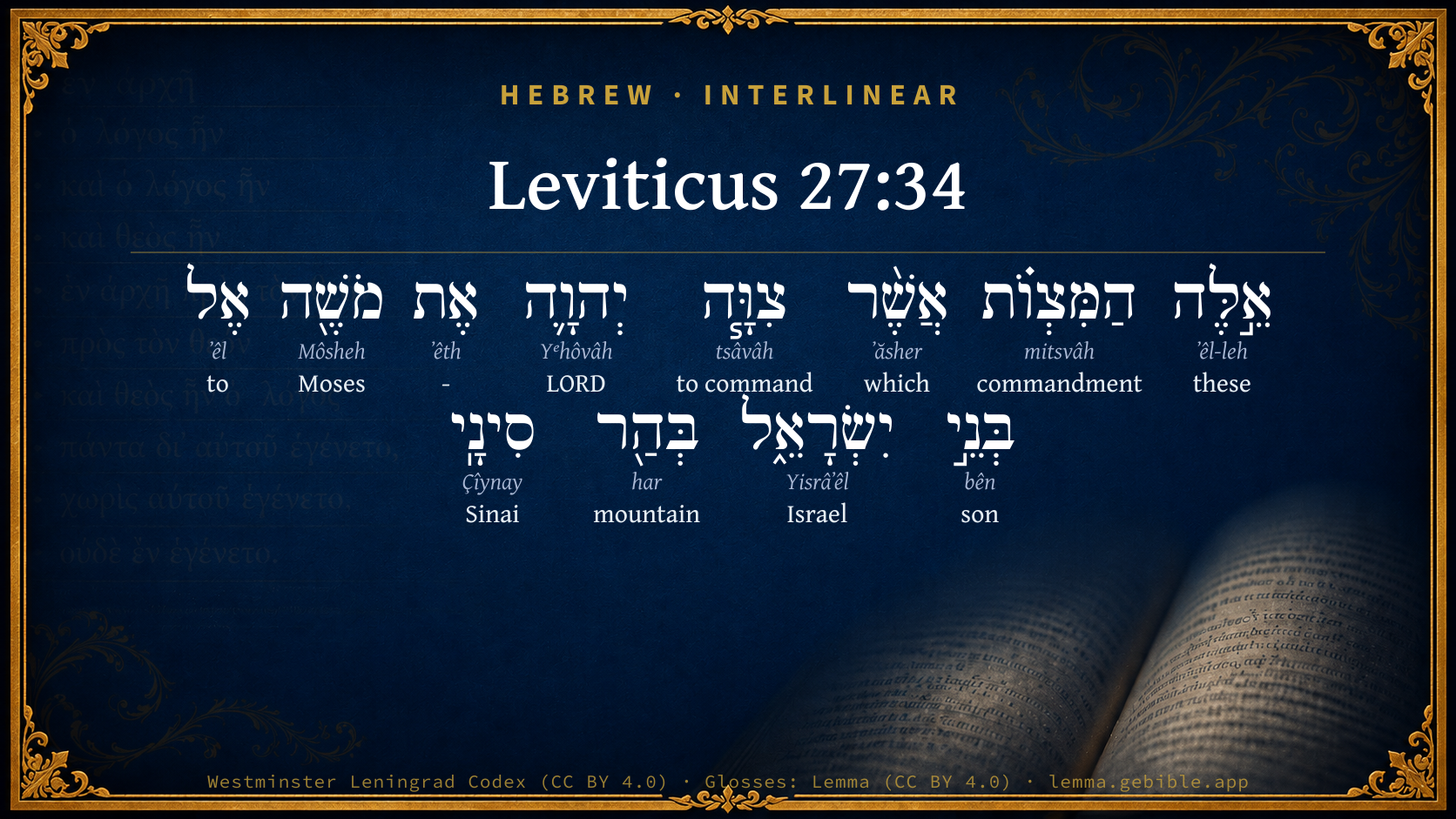
Leviticus 27:34

Hebrew (Westminster Leningrad Codex) Leviticus 27:34 appears in the Hebrew Old Testament. The text above is from the Westminster Leningrad Codex. Each word links to its Strong’s number, a concise gloss, and parsing drawn from the Open Scriptures Hebrew Bible morphology. Click any word for its full Brown-Driver-Briggs (BDB) entry.
Download image
Cite this verse

Leviticus 27:34 (World English Bible). Public Domain. Lemma interlinear Bible study tool, https://lemma.gebible.app/v/leviticus/27/34.

Show BibTeX & RIS
BibTeX
RIS
English Translation
These are the commandments which Yahweh commanded Moses for the children of Israel on Mount Sinai.
World English Bible · Public Domain
Download a study sheet

One document with this verse’s original text, its word-by-word gloss line, the meaning frame, cross-references with their text, attributed commentary, and full source and license credits — printable, and it pastes into notes with its structure intact.

This verse Autodidact and up

Study sheet (.html) Plain text (.txt)

A passage Seminary Student

Up to 50 verses in one chapter. A passage sheet keeps up to 6 commentary sources and 12 cross-references per verse, in the order this page ranks them, and says so on the sheet whenever that leaves anything out. Ask for a single verse and you get the Autodidact verse sheet above.

Everything on this page stays free to read, with no account — the sheet is a download of what is already on screen, not access to it.

Want to remove ads? Support Godless Engineer
Compare translations 3

The same verse in 3 English versions, stacked beneath the original-language interlinear above. Click any original word for its lexicon entry.

Each is an independent rendering of the whole verse — the interlinear is not word-aligned to these translations.

Highlighted words mark where these versions differ — a whole-verse word diff, not a word-by-word alignment.

  • World English Bible Public Domain
    These are the commandments which Yahweh commanded Moses for the children of Israel on Mount Sinai.
  • King James Version Public Domain
    These are the commandments, which the LORD commanded Moses for the children of Israel in mount Sinai.
  • unfoldingWord Literal Text CC BY-SA 4.0
    These the commandments which Yahweh commanded Moses to the sons of Israel on Mount Sinai.

unfoldingWord Literal Text — © unfoldingWord, licensed CC BY-SA 4.0. Word-aligned USFM3 via Door43 (git.door43.org/unfoldingWord/en_ult).

Versions to compare (up to 4)

3 of 4 selected

Show all 18 translations

Every available English version of this verse, each an independent rendering of the whole verse.

  • World English Bible Public Domain
    These are the commandments which Yahweh commanded Moses for the children of Israel on Mount Sinai.
  • Berean Standard Bible Public Domain
    These are the commandments that the LORD gave to Moses for the Israelites on Mount Sinai.
  • Majority Standard Bible Public Domain
    These are the commandments that the LORD gave to Moses for the Israelites on Mount Sinai.
  • King James Version Public Domain
    These are the commandments, which the LORD commanded Moses for the children of Israel in mount Sinai.
  • American Standard Version (1901) Public Domain
    These are the commandments, which Jehovah commanded Moses for the children of Israel in mount Sinai.
  • Revised Version (1885) Public Domain
    These are the commandments, which the LORD commanded Moses for the children of Israel in mount Sinai.
  • Geneva Bible (1599) Public Domain
    These are the commandements which the Lord commanded by Moses vnto the children of Israel in mount Sinai.
  • Douay-Rheims (1899) Public Domain
    These are the precepts which the Lord commanded Moses for the children of Israel in mount Sinai.
  • Young's Literal Translation Public Domain
    These `are' the commands which Jehovah hath commanded Moses for the sons of Israel, in mount Sinai.
  • Literal Standard Version CC BY-SA 4.0
    These [are] the commands which YHWH has commanded Moses for the sons of Israel in Mount Sinai.
  • Unlocked Literal Bible CC BY-SA 4.0
    These are the commandments that Yahweh gave at Mount Sinai to Moses for the people of Israel.
  • unfoldingWord Literal Text CC BY-SA 4.0
    These the commandments which Yahweh commanded Moses to the sons of Israel on Mount Sinai.
  • Darby Bible Public Domain
    These are the commandments which Jehovah commanded Moses for the children of Israel upon mount Sinai.
  • World Messianic Bible Public Domain
    These are the commandments which the LORD commanded Moses for the children of Israel on Mount Sinai.
  • Webster's Bible Public Domain
    These are the commandments which the LORD commanded Moses for the children of Israel in mount Sinai.
  • Free Bible Version CC BY-SA 4.0
    These are the laws the Lord gave to Moses for the Israelites on Mount Sinai.
  • Bible in Basic English Public Domain
    These are the orders which the Lord gave to Moses for the children of Israel in Mount Sinai.
  • JPS Tanakh (1917) Public Domain
    These are the commandments, which the LORD commanded Moses for the children of Israel in mount Sinai.

Literal Standard Version (2020), Covenant Press — licensed CC BY-SA 4.0. Text via the HelloAO Bible API (eBible.org). Unlocked Literal Bible (unfoldingWord) — licensed CC BY-SA 4.0. Text via the HelloAO Bible API (eBible.org). unfoldingWord Literal Text — © unfoldingWord, licensed CC BY-SA 4.0. Word-aligned USFM3 via Door43 (git.door43.org/unfoldingWord/en_ult). Free Bible Version, Dr. Jonathan Gallagher — licensed CC BY-SA 4.0. Text via the HelloAO Bible API (eBible.org).

Word by word

More ways to search: Search by grammar → Find every occurrence → Compare this word →

Practice this passage: Drill this verse → Learn its vocabulary →

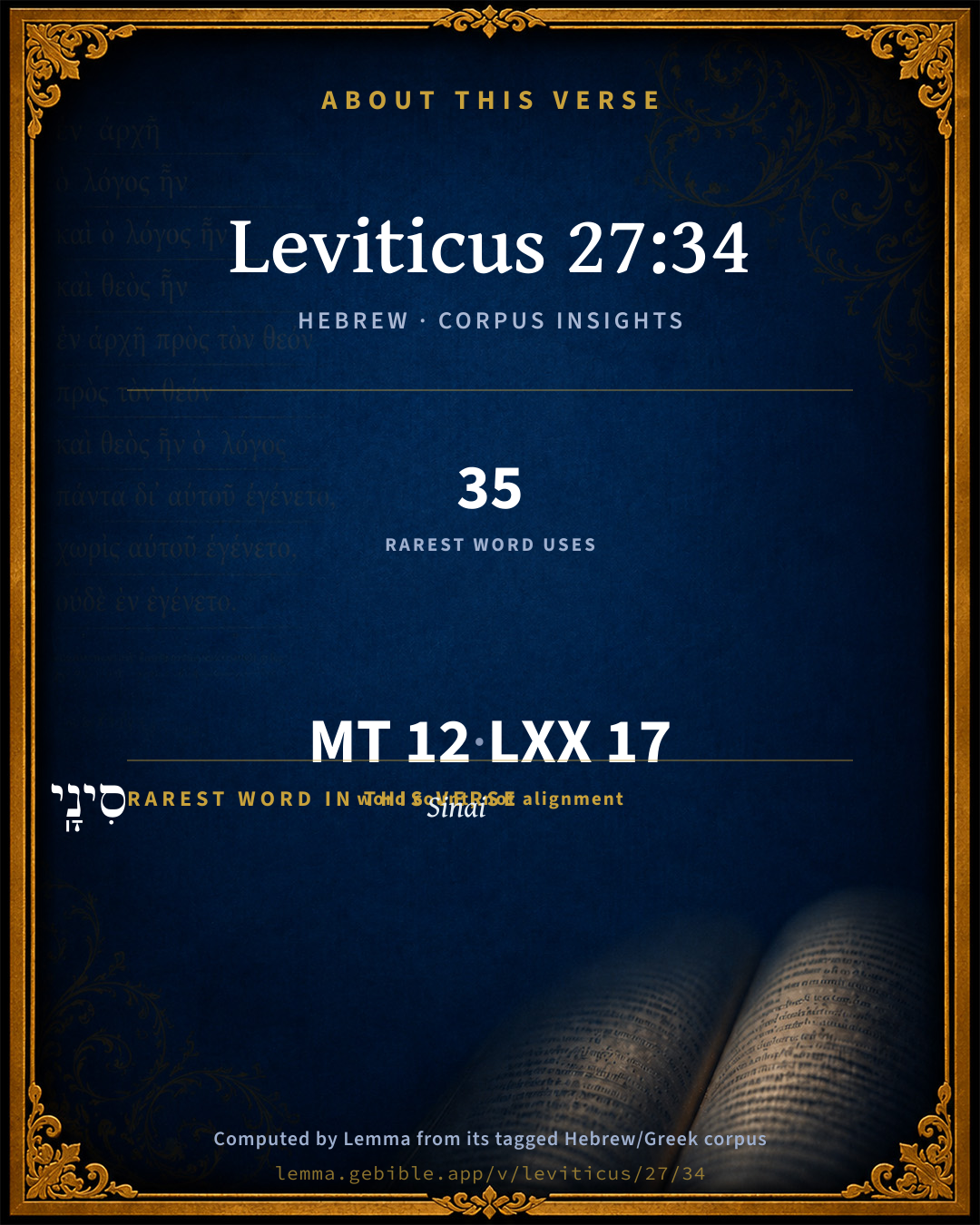
About this verse

These counts appear in no published source. They are computed here, from the morphology-tagged text and Lemma’s own curated glosses. What Lemma adds →

12
words
12
distinct lemmas
Pentateuch
section

Shared distinctive vocabulary

סִינָֽי Sinai H5514 occurs in 34 verses of the Hebrew Bible. Also found in:

Grammatical profile

  • 1 verb
  • 7 nouns
  • 1 pronoun
  • 1 preposition
  • 2 particles

Verb forms

  • צִוָּ֧ה Piel · Perfect

Hebrew & Septuagint length

In English translation the verse runs 16 words from the Hebrew and 17 from the Septuagint (LXX English) — closely comparable.

A rough comparison of the two English renderings, which tokenize alike — not a word-level alignment.

Word counts can differ between the Hebrew and the Greek without any difference in meaning — e.g. the Hebrew direct-object marker אֵת has no separate Greek word, and Greek often adds the article ὁ.

In the original languages it is 12 Hebrew tokens and 17 Greek tokens — but the two are counted differently (Hebrew bundles its prefixes and suffixes into one token; the Greek is in lemma form), so that isn’t a like-for-like length.

Cross-references

7

Topical passages linked to Leviticus 27:34 in the Treasury of Scripture Knowledge — connected by theme and wording, ordered by reader-vote popularity; previews shown in the World English Bible.

  • Leviticus 26:46 These are the statutes, ordinances and laws, which Yahweh made between him and the children of Israel in Mount Sinai by Moses.
  • Numbers 1:1 Yahweh spoke to Moses in the wilderness of Sinai, in the Tent of Meeting, on the first day of the second month, in the second year after they had come out of the land of Egypt, saying,
  • Deuteronomy 4:5 Behold, I have taught you statutes and ordinances, even as Yahweh my God commanded me, that you should do so in the midst of the land where you go in to possess it.
  • Deuteronomy 4:45 these are the testimonies, and the statutes, and the ordinances, which Moses spoke to the children of Israel, when they came forth out of Egypt,
  • John 1:17 For the law was given through Moses. Grace and truth came through Jesus Christ.
  • Galatians 4:24–25 These things contain an allegory, for these are two covenants. One is from Mount Sinai, bearing children to bondage, which is Hagar.
  • Hebrews 12:18–25 For you have not come to a mountain that might be touched, and that burned with fire, and to blackness, darkness, tempest,

Cross-references courtesy of OpenBible.info (CC BY 4.0).

Hebrew and Greek witnesses Masoretic Hebrew ↔ Greek Septuagint

The same verse in the two great witnesses to the Old Testament, shown verse-for-verse.

These are two independent witnesses, not word-aligned to each other, and the Septuagint is shown in lemma (dictionary) form.

Hebrew Leviticus 27:34 Masoretic · Westminster Leningrad Codex

אֵ֣לֶּה הַמִּצְוֺ֗ת אֲשֶׁ֨ר צִוָּ֧ה יְהוָ֛ה אֶת מֹשֶׁ֖ה אֶל בְּנֵ֣י יִשְׂרָאֵ֑ל בְּהַ֖ר סִינָֽי

These are the commandments which Yahweh commanded Moses for the children of Israel on Mount Sinai.

World English Bible · Public Domain

Greek LXX Leviticus 27:34 Septuagint · lemma form

οὗτος εἰμί ὁ ἐντολή ὅς ἐντέλλομαι κύριος ὁ μωυσῆς πρός ὁ υἱός ἰσραήλ ἐν ὁ ὄρος σινα

These are the commandments which the Lord commanded Moses for the sons of Israel in mount Sina.

LXX2012 (modern English Septuagint) · Public Domain

Hebrew: Westminster Leningrad Codex (CC BY 4.0). Greek: Septuagint (public domain); English from LXX2012 (modern English Septuagint) (Public Domain). How the Septuagint differs from the Hebrew →

Targum (Aramaic paraphrase)

2

The Targum is the ancient Jewish Aramaic paraphrase of the Hebrew Scriptures — an interpretive translation, not the Hebrew text itself. Onkelos (literal) and Pseudo-Jonathan (expansive) render the Torah, and Jonathan the Prophets. Coverage is partial: where no permissively-licensed English translation exists for a verse, only the Aramaic is shown. This is verse-level text, not a word-by-word alignment to the Hebrew.

  1. Targum Onkelos Torah (Genesis–Deuteronomy)
    אִלֵין פִּקוֹדַיָא דִי פַקִיד יְיָ יָת מֹשֶׁה לְוָת בְּנֵי יִשְׂרָאֵל בְּטוּרָא דְסִינָי

    (no public-domain English translation for this verse)

    Targum Onkelos — Aramaic: “Onkelos Genesis” (public domain); “Onkelos Exodus” (public domain); “Onkelos Leviticus” (public domain); “Onkelos Numbers” (public domain); “Onkelos Deuteronomy” (public domain). English: “Sefaria Community Translation” (CC0 1.0 (public-domain dedication)); “J.W. Etheridge. The Targums of Onkelos and Jonathan Ben Uzziel on the Pentateuch. London: Longmans, Green, 1862” (public domain). Text via Sefaria.

  2. Targum Pseudo-Jonathan Torah (Genesis–Deuteronomy)
    אִילִין פִּקוּדַיָא דְפַקֵיד יְיָ יַת משֶׁה וְלֵית אֶפְשַׁר לְחַדְתָּא בְּהוֹן מִדַעַם וּפַקֵדִינוּן מְטוֹל לְאַחְוָואוּתְהוֹן לְוַת בְּנֵי יִשְרָאֵל בְּטוּרָא דְסִינַי

    These are the precepts which the Lord prescribed unto Mosheh, and of which not one must be trifled with (or, innovated upon); and He prescribed them to be shown Unto the children of Israel at Mount Sinai.

    Targum Pseudo-Jonathan — Aramaic: “Targum Jonathan on Genesis” (public domain); “Targum Jonathan on Exodus” (public domain); “Targum Jonathan on Leviticus” (public domain); “Targum Jonathan on Numbers” (public domain); “Targum Jonathan on Deuteronomy” (public domain). English: “The Targum of Jonathan ben Uzziel, trans. J. W. Etheridge, London, 1862” (public domain). Text via Sefaria.

Commentary

Notes on Leviticus 27:34 from classic Christian and Jewish commentators (each source and its license shown beneath its notes). The classic Christian expositions comment on the surrounding passage and are grouped to its opening verse, so a note may address several verses; the Jewish commentaries on the Tanakh (Rashi and others) are per-verse, so they appear only where the commentator wrote on this verse.

Lemma curates 59 commentaries, every one of them public domain or Creative Commons licensed, each selected and text-cleaned for this edition rather than reprinted as found. About our sources →

Adam Clarke's Commentary

Verse 34. These are the commandments] This conclusion is very similar to that at the end of the preceding chapter. I have already supposed that this chapter should have followed the 25th, and that the 26th originally terminated the book.

Mr. Ainsworth, the whole of whose writings are animated with the spirit of piety, concludes this book with the following excellent remarks: -

"The tithes in Israel being thus sanctified by the commandment of God to his honour, the maintenance of his ministers, and the relief of the poor, it taught them and teaches us to honour the Lord with our substance, (Pr 3:9), acknowledging him to be the author of all our increase and store; (De 8:13-18; Ho 2:8;) to honour his MINISTERS, and to communicate unto them in all good things, (1Ti 5:17-18; Ga 6:6), that they who sow unto us spiritual things should reap our carnal things, (1Co 9:11), and to give ALMS of such things as we have, that all things may be clear unto us, (Lu 11:41,) yea, even to sell that we have, and give alms; to provide ourselves bags that wax not old, a treasure in the heavens that faileth not. Lu 12:33." They who forget their Maker, his ministers, and the poor, are never likely to hear that blessed word in the great day: "Come, ye blessed of my Father, inherit the kingdom prepared for you; for I was hungry, and ye gave me meat; thirsty, and ye gave me drink; naked, and ye clothed me; sick and in prison, and ye came unto me."

READER, thou hast now gone through the whole of this most interesting book; a book whose subject is too little regarded by Christians in general. Here thou mayest discover the rigid requisitions of Divine justice, the sinfulness of sin, the exceeding breadth of the commandment, and the end of all human perfection. And now what thinkest thou of that word, "Whatsoever the law saith, it saith to them who are under the law?" Ro 3:19. But who are under the law - the condemning power of the pure, rigid, moral law of God? Not the Jews only, but every soul of man: all to whom it is sent, and who acknowledge it as a Divine revelation, and have not been redeemed from the guilt of sin by the grace of our Lord Jesus Christ; for "cursed is every one that continueth not in all things that are written in the book of the law to do them." By this law then is the knowledge, but not the cure, of sin. Here then what God saith unto thee: "If therefore perfection were by the Levitical priesthood, (for under it the people received the law,) what farther need was there that another priest should rise after the order of Melchisedec, and not be called after the order of Aaron? For the priesthood being changed, there is made of necessity a change also of the law; Heb 7:11-12. Now of the things which we have spoken, this is the sum: We have such a high priest, who is set on the right hand of the throne of the Majesty in the heavens; a minister of the sanctuary, and of the true tabernacle, which the Lord pitched, and not man; Heb 8:1-2. For it is not possible that the blood of bulls and of goats should take away sins; Heb 10:4. But Christ being come a high priest of good things to come, - neither by the blood of goats and calves, but by his own blood, he entered in once into the holy place, having obtained eternal redemption for us. And for this cause he is the Mediator of the New Testament, that, by means of death, they which are called might receive the promise of eternal inheritance. And without shedding of blood is no remission. So Christ was once offered to bear the sins of many, and unto them that look for him shall he appear the second time, without sin, unto salvation;" Heb 9:11-12; Heb 9:15; Heb 9:22; Heb 9:28. We see then that Christ was the END of the law for righteousness (for justification) to every one that believeth. "Unto him, therefore, who hath loved us, and washed us from our sins in his own blood, and hath made us kings and priests unto God and his Father; to him be glory and dominion for ever and ever. Amen." Re 1:5-6.

SECTIONS in the Book of Leviticus, carried on from Exodus, which ends with the TWENTY-THIRD.

The TWENTY-FOURTH, called ויקרא valyikra, begins Le 1:6, and ends Le 6:7.

The TWENTY-FIFTH, called צו tsav, begins Le 6:8, and ends Le 8:36.

The TWENTY-SIXTH, called שמיני shemini, begins Le 9:1, and ends Le 11:47.

The TWENTY-SEVENTH, called תזריע tazria, begins Le 12:1, and ends Le 13:59.

The TWENTY-EIGHTH, called מצרע metsora, begins Le 14:1, and ends Le 15:33.

The TWENTY-NINTH, called אחרי מות acharey moth, begins Le 16:1, and ends Le 18:30.

The THIRTIETH, called קדשים kedoshim, begins Le 19:1, and ends Le 20:27.

The THIRTY-FIRST, called אמר emor, begins Le 21:1, and ends Le 24:23.

The THIRTY-SECOND, called בהר סיני behar Sinai, begins Le 25:1, and ends Le 26:2.

The THIRTY-THIRD, called בחקתי bechukkothai, begins Le 26:3, and ends Le 27:34.

These sections, as was observed on Exodus, have their technical names from some remarkable word, either in the first or second verse of their commencement.

MASORETIC Notes on LEVITICUS

The number of verses in vaiyikra, i. e., Leviticus, is 859. The symbol of which is 'נטף'. where ף pe final stands for 800, נ nun for 50, and ט teth for 9.

The middle verse is Le 15:11: And he that toucheth the flesh, c.

Its pareshioth, or larger sections, are 10, the memorial symbol of which is taken from Ge 30:11: בא גד ba gad, a troop cometh: in which ב beth stands for 2, א aleph for 1, ג gimel for 3, and ד daleth for 4.

Its sedarim, or Masoretic sections, are 23. The symbol of which is taken from Ps 1:2, יהגה yehgeh: In thy law shall he MEDITATE day and night.

Its perakim, or modern chapters, are 27. The memorial sign which is ואהיה veeyeheh, Ge 26:3: AND I WILL BE with thee, and will bless thee.

The number of its open divisions is 52 of its close divisions, 46: total 98. The memorial sign of which is צח tsach, Cant. So 5:10; My beloved is WHITE and ruddy. In this word צ tsaddi stands for 90, and ח cheth for 8.

VERSES 859. WORDS 11,902. LETTERS computed to be 44,989.

See the concluding note on GENESIS.

Finished the correction of Exodus and Leviticus, April 2, 1827. - A. CLARKE.

Adam Clarke's Commentary on the Bible (1810–1826) — public domain. Text from a community e-Sword/MySword module.

The Biblical Illustrator

Joseph S. Exell

Lev_27:34

These are the commandments which the Lord commanded Moses for the children of Israel.

The moral and ceremonial commandments, as compared with the gospel law

Many of these commandments are moral and of perpetual obligation. Others of them ceremonial and peculiar to the Jewish economy, which yet have a spiritual significance, and are instructive to us who are furnished with a key to let us into the mysteries contained in them; for unto us by these institutions is the gospel preached, as well as unto them (Heb_4:2). And upon the whole matter we may see cause to bless God that we are not come to Mount Sinai (Heb_12:18).

1. That we are not under the dark shadows of the law, but enjoy the clear light of the gospel, which shows us Christ the end of the law for righteousness (Rom_10:4). The doctrine of our reconciliation to God by a Mediator is not clouded with the smoke of burning sacrifices, but cleared by the knowledge of Christ, and Him crucified.

2. That we are not under the heavy yoke of the law and the carnal ordinances of it, as the apostle calls them (Heb_9:10), imposed till the time of reformation, a yoke which neither they nor their fathers were able to bear (Act_15:10); but under the sweet and easy institutions of the gospel, which pronounces those the true worshippers, that worship the Father in spirit and truth, by Christ only, and in His name, who is our Priest, Temple, Altar, Sacrifice, Purification, and All. Let us not therefore think that because we are not tied to the ceremonial cleansings, feasts, and oblations, a little care, time, and expense will serve to honour God with. No, but rather have our hearts more enlarged in free-will-offerings, to His praise, more inflamed with holy love and joy, and more engaged in seriousness of thoughts, and sincerity of intention. Having boldness to enter into the holiness by the blood of Jesus, let us draw near with a true heart, and in full assurance of faith, worshipping God with so much the more cheerfulness and humble confidence, still saying, Blessed be God for Jesus Christ. (Matthew Henry, D. D.)

The covenant in its relation to nations and individuals

The last chapter of the book is taken up with directions for individual worship, on the details of which we cannot enter; but this general thought is suggested, that though the nation as a whole may lose its covenant standing, the way is always open for individuals. There is much comfort in this thought, in view of such dark times as those to which the prophetical part of the preceding chapter points. The door of mercy is never shut, however dark and degenerate the times may be. However wickedness may abound in the world, and coldness and deadness in the Church, God will always have His witnesses, and they will always have their opportunities. This word is never changed, Whosoever will, let him come. In all times religion in the last resort must be an individual matter between the soul and God. No man can be saved in a crowd; but neither can any man be lost in a crowd. And sometimes, when the great multitude seems to carry all before it, God still may have His seven thousand men, known to Him alone, who have brought their individual offerings to Him, and never bowed the knee to Baal. Remember the comfort that was given to Daniel, when his spirit was ready to faint in the prospect of the dark days which the prophetic vision had disclosed. Go thou thy way till the end be; for thou shalt rest and stand in thy lot at the end of the days. Go thou thy way--in times of apostasy and darkness, it is for the individual believer to leave the destinies of the world and of the Church in the hands of Him who doeth all things well, and seek only to be faithful to his own duty. As for others: shall not the Judge of all the earth do right? And as for thee, thou shalt rest--there is the fulfilment of the Sabbath and all the sabbatic series--and stand in thy lot at the end of the days--there is the fulfilment of the jubilee and all the eighth day series. Amid all the secularities and unbelief and disobedience of the times, let us seek to maintain communion with God, and bring our individual offerings, however singular they be, and we shall certainly find that the joy of the Lord is our strength, and that His thoughts of love expressed in the feasts of the old covenant will be fulfilled for us, and then at the end of the days we shall enter on our sabbath of rest, and our jubilee of joy eternal. (J. M. Gibson, D. D.)

The Biblical Illustrator, edited by Joseph S. Exell (c. 1880s–1900s) — public domain. Text from a community e-Sword module.

Joseph Benson's Commentary

Lev 27:34. These are the commandments which the Lord commanded Moses for the children of Israel in mount Sinai — This has reference to the whole book. Many of these commandments are moral; others ceremonial, and peculiar to the Jewish economy; which yet are instructive to us, who have a key to the mysteries that are contained in them. Upon the whole, we have cause to bless God that we are not come to mount Sinai, that we are not under the dark shadows of the law, but enjoy the clear light of the gospel. The doctrine of our reconciliation to God by a Mediator, is not clouded with the smoke of burning sacrifices, but cleared by the knowledge of Christ, and him crucified. And we may praise him that we are not under the yoke of the law, but under the sweet and easy instructions of the gospel, which pronounces those the true worshippers that worship the Father in spirit and in truth, by Christ only, who is our priest, temple, altar, sacrifice, purification, and all.

Joseph Benson's Commentary on the Old and New Testaments (1811–1818) — public domain. Text from a community e-Sword module.

Tyndale Open Study Notes

Tyndale Open Resources

27:34 The book closes as it opened (see 1:1), clearly noting the divine origin of its contents as mediated through Moses.

Tyndale Open Study Notes — © Tyndale Open Resources, licensed CC BY-SA 4.0. Text via the HelloAO Bible API.

Jamieson, Fausset & Brown

Robert Jamieson, A. R. Fausset & David Brown

These are the commandments, &c.--The laws contained in this book, for the most part ceremonial, had an important spiritual bearing, the study of which is highly instructive (Rom 10:4; Heb 4:2; Heb 12:18). They imposed a burdensome yoke (Act 15:10), but yet in the infantine age of the Church formed the necessary discipline of "a schoolmaster to Christ" [Gal 3:24].

Next: Numbers Introduction

Jamieson, Fausset & Brown — Commentary Critical and Explanatory on the Whole Bible (1871) — public domain (CC PDM 1.0). Text via the HelloAO Bible API.

Ellicott's Commentary for English Readers

(34) These are the commandments.—That is, the laws laid down in Lev_27:1-34.

In Mount Sinai.—In the mountainous district of Sinai. (See Lev_26:46.)

A Bible Commentary for English Readers, edited by Charles John Ellicott (1878–1897) — public domain. Text from a community e-Sword module.

The Cambridge Bible for Schools and Colleges

gen. ed. J. J. S. Perowne

34. See introd. note to this ch.

The Cambridge Bible for Schools and Colleges (gen. ed. J. J. S. Perowne; Cambridge University Press, 1878–1918) — public domain. Text from a community e-Sword module.

Haydock's Catholic Bible Commentary

Sinai. The laws specified in the ten first chapters of the following book, were given here also. (Haydock)

George Leo Haydock (1774–1849), Haydock's Catholic Family Bible and Commentary, 1859 edition — public domain. Excludes Psalms (Douay-Rheims chapter numbering differs from Protestant) and Deuterocanonical books (Catholic canon only).

Whedon's Commentary on the Bible

Daniel D. Whedon

34. The Lord commanded Moses — Not some unknown forger in the days of the kings or after the Babylonian exile. Nevertheless we have no objection to the position of Dr. George P. Fisher, “That there was a growth in Hebrew laws; that the codes were kept open, the original rubrics being retained; that legislation was added from time to time, under the guidance of the prophets, to suit changing circumstances, new ordinances being looked on as Mosaic, for the reason that they were conceived in the spirit, and were considered a legitimate development of, the primitive enactments.”

In Mount Sinai — Lev_26:46, note. Thus this supplementary chapter is attached to the body of the Levitical law delivered, at least in outline, at the foot of Sinai. It is fitting that its divine authorship, through the agency of Moses, should be attested in these concluding words.

Daniel D. Whedon (gen. ed.), Commentary on the Old and New Testaments (1874–1909) — public domain. Text from a community e-Sword module.

The Pulpit Commentary

The final verse of the previous chapter is repeated after the further legislation on vows and on their commutation has been added, to show that it too makes part of the Sinaitic code.

The Law and the gospel.

1. It may be rightly said that true religion is essentially the same everywhere and at all times. Whithersoever and whensoever we look, we shall find the same cardinal elements the fear of God, the love of God, respect for our own spiritual nature, regard for the rights and claims of others, abstinence from that which is immoral, kindness and helpfulness, etc.

2. It may also be truly said that in the Law there was much more than many have supposed of those elements which are prominent in the gospel: more of spiritual freedom, of joy in God, of happy and sacred fellowship than we are apt to associate with "Mount Sinai," and "the commandments which the Lord commanded Moses." When, therefore, we draw a distinction between the Law and the gospel, it must be remembered that it is not without important qualifications; that the Law had, in most cases, an aspect which was essentially Christian; and that, similarly, the gospel in most cases has an aspect which is legal. With this in mind, we may draw the contrast

I THAT THE LAW WAS PREPARATORY AND PROPHETIC; the gospel is final and in fulfillment of that which had been anticipated. This, especially, in regard to sacrifice and offering.

II THAT THE LAW WAS PRECEPTIVE; the gospel is suggestive. The one supplied a multitude of rules for the regulation of worship and of daily life, the other has few "commandments." Its positive precepts are small in number, but it lays down those principles and implants that spirit by which the right and the wrong course are suggested, to be pursued or shunned by the obedient heart.

III THAT THE LAW WAS PROHIBITIVE; the gospel is inspiring. Not wholly, but strikingly, in each case. The Law continually said imperatively, "Thou shalt not;" the gospel says encouragingly, "Wilt not thou?" The Law interdicted very many things, and an Israelite was obedient very much according to his conscientious avoidance of that which was forbidden. The gospel incites to feelings, words, actions of goodness, wisdom, grace, helpfulness; and a Christian man is obedient and acceptable in proportion as he opens his heart to heavenly inspiration, and is stirred to be and do that which is noble and Christ-like.

IV THAT THE LAW MADE ITS APPEAL TO HUMAN EAR; the gospel to human love. Jehovah was, indeed, presented often to the Hebrew as his Redeemer from bondage; but, upon the whole, he was so revealed as, above everything, to strike the soul with profoundest reverence and awe. The Jew never ceased to hear the thunderings and see the lightnings of Sinai. The motto of the devout Israelite was this fear God." In the gospel God is manifested in Jesus Christ, our Saviour, our Friend, our sympathizing High Priest; and, while not without deepest reverence, we feel that "the love of God in Christ Jesus" is the spring and the strength of our devotion; it is the key to which the sacred music of our life is set.

V THAT THE LAW HAD RESPECT TO EARTHLY LIFE; the gospel to the farthest future. The Law said, "Do this, and thou shalt live long in the land;" "do this, and the rains shall fall and the vines shall bear and the barns be full;" but the gospel says, "Do this repent, believe, follow Christ; and while there shall be sufficiency of present food for present need, there shall be abounding grace in the heart, fruitfulness in the life, peace in death, and a long eternity of sinless service and unclouded joy in the presence of the King, in the home of God. C.

The Pulpit Commentary (1880–1919), ed. H.D.M. Spence-Jones & Joseph S. Exell — public domain. Text from a community e-Sword module.

John Wesley's Explanatory Notes

These are the commandments which the Lord commanded Moses for the children of Israel in M/ount Sinai - This has reference to the whole book. Many of these commandments are moral: others ceremonial and peculiar to the Jewish economy: Which yet are instructive to us, who have a key to the mysteries that are contained in them. Upon the whole, we have cause to bless God, that we are not come to Mount Sinai, that we are not under the dark shadows of the law, but enjoy the clear light of the gospel. The doctrine of our reconciliation to God by a Mediator, is not clouded with the smoke of burning sacrifices, but cleared by the knowledge of Christ, and him crucified. And we may praise him, that we are not under the yoke of the law, but under the sweet and easy instructions of the gospel, which pronounces those the true worshippers, that worship the Father in spirit and in truth, by Christ only, who is our priest, temple, altar, sacrifice, purification and all.

John Wesley, Explanatory Notes Upon the Whole Bible (1754–1765) — public domain. Text via the GEBible commentary corpus.

unfoldingWord translationNotes

Door43 World Missions Community

These are the commandments

This is a summary statement. It refers to the commandments that were given in the past chapters.

translationWords

command

Yahweh

Sinai

Moses

Israel

unfoldingWord translationNotes — © Distant Shores Media and the Door43 World Missions Community, licensed CC BY-SA 4.0. Source: git.door43.org/Door43/en_tn.

Lesson kit

Teaching starters — assembled from the data on this page, not authored interpretation. Every prompt links to the verse data it draws on. Edit before teaching.

Leviticus, in the Pentateuch, opens this verse with 12 words (12 distinct Hebrew lemmas). Its most distinctive word is Çîynay (“Sinai”). A historical commentator’s framing appears above. Read the whole chapter for the surrounding context.

Discussion questions

  1. How does “Sinai” (Çîynay) shape what this verse is saying?
  2. Exodus 16:1 shares the word «Sinai» with this verse. How do the two illuminate each other?
  3. The translations on this page render this verse differently — a whole-verse word diff, not a word-by-word alignment. What might account for the different wordings?
  4. The verb «צִוָּ֧ה» is Piel Perfect. How does its form color the action?
  5. Reading how Adam Clarke's Commentary and The Biblical Illustrator read this verse, where do the two commentators agree and where do they part?

Things to notice

Reading settings

Reading text

Shown beneath each verse's original-language words.

Old Testament
Old Testament edition

Read the OT as the Masoretic Hebrew (MT) or the Greek Septuagint (LXX).

English shown for the Greek Septuagint (in the Hebrew ↔ Greek comparison).

Comparing translations? Open the Compare panel on any verse page to stack up to four side by side.