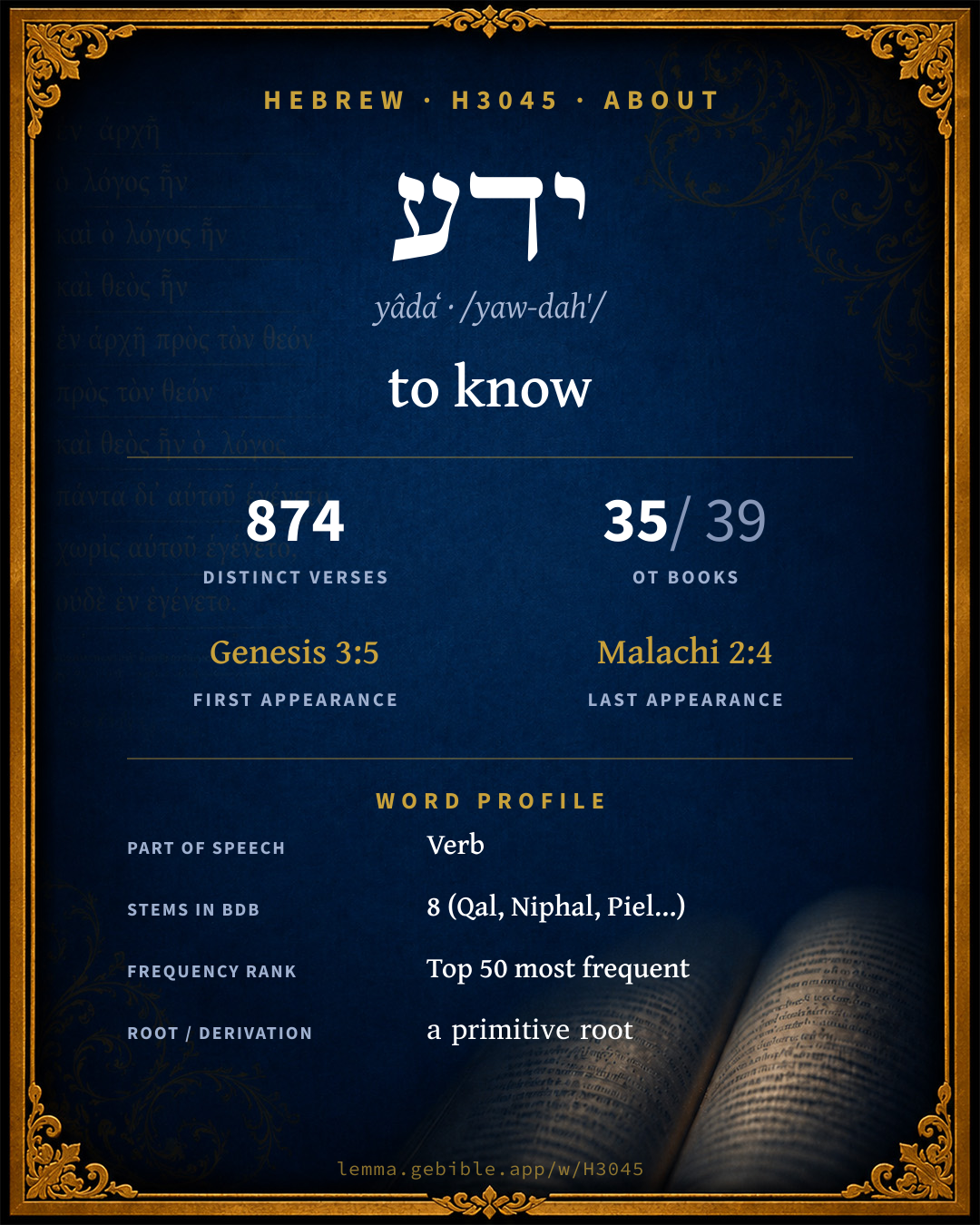
יָדַע
to know
‘to know’ is one of 6 main senses fuller range ↓
Full lexicon entry — Brown-Driver-Briggs (BDB)
From Brown-Driver-Briggs (BDB)
Where this word appears
See every Qal verb in the Hebrew Bible →
Grammar key — what these labels mean
Part of speech
- Verb
- An action or state-of-being word.
Stem
- Qal
- The basic, simple active stem — the plain form of the verb (“he wrote”). Here: ‘know’
- Niphal
- Usually the simple passive or reflexive of the Qal (“he was written”). Here: ‘be made known’
- Hiphil
- The causative active stem (“he caused / brought about”).
- Hophal
- The passive counterpart of the Hiphil (“he was caused to…”).
- Pual
- The passive counterpart of the Piel. Here: ‘known’
- Piel
- An intensive or resultative active stem.
- Hithpael
- The reflexive or reciprocal stem (the subject acts on itself).
Form
- Perfect
- A completed action or state — Hebrew marks aspect (completeness) more than strict tense (“he wrote”).
- Sequential Perfect
- A perfect with prefixed waw continuing a preceding imperfect or command (waw-consecutive perfect).
- Participle Active
- A verbal adjective expressing ongoing or characteristic action (“writing / one who writes”).
- Infinitive Construct
- A bound verbal noun, frequently with prepositions (“to write / in writing”).
- Imperfect
- An incomplete, ongoing, or future action (“he will / would write”).
- Sequential Imperfect
- An imperfect with prefixed waw — the standard past-narrative form (waw-consecutive imperfect).
- Infinitive Absolute
- An unbound verbal noun, often intensifying or standing in for a finite verb.
- Imperative
- A direct command (“write!”).
- Cohortative
- A first-person volitional form expressing wish or resolve (“let me / let us write”).
- Jussive
- A third- or second-person volitional form expressing wish or command (“let him write”).
- Participle Passive
- A verbal adjective expressing action received (“written”).
State
- Absolute
- The independent form of a noun, not bound to a following word.
- Construct
- A noun bound to a following noun in a possessive / “of” relationship (the construct chain).
Person
- 1st Person
- The speaker (“I / we”).
- 3rd Person
- The one spoken about (“he / she / it / they”).
- 2nd Person
- The one addressed (“you”).
Gender
- Common
- Either gender — not distinguished for this form.
- Masculine
- Grammatically masculine.
- Feminine
- Grammatically feminine.
Number
- Singular
- One.
- Plural
- More than one (in Hebrew, generally three or more).
Every verse where H3045 appears in the Book of 1 Samuel — 51 distinct verses. Click any verse to open its interlinear word-by-word view. Verse text shown in the World English Bible for context — . Each verse’s Hebrew form is shown with its reference; the English is not keyword-highlighted, since the data carries no word-level English alignment. Use “Compare translations” on any verse to read it across multiple English versions. This concordance covers the Hebrew Bible; Septuagint (Greek Old Testament) occurrences are not indexed here.
1 Samuel
- 1 Samuel 1:19 וַ/יֵּ֤דַע conj + Qal wimpf 3ms They rose up in the morning early, and worshiped before Yahweh, and returned, and came to their house to Ramah: and Elkanah knew Hannah his wife; and Yahweh remembered her.
- 1 Samuel 2:12 יָדְע֖וּ Qal pf 3cp Now the sons of Eli were base men; they didn't know Yahweh.
- 1 Samuel 3:7 יָדַ֣ע Qal pf 3ms Now Samuel didn't yet know Yahweh, neither was the word of Yahweh yet revealed to him.
- 1 Samuel 3:13 יָדַ֗ע Qal pf 3ms For I have told him that I will judge his house forever, for the iniquity which he knew, because his sons did bring a curse on themselves, and he didn't restrain them.
- 1 Samuel 3:20 וַ/יֵּ֨דַע֙ conj + Qal wimpf 3ms All Israel from Dan even to Beersheba knew that Samuel was established to be a prophet of Yahweh.
- 1 Samuel 4:6 וַ/יֵּ֣דְע֔וּ conj + Qal wimpf 3mp When the Philistines heard the noise of the shout, they said, What means the noise of this great shout in the camp of the Hebrews? They understood that the ark of Yahweh was come into the camp.
- 1 Samuel 6:2 הוֹדִעֻ֕/נוּ Hiphil impv 2mp + sfx pers 1cp The Philistines called for the priests and the diviners, saying, "What shall we do with the ark of Yahweh? Show us with which we shall send it to its place."
- 1 Samuel 6:3 וְ/נוֹדַ֣ע conj + Niphal wpf 3ms They said, "If you send away the ark of the God of Israel, don't send it empty; but by all means return him a trespass-offering: then you shall be healed, and it shall be known to you why his hand is not removed from you."
- 1 Samuel 6:9 וְ/יָדַ֨עְנוּ֙ conj + Qal wpf 1cp Behold; if it goes up by the way of its own border to Beth-shemesh, then he has done us this great evil: but if not, then we shall know that it is not his hand that struck us; it was a chance that happened to us."
- 1 Samuel 10:8 וְ/הוֹדַעְתִּ֣י conj + Hiphil wpf 1cs You shall go down before me to Gilgal; and, behold, I will come down to you, to offer burnt offerings, and to sacrifice sacrifices of peace-offerings: seven days shall you wait, until I come to you, and show you what you shall do.
- 1 Samuel 10:11 יֽוֹדְע/וֹ֙ Qal ptcp.act ms cs + sfx pers 3ms It happened, when all who knew him before saw that, behold, he prophesied with the prophets, then the people said one to another, What is this that is come to the son of Kish? Is Saul also among the prophets?
- 1 Samuel 12:17 וּ/דְע֣וּ conj + Qal impv 2mp Isn't it wheat harvest today? I will call to Yahweh, that he may send thunder and rain; and you shall know and see that your wickedness is great, which you have done in the sight of Yahweh, in asking you a king.
- 1 Samuel 14:3 יָדַ֔ע Qal pf 3ms and Ahijah, the son of Ahitub, Ichabod's brother, the son of Phinehas, the son of Eli, the priest of Yahweh in Shiloh, wearing an ephod. The people didn't know that Jonathan was gone.
- 1 Samuel 14:12 וְ/נוֹדִ֥יעָה conj + Hiphil coh 1cp The men of the garrison answered Jonathan and his armor bearer, and said, Come up to us, and we will show you a thing. Jonathan said to his armor bearer, Come up after me; for Yahweh has delivered them into the hand of Israel.
- 1 Samuel 14:38 וּ/דְע֣וּ conj + Qal impv 2mp Saul said, Draw near here, all you chiefs of the people; and know and see in which this sin has been this day.
- 1 Samuel 16:3 אוֹדִֽיעֲ/ךָ֙ Hiphil impf 1cs + sfx pers 2mp Call Jesse to the sacrifice, and I will show you what you shall do: and you shall anoint to me him whom I name to you.
- 1 Samuel 16:16 יֹדֵ֖עַ Qal ptcp.act ms Let our lord now command your servants who are before you, to seek out a man who is a skillful player on the harp: and it shall happen, when the evil spirit from God is on you, that he shall play with his hand, and you shall be well.
- 1 Samuel 16:18 יֹדֵ֣עַ Qal ptcp.act ms Then answered one of the young men, and said, Behold, I have seen a son of Jesse the Bethlehemite, who is skillful in playing, and a mighty man of valor, and a man of war, and prudent in speech, and a comely person; and Yahweh is with him.
- 1 Samuel 17:28 יָדַ֣עְתִּי Qal pf 1cs Eliab his eldest brother heard when he spoke to the men; and Eliab's anger was kindled against David, and he said, Why are you come down? and with whom have you left those few sheep in the wilderness? I know your pride, and the naughtiness of your heart; for you have come down that you might see the battle.
- 1 Samuel 17:46 וְ/יֵֽדְעוּ֙ conj + Qal impf 3mp This day will Yahweh deliver you into my hand; and I will strike you, and take your head from off you; and I will give the dead bodies of the host of the Philistines this day to the birds of the sky, and to the wild animals of the earth; that all the earth may know that there is a God in Israel,
- 1 Samuel 17:47 וְ/יֵֽדְעוּ֙ conj + Qal impf 3mp and that all this assembly may know that Yahweh doesn't save with sword and spear: for the battle is Yahweh's, and he will give you into our hand.
- 1 Samuel 17:55 יָדָֽעְתִּי Qal pf 1cs When Saul saw David go forth against the Philistine, he said to Abner, the captain of the host, Abner, whose son is this youth? Abner said, As your soul lives, O king, I can't tell.
- 1 Samuel 18:28 וַ/יֵּ֔דַע conj + Qal wimpf 3ms Saul saw and knew that Yahweh was with David; and Michal, Saul's daughter, loved him.
- 1 Samuel 20:3 יָדֹ֨עַ יָדַ֜ע יֵֽדַע Qal inf.abs Qal pf 3ms Qal juss 3ms David swore moreover, and said, Your father knows well that I have found favor in your eyes; and he says, Don't let Jonathan know this, lest he be grieved: but truly as Yahweh lives, and as your soul lives, there is but a step between me and death.
- 1 Samuel 20:7 דַּ֕ע Qal impv 2ms If he says, 'It is well;' your servant shall have peace: but if he be angry, then know that evil is determined by him.
- 1 Samuel 20:9 יָדֹ֣עַ אֵדַ֗ע Qal inf.abs Qal impf 1cs Jonathan said, Far be it from you; for if I should at all know that evil were determined by my father to come on you, then wouldn't I tell you that?
- 1 Samuel 20:30 יָדַ֗עְתִּי Qal pf 1cs Then Saul's anger was kindled against Jonathan, and he said to him, You son of a perverse rebellious woman, don't I know that you have chosen the son of Jesse to your own shame, and to the shame of your mother's nakedness?
- 1 Samuel 20:33 וַ/יֵּ֨דַע֙ conj + Qal wimpf 3ms Saul cast his spear at him to strike him. By this Jonathan knew that his father was determined to put David to death.
- 1 Samuel 20:39 יָדַ֣ע יָדְע֖וּ Qal pf 3ms Qal pf 3cp But the boy didn't know anything: only Jonathan and David knew the matter.
- 1 Samuel 21:2 יֵ֧דַע יוֹדַ֔עְתִּי Qal juss 3ms Poel pf 1cs David said to Ahimelech the priest, The king has commanded me a business, and has said to me, Let no man know anything of the business about which I send you, and what I have commanded you: and I have appointed the young men to such and such a place.
- 1 Samuel 22:3 אֵדַ֔ע Qal impf 1cs David went there to Mizpeh of Moab: and he said to the king of Moab, Please let my father and my mother come forth, [and be] with you, until I know what God will do for me.
- 1 Samuel 22:6 נוֹדַ֣ע Niphal pf 3ms Saul heard that David was discovered, and the men who were with him: now Saul was sitting in Gibeah, under the tamarisk tree in Ramah, with his spear in his hand, and all his servants were standing about him.
- 1 Samuel 22:15 יָדַ֤ע Qal pf 3ms Have I today begun to inquire of God for him? be it far from me: don't let the king impute anything to his servant, nor to all the house of my father; for your servant knows nothing of all this, less or more.
- 1 Samuel 22:17 יָֽדְעוּ֙ Qal pf 3cp The king said to the guard who stood about him, Turn, and kill the priests of Yahweh; because their hand also is with David, and because they knew that he fled, and didn't disclose it to me. But the servants of the king wouldn't put forth their hand to fall on the priests of Yahweh.
- 1 Samuel 22:22 יָדַ֜עְתִּי Qal pf 1cs David said to Abiathar, I knew on that day, when Doeg the Edomite was there, that he would surely tell Saul: I have occasioned [the death] of all the persons of your father's house.
- 1 Samuel 23:9 וַ/יֵּ֣דַע conj + Qal wimpf 3ms David knew that Saul was devising mischief against him; and he said to Abiathar the priest, Bring here the ephod.
- 1 Samuel 23:17 יֹדֵ֥עַ Qal ptcp.act ms He said to him, Don't be afraid; for the hand of Saul my father shall not find you; and you shall be king over Israel, and I shall be next to you; and that also Saul my father knows.
- 1 Samuel 23:22 וּ/דְע֤וּ conj + Qal impv 2mp Please go make yet more sure, and know and see his place where his haunt is, [and] who has seen him there; for it is told me that he deals very subtly.
- 1 Samuel 23:23 וּ/דְע֗וּ conj + Qal impv 2mp See therefore, and take knowledge of all the lurking-places where he hides himself, and come you again to me of a certainty, and I will go with you: and it shall happen, if he be in the land, that I will search him out among all the thousands of Judah.
- 1 Samuel 24:11 דַּ֤ע Qal impv 2ms Moreover, my father, behold, yes, see the skirt of your robe in my hand; for in that I cut off the skirt of your robe, and didn't kill you, know you and see that there is neither evil nor disobedience in my hand, and I have not sinned against you, though you hunt after my life to take it.
- 1 Samuel 24:20 יָדַ֔עְתִּי Qal pf 1cs Now, behold, I know that you shall surely be king, and that the kingdom of Israel shall be established in your hand.
- 1 Samuel 25:11 יָדַ֔עְתִּי Qal pf 1cs Shall I then take my bread, and my water, and my meat that I have killed for my shearers, and give it to men who I don't know where they come from?
- 1 Samuel 25:17 דְּעִ֤י Qal impv 2fs Now therefore know and consider what you will do; for evil is determined against our master, and against all his house: for he is such a worthless fellow that one can't speak to him.
- 1 Samuel 26:4 וַ/יֵּ֕דַע conj + Qal wimpf 3ms David therefore sent out spies, and understood that Saul was come of a certainty.
- 1 Samuel 26:12 יוֹדֵ֜עַ Qal ptcp.act ms So David took the spear and the jar of water from Saul's head; and they got them away: and no man saw it, nor knew it, neither did any awake; for they were all asleep, because a deep sleep from Yahweh was fallen on them.
- 1 Samuel 28:1 יָדֹ֣עַ תֵּדַ֗ע Qal inf.abs Qal impf 2ms It happened in those days, that the Philistines gathered their hosts together for warfare, to fight with Israel. Achish said to David, Know you assuredly, that you shall go out with me in the host, you and your men.
- 1 Samuel 28:2 תֵדַ֔ע Qal impf 2ms David said to Achish, Therefore you shall know what your servant will do. Achish said to David, Therefore will I make you keeper of my head for ever.
- 1 Samuel 28:9 יָדַ֨עְתָּ֙ Qal pf 2ms The woman said to him, Behold, you know what Saul has done, how he has cut off those who have familiar spirits, and the wizards, out of the land: why then lay you a snare for my life, to cause me to die?
- 1 Samuel 28:14 וַ/יֵּ֤דַע conj + Qal wimpf 3ms He said to her, What form is he of? She said, An old man comes up; and he is covered with a robe. Saul perceived that it was Samuel, and he bowed with his face to the ground, and did obeisance.
- 1 Samuel 28:15 לְ/הוֹדִיעֵ֖/נִי prep + Hiphil inf.cs + sfx pers 1cs Samuel said to Saul, Why have you disquieted me, to bring me up? Saul answered, I am sore distressed; for the Philistines make war against me, and God is departed from me, and answers me no more, neither by prophets, nor by dreams: therefore I have called you, that you may make known to me what I shall do.
- 1 Samuel 29:9 יָדַ֕עְתִּי Qal pf 1cs Achish answered David, I know that you are good in my sight, as an angel of God: notwithstanding the princes of the Philistines have said, He shall not go up with us to the battle.
About this entry
At a glance — auto-summarized from this page’s data, not written by a person. Every figure links to its source below. This summary describes the numbers; it doesn’t interpret them.
At its core, ידע (yâdaʻ) means “to know.” One archaism survives in the King James Version — “thou knowest” — where modern Bibles read “know”; see the renderings breakdown. It turns up in 874 verses across 35 books, one of the most common footprint. It first appears in Genesis 3:5. Different stems carry different senses — BDB groups them under 8 stems, among them Qal and Niphal. Each statement above links to its evidence; the full detail follows below.
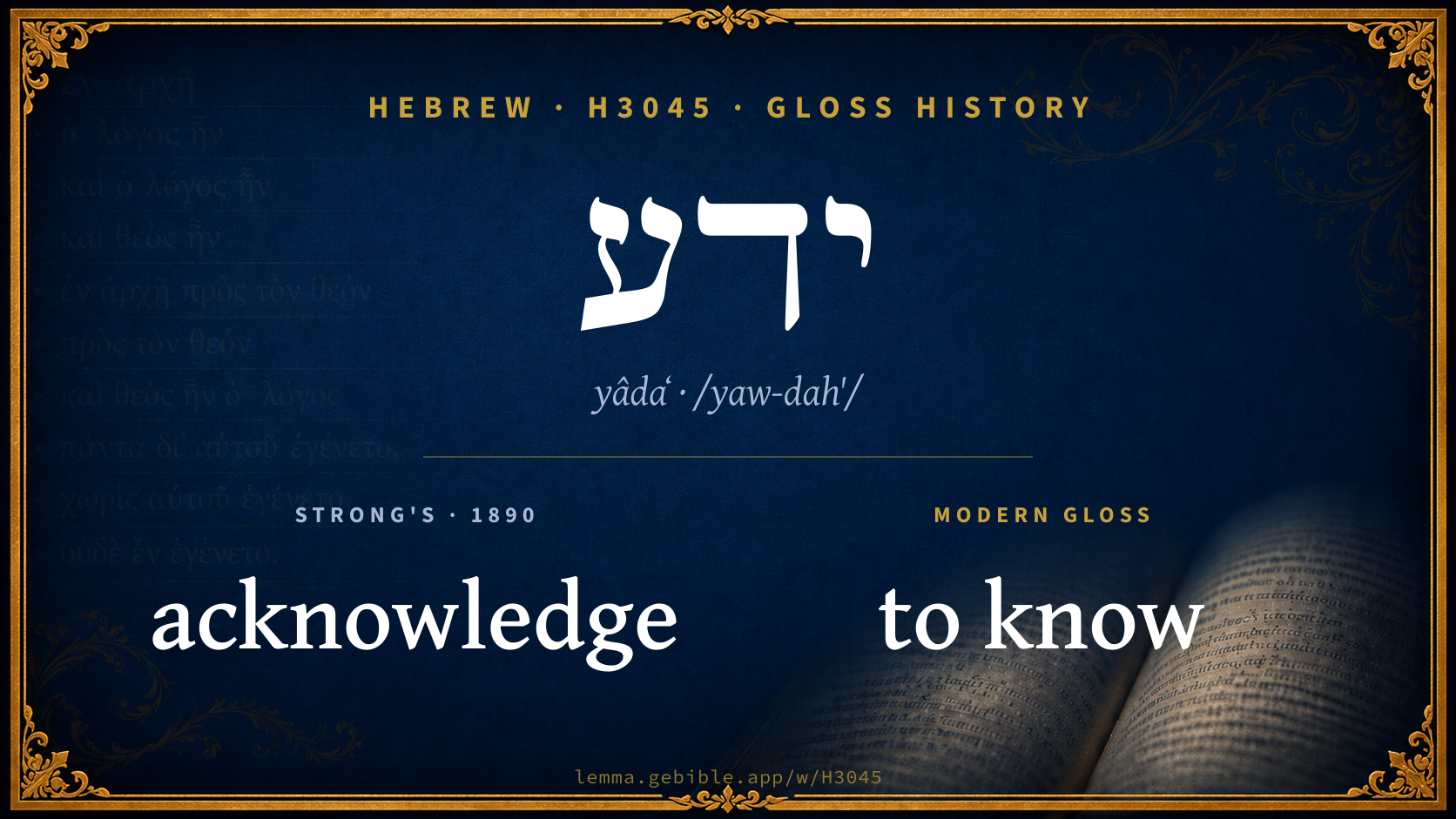
Gloss history
Strong's 1890 vs modern scholarship
About this word
Strong's H3045 catalogs a Hebrew word from the Hebrew Old Testament.
These counts are not copied from any lexicon or concordance. They are computed here, from the morphology-tagged Hebrew Old Testament. What Lemma adds →
- 874
- distinct verses
- The word appears in 874 distinct verses.
- 35 / 39
- OT books
- The word appears in 35 of 39 Old Testament books.
- #45
- by frequency
- Top 50 most frequent Hebrew words (rank 45 of 8,640 Hebrew words by occurrence).
View all 874 occurrences in the concordance →
By section of the Old Testament
By traditional corpus
Conventional, traditional groupings — biblical authorship is debated, so this is a traditional corpus grouping, not an authorship claim. Each share is this word’s portion of its verses in that division of the Hebrew canon. Each figure is a share of the word’s 874 distinct verses.
- Prophets (Nevi'im) 429 verses · 49%
- Writings (Ketuvim) 281 verses · 32%
- Torah (Pentateuch) 164 verses · 19%
How translations render this word
Counts come from each version’s own published word-to-Strong’s tagging or interlinear alignment — an approximate guide to how each version renders this word, not a word-level alignment the data otherwise carries. Because each total is that version’s own tagged count, the per-version totals vary from one another and need not match the appearance or distinct-verse counts above. These counts may also differ from a printed concordance because Lemma counts each distinctly tagged rendering and does not collapse phrase taggings into a single head-word total. This is a fixed set of word-tagged versions (KJV, ASV, BSB, ULT) and does not change with the reading translation you choose elsewhere. Each version’s license is shown beside its name below (and on Sources).
- King James Version: Know 83×, I know 58×, Thou knowest 42×
- American Standard Version: Know 71×, I know 51×, Knoweth 36×
- Berean Standard Bible: Know 173×, You will know 56×, I know 44×
- unfoldingWord Literal Text: Know 276×, You will know 53×, I know 51×
King James Version Public Domain
Renders H3045 across 941 tagged occurrences — most commonly:
Plus other, less common renderings. Plus 270 renderings that appear only once — usually multi-word phrases or single function words the recovered tagging swept in, not distinct renderings. Not rendered by a distinct English word in 6 further occurrences.
American Standard Version Public Domain
Renders H3045 across 935 tagged occurrences — most commonly:
Plus other, less common renderings. Plus 303 renderings that appear only once — usually multi-word phrases or single function words the recovered tagging swept in, not distinct renderings.
Berean Standard Bible Public Domain
Renders H3045 across 913 tagged occurrences — most commonly:
Plus other, less common renderings. Plus 241 renderings that appear only once — usually multi-word phrases or single function words the recovered tagging swept in, not distinct renderings. Not rendered by a distinct English word in 31 further occurrences.
unfoldingWord Literal Text CC BY-SA 4.0
Renders H3045 across 1,237 tagged occurrences — most commonly:
Plus other, less common renderings. Plus 173 renderings that appear only once — usually multi-word phrases or single function words the recovered tagging swept in, not distinct renderings.
25 senses and sub-senses in the full BDB
Hebrew verbs can shift meaning by stem (binyan): Qal is the basic action, Niphal is often passive or reflexive, Piel often intensifies or makes it factitive, and Hiphil is typically causative. The senses below are grouped under the stem BDB assigns to each. This entry also uses Pual (the passive of Piel), Hophal (the passive of Hiphil), Hithpael (reflexive or reciprocal), and one or more reduplicated stems (the Pōlēl/Pilpēl type), which for hollow or geminate roots behave much like Piel — often intensive or iterative.
What do BDB’s symbols mean?
BDB uses these scholarly abbreviations:
| Symbol | Meaning |
|---|---|
| 𝔊 | the Septuagint (the ancient Greek translation, LXX) |
| 𝔙 | the Vulgate (the Latin translation) |
| 𝔖 | the Syriac version (the Peshitta) |
| 𝔗 | the Targum (the Aramaic translation) |
| ψ | the Psalms |
| √ | root (the underlying root or stem) |
| ‖ | parallel passage (a synonymous or contrasted parallel) |
| † | the dagger: every passage where the word occurs is cited |
The 25 senses and sub-senses the full Brown-Driver-Briggs lexicon distinguishes for this word, in lexicon order (not ranked by frequency), with BDB’s own verbatim wording and sub-sense lettering. Shown in Hebrew script with BDB’s own scholarly abbreviations. The condensed entry is in the Lexicon Entry tab. See also the Forms in the corpus table below.
Qal
- Pf. יָדַע Gn 4:1 +; יָדָ֑ע Lv 5:1 +; sf. יְדָעוֹ Dt 34:10 Jb 28:7; יְדָעָהּ Gn 24:16 1 K 1:4; יְדָעָ֫נוּ Is 63:16; 3 fs. יָֽדְעָה Ju 11:39 + 4 times; 2 ms. יָדַ֫עְתָּ Gn 30:26 +; יָדַ֫עְתָּה 2 S 2:26; יָדַ֫עַתְּ Ru 2:11; 1 K 2:15; יָדָ֑עַתְּ Je 50:24; וְיָדַ֫עַתְּ consec. Ru 3:4 + 6 times (incl. Ez 22:16, Co וִידַעְתֶּם, so 𝔊 𝔗) + Ez 28:22 Co (for וְיָֽדְעוּ), so 𝔊; יָדַ֫עְתִּי Gn 4:9 +; sf. יְדַעְתִּ֫יךָ Ex 33:12 + 2 times; יְדַעְתִּיו Gn 18:19; יְדַעְתִּים Pr 30:18; יְדַעְתִּין Is 48:7; יָֽדְעוּ Gn 19:8 +; יָדָ֑עוּ 2 K 4:39 +; יָֽדְעוּן Dt 8:3, 16 (Dr§ 6 n.); 2 mpl. יְדַעְתֶּם Gn 44:15 +; 2 fpl. יְדַעְתֶּן Gn 31:6; וִידַעְתֶּן consec. Ez 13:21, 23, etc.; Impf. יֵדַע Is 7:16 +; יֵדָ֑ע Jos 22:22 + 5 times; יְיֵדָ֑ע ψ 138:6 (read prob. יֵידָ֑ע v. Ges§ 69, 2 R. 3); וַיֵּ֫דַע Gn 4:17 +; sf. יֵדָֽעֶנּוּ Je 17:9; וְיֵֽדָעֵם Ho 14:10; Imv. דַּע Gn 20:7 + 10 times; דְּעֶה Pr 24:14; דָּ֑ע Ec 11:9; sf. דָּעֵ֫הוּ Pr 3:6; דְּעִי Je 2:19 + 4 times; דְּעוּ Nu 32:23 + 15 times; Inf. cstr. דֵּעָה Ex 2:4; דַּ֫עַת Gn 3:22 +; דַּעְתִּי Dt 9:24 Is 48:4, etc.; Inf. abs. יָדוֹעַ Gn 43:7 Jos 23:13; יָדֹעַ Gn 15:13 + 11 times; Pt. act. יֹדֵעַ Gn 3:5 +; f. יֹדַ֫עַת Nu 31:17 + 2 times; יֹדְעִים 2 K 17:26 +; pass. וִידוּעַ cstr. Is 53:3; pl. וִידֻעִים Dt 1:13, 15;— e.g. Genesis 4:1
- 1.
- a. know, learn to know, good and evil Gn 3:22 (J), sq. אֶת־אֲשֶׁר 1 S 28:9; מִסְפַּר הָעָם 2 S 24:2; anything מְאוּמָה 1 S 20:39; לֹא יָדַע אִתּוֹ מְאוּמָה Gn 39:6 (v. II. אֵת 1 b), so v 8; כָּל־דָּבָר 2 S 15:11; subj. God, knowing fowls ψ 50:11; way to wisdom Jb 28:23, etc.; of bird of prey נָתִיב לֹא יְדָעוֹ עָ֑יִט Jb 28:7; the price of wisdom Jb 28:13; something future יום מוֹתִי Gn 27:2 (J); especially sq. cl. Gn 12:11 (J) I know that thou art a woman of fair appearance, 22:12 (E), Ec 1:17; לֹא ידעתי Gn 28:16; answering qu. Where? without other obj., 4:9 (both J); sq. acc. + בְּ, in, in the matter of (v. בְּ I 2 b) לֹא יָדַע עַבְדְּךָ בְּכָל־זֹאת דָּבָר קָטֹן אוֹ גדוֹל 1 S 22:15 thy servant knoweth not of all this anything, little or much; sq. בְּ (rare), gain knowledge of, learn of or about, c. inf., הֲתֵדַע בְּשׂוּם־אֱלוֹהַּ עֲלֵיהֶם Jb 37:15 dost thou know about God’s enjoining upon them? also c. subst. אִישׁ אַל־יֵדַע בַּדְּבָרִים הָאֵלֶּה Je 38:24 let not a man know of these words; similarly sq. עַל, only הֲתֵדַע עַל־מִפְלְשֵׂי־עָ֑ב Jb 37:16 dost thou know concerning the balancings of clouds? (in Jb 12:9 בְּ is instr. as Gn 15:8 ψ 41:12); sq. מִן, רְאוּ וּדְעוּ מִכָּל־הַמַּחֲבֹאִים 1 S 23:23 observe and get knowledge of all the hiding-places; but sq. obj. cl. + מִן of source, קֶדֶם יָדַעְתִּי מֵעֵדֹתֶ֑יךָ כִּי ψ 119:152 long ago I gained knowledge out of thy testimonies that etc.; sq. לְ, have knowledge of, †יָדַעְתָּ לְאִוַּלְתִּי ψ 69:6 thou knowest my foolishness; especially וידע כי אני יהוה and he shall (thou shalt, etc.) know that I am Yahweh Ex 10:2 (R), 6:7; 14:4; 16:12; 29:46 (all P), Ez 6:7, 10, 13 + often in Ezek., 1 K 20:13, 28; sq. acc., which is really subj. of foll. cl., Gn 18:19 (J) I know him that he will, etc. 2 S 3:25 (Ges§ 117. 1, R. 6). e.g. Genesis 3:22
- b. perceive Gn 19:33, 35 (J obj. cl., inf. c. בְּ); with added idea of observing, taking note of, a place, acc. Ru 3:4; c. בְּ, יָדַעְתָּ בְּצָרוֹת נַפְשִׁי ψ 31:8 (‖ רָאָה אֶת־). e.g. Genesis 19:33
- c. ‖ ראה, imv. דע וראה perceive and see 1 S 12:17; 24:12; find out and discern 14:38; 23:22; in reverse order, ראו ודעו only 23:23 (v. a supr.), Je 5:1 (v. DrSm).—Vid. also g infr. e.g. 1 Samuel 12:17
- d. discriminate, distinguish הַאֵדַע בֵּין־טוֹב לְרָ֑ע 2 S 19:36, cf. Dt 1:39 (no בֵּין); לֹא יָדְֽעוּ בֵין־יְמִינוֹ לִשְׂמֹאלוֹ Jon 4:11 they cannot distinguish between their right hand and their left. e.g. 2 Samuel 19:36
- e. know by experience, וִידַעְתֶּם בְּכָל־לְבַבְכֶם וּבְכָל־נַפְשְׁכֶם כִּי Jos 23:14 (D) and know in all your hearts, and all your souls, that, etc.; learn to know י׳ Ho 13:4; learn (a bitter lesson) Ho 9:7 Is 9:8 ψ 14:4; experience י׳’s vengeance Ez 25:14 ψ 14:4 (abs.); quietness Jb 20:20. e.g. Joshua 23:14
- f. recognise, admit, acknowledge, confess Je 3:13; 14:20 Is 59:12 ψ 51:5. e.g. Jeremiah 3:13
- g. consider דְּעוּ מַה־תַּעֲשׂוּ Ju 18:14; ‖ ראה, imv. דע וראה, דעו וראו, 2 S 24:13; 1 K 20:7, 22; also וְיָדַעְתָּ עִם־לִבָבֶ֑ךָ כִּי Dt 8:5 and thou shalt consider with (in) thy heart, that, 4:39. e.g. Judges 18:14
- h. לֹא ידע not know = not expect Is 47:11 ψ 35:8. e.g. Isaiah 47:11
- 2. know a person, be acquainted with Gn 29:5 (J), Ex 1:8 (E), Jb 42:11, know י׳ 24:1; c. לֹא, obj. especially other gods, strange land, etc. = have no knowledge of, or acquaintance with, have not heard of, especially Dt Je:—Dt 11:28; 13:3, 7, 14; 28:64; 29:25; 32:17 (poem), Je 7:9; 9:15; 14:18; 16:13; 17:4; 19:4; 22:28; 44:3; pt. act. acquaintance Jb 19:13; †pt. pass. acquainted with אִישׁ מַכְאֹבוֹת וִידוּעַ חֹ֑לִי Is 53:3 (lit. known of sickness, v. Thes Ew Che Di Du); well-known (with implied trustworthiness) Dt 1:13, 15 †; of beasts knowing owner and master’s crib Is 1:3 (cf. Je 8:7); especially of knowing God לֹא יָדַעְתִּי (י׳) אֶת־י׳ Ex 5:2 (J); involving intelligent worship, obedience, etc. Ju 2:10 1 S 2:12 (read יֵדַע for MT יָדַע, Dr), 3:7 Ho 2:22; 8:2; 5:4 Jb 18:21 ψ 79:6 (v. also דַּעַת 2 b); of God’s knowing persons, etc., thoroughly Ho 5:3; Jb 11:11; knowing the heart 1 K 8:39; 2 Ch 6:30 ψ 139:4; knowing his true servants, recognising and acknowledging them 2 S 7:20; Na 1:7 1 Ch 17:18 +; יְדַעְתִּיךָ בְּשֵׁם Ex 33:12 (JE); = take notice of, regard ψ 1:6; 31:8; 37:18; so of Isr. as chosen people Am 3:2; Ho 13:5 (Assyrian ilu šâ îdûšu, God who regardeth him, HptBAS i. 15) cf. Gn. 18:19; 39:6 (J) Dt 33:9 Jb 9:21. e.g. Genesis 29:5
- 3. know a person carnally, sq. acc.: man subj. Gn 4:1, 17, 25; 24:16; 38:26 (all J), 1 S 1:19; Ju 19:25; 1 K 1:4; woman subj. Gn 19:8 (J), Nu 31:17, 18, 35 (all P), Ju 11:39; יֹדַעַת מִשְׁכַּב זָכָר Ju 21:11; לֹא יָֽדְעָה אִישׁ לְמִשְׁכַּב זָכָר v 12; man subj. and obj. (of sodomy) Gn 19:5 (J), Ju 19:22. e.g. Genesis 4:1
- 4.
- a. know how to do a thing, be able to do it, often c. לֹא and sq. inf.: לֹא יָֽדְעוּ עֲשׂוֹת־נְכֹחָה Am 3:10 they know not how to do right; לֹא יָדַעְתִּי דַבֵּר Je 1:6; 6:15; 1 K 3:7; Is 56:11(×11), c. לְ 50:4 Ec 10:15; לֹא יָדַע לְהִזָּהֵר Ec 4:13 know not how to be admonished (v 17 know that); inf. abs. ידע מָאוֹס בָּרָע וּבָחוֹר בַּטּוֹב Is 7:15, 16. e.g. Amos 3:10
- b. be skilful in, especially pt., sq. acc. יֹדֵעַ צַיִד Gn 25:27 (J) skilled in hunting; ידע סֵפֶר skilled in a book, learned Is 29:11, 12(×12); as pl. cstr. יוֹדְעֵי נֶ֑הִי Am 5:16 knowers of lamentation, professional mourners; יֹדְעֵי הַיָּם 1 K 9:27 skilled in the sea, 2 Ch 8:18; especially sq. inf. יֹדֵעַ נַגֵּן 1 S 16:18 skilled in playing, 1 K 5:20; 2 Ch 2:6, 7, 13: יֹדֵעַ מְנַגֵּן בַּכִּנּוֹר 1 S 16:16 knowing, (as) a player on the lyre (v. Dr). e.g. Genesis 25:27
- 5. abs. have knowledge, be wise: לַיֹּדְעִים Ec 9:11 (‖ חֲכָמִים, נְבֹנִים); especially have knowledge of God and duty, or in practical affairs Is 1:3 (‖ בין), 56:10; often c. acc. cogn.: דַּעַת Pr 17:27; 30:3; בִּינָה Is 29:24; Pr 4:1; 2 Ch 2:12, cf. יוֹדְעֵי בִּינָה לָעִתִּים 1 Ch 12:33 (Baer), Est 1:13; also יֹדְעֵי דָּת וָדִין v 13; יֹדְעֵי דַעַת וּמְבִינֵי מַדָּע Dn 1:4; obj. שֶׂכֶל וּבִינָה 2 Ch 2:11 (‖ בֵּן חָכָם); חָכְמָה וּמוּסָר Pr 1:2 (‖ הבין אִמְרֵי בִּינָה); חָכְמָה Pr 24:14; Ec 8:16. e.g. Ecclesiastes 9:11
Niphal
- Pf. נוֹדַע Gn 41:21 + 10 times; וְנוֹדַע consec. 1 S 6:3 + 2 times; 3 fs. וְנוֹדְעָה Lv 4:14; Is 66:14, etc.; Impf. יִוָּדַע Gn 41:31 + 10 times; יִוָּדֵ֑עַ Pr 10:9; וַיִּוָּדַ֫ע Est 2:22; 3 fs. תִּוָּדֵ֑עַ Pr 14:33; 2 fs. תִּוָּֽדְעִי Ru 3:3; וָאִוָּדַע Ez 20:5; Inf. sf. הִוָּֽדְעִי Je 31:19; Pt. נוֹדָע ψ 76:2 + 2 times;— e.g. Genesis 41:21
- 1. be made known, be or become known, of things Gn 41:31 (sq. בְּ), Ex 2:14 (both E), Lv 4:14 (P), Ju 16:9; 2 S 17:19; Na 3:17; Zc 14:7 (sq. לְ), ψ 77:20; 79:10 (sq. בְּ), 88:13 (sq. בְּ); of hand of י׳ Is 66:14 (sq. אֶת); c. subj. cl. Ex 21:36; 33:16 (both JE), Dt 21:1; 1 S 6:3 (sq. לְ), 1 K 18:36 Ez 36:32 (sq. לְ), Ru 3:14; Ec 6:10; Est 2:22 (sq. לְ); of pers., Pr 31:23 (sq. בְּ) Is 61:9 (sq. בְּ and בְּתוֹךְ); of י׳ ψ 76:2 (sq. בְּ); = be revealed, discovered, of pers. 1 S 22:6; Je 28:9; Pr 10:9; of things Ne 4:9; Pr 12:16; 14:33. e.g. Genesis 41:31
- 2. make oneself known, of pers., sq. לְ Ru 3:3, usually of God (י׳) Ex 6:3 (P; ‖ וָאֵרָא אֶל־), Is 19:21; Ez 20:5, sq. לְעֵינֵי 38:23; sq. אֶל־ 20:9; sq. בְּ 35:11 ψ 48:4; without prep. 9:17. e.g. Ruth 3:3
- 3. be perceived (pass. of Qal), of perception by the eye Gn 41:21 (E), ψ 74:5. e.g. Genesis 41:21
- 4. be instructed (pass. of Hiph.) Je 31:19, in spiritual sense, through chastisement. e.g. Jeremiah 31:19
Piel
- Pf. 2 ms. יִדַּ֫עְתָּ, only ידעתה שַׁחַר מְקֹמוֹ Jb 38:12 Kt; read with Qr יִדַּעְתָּ הַשַּׁחַר cause to know, sq. 2 acc.; so ψ 104:19 according to Bae, who reads יִדַּע, after Aq Symm. e.g. Job 38:12
Po
- Pf. 1 s. יוֹדַעְתִּי 1 S 21:3 I have caused to know, i.e. directed, sq. acc., but read יוֹעַדְתִּי or יָעַדְתִּי, from יעד, so 𝔊 We Dr. e.g. 1 Samuel 21:3
Pual
- Pt. known מידעת Is 12:5 Kt (Qr מוּדַעַת v. Hoph.); elsewhere as subst. = acquaintance מְיֻדָּעִי ψ 55:14; מְיֻדָּעָיו 2 K 10:11; מְיֻדָּעַי ψ 88:9 Jb 19:14 (‖ קְרוֹבָ֑י), ψ 88:19 (‖ אֹהֵב and רֵעַ); מְיֻדָּעָ֑י ψ 31:12, Kt מידע Ru 2:1 (Qr מוֹדַע q.v. infr.) e.g. Isaiah 12:5
Hiphil
- Pf. הוֹדִיעַ ψ 98:2; הוֹדִיעַ֫נִי Je 11:18; הוֹדַ֫עְתָּ 1 K 1:27 + 2 times; הוֹדָ֑עְתָּ Jb 26:3, etc.; Impf. יוֹדִיעַ ψ 103:7 Is 38:19; juss. יֹדַ֫ע Nu 16:5; וַיֹּדַע Ju 8:16; יוֹדִיעֶנּוּ Is 40:13, 14; 2 ms. תּוֹדִיעַ Hb 3:2; תּוֹדִיעֵנִי ψ 16:11; 51:8; 1 s. אוֹדִיעַ ψ 89:2 Ez 39:7; אוֹדִיעָה Pr 1:23 Is 5:5; יוֹדִיעוּ Jb 32:7; יוֹדִעֻם Ez 44:23; נוֹדִיעָה 1 S 14:12; Imv. הוֹדַע Pr 9:9 + 3 times (הוֹדַ֑ע ψ 90:12); sf. חוֹדִיעֵנִי Jb 10:2 + 6 times, etc.; Inf. cstr. הוֹדִיעַ 2 S 7:21 + 3 times; הֹדִיעַ 1 Ch 17:19; הוֹדִיעֵנִי 1 S 28:15, etc.; Pt. מוֹדִיעֲךָ Dn 8:19; מוֹדִיעָם Je 16:21; מוֹדִיעִים Is 47:13 2 Ch 23:13;—make known, declare, c. acc. rei Nu 16:5 (P), Ez 39:7; 1 Ch 17:19; Jb 26:3 ψ 89:2; 98:2; 106:8; obj. om. Hb 3:2; teach, c. acc. rei Jb 32:7; sq. inf. ψ 90:12 and (peculiarly) מ׳ לְהַלֵּל 2 Ch 23:13 i.e. led in praising; c. לְ pers. Pr 9:9; c. acc. pers. Is 40:13; Ju 8:16 (but read וַיָּ֫דָשׁ, v. דושׁ); make known, declare, c. acc. rei, + לְ pers. Ex 18:20; Dt 4:9; Ne 8:12; 9:14 ψ 78:5; 103:7; 145:12; Is 38:19 (c. אל rei) 64:1; c. cl., + לְ pers. 1 S 10:8; make one know, c. cl. of thing and acc. (sf.) pers. Ex 33:12 Dt 8:3 1 S 6:2; 16:3; 28:15 Jb 10:2; 37:19; c. acc. rei + sf. pers. הוֹדִעֵנִי נָא אֶת־דְּרָכֶ֔ךָ וְאֵדָעֲךָ Ex 33:13 (JE) make me, I pray, to know thy ways, that I may know thee; Je 16:21 Ez 20:4; 22:2; 43:11; Is 40:14 (‖ וַיְלַמְּדֵהוּ דַעַת, also v a וַיְבִינֵהוּ), Pr 22:21; Jb 13:23 ψ 16:11; 25:4 (‖ לַמְּדֵנִי), v 14 (on inf. c. לְ v. Ges§ 114. 2, R. 2, Exx.), 39:5; 51:8; 143:8 (‖ הַשְׁמִיעֵנִי); חַטָּאתִי אוֹדִיעֲךָ 32:5 (‖ עֲוֹנִי לֹא־כִסִּיתִי); sq. 2 separate acc. Gn 41:39 (E), 1 S 14:12; Is 5:5 Ez 20:11; 16:2 Pr 1:23; Dn 8:19; acc. pers. om. Ex 18:16 (E); acc. rei om. Jos 4:22 = teach one (D), so Is 40:13, 2 S 7:21; 1 K 1:27; = answer Jb 38:3; 40:7; 42:4; c. sf. pers., acc. rei om. Je 11:18; 16:21 Pr 22:19; sq. acc. rei + בְּ ψ 77:15 thou hast made known thy might among the peoples, Is 12:4 1 Ch 18:8 = ψ 105:1; sq. cl. + בְּ pers. Ho 5:9; sq. בֵּין, teach the difference between, to discriminate between בֵּין הַטָּמֵא לְטָהוֹר Ez 22:26; + sf. pers. 44:23 (cf. Qal 1 d); sq. מִן partit. מוֹדִעִים לֶחֳדָשִׁים מֵאֲשֶׁר יָבוֹאוּ Is 47:13 who declare, at the new moons, of (the things) which are to come. e.g. Psalms 98:2
Hophal
- Pf. הוֹדַע Lv 4:23, 28 (v. Köi, 427); Pt. מוּדַעַת Qr Is 12:5 (> Kt מְיֻדַּעַת);—made known (Pt.) Qr Is 12:5 let this be made known in (בְּ) all the earth (> Kt Pu. Pt. which is not elsewhere in this sense); sq. אֵלָיו if his sin be made known unto himself Lv 4:23, 28 (P). e.g. Leviticus 4:23
Hithpael
- Impf. אֶתְוַדָּ֑ע Nu 12:6 (E), sq. אֶל־ make oneself known to, of י׳; Inf. הִתְוַדַּע אֶל־ Gn 45:1 (E), of Joseph. e.g. Numbers 12:6
Senses from the full Brown-Driver-Briggs lexicon (Brown, Driver, Briggs; Oxford 1906 — public domain), digitized via Sefaria, supplemented by the OpenScriptures HebrewLexicon (CC BY 4.0). Full attribution on Sources.
Word origin
vb. know (NH id.; Aramaic יְדַע, ܝܺܕܰܥ Ph. ידע; Ethiopic አይድዐ ii. i. indicate, announce, narrate; Assyrian idû, know, COTGloss.; Sab. ידע, especially in cpd. n.pr. DHMZMG 1875, 612)—
— Brown-Driver-Briggs (Oxford 1906, public domain), digitized via Sefaria, supplemented by the OpenScriptures HebrewLexicon (CC BY 4.0). See Sources.
Origin: a primitive root
Jastrow Dictionary
A second Hebrew/Aramaic lexicon for comparison, covering Aramaic and post-biblical (Talmudic, Targumic, Midrashic) usage that the biblical-Hebrew BDB does not. Matched by lemma rather than by Strong’s number, so a lemma may carry more than one Jastrow headword (shown separately below), and the entries cover usage well beyond the Bible.
יָדַע
- [to point out, select, love,]
- 1. to recognize, know; to find out. Pes. 87ᵇ כיון שי׳ שחטא when he was convinced that he had done wrong. Ib. ואין אתה יוֹדֵעַ אם וכ׳ and thou knowest not whether &c. Ib. יודע הקב"ה את ישראל וכ׳ the Lord knows that Israel cannot endure the cruel persecutions of Rome (v. Rabb. D. S. a. l. note); Yalk. Hos. 529. Shebu. 4ᵇ; ib. 5ᵃ ונעלם מבלל שי׳ it says, ‘and it escaped his memory’ (Lev. V, 3)—this proves that there was a time when he knew (the nature of his act, v. יְדִיעָה). Zeb. 115ᵇ דבר זה … ולא יְדָעוֹ וכ׳ this word (Ex. XXIX, 43) the Lord had said to Moses, but he did not understand it, until the sons of Aaron died. Ib. כיון שי׳ … יְדוּעֵי מקום הן when Aaron learned that his sons were the chosen of the Lord (Lev. X, 3); a. v. fr.—Part. pass. יָדוּעַ a) chosen. Pl. יְדוּעִים, constr. יְדוּעֵי, v. supra.—b) known, special, certain. Sifra Vayikra, Ḥobah, Par. 6, ch. VIII חטא י׳ a known (discovered) sin, v. יְדִיעָה. Y. Sot. I, 16ᶜ טומאה יְדוּעָה (not ידוע) an ascertained levitical uncleanness, opp. ספק; a. fr.—בְּיָדוּעַ it is sure. R. Hash. 20ᵇ בי׳ שנראה וכ׳ the moon must have been visible &c. Succ. 49ᵇ כל אדם … בי׳ שהוא וכ׳ a popular man (v. חֵן) is, you may be sure, a God-fearing man; a. fr. e.g. Leviticus 5:3
- 2. (euphem.) to have sexual intercourse with. Yeb. 57ᵃ בלא יְדָעָהּ when he never had connection with her. Esth. R. to III, 7 שלא יְדָעָהּ איש וכ׳ whom no man except her husband touched; a. e.
- to make known, inform. Gen. R. s. 22, beg. (ref. to Gen. IV, 1, reading יִדַּע for homiletical purposes) ה׳ דרך ארץ לכל he showed to all the way of the land (propagation, v. דֶּרֶךְ). Ḥull. V, 3 צריך להוֹדִיעַ must inform (the purchaser). Ab. IV, 22 לֵידַע להודיע ולהִוָּורַע to learn, to proclaim and to be made to feel (be thoroughly convinced). Sabb. 10ᵇ צריך להוֹדִיעוֹ must inform him. Ib. לך והוֹדִיעֵם go and tell them. Ib. הנותן … צריך לה׳ לאמו he who gives bread to a child must inform his mother; a. fr. e.g. Genesis 4:1
- to be informed, become conscious; to be made known. Shebu. I, 6 ה׳ ולא ה׳ whether he became conscious (of his transgression) or not. Sifra Vayikra, Ḥobah, ch. XX, Par. 12 (ref. to Lev. IV, 23; 28) את ה׳ שלהם when they become known; a. fr.—B. Bath. 113ᵇ הוֹדְעָה Ms. M. (v. אָרַע II). e.g. Leviticus 4:23
- same. Hor. III, 3. Ab. IV, 22, v. supra. Shebu. 9ᵇ שסופו לִיוָּדַע of which he is likely to be informed. Ḥull. 9ᵃ עד שיִוָּדַע לך, v. חֲזָקָה. Nidd. IX, 5, v. infra; a. fr.
- , Nithpa. נִתְוַודַּע
- 1. same. Bekh. 25ᵇ עד שיִתְוַורַּע הטומאה (Nidd. l. c. עד שיודע לך וכ׳) until he ascertains the exact place of uncleanness; Pes. 10ᵃ עד שתִּיוָּדַע לך Ms. M. (v. Rabb. D. S. a. l.). Y. Sabb. III, 6ᵇ נתודע לו וכ׳ he found it out after sunset; a. fr.
- 2. (v. מוֹדַע) to force one’s self upon the notice of, to pretend friendship for. Ab. I, 10 אל תִּתְוַדַּע לרשות do not make thyself a partisan of the (foreign) government.
יְדַע
- Targ. Gen. IV, 1; a. fr.—Ib. XXX, 26; a. fr:—Fut. יִדַּע, יִנְדַּע (fr. נדע). Targ. Ps. XXXIX, 5 אִידַּע Ms. (ed. אֵידַע). Targ. Ex. VIII, 6; a. fr.—Ber. 33ᵇ אנא לא האי יְדַעְנָע I learned nothing either about this &c. Snh. 103ᵃ (prov.—of one who derives no lesson from adversity or success) בכיי ליה למר ולא י׳ וכ׳ Ms. M. (ed. דלא, v. Rabb. D. S. a. l.) they lament to you and you understand it not, they laugh to you and you understand it not; וי ליה למאן דלא י׳ וכ׳ (not למר) woe to him who knows not the difference between good and evil; a. fr.
- as preced. Hif. Targ. Ex. XXXIII, 13. Targ. Ps. CVI, 8 לאוֹדָעָה (Ms. לאַנְדָּ׳, v. supra); a. fr.—Snh. 11ᵇ מְהוֹדְעִין אנחנא וכ׳ we (the Sanhedrin) notify you &c.; Y. ib. I, 18ᵈ top מוֹדַעְנָא; Tosef. ib. II, 6 מְהוֹדַעְנָא (Var. מְהוֹדְעֵי אנחנא). Sabb. 33ᵇ מאן לוֹדְעֵיה לבר וכ׳ (Ms. M. מוֹדְעֵיה) Oh, that some one would inform the son of Yoḥai &c. Ned. 62ᵃ לאוֹדוּעֵי נפשיה to make one’s self known (as a scholar). Gen. R. s. 11 מנאן את מוֹדַע לי (some ed. מְיַדַּע) how will you prove it to me?; a. fr.
- same. Cant. R. to III, 6 לינא מְיַדַּע לדין וכ׳ shall I not let him know with whom he is dealing?. Gen. R. s. 11, v. supra.—Part. pass. מְיַדַּע friend. Targ. Ps. LXXXVIII, 9 מְיַדְּעַי Ms. (ed. מיודעי, hebraism).
- to be made known, to make one’s self known. Targ. O. Gen. XLV, 1. Ib. XLI, 21; a. fr.—[Targ. Y. Deut. XXI, 11 תתידעון, read: תיתרעון, as in v. 14.]—Hor. 2ᵃ כי מִתְיַדַּע להו לבי דינא if the court were made aware of it. Sabb. 71ᵇ א׳ ליה קודם וכ׳ he became aware of it before setting the sacrifice aside; a. e.
A Dictionary of the Targumim, the Talmud Babli and Yerushalmi, and the Midrashic Literature (Marcus Jastrow; London, Luzac, 1903) — Public Domain. Digitized via Sefaria. Digitized via Sefaria. Full attribution on Sources.
Forms in the corpus
The 509 distinct written forms H3045 takes in the Hebrew Bible, most frequent first — each parse links to that stem’s occurrences in the concordance. Hebrew forms include their vowel points and cantillation, so a single lemma takes many written forms.
The 60 most common forms are shown; 449 rarer forms follow in the full concordance.
Same root — word family
Other BDB entries built from the same root as H3045, grouped by Strong’s listed origin. These share a root / origin per the lexicon — not necessarily a shared meaning. Each links to that word’s own entry.
Derived from this word
- דע dêaʻ H1843 knowledge
- דעת daʻath H1847 knowledge
- ידע yᵉdaʻ H3046 to know
- ידעני yiddᵉʻônîy H3049 soothsayer
- מדע maddâʻ H4093 knowledge
- מודע môwdaʻ H4129 kinsman
- מודעת môwdaʻath H4130 kindred
Proper names from this root
People and places named from this root — a name, not an additional meaning of the word.
- דעואל Dᵉʻûwʼêl H1845 Deuel
- ידוע Yaddûwaʻ H3037 Jaddua
- ידיעאל Yᵉdîyʻăʼêl H3043 Jediael
- ידע Yâdâʻ H3047 Jada
- ידעיה Yᵉdaʻyâh H3048 Jedaiah
Compare all same-root words → Showing 4 of 13 — not the complete family. 5 of the same-root words are proper names (people or places). They share a root, not necessarily a meaning.
Septuagint verse parallels
This word appears in 830 verses that also exist in the Greek Old Testament (Septuagint), out of the 874 Hebrew verses it occurs in. You can read those verses in Greek by switching the Old Testament edition to the Septuagint.
Read these verses in the Septuagint
- Genesis 3:5
- Exodus 1:8
- Leviticus 4:14
- Numbers 10:31
- Deuteronomy 1:13
- Joshua 2:4
- Judges 2:10
- Ruth 2:1
- 1 Samuel 1:19
- 2 Samuel 1:5
- 1 Kings 1:4
- 2 Kings 2:3
This is a verse-level parallel only — the same verses exist in both the Hebrew and Greek Old Testaments. No word-level Hebrew↔Greek correspondence is claimed: the data carries no such alignment, so no Greek word is shown as this Hebrew word’s translation. Coverage is not total — the Septuagint omits the deuterocanon and renumbers the Psalms, so some Hebrew verses have no direct Greek parallel.