
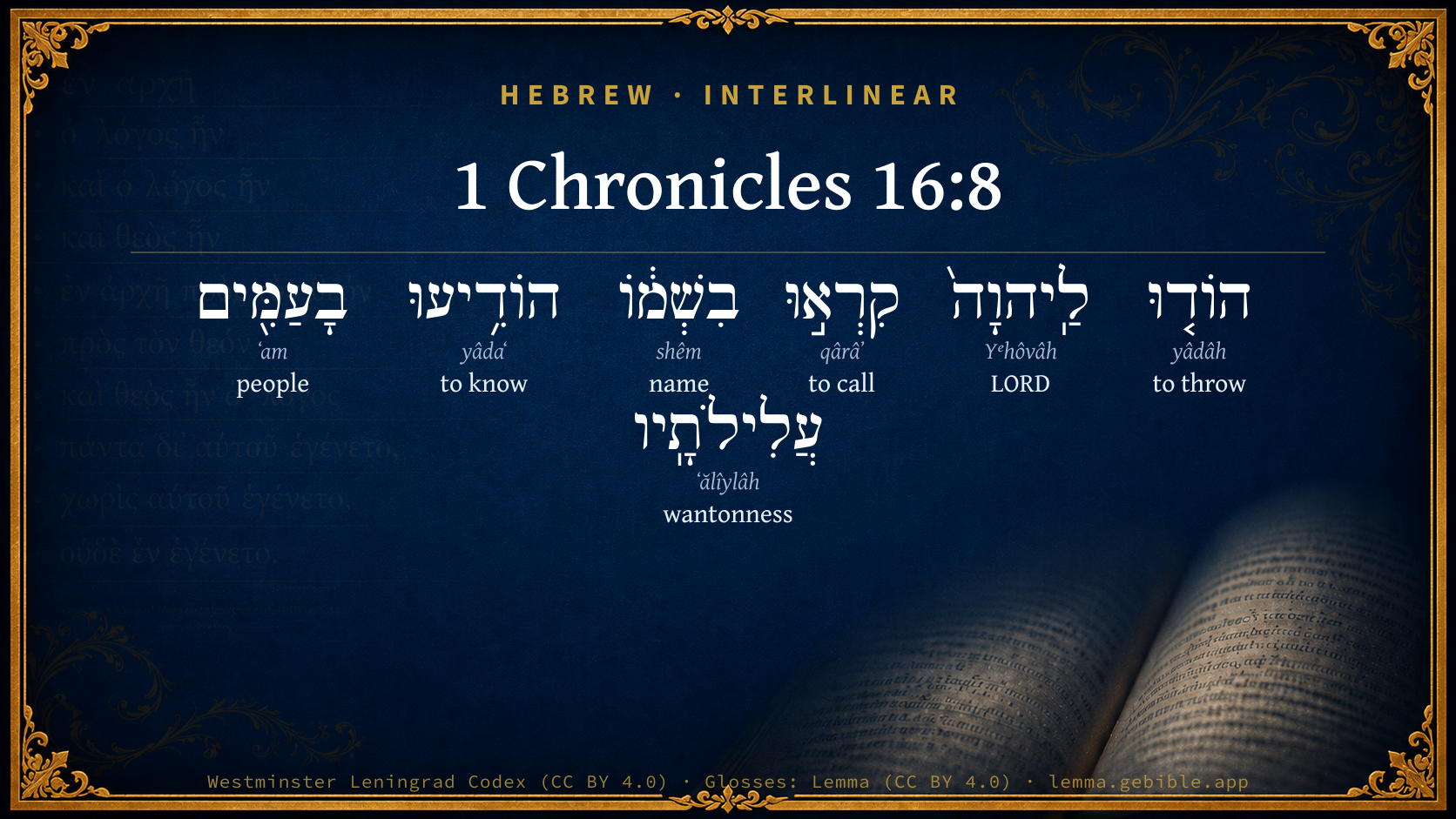
1 Chronicles 16:8

Hebrew (Westminster Leningrad Codex) 1 Chronicles 16:8 appears in the Hebrew Old Testament. The text above is from the Westminster Leningrad Codex. Each word links to its Strong’s number, a concise gloss, and parsing drawn from the Open Scriptures Hebrew Bible morphology. Click any word for its full Brown-Driver-Briggs (BDB) entry.
Download image
Cite this verse

1 Chronicles 16:8 (World English Bible). Public Domain. Lemma interlinear Bible study tool, https://lemma.gebible.app/v/1-chronicles/16/8.

Show BibTeX & RIS
BibTeX
RIS
English Translation
Oh give thanks to Yahweh, call on his name; Make known his doings among the peoples.
World English Bible · Public Domain
Download a study sheet

One document with this verse’s original text, its word-by-word gloss line, the meaning frame, cross-references with their text, attributed commentary, and full source and license credits — printable, and it pastes into notes with its structure intact.

This verse Autodidact and up

Study sheet (.html) Plain text (.txt)

A passage Seminary Student

Up to 50 verses in one chapter. A passage sheet keeps up to 6 commentary sources and 12 cross-references per verse, in the order this page ranks them, and says so on the sheet whenever that leaves anything out. Ask for a single verse and you get the Autodidact verse sheet above.

Everything on this page stays free to read, with no account — the sheet is a download of what is already on screen, not access to it.

Want to remove ads? Support Godless Engineer
Compare translations 3

The same verse in 3 English versions, stacked beneath the original-language interlinear above. Click any original word for its lexicon entry.

Each is an independent rendering of the whole verse — the interlinear is not word-aligned to these translations.

Highlighted words mark where these versions differ — a whole-verse word diff, not a word-by-word alignment.

  • World English Bible Public Domain
    Oh give thanks to Yahweh, call on his name; Make known his doings among the peoples.
  • King James Version Public Domain
    Give thanks unto the LORD, call upon his name, make known his deeds among the people.
  • unfoldingWord Literal Text CC BY-SA 4.0
    Give thanks to Yahweh, call on his name; make known his deeds among the peoples!

unfoldingWord Literal Text — © unfoldingWord, licensed CC BY-SA 4.0. Word-aligned USFM3 via Door43 (git.door43.org/unfoldingWord/en_ult).

Versions to compare (up to 4)

3 of 4 selected

Show all 18 translations

Every available English version of this verse, each an independent rendering of the whole verse.

  • World English Bible Public Domain
    Oh give thanks to Yahweh, call on his name; Make known his doings among the peoples.
  • Berean Standard Bible Public Domain
    “Give thanks to the LORD; call upon His name; make known His deeds among the nations.
  • Majority Standard Bible Public Domain
    “Give thanks to the LORD; call upon His name; make known His deeds among the nations.
  • King James Version Public Domain
    Give thanks unto the LORD, call upon his name, make known his deeds among the people.
  • American Standard Version (1901) Public Domain
    O give thanks unto Jehovah, call upon his name; Make known his doings among the peoples.
  • Revised Version (1885) Public Domain
    O give thanks unto the LORD, call upon his name; make known his doings among the peoples.
  • Geneva Bible (1599) Public Domain
    Praise the Lord and call vpon his Name: declare his workes among the people.
  • Douay-Rheims (1899) Public Domain
    Praise ye the Lord, and call upon his name: make known his doings among the nations.
  • Young's Literal Translation Public Domain
    Give thanks to Jehovah, call in His name, Make known among the peoples His doings.
  • Literal Standard Version CC BY-SA 4.0
    “Give thanks to YHWH, call on His Name, || Make His doings known among the peoples.
  • Unlocked Literal Bible CC BY-SA 4.0
    Give thanks to Yahweh, call on his name; make known his deeds among the nations.
  • unfoldingWord Literal Text CC BY-SA 4.0
    Give thanks to Yahweh, call on his name; make known his deeds among the peoples!
  • Darby Bible Public Domain
    Give thanks unto Jehovah, call upon his name; Make known his acts among the peoples.
  • World Messianic Bible Public Domain
    Oh give thanks to the LORD. Call on his name. Make what he has done known among the peoples.
  • Webster's Bible Public Domain
    Give thanks to the LORD, call upon his name, make known his deeds among the people.
  • Free Bible Version CC BY-SA 4.0
    Give the Lord thanks, worship his wonderful nature, let people know what he's done!
  • Bible in Basic English Public Domain
    O give praise to the Lord; give honour to his name, talking of his doings among the peoples.
  • JPS Tanakh (1917) Public Domain
    O give thanks unto the LORD, call upon His name; make known His doings among the peoples.

Literal Standard Version (2020), Covenant Press — licensed CC BY-SA 4.0. Text via the HelloAO Bible API (eBible.org). Unlocked Literal Bible (unfoldingWord) — licensed CC BY-SA 4.0. Text via the HelloAO Bible API (eBible.org). unfoldingWord Literal Text — © unfoldingWord, licensed CC BY-SA 4.0. Word-aligned USFM3 via Door43 (git.door43.org/unfoldingWord/en_ult). Free Bible Version, Dr. Jonathan Gallagher — licensed CC BY-SA 4.0. Text via the HelloAO Bible API (eBible.org).

Word by word

More ways to search: Search by grammar → Find every occurrence → Compare this word →

Practice this passage: Drill this verse → Learn its vocabulary →

About this verse

These counts appear in no published source. They are computed here, from the morphology-tagged text and Lemma’s own curated glosses. What Lemma adds →

7
words
7
distinct lemmas
Historical
section

Notable vocabulary

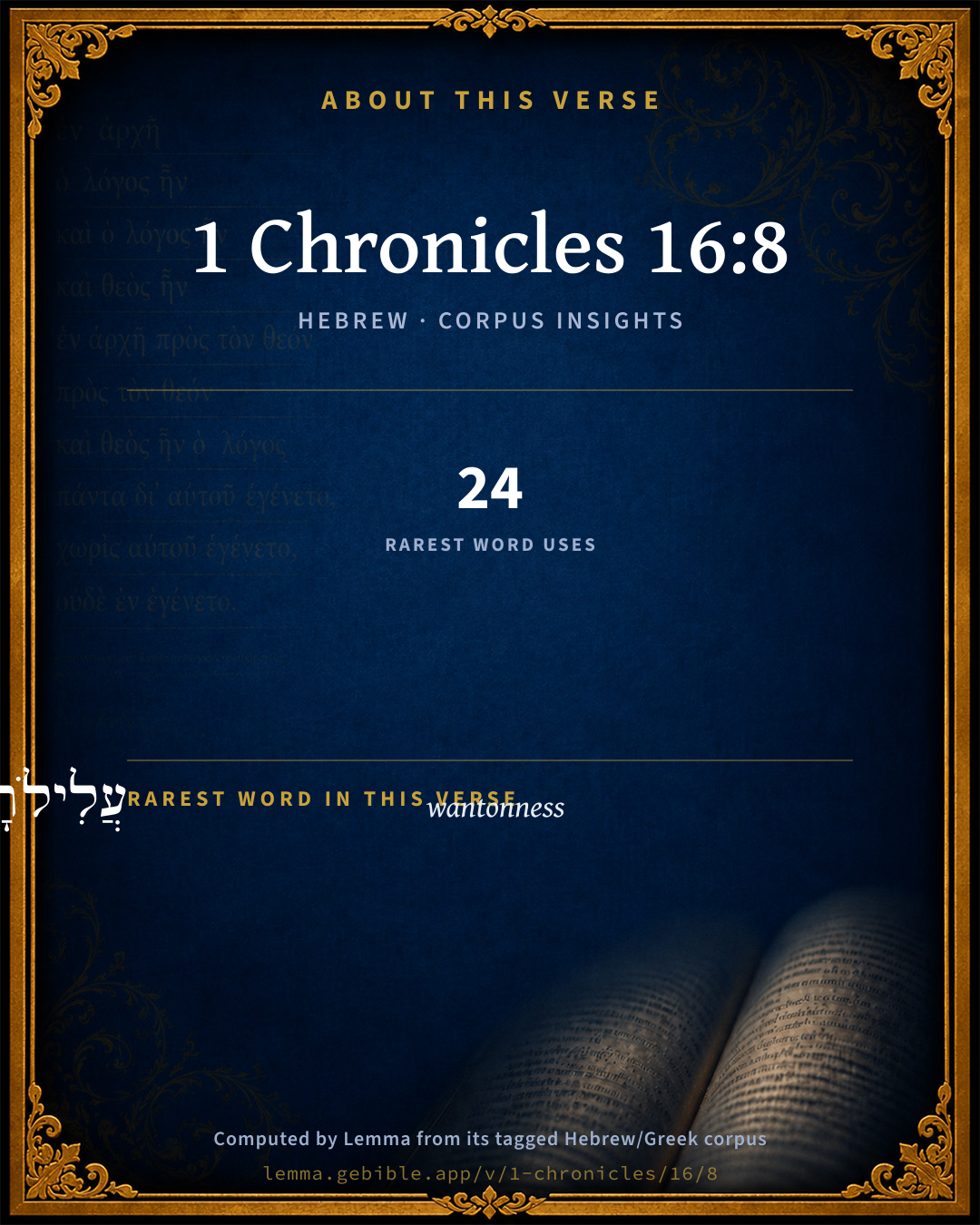
The rarest word here is עֲלִילֹתָֽיו wantonness H5949 — appearing just 24 times in the whole Hebrew Bible.

Shared distinctive vocabulary

עֲלִילֹתָֽיו wantonness H5949 occurs in 24 verses of the Hebrew Bible. Also found in:

Grammatical profile

  • 3 verbs
  • 4 nouns

Verb forms

  • הוֹד֤וּ Hiphil · Imperative
  • קִרְא֣וּ Qal · Imperative
  • הוֹדִ֥יעוּ Hiphil · Imperative

Hebrew & Septuagint length

In English translation the verse runs 16 words from the Hebrew and 19 from the Septuagint (LXX English) — closely comparable.

A rough comparison of the two English renderings, which tokenize alike — not a word-level alignment.

Word counts can differ between the Hebrew and the Greek without any difference in meaning — e.g. the Hebrew direct-object marker אֵת has no separate Greek word, and Greek often adds the article ὁ.

Cross-references

11

Topical passages linked to 1 Chronicles 16:8 in the Treasury of Scripture Knowledge — connected by theme and wording, ordered by reader-vote popularity; previews shown in the World English Bible.

  • Psalms 105:1–15 Give thanks to Yahweh! Call on his name! Make his doings known among the peoples.
  • Isaiah 12:4 In that day you will say, "Give thanks to Yahweh! Call on his name. Declare his doings among the peoples. Proclaim that his name is exalted!
  • 2 Kings 19:19 Now therefore, Yahweh our God, save you us, I beg you, out of his hand, that all the kingdoms of the earth may know that you Yahweh are God alone.
  • Psalms 145:5–6 Of the glorious majesty of your honor, Of your wondrous works, I will meditate.
  • 1 Chronicles 16:8–22 Oh give thanks to Yahweh, call on his name; Make known his doings among the peoples.
  • 1 Chronicles 16:34 Oh give thanks to Yahweh; for he is good; For his loving kindness endures forever.
  • 1 Corinthians 1:2 to the assembly of God which is at Corinth; those who are sanctified in Christ Jesus, called to be saints, with all who call on the name of our Lord Jesus Christ in every place, both theirs and ours:
  • 1 Kings 8:43 hear in heaven, your dwelling-place, and do according to all that the foreigner calls to you for; that all the peoples of the earth may know your name, to fear you, as does your people Israel, and that they may know that this house which I have built is called by my name.
  • Psalms 67:2–4 That your way may be known on earth, And your salvation among all nations,
  • Psalms 78:3–6 Which we have heard and known, And our fathers have told us.
  • Acts 9:14 Here he has authority from the chief priests to bind all who call on your name."

Cross-references courtesy of OpenBible.info (CC BY 4.0).

Hebrew and Greek witnesses Masoretic Hebrew ↔ Greek Septuagint

The same verse in the two great witnesses to the Old Testament, shown verse-for-verse.

These are two independent witnesses, not word-aligned to each other, and the Septuagint is shown in lemma (dictionary) form.

Hebrew 1 Chronicles 16:8 Masoretic · Westminster Leningrad Codex

הוֹד֤וּ לַֽיהוָה֙ קִרְא֣וּ בִשְׁמ֔וֹ הוֹדִ֥יעוּ בָעַמִּ֖ים עֲלִילֹתָֽיו

Oh give thanks to Yahweh, call on his name; Make known his doings among the peoples.

World English Bible · Public Domain

Greek LXX 1 Chronicles 16:8 Septuagint · lemma form

ἐκὁμολογέω ὁ κύριος ἐπικαλέω αὐτός ἐν ὄνομα αὐτός γνωρίζω ἐν λαός ὁ ἐπιτήδευμα αὐτός

Song. Give thanks to the Lord, call upon him by his name, make known his designs among the people.

LXX2012 (modern English Septuagint) · Public Domain

Hebrew: Westminster Leningrad Codex (CC BY 4.0). Greek: Septuagint (public domain); English from LXX2012 (modern English Septuagint) (Public Domain). How the Septuagint differs from the Hebrew →

Commentary

Notes on 1 Chronicles 16:8 from classic Christian and Jewish commentators (each source and its license shown beneath its notes). The classic Christian expositions comment on the surrounding passage and are grouped to its opening verse, so a note may address several verses; the Jewish commentaries on the Tanakh (Rashi and others) are per-verse, so they appear only where the commentator wrote on this verse.

Lemma curates 59 commentaries, every one of them public domain or Creative Commons licensed, each selected and text-cleaned for this edition rather than reprinted as found. About our sources →

Trapp's Complete Commentary

John Trapp

1Ch 16:8 Give thanks unto the LORD, call upon his name, make known his deeds among the people.

Ver. 8. Call upon his name.] This psalm was sung in times of any great joy, as may be gathered from Isa 12:4.

John Trapp, A Commentary or Exposition upon All the Books of the Old and New Testament (1647–1656) — public domain. Text from a community e-Sword module.

Geneva Bible (1599)

Geneva Bible translators

Whereof this is the chiefest, that he hath chosen himself a Church to call upon his Name.

Geneva Bible (1599) marginal notes — public domain. Text via Bolls.life.

Ellicott's Commentary for English Readers

(8) Give thanks.—The same Hebrew verb as in 1Ch_16:4, “to thank.” Psalms 105 is a tôdâh, or thanksgiving, hence its use here.

Call upon his name.—Invoke His help, appealing to Him by His revealed name of Jehovah. (Comp. Psa_3:1-7; Psa_5:1; Psa_7:6, and many others.)

Make known.—Israel’s mission.

Deeds.—Feats, exploits, deeds of wonder; a poetic word.

People.—Peoples.

(8-22) The first four strophes of Psalms 105 (1Ch_16:1-15.)

A Bible Commentary for English Readers, edited by Charles John Ellicott (1878–1897) — public domain. Text from a community e-Sword module.

The Cambridge Bible for Schools and Colleges

gen. ed. J. J. S. Perowne

8–22 (= Psa_105:1-15)

8. his deeds among the people] R.V. his doings among the peoples.

The Cambridge Bible for Schools and Colleges (gen. ed. J. J. S. Perowne; Cambridge University Press, 1878–1918) — public domain. Text from a community e-Sword module.

The Pulpit Commentary

Vers. 8-36. These verses, then, provide the form of praise which David wished to be used on this, and probably in grateful repetition on some succeeding occasions. David makes selections from four psalms already known; for it cannot be supposed that the verses we have hero were the original, and that they were afterwards supplemented. The first fifteen verses (viz. 8-22) are from Psa_105:1-15. The next eleven verses (23-33) are from Psa_96:1-13; but a small portion of the first and last of these verses is omitted. Our thirty-fourth verso is identical with Psalm evil. 1; 118:1; 136:1; and forms the larger part of Psa_106:1. It is, in fact, a doxology. And our thirty-fifth and thirty-sixth verses consist of a short responsive ("and say ye invocation, followed by another doxology. These are taken from Psa_106:47, Psa_106:48. Hereupon "all the people" are directed to find the final outburst of praise to Jehovah, and "Amen." In the first of these selections (vers. 8-23) there is no material variation from the language of the psalm itself. Yet the original psalm has Abraham, where our own thirteenth verse reads Israel. And the original psalm uses the third person, where our fifteenth and nineteenth verses have the second person. In the second selection it is worthy of note that our ver. 29, "Come before him," probably preserves the ante-temple reading, while Psa_96:8 was afterwards, to fit temple times, altered into, Come into his courts. " The arrangement of all the succeeding clauses does not exactly agree with the arrangement of them found in the psalm, as for instance in the latter half of our ver. 30 and in ver. 31, compared with the clauses of vers. 10, 11 of the psalm. Again, one clause of the tenth verse of the psalm, "He shall judge the people righteously," is not found in either alternative position open to it through the inversion of clauses, in our vers. 80, 81. The rhythm and metre of the psalm are, however, equally unexceptionable. The whole of the twenty-nine verses of this Psalm of praise (vers. 8-36 inclusive) are divided into portions of three verses each, except the portion vers. 23-27 inclusive which consists of five verses. As regards the matter of it, it may be remarked on as breaking into two parts, in the first of which (vers. 8-22) the people are reminded of their past history anti of the marvellous providence which had governed their career from Abraham to the time they were settled in Canaan, but in the second (vers. 23-36) their thought is enlarged, their sympathies immensely widened, so as to include all the world, and their view is borne on to the momentous reality of judgment.

Vers. 8-10. These verses are an animated invocation to thanks and praise.

Vers. 8-14. The constituents of piety.

In our psalms and in our prayers we often indicate the real elements of religion as fully, and perhaps as clearly, as in our exhortations. In this psalm of David we have the essential principles of piety.

I MINDFULNESS OF GOD"S POWER AND GOODNESS. (Vers. 8, 9, 12.) We cannot feel toward him as we should except we consider "his deeds among the people," except we "talk of all his wondrous works," except we "remember his marvellous works." Calling these to mind, we shall be powerfully and rightly affected by a realization of his Divine power and goodness. We shall naturally dwell on his works in nature, his power as displayed in the creation and sustenance of our own spirit and our own human life, his handiwork in the providential ordering of the world.

II A SENSE OF HIS INTIMATE DIVINE RELATION TO US AND TO THE WHOLE WORLD. (Vers. 13, 14.) As the children of Israel felt that they were chosen of God, having received direct and special communication and consideration; as they could speak of themselves as his "chosen ones," and could say, "He is the Lord our God;" so we may and must feel that we all are the objects of his Divine regard, that he looks with benignant eye on us and stretches out the hand of Divine friendship toward us, that he is the Lord our God who has chosen us and whom we have chosen. And as they were taught to feel that "his judgments are in all the earth," so we also are to think of him as the supreme almighty Power reigning and ruling everywhere, "speaking and it is done, commanding and it stands fast". (Psa_33:9)

III THANKSGIVING IN MEMORY OF HIS GOODNESS AND MERCY. (Vers. 8, 9.) A large part of the sacred service of the Jews consisted in praise. In heathendom there was much of deprecation, something of supplication, little or nothing of praise. God"s own people had such a sense of his absolute excellence that they "gave thanks at the remembrance of his holiness," and such a remembrance of his distinguishing goodness to them that they sang psalms of praise because they were such large recipients at his hand. The piety of the Hebrew was vocal with constantly recurring praise; the psalms of the "sweet singer of Israel," and of Jewish worship altogether, were so largely hymns of thanksgiving, that we always associate the thought of praise with the name of them. And from us, for whom as for them God has done such great things, for whom, indeed, God has done greater things than for them, it may well be that praise is found to be the prevailing note of our worship, the chief strain in our piety.

IV JOY IN GOD. (Ver. 10.) The people were encouraged to "glory in God"s holy Name," to triumph in the thought that they were worshipping him who was the "Holy One of Israel," in every way worthy of their profoundest adoration; also to "rejoice" in him as in One the knowledge and service of whom was the spring of truest and abiding satisfaction. We may well do the same; and having "such a High Priest" as we have, such a Saviour and Divine Friend, such a Refuge of our soul, we may glory and rejoice with intenser joy than they.

V COMMUNION WITH GOD. (Ver. 11.) We do not enter into the full heritage of the people of God until we "seek the face of the Lord continually." Both in his house and in our own home, we are to seek him, to "seek his strength," to come consciously into his presence, to draw nigh with our spirit to his Spirit, to walk with him, to hold converse with him, to pour out our heart before him, to dwell in the house of the Lord for ever, beholding his beauty as well as inquiring in his temple. (Psa_27:4)

C.

Vers. 8-10. The duty of praise.

David calls upon the people, as a matter of solemn duty, to "give thanks unto the Lord and sing psalms unto him." Dr. Goulburn well says, "Praise is the religious exercise the one religious exercise-of heaven. Angels are offering it ceaselessly, resting not night or day. Saints are offering it ceaselessly in paradise, Nature in her every district is offering it ceaselessly. From the heavens, which declare the glory of God, and the firmament which showeth his handiwork, down to the dew-drop which sparkles with the colours of the rainbow, and the lark, who tunes his cheerful carol as he salutes the rising sun, the whole creation sends up one grand chorus of praise to the throne of God." The sincere heart will ever fee! disposed to sing

I"ll praise my Maker with my breath; And when my voice is lost in death, Praise shall employ my nobler powers; My days of praise shall ne"er be past, While life, or thought, or being last, Or immortality endures.

I PRAISE IS DUE TO GOD. "For his mercy endureth for ever." Recall the reasons for praise each man can find, and each nation, especially noting those which are associated with religion, and illustrated in the connections of this passage.

II PRAISE IS REQUIRED BY GOD. AS the fitting mode of expressing our feeling towards him and our sense of what he is and does. His own declaration is, "Whoso offereth praise glorifieth me.

III PRAISE IS ACCEPTABLE TO GOD. It is to him as "sweet-smelling incense." It is the sacrifice he most desires.

IV PRAISE IS SERVICEABLE TO GOD. It is a gracious influence. It draws forth right feeling in men. The praise of one calls out the praise of many, and so aids in carrying on God"s purpose in the blessing of men.

These points sufficiently suggest of themselves lines of treatment, and scarcely need further elaboration. But it may be well to discuss the question how far our praise must needs be intelligent shaped, that is into forms that our minds can distinctly grasp and fully follow. Cannot sound music without words by its tone and character find adequate utterance for soul-emotion? Illustrate by the power of music to express varying emotion. A great musical composer gives us "Songs without Words." On this point the following passage from a sermon of the great Florentine preacher, Savonarola, may be suggestive. It refers directly to prayer, but it is equally applicable to praise: prayer, a man may be attending to the words, and this is a thing of a wholly material nature; he may be attending to the sense of the words, and this is rather study than prayer; and lastly, his whole thoughts may be directed to God, and this alone is true prayer. It is unnecessary to be considering either sentences or language the mind must be elevated above self, and must be wholly absorbed in the thought of God. Arrived at this state, the true believer forgets the world and its wants; he has attained almost a foreshadow of celestial happiness. To this state of elevation the ignorant may arrive as easily as the learned. It even frequently happens that he who repeats a psalm without understanding its words utters a much more holy prayer than the learned man who can explain its meaning. Words, in fact, are not indispensable to an act of prayer: when a man is truly rapt in the spirit an uttered prayer becomes rather an impediment, and ought to yield to that which is wholly mental. Thus it will be seen how great a mistake those commit who prescribe a fixed number of prayers. God does not delight in a multitude of words, but in a fervent spirit." Apply to the difficulty often felt in mentally following the words and truths and figures of our hymns, and show how true praise is not dependent on precise mental apprehensions. Also carefully impress that private acts of praise, however numerous, orderly, or sincere, can never relieve a man from the duty of joining in the praises of the great congregation. R.T.

The Pulpit Commentary (1880–1919), ed. H.D.M. Spence-Jones & Joseph S. Exell — public domain. Text from a community e-Sword module.

Lesson kit

Teaching starters — assembled from the data on this page, not authored interpretation. Every prompt links to the verse data it draws on. Edit before teaching.

1 Chronicles, in the Historical, opens this verse with 7 words (7 distinct Hebrew lemmas). Its most distinctive word is ʻălîylâh (“wantonness”). A historical commentator’s framing appears above. Read the whole chapter for the surrounding context.

Discussion questions

  1. The word ʻălîylâh carries the sense “wantonness.” How does it shape the verse?
  2. Deuteronomy 22:14 shares the word «wantonness» with this verse. How do the two illuminate each other?
  3. These translations render this verse differently. What is at stake in choosing one wording over another?
  4. The verb «הוֹד֤וּ» is Hiphil Imperative. How does its form color the action?
  5. Reading how Trapp's Complete Commentary and Geneva Bible (1599) read this verse, where do the two commentators agree and where do they part?

Things to notice

Reading settings

Reading text

Shown beneath each verse's original-language words.

Old Testament
Old Testament edition

Read the OT as the Masoretic Hebrew (MT) or the Greek Septuagint (LXX).

English shown for the Greek Septuagint (in the Hebrew ↔ Greek comparison).

Comparing translations? Open the Compare panel on any verse page to stack up to four side by side.