1 Samuel 23:9

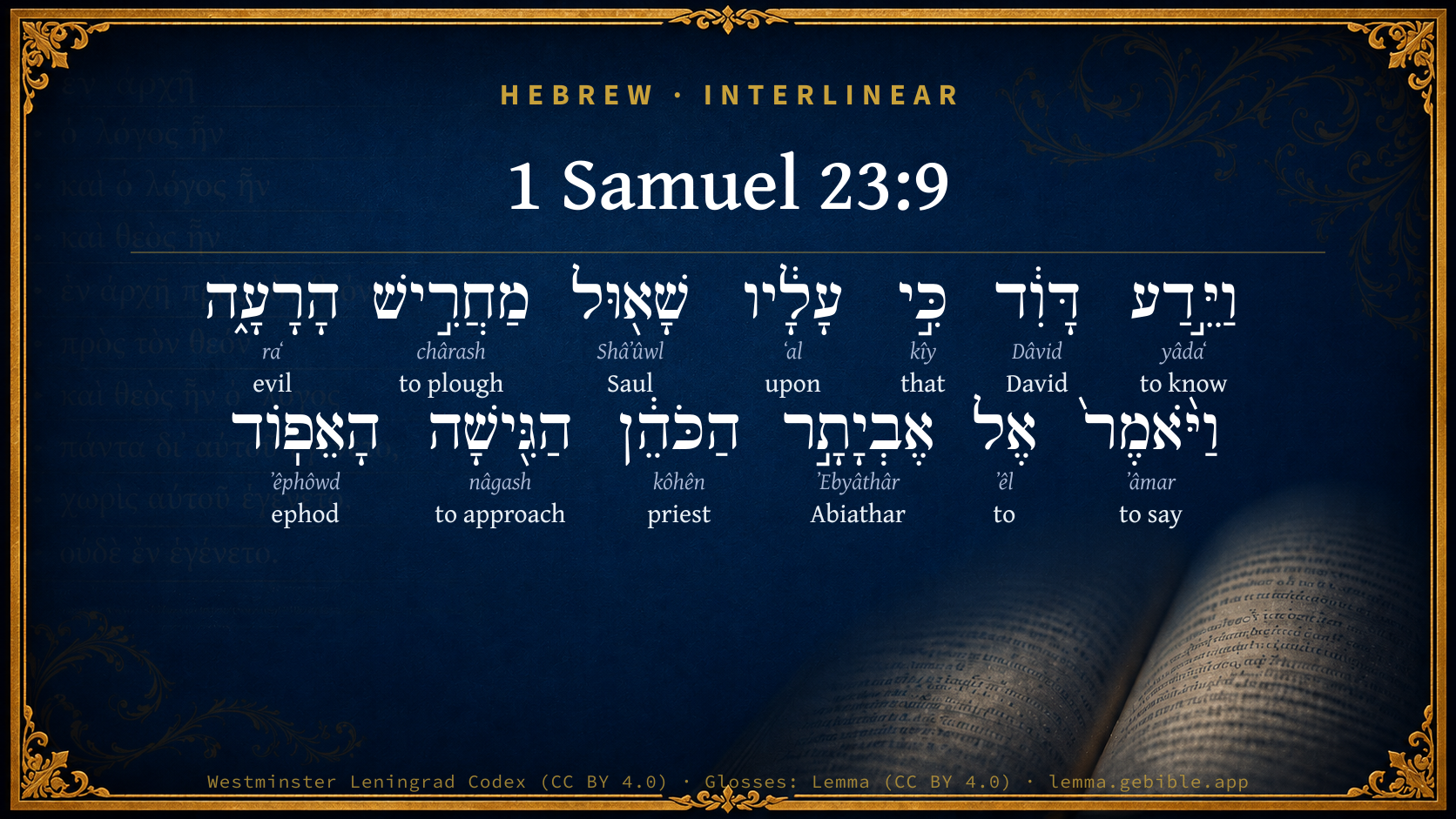
Hebrew (Westminster Leningrad Codex) 1 Samuel 23:9 appears in the Hebrew Old Testament. The text above is from the Westminster Leningrad Codex. Each word links to its Strong’s number, a concise gloss, and parsing drawn from the Open Scriptures Hebrew Bible morphology. Click any word for its full Brown-Driver-Briggs (BDB) entry.
Download image
Cite this verse

1 Samuel 23:9 (World English Bible). Public Domain. Lemma interlinear Bible study tool, https://lemma.gebible.app/v/1-samuel/23/9.

Show BibTeX & RIS
BibTeX
RIS
English Translation
David knew that Saul was devising mischief against him; and he said to Abiathar the priest, Bring here the ephod.
World English Bible · Public Domain
Download a study sheet

One document with this verse’s original text, its word-by-word gloss line, the meaning frame, cross-references with their text, attributed commentary, and full source and license credits — printable, and it pastes into notes with its structure intact.

This verse Autodidact and up

Study sheet (.html) Plain text (.txt)

A passage Seminary Student

Up to 50 verses in one chapter. A passage sheet keeps up to 6 commentary sources and 12 cross-references per verse, in the order this page ranks them, and says so on the sheet whenever that leaves anything out. Ask for a single verse and you get the Autodidact verse sheet above.

Everything on this page stays free to read, with no account — the sheet is a download of what is already on screen, not access to it.

Want to remove ads? Support Godless Engineer
Compare translations 3

The same verse in 3 English versions, stacked beneath the original-language interlinear above. Click any original word for its lexicon entry.

Each is an independent rendering of the whole verse — the interlinear is not word-aligned to these translations.

Highlighted words mark where these versions differ — a whole-verse word diff, not a word-by-word alignment.

  • World English Bible Public Domain
    David knew that Saul was devising mischief against him; and he said to Abiathar the priest, Bring here the ephod.
  • King James Version Public Domain
    And David knew that Saul secretly practiced mischief against him; and he said to Abiathar the priest, Bring hither the ephod.
  • unfoldingWord Literal Text CC BY-SA 4.0
    But David knew that Saul was devising harm against him. And he said to Abiathar the priest, “Bring near the ephod.”

unfoldingWord Literal Text — © unfoldingWord, licensed CC BY-SA 4.0. Word-aligned USFM3 via Door43 (git.door43.org/unfoldingWord/en_ult).

Versions to compare (up to 4)

3 of 4 selected

Show all 18 translations

Every available English version of this verse, each an independent rendering of the whole verse.

  • World English Bible Public Domain
    David knew that Saul was devising mischief against him; and he said to Abiathar the priest, Bring here the ephod.
  • Berean Standard Bible Public Domain
    When David learned that Saul was plotting evil against him, he said to Abiathar the priest, “Bring the ephod.”
  • Majority Standard Bible Public Domain
    When David learned that Saul was plotting evil against him, he said to Abiathar the priest, “Bring the ephod.”
  • King James Version Public Domain
    And David knew that Saul secretly practiced mischief against him; and he said to Abiathar the priest, Bring hither the ephod.
  • American Standard Version (1901) Public Domain
    And David knew that Saul was devising mischief against him; and he said to Abiathar the priest, Bring hither the ephod.
  • Revised Version (1885) Public Domain
    And David knew that Saul devised mischief against him; and he said to Abiathar the priest, Bring hither the ephod.
  • Geneva Bible (1599) Public Domain
    And Dauid hauing knowledge that Saul imagined mischiefe against him, saide to Abiathar the Priest, Bring the Ephod.
  • Douay-Rheims (1899) Public Domain
    Now when David understood, that Saul secretly prepared evil against him, he said to Abiathar the priest: Bring hither the ephod.
  • Young's Literal Translation Public Domain
    And David knoweth that against him Saul is devising the evil, and saith unto Abiathar the priest, `Bring nigh the ephod.'
  • Literal Standard Version CC BY-SA 4.0
    And David knows that Saul is devising the evil against him and says to Abiathar the priest, “Bring the ephod near.”
  • Unlocked Literal Bible CC BY-SA 4.0
    David knew that Saul was plotting harm against him. He said to Abiathar the priest, “Bring the ephod here.”
  • unfoldingWord Literal Text CC BY-SA 4.0
    But David knew that Saul was devising harm against him. And he said to Abiathar the priest, “Bring near the ephod.”
  • Darby Bible Public Domain
    And when David knew that Saul devised mischief against him, he said to Abiathar the priest, Bring the ephod.
  • World Messianic Bible Public Domain
    David knew that Saul was devising mischief against him. He said to Abiathar the priest, “Bring the ephod here.”
  • Webster's Bible Public Domain
    And David knew that Saul secretly plotted mischief against him; and he said to Abiathar the priest, Bring hither the ephod.
  • Free Bible Version CC BY-SA 4.0
    When David learned that Saul was plotting to attack him, he asked Abiathar the priest, “Please bring the ephod.”
  • Bible in Basic English Public Domain
    And it was clear to David that Saul had evil designs against him, and he said to Abiathar the priest, Come here with the ephod.
  • JPS Tanakh (1917) Public Domain
    And David knew that Saul devised mischief against him; and he said to Abiathar the priest: 'Bring hither the ephod.'

Literal Standard Version (2020), Covenant Press — licensed CC BY-SA 4.0. Text via the HelloAO Bible API (eBible.org). Unlocked Literal Bible (unfoldingWord) — licensed CC BY-SA 4.0. Text via the HelloAO Bible API (eBible.org). unfoldingWord Literal Text — © unfoldingWord, licensed CC BY-SA 4.0. Word-aligned USFM3 via Door43 (git.door43.org/unfoldingWord/en_ult). Free Bible Version, Dr. Jonathan Gallagher — licensed CC BY-SA 4.0. Text via the HelloAO Bible API (eBible.org).

Word by word

More ways to search: Search by grammar → Find every occurrence → Compare this word →

Practice this passage: Drill this verse → Learn its vocabulary →

אֶבְיָתָ֣ר
ʼEbyâthâr
H54
“Abiathar”
Noun, Proper
Part of Speech
Noun
Type
Proper
Full BDB Definition

Origin: contracted from H1 and H3498

TWOT: None

Abiathar = "my father is great" - priest, son of Ahitub (Ahimelech), faithful to David, but later rebelled with Adonijah
  1. וַיֵּ֣דַע yâdaʻ H3045 “and · to know” Conjunction + Verb, Qal, Sequential Imperfect, 3rd Person, Masculine, Singular
  2. דָּוִ֔ד Dâvid H1732 “David” Noun, Proper
  3. כִּ֣י kîy H3588 “that” Conjunction
  4. עָלָ֔יו ʻal H5921 “upon · him” Preposition + Suffix, Personal, 3rd Person, Masculine, Singular
  5. שָׁא֖וּל Shâʼûwl H7586 “Saul” Noun, Proper
  6. מַחֲרִ֣ישׁ chârash H2790 “ploughing” Verb, Hiphil, Participle Active, Masculine, Singular, Absolute
  7. הָרָעָ֑ה raʻ H7451 “the · evil” Particle, Definite Article + Noun, Common, Feminine, Singular, Absolute
  8. וַיֹּ֨אמֶר֙ ʼâmar H559 “and · to say” Conjunction + Verb, Qal, Sequential Imperfect, 3rd Person, Masculine, Singular
  9. אֶל ʼêl H413 “to” Preposition
  10. הַכֹּהֵ֔ן kôhên H3548 “the · priest” Particle, Definite Article + Noun, Common, Masculine, Singular, Absolute
  11. הַגִּ֖ישָׁה nâgash H5066 “approach” Verb, Hiphil, Imperative, 2nd Person, Masculine, Singular + Suffix, h
  12. הָאֵפֽוֹד ʼêphôwd H646 “the · ephod” Particle, Definite Article + Noun, Common, Masculine, Singular, Absolute

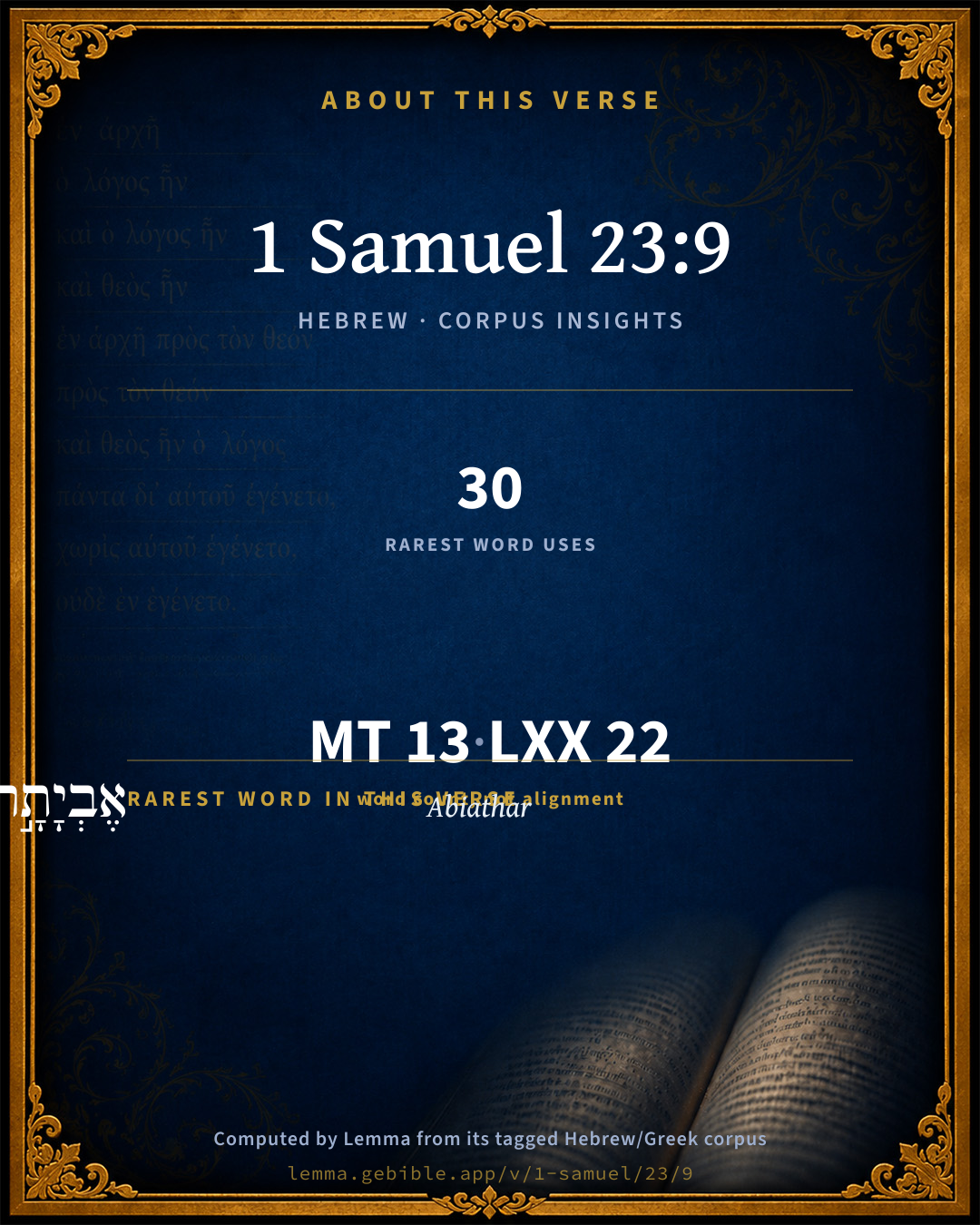
About this verse

These counts appear in no published source. They are computed here, from the morphology-tagged text and Lemma’s own curated glosses. What Lemma adds →

13
words
13
distinct lemmas
Historical
section

Shared distinctive vocabulary

אֶבְיָתָ֣ר Abiathar H54 occurs in 28 verses of the Hebrew Bible. Also found in:

Grammatical profile

  • 4 verbs
  • 6 nouns
  • 2 prepositions
  • 1 conjunction

Verb forms

  • וַיֵּ֣דַע Qal · Sequential Imperfect
  • מַחֲרִ֣ישׁ Hiphil · Participle Active
  • וַיֹּ֨אמֶר֙ Qal · Sequential Imperfect
  • הַגִּ֖ישָׁה Hiphil · Imperative

Hebrew & Septuagint length

In English translation the verse runs 20 words from the Hebrew and 24 from the Septuagint (LXX English) — closely comparable.

A rough comparison of the two English renderings, which tokenize alike — not a word-level alignment.

Word counts can differ between the Hebrew and the Greek without any difference in meaning — e.g. the Hebrew direct-object marker אֵת has no separate Greek word, and Greek often adds the article ὁ.

In the original languages it is 13 Hebrew tokens and 22 Greek tokens — but the two are counted differently (Hebrew bundles its prefixes and suffixes into one token; the Greek is in lemma form), so that isn’t a like-for-like length.

Cross-references

10

Topical passages linked to 1 Samuel 23:9 in the Treasury of Scripture Knowledge — connected by theme and wording, ordered by reader-vote popularity; previews shown in the World English Bible.

  • 1 Samuel 30:7 David said to Abiathar the priest, the son of Ahimelech, Please bring me here the ephod. Abiathar brought there the ephod to David.
  • 1 Samuel 23:6 It happened, when Abiathar the son of Ahimelech fled to David to Keilah, that he came down with an ephod in his hand.
  • Numbers 27:21 He shall stand before Eleazar the priest, who shall inquire for him by the judgment of the Urim before Yahweh: at his word shall they go out, and at his word they shall come in, both he, and all the children of Israel with him, even all the congregation.
  • 1 Samuel 14:18 Saul said to Ahijah, Bring here the ark of God. For the ark of God was [there] at that time with the children of Israel.
  • 1 Samuel 22:20 One of the sons of Ahimelech, the son of Ahitub, named Abiathar, escaped, and fled after David.
  • Jeremiah 11:18–19 Yahweh gave me knowledge of it, and I knew it: then you shown me their doings.
  • Jeremiah 33:3 Call to me, and I will answer you, and will show you great things, and difficult, which you don't know.
  • Acts 9:24 but their plot became known to Saul. They watched the gates both day and night that they might kill him,
  • Acts 14:6 they became aware of it, and fled to the cities of Lycaonia, Lystra, Derbe, and the surrounding region.
  • Acts 23:16–18 But Paul's sister's son heard of their lying in wait, and he came and entered into the barracks and told Paul.

Cross-references courtesy of OpenBible.info (CC BY 4.0).

Hebrew and Greek witnesses Masoretic Hebrew ↔ Greek Septuagint

The same verse in the two great witnesses to the Old Testament, shown verse-for-verse.

These are two independent witnesses, not word-aligned to each other, and the Septuagint is shown in lemma (dictionary) form.

Hebrew 1 Samuel 23:9 Masoretic · Westminster Leningrad Codex

וַיֵּ֣דַע דָּוִ֔ד כִּ֣י עָלָ֔יו שָׁא֖וּל מַחֲרִ֣ישׁ הָרָעָ֑ה וַיֹּ֨אמֶר֙ אֶל אֶבְיָתָ֣ר הַכֹּהֵ֔ן הַגִּ֖ישָׁה הָאֵפֽוֹד

David knew that Saul was devising mischief against him; and he said to Abiathar the priest, Bring here the ephod.

World English Bible · Public Domain

Greek LXX 1 Samuel 23:9 Septuagint · lemma form

καί γιγνώσκω δαυίδ ὅτι οὐ παρασιωπάω σαούλ περί αὐτός ὁ κακία καί εἶπον δαυίδ πρός αβιαθαρ ὁ ἱερεύς προςἄγω ὁ εφουδ κύριος

And David knew that Saul spoke openly of mischief against him: and David said to Abiathar the priest, Bring the ephod of the Lord.

LXX2012 (modern English Septuagint) · Public Domain

Hebrew: Westminster Leningrad Codex (CC BY 4.0). Greek: Septuagint (public domain); English from LXX2012 (modern English Septuagint) (Public Domain). How the Septuagint differs from the Hebrew →

Targum (Aramaic paraphrase)

1

The Targum is the ancient Jewish Aramaic paraphrase of the Hebrew Scriptures — an interpretive translation, not the Hebrew text itself. Onkelos (literal) and Pseudo-Jonathan (expansive) render the Torah, and Jonathan the Prophets. Coverage is partial: where no permissively-licensed English translation exists for a verse, only the Aramaic is shown. This is verse-level text, not a word-by-word alignment to the Hebrew.

  1. Targum Jonathan Prophets (Joshua–Malachi)
    וִידַע דָוִד אֲרֵי עֲלוֹהִי שָׁאוּל כָּמִין בִּישְׁתָא וַאֲמַר לְאֶבְיָתָר כַּהֲנָא קְרֵיב אֵפוֹדָא:

    (no public-domain English translation for this verse)

    Targum Jonathan — Aramaic: “Mikraot Gedolot” (public domain). English: “Sefaria Community Translation” (CC0 1.0 (public-domain dedication)); “London "Chaldee Paraphrase," 1871” (public domain). Text via Sefaria.

Commentary

Notes on 1 Samuel 23:9 from classic Christian and Jewish commentators (each source and its license shown beneath its notes). The classic Christian expositions comment on the surrounding passage and are grouped to its opening verse, so a note may address several verses; the Jewish commentaries on the Tanakh (Rashi and others) are per-verse, so they appear only where the commentator wrote on this verse.

Lemma curates 59 commentaries, every one of them public domain or Creative Commons licensed, each selected and text-cleaned for this edition rather than reprinted as found. About our sources →

Trapp's Complete Commentary

John Trapp

1Sa 23:9 And David knew that Saul secretly practised mischief against him; and he said to Abiathar the priest, Bring hither the ephod.

Ver. 9. Secretly practised mischief.] Plotted and ploughed mischief: pretending to raise an army against the Philistines, but intending the same against David.

John Trapp, A Commentary or Exposition upon All the Books of the Old and New Testament (1647–1656) — public domain. Text from a community e-Sword module.

Joseph Benson's Commentary

1Sa 23:9-11. Bring hither the ephod — Which, doubtless, Abiathar put on; otherwise he could not have inquired of the Lord by it. The Lord said, He will come down — He purposeth to come if thou continue here. For still both David’s question and God’s answer are conditional, upon supposition. As David’s being there was the only motive for Saul’s coming, so, if he departed, Saul could have no inducement to come. And accordingly we find he laid aside his design so soon as he was informed that David had escaped. It seems probable from this place that God’s answer by Urim and Thummim was not by any change in the colour or situation of the precious stones in the breast-plate of the ephod, but by a voice or suggestion from God to the high-priest.

Joseph Benson's Commentary on the Old and New Testaments (1811–1818) — public domain. Text from a community e-Sword module.

Geneva Bible (1599)

Geneva Bible translators

To consult with the Lord by Urim and Thummim.

Geneva Bible (1599) marginal notes — public domain. Text via Bolls.life.

Jamieson, Fausset & Brown

Robert Jamieson, A. R. Fausset & David Brown

he said to Abiathar the priest, Bring hither the ephod--The consultation was made, and the prayer uttered, by means of the priest. The alternative conditions here described have often been referred to as illustrating the doctrine of God's foreknowledge and preordination of events.

Jamieson, Fausset & Brown — Commentary Critical and Explanatory on the Whole Bible (1871) — public domain (CC PDM 1.0). Text via the HelloAO Bible API.

Adam Clarke's Commentary

Verse 9. Bring hither the ephod.] It seems as if David himself, clothed with the ephod, had consulted the Lord; and 1Sa 23:10-12 contain the words of the consultation, and the Lord's answer. But see on 1Sa 23:2.

Adam Clarke's Commentary on the Bible (1810–1826) — public domain. Text from a community e-Sword/MySword module.

Ellicott's Commentary for English Readers

(9) Secretly practised mischief.—The idea of secrecy suggested in the English translation does not appear in the Hebrew; the accurate rendering would be, “was forging, or devising.” It is likely enough that Jonathan contrived to keep his friend informed of these Court plots against him.

Bring hither the ephod.—It is quite clear that a different method of enquiry was used by David on this occasion. In 1Sa_23:3-4 it is merely stated that he enquired of the Lord; here at Keilah his enquiry was prefaced, in 1Sa_23:6, by a definite statement that Abiathar the priest, with the ephod, had arrived here before he asked the question of God. The history tells us he directed Abiathar the priest to “bring hither the ephod,” thus pointedly connecting the enquiry in some way with the ephod. In this ephod were set twelve precious stones, one for each of the twelve tribes. The names of the tribes were engraved on these gems, the Rabbis tell us, along with some other sacred words. On important solemn occasions—it seems perfectly certain during a considerable time—that these stones were allowed by the providence of God, who worked so many marvels for His people, to be used as oracles. It has been already stated that according to a most ancient tradition the use of the sacred gems was restricted to the high priest, who could only call out the supernatural power at the bidding of the king or the head of the State for the time being (such an one as Joshua, for instance). The Divine response given by the sacred gems seems to have been the visible response to earnest, faithful prayer.

The common belief is that the ephod stones gave their answer to the royal and high priestly questions by some peculiar shining. But a passage (quoted at length in the Excursus M on the Urim and Thummim at the end of this Book) from the Babylonian Talmud (Treatise Yoma)—apparently little known—tells us that the Rabbis had two other explanations traditionally handed down from the days when the ephod and its holy gemmed breastplate was questioned on solemn occasions by the high priest.

A Bible Commentary for English Readers, edited by Charles John Ellicott (1878–1897) — public domain. Text from a community e-Sword module.

The Cambridge Bible for Schools and Colleges

gen. ed. J. J. S. Perowne

9. secretly practised] Lit. was forging. Omit “secretly.”

Bring hither the ephod] For the high-priest did not always wear it. See note on 1Sa_14:18, and cp. 1Sa_30:7.

The Cambridge Bible for Schools and Colleges (gen. ed. J. J. S. Perowne; Cambridge University Press, 1878–1918) — public domain. Text from a community e-Sword module.

John Gill's Exposition

And. David knew that Saul secretly practised mischief against him,.... That is, plotted and contrived it, formed schemes in order to do him mischief, giving out one thing, and designing another; so he pretended war against the Philistines, but his intention was to come against Keilah, and take David there:

and he said to Abiathar the priest, bring hither the ephod; not for David to put on, but for the priest himself, that being clothed with it, and the Urim and Thummim in it, he might inquire for him of the Lord.

John Gill's Exposition of the Whole Bible (1746–1763) — public domain (CC PDM 1.0). Text via the HelloAO Bible API.

Haydock's Catholic Bible Commentary

Secretly. He might have pretended that the armament was against the Philistines. (Menochius) --- Ephod. Some say that David put it on. But this was the privilege of the high priest, who gave the answer to David’s consultation, which he might perhaps repeat after him. (Calmet) --- He put on the rational to consult God, Exodus xxviii., and Leviticus viii. (Worthington)

George Leo Haydock (1774–1849), Haydock's Catholic Family Bible and Commentary, 1859 edition — public domain. Excludes Psalms (Douay-Rheims chapter numbering differs from Protestant) and Deuterocanonical books (Catholic canon only).

Matthew Poole's English Annotations

Saul secretly practised mischief against him; whereby it may seem he pretended that he raised his army to defend Keilah and his country from the Philistines, and kept his intention against David in his own breast. Or, designed or devised; for so the word signifies; and so it is here translated by many; and it seems both from 1Sa 23:8, and from his publicly avowed jealousy of and rage against David, that he declared his design to be against him, as a traitor to his crown and dignity.

Bring hither the ephod, and put it upon thee, that thou mayst ask counsel of God for me.

Matthew Poole's English Annotations on the Holy Bible (1683–1685) — public domain. Text from a community e-Sword/MySword module.

The Pulpit Commentary

Vers. 9-13. Saul secretly practised mischief. This phrase is correctly translated "devised evil" in Pro_3:29 Pro_14:22. There is no idea of secrecy in the Hebrew verb, which literally means "to work in metals," "to forge." Saul"s purpose was open enough, and when David heard of it he tells Abiathar to bring the ephod, and then offers earnest prayer to God for counsel and advice. In his prayer his two questions are put inversely to the logical order, but in accordance with their relative importance in David"s mind, and no ground exists for altering the text. But when the ephod was brought forward the questions were of course put in their logical sequence. To the first question, "Will Saul come down to besiege Keilah?" the answer was, "He will." To the second, "Will the citizens of Keilah deliver me and my men into the hand of Saul?" the answer also was, "They will. Whereupon he and his followers, now increased to 600 men, withdrew, and went whithersoever they could go. Literally. "they went about whither they went about," i.e. without any fixed plan, as chance or their necessities dictated. As David was once again at large, Saul had no longer any reason for besieging Keilah, especially as its citizens had preferred his side, as that of the more powerful, to gratitude for the safety of their lives and property.

The Pulpit Commentary (1880–1919), ed. H.D.M. Spence-Jones & Joseph S. Exell — public domain. Text from a community e-Sword module.

Rashi

Rabbi Shlomo Yitzchaki (Rashi)

Planning evil. Plotting the evil.

Rashi on the Tanakh — English translations: “The Judaica Press complete Tanach with Rashi, translated by A. J. Rosenberg” (CC BY 4.0); “Pentateuch with Rashi's commentary by M. Rosenbaum and A.M. Silbermann, 1929-1934” (public domain); “The Metsudah Tanach series, Lakewood, N.J” (CC BY 4.0); and “The Book of Joshua, Metsudah Publications, 1997” (CC BY 4.0). Text via Sefaria.

Lesson kit

Teaching starters — assembled from the data on this page, not authored interpretation. Every prompt links to the verse data it draws on. Edit before teaching.

1 Samuel, in the Historical, opens this verse with 13 words (13 distinct Hebrew lemmas). Its most distinctive word is ʼEbyâthâr (“Abiathar”). A historical commentator’s framing appears above. Read the whole chapter for the surrounding context.

Discussion questions

  1. The word ʼEbyâthâr carries the sense “Abiathar.” How does it shape the verse?
  2. 1 Samuel 22:20 shares the word «Abiathar» with this verse. How do the two illuminate each other?
  3. The translations on this page render this verse differently — a whole-verse word diff, not a word-by-word alignment. What might account for the different wordings?
  4. The verb «וַיֵּ֣דַע» is Qal Sequential Imperfect. How does its form color the action?
  5. Reading how Trapp's Complete Commentary and Joseph Benson's Commentary read this verse, where do the two commentators agree and where do they part?

Things to notice

Reading settings

Reading text

Shown beneath each verse's original-language words.

Old Testament
Old Testament edition

Read the OT as the Masoretic Hebrew (MT) or the Greek Septuagint (LXX).

English shown for the Greek Septuagint (in the Hebrew ↔ Greek comparison).

Comparing translations? Open the Compare panel on any verse page to stack up to four side by side.