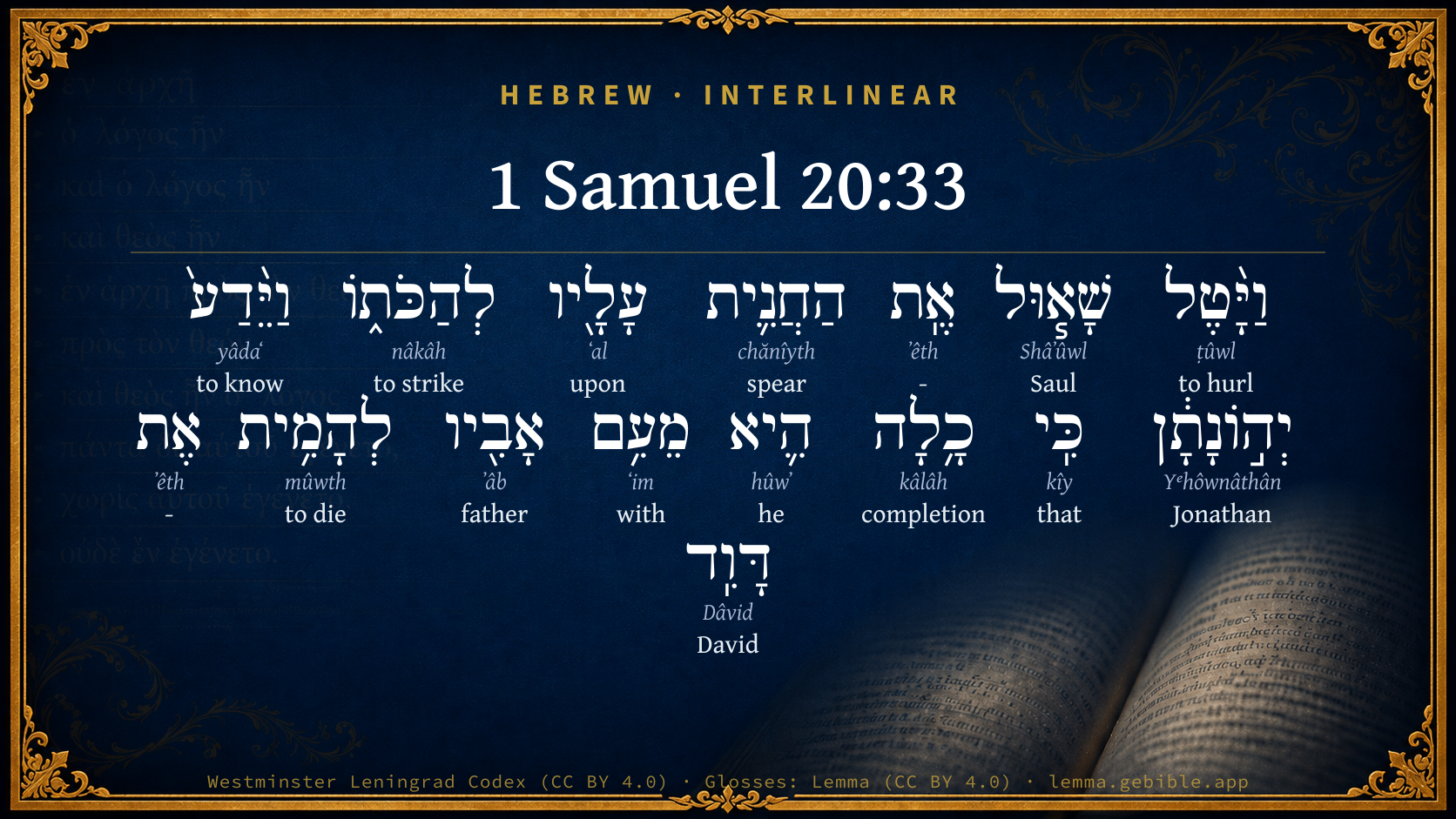
1 Samuel 20:33

Hebrew (Westminster Leningrad Codex) 1 Samuel 20:33 appears in the Hebrew Old Testament. The text above is from the Westminster Leningrad Codex. Each word links to its Strong’s number, a concise gloss, and parsing drawn from the Open Scriptures Hebrew Bible morphology. Click any word for its full Brown-Driver-Briggs (BDB) entry.
Download image
Cite this verse

1 Samuel 20:33 (World English Bible). Public Domain. Lemma interlinear Bible study tool, https://lemma.gebible.app/v/1-samuel/20/33.

Show BibTeX & RIS
BibTeX
RIS
English Translation
Saul cast his spear at him to strike him. By this Jonathan knew that his father was determined to put David to death.
World English Bible · Public Domain
Download a study sheet

One document with this verse’s original text, its word-by-word gloss line, the meaning frame, cross-references with their text, attributed commentary, and full source and license credits — printable, and it pastes into notes with its structure intact.

This verse Autodidact and up

Study sheet (.html) Plain text (.txt)

A passage Seminary Student

Up to 50 verses in one chapter. A passage sheet keeps up to 6 commentary sources and 12 cross-references per verse, in the order this page ranks them, and says so on the sheet whenever that leaves anything out. Ask for a single verse and you get the Autodidact verse sheet above.

Everything on this page stays free to read, with no account — the sheet is a download of what is already on screen, not access to it.

Want to remove ads? Support Godless Engineer
Compare translations 3

The same verse in 3 English versions, stacked beneath the original-language interlinear above. Click any original word for its lexicon entry.

Each is an independent rendering of the whole verse — the interlinear is not word-aligned to these translations.

Highlighted words mark where these versions differ — a whole-verse word diff, not a word-by-word alignment.

  • World English Bible Public Domain
    Saul cast his spear at him to strike him. By this Jonathan knew that his father was determined to put David to death.
  • King James Version Public Domain
    And Saul cast a javelin at him to smite him: whereby Jonathan knew that it was determined of his father to slay David.
  • unfoldingWord Literal Text CC BY-SA 4.0
    And Saul hurled the spear at him to strike him. And Jonathan knew that it had completed from with his father to kill David.

unfoldingWord Literal Text — © unfoldingWord, licensed CC BY-SA 4.0. Word-aligned USFM3 via Door43 (git.door43.org/unfoldingWord/en_ult).

Versions to compare (up to 4)

3 of 4 selected

Show all 18 translations

Every available English version of this verse, each an independent rendering of the whole verse.

  • World English Bible Public Domain
    Saul cast his spear at him to strike him. By this Jonathan knew that his father was determined to put David to death.
  • Berean Standard Bible Public Domain
    Then Saul hurled his spear at Jonathan to kill him; so Jonathan knew that his father was determined to kill David.
  • Majority Standard Bible Public Domain
    Then Saul hurled his spear at Jonathan to kill him. So Jonathan knew that his father was determined to kill David.
  • King James Version Public Domain
    And Saul cast a javelin at him to smite him: whereby Jonathan knew that it was determined of his father to slay David.
  • American Standard Version (1901) Public Domain
    And Saul cast his spear at him to smite him; whereby Jonathan knew that is was determined of his father to put David to death.
  • Revised Version (1885) Public Domain
    And Saul cast his spear at him to smite him: whereby Jonathan knew that it was determined of his father to put David to death.
  • Geneva Bible (1599) Public Domain
    And Saul cast a speare at him to hit him, whereby Ionathan knew, that it was determined of his father to slay Dauid.
  • Douay-Rheims (1899) Public Domain
    And Saul caught up a spear to strike him. And Jonathan understood that it was determined by his father to kill David.
  • Young's Literal Translation Public Domain
    And Saul casteth the javelin at him to smite him, and Jonathan knoweth that it hath been determined by his father to put David to death.
  • Literal Standard Version CC BY-SA 4.0
    And Saul casts the javelin at him to strike him, and Jonathan knows that it has been determined by his father to put David to death.
  • Unlocked Literal Bible CC BY-SA 4.0
    Then Saul threw his spear at him to kill him. So Jonathan knew that his father was determined to put David to death.
  • unfoldingWord Literal Text CC BY-SA 4.0
    And Saul hurled the spear at him to strike him. And Jonathan knew that it had completed from with his father to kill David.
  • Darby Bible Public Domain
    Then Saul cast the spear at him to smite him; and Jonathan knew that it was determined by his father to put David to death.
  • World Messianic Bible Public Domain
    Saul cast his spear at him to strike him. By this Jonathan knew that his father was determined to put David to death.
  • Webster's Bible Public Domain
    And Saul cast a javelin at him to smite him: by which Jonathan knew that it was determined by his father to slay David.
  • Free Bible Version CC BY-SA 4.0
    Saul threw his spear at Jonathan, trying to kill him, so he knew that his father definitely wanted David dead.
  • Bible in Basic English Public Domain
    And Saul, pointing his spear at him, made an attempt to give him a wound: from which it was clear to Jonathan that his father's purpose was to put David to death.
  • JPS Tanakh (1917) Public Domain
    And Saul cast his spear at him to smite him; whereby Jonathan knew that it was determined of his father to put David to death.

Literal Standard Version (2020), Covenant Press — licensed CC BY-SA 4.0. Text via the HelloAO Bible API (eBible.org). Unlocked Literal Bible (unfoldingWord) — licensed CC BY-SA 4.0. Text via the HelloAO Bible API (eBible.org). unfoldingWord Literal Text — © unfoldingWord, licensed CC BY-SA 4.0. Word-aligned USFM3 via Door43 (git.door43.org/unfoldingWord/en_ult). Free Bible Version, Dr. Jonathan Gallagher — licensed CC BY-SA 4.0. Text via the HelloAO Bible API (eBible.org).

Word by word

More ways to search: Search by grammar → Find every occurrence → Compare this word →

Practice this passage: Drill this verse → Learn its vocabulary →

וַיָּ֨טֶל
ṭûwl
H2904
“and · to hurl”
Conjunction + Verb, Hiphil, Sequential Imperfect, 3rd Person, Masculine, Singular
Part of Speech
Conjunction + Verb
Stem
Hiphil
Form
Sequential Imperfect
Person
3rd Person
Gender
Masculine
Number
Singular
Full BDB Definition

Origin: a primitive root

TWOT: 797

to hurl, cast - (Pilpel) to throw away, carry away, hurl - (Hiphil) to throw, cast, cast out - (Hophal) - to be hurled, hurled down - to be cast, be thrown, be cast out, be thrown down
  1. שָׁא֧וּל Shâʼûwl H7586 “Saul” Noun, Proper
  2. אֶֽת ʼêth H853 “-” Particle, Direct Object
  3. הַחֲנִ֛ית chănîyth H2595 “the · spear” Particle, Definite Article + Noun, Common, Feminine, Singular, Absolute
  4. עָלָ֖יו ʻal H5921 “upon · him” Preposition + Suffix, Personal, 3rd Person, Masculine, Singular
  5. לְהַכֹּת֑וֹ nâkâh H5221 “to strike · him” Preposition + Verb, Hiphil, Infinitive Construct + Suffix, Personal, 3rd Person, Masculine, Singular
  6. וַיֵּ֨דַע֙ yâdaʻ H3045 “and · to know” Conjunction + Verb, Qal, Sequential Imperfect, 3rd Person, Masculine, Singular
  7. יְה֣וֹנָתָ֔ן Yᵉhôwnâthân H3083 “Jonathan” Noun, Proper
  8. כִּֽי kîy H3588 “that” Conjunction
  9. כָ֥לָה kâlâh H3617 “completion” Noun, Common, Feminine, Singular, Absolute
  10. הִ֛יא hûwʼ H1931 “he” Pronoun, Personal, 3rd Person, Feminine, Singular
  11. מֵעִ֥ם ʻim H5973 “from · with” Preposition + Preposition
  12. אָבִ֖יו ʼâb H1 “father · his” Noun, Common, Masculine, Singular, Construct + Suffix, Personal, 3rd Person, Masculine, Singular
  13. לְהָמִ֥ית mûwth H4191 “to die” Preposition + Verb, Hiphil, Infinitive Construct
  14. אֶת ʼêth H853 “-” Particle, Direct Object
  15. דָּוִֽד Dâvid H1732 “David” Noun, Proper

About this verse

These counts appear in no published source. They are computed here, from the morphology-tagged text and Lemma’s own curated glosses. What Lemma adds →

16
words
15
distinct lemmas
Historical
section

Notable vocabulary

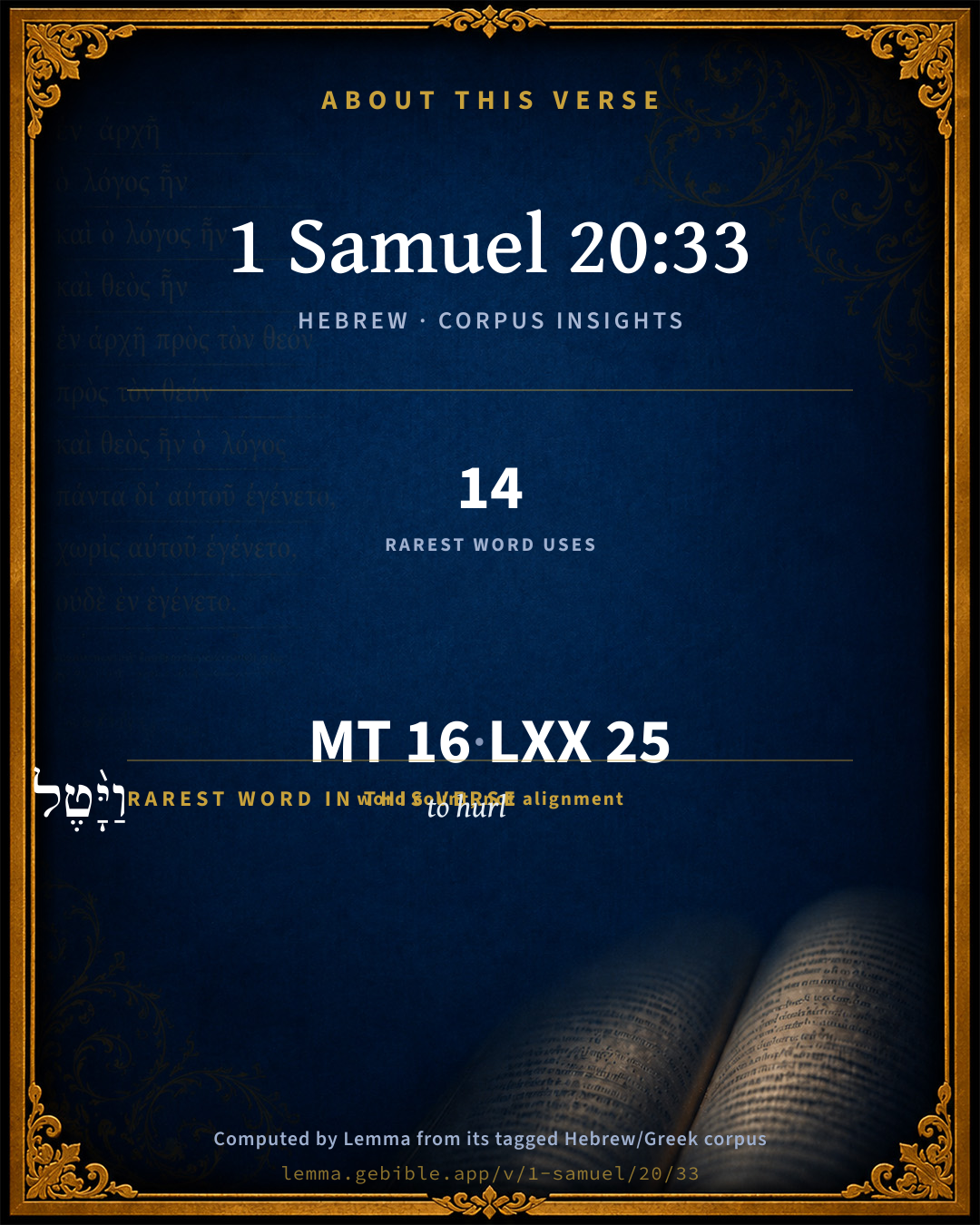
The rarest word here is וַיָּ֨טֶל to hurl H2904 — appearing just 14 times in the whole Hebrew Bible.

Shared distinctive vocabulary

וַיָּ֨טֶל to hurl H2904 occurs in 14 verses of the Hebrew Bible. Also found in:

Grammatical profile

  • 4 verbs
  • 6 nouns
  • 1 pronoun
  • 2 prepositions
  • 1 conjunction
  • 2 particles

Verb forms

  • וַיָּ֨טֶל Hiphil · Sequential Imperfect
  • לְהַכֹּת֑וֹ Hiphil · Infinitive Construct
  • וַיֵּ֨דַע֙ Qal · Sequential Imperfect
  • לְהָמִ֥ית Hiphil · Infinitive Construct

Hebrew & Septuagint length

In English translation the verse runs 23 words from the Hebrew and 26 from the Septuagint (LXX English) — closely comparable.

A rough comparison of the two English renderings, which tokenize alike — not a word-level alignment.

Word counts can differ between the Hebrew and the Greek without any difference in meaning — e.g. the Hebrew direct-object marker אֵת has no separate Greek word, and Greek often adds the article ὁ.

In the original languages it is 16 Hebrew tokens and 25 Greek tokens — but the two are counted differently (Hebrew bundles its prefixes and suffixes into one token; the Greek is in lemma form), so that isn’t a like-for-like length.

Cross-references

3

Topical passages linked to 1 Samuel 20:33 in the Treasury of Scripture Knowledge — connected by theme and wording, ordered by reader-vote popularity; previews shown in the World English Bible.

  • 1 Samuel 18:11 and Saul cast the spear; for he said, I will strike David even to the wall. David avoided out of his presence twice.
  • 1 Samuel 20:7 If he says, 'It is well;' your servant shall have peace: but if he be angry, then know that evil is determined by him.
  • 1 Samuel 19:10 Saul sought to strike David even to the wall with the spear; but he slipped away out of Saul's presence, and he struck the spear into the wall: and David fled, and escaped that night.

Cross-references courtesy of OpenBible.info (CC BY 4.0).

Hebrew and Greek witnesses Masoretic Hebrew ↔ Greek Septuagint

The same verse in the two great witnesses to the Old Testament, shown verse-for-verse.

These are two independent witnesses, not word-aligned to each other, and the Septuagint is shown in lemma (dictionary) form.

Hebrew 1 Samuel 20:33 Masoretic · Westminster Leningrad Codex

וַיָּ֨טֶל שָׁא֧וּל אֶֽת הַחֲנִ֛ית עָלָ֖יו לְהַכֹּת֑וֹ וַיֵּ֨דַע֙ יְה֣וֹנָתָ֔ן כִּֽי כָ֥לָה הִ֛יא מֵעִ֥ם אָבִ֖יו לְהָמִ֥ית אֶת דָּוִֽד

Saul cast his spear at him to strike him. By this Jonathan knew that his father was determined to put David to death.

World English Bible · Public Domain

Greek LXX 1 Samuel 20:33 Septuagint · lemma form

καί ἐπιαἴρω σαούλ ὁ δόρυ ἐπί ιωναθαν ὁ θανατόω αὐτός καί γιγνώσκω ιωναθαν ὅτι συντελέω ὁ κακία οὗτος παρά ὁ πατήρ αὐτός θανατόω ὁ δαυίδ

And Saul lifted up his spear against Jonathan to kill him: so Jonathan knew that this evil was determined on by his father to kill David.

LXX2012 (modern English Septuagint) · Public Domain

Hebrew: Westminster Leningrad Codex (CC BY 4.0). Greek: Septuagint (public domain); English from LXX2012 (modern English Septuagint) (Public Domain). How the Septuagint differs from the Hebrew →

Targum (Aramaic paraphrase)

1

The Targum is the ancient Jewish Aramaic paraphrase of the Hebrew Scriptures — an interpretive translation, not the Hebrew text itself. Onkelos (literal) and Pseudo-Jonathan (expansive) render the Torah, and Jonathan the Prophets. Coverage is partial: where no permissively-licensed English translation exists for a verse, only the Aramaic is shown. This is verse-level text, not a word-by-word alignment to the Hebrew.

  1. Targum Jonathan Prophets (Joshua–Malachi)
    וַאֲרֵים שָׁאוּל יַת מוּרְנִיתָא עֲלוֹהִי לְמִמְחֵיהּ וִידַע יְהוֹנָתָן אֲרֵי גְמִירָא הוּא מִן אֲבוּהִי לְמִקְטַל יַת דָוִד:

    (no public-domain English translation for this verse)

    Targum Jonathan — Aramaic: “Mikraot Gedolot” (public domain). English: “Sefaria Community Translation” (CC0 1.0 (public-domain dedication)); “London "Chaldee Paraphrase," 1871” (public domain). Text via Sefaria.

Commentary

Notes on 1 Samuel 20:33 from classic Christian and Jewish commentators (each source and its license shown beneath its notes). The classic Christian expositions comment on the surrounding passage and are grouped to its opening verse, so a note may address several verses; the Jewish commentaries on the Tanakh (Rashi and others) are per-verse, so they appear only where the commentator wrote on this verse.

Lemma curates 59 commentaries, every one of them public domain or Creative Commons licensed, each selected and text-cleaned for this edition rather than reprinted as found. About our sources →

Trapp's Complete Commentary

John Trapp

1Sa 20:33 And Saul cast a javelin at him to smite him: whereby Jonathan knew that it was determined of his father to slay David.

Ver. 33. And Saul cast a javelin at him to smite him.] Which, if it had hit him, and killed him, Saul would have had as small joy of it as Alexander when he had killed Clitus in his passion, whom he would have revived, but could not, with his own heart’s blood.

“ Qui non moderabitur irae, &c. ”

John Trapp, A Commentary or Exposition upon All the Books of the Old and New Testament (1647–1656) — public domain. Text from a community e-Sword module.

Joseph Benson's Commentary

1Sa 20:33-34. Saul cast a javelin to smite him — Saul seemed a moment before to be in great care, that Jonathan should be established in his kingdom: and now he himself aims at his life! What fools, what worse than savage beasts, does anger make men! Because — Or, and because, &c., for this seems to be a second cause of his grief; his father had done him shame — That is, had done shame, not to David, but Jonathan, by giving him such rough words, and throwing a javelin at him. It may, however, be understood of his father’s speaking so contemptuously of David.

Joseph Benson's Commentary on the Old and New Testaments (1811–1818) — public domain. Text from a community e-Sword module.

Tyndale Open Study Notes

Tyndale Open Resources

20:33 hurled his spear at Jonathan: See also 18:11; 19:10. • at last Jonathan realized: Jonathan had been reluctant to believe the truth about his own father (20:2-3), but he could no longer deny it.

Tyndale Open Study Notes — © Tyndale Open Resources, licensed CC BY-SA 4.0. Text via the HelloAO Bible API.

Jamieson, Fausset & Brown

Robert Jamieson, A. R. Fausset & David Brown

Saul cast a javelin at him--This is a sad proof of the maniacal frenzy into which the unhappy monarch was transported.

Jamieson, Fausset & Brown — Commentary Critical and Explanatory on the Whole Bible (1871) — public domain (CC PDM 1.0). Text via the HelloAO Bible API.

The Cambridge Bible for Schools and Colleges

gen. ed. J. J. S. Perowne

33. cast a javelin] Or, as in 1Sa_18:11, lifted his spear: brandished it threateningly, without actually casting it.

The Cambridge Bible for Schools and Colleges (gen. ed. J. J. S. Perowne; Cambridge University Press, 1878–1918) — public domain. Text from a community e-Sword module.

John Gill's Exposition

And Saul cast a javelin at him to smite him,.... So provoked to wrath was he by what he said. It seems by this that Saul always had a javelin or spear in his hand, which is to be accounted for by the custom of those times; in other countries, as well as in this, the kings used to carry spears in their hands instead of sceptres, and which they used as such; so Justin (h), speaking of the times of Romulus, says, that kings in those times had spears, as an ensign of royalty, which the Greeks call sceptres; and so the Greeks called sceptres spears (i):

whereby Jonathan knew that it was determined of his father to slay David; for since he attempted to smite him, his own son, for speaking on his behalf, it might be well concluded, that such was his settled wrath and malice, that he would if possible kill David, could he get him into his hands.

(h) E Trogo, l. 43. c. 3. (i) Pausanias in Boeoticis, sive, l. 9. p. 859. Vid. Barthii Animadv. ad Claudian in nupt. Honor ver. 119.

John Gill's Exposition of the Whole Bible (1746–1763) — public domain (CC PDM 1.0). Text via the HelloAO Bible API.

Matthew Poole's English Annotations

To smite him, i. e. to wound him, though not to smite him even to the wall, as he designed to do to David, 1Sa 19:10.

Matthew Poole's English Annotations on the Holy Bible (1683–1685) — public domain. Text from a community e-Sword/MySword module.

Whedon's Commentary on the Bible

Daniel D. Whedon

33. Jonathan knew that it was determined… to slay David — He had before been disposed to attribute his father’s acts of violence towards David to his madness, and the demon that at times possessed him; but now he is convinced that David’s suspicions of his bloody design (1Sa_20:3) are well founded, and he arose from the table in a wild tumult of passions, and the next morning, true to his word, he went forth to bid David fly.

Daniel D. Whedon (gen. ed.), Commentary on the Old and New Testaments (1874–1909) — public domain. Text from a community e-Sword module.

John Wesley's Explanatory Notes

To smite him - Saul seemed to be in great care, that Jonathan should be established in his kingdom: and now he himself aims at his life! What fools, what worse than savage beasts does anger make.

John Wesley, Explanatory Notes Upon the Whole Bible (1754–1765) — public domain. Text via the GEBible commentary corpus.

Lesson kit

Teaching starters — assembled from the data on this page, not authored interpretation. Every prompt links to the verse data it draws on. Edit before teaching.

1 Samuel, in the Historical, opens this verse with 16 words (15 distinct Hebrew lemmas). Its most distinctive word is ṭûwl (“to hurl”). A historical commentator’s framing appears above. Read the whole chapter for the surrounding context.

Discussion questions

  1. How does “to hurl” (ṭûwl) shape what this verse is saying?
  2. 1 Samuel 18:11 shares the word «to hurl» with this verse. How do the two illuminate each other?
  3. These translations render this verse differently; the difference is in the English rendering, not the original. What questions does that raise?
  4. The verb «וַיָּ֨טֶל» is Hiphil Sequential Imperfect. How does its form color the action?
  5. Reading how Trapp's Complete Commentary and Joseph Benson's Commentary read this verse, where do the two commentators agree and where do they part?

Things to notice

Reading settings

Reading text

Shown beneath each verse's original-language words.

Old Testament
Old Testament edition

Read the OT as the Masoretic Hebrew (MT) or the Greek Septuagint (LXX).

English shown for the Greek Septuagint (in the Hebrew ↔ Greek comparison).

Comparing translations? Open the Compare panel on any verse page to stack up to four side by side.