Genesis 41:31

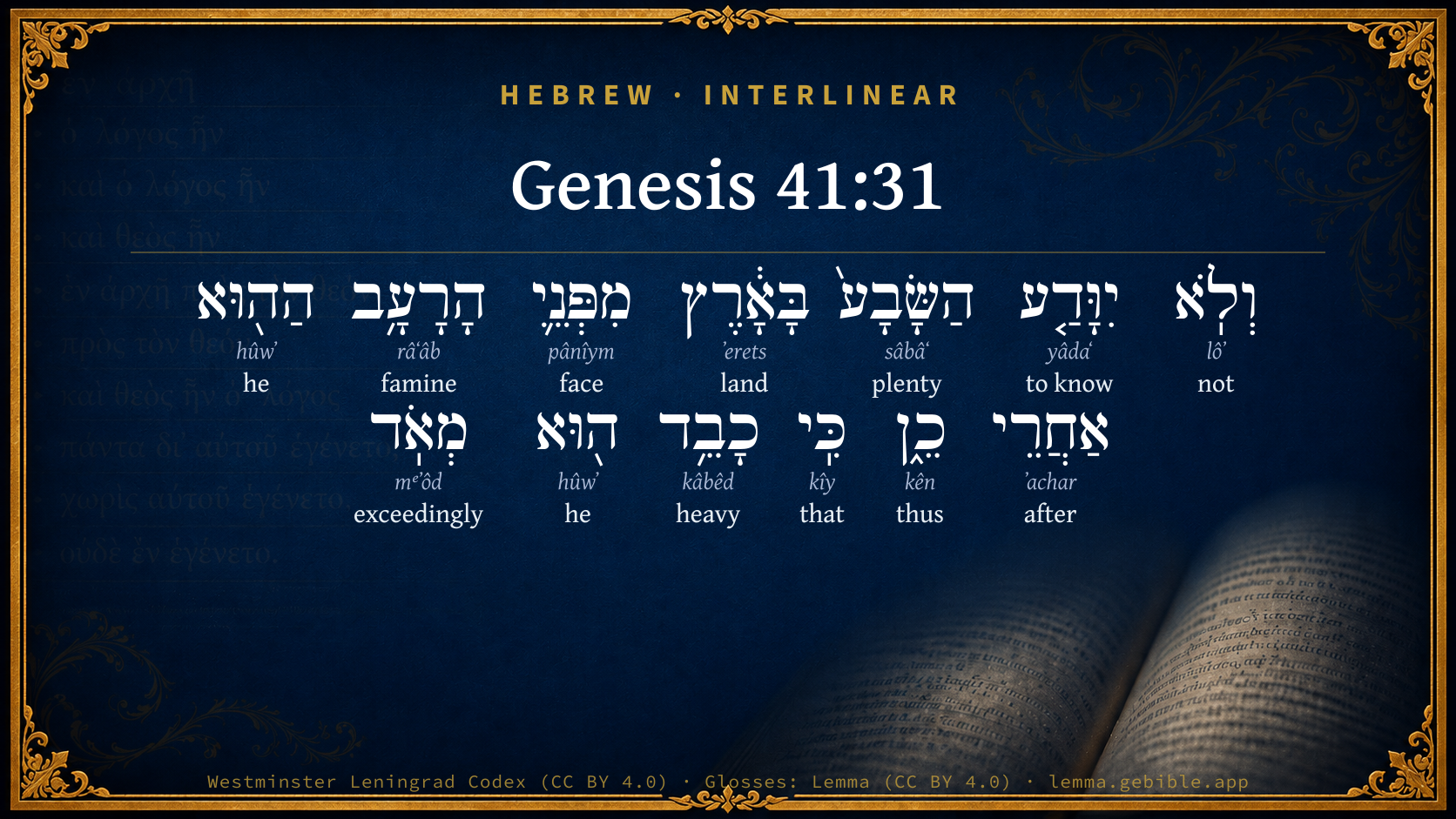
Hebrew (Westminster Leningrad Codex) Genesis 41:31 appears in the Hebrew Old Testament. The text above is from the Westminster Leningrad Codex. Each word links to its Strong’s number, a concise gloss, and parsing drawn from the Open Scriptures Hebrew Bible morphology. Click any word for its full Brown-Driver-Briggs (BDB) entry.
Download image
Cite this verse

Genesis 41:31 (World English Bible). Public Domain. Lemma interlinear Bible study tool, https://lemma.gebible.app/v/genesis/41/31.

Show BibTeX & RIS
BibTeX
RIS
English Translation
and the plenty will not be known in the land by reason of that famine which follows; for it will be very grievous.
World English Bible · Public Domain
Download a study sheet

One document with this verse’s original text, its word-by-word gloss line, the meaning frame, cross-references with their text, attributed commentary, and full source and license credits — printable, and it pastes into notes with its structure intact.

This verse Autodidact and up

Study sheet (.html) Plain text (.txt)

A passage Seminary Student

Up to 50 verses in one chapter. A passage sheet keeps up to 6 commentary sources and 12 cross-references per verse, in the order this page ranks them, and says so on the sheet whenever that leaves anything out. Ask for a single verse and you get the Autodidact verse sheet above.

Everything on this page stays free to read, with no account — the sheet is a download of what is already on screen, not access to it.

Want to remove ads? Support Godless Engineer
Compare translations 3

The same verse in 3 English versions, stacked beneath the original-language interlinear above. Click any original word for its lexicon entry.

Each is an independent rendering of the whole verse — the interlinear is not word-aligned to these translations.

Highlighted words mark where these versions differ — a whole-verse word diff, not a word-by-word alignment.

  • World English Bible Public Domain
    and the plenty will not be known in the land by reason of that famine which follows; for it will be very grievous.
  • King James Version Public Domain
    And the plenty shall not be known in the land by reason of that famine following; for it shall be very grievous.
  • unfoldingWord Literal Text CC BY-SA 4.0
    And the abundance in the land will not be remembered because of that famine after it, because it very heavy.

unfoldingWord Literal Text — © unfoldingWord, licensed CC BY-SA 4.0. Word-aligned USFM3 via Door43 (git.door43.org/unfoldingWord/en_ult).

Versions to compare (up to 4)

3 of 4 selected

Show all 18 translations

Every available English version of this verse, each an independent rendering of the whole verse.

  • World English Bible Public Domain
    and the plenty will not be known in the land by reason of that famine which follows; for it will be very grievous.
  • Berean Standard Bible Public Domain
    The abundance in the land will not be remembered, since the famine that follows it will be so severe.
  • Majority Standard Bible Public Domain
    The abundance in the land will not be remembered, since the famine that follows it will be so severe.
  • King James Version Public Domain
    And the plenty shall not be known in the land by reason of that famine following; for it shall be very grievous.
  • American Standard Version (1901) Public Domain
    and the plenty shall not be known in the land by reason of that famine which followeth; for it shall be very grievous.
  • Revised Version (1885) Public Domain
    and the plenty shall not be known in the land by reason of that famine which followeth; for it shall be very grievous.
  • Geneva Bible (1599) Public Domain
    Neither shall the plentie bee knowen in the land, by reason of this famine that shall come after: for it shalbe exceeding great.
  • Douay-Rheims (1899) Public Domain
    Behold, there shall come seven years of great plenty in the whole land of Egypt:
  • Young's Literal Translation Public Domain
    and the plenty is not known in the land because of that famine afterwards, for it `is' very grievous.
  • Literal Standard Version CC BY-SA 4.0
    and the plenty is not known in the land because of that famine afterward, for it [is] very grievous.
  • Unlocked Literal Bible CC BY-SA 4.0
    The abundance will not be remembered in the land because of the famine that will follow, for it will be very severe.
  • unfoldingWord Literal Text CC BY-SA 4.0
    And the abundance in the land will not be remembered because of that famine after it, because it very heavy.
  • Darby Bible Public Domain
    And the plenty will not be known afterwards in the land by reason of that famine; for it will be very grievous.
  • World Messianic Bible Public Domain
    and the plenty will not be known in the land by reason of that famine which follows; for it will be very grievous.
  • Webster's Bible Public Domain
    And the plenty shall not be known in the land by reason of the famine following: for it will be very grievous.
  • Free Bible Version CC BY-SA 4.0
    The time of plenty will be completely forgotten because the famine that follows it will be so terrible.
  • Bible in Basic English Public Domain
    And men will have no memory of the good time because of the need which will come after, for it will be very bitter.
  • JPS Tanakh (1917) Public Domain
    and the plenty shall not be known in the land by reason of that famine which followeth; for it shall be very grievous.

Literal Standard Version (2020), Covenant Press — licensed CC BY-SA 4.0. Text via the HelloAO Bible API (eBible.org). Unlocked Literal Bible (unfoldingWord) — licensed CC BY-SA 4.0. Text via the HelloAO Bible API (eBible.org). unfoldingWord Literal Text — © unfoldingWord, licensed CC BY-SA 4.0. Word-aligned USFM3 via Door43 (git.door43.org/unfoldingWord/en_ult). Free Bible Version, Dr. Jonathan Gallagher — licensed CC BY-SA 4.0. Text via the HelloAO Bible API (eBible.org).

Word by word

More ways to search: Search by grammar → Find every occurrence → Compare this word →

Practice this passage: Drill this verse → Learn its vocabulary →

הַשָּׂבָע֙
sâbâʻ
H7647
“the · plenty”
Particle, Definite Article + Noun, Common, Masculine, Singular, Absolute
Part of Speech
Particle + Noun
Type
Common
Gender
Masculine
Number
Singular
State
Absolute
Full BDB Definition

Origin: from H7646

TWOT: 2231c

plenty, satiety - plenty (of breadstuffs) - satiety
  1. וְלֹֽא lôʼ H3808 “and · not” Conjunction + Particle, Negative
  2. יִוָּדַ֤ע yâdaʻ H3045 “to know” Verb, Niphal, Imperfect, 3rd Person, Masculine, Singular
  3. בָּאָ֔רֶץ ʼerets H776 “in/at the · land” Preposition, Determined + Noun, Common, Both, Singular, Absolute
  4. מִפְּנֵ֛י pânîym H6440 “from · face(s) of” Preposition + Noun, Common, Both, Plural, Construct
  5. הָרָעָ֥ב râʻâb H7458 “the · famine” Particle, Definite Article + Noun, Common, Masculine, Singular, Absolute
  6. הַה֖וּא hûwʼ H1931 “the · he” Particle, Definite Article + Pronoun, Personal, 3rd Person, Masculine, Singular
  7. אַחֲרֵי ʼachar H310 “after” Preposition
  8. כֵ֑ן kên H3651 “thus” Adverb
  9. כִּֽי kîy H3588 “that” Conjunction
  10. כָבֵ֥ד kâbêd H3515 “heavy” Adjective, Adjective, Masculine, Singular, Absolute
  11. ה֖וּא hûwʼ H1931 “he” Pronoun, Personal, 3rd Person, Masculine, Singular
  12. מְאֹֽד mᵉʼôd H3966 “exceedingly” Adverb

About this verse

These counts appear in no published source. They are computed here, from the morphology-tagged text and Lemma’s own curated glosses. What Lemma adds →

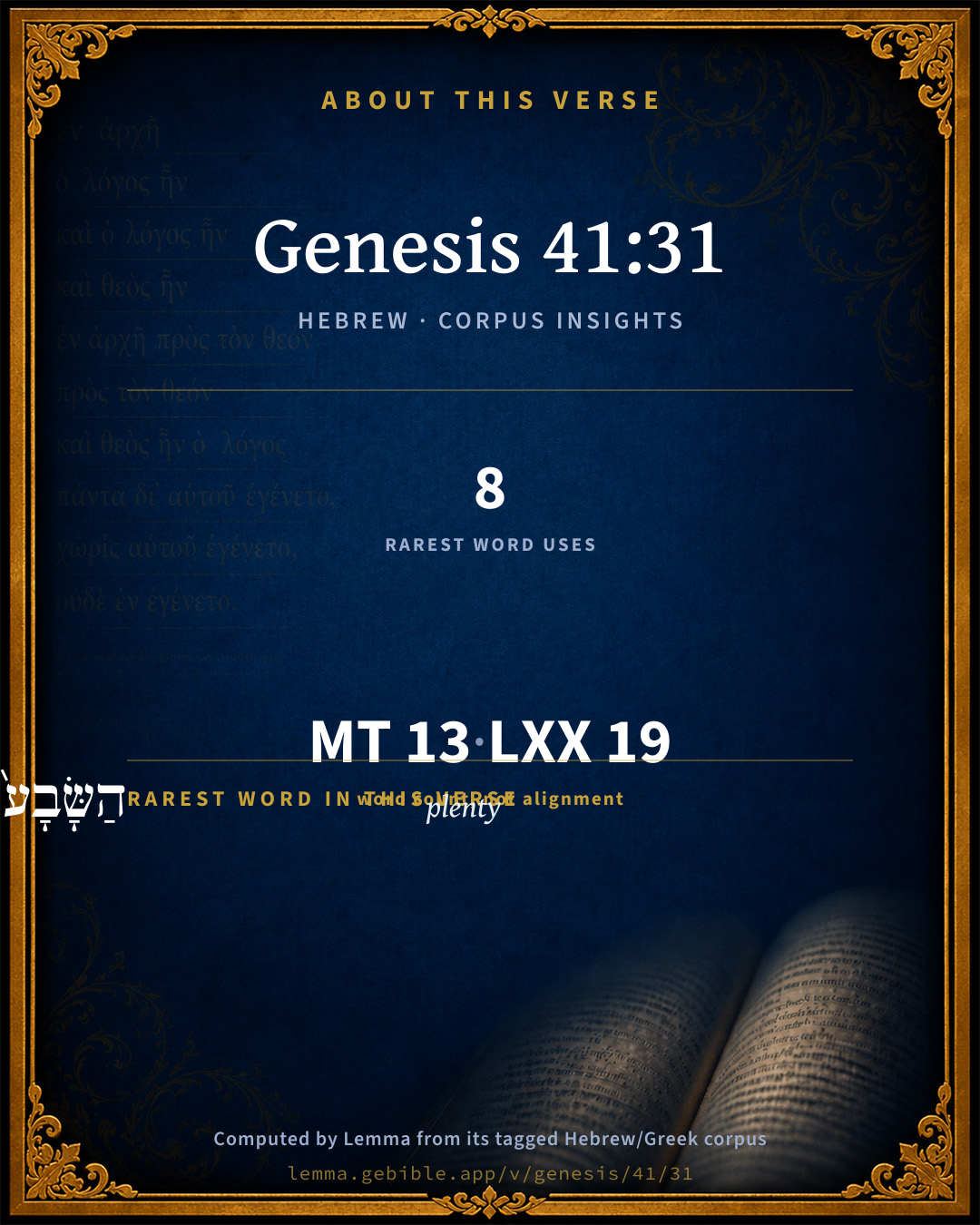
13
words
12
distinct lemmas
Pentateuch
section

Notable vocabulary

The rarest word here is הַשָּׂבָע֙ plenty H7647 — appearing just 8 times in the whole Hebrew Bible.

Shared distinctive vocabulary

הַשָּׂבָע֙ plenty H7647 occurs in 8 verses of the Hebrew Bible. Also found in:

Grammatical profile

  • 1 verb
  • 4 nouns
  • 1 adjective
  • 2 pronouns
  • 1 preposition
  • 1 conjunction
  • 2 adverbs
  • 1 particle

Verb forms

  • יִוָּדַ֤ע Niphal · Imperfect

Repetition

A word recurs within this verse — often emphatic in Hebrew:

  • הַה֖וּא he H1931 ×2

Hebrew & Septuagint length

In English translation the verse runs 23 words from the Hebrew and 26 from the Septuagint (LXX English) — closely comparable.

A rough comparison of the two English renderings, which tokenize alike — not a word-level alignment.

Word counts can differ between the Hebrew and the Greek without any difference in meaning — e.g. the Hebrew direct-object marker אֵת has no separate Greek word, and Greek often adds the article ὁ.

In the original languages it is 13 Hebrew tokens and 19 Greek tokens — but the two are counted differently (Hebrew bundles its prefixes and suffixes into one token; the Greek is in lemma form), so that isn’t a like-for-like length.

Cross-references

2

Topical passages linked to Genesis 41:31 in the Treasury of Scripture Knowledge — connected by theme and wording, ordered by reader-vote popularity; previews shown in the World English Bible.

  • Isaiah 24:20 The earth shall stagger like a drunken man, and shall sway back and forth like a hammock; and the disobedience of it shall be heavy on it, and it shall fall, and not rise again.
  • 1 Samuel 5:6 But the hand of Yahweh was heavy on them of Ashdod, and he destroyed them, and struck them with tumors, even Ashdod and the borders of it.

Cross-references courtesy of OpenBible.info (CC BY 4.0).

Hebrew and Greek witnesses Masoretic Hebrew ↔ Greek Septuagint

The same verse in the two great witnesses to the Old Testament, shown verse-for-verse.

These are two independent witnesses, not word-aligned to each other, and the Septuagint is shown in lemma (dictionary) form.

Hebrew Genesis 41:31 Masoretic · Westminster Leningrad Codex

וְלֹֽא יִוָּדַ֤ע הַשָּׂבָע֙ בָּאָ֔רֶץ מִפְּנֵ֛י הָרָעָ֥ב הַה֖וּא אַחֲרֵי כֵ֑ן כִּֽי כָבֵ֥ד ה֖וּא מְאֹֽד

and the plenty will not be known in the land by reason of that famine which follows; for it will be very grievous.

World English Bible · Public Domain

Greek LXX Genesis 41:31 Septuagint · lemma form

καί οὐ ἐπιγιγνώσκω ὁ εὐθηνία ἐπί ὁ γῆ ἀπό ὁ λιμός ὁ εἰμί μετά οὗτος ἰσχυρός γάρ εἰμί σφόδρα

And the plenty shall not be known in the land by reason of the famine that shall be after this, for it shall be very grievous.

LXX2012 (modern English Septuagint) · Public Domain

Hebrew: Westminster Leningrad Codex (CC BY 4.0). Greek: Septuagint (public domain); English from LXX2012 (modern English Septuagint) (Public Domain). How the Septuagint differs from the Hebrew →

Targum (Aramaic paraphrase)

2

The Targum is the ancient Jewish Aramaic paraphrase of the Hebrew Scriptures — an interpretive translation, not the Hebrew text itself. Onkelos (literal) and Pseudo-Jonathan (expansive) render the Torah, and Jonathan the Prophets. Coverage is partial: where no permissively-licensed English translation exists for a verse, only the Aramaic is shown. This is verse-level text, not a word-by-word alignment to the Hebrew.

  1. Targum Onkelos Torah (Genesis–Deuteronomy)
    וְלָא יִתְיְדַע שׂוֹבְעָא בְּאַרְעָא מִן קֳדָם כַּפְנָא הַהוּא דִּיהֵי בָתַר כֵּן אֲרֵי תַקִּיף הוּא לַחֲדָא

    (no public-domain English translation for this verse)

    Targum Onkelos — Aramaic: “Onkelos Genesis” (public domain); “Onkelos Exodus” (public domain); “Onkelos Leviticus” (public domain); “Onkelos Numbers” (public domain); “Onkelos Deuteronomy” (public domain). English: “Sefaria Community Translation” (CC0 1.0 (public-domain dedication)); “J.W. Etheridge. The Targums of Onkelos and Jonathan Ben Uzziel on the Pentateuch. London: Longmans, Green, 1862” (public domain). Text via Sefaria.

  2. Targum Pseudo-Jonathan Torah (Genesis–Deuteronomy)
    וְלָא יִתְיְדַע שׁוּבְעָא דַהֲוָה בְּאַרְעָא מִן כַּפְנָא הַהוּא דִיהֵי מִן בָּתַר כֵּן אֲרוּם תַּקִיף הוּא לַחֲדָא

    neither will the plenty which had been in the land be known, for the famine that will be afterward, because it will be exceeding strong.

    Targum Pseudo-Jonathan — Aramaic: “Targum Jonathan on Genesis” (public domain); “Targum Jonathan on Exodus” (public domain); “Targum Jonathan on Leviticus” (public domain); “Targum Jonathan on Numbers” (public domain); “Targum Jonathan on Deuteronomy” (public domain). English: “The Targum of Jonathan ben Uzziel, trans. J. W. Etheridge, London, 1862” (public domain). Text via Sefaria.

Commentary

Notes on Genesis 41:31 from classic Christian and Jewish commentators (each source and its license shown beneath its notes). The classic Christian expositions comment on the surrounding passage and are grouped to its opening verse, so a note may address several verses; the Jewish commentaries on the Tanakh (Rashi and others) are per-verse, so they appear only where the commentator wrote on this verse.

Lemma curates 59 commentaries, every one of them public domain or Creative Commons licensed, each selected and text-cleaned for this edition rather than reprinted as found. About our sources →

Geneva Bible (1599)

Geneva Bible translators

Or, they shall remember no more the plenty.

Geneva Bible (1599) marginal notes — public domain. Text via Bolls.life.

Adam Clarke's Commentary

Verse 31. The plenty shall not be known in the land by reason of that famine following] As Egypt depends for its fertility on the flowing of the Nile, and this flowing is not always equal, there must be a point to which it must rise to saturate the land sufficiently, in order to produce grain sufficient for the support of its inhabitants. Pliny, Hist. Nat., lib. v., cap. 9, has given us a scale by which the plenty and dearth may be ascertained; and, from what I have been able to collect from modern travellers, this scale may be yet considered as perfectly correct. Justum incrementum est cubitorum xvi. Minores aquae non omnia rigant, ampliores detinent, tardius recedendo. HAE serendi tempora absumunt, solo madente, ILLAE non dant, sitiente. Utrumque reputat provincia. In xii. cubitis famen sentit. In xiii. etiamnum esurit; xiv. cubita hilaritatem afferunt; xv. securitatem; xvi. delicias. "The ordinary height of the inundations is sixteen cubits. When the waters are lower than this standard they do not overflow the whole ground; when above this standard, they are too long in running off. In the first case the ground is not saturated: by the second, the waters are detained so long on the ground that seed-time is lost. The province marks both. If it rise only twelve cubits, a famine is the consequence. Even at thirteen cubits hunger prevails; fourteen cubits produces general rejoicing; fifteen, perfect security; and sixteen, all the luxuries of life."

When the Nile rises to eighteen cubits it prevents the sowing of the land in due season, and as necessarily produces a famine as when it does not overflow its banks.

Adam Clarke's Commentary on the Bible (1810–1826) — public domain. Text from a community e-Sword/MySword module.

John Gill's Exposition

Let Pharaoh do this,.... Appoint such a person; who as a sovereign prince could do it of himself:

and let him appoint officers over the land; not Pharaoh, but the wise and discreet governor he should set over the land, who should have a power of appointing officers or overseers under him to manage things according to his direction:

and take up the fifth part of the land of Egypt in the seven plenteous years; not the officers appointed, but the appointer of them, the chief governor under Pharaoh, for the word is singular; it is proposed that he should, in Pharaoh's name, and by his order, take a fifth part of all the corn in the land of Egypt during seven years of plenty; not by force, which so good a man as Joseph would never advise to, whatever power Pharaoh might have, and could exercise if he pleased; but by making a purchase of it, which in such time of plenty would be bought cheap, and which so great a prince as Pharaoh was capable of. It is commonly asked, why an half part was not ordered to be took up, since there were to be as many years of famine as of plenty? and to this it is usually replied, that besides this fifth part taken up, as there might be an old stock of former years, so there would be something considerable remain of these seven years of plenty, which men of substance would lay up, as Pharaoh did; and besides, a fifth part might be equal to the crop of an ordinary year, or near it: to which may be added, that in times of famine men live more sparingly, as they are obliged, and therefore such a quantity would go the further; as well as it may be considered, that notwithstanding the barrenness of the land in general, yet in some places, especially on the banks of the Nile, some corn might be produced; so that upon the whole a fifth part might be judged sufficient to answer the extremity of the seven years of famine, and even to allow a distribution to other countries.

John Gill's Exposition of the Whole Bible (1746–1763) — public domain (CC PDM 1.0). Text via the HelloAO Bible API.

Rashi

Rabbi Shlomo Yitzchaki (Rashi)

ולא יודע השבע AND THE PLENTY SHALL NOT BE KNOWN — this is the interpretation of (v. 21) “And it could not be noticed that they had eaten them up”.

Rashi on the Tanakh — English translations: “The Judaica Press complete Tanach with Rashi, translated by A. J. Rosenberg” (CC BY 4.0); “Pentateuch with Rashi's commentary by M. Rosenbaum and A.M. Silbermann, 1929-1934” (public domain); “The Metsudah Tanach series, Lakewood, N.J” (CC BY 4.0); and “The Book of Joshua, Metsudah Publications, 1997” (CC BY 4.0). Text via Sefaria.

Lesson kit

Teaching starters — assembled from the data on this page, not authored interpretation. Every prompt links to the verse data it draws on. Edit before teaching.

Genesis, in the Pentateuch, opens this verse with 13 words (12 distinct Hebrew lemmas). Its most distinctive word is sâbâʻ (“plenty”). A historical commentator’s framing appears above. Read the whole chapter for the surrounding context.

Discussion questions

  1. The word sâbâʻ carries the sense “plenty.” How does it shape the verse?
  2. How does Genesis 41:29, which shares the word «plenty», read alongside this verse?
  3. What does the repetition of “he” (2× in this one verse) do in this verse?
  4. The translations on this page render this verse differently — a whole-verse word diff, not a word-by-word alignment. What might account for the different wordings?
  5. «יִוָּדַ֤ע» is a Niphal Imperfect verb. How does that grammatical form shape the action described?
  6. Compare how Geneva Bible (1599) and Adam Clarke's Commentary read this verse. Where do they agree or differ?

Things to notice

Reading settings

Reading text

Shown beneath each verse's original-language words.

Old Testament
Old Testament edition

Read the OT as the Masoretic Hebrew (MT) or the Greek Septuagint (LXX).

English shown for the Greek Septuagint (in the Hebrew ↔ Greek comparison).

Comparing translations? Open the Compare panel on any verse page to stack up to four side by side.