
1 Samuel 28:2

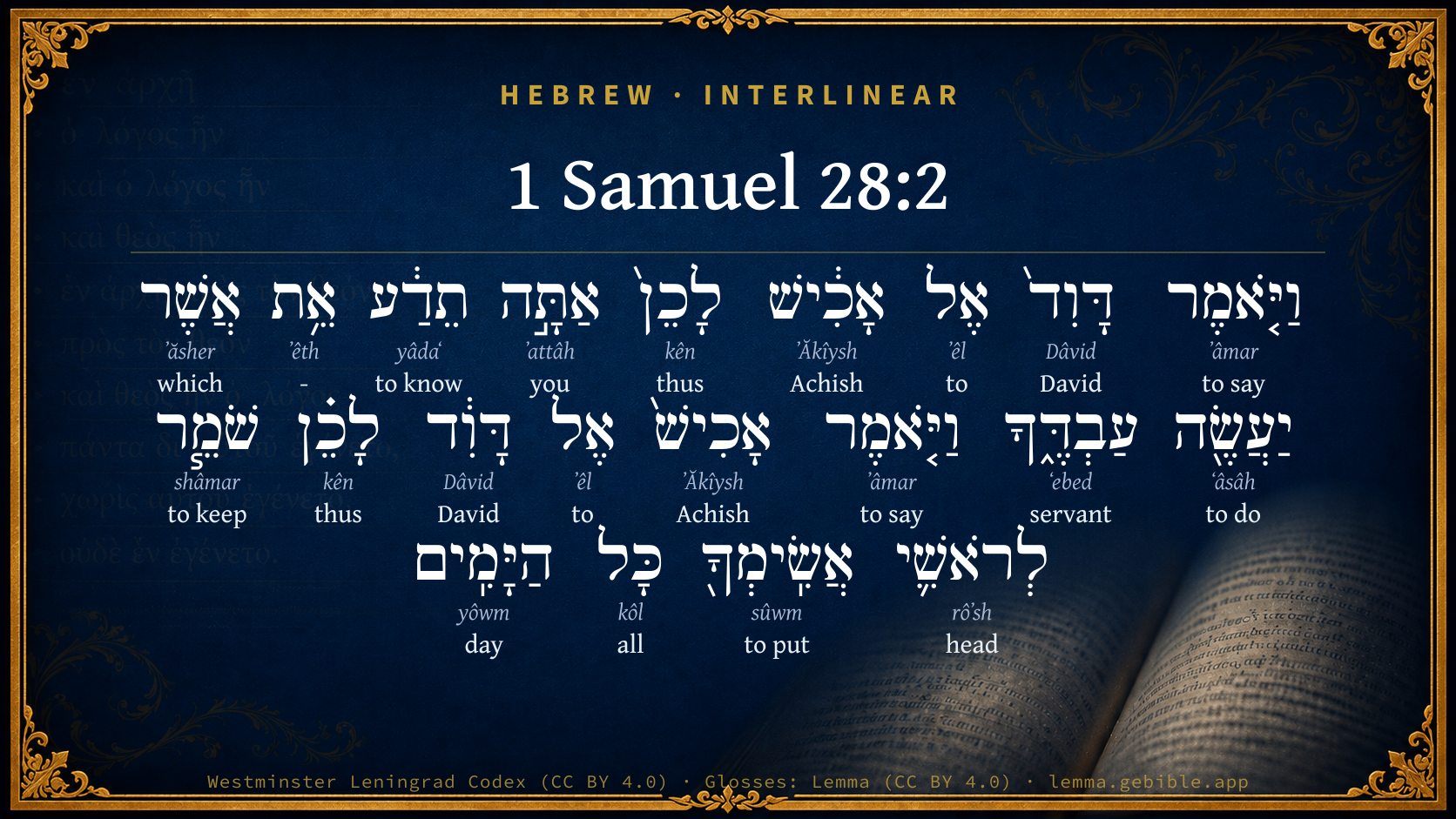
Hebrew (Westminster Leningrad Codex) 1 Samuel 28:2 appears in the Hebrew Old Testament. The text above is from the Westminster Leningrad Codex. Each word links to its Strong’s number, a concise gloss, and parsing drawn from the Open Scriptures Hebrew Bible morphology. Click any word for its full Brown-Driver-Briggs (BDB) entry.
Download image
Cite this verse

1 Samuel 28:2 (World English Bible). Public Domain. Lemma interlinear Bible study tool, https://lemma.gebible.app/v/1-samuel/28/2.

Show BibTeX & RIS
BibTeX
RIS
English Translation
David said to Achish, Therefore you shall know what your servant will do. Achish said to David, Therefore will I make you keeper of my head for ever.
World English Bible · Public Domain
Download a study sheet

One document with this verse’s original text, its word-by-word gloss line, the meaning frame, cross-references with their text, attributed commentary, and full source and license credits — printable, and it pastes into notes with its structure intact.

This verse Autodidact and up

Study sheet (.html) Plain text (.txt)

A passage Seminary Student

Up to 50 verses in one chapter. A passage sheet keeps up to 6 commentary sources and 12 cross-references per verse, in the order this page ranks them, and says so on the sheet whenever that leaves anything out. Ask for a single verse and you get the Autodidact verse sheet above.

Everything on this page stays free to read, with no account — the sheet is a download of what is already on screen, not access to it.

Want to remove ads? Support Godless Engineer
Compare translations 3

The same verse in 3 English versions, stacked beneath the original-language interlinear above. Click any original word for its lexicon entry.

Each is an independent rendering of the whole verse — the interlinear is not word-aligned to these translations.

Highlighted words mark where these versions differ — a whole-verse word diff, not a word-by-word alignment.

  • World English Bible Public Domain
    David said to Achish, Therefore you shall know what your servant will do. Achish said to David, Therefore will I make you keeper of my head for ever.
  • King James Version Public Domain
    And David said to Achish, Surely thou shalt know what thy servant can do. And Achish said to David, Therefore will I make thee keeper of mine head for ever.
  • unfoldingWord Literal Text CC BY-SA 4.0
    And David said to Achish, “Therefore you yourself will know what your servant will do.” And Achish said to David, “Therefore I am appointing you the keeper of my head all of the days.”

unfoldingWord Literal Text — © unfoldingWord, licensed CC BY-SA 4.0. Word-aligned USFM3 via Door43 (git.door43.org/unfoldingWord/en_ult).

Versions to compare (up to 4)

3 of 4 selected

Show all 18 translations

Every available English version of this verse, each an independent rendering of the whole verse.

  • World English Bible Public Domain
    David said to Achish, Therefore you shall know what your servant will do. Achish said to David, Therefore will I make you keeper of my head for ever.
  • Berean Standard Bible Public Domain
    David replied, “Then you will come to know what your servant can do.” “Very well,” said Achish. “I will make you my bodyguard for life.”
  • Majority Standard Bible Public Domain
    David replied, “Then you will come to know what your servant can do.” “Very well,” said Achish. “I will make you my bodyguard for life.”
  • King James Version Public Domain
    And David said to Achish, Surely thou shalt know what thy servant can do. And Achish said to David, Therefore will I make thee keeper of mine head for ever.
  • American Standard Version (1901) Public Domain
    And David said to Achish, Therefore thou shalt know what thy servant will do. And Achish said to David, Therefore will I make thee keeper of my head for ever.
  • Revised Version (1885) Public Domain
    And David said to Achish, Therefore thou shalt know what thy servant will do. And Achish said to David, Therefore will I make thee keeper of mine head for ever.
  • Geneva Bible (1599) Public Domain
    And Dauid said to Achish, Surely thou shalt knowe, what thy seruant can doe. And Achish sayde to Dauid, Surely I will make thee keeper of mine head for euer.
  • Douay-Rheims (1899) Public Domain
    And David said to Achis: Now thou shalt know what thy servant will do. And Achis said to David: And I will appoint thee to guard my life for ever.
  • Young's Literal Translation Public Domain
    And David saith unto Achish, `Therefore -- thou dost know that which thy servant dost do.' And Achish saith unto David, `Therefore -- keeper of my head I do appoint thee all the days.'
  • Literal Standard Version CC BY-SA 4.0
    And David says to Achish, “Therefore you know that which your servant does.” And Achish says to David, “Therefore I appoint you keeper of my head [for] all the days.”
  • Unlocked Literal Bible CC BY-SA 4.0
    David said to Achish, “So you will know what your servant can do.” Achish said to David, “So I will make you my bodyguard all your days.”
  • unfoldingWord Literal Text CC BY-SA 4.0
    And David said to Achish, “Therefore you yourself will know what your servant will do.” And Achish said to David, “Therefore I am appointing you the keeper of my head all of the days.”
  • Darby Bible Public Domain
    And David said to Achish, Thereby thou shalt know what thy servant can do. And Achish said to David, Therefore will I make thee keeper of my person for ever.
  • World Messianic Bible Public Domain
    David said to Achish, “Therefore you will know what your servant can do.” Achish said to David, “Therefore I will make you my bodyguard forever.”
  • Webster's Bible Public Domain
    And David said to Achish, Surely thou shalt know what thy servant can do. And Achish said to David, Therefore will I make thee keeper of my head for ever.
  • Free Bible Version CC BY-SA 4.0
    “That's fine!” David replied. “Then you yourself will discover what I, your servant, can do.” “That's fine too,” Achish responded. “I'll make you my bodyguard for life.”
  • Bible in Basic English Public Domain
    And David said to Achish, You will see now what your servant will do. And Achish said to David, Then I will make you keeper of my head for ever.
  • JPS Tanakh (1917) Public Domain
    And David said to Achish: 'Therefore thou shalt know what thy servant will do.' And Achish said to David: 'Therefore will I make thee keeper of my head for ever.'

Literal Standard Version (2020), Covenant Press — licensed CC BY-SA 4.0. Text via the HelloAO Bible API (eBible.org). Unlocked Literal Bible (unfoldingWord) — licensed CC BY-SA 4.0. Text via the HelloAO Bible API (eBible.org). unfoldingWord Literal Text — © unfoldingWord, licensed CC BY-SA 4.0. Word-aligned USFM3 via Door43 (git.door43.org/unfoldingWord/en_ult). Free Bible Version, Dr. Jonathan Gallagher — licensed CC BY-SA 4.0. Text via the HelloAO Bible API (eBible.org).

Word by word

More ways to search: Search by grammar → Find every occurrence → Compare this word →

Practice this passage: Drill this verse → Learn its vocabulary →

אָכִ֔ישׁ
ʼĂkîysh
H397
“Achish”
Noun, Proper
Part of Speech
Noun
Type
Proper
Full BDB Definition

Origin: of uncertain derivation

TWOT: None

Achish = "I will blacken (or terrify)" or " only a man" - Philistine king of Gath
  1. וַיֹּ֤אמֶר ʼâmar H559 “and · to say” Conjunction + Verb, Qal, Sequential Imperfect, 3rd Person, Masculine, Singular
  2. דָּוִד֙ Dâvid H1732 “David” Noun, Proper
  3. אֶל ʼêl H413 “to” Preposition
  4. לָכֵן֙ kên H3651 “to/for · thus” Preposition + Adverb
  5. אַתָּ֣ה ʼattâh H859 “you” Pronoun, Personal, 2nd Person, Masculine, Singular
  6. תֵדַ֔ע yâdaʻ H3045 “to know” Verb, Qal, Imperfect, 2nd Person, Masculine, Singular
  7. אֵ֥ת ʼêth H853 “-” Particle, Direct Object
  8. אֲשֶׁר ʼăsher H834 “which” Particle, Relative
  9. יַעֲשֶׂ֖ה ʻâsâh H6213 “to do” Verb, Qal, Imperfect, 3rd Person, Masculine, Singular
  10. עַבְדֶּ֑ךָ ʻebed H5650 “servant · your” Noun, Common, Masculine, Singular, Construct + Suffix, Personal, 2nd Person, Masculine, Singular
  11. וַיֹּ֤אמֶר ʼâmar H559 “and · to say” Conjunction + Verb, Qal, Sequential Imperfect, 3rd Person, Masculine, Singular
  12. אָכִישׁ֙ ʼĂkîysh H397 “Achish” Noun, Proper
  13. אֶל ʼêl H413 “to” Preposition
  14. דָּוִ֔ד Dâvid H1732 “David” Noun, Proper
  15. לָכֵ֗ן kên H3651 “to/for · thus” Preposition + Adverb
  16. שֹׁמֵ֧ר shâmar H8104 “keeping” Verb, Qal, Participle Active, Masculine, Singular, Absolute
  17. לְרֹאשִׁ֛י rôʼsh H7218 “to/for · head · my” Preposition + Noun, Common, Masculine, Singular, Construct + Suffix, Personal, 1st Person, Common, Singular
  18. אֲשִֽׂימְךָ֖ sûwm H7760 “to put · you” Verb, Qal, Imperfect, 1st Person, Common, Singular + Suffix, Personal, 2nd Person, Masculine, Singular
  19. כָּל kôl H3605 “all of” Noun, Common, Masculine, Singular, Construct
  20. הַיָּמִֽים yôwm H3117 “the · days” Particle, Definite Article + Noun, Common, Masculine, Plural, Absolute

About this verse

These counts appear in no published source. They are computed here, from the morphology-tagged text and Lemma’s own curated glosses. What Lemma adds →

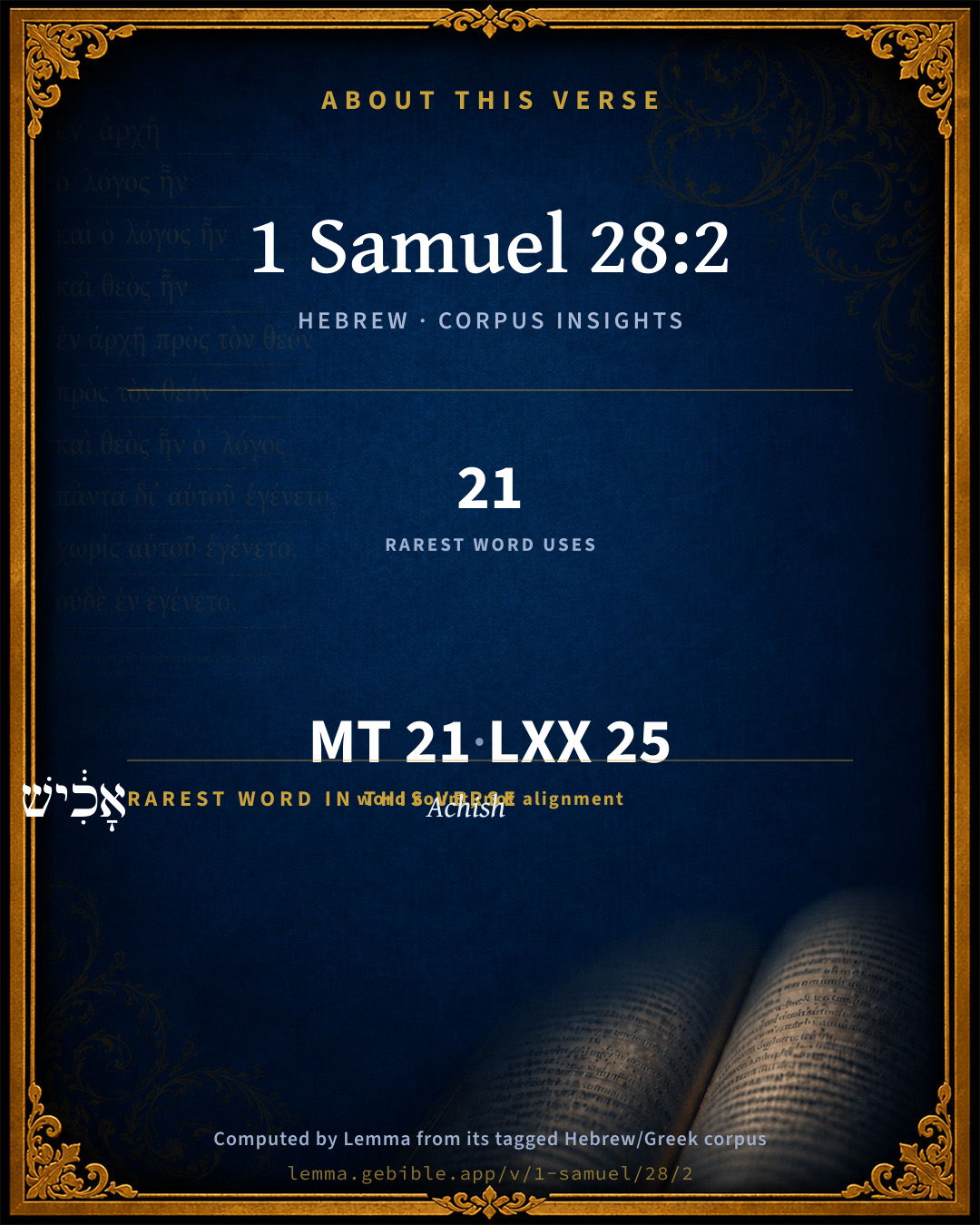
21
words
16
distinct lemmas
Historical
section

Notable vocabulary

The rarest word here is אָכִ֔ישׁ Achish H397 — appearing just 21 times in the whole Hebrew Bible.

Shared distinctive vocabulary

אָכִ֔ישׁ Achish H397 occurs in 20 verses of the Hebrew Bible. Also found in:

Grammatical profile

  • 6 verbs
  • 8 nouns
  • 1 pronoun
  • 2 prepositions
  • 2 adverbs
  • 2 particles

Verb forms

  • וַיֹּ֤אמֶר Qal · Sequential Imperfect
  • תֵדַ֔ע Qal · Imperfect
  • יַעֲשֶׂ֖ה Qal · Imperfect
  • וַיֹּ֤אמֶר Qal · Sequential Imperfect
  • שֹׁמֵ֧ר Qal · Participle Active
  • אֲשִֽׂימְךָ֖ Qal · Imperfect

Repetition

Words recur within this verse — often emphatic in Hebrew:

  • וַיֹּ֤אמֶר to say H559 ×2
  • דָּוִד֙ David H1732 ×2
  • אָכִ֔ישׁ Achish H397 ×2
  • לָכֵן֙ thus H3651 ×2
  • אֶל to H413 ×2

Hebrew & Septuagint length

In English translation the verse runs 28 words from the Hebrew and 30 from the Septuagint (LXX English) — closely comparable.

A rough comparison of the two English renderings, which tokenize alike — not a word-level alignment.

Word counts can differ between the Hebrew and the Greek without any difference in meaning — e.g. the Hebrew direct-object marker אֵת has no separate Greek word, and Greek often adds the article ὁ.

In the original languages it is 21 Hebrew tokens and 25 Greek tokens — but the two are counted differently (Hebrew bundles its prefixes and suffixes into one token; the Greek is in lemma form), so that isn’t a like-for-like length.

Cross-references

3

Topical passages linked to 1 Samuel 28:2 in the Treasury of Scripture Knowledge — connected by theme and wording, ordered by reader-vote popularity; previews shown in the World English Bible.

  • 1 Samuel 27:10 Achish said, Against whom have you made a raid today? David said, Against the South of Judah, and against the South of the Jerahmeelites, and against the South of the Kenites.
  • 2 Samuel 16:16–19 It happened, when Hushai the Archite, David's friend, was come to Absalom, that Hushai said to Absalom, [Long] live the king, [Long] live the king.
  • Romans 12:9 Let love be without hypocrisy. Abhor that which is evil. Cling to that which is good.

Cross-references courtesy of OpenBible.info (CC BY 4.0).

Hebrew and Greek witnesses Masoretic Hebrew ↔ Greek Septuagint

The same verse in the two great witnesses to the Old Testament, shown verse-for-verse.

These are two independent witnesses, not word-aligned to each other, and the Septuagint is shown in lemma (dictionary) form.

Hebrew 1 Samuel 28:2 Masoretic · Westminster Leningrad Codex

וַיֹּ֤אמֶר דָּוִד֙ אֶל אָכִ֔ישׁ לָכֵן֙ אַתָּ֣ה תֵדַ֔ע אֵ֥ת אֲשֶׁר יַעֲשֶׂ֖ה עַבְדֶּ֑ךָ וַיֹּ֤אמֶר אָכִישׁ֙ אֶל דָּוִ֔ד לָכֵ֗ן שֹׁמֵ֧ר לְרֹאשִׁ֛י אֲשִֽׂימְךָ֖ כָּל הַיָּמִֽים

David said to Achish, Therefore you shall know what your servant will do. Achish said to David, Therefore will I make you keeper of my head for ever.

World English Bible · Public Domain

Greek LXX 1 Samuel 28:2 Septuagint · lemma form

καί εἶπον δαυίδ πρός αγχους οὕτως νῦν γιγνώσκω ὅς ποιέω ὁ δοῦλος σύ καί εἶπον αγχους πρός δαυίδ οὕτως ἀρχισωματοφύλαξ τίθημι σύ πᾶς ὁ ἡμέρα

And David said to Anchus, Thus now you shall know what your servant will do. And Anchus said to David, So will I make you captain of my body-guard continually.

LXX2012 (modern English Septuagint) · Public Domain

On this verse, Haydock's Catholic Bible Commentary discusses the Septuagint’s reading. Read the note in Commentary ↓

Hebrew: Westminster Leningrad Codex (CC BY 4.0). Greek: Septuagint (public domain); English from LXX2012 (modern English Septuagint) (Public Domain). How the Septuagint differs from the Hebrew →

Targum (Aramaic paraphrase)

1

The Targum is the ancient Jewish Aramaic paraphrase of the Hebrew Scriptures — an interpretive translation, not the Hebrew text itself. Onkelos (literal) and Pseudo-Jonathan (expansive) render the Torah, and Jonathan the Prophets. Coverage is partial: where no permissively-licensed English translation exists for a verse, only the Aramaic is shown. This is verse-level text, not a word-by-word alignment to the Hebrew.

  1. Targum Jonathan Prophets (Joshua–Malachi)
    וַאֲמַר דָוִד לְאָכִישׁ בְּכֵן אַתְּ תְּדַע יַת דִי יַעְבַּד עַבְדָךְ וַאֲמַר אָכִישׁ לְדָוִד בְּכֵן נַטְרָא לְרֵישֵׁי אֲשַׁוִינָךְ כָּל יוֹמַיָא:

    (no public-domain English translation for this verse)

    Targum Jonathan — Aramaic: “Mikraot Gedolot” (public domain). English: “Sefaria Community Translation” (CC0 1.0 (public-domain dedication)); “London "Chaldee Paraphrase," 1871” (public domain). Text via Sefaria.

Commentary

Notes on 1 Samuel 28:2 from classic Christian and Jewish commentators (each source and its license shown beneath its notes). The classic Christian expositions comment on the surrounding passage and are grouped to its opening verse, so a note may address several verses; the Jewish commentaries on the Tanakh (Rashi and others) are per-verse, so they appear only where the commentator wrote on this verse.

Lemma curates 59 commentaries, every one of them public domain or Creative Commons licensed, each selected and text-cleaned for this edition rather than reprinted as found. About our sources →

Trapp's Complete Commentary

John Trapp

1Sa 28:2 And David said to Achish, Surely thou shalt know what thy servant can do. And Achish said to David, Therefore will I make thee keeper of mine head for ever.

Ver. 2. Surely thou shalt know what thy servant can do.] But whether for Achish or against him, he saith not. Indeed, he could do neither with any honesty, and therefore he maketh a double answer; equivocating, as he had done before. {1Sa 27:9} Josephus is out when he saith that David did readily promise Achish his help; for what show soever he made, he meant nothing less, but prayed and hoped that God would extricate him out of this labyrinth, as also he did, {1Sa 29:3-7} so that he neither fought against Israel, nor was false to Achish.

Thee keeper of mine head.] Captain of my bodyguard. Wicked men will sooner trust the saints, than those that are graceless. Natural conscience cannot but stoop to the image of God stamped upon the hearts and lives of the religious.

John Trapp, A Commentary or Exposition upon All the Books of the Old and New Testament (1647–1656) — public domain. Text from a community e-Sword module.

Joseph Benson's Commentary

1Sa 28:2. David said, Surely thou shalt know what thy servant can do — He answered ambiguously, as he did before. Achish said, Therefore will I make thee keeper of my head — That is, he promised to make him captain of his life-guard, which, we find by the sequel, he accordingly did. Achish evidently understood David as promising that he would do his best to serve him. Delaney thinks that David gave Achish a doubtful answer, because he would not resolve upon so extraordinary a step without consulting God, either by his priest or his prophet. And that, as he proceeded so far as to attend Achish to Aphek, the place appointed for the assembling of the Philistine forces, there is no reason to doubt that he went thither with honest intentions toward his protector, and that he did it by the divine permission.

Joseph Benson's Commentary on the Old and New Testaments (1811–1818) — public domain. Text from a community e-Sword module.

Jamieson, Fausset & Brown

Robert Jamieson, A. R. Fausset & David Brown

Surely thou shalt know what thy servant can do--This answer, while it seemed to express an apparent cheerfulness in agreeing to the proposal, contained a studied ambiguity--a wary and politic generality.

Therefore will I make thee keeper of mine head for ever--or, "my life"; that is, "captain of my bodyguard," an office of great trust and high honor.

Jamieson, Fausset & Brown — Commentary Critical and Explanatory on the Whole Bible (1871) — public domain (CC PDM 1.0). Text via the HelloAO Bible API.

Adam Clarke's Commentary

Verse 2. Surely thou shalt know what thy servant can do] This was another equivocal answer; and could only be understood by his succeeding conduct. It might imply what he could do in favour of the Philistines against Israel; or in favour of Israel against the Philistines. Achish understood it in the former sense; and therefore he said to David, I will make thee keeper of my head for ever; i.e., Thou shalt be captain of my life-guards.

Adam Clarke's Commentary on the Bible (1810–1826) — public domain. Text from a community e-Sword/MySword module.

Ellicott's Commentary for English Readers

(2) And David said to Achish.—Sorely perplexed, David temporises. He dares not refuse; and yet, the idea of commanding a Philistine division in a war with Israel was to him a terrible alternative.

And Achish said to David, Therefore will I make thee keeper of mine head for ever.—The King of Gath, like so many others with whom the winning son of Jesse came in contact in his career, seems to have been completely won by his loveable, generous character, and would not see any ambiguity in David’s reply, but at once offers him in the coming campaign a most distinguished appointment in the army of Gath—the command of the body-guard: for this is what Ewald understands the offer of King Achish to signify.

But, as we shall see, the blind confidence of the king was not fully shared in by the Philistine chieftains; jealousy of the distinguished stranger captain opened their eyes to David’s real feelings. (See 1Sa_29:3; 1Sa_29:11.) It is also quite conceivable, too, that whispers respecting David s expeditions during the past year were current in some Philistine quarters. The eyes of the king, thought these more far-seeing nobles, were blinded by his partiality for his military vassal. (See Note on 1Sa_29:3.)

A Bible Commentary for English Readers, edited by Charles John Ellicott (1878–1897) — public domain. Text from a community e-Sword module.

The Cambridge Bible for Schools and Colleges

gen. ed. J. J. S. Perowne

2. Surely thou shalt know] Better, Therefore now shalt thou know: reading now for thou with the Sept. and Vulg. David’s answer is designedly ambiguous. He is placed in a perplexing dilemma. It seems as though he must either fight against his own nation, or appear false to his liege lord Achish. The difficulty was providentially solved by the suspicion of the Philistine princes (1Sa_29:3 ff.).

keeper of mine head] Captain of his body-guard. Achish accepts David’s answer as a profession of loyalty.

The Cambridge Bible for Schools and Colleges (gen. ed. J. J. S. Perowne; Cambridge University Press, 1878–1918) — public domain. Text from a community e-Sword module.

John Gill's Exposition

And David said to Achish, surely thou shalt know what thy servant can do,.... By which he would have Achish understand, and so he did, that he would exert himself in favour of the Philistines, and against Israel, and do great and brave things, of which Achish would be, made sensible, through his heroic courage and valour; though he meant rather what he could and should do for Israel against the Philistines, if he had an opportunity: but it seems best of all to consider David as quite undetermined, and at a loss what to do, hoping that God in his providence would extricate him out of this difficulty, and direct him what he should do, which then Achish would know; and accordingly he was delivered out of it:

and Achish said to David: putting confidence in him on account of his answer, and believing he was hearty in engaging in the war with the Philistines against Israel:

therefore will I make thee keeper of mine head for ever; the captain of his bodyguard, which post he should hold for life; or he proposed to put him into this post, that he might be with him, near his person, and under his eye, that he might observe how he behaved himself; which may show some suspicion of him.

John Gill's Exposition of the Whole Bible (1746–1763) — public domain (CC PDM 1.0). Text via the HelloAO Bible API.

Albert Barnes' Notes on the Bible

Thou shalt know ... - David dissembled (compare also 1Sa 29:8), hoping, no doubt, that something would happen to prevent his fighting against his king and country.

Keeper of mine head - Captain of his bodyguard.

Albert Barnes' Notes on the Bible (1834–1885) — public domain. Text from a community e-Sword/MySword module.

Haydock's Catholic Bible Commentary

Do; or "can do." Thou wilt be convinced of my valour and fidelity. (Haydock) --- But could David lawfully fight against his brethren? or could he desert Achis in the heat of the engagement? His answer is ambiguous. (Calmet) --- He prudently committed his cause into the hands of Providence, resolved to do nothing contrary to his duty, and to abide by God’s decision, in this critical juncture, so that Cajetan blames him unjustly. (Salien; Menochius; Tirinus) --- Guard. Septuagint, "captain of my body guard."

George Leo Haydock (1774–1849), Haydock's Catholic Family Bible and Commentary, 1859 edition — public domain. Excludes Psalms (Douay-Rheims chapter numbering differs from Protestant) and Deuterocanonical books (Catholic canon only).

Matthew Poole's English Annotations

David speaks ambitiously, as he did before, that Achish might understand him, as he did, of his acting for him against the Israelites; whereas he meant it of his acting for the Israelites against the Philistines, to which he was obliged both by God’s express command, and by his indelible and manifold obligations to God, and to God’s people, and by his own manifest interest. Though it is likely he would have managed his affairs with all possible regard and care of Achish’s person, to whom alone, upon the matter, David stood obliged, and not to the rest of the Philistines, who had an ill opinion of him, as we shall see.

Therefore; for that valour which I doubt not thou wilt show on my behalf.

Of mine head, i.e. of my body and life, the captain of my life-guard.

Matthew Poole's English Annotations on the Holy Bible (1683–1685) — public domain. Text from a community e-Sword/MySword module.

Whedon's Commentary on the Bible

Daniel D. Whedon

2. Surely thou shalt know what thy servant can do — This was an ambiguous reply, and capable of being construed for or against Achish. The king, however, understood it in a favourable sense.

Keeper of mine head — Guard of my person; chief of my life-guards. How David was providentially delivered from his difficult position we learn in chap. 29.

Daniel D. Whedon (gen. ed.), Commentary on the Old and New Testaments (1874–1909) — public domain. Text from a community e-Sword module.

The Pulpit Commentary

Surely thou shalt know. Hebrew, "Therefore thou shalt know," i.e. if the case be so, thou shalt know, etc. The rendering of the A.V makes David repeat the words of Achish, which literally are, "knowing thou shalt know," the Hebrew way of making a strong affirmation. David"s reply is really ambiguous, but is understood by Achish as a boastful assent, and he thereupon promises, Therefore will I make thee keeper of mine head, i.e. captain of my bodyguard, forever. Therefore is exactly the same word as that used by David, and has just the same meaning, namely, "If the case be so, if thou provest thy valour, then I, etc.

The Pulpit Commentary (1880–1919), ed. H.D.M. Spence-Jones & Joseph S. Exell — public domain. Text from a community e-Sword module.

John Wesley's Explanatory Notes

Can do - He speaks ambiguously, as he did before.

John Wesley, Explanatory Notes Upon the Whole Bible (1754–1765) — public domain. Text via the GEBible commentary corpus.

Lesson kit

Teaching starters — assembled from the data on this page, not authored interpretation. Every prompt links to the verse data it draws on. Edit before teaching.

1 Samuel, in the Historical, opens this verse with 21 words (16 distinct Hebrew lemmas). Its most distinctive word is ʼĂkîysh (“Achish”). A historical commentator’s framing appears above. Read the whole chapter for the surrounding context.

Discussion questions

  1. How does “Achish” (ʼĂkîysh) shape what this verse is saying?
  2. 1 Samuel 21:10 shares the word «Achish» with this verse. How do the two illuminate each other?
  3. “to say” occurs 2× in this one verse. What is the effect of the repetition?
  4. These translations render this verse differently; the difference is in the English rendering, not the original. What questions does that raise?
  5. The verb «וַיֹּ֤אמֶר» is Qal Sequential Imperfect. How does its form color the action?
  6. Reading how Trapp's Complete Commentary and Joseph Benson's Commentary read this verse, where do the two commentators agree and where do they part?

Things to notice

Reading settings

Reading text

Shown beneath each verse's original-language words.

Old Testament
Old Testament edition

Read the OT as the Masoretic Hebrew (MT) or the Greek Septuagint (LXX).

English shown for the Greek Septuagint (in the Hebrew ↔ Greek comparison).

Comparing translations? Open the Compare panel on any verse page to stack up to four side by side.