
Jeremiah 31:19

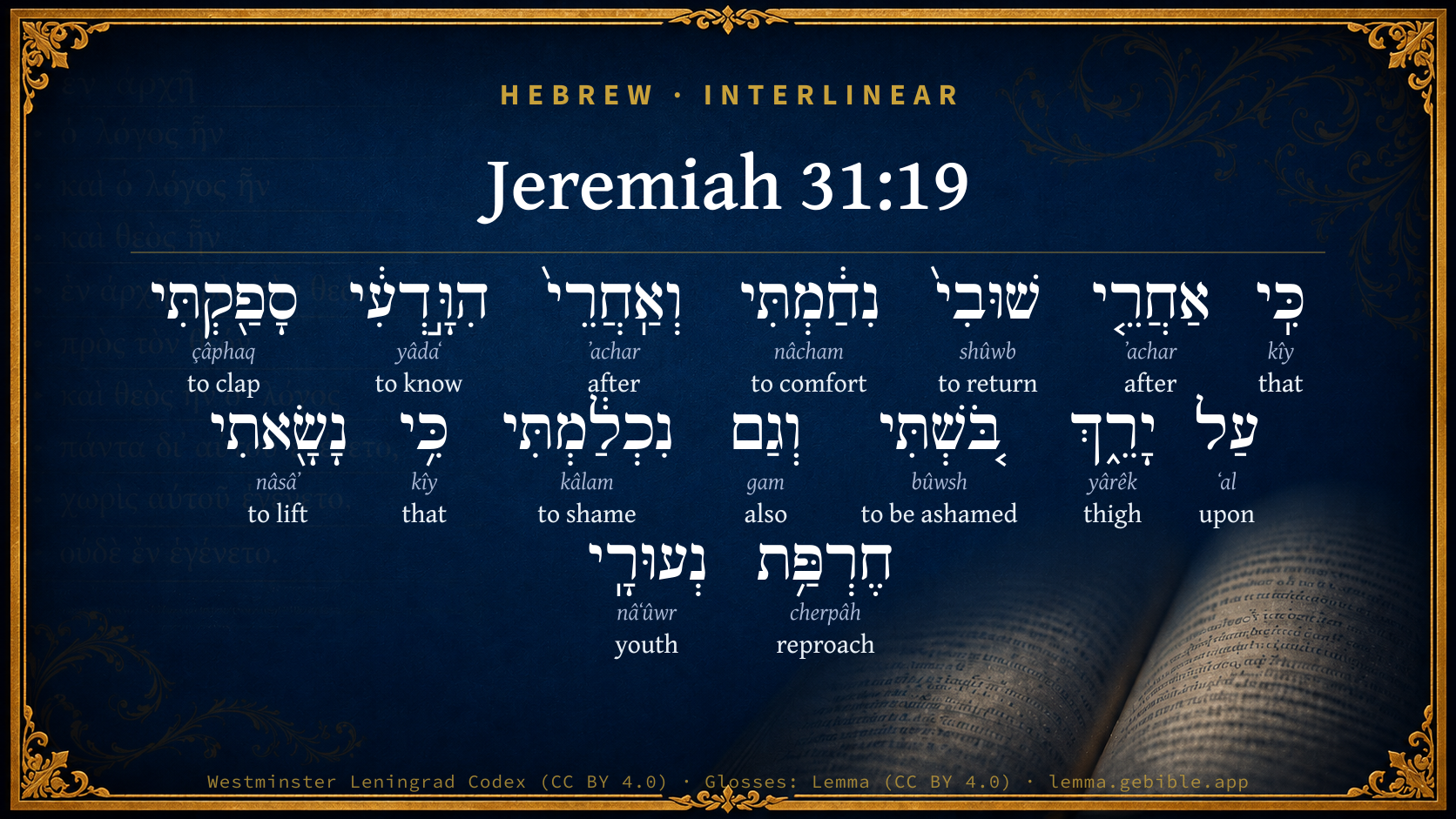
Hebrew (Westminster Leningrad Codex) Jeremiah 31:19 appears in the Hebrew Old Testament. The text above is from the Westminster Leningrad Codex. Each word links to its Strong’s number, a concise gloss, and parsing drawn from the Open Scriptures Hebrew Bible morphology. Click any word for its full Brown-Driver-Briggs (BDB) entry.
Download image
Cite this verse

Jeremiah 31:19 (World English Bible). Public Domain. Lemma interlinear Bible study tool, https://lemma.gebible.app/v/jeremiah/31/19.

Show BibTeX & RIS
BibTeX
RIS
English Translation
Surely after that I was turned, I repented; and after that I was instructed, I struck on my thigh: I was ashamed, yes, even confounded, because I did bear the reproach of my youth.
World English Bible · Public Domain
Download a study sheet

One document with this verse’s original text, its word-by-word gloss line, the meaning frame, cross-references with their text, attributed commentary, and full source and license credits — printable, and it pastes into notes with its structure intact.

This verse Autodidact and up

Study sheet (.html) Plain text (.txt)

A passage Seminary Student

Up to 50 verses in one chapter. A passage sheet keeps up to 6 commentary sources and 12 cross-references per verse, in the order this page ranks them, and says so on the sheet whenever that leaves anything out. Ask for a single verse and you get the Autodidact verse sheet above.

Everything on this page stays free to read, with no account — the sheet is a download of what is already on screen, not access to it.

Want to remove ads? Support Godless Engineer
Compare translations 3

The same verse in 3 English versions, stacked beneath the original-language interlinear above. Click any original word for its lexicon entry.

Each is an independent rendering of the whole verse — the interlinear is not word-aligned to these translations.

Highlighted words mark where these versions differ — a whole-verse word diff, not a word-by-word alignment.

  • World English Bible Public Domain
    Surely after that I was turned, I repented; and after that I was instructed, I struck on my thigh: I was ashamed, yes, even confounded, because I did bear the reproach of my youth.
  • King James Version Public Domain
    Surely after that I was turned, I repented; and after that I was instructed, I smote upon my thigh: I was ashamed, yea, even confounded, because I did bear the reproach of my youth.
  • unfoldingWord Literal Text CC BY-SA 4.0
    For after I turned back to you, I was sorry; after I was trained, I slapped my thigh. I was ashamed and humiliated, for I have borne the guilt of my youth.’

unfoldingWord Literal Text — © unfoldingWord, licensed CC BY-SA 4.0. Word-aligned USFM3 via Door43 (git.door43.org/unfoldingWord/en_ult).

Versions to compare (up to 4)

3 of 4 selected

Show all 18 translations

Every available English version of this verse, each an independent rendering of the whole verse.

  • World English Bible Public Domain
    Surely after that I was turned, I repented; and after that I was instructed, I struck on my thigh: I was ashamed, yes, even confounded, because I did bear the reproach of my youth.
  • Berean Standard Bible Public Domain
    After I returned, I repented; and after I was instructed, I struck my thigh in grief. I was ashamed and humiliated because I bore the disgrace of my youth.’
  • Majority Standard Bible Public Domain
    After I returned, I repented; and after I was instructed, I struck my thigh in grief. I was ashamed and humiliated because I bore the disgrace of my youth.’
  • King James Version Public Domain
    Surely after that I was turned, I repented; and after that I was instructed, I smote upon my thigh: I was ashamed, yea, even confounded, because I did bear the reproach of my youth.
  • American Standard Version (1901) Public Domain
    Surely after that I was turned, I repented; and after that I was instructed, I smote upon my thigh: I was ashamed, yea, even confounded, because I did bear the reproach of my youth.
  • Revised Version (1885) Public Domain
    Surely after that I was turned, I repented; and after that I was instructed, I smote upon my thigh: I was ashamed, yea, even confounded, because I did bear the reproach of my youth.
  • Geneva Bible (1599) Public Domain
    Surely after that I conuerted, I repented: and after that I was instructed, I smote vpon my thigh: I was ashamed, yea, euen confounded, because I did beare the reproch of my youth.
  • Douay-Rheims (1899) Public Domain
    For after thou didst convert me, I did penance: and after thou didst shew unto me, I struck my thigh: I am confounded and ashamed, because I have borne the reproach of my youth.
  • Young's Literal Translation Public Domain
    For after my turning back I repented, And after my being instructed I struck on the thigh, I have been ashamed, I have also blushed, For I have borne the reproach of my youth.
  • Literal Standard Version CC BY-SA 4.0
    For after my turning back I regretted, || And after my being instructed I struck on the thigh, || I have been ashamed, I have also blushed, || For I have borne the reproach of my youth.
  • Unlocked Literal Bible CC BY-SA 4.0
    For after I turned back to you, I was sorry; after I was trained, I slapped my thigh. I was ashamed and humiliated, for I have borne the guilt of my youth.'
  • unfoldingWord Literal Text CC BY-SA 4.0
    For after I turned back to you, I was sorry; after I was trained, I slapped my thigh. I was ashamed and humiliated, for I have borne the guilt of my youth.’
  • Darby Bible Public Domain
    Surely after that I was turned, I repented; and after I knew myself, I smote upon [my] thigh. I was ashamed, yea, even confounded, for I bear the reproach of my youth.
  • World Messianic Bible Public Domain
    Surely after that I was turned. I repented. After that I was instructed. I struck my thigh. I was ashamed, yes, even confounded, because I bore the reproach of my youth.’
  • Webster's Bible Public Domain
    Surely after I was turned, I repented; and after I was instructed, I smote upon my thigh: I was ashamed, and even confounded, because I bore the reproach of my youth.
  • Free Bible Version CC BY-SA 4.0
    When I came back to you I was sorry, and once I understood, I held my head in sadness. I was ashamed and I blushed, embarrassed at what I'd done when I was young.”
  • Bible in Basic English Public Domain
    Truly, after I had been turned, I had regret for my ways; and after I had got knowledge, I made signs of sorrow: I was put to shame, truly, I was covered with shame, because I had to undergo the shame of my early years.
  • JPS Tanakh (1917) Public Domain
    Surely after that I was turned, I repented, and after that I was instructed, I smote upon my thigh; I was ashamed, yea, even confounded, because I did bear the reproach of my youth.'

Literal Standard Version (2020), Covenant Press — licensed CC BY-SA 4.0. Text via the HelloAO Bible API (eBible.org). Unlocked Literal Bible (unfoldingWord) — licensed CC BY-SA 4.0. Text via the HelloAO Bible API (eBible.org). unfoldingWord Literal Text — © unfoldingWord, licensed CC BY-SA 4.0. Word-aligned USFM3 via Door43 (git.door43.org/unfoldingWord/en_ult). Free Bible Version, Dr. Jonathan Gallagher — licensed CC BY-SA 4.0. Text via the HelloAO Bible API (eBible.org).

Word by word

More ways to search: Search by grammar → Find every occurrence → Compare this word →

Practice this passage: Drill this verse → Learn its vocabulary →

סָפַ֖קְתִּי
çâphaq
H5606
“to clap”
Verb, Qal, Perfect, 1st Person, Common, Singular
Part of Speech
Verb
Stem
Qal
Form
Perfect
Person
1st Person
Gender
Common
Number
Singular
Full BDB Definition

Origin: a primitive root

TWOT: 1539

( 1Ki 20:10 , Job 27:23 , Is Job 2:6 ) - to clap, slap - (Qal) - to slap, clap - to slap, chastise - to splash, throw up - (Hiphil) to cause to clap
  1. כִּֽי kîy H3588 “that” Conjunction
  2. אַחֲרֵ֤י ʼachar H310 “after” Preposition
  3. שׁוּבִי֙ shûwb H7725 “to return · me” Verb, Qal, Infinitive Construct + Suffix, Personal, 1st Person, Common, Singular
  4. נִחַ֔מְתִּי nâcham H5162 “to comfort” Verb, Niphal, Perfect, 1st Person, Common, Singular
  5. וְאַֽחֲרֵי֙ ʼachar H310 “and · after” Conjunction + Preposition
  6. הִוָּ֣דְעִ֔י yâdaʻ H3045 “to know · me” Verb, Niphal, Infinitive Construct + Suffix, Personal, 1st Person, Common, Singular
  7. עַל ʻal H5921 “upon” Preposition
  8. יָרֵ֑ךְ yârêk H3409 “thigh” Noun, Common, Feminine, Singular, Absolute
  9. בֹּ֚שְׁתִּי bûwsh H954 “to be ashamed” Verb, Qal, Perfect, 1st Person, Common, Singular
  10. וְגַם gam H1571 “and · also” Conjunction + Particle, Accusative
  11. נִכְלַ֔מְתִּי kâlam H3637 “to shame” Verb, Niphal, Perfect, 1st Person, Common, Singular
  12. כִּ֥י kîy H3588 “that” Conjunction
  13. נָשָׂ֖אתִי nâsâʼ H5375 “to lift” Verb, Qal, Perfect, 1st Person, Common, Singular
  14. חֶרְפַּ֥ת cherpâh H2781 “reproach of” Noun, Common, Feminine, Singular, Construct
  15. נְעוּרָֽי nâʻûwr H5271 “youth · my” Noun, Common, Both, Plural, Construct + Suffix, Personal, 1st Person, Common, Singular

About this verse

These counts appear in no published source. They are computed here, from the morphology-tagged text and Lemma’s own curated glosses. What Lemma adds →

16
words
14
distinct lemmas
Prophets
section

Notable vocabulary

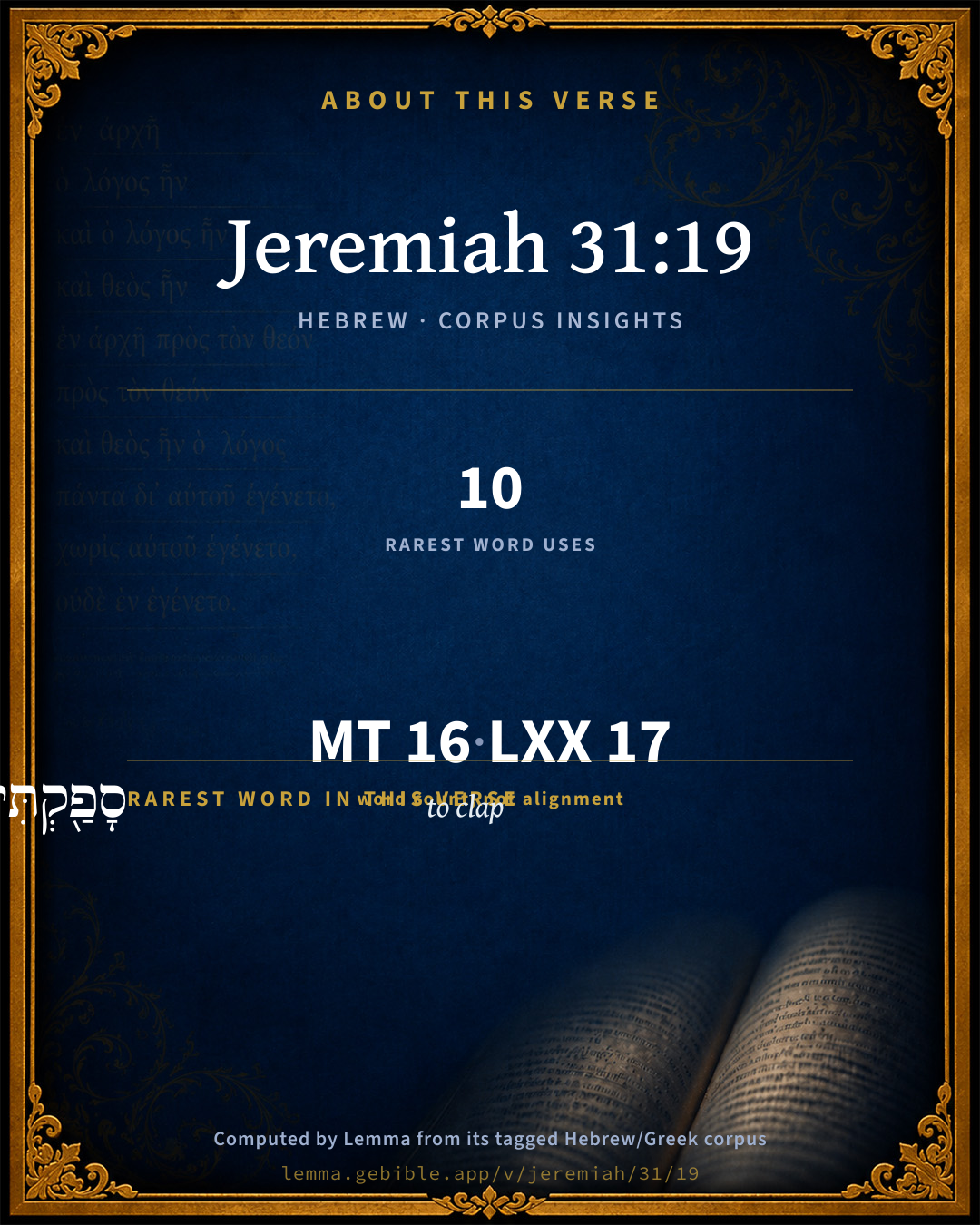
The rarest word here is סָפַ֖קְתִּי to clap H5606 — appearing just 10 times in the whole Hebrew Bible.

Shared distinctive vocabulary

סָפַ֖קְתִּי to clap H5606 occurs in 10 verses of the Hebrew Bible. Also found in:

Grammatical profile

  • 7 verbs
  • 3 nouns
  • 3 prepositions
  • 2 conjunctions
  • 1 particle

Verb forms

  • שׁוּבִי֙ Qal · Infinitive Construct
  • נִחַ֔מְתִּי Niphal · Perfect
  • הִוָּ֣דְעִ֔י Niphal · Infinitive Construct
  • סָפַ֖קְתִּי Qal · Perfect
  • בֹּ֚שְׁתִּי Qal · Perfect
  • נִכְלַ֔מְתִּי Niphal · Perfect
  • נָשָׂ֖אתִי Qal · Perfect

Repetition

Words recur within this verse — often emphatic in Hebrew:

  • אַחֲרֵ֤י after H310 ×2
  • כִּֽי that H3588 ×2

Hebrew & Septuagint length

In the original languages it is 16 Hebrew tokens and 17 Greek tokens — but the two are counted differently (Hebrew bundles its prefixes and suffixes into one token; the Greek is in lemma form), so that isn’t a like-for-like length.

Cross-references

28

Topical passages linked to Jeremiah 31:19 in the Treasury of Scripture Knowledge — connected by theme and wording, ordered by reader-vote popularity; previews shown in the World English Bible.

  • Jeremiah 3:25 Let us lie down in our shame, and let our confusion cover us; for we have sinned against Yahweh our God, we and our fathers, from our youth even to this day; and we have not obeyed the voice of Yahweh our God.
  • Ezekiel 36:31 Then shall you remember your evil ways, and your doings that were not good; and you shall loathe yourselves in your own sight for your iniquities and for your abominations.
  • Ezekiel 21:12 Cry and wail, son of man; for it is on my people, it is on all the princes of Israel: they are delivered over to the sword with my people; strike therefore on your thigh.
  • Luke 18:13 But the tax collector, standing far away, wouldn't even lift up his eyes to heaven, but beat his breast, saying, 'God, be merciful to me, a sinner!'
  • Deuteronomy 30:2 and shall return to Yahweh your God, and shall obey his voice according to all that I command you this day, you and your children, with all your heart, and with all your soul;
  • Leviticus 26:41–42 I also walked contrary to them, and brought them into the land of their enemies: if then their uncircumcised heart is humbled, and they then accept the punishment of their iniquity;
  • Ezra 9:6 and I said, my God, I am ashamed and blush to lift up my face to you, my God; for our iniquities are increased over our head, and our guiltiness is grown up to the heavens.
  • Psalms 25:7 Don't remember the sins of my youth, nor my transgressions. Remember me according to your loving kindness, For your goodness' sake, Yahweh.
  • Zechariah 12:10 I will pour on the house of David, and on the inhabitants of Jerusalem, the spirit of grace and of supplication; and they will look to me whom they have pierced; and they shall mourn for him, as one mourns for his only son, and will grieve bitterly for him, as one grieves for his firstborn.
  • 2 Corinthians 7:10–11 For godly sorrow works repentance to salvation, which brings no regret. But the sorrow of the world works death.
  • Ephesians 2:3–5 among whom we also all once lived in the lust of our flesh, doing the desires of the flesh and of the mind, and were by nature children of wrath, even as the rest.
  • Deuteronomy 30:6–8 Yahweh your God will circumcise your heart, and the heart of your seed, to love Yahweh your God with all your heart, and with all your soul, that you may live.
  • Job 13:26 For you write bitter things against me, And make me inherit the iniquities of my youth:
  • Job 20:11 His bones are full of his youth, But youth shall lie down with him in the dust.
  • Isaiah 54:4 Don't be afraid; for you shall not be ashamed: neither be confounded; for you shall not be disappointed: for you shall forget the shame of your youth; and the reproach of your widowhood shall you remember no more.
  • Jeremiah 22:21 I spoke to you in your prosperity; but you said, I will not hear. This has been your manner from your youth, that you didn't obey my voice.
  • Jeremiah 32:30 For the children of Israel and the children of Judah have done only that which was evil in my sight from their youth; for the children of Israel have only provoked me to anger with the work of their hands, says Yahweh.
  • Ezekiel 6:9 Those of you that escape shall remember me among the nations where they shall be carried captive, how that I have been broken with their lewd heart, which has departed from me, and with they eyes, which play the prostitute after their idols: and they shall loathe themselves in their own sight for the evils which they have committed in all their abominations.
  • Ezekiel 16:61–63 Then shall you remember your ways, and be ashamed, when you shall receive your sisters, your elder [sisters] and your younger; and I will give them to you for daughters, but not by your covenant.
  • Ezekiel 20:43–44 There shall you remember your ways, and all your doings, in which you have polluted yourselves; and you shall loathe yourselves in your own sight for all your evils that you have committed.
  • Ezekiel 23:3 and they played the prostitute in Egypt; they played the prostitute in their youth; there were their breasts pressed, and there was handled the bosom of their virginity.
  • Ezekiel 36:26 A new heart also will I give you, and a new spirit will I put within you; and I will take away the stony heart out of your flesh, and I will give you a heart of flesh.
  • Luke 15:17–19 But when he came to himself he said, 'How many hired servants of my father's have bread enough to spare, and I'm dying with hunger!
  • Luke 15:30 But when this, your son, came, who has devoured your living with prostitutes, you killed the fattened calf for him.'
  • John 6:44–45 No one can come to me unless the Father who sent me draws him, and I will raise him up in the last day.
  • Romans 6:21 What fruit then did you have at that time in the things of which you are now ashamed? For the end of those things is death.
  • 2 Timothy 2:25 in gentleness correcting those who oppose him: perhaps God may give them repentance leading to a full knowledge of the truth,
  • Titus 3:3–7 For we were also once foolish, disobedient, deceived, serving various lusts and pleasures, living in malice and envy, hateful, and hating one another.

Cross-references courtesy of OpenBible.info (CC BY 4.0).

Hebrew and Greek witnesses Masoretic Hebrew ↔ Greek Septuagint

The same verse in the two great witnesses to the Old Testament, shown verse-for-verse.

These are two independent witnesses, not word-aligned to each other, and the Septuagint is shown in lemma (dictionary) form.

Hebrew Jeremiah 31:19 Masoretic · Westminster Leningrad Codex

כִּֽי אַחֲרֵ֤י שׁוּבִי֙ נִחַ֔מְתִּי וְאַֽחֲרֵי֙ הִוָּ֣דְעִ֔י סָפַ֖קְתִּי עַל יָרֵ֑ךְ בֹּ֚שְׁתִּי וְגַם נִכְלַ֔מְתִּי כִּ֥י נָשָׂ֖אתִי חֶרְפַּ֥ת נְעוּרָֽי

Surely after that I was turned, I repented; and after that I was instructed, I struck on my thigh: I was ashamed, yes, even confounded, because I did bear the reproach of my youth.

World English Bible · Public Domain

Greek LXX Structure differs

In the Septuagint, Jeremiah is about an eighth shorter than the Hebrew and arranges its material differently — the Oracles Against the Nations (Hebrew chapters 46–51) appear in the middle of the Greek book, after 25:13. Because the chapter and verse boundaries do not line up, a verse-for-verse comparison with the Hebrew is not shown.

A verse-for-verse comparison isn’t shown here because the chapters and verses don’t line up. Switch to the LXX edition with the MT / LXX toggle above to read the Greek directly.

On this verse, The Cambridge Bible for Schools and Colleges discusses the Septuagint’s reading. Read the note in Commentary ↓

Hebrew: Westminster Leningrad Codex (CC BY 4.0). Greek: Septuagint (public domain); English from a public-domain English Septuagint. How the Septuagint differs from the Hebrew →

Targum (Aramaic paraphrase)

1

The Targum is the ancient Jewish Aramaic paraphrase of the Hebrew Scriptures — an interpretive translation, not the Hebrew text itself. Onkelos (literal) and Pseudo-Jonathan (expansive) render the Torah, and Jonathan the Prophets. Coverage is partial: where no permissively-licensed English translation exists for a verse, only the Aramaic is shown. This is verse-level text, not a word-by-word alignment to the Hebrew.

  1. Targum Jonathan Prophets (Joshua–Malachi)
    אֲרֵי כַּד אֲנַחְנָא תָיְבִין לְאוֹרַיְתָא מִתְנַחֵם עֲלָנָא וּכְדוּ דְאִתְגְלֵי לָנָא טִפַּחְנָא עַל יְרַכָנָא בְּהֵיתְנָא וְאַף אִתְכְּנָעֲנָא אֲרֵי קַבֵּילְנָא חִסוּדֵי חוֹבָנָא דְמִלְקָדְמִין:

    "...For when we return to your Torah, we are comforted. When You reveal Yourself to us, we beat our thighs in shame and submit because we accept our previous transgressions.

    Targum Jonathan — Aramaic: “Mikraot Gedolot” (public domain). English: “Sefaria Community Translation” (CC0 1.0 (public-domain dedication)); “London "Chaldee Paraphrase," 1871” (public domain). Text via Sefaria.

Commentary

Notes on Jeremiah 31:19 from classic Christian and Jewish commentators (each source and its license shown beneath its notes). The classic Christian expositions comment on the surrounding passage and are grouped to its opening verse, so a note may address several verses; the Jewish commentaries on the Tanakh (Rashi and others) are per-verse, so they appear only where the commentator wrote on this verse.

Lemma curates 59 commentaries, every one of them public domain or Creative Commons licensed, each selected and text-cleaned for this edition rather than reprinted as found. About our sources →

Trapp's Complete Commentary

John Trapp

Jer 31:19 Surely after that I was turned, I repented; and after that I was instructed, I smote upon [my] thigh: I was ashamed, yea, even confounded, because I did bear the reproach of my youth.

Ver. 19. Surely after that I was turned, I repented.] After that I had turned short again upon myself, as those penitents, {1Ki 8:47} as Manasseh, the publican, {Luk 18:13} and that prodigal. {Luk 15:17}

And after that I was instructed.] Postquam ostensum fuerit mihi. {a} After that I knew myself, or rather was made known to myself - scil., by mine afflictions sanctified; for Schola crucis, schola lucis. The followers of the cross are the followers of light. Afflictions are those pillulae lucis, that serve notably to clear the soul’s eye sight.

I smote upon my thigh,] {b} Sicut mulierculae in puerperio facere solent, saith Luther, as travailing women use to do. It is a token of greatest grief. See Eze 21:12.

I was ashamed, yea, even confounded.] Abashed and abased to the utmost; my sorrow was deep and downright.

Because I did bear the reproach of my youth,] i.e., The brunt and burden of my reproachful practices in my youth. See Job 13:26 Psa 25:7.

{a} Tremel., In Gloss. Marginal.

{b} Homer hath it oft πεπληγετο μηρω, he smote on his thigh. Cicero hath the like, lib. iii. Tuscul.

John Trapp, A Commentary or Exposition upon All the Books of the Old and New Testament (1647–1656) — public domain. Text from a community e-Sword module.

Joseph Benson's Commentary

Jer 31:19. Surely after that I was turned, I repented — After I was enlightened and impressed with a due sense of my duty, and of the many deviations from it of which I had been guilty, and after my will was subjected to the will of God, I straightway became a true penitent, and expressed my repentance by all the outward and inward signs of an unfeigned sorrow for, and hatred to, my past conduct. And after that I was instructed — Respecting my sin and folly, in forsaking the fountain of living waters for the broken cisterns that could hold no water; I smote upon my thigh — Through the most poignant grief and concern, and with indignation against myself. I was ashamed, yea, even confounded — At my own stupidity and frowardness, and could neither with any confidence look up to God, nor with any comfort reflect upon myself; because I did bear the reproach of my youth — The burden of my former sins lay heavy upon my mind, and I became sensible that all the calamities and reproaches I had undergone were the due deserts of my offences. Ephraim smote upon his thigh, as the publican upon his breast. We find, both in the Holy Scriptures, and other ancient records, smiting on the thigh mentioned as an expression of great surprise and concern. Thus God commands Ezekiel to cry and howl, on account of the sword that should be upon his people, and to smite upon his thigh. We find the same custom noticed by Homer, Iliad 16. 50:124.

— — — — — — αυταρ Αχιλλευς Μηρω πληξαμενος Πατροληα πρωσεειπεν,

Divine Achilles view’d the rising flames, And smote his thigh, and thus aloud exclaims, Arm, arm, Patroclus! POPE.

It is also noticed by Xenophon, Cicero, and others. The meaning is, when Ephraim was made sensible of his sinfulness he showed marks of real contrition.

Joseph Benson's Commentary on the Old and New Testaments (1811–1818) — public domain. Text from a community e-Sword module.

Tyndale Open Study Notes

Tyndale Open Resources

31:19 When the exiles realized the stupidity of their sins, they were ashamed.

Tyndale Open Study Notes — © Tyndale Open Resources, licensed CC BY-SA 4.0. Text via the HelloAO Bible API.

Geneva Bible (1599)

Geneva Bible translators

In sign of repentance and detestation of my sin.

Geneva Bible (1599) marginal notes — public domain. Text via Bolls.life.

Jamieson, Fausset & Brown

Robert Jamieson, A. R. Fausset & David Brown

after that I was turned, I repented--Repentance in the full sense follows, not precedes, our being turned to God by God (Zac 12:10). The Jews' "looking to Him whom they pierced" shall result in their "mourning for Him." Repentance is the tear that flows from the eye of faith turned to Jesus. He Himself gives it: we give it not of ourselves, but must come to Him for it (Act 5:31).

instructed--made to learn by chastisement. God's Spirit often works through the corrections of His providence.

smote upon . . . thigh-- (Eze 21:12). A token of indignant remorse, shame, and grief, because of his past sin.

bear . . . reproach of . . . youth--"because the calamities which I bore were the just punishment of my scandalous wantonness against God in my youth"; alluding to the idols set up at Dan and Beth-el immediately after the ten tribes revolted from Judah. His sense of shame shows that he no longer delights in his sin.

Jamieson, Fausset & Brown — Commentary Critical and Explanatory on the Whole Bible (1871) — public domain (CC PDM 1.0). Text via the HelloAO Bible API.

Adam Clarke's Commentary

Verse 19. After that I was turned] Converted from my sin, folly, and idolatry.

I repented] To conviction of sin, I now added contrition for sin. Conviction, in this sense of the word, must precede contrition or repentance. As soon as a man sees himself lost and undone, he is convicted of sin; when convicted, he begins to mourn. Thus contrition follows conviction.

I smote upon my thigh] My sorrow grew deeper and deeper; I smote upon my thigh through the extremity of my distress. This was a usual sign of deep affliction. See Eze 21:12. It was the same among the ancient Greeks. So Homer: -

Ως εφατ' αυταρ Αρης θαλερω πεπληγετο μηρω

Χερσι καταπρηνεσσ,ολοφυρομενος δε προσηυδα.

IL. lib. xv. 113.

"She spake: and with expanded arms, his thighs

Smiting, thus sorrowful, the god exclaimed."

COWPER.

---- αυταρ Αχιλλευς

Μηρω πληξαμενος Πατροκληα προσεειπεν.

IL. lib. xvi. 124.

"Achilles saw it, smote his thigh, and said -----."

COWPER.

I have often seen persons in deep grief act thus.

Adam Clarke's Commentary on the Bible (1810–1826) — public domain. Text from a community e-Sword/MySword module.

John Calvin's Commentaries

Jeremiah now proceeds with what he had before briefly touched upon, even to shew that the punishment inflicted on the Israelites had not been without its fruit. And this is a doctrine which ought especially to be known, for we always shun whatever is hard to the flesh; so that if it were according to our own will, the chastisements of God would never be well received by us. It is, therefore, necessary to regard the end, as the Apostle reminds us. (Hebrews 12:11) Now when we see that God has a regard for our own salvation while handling us somewhat roughly, our sorrow is mitigated and lessened, especially when experience proves that punishment is good for us; we then felicitate ourselves, and give thanks to God that he has not suffered us wholly to perish in our sins. This is the reason why the Prophet enlarges on this doctrine.

He therefore says, After thou hast turned me, I repented He confirms what he has already said, that it is the peculiar work of God when a sinner repents, and that it cannot be ascribed to human powers, as though men could of themselves turn to the right way. But how was this done? After thou hast turned me He thus repeats in other words what he had said, but for the purpose of confirming his previous declaration. The meaning is, that we are never touched by a serious feeling, so as to be displeased with our sins, until God himself turns us.

We hence learn how blind the Papists are, who, speaking of repentance, hold that man, through his own free-will, returns to God; and on this point is our greatest contest with them at this day. But the Prophet briefly determines the whole question; for, as he had said before, that men cannot turn except God turns them, he now adds, that he had found this to be really the fact, that people had never become conscious of their sins though God had grievously punished them until they were turned, not by their own free-will, but by the hidden working and influence of the ttoly Spirit; after thou hast turned me, I repented The meaning is, that men never entertain a real hatred towards sin, unless God illuminates their minds and changes their hearts; for what is the turning or conversion of which the Prophet speaks? It is the renewal of the mind and heart. For let its definition be fetched, as they say, from what is contrary to it; what is turning away? It is the alienation of the mind and heart from God. It then follows that when we turn we are converted, we are renewed in knowledge, and then in heart, or in our affections; both of which the Prophet ascribes to the grace of God, for he says that the people repented not of their sins until they were turned or converted, that is, until they were renewed both in mind and heart. Some give this version, “After I received consolation;” but their mistake is easily confuted by the context; for it immediately follows, I was ashamed and also confounded. There is no doubt then but that here is set forth the displeasure at sin that is felt when the sinner is terrified by God’s judgment so as to renounce his vices.

After I was made known to myself, or, after it was shewn to me, or, simply, after I knew it, etc. For we may take the meaning to be, After it was given to Ephraim to know himself, or, after he knew himself. Some give this version, “After I was known;” and so the meaning would be the same with those words of Paul,

“After ye have known God, or rather are known by him.” (Galatians 4:9)

But I fear that this exposition is too refined. I therefore would rather follow those who give this rendering, After I became known to myself, or, after the thing was made known to me. The Prophet, no doubt, commends here the grace of God, because the veil had been taken away from the eyes of the people, or because they had been cured of their blindness; as though they had said, that they had long been blind, because they took delight in their vices, and their whole soul was in a torpid state; for we know that those who are forsaken by God are wholly insensible, and are as it were like the beasts. Then the people of Israel confess that they were, for a time, thus stupid, and that their minds were blinded: they therefore acknowledge here the grace of God, that he had at length opened their eyes. For they do not speak here, as we have said, of their virtue or power, but acknowledge that it proceeded wholly from God’s gratuitous favor that they repented.

As then, under the word, turning or conversion, is included the renewal of the whole soul, so now it is expressly said, that they were endued with a right mind, because God had taken away the veil by which their eyes were covered, and had conferred on them new light. The meaning is, that they were not touched by the true fear of God before they were endued with a right mind; but at the same time he testifies that it had been obtained through the peculiar favor of God. We hence see that the Prophet, in the name of the ten tribes, acknowledges that nothing depended on the free-will of man, but that a sound mind and a right feeling of the heart is the work of the Holy Spirit.

The smiting of the thigh means sorrow or grief, which arises from the fear of God: for as long as we disregard God’s judgment, Satan must necessarily fascinate us with his allurements; but when God manifestly shews that he is our judge, and when our own baseness comes to view, then we begin to smite the thigh And he adds, what means the same thing, I was ashamed and even confounded I wonder why many interpreters have omitted the particle גמ gam, even: they invert the order, and render thus, “I was confounded and ashamed.” But the particle shews that the Prophet enhances the greatness of the sorrow and shame when he says, I was ashamed and even confounded

He then adds, Because I have borne the reproach of my youth He here repeats what he had said before, even that punishment, sent from above, had done good to the Israelites. For except they had been thus made ashamed, they would have always taken delight in their vices; for we see that the wicked flatter and deceive themselves as long as God spares and shews forbearance towards them. Hence the Prophet, in the name of the people, says, that punishment had been profitable to him. But we must bear in mind what we have said, that this fruit altogether proceeds from the grace of God: for the reprobate, however dreadful the examples of vengeance which God may exhibit, still remain unbending, nor do they bear their own reproach, that is, confess that they have sinned. To bear reproach, then, is peculiar to the elect of God, who have been regenerated by his Spirit; for they understand the cause of their evils. When we see two diseased persons, one of whom is insane, and so is insensible as to his disease, and the other feels his sorrow, and is affected by it: in this case we see some difference. But we see another difference in others who are diseased; we may therefore suppose a third case, for it often happens, that he who is affected with sorrow, does not yet examine into its cause. He then who is healable is one who understands whence has arisen his disease, and so is ready to obey, and willing to adopt the necessary remedies. There are also many who rush headlong to their own ruin; some, indeed, feel their punishment to be bitter, but consider not the cause of it, that is, that they have provoked God’s wrath: but they who are prepared to seek the restoration of health, well know how they have contracted their disease. Hence the Prophet here says, that they bore their reproach, for they not only felt their sorrow, but also considered its fountain, that is, that they had, by their sins, provoked the wrath of God.

By youth he metaphorically points out the time when the Israelites indulged in excesses; for we know how much ardor belongs to that age. In the aged there is more moderation; but the young intemperately indulge themselves. It is therefore a metaphorical expression, by which the Prophet intimates, that the Israelites had, for a time, been wanton against God, their petulance being not subdued, for, as he had said, they had been like untamed bullocks. It follows, —

John Calvin's Commentaries (1540-1563) — public domain. Text from the Calvin Translation Society English edition (1840s-50s) via the Christian Classics Ethereal Library (ccel.org). Calvin's coverage is partial (roughly two-thirds of the Bible); uncommented books and verses are honest gaps, never fabricated. The 19th-century editor's footnotes and remarks are omitted so the notes are faithfully Calvin's own voice.

Ellicott's Commentary for English Readers

(19) After that I was turned.—The words have been referred by some commentators (Hitzig) to the previous turning away from God—the apostasy of Ephraim; but the repetition of the word that had been used in the previous verse makes it far more natural to connect it with the first movement of repentance. The “smiting upon the thigh” is, like the Publican’s “smiting on his breast” (Luk_18:13), an Eastern expression of extremest grief. So in Eze_21:17 we have the “smiting of the hands together” as a symbol of anger, which is also sorrow. In Homer (Odyss. xiii. 193) we have the very gesture here depicted—

“And then he groaned, and smote on both his thighs

With headlong hands, and so in sorrow spoke.”

The reproach of my youth—i.e., the shame which the sins of his youth had brought upon him.

A Bible Commentary for English Readers, edited by Charles John Ellicott (1878–1897) — public domain. Text from a community e-Sword module.

The Cambridge Bible for Schools and Colleges

gen. ed. J. J. S. Perowne

19. after that I was turned] rather (see preceding note), after I turned. Ephraim turns, and his repentance is the completion of his conversion. The Heb. text which seems to underlie the LXX rendering, viz. “after my captivity,” is hardly to be accepted.

instructed] by punishment. Cp. the use of the word “taught” (the same verb in the Hebrew), Jdg_8:16.

I smote upon my thigh] in token of contrition. Cp. Eze_21:12.

the reproach of my youth] the disgrace brought upon me by the sins of my earlier life as a nation.

The Cambridge Bible for Schools and Colleges (gen. ed. J. J. S. Perowne; Cambridge University Press, 1878–1918) — public domain. Text from a community e-Sword module.

John Gill's Exposition

Surely after that I was turned I repented,.... Ephraim's prayer was answered; as he prayed he might be turned, he was; and when he was turned, then he repented, not only of sin in general, but of such sins as he had been particularly guilty of; not only of the grosser actions of life, but of inward sins, secret lusts and corruptions; even of sins of holy things, having now different sentiments, affections, and conduct: and this is what is called evangelical repentance, and is from the grace of God; springs from love; flows from a sight of God and a view of Christ; is increased by the discoveries of God's love, and is unto life and salvation; and this sort of repentance follows upon conversion; there must be first a true and real conversion before this evangelical repentance can take place:

and after that I was instructed I smote upon my thigh: as expressive of sorrow for sin after a godly sort; of indignation at it; and shame and confusion for it; and also of astonishment, at the mercy, forbearance, and long suffering of God, Eze 21:12; and this humiliation follows upon spiritual instruction, which is previously necessary to it; "after it was made known to me" (u); as the words may be rendered; what a sinful, guilty, impure, and impotent, and unrighteous creature he was; after that he became acquainted with himself, and his wretched state and condition; when instructed either by the rod, or by the word, and by the Spirit of God, in the use of both, or either; when led into the knowledge of divine things; of the love and grace of God through Christ; of the person, offices, and glory of Christ; of the way of life and salvation by him; and of the doctrines of pardon, and righteousness, and acceptance through him:

I was ashamed, yea, even confounded, because I did bear the reproach of my youth; in his conscience; the sins and follies of his youth being presented and set before him, and he convinced of them, was filled with shame and confusion at the remembrance of them; which is a common thing when a man is thoroughly awakened and converted, and is brought to true repentance and humiliation. So the Targum,

"because we have received the reproach of our sins, which were of old?''

(u) "et postquam ostensum est mihi", Pagninus, Vatablus; "ostensum fuerit", Junius & Tremellius; "et post notum est mihi", Montanus.

John Gill's Exposition of the Whole Bible (1746–1763) — public domain (CC PDM 1.0). Text via the HelloAO Bible API.

Haydock's Catholic Bible Commentary

Thigh, through grief. Femur mœrenti plangere dextra. (Ovid, Metam. xi.) --- Cyrus struck his thigh, mounted his horse, and went to attend the funeral of Abradates. (Xenophon vii.) --- So did Achilles for Patroclus. (Homer, Iliad xvi.) --- Youth, being seduced by Jeroboam.

George Leo Haydock (1774–1849), Haydock's Catholic Family Bible and Commentary, 1859 edition — public domain. Excludes Psalms (Douay-Rheims chapter numbering differs from Protestant) and Deuterocanonical books (Catholic canon only).

Matthew Poole's English Annotations

We must consider that we are not in a history or a narration of things done, but in a prophecy foretelling what should come to pass. The prophet foretelleth that before this promised deliverance should come, the Israelites should be in another temper, that their uncircumcised hearts should be humbled, they should accept of the punishment of their sins, confess God’s justice and righteousness, and their own wantonness and unruliness, pray unto God to change their hearts, which would never else be changed, and change their conditions, which would depend upon that change of their hearts, laying claim to God as their God, who had promised, Deu 30:1,2, that when the blessings and the curses spoken of Deu 28 Deu 29 should come upon them, and they should call them to mind among all the nations whither the Lord had driven them, if they returned unto the Lord their God, and obeyed his voice, according to all that he commanded them, they and their children, with all their heart, and all their soul; that then the Lord their God would turn their captivity, and have compassion on them, &c. Now, saith Ephraim,

after I was turned, after God had changed our hearts, we

repented and changed our practices; after that God had instructed us, either by his prophets, or by briers and thorns, by our afflictions, or by his Holy Spirit, we smote upon our thighs in testimony of our sorrow and affliction, Eze 21:12. Then I was ashamed and confounded for my sins, understanding that I did but bear the just punishment of the sins which I had long ago committed, in the time of my wantonness, rebellion, and disobedience to God. This is expressed by the term youth, because ordinarily men and women’s youth is their time of wantonness; persons ordinarily growing more considerate and sober as years increase upon them. Thus the prophet foretelleth that God would prepare this people for mercy. In the next verses he showeth how ready God’s ear would be to hear.

Matthew Poole's English Annotations on the Holy Bible (1683–1685) — public domain. Text from a community e-Sword/MySword module.

Whedon's Commentary on the Bible

Daniel D. Whedon

19. After that I was turned — “Turned” is equivocal, and may mean either turning away from God or turning to him. Here it is the former.

Daniel D. Whedon (gen. ed.), Commentary on the Old and New Testaments (1874–1909) — public domain. Text from a community e-Sword module.

The Pulpit Commentary

After that I was turned, I repented; rather, after my turning away, (as Jer_8:4) I have repented. It is a different kind of "turning" which is here meant, a turning away from God. I was instructed; literally, I was made to know; i.e. brought to my senses by punishment. I smote upon my thigh; rather, I have smitten, etc. Ephraim describes his present state of mind, and the symbols by which he translates it into act. Smiting upon the thigh was a sign of mourning. (comp. Eze_21:17) I did bear, etc.; rather, I have borne, etc. The "reproach of Ephraim"s youth" is that which he brought upon himself in early times by his unfaithfulness to Jehovah.

Conversion and repentance.

I BOTH THESE ARE TOLD OF HERE. Conversion is. It is spoken of as "being turned" and "instructed." Repentance is. It is spoken of plainly and again figuratively: "I smote upon my thigh" This is a common mode of expressing indignation and grief.

II AND REPENTANCE IS SAID TO COME AFTER CONVERSION. And this is ever so. Not that there is no repentance prior to conversion. There is, and a genuine one. The "bemoaning" spoken of in the previous verse tells of that repentance which comes prior to conversion. But the true, deep, abiding repentance comes after. It consists, not so much in some passionate outburst of sorrow over sin, but in a settled hatred of it, and a remembrance ever with shame of the time when we allowed ourselves in it. In proportion as we see the love of God in Christ will this repentance deepen. It is in the light of that love that sin takes on its darkest hue. And if it be not so, then our conversion, our turning, our being instructed, has been apparent, not real. For

III THERE MAY BE REPENTANCE WITHOUT CONVERSION. We find many instances in Scripture of transgressors saying, "I have sinned," and their words were true, and felt to be true by themselves. They were the utterance of grief and real distress; but because such repentance never roused the energies of the will to resolve on the abandonment of the sin, therefore, though there was repentance, it led to no conversion. And even a true repentance in its initial stages, and until it has led the soul really to God, exists without conversion. It is a most solemn fact that there can be real distress about sin, and yet no forsaking of it. And if sin be not forsaken, then this distress, which is God"s distinct call to turn unto him and live, grows fainter and fainter with every repetition of the sin.

IV AND THERE MAY BE THE FRUITS OF CONVERSION WITHOUT REPENTANCE. There may be the hatred of sin, the love of goodness and of God, without the previous process of conversion. The gift of regeneration is essential to every soul, but some regenerate ones are kept by the grace of God from ever needing that deep repentance which is essential to conversion. It is possible to grow up in the kingdom of Odd, never to go away from the Father"s house. That does not mean to be faultless, but to live, as the settled tenor of one"s life, in love, obedience, and trust. These are the most blessed ones, who are "kept from the evil that it should not hurt them," to whom the Father will say, "Son, thou art ever with me, and all that I have is thine." But

V GENERALLY THERE HAS BEEN BOTH IN GOD"S SAVED ONES. Therefore it is safer for the most of us to conclude that we need both, and to seek both from him who is "exalted to give repentance and remission of sins." And let us not be content with repentance alone, unless it lead on to conversion, nor let us deem our conversion genuine unless it cause, as here in this verse, our repentance to deepen more and more. C.

The Pulpit Commentary (1880–1919), ed. H.D.M. Spence-Jones & Joseph S. Exell — public domain. Text from a community e-Sword module.

John Wesley's Explanatory Notes

Surely - After God had changed our hearts, we repented. I smote - After God had instructed us, by his prophets, by our afflictions, and by his Holy Spirit, we smote upon our thighs in testimony of our sorrow. The reproach - The just punishment of the sins which I had long ago committed.

John Wesley, Explanatory Notes Upon the Whole Bible (1754–1765) — public domain. Text via the GEBible commentary corpus.

Scofield Reference Notes

C. I. Scofield

repented

(See Scofield "Zec 8:14").

The Scofield Reference Bible (1917 edition), notes by C. I. Scofield — public domain. Text from a community e-Sword module.

Rashi

Rabbi Shlomo Yitzchaki (Rashi)

I have completely changed my mind I regret my abominations.

I had been brought to know myself That I thought of myself that I was treacherous, (aparsoujjge in O. F.).

the reproach of my youth That my enemies can reproach me for the sins of my youth.

Rashi on the Tanakh — English translations: “The Judaica Press complete Tanach with Rashi, translated by A. J. Rosenberg” (CC BY 4.0); “Pentateuch with Rashi's commentary by M. Rosenbaum and A.M. Silbermann, 1929-1934” (public domain); “The Metsudah Tanach series, Lakewood, N.J” (CC BY 4.0); and “The Book of Joshua, Metsudah Publications, 1997” (CC BY 4.0). Text via Sefaria.

Lesson kit

Teaching starters — assembled from the data on this page, not authored interpretation. Every prompt links to the verse data it draws on. Edit before teaching.

Jeremiah, in the Prophets, opens this verse with 16 words (14 distinct Hebrew lemmas). Its most distinctive word is çâphaq (“to clap”). A historical commentator’s framing appears above. Read the whole chapter for the surrounding context.

Discussion questions

  1. The word çâphaq carries the sense “to clap.” How does it shape the verse?
  2. How does Numbers 24:10, which shares the word «to clap», read alongside this verse?
  3. What does the repetition of “after” (2× in this one verse) do in this verse?
  4. These translations render this verse differently. What is at stake in choosing one wording over another?
  5. «שׁוּבִי֙» is a Qal Infinitive Construct verb. How does that grammatical form shape the action described?
  6. Compare how Trapp's Complete Commentary and Joseph Benson's Commentary read this verse. Where do they agree or differ?

Things to notice

Reading settings

Reading text

Shown beneath each verse's original-language words.

Old Testament
Old Testament edition

Read the OT as the Masoretic Hebrew (MT) or the Greek Septuagint (LXX).

English shown for the Greek Septuagint (in the Hebrew ↔ Greek comparison).

Comparing translations? Open the Compare panel on any verse page to stack up to four side by side.