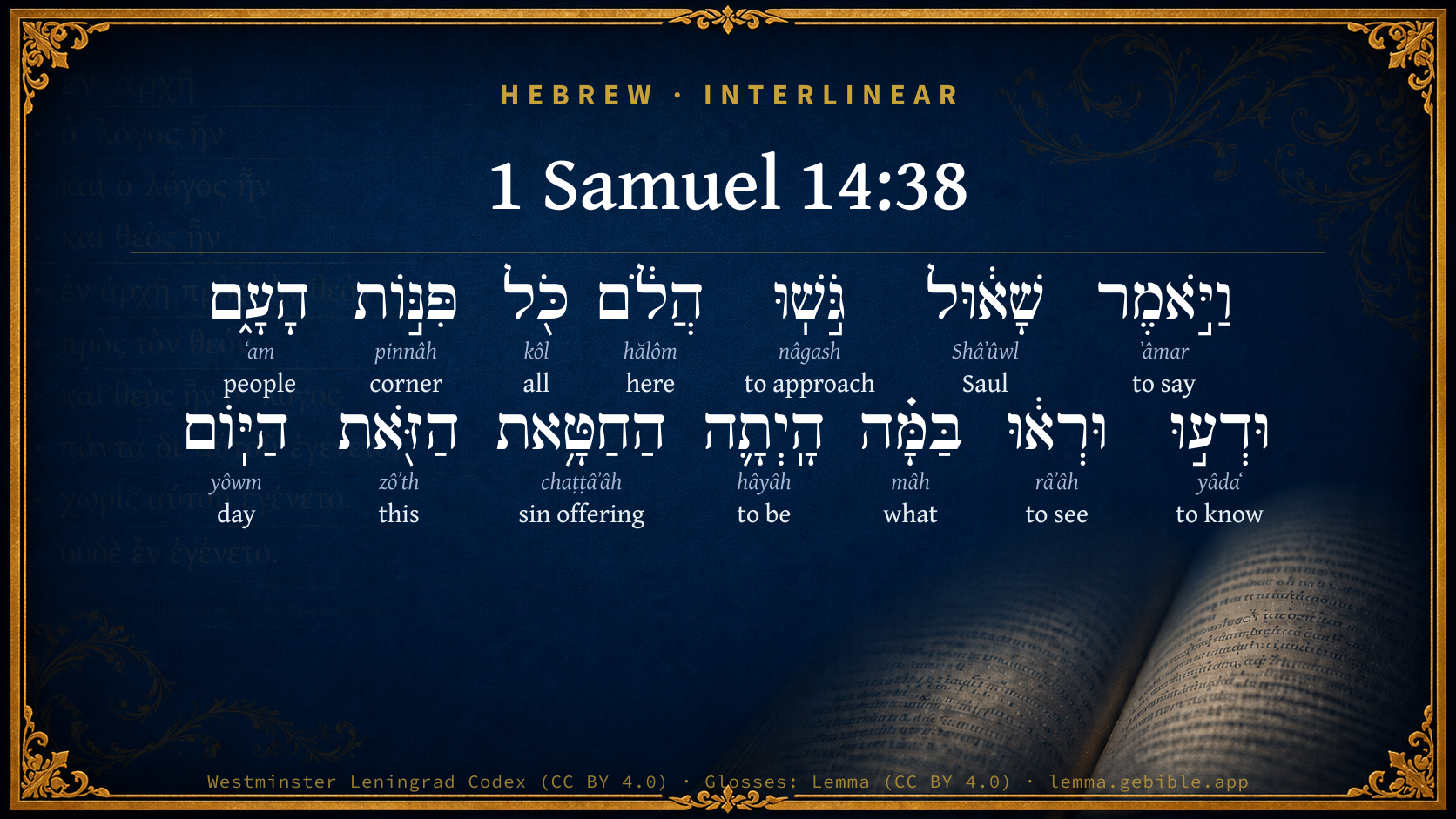
1 Samuel 14:38

Hebrew (Westminster Leningrad Codex) 1 Samuel 14:38 appears in the Hebrew Old Testament. The text above is from the Westminster Leningrad Codex. Each word links to its Strong’s number, a concise gloss, and parsing drawn from the Open Scriptures Hebrew Bible morphology. Click any word for its full Brown-Driver-Briggs (BDB) entry.
Download image
Cite this verse

1 Samuel 14:38 (World English Bible). Public Domain. Lemma interlinear Bible study tool, https://lemma.gebible.app/v/1-samuel/14/38.

Show BibTeX & RIS
BibTeX
RIS
English Translation
Saul said, Draw near here, all you chiefs of the people; and know and see in which this sin has been this day.
World English Bible · Public Domain
Download a study sheet

One document with this verse’s original text, its word-by-word gloss line, the meaning frame, cross-references with their text, attributed commentary, and full source and license credits — printable, and it pastes into notes with its structure intact.

This verse Autodidact and up

Study sheet (.html) Plain text (.txt)

A passage Seminary Student

Up to 50 verses in one chapter. A passage sheet keeps up to 6 commentary sources and 12 cross-references per verse, in the order this page ranks them, and says so on the sheet whenever that leaves anything out. Ask for a single verse and you get the Autodidact verse sheet above.

Everything on this page stays free to read, with no account — the sheet is a download of what is already on screen, not access to it.

Want to remove ads? Support Godless Engineer
Compare translations 3

The same verse in 3 English versions, stacked beneath the original-language interlinear above. Click any original word for its lexicon entry.

Each is an independent rendering of the whole verse — the interlinear is not word-aligned to these translations.

Highlighted words mark where these versions differ — a whole-verse word diff, not a word-by-word alignment.

  • World English Bible Public Domain
    Saul said, Draw near here, all you chiefs of the people; and know and see in which this sin has been this day.
  • King James Version Public Domain
    And Saul said, Draw ye near hither, all the chief of the people: and know and see wherein this sin hath been this day.
  • unfoldingWord Literal Text CC BY-SA 4.0
    Then Saul said, “Come near here, all of the cornerstones of the people! And know and see by what this sin has happened today.

unfoldingWord Literal Text — © unfoldingWord, licensed CC BY-SA 4.0. Word-aligned USFM3 via Door43 (git.door43.org/unfoldingWord/en_ult).

Versions to compare (up to 4)

3 of 4 selected

Show all 18 translations

Every available English version of this verse, each an independent rendering of the whole verse.

  • World English Bible Public Domain
    Saul said, Draw near here, all you chiefs of the people; and know and see in which this sin has been this day.
  • Berean Standard Bible Public Domain
    Therefore Saul said, “Come here, all you leaders of the troops, and let us investigate how this sin has occurred today.
  • Majority Standard Bible Public Domain
    Therefore Saul said, “Come here, all you leaders of the troops, and let us investigate how this sin has occurred today.
  • King James Version Public Domain
    And Saul said, Draw ye near hither, all the chief of the people: and know and see wherein this sin hath been this day.
  • American Standard Version (1901) Public Domain
    And Saul said, Draw nigh hither, all ye chiefs of the people; and know and see wherein this sin hath been this day.
  • Revised Version (1885) Public Domain
    And Saul said, Draw nigh hither, all ye chiefs of the people: and know and see wherein this sin hath been this day.
  • Geneva Bible (1599) Public Domain
    And Saul said, All ye chiefe of the people, come ye hither, and knowe, and see by whom this sinne is done this day.
  • Douay-Rheims (1899) Public Domain
    And Saul said: Bring hither all the corners of the people: and know, and see by whom this sin hath happened to day.
  • Young's Literal Translation Public Domain
    And Saul saith, `Draw ye nigh hither all, the chiefs of the people, and know and see in what this sin hath been to-day;
  • Literal Standard Version CC BY-SA 4.0
    And Saul says, “Everyone draw near here, the chiefs of the people, and know and see in what this sin has been today;
  • Unlocked Literal Bible CC BY-SA 4.0
    Then Saul said, “Come here, all you leaders of the people; learn and see how this sin has happened today.
  • unfoldingWord Literal Text CC BY-SA 4.0
    Then Saul said, “Come near here, all of the cornerstones of the people! And know and see by what this sin has happened today.
  • Darby Bible Public Domain
    And Saul said, Draw ye near hither, all the heads of the people; and know and see wherein this sin has been this day.
  • World Messianic Bible Public Domain
    Saul said, “Draw near here, all you chiefs of the people, and know and see in whom this sin has been today.
  • Webster's Bible Public Domain
    And Saul said, Draw ye near hither all the chief of the people: and know and see wherein this sin hath been this day.
  • Free Bible Version CC BY-SA 4.0
    So Saul gave the order, “All you army commanders, come here so we can investigate what sin has happened today.
  • Bible in Basic English Public Domain
    And Saul said, Come near, all you chiefs of the people, and let us get word from God and see in whom is this sin today.
  • JPS Tanakh (1917) Public Domain
    And Saul said: 'Draw nigh hither, all ye chiefs of the people; and know and see wherein this sin hath been this day.

Literal Standard Version (2020), Covenant Press — licensed CC BY-SA 4.0. Text via the HelloAO Bible API (eBible.org). Unlocked Literal Bible (unfoldingWord) — licensed CC BY-SA 4.0. Text via the HelloAO Bible API (eBible.org). unfoldingWord Literal Text — © unfoldingWord, licensed CC BY-SA 4.0. Word-aligned USFM3 via Door43 (git.door43.org/unfoldingWord/en_ult). Free Bible Version, Dr. Jonathan Gallagher — licensed CC BY-SA 4.0. Text via the HelloAO Bible API (eBible.org).

Word by word

More ways to search: Search by grammar → Find every occurrence → Compare this word →

Practice this passage: Drill this verse → Learn its vocabulary →

הֲלֹ֔ם
hălôm
H1988
“here”
Adverb
Part of Speech
Adverb
Full BDB Definition

Origin: from the article [see H1973 ]

TWOT: 503

here, hither
  1. וַיֹּ֣אמֶר ʼâmar H559 “and · to say” Conjunction + Verb, Qal, Sequential Imperfect, 3rd Person, Masculine, Singular
  2. שָׁא֔וּל Shâʼûwl H7586 “Saul” Noun, Proper
  3. גֹּ֣שֽׁוּ nâgash H5066 “approach” Verb, Qal, Imperative, 2nd Person, Masculine, Plural
  4. כֹּ֖ל kôl H3605 “all of” Noun, Common, Masculine, Singular, Construct
  5. פִּנּ֣וֹת pinnâh H6438 “corners of” Noun, Common, Feminine, Plural, Construct
  6. הָעָ֑ם ʻam H5971 “the · people” Particle, Definite Article + Noun, Common, Masculine, Singular, Absolute
  7. וּדְע֣וּ yâdaʻ H3045 “and · know” Conjunction + Verb, Qal, Imperative, 2nd Person, Masculine, Plural
  8. וּרְא֔וּ râʼâh H7200 “and · see” Conjunction + Verb, Qal, Imperative, 2nd Person, Masculine, Plural
  9. בַּמָּ֗ה mâh H4100 “in/at · what” Preposition + Particle, Interrogative
  10. הָֽיְתָ֛ה hâyâh H1961 “to be” Verb, Qal, Perfect, 3rd Person, Feminine, Singular
  11. הַחַטָּ֥את chaṭṭâʼâh H2403 “the · sin offering” Particle, Definite Article + Noun, Common, Feminine, Singular, Absolute
  12. הַזֹּ֖את zôʼth H2063 “the · this” Particle, Definite Article + Pronoun, Demonstrative, Feminine, Singular
  13. הַיּֽוֹם yôwm H3117 “the · day” Particle, Definite Article + Noun, Common, Masculine, Singular, Absolute

About this verse

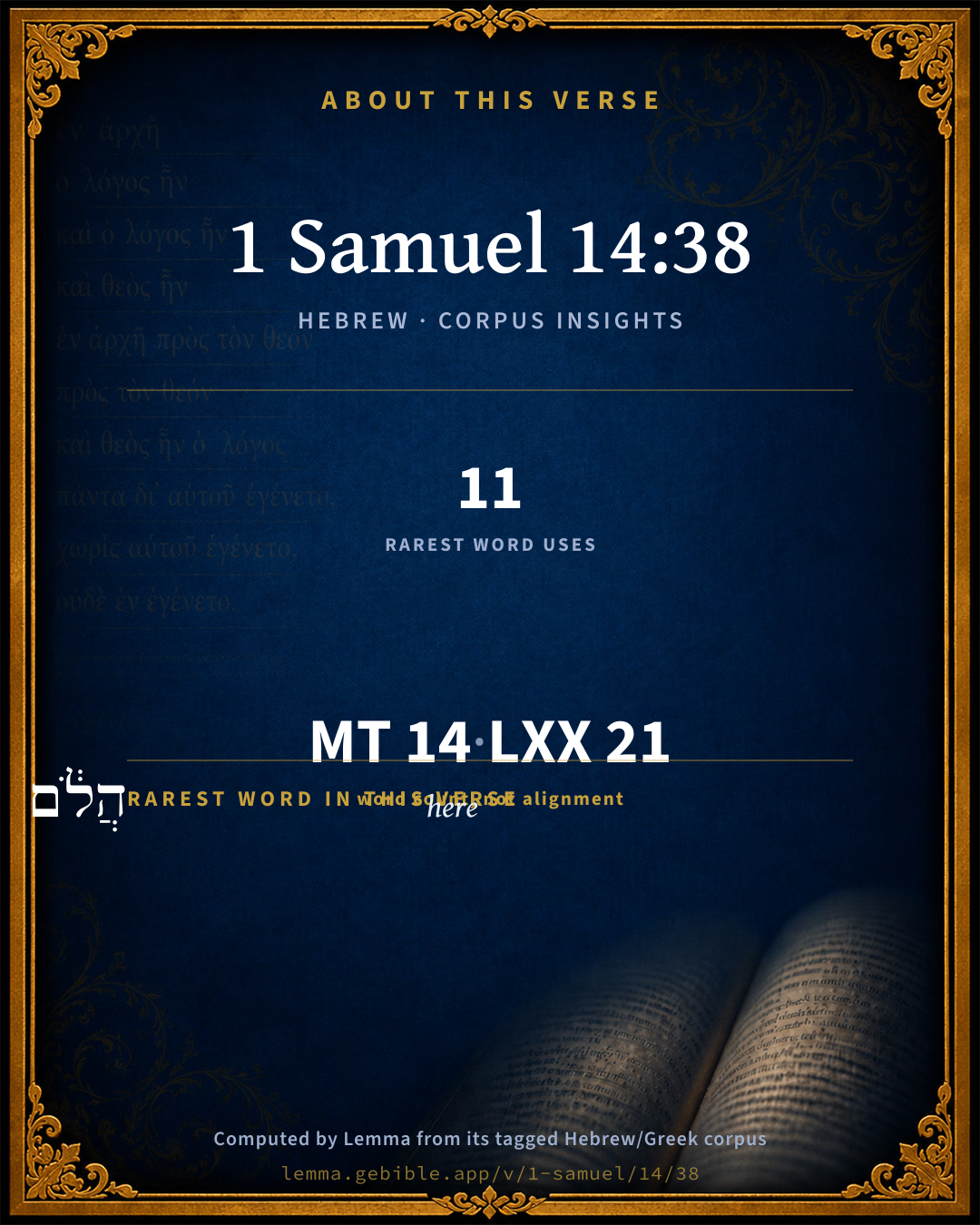
These counts appear in no published source. They are computed here, from the morphology-tagged text and Lemma’s own curated glosses. What Lemma adds →

14
words
14
distinct lemmas
Historical
section

Notable vocabulary

The rarest word here is הֲלֹ֔ם here H1988 — appearing just 11 times in the whole Hebrew Bible.

Shared distinctive vocabulary

הֲלֹ֔ם here H1988 occurs in 11 verses of the Hebrew Bible. Also found in:

Grammatical profile

  • 5 verbs
  • 6 nouns
  • 1 pronoun
  • 1 adverb
  • 1 particle

Verb forms

  • וַיֹּ֣אמֶר Qal · Sequential Imperfect
  • גֹּ֣שֽׁוּ Qal · Imperative
  • וּדְע֣וּ Qal · Imperative
  • וּרְא֔וּ Qal · Imperative
  • הָֽיְתָ֛ה Qal · Perfect

Hebrew & Septuagint length

In English translation the verse runs 23 words from the Hebrew and 23 from the Septuagint (LXX English) — the same length.

A rough comparison of the two English renderings, which tokenize alike — not a word-level alignment.

Word counts can differ between the Hebrew and the Greek without any difference in meaning — e.g. the Hebrew direct-object marker אֵת has no separate Greek word, and Greek often adds the article ὁ.

In the original languages it is 14 Hebrew tokens and 21 Greek tokens — but the two are counted differently (Hebrew bundles its prefixes and suffixes into one token; the Greek is in lemma form), so that isn’t a like-for-like length.

Cross-references

10

Topical passages linked to 1 Samuel 14:38 in the Treasury of Scripture Knowledge — connected by theme and wording, ordered by reader-vote popularity; previews shown in the World English Bible.

  • Numbers 24:17 I see him, but not now; I see him, but not near: There shall come forth a star out of Jacob, A scepter shall rise out of Israel, Shall strike through the corners of Moab, Break down all the sons of tumult.
  • Joshua 7:11 Israel has sinned; yes, they have even transgressed my covenant which I commanded them: yes, they have even taken of the devoted thing, and have also stolen, and dissembled also; and they have even put it among their own stuff.
  • Joshua 7:14–26 In the morning therefore you shall be brought near by your tribes: and it shall be, that the tribe which Yahweh takes shall come near by families; and the family which Yahweh shall take shall come near by households; and the household which Yahweh shall take shall come near man by man.
  • Judges 20:2 The chiefs of all the people, even of all the tribes of Israel, presented themselves in the assembly of the people of God, four hundred thousand footmen who drew sword.
  • 1 Samuel 10:19–20 but you have this day rejected your God, who himself saves you out of all your calamities and your distresses; and you have said to him, [No], but set a king over us. Now therefore present yourselves before Yahweh by your tribes, and by your thousands.
  • 2 Samuel 18:3 But the people said, You shall not go forth: for if we flee away, they will not care for us; neither if half of us die, will they care for us: but you are worth ten thousand of us; therefore now it is better that you are ready to help us out of the city.
  • Psalms 47:9 The princes of the peoples are gathered together, The people of the God of Abraham. For the shields of the earth belong to God. He is greatly exalted!
  • Zechariah 10:4 From him will come forth the corner-stone, From him the nail, From him the battle bow, From him every ruler together.
  • Matthew 21:42 Jesus said to them, "Did you never read in the Scriptures, 'The stone which the builders rejected, The same was made the head of the corner. This was from the Lord. It is marvelous in our eyes?'
  • Ephesians 2:20 being built on the foundation of the apostles and prophets, Christ Jesus himself being the chief cornerstone;

Cross-references courtesy of OpenBible.info (CC BY 4.0).

Hebrew and Greek witnesses Masoretic Hebrew ↔ Greek Septuagint

The same verse in the two great witnesses to the Old Testament, shown verse-for-verse.

These are two independent witnesses, not word-aligned to each other, and the Septuagint is shown in lemma (dictionary) form.

Hebrew 1 Samuel 14:38 Masoretic · Westminster Leningrad Codex

וַיֹּ֣אמֶר שָׁא֔וּל גֹּ֣שֽׁוּ הֲלֹ֔ם כֹּ֖ל פִּנּ֣וֹת הָעָ֑ם וּדְע֣וּ וּרְא֔וּ בַּמָּ֗ה הָֽיְתָ֛ה הַחַטָּ֥את הַזֹּ֖את הַיּֽוֹם

Saul said, Draw near here, all you chiefs of the people; and know and see in which this sin has been this day.

World English Bible · Public Domain

Greek LXX 1 Samuel 14:38 Septuagint · lemma form

καί εἶπον σαούλ προςἄγω ἐνταῦθα πᾶς ὁ γωνία ὁ ἰσραήλ καί γιγνώσκω καί ὁράω ἐν τίς γίγνομαι ὁ ἁμαρτία οὗτος σήμερον

And Saul said, Bring hither all the chiefs of Israel, and know and see by whom this sin has been committed this day.

LXX2012 (modern English Septuagint) · Public Domain

Hebrew: Westminster Leningrad Codex (CC BY 4.0). Greek: Septuagint (public domain); English from LXX2012 (modern English Septuagint) (Public Domain). How the Septuagint differs from the Hebrew →

Targum (Aramaic paraphrase)

1

The Targum is the ancient Jewish Aramaic paraphrase of the Hebrew Scriptures — an interpretive translation, not the Hebrew text itself. Onkelos (literal) and Pseudo-Jonathan (expansive) render the Torah, and Jonathan the Prophets. Coverage is partial: where no permissively-licensed English translation exists for a verse, only the Aramaic is shown. This is verse-level text, not a word-by-word alignment to the Hebrew.

  1. Targum Jonathan Prophets (Joshua–Malachi)
    וַאֲמַר שָׁאוּל אִתְקְרִיבוּ הַלְכָא כָּל רֵישֵׁי עַמָא וּדְעוֹ וַחֲזוֹ בְּמָן הֲוַת חוֹבָא הָדֵין יוֹמָא דֵין:

    (no public-domain English translation for this verse)

    Targum Jonathan — Aramaic: “Mikraot Gedolot” (public domain). English: “Sefaria Community Translation” (CC0 1.0 (public-domain dedication)); “London "Chaldee Paraphrase," 1871” (public domain). Text via Sefaria.

Commentary

Notes on 1 Samuel 14:38 from classic Christian and Jewish commentators (each source and its license shown beneath its notes). The classic Christian expositions comment on the surrounding passage and are grouped to its opening verse, so a note may address several verses; the Jewish commentaries on the Tanakh (Rashi and others) are per-verse, so they appear only where the commentator wrote on this verse.

Lemma curates 59 commentaries, every one of them public domain or Creative Commons licensed, each selected and text-cleaned for this edition rather than reprinted as found. About our sources →

Trapp's Complete Commentary

John Trapp

1Sa 14:38 And Saul said, Draw ye near hither, all the chief of the people: and know and see wherein this sin hath been this day.

Ver. 38. Draw ye near hither, all the chief of the people.] Heb., The corners: for what the cornerstones are to the building, that the princes are to the people. See Jdg 20:2. The Switzers at this day call their chief towns Cantons, that is, corners; and the Greeks of old called their town governors Pagites; the Hebrews, Corners.

And know and see wherein this sin hath been this day.] He knew it was for some sin that God was so silent, - "we know that God heareth not sinners," said that blind man in Joh 9:31, - and he doubted not but that it was the breach of that oath imposed by himself, but rashly and without reason; which yet he never regretteth.

John Trapp, A Commentary or Exposition upon All the Books of the Old and New Testament (1647–1656) — public domain. Text from a community e-Sword module.

Geneva Bible (1599)

Geneva Bible translators

Hebrew, corners.

Geneva Bible (1599) marginal notes — public domain. Text via Bolls.life.

Ellicott's Commentary for English Readers

(38) Draw ye near hither.—Round that rough unfinished altar, in the dark night, King Saul hastily summoned his leading officers and the prominent chiefs of the Israelites who had joined him in the late battle. The word rendered “chief of the people” (pinnoth) is literally, corner stones (as in Jdg_20:2).

He would ask God’s help in the casting of lots, to discover who of these was the transgressor, whose sin made dumb the Divine Oracle.

A Bible Commentary for English Readers, edited by Charles John Ellicott (1878–1897) — public domain. Text from a community e-Sword module.

The Cambridge Bible for Schools and Colleges

gen. ed. J. J. S. Perowne

38. the chief of the people] Lit. “the corner-stones of the people,” as in Jdg_20:2, probably the elders or heads of houses.

wherein this sin hath been] Saul assumes that some undiscovered sin must have caused God to refuse an answer, as Achan’s trespass led Him to withdraw His Presence and abandon Israel to defeat (Jos_7:11-12). At a later time Saul’s own sin made God desert Him in the same way (ch. 1Sa_28:6; 1Sa_28:15). Jonathan’s transgression of the oath, although unintentional, was an offence against the Majesty of the Divine Name which could not be left unnoticed.

The Cambridge Bible for Schools and Colleges (gen. ed. J. J. S. Perowne; Cambridge University Press, 1878–1918) — public domain. Text from a community e-Sword module.

John Gill's Exposition

And Saul said, draw ye near hither all the chief of the people,.... Or, the corners of the peoples (g); the princes, as Jarchi interprets it: and so the Targum, the heads of the people, in allusion to the cornerstones in buildings, which are the ornament, strength, and cement of them, see Zac 10:4, though Abarbinel thinks the tribes themselves are meant, which lay encamped everyone in a corner by themselves, separated from one another; and these he would have brought together; not the heads only, but everyone, small and great, that it might be seen and known where the sin lay; but he should have observed, that the tribes of Israel were not now present with Saul, but a small number of them:

and know and see wherein this sin hath been this day; he concluded, from having no answer from the Lord, that sin had been committed, which was the cause of it; but never thought of his own rash oath, which was the cause of the people's sinning, and had brought his son into danger; nor the sin of the people in eating the flesh with the blood; nothing ran in his mind but the breach of the oath with which he had adjured the people, and this he was determined to find out, if possible.

(g) "anguli populi", Pagninus, Montanus, &c.

John Gill's Exposition of the Whole Bible (1746–1763) — public domain (CC PDM 1.0). Text via the HelloAO Bible API.

Haydock's Catholic Bible Commentary

Corners, to the very last; or all the princes, Judges xviii. 9.

George Leo Haydock (1774–1849), Haydock's Catholic Family Bible and Commentary, 1859 edition — public domain. Excludes Psalms (Douay-Rheims chapter numbering differs from Protestant) and Deuterocanonical books (Catholic canon only).

Matthew Poole's English Annotations

All the chief of the people; in the name of all the people, that you may be witnesses, and may see where the fault lies.

Matthew Poole's English Annotations on the Holy Bible (1683–1685) — public domain. Text from a community e-Sword/MySword module.

Whedon's Commentary on the Bible

Daniel D. Whedon

38. Draw ye near hither — For the purpose of casting lots.

Chief of the people — פנות, corners, applied to princes and chief men as corner-stones or pillars of the state. Saul supposed that the blame must lie on some prominent man of his army, and he vowed his death, even should it be Jonathan.

Daniel D. Whedon (gen. ed.), Commentary on the Old and New Testaments (1874–1909) — public domain. Text from a community e-Sword module.

unfoldingWord translationNotes

Door43 World Missions Community

the people

This refers to the Israelites.

learn and see how this sin has happened

"find who sinned"

even if it is in Jonathan my son, he will surely die

Saul stated this as a hypothetical situation because he did not believe that Jonathan was guilty. (See: Hypothetical Situations)

But none of the men among all the people answered him

The people remained silent because most of them knew that Jonathan had broken Saul's oath. This can be stated explicitly. AT: "His men knew who was guilty, but none of them said anything to Saul" (See: Assumed Knowledge and Implicit Information)

translationWords

Yahweh

save

Jonathan

die

unfoldingWord translationNotes — © Distant Shores Media and the Door43 World Missions Community, licensed CC BY-SA 4.0. Source: git.door43.org/Door43/en_tn.

Rashi

Rabbi Shlomo Yitzchaki (Rashi)

Leaders of the people. The chiefs of the people; the cornerstone אֶבֶן הַפִּנָּה is the most esteemed.

Rashi on the Tanakh — English translations: “The Judaica Press complete Tanach with Rashi, translated by A. J. Rosenberg” (CC BY 4.0); “Pentateuch with Rashi's commentary by M. Rosenbaum and A.M. Silbermann, 1929-1934” (public domain); “The Metsudah Tanach series, Lakewood, N.J” (CC BY 4.0); and “The Book of Joshua, Metsudah Publications, 1997” (CC BY 4.0). Text via Sefaria.

Lesson kit

Teaching starters — assembled from the data on this page, not authored interpretation. Every prompt links to the verse data it draws on. Edit before teaching.

1 Samuel, in the Historical, opens this verse with 14 words (14 distinct Hebrew lemmas). Its most distinctive word is hălôm (“here”). A historical commentator’s framing appears above. Read the whole chapter for the surrounding context.

Discussion questions

  1. What does “here” (hălôm) contribute to the verse as a whole?
  2. Genesis 16:13 shares the word «here» with this verse. How do the two illuminate each other?
  3. These translations render this verse differently. What is at stake in choosing one wording over another?
  4. The verb «וַיֹּ֣אמֶר» is Qal Sequential Imperfect. How does its form color the action?
  5. Reading how Trapp's Complete Commentary and Geneva Bible (1599) read this verse, where do the two commentators agree and where do they part?

Things to notice

Reading settings

Reading text

Shown beneath each verse's original-language words.

Old Testament
Old Testament edition

Read the OT as the Masoretic Hebrew (MT) or the Greek Septuagint (LXX).

English shown for the Greek Septuagint (in the Hebrew ↔ Greek comparison).

Comparing translations? Open the Compare panel on any verse page to stack up to four side by side.