1 Samuel 16:3

Hebrew (Westminster Leningrad Codex) 1 Samuel 16:3 appears in the Hebrew Old Testament. The text above is from the Westminster Leningrad Codex. Each word links to its Strong’s number, a concise gloss, and parsing drawn from the Open Scriptures Hebrew Bible morphology. Click any word for its full Brown-Driver-Briggs (BDB) entry.
Download image
Cite this verse

1 Samuel 16:3 (World English Bible). Public Domain. Lemma interlinear Bible study tool, https://lemma.gebible.app/v/1-samuel/16/3.

Show BibTeX & RIS
BibTeX
RIS
English Translation
Call Jesse to the sacrifice, and I will show you what you shall do: and you shall anoint to me him whom I name to you.
World English Bible · Public Domain
Download a study sheet

One document with this verse’s original text, its word-by-word gloss line, the meaning frame, cross-references with their text, attributed commentary, and full source and license credits — printable, and it pastes into notes with its structure intact.

This verse Autodidact and up

Study sheet (.html) Plain text (.txt)

A passage Seminary Student

Up to 50 verses in one chapter. A passage sheet keeps up to 6 commentary sources and 12 cross-references per verse, in the order this page ranks them, and says so on the sheet whenever that leaves anything out. Ask for a single verse and you get the Autodidact verse sheet above.

Everything on this page stays free to read, with no account — the sheet is a download of what is already on screen, not access to it.

Want to remove ads? Support Godless Engineer
Compare translations 3

The same verse in 3 English versions, stacked beneath the original-language interlinear above. Click any original word for its lexicon entry.

Each is an independent rendering of the whole verse — the interlinear is not word-aligned to these translations.

Highlighted words mark where these versions differ — a whole-verse word diff, not a word-by-word alignment.

  • World English Bible Public Domain
    Call Jesse to the sacrifice, and I will show you what you shall do: and you shall anoint to me him whom I name to you.
  • King James Version Public Domain
    And call Jesse to the sacrifice, and I will show thee what thou shalt do: and thou shalt anoint unto me him whom I name unto thee.
  • unfoldingWord Literal Text CC BY-SA 4.0
    And invite Jesse to the sacrifice, and I myself will make you know what you shall do. And you shall anoint for me whom I say to you.”

unfoldingWord Literal Text — © unfoldingWord, licensed CC BY-SA 4.0. Word-aligned USFM3 via Door43 (git.door43.org/unfoldingWord/en_ult).

Versions to compare (up to 4)

3 of 4 selected

Show all 18 translations

Every available English version of this verse, each an independent rendering of the whole verse.

  • World English Bible Public Domain
    Call Jesse to the sacrifice, and I will show you what you shall do: and you shall anoint to me him whom I name to you.
  • Berean Standard Bible Public Domain
    Then invite Jesse to the sacrifice, and I will show you what you are to do. You are to anoint for Me the one I indicate.”
  • Majority Standard Bible Public Domain
    Then invite Jesse to the sacrifice, and I will show you what you are to do. You are to anoint for Me the one I indicate.”
  • King James Version Public Domain
    And call Jesse to the sacrifice, and I will show thee what thou shalt do: and thou shalt anoint unto me him whom I name unto thee.
  • American Standard Version (1901) Public Domain
    And call Jesse to the sacrifice, and I will show thee what thou shalt do: and thou shalt anoint unto me him whom I name unto thee.
  • Revised Version (1885) Public Domain
    And call Jesse to the sacrifice, and I will shew thee what thou shalt do: and thou shalt anoint unto me him whom I name unto thee.
  • Geneva Bible (1599) Public Domain
    And call Ishai to the sacrifice, and I will shewe thee what thou shalt doe, and thou shalt anoynt vnto me him whom I name vnto thee.
  • Douay-Rheims (1899) Public Domain
    And thou shalt call Isai to the sacrifice, and I will shew thee what thou art to do, and thou shalt anoint him whom I shall shew to thee.
  • Young's Literal Translation Public Domain
    and thou hast called for Jesse in the sacrifice, and I cause thee to know that which thou dost do, and thou hast anointed to Me him of whom I speak unto thee.'
  • Literal Standard Version CC BY-SA 4.0
    and you have called for Jesse in the sacrifice, and I cause you to know that which you do, and you have anointed for Me him of whom I speak to you.”
  • Unlocked Literal Bible CC BY-SA 4.0
    Call Jesse to the sacrifice, and I will show you what you will do. You will anoint for me the one whom I tell you.”
  • unfoldingWord Literal Text CC BY-SA 4.0
    And invite Jesse to the sacrifice, and I myself will make you know what you shall do. And you shall anoint for me whom I say to you.”
  • Darby Bible Public Domain
    And call Jesse to the sacrifice, and I will tell thee what thou shalt do; and thou shalt anoint unto me him whom I name unto thee.
  • World Messianic Bible Public Domain
    Call Jesse to the sacrifice, and I will show you what you shall do. You shall anoint to me him whom I name to you.”
  • Webster's Bible Public Domain
    And call Jesse to the sacrifice, and I will show thee what thou shalt do: and thou shalt anoint to me him whom I name to thee.
  • Free Bible Version CC BY-SA 4.0
    Invite Jesse to the sacrifice, and I will show you what you have to do. Anoint for me the one I tell you to.”
  • Bible in Basic English Public Domain
    And send for Jesse to be present at the offering, and I will make clear to you what you are to do: and you are to put the holy oil on him whose name I give you.
  • JPS Tanakh (1917) Public Domain
    And call Jesse to the sacrifice, and I will tell thee what thou shalt do; and thou shalt anoint unto Me him whom I name unto thee.'

Literal Standard Version (2020), Covenant Press — licensed CC BY-SA 4.0. Text via the HelloAO Bible API (eBible.org). Unlocked Literal Bible (unfoldingWord) — licensed CC BY-SA 4.0. Text via the HelloAO Bible API (eBible.org). unfoldingWord Literal Text — © unfoldingWord, licensed CC BY-SA 4.0. Word-aligned USFM3 via Door43 (git.door43.org/unfoldingWord/en_ult). Free Bible Version, Dr. Jonathan Gallagher — licensed CC BY-SA 4.0. Text via the HelloAO Bible API (eBible.org).

Word by word

More ways to search: Search by grammar → Find every occurrence → Compare this word →

Practice this passage: Drill this verse → Learn its vocabulary →

לְיִשַׁ֖י
Yishay
H3448
“to/for · Jesse”
Preposition + Noun, Proper
Part of Speech
Preposition + Noun
Type
Proper
Full BDB Definition

Origin: from the same as H3426

TWOT: 926

Jesse = "I possess" - son of Boaz and the father of king David
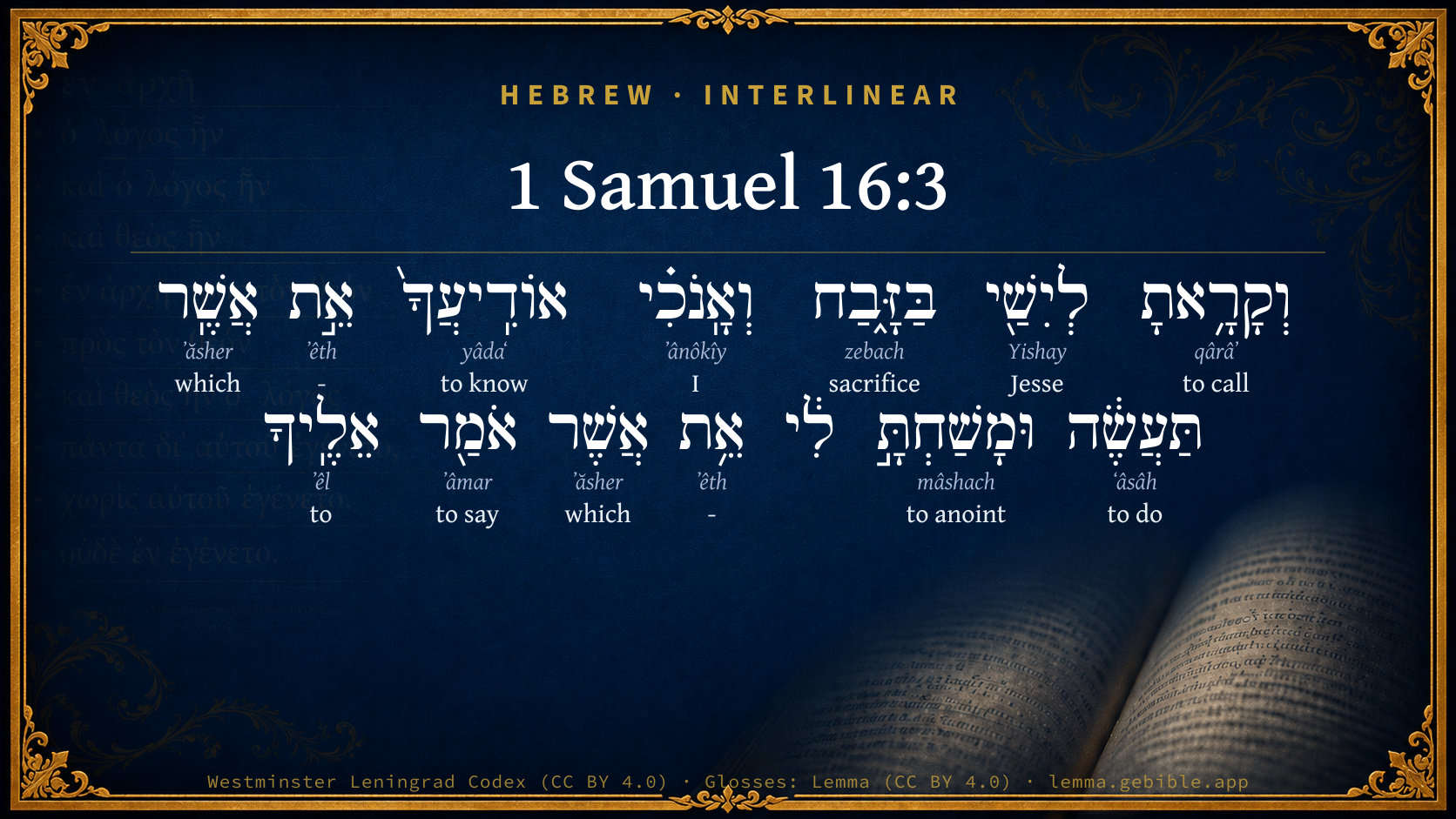
  1. וְקָרָ֥אתָ qârâʼ H7121 “and · to call” Conjunction + Verb, Qal, Sequential Perfect, 2nd Person, Masculine, Singular
  2. בַּזָּ֑בַח zebach H2077 “in/at the · sacrifice” Preposition, Determined + Noun, Common, Masculine, Singular, Absolute
  3. וְאָֽנֹכִ֗י ʼânôkîy H595 “and · I” Conjunction + Pronoun, Personal, 1st Person, Common, Singular
  4. אוֹדִֽיעֲךָ֙ yâdaʻ H3045 “to know · you” Verb, Hiphil, Imperfect, 1st Person, Common, Singular + Suffix, Personal, 2nd Person, Masculine, Plural
  5. אֵ֣ת ʼêth H853 “-” Particle, Direct Object
  6. אֲשֶֽׁר ʼăsher H834 “which” Particle, Relative
  7. תַּעֲשֶׂ֔ה ʻâsâh H6213 “to do” Verb, Qal, Imperfect, 2nd Person, Masculine, Singular
  8. וּמָשַׁחְתָּ֣ mâshach H4886 “and · to anoint” Conjunction + Verb, Qal, Sequential Perfect, 2nd Person, Masculine, Singular
  9. אֵ֥ת ʼêth H853 “-” Particle, Direct Object
  10. אֲשֶׁר ʼăsher H834 “which” Particle, Relative
  11. אֹמַ֖ר ʼâmar H559 “to say” Verb, Qal, Imperfect, 1st Person, Common, Singular
  12. אֵלֶֽיךָ ʼêl H413 “to · you” Preposition + Suffix, Personal, 2nd Person, Masculine, Singular

About this verse

These counts appear in no published source. They are computed here, from the morphology-tagged text and Lemma’s own curated glosses. What Lemma adds →

14
words
11
distinct lemmas
Historical
section

Shared distinctive vocabulary

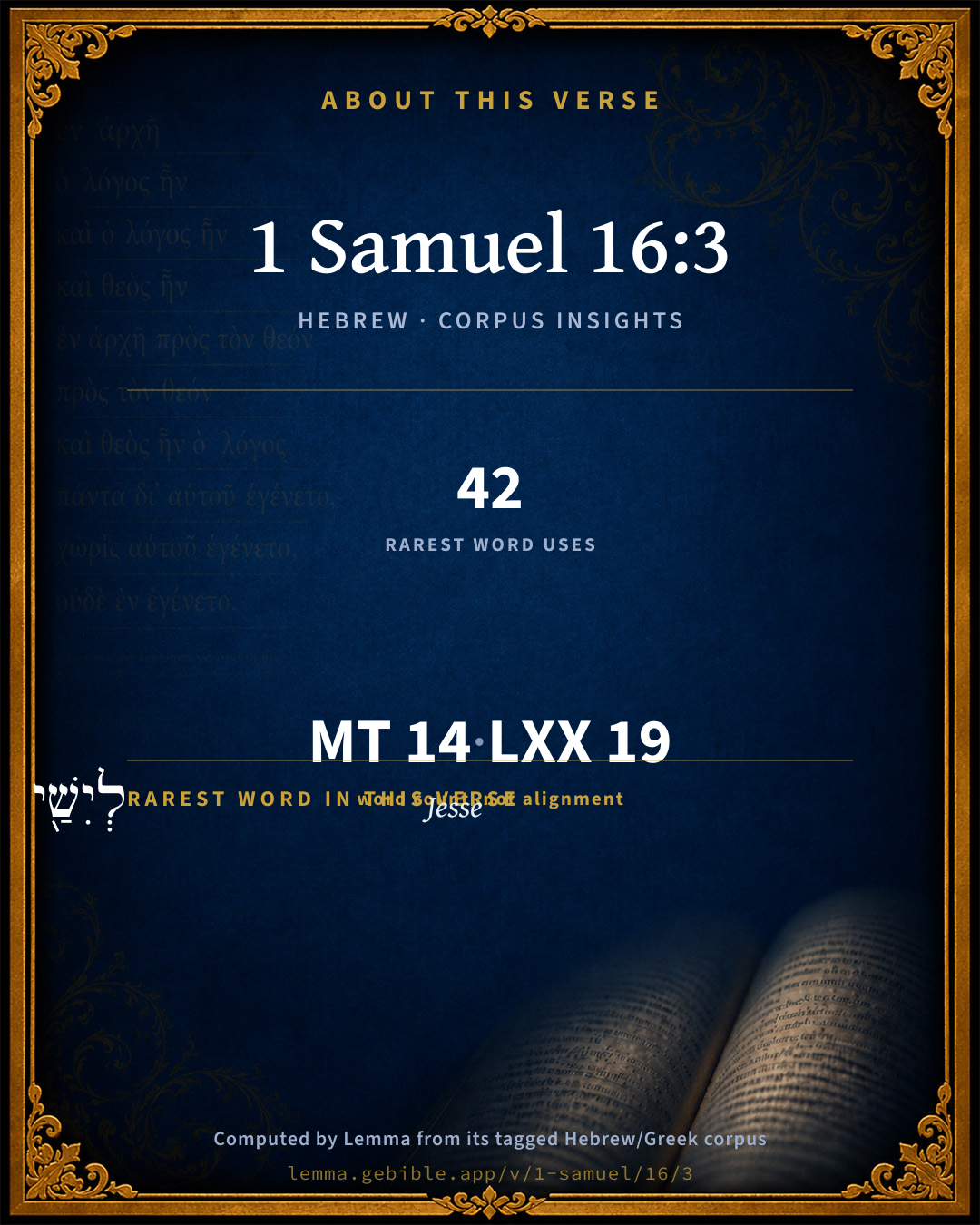
לְיִשַׁ֖י Jesse H3448 occurs in 39 verses of the Hebrew Bible. Also found in:

Grammatical profile

  • 5 verbs
  • 2 nouns
  • 1 pronoun
  • 2 prepositions
  • 4 particles

Verb forms

  • וְקָרָ֥אתָ Qal · Sequential Perfect
  • אוֹדִֽיעֲךָ֙ Hiphil · Imperfect
  • תַּעֲשֶׂ֔ה Qal · Imperfect
  • וּמָשַׁחְתָּ֣ Qal · Sequential Perfect
  • אֹמַ֖ר Qal · Imperfect

Repetition

A word recurs within this verse — often emphatic in Hebrew:

  • אֲשֶֽׁר which H834 ×2

Hebrew & Septuagint length

In English translation the verse runs 26 words from the Hebrew and 30 from the Septuagint (LXX English) — closely comparable.

A rough comparison of the two English renderings, which tokenize alike — not a word-level alignment.

Word counts can differ between the Hebrew and the Greek without any difference in meaning — e.g. the Hebrew direct-object marker אֵת has no separate Greek word, and Greek often adds the article ὁ.

In the original languages it is 14 Hebrew tokens and 19 Greek tokens — but the two are counted differently (Hebrew bundles its prefixes and suffixes into one token; the Greek is in lemma form), so that isn’t a like-for-like length.

Cross-references

8

Topical passages linked to 1 Samuel 16:3 in the Treasury of Scripture Knowledge — connected by theme and wording, ordered by reader-vote popularity; previews shown in the World English Bible.

  • 1 Samuel 9:16 Tomorrow about this time I will send you a man out of the land of Benjamin, and you shall anoint him to be prince over my people Israel; and he shall save my people out of the hand of the Philistines: for I have looked on my people, because their cry is come to me.
  • 1 Samuel 16:12–13 He sent, and brought him in. Now he was ruddy, and withal of a beautiful face, and goodly to look on. Yahweh said, Arise, anoint him; for this is he.
  • 2 Samuel 15:11 With Absalom went two hundred men out of Jerusalem, who were invited, and went in their simplicity; and they didn't know anything.
  • Acts 9:6 But rise up, and enter into the city, and you will be told what you must do."
  • Exodus 4:15 You shall speak to him, and put the words in his mouth. I will be with your mouth, and with his mouth, and will teach you what you shall do.
  • Deuteronomy 17:14–15 When you are come to the land which Yahweh your God gives you, and shall possess it, and shall dwell therein, and shall say, I will set a king over me, like all the nations that are round about me;
  • 1 Samuel 9:12–13 They answered them, and said, He is; behold, [he is] before you: make haste now, for he is come today into the city; for the people have a sacrifice today in the high place:
  • Matthew 22:1–4 Jesus answered and spoke again in parables to them, saying,

Cross-references courtesy of OpenBible.info (CC BY 4.0).

Hebrew and Greek witnesses Masoretic Hebrew ↔ Greek Septuagint

The same verse in the two great witnesses to the Old Testament, shown verse-for-verse.

These are two independent witnesses, not word-aligned to each other, and the Septuagint is shown in lemma (dictionary) form.

Hebrew 1 Samuel 16:3 Masoretic · Westminster Leningrad Codex

וְקָרָ֥אתָ לְיִשַׁ֖י בַּזָּ֑בַח וְאָֽנֹכִ֗י אוֹדִֽיעֲךָ֙ אֵ֣ת אֲשֶֽׁר תַּעֲשֶׂ֔ה וּמָשַׁחְתָּ֣ לִ֔י אֵ֥ת אֲשֶׁר אֹמַ֖ר אֵלֶֽיךָ

Call Jesse to the sacrifice, and I will show you what you shall do: and you shall anoint to me him whom I name to you.

World English Bible · Public Domain

Greek LXX 1 Samuel 16:3 Septuagint · lemma form

καί καλέω ὁ ιεσσαι εἰς ὁ θυσία καί γνωρίζω σύ ὅς ποιέω καί χρίω ὅς ἐάν εἶπον πρός σύ

And you shall call Jessae to the sacrifice, and I will make known to you what you shall do; and you shall anoint him whom I shall mention to you.

LXX2012 (modern English Septuagint) · Public Domain

Hebrew: Westminster Leningrad Codex (CC BY 4.0). Greek: Septuagint (public domain); English from LXX2012 (modern English Septuagint) (Public Domain). How the Septuagint differs from the Hebrew →

Targum (Aramaic paraphrase)

1

The Targum is the ancient Jewish Aramaic paraphrase of the Hebrew Scriptures — an interpretive translation, not the Hebrew text itself. Onkelos (literal) and Pseudo-Jonathan (expansive) render the Torah, and Jonathan the Prophets. Coverage is partial: where no permissively-licensed English translation exists for a verse, only the Aramaic is shown. This is verse-level text, not a word-by-word alignment to the Hebrew.

  1. Targum Jonathan Prophets (Joshua–Malachi)
    וְתַזְמִין לְיִשַׁי בְּשֵׁירוּתָא וַאֲנָא אַחֲזִינָךְ יַת דְתַעְבֵּד וְתִמְשַׁח קֳדָמַי יַת דְאֵימַר לָךְ:

    (no public-domain English translation for this verse)

    Targum Jonathan — Aramaic: “Mikraot Gedolot” (public domain). English: “Sefaria Community Translation” (CC0 1.0 (public-domain dedication)); “London "Chaldee Paraphrase," 1871” (public domain). Text via Sefaria.

Commentary

Notes on 1 Samuel 16:3 from classic Christian and Jewish commentators (each source and its license shown beneath its notes). The classic Christian expositions comment on the surrounding passage and are grouped to its opening verse, so a note may address several verses; the Jewish commentaries on the Tanakh (Rashi and others) are per-verse, so they appear only where the commentator wrote on this verse.

Lemma curates 59 commentaries, every one of them public domain or Creative Commons licensed, each selected and text-cleaned for this edition rather than reprinted as found. About our sources →

Trapp's Complete Commentary

John Trapp

1Sa 16:3 And call Jesse to the sacrifice, and I will shew thee what thou shalt do: and thou shalt anoint unto me [him] whom I name unto thee.

Ver. 3. And call Jesse to the sacrifice.] Who was grandchild to Ruth the Moabitess, {Rth 4:22} now grown a great lady in Bethlehem, great-grandmother to the king of Israel. So little is there lost by adhering to God and his people.

John Trapp, A Commentary or Exposition upon All the Books of the Old and New Testament (1647–1656) — public domain. Text from a community e-Sword module.

Joseph Benson's Commentary

1Sa 16:3-4. Call Jesse to the sacrifice — To the feast upon the sacrifice, to which they might invite their neighbours and friends. The elders trembled at his coming — Because it was strange and unexpected to them, this being but an obscure town, and remote from Samuel, and therefore they justly thought there was some extraordinary reason for it. They might fear lest he came to denounce some judgment against them, or to shun Saul’s displeasure, in which case it might have been dangerous for them to entertain him. Peaceably — The Hebrew phrase, Comest thou in peace? was as much as to say, (in our phrase,) Is all well?

Joseph Benson's Commentary on the Old and New Testaments (1811–1818) — public domain. Text from a community e-Sword module.

Jamieson, Fausset & Brown

Robert Jamieson, A. R. Fausset & David Brown

call Jesse to the sacrifice--that is, the social feast that followed the peace offering. Samuel, being the offerer, had a right to invite any guest he pleased.

Jamieson, Fausset & Brown — Commentary Critical and Explanatory on the Whole Bible (1871) — public domain (CC PDM 1.0). Text via the HelloAO Bible API.

Adam Clarke's Commentary

Verse 3. Call Jesse to the sacrifice] The common custom was, after the blood of the victim had been poured out to God, and the fat burnt, to feast on the flesh of the sacrifice. This appears to have been the case in all, except in the whole burnt-offering; this was entirely consumed.

Adam Clarke's Commentary on the Bible (1810–1826) — public domain. Text from a community e-Sword/MySword module.

Ellicott's Commentary for English Readers

(3) And thou shalt anoint.—From very early times the ceremony of anointing to important offices was customary among the Hebrews. In the first instance, all the priests were anointed (Exo_40:15; Num_3:3), but afterwards anointing seems to have been reserved especially for the high priest (Exo_29:29). Prophets also seem occasionally to have been anointed to their holy office. Anointing, however, was the principal ceremony in the inauguration of the Hebrew kings. It belonged in so especial a manner to the royal functions that the favourite designation for the king in Israel was “the Lord’s anointed.” In the case of David, the ceremony of anointing was performed three times—(1) on this occasion by Samuel, when the boy was set apart for the service of the Lord; (2) when appointed king over Judah at Hebron (2Sa_2:4); (3) when chosen as monarch over all Israel (2Sa_5:3). All these official personages, the priest, the prophet, and peculiarly the king, were types of the great expected Deliverer, ever known as the “Messiah,” “the Christ,” “the Anointed One.”

Wordsworth curiously considers these three successive unctions of David figurative of the successive unctions of Christ: conceived by the Holy Ghost in the Virgin’s womb; then anointed publicly at his baptism; and finally, set at God’s right hand as King of the Universal Church in the heavenly Jerusalem.

A Bible Commentary for English Readers, edited by Charles John Ellicott (1878–1897) — public domain. Text from a community e-Sword module.

John Gill's Exposition

And call Jesse to the sacrifice,.... His family, both him and his sons, to partake of the peace offerings; as every offerer had a right to invite his friends, and whomsoever he pleased, to eat of those parts of them which belonged to him, as a feast before the Lord:

and I will show thee what thou shall do; when Jesse and his family were with him:

and thou shalt anoint unto me him whom I name unto thee; that is, anoint him to be king over Israel, whom he should point out so plainly to him, as if he called him by name.

John Gill's Exposition of the Whole Bible (1746–1763) — public domain (CC PDM 1.0). Text via the HelloAO Bible API.

Haydock's Catholic Bible Commentary

Sacrifice, to partake of the feast, (Menochius) which must be consumed in two days, or thrown into the fire, Leviticus vii. 16. (Calmet)

George Leo Haydock (1774–1849), Haydock's Catholic Family Bible and Commentary, 1859 edition — public domain. Excludes Psalms (Douay-Rheims chapter numbering differs from Protestant) and Deuterocanonical books (Catholic canon only).

Matthew Poole's English Annotations

Call Jesse to the sacrifice, i.e. invite him to the feast, which, after the manner, was made of the flesh of the sacrifice; and it belonged to Samuel, as the offerer of the sacrifice, to invite whom he pleased.

Whom I name, i.e. whom I shall describe, as it were, by name.

Matthew Poole's English Annotations on the Holy Bible (1683–1685) — public domain. Text from a community e-Sword/MySword module.

The Pulpit Commentary

Vers. 3-5. Call Jesse to the sacrifice. The word used is zebach, and means a sacrifice followed by a feast, at which all the elders of the town, and with them Jesse and his elder sons, would be present by the prophet"s invitation. It is plain that such sacrifices were not unusual, or Saul would have demanded a reason for Samuel"s conduct. As the ark remained so long in obscurity at Kirjath-jearim, and the solemn services of the tabernacle were not restored until Saul at some period of his reign removed it to Nob, possibly Samuel may have instituted this practice of occasionally holding sacrifices, now at one place and now at another, to keep alive a sense of religion in the hearts of the people; and probably on such occasions he taught them the great truths of the law, thus combining in his person the offices of prophet and priest. Nevertheless, the elders of the town trembled at his coming. More literally, "went with trembling to meet him." Very probably such visitations often took place because some crime had been committed into which Samuel wished to inquire, or because the people had been negligent in some duty. And though conscious of no such fault, yet at the coming of one of such high rank their minds foreboded evil. He quiets, however, their fears and bids them sanctify themselves; i.e. they were to wash and purify themselves, and abstain from everything unclean, and put on their festal garments. (Exo_19:10; and comp. 1Sa_21:5) It is added, He sanctified Jesse and his sons, i.e. he took especial care that no legal impurity on their part should stand in the way of the execution of his errand.

The Pulpit Commentary (1880–1919), ed. H.D.M. Spence-Jones & Joseph S. Exell — public domain. Text from a community e-Sword module.

Lesson kit

Teaching starters — assembled from the data on this page, not authored interpretation. Every prompt links to the verse data it draws on. Edit before teaching.

1 Samuel, in the Historical, opens this verse with 14 words (11 distinct Hebrew lemmas). Its most distinctive word is Yishay (“Jesse”). A historical commentator’s framing appears above. Read the whole chapter for the surrounding context.

Discussion questions

  1. How does “Jesse” (Yishay) shape what this verse is saying?
  2. Ruth 4:17 shares the word «Jesse» with this verse. How do the two illuminate each other?
  3. “which” occurs 2× in this one verse. What is the effect of the repetition?
  4. These translations render this verse differently; the difference is in the English rendering, not the original. What questions does that raise?
  5. The verb «וְקָרָ֥אתָ» is Qal Sequential Perfect. How does its form color the action?
  6. Reading how Trapp's Complete Commentary and Joseph Benson's Commentary read this verse, where do the two commentators agree and where do they part?

Things to notice

Reading settings

Reading text

Shown beneath each verse's original-language words.

Old Testament
Old Testament edition

Read the OT as the Masoretic Hebrew (MT) or the Greek Septuagint (LXX).

English shown for the Greek Septuagint (in the Hebrew ↔ Greek comparison).

Comparing translations? Open the Compare panel on any verse page to stack up to four side by side.