
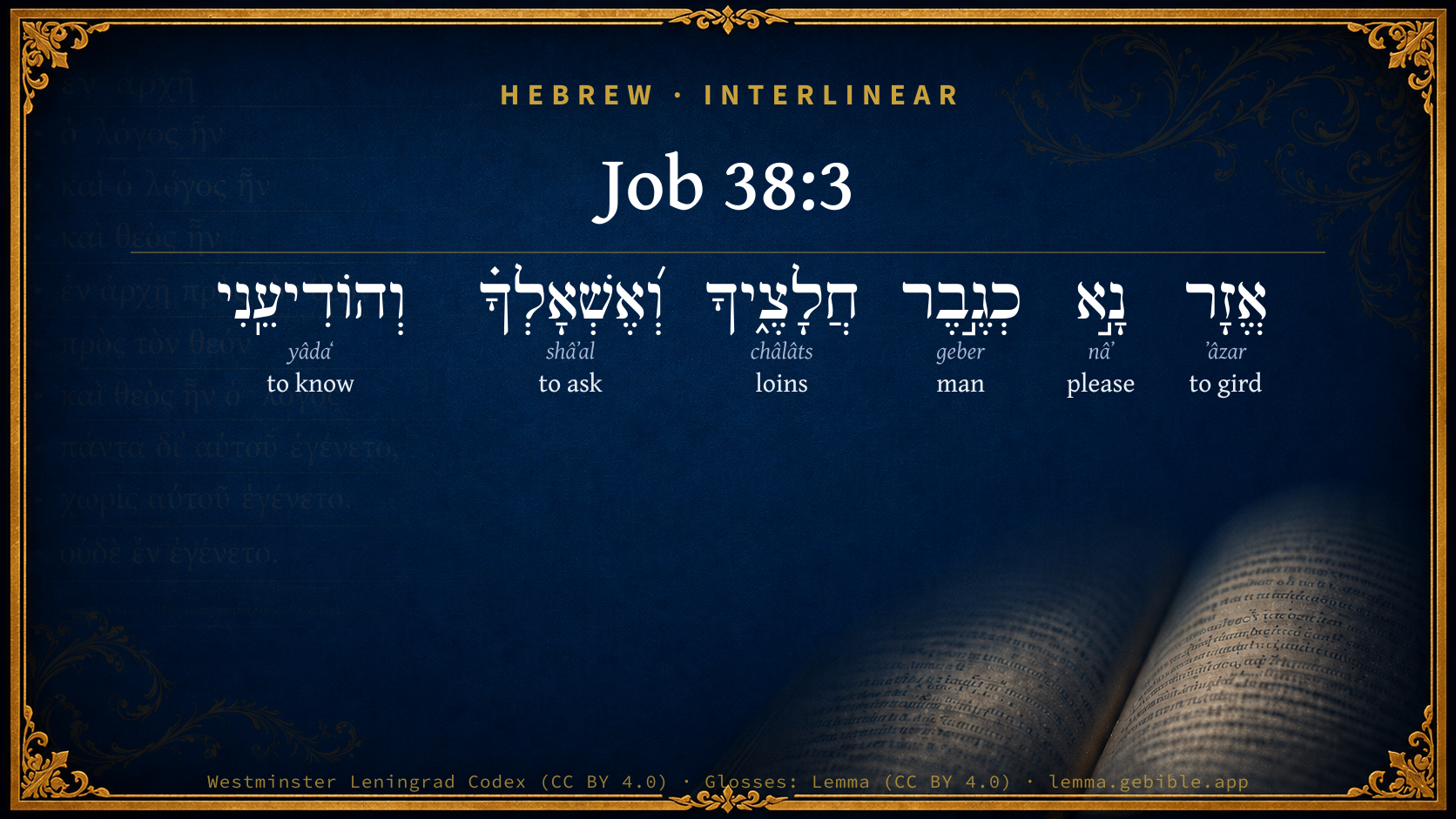
Job 38:3

Hebrew (Westminster Leningrad Codex) Job 38:3 appears in the Hebrew Old Testament. The text above is from the Westminster Leningrad Codex. Each word links to its Strong’s number, a concise gloss, and parsing drawn from the Open Scriptures Hebrew Bible morphology. Click any word for its full Brown-Driver-Briggs (BDB) entry.
Download image
Cite this verse

Job 38:3 (World English Bible). Public Domain. Lemma interlinear Bible study tool, https://lemma.gebible.app/v/job/38/3.

Show BibTeX & RIS
BibTeX
RIS
English Translation
Brace yourself like a man, For I will question you, then you answer me!
World English Bible · Public Domain
Download a study sheet

One document with this verse’s original text, its word-by-word gloss line, the meaning frame, cross-references with their text, attributed commentary, and full source and license credits — printable, and it pastes into notes with its structure intact.

This verse Autodidact and up

Study sheet (.html) Plain text (.txt)

A passage Seminary Student

Up to 50 verses in one chapter. A passage sheet keeps up to 6 commentary sources and 12 cross-references per verse, in the order this page ranks them, and says so on the sheet whenever that leaves anything out. Ask for a single verse and you get the Autodidact verse sheet above.

Everything on this page stays free to read, with no account — the sheet is a download of what is already on screen, not access to it.

Want to remove ads? Support Godless Engineer
Compare translations 3

The same verse in 3 English versions, stacked beneath the original-language interlinear above. Click any original word for its lexicon entry.

Each is an independent rendering of the whole verse — the interlinear is not word-aligned to these translations.

Highlighted words mark where these versions differ — a whole-verse word diff, not a word-by-word alignment.

  • World English Bible Public Domain
    Brace yourself like a man, For I will question you, then you answer me!
  • King James Version Public Domain
    Gird up now thy loins like a man; for I will demand of thee, and answer thou me.
  • unfoldingWord Literal Text CC BY-SA 4.0
    Now gird up your loins like a man, and I will question you and you will inform me.

unfoldingWord Literal Text — © unfoldingWord, licensed CC BY-SA 4.0. Word-aligned USFM3 via Door43 (git.door43.org/unfoldingWord/en_ult).

Versions to compare (up to 4)

3 of 4 selected

Show all 18 translations

Every available English version of this verse, each an independent rendering of the whole verse.

  • World English Bible Public Domain
    Brace yourself like a man, For I will question you, then you answer me!
  • Berean Standard Bible Public Domain
    Now brace yourself like a man; I will question you, and you shall inform Me.
  • Majority Standard Bible Public Domain
    Now brace yourself like a man; I will question you, and you shall inform Me.
  • King James Version Public Domain
    Gird up now thy loins like a man; for I will demand of thee, and answer thou me.
  • American Standard Version (1901) Public Domain
    Gird up now thy loins like a man; For I will demand of thee, and declare thou unto me.
  • Revised Version (1885) Public Domain
    Gird up now thy loins like a man; for I will demand of thee, and declare thou unto me.
  • Geneva Bible (1599) Public Domain
    Girde vp nowe thy loynes like a man: I will demande of thee and declare thou vnto me.
  • Douay-Rheims (1899) Public Domain
    Gird up thy loins like a man: I will ask thee, and answer thou me.
  • Young's Literal Translation Public Domain
    Gird, I pray thee, as a man, thy loins, And I ask thee, and cause thou Me to know.
  • Literal Standard Version CC BY-SA 4.0
    Now gird your loins as a man, || And I ask you, and you cause Me to know.
  • Unlocked Literal Bible CC BY-SA 4.0
    Now gird up your loins like a man for I will ask you questions, and you must answer me.
  • unfoldingWord Literal Text CC BY-SA 4.0
    Now gird up your loins like a man, and I will question you and you will inform me.
  • Darby Bible Public Domain
    Gird up now thy loins like a man; and I will demand of thee, and inform thou me.
  • World Messianic Bible Public Domain
    Brace yourself like a man, for I will question you, then you answer me!
  • Webster's Bible Public Domain
    Gird up now thy loins like a man; for I will demand of thee, and answer thou me.
  • Free Bible Version CC BY-SA 4.0
    Prepare yourself, be strong, for I am going to question you, and you must answer me.
  • Bible in Basic English Public Domain
    Get your strength together like a man of war; I will put questions to you, and you will give me the answers.
  • JPS Tanakh (1917) Public Domain
    Gird up now thy loins like a man; for I will demand of thee, and declare thou unto Me.

Literal Standard Version (2020), Covenant Press — licensed CC BY-SA 4.0. Text via the HelloAO Bible API (eBible.org). Unlocked Literal Bible (unfoldingWord) — licensed CC BY-SA 4.0. Text via the HelloAO Bible API (eBible.org). unfoldingWord Literal Text — © unfoldingWord, licensed CC BY-SA 4.0. Word-aligned USFM3 via Door43 (git.door43.org/unfoldingWord/en_ult). Free Bible Version, Dr. Jonathan Gallagher — licensed CC BY-SA 4.0. Text via the HelloAO Bible API (eBible.org).

Word by word

More ways to search: Search by grammar → Find every occurrence → Compare this word →

Practice this passage: Drill this verse → Learn its vocabulary →

About this verse

These counts appear in no published source. They are computed here, from the morphology-tagged text and Lemma’s own curated glosses. What Lemma adds →

6
words
6
distinct lemmas
Wisdom
section

Notable vocabulary

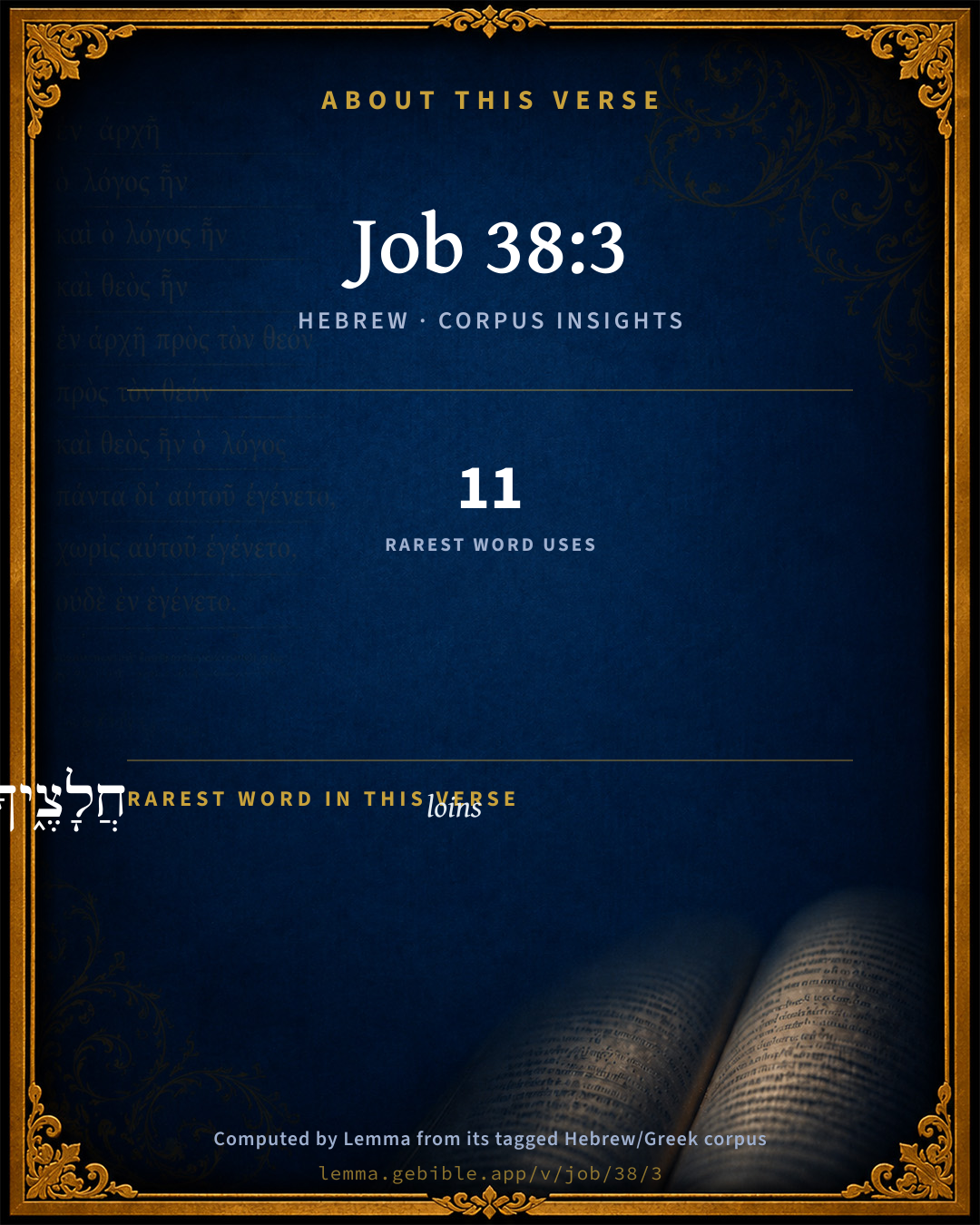
The rarest word here is חֲלָצֶ֑יךָ loins H2504 — appearing just 11 times in the whole Hebrew Bible.

Shared distinctive vocabulary

חֲלָצֶ֑יךָ loins H2504 occurs in 10 verses of the Hebrew Bible. Also found in:

Grammatical profile

  • 3 verbs
  • 2 nouns
  • 1 particle

Verb forms

  • אֱזָר Qal · Imperative
  • וְ֝אֶשְׁאָלְךָ֗ Qal · Imperfect
  • וְהוֹדִיעֵֽנִי Hiphil · Imperative

Hebrew & Septuagint length

In English translation the verse runs 14 words from the Hebrew and 16 from the Septuagint (LXX English) — closely comparable.

A rough comparison of the two English renderings, which tokenize alike — not a word-level alignment.

Word counts can differ between the Hebrew and the Greek without any difference in meaning — e.g. the Hebrew direct-object marker אֵת has no separate Greek word, and Greek often adds the article ὁ.

Cross-references

9

Topical passages linked to Job 38:3 in the Treasury of Scripture Knowledge — connected by theme and wording, ordered by reader-vote popularity; previews shown in the World English Bible.

  • Job 40:7 "Now brace yourself like a man. I will question you, and you will answer me.
  • Exodus 12:11 This is how you shall eat it: with your loins girded, your shoes on your feet, and your staff in your hand; and you shall eat it in haste: it is Yahweh's Passover.
  • Jeremiah 1:17 You therefore gird up your loins, and arise, and speak to them all that I command you: don't be dismayed at them, lest I dismay you before them.
  • 1 Kings 18:46 and the hand of Yahweh was on Elijah; and he girded up his loins, and ran before Ahab to the entrance of Jezreel.
  • 1 Peter 1:13 Therefore, prepare your minds for action, be sober and set your hope fully on the grace that will be brought to you at the revelation of Jesus Christ--
  • Job 13:15 Behold, he will kill me; I have no hope. Nevertheless, I will maintain my ways before him.
  • Job 13:22 Then call, and I will answer; Or let me speak, and you answer me.
  • Job 23:3–7 Oh that I knew where I might find him! That I might come even to his seat!
  • Job 31:35–37 Oh that I had one to hear me! (Behold, here is my signature, let the Almighty answer me); Let the accuser write my indictment!

Cross-references courtesy of OpenBible.info (CC BY 4.0).

Hebrew and Greek witnesses Masoretic Hebrew ↔ Greek Septuagint

The same verse in the two great witnesses to the Old Testament, shown verse-for-verse.

These are two independent witnesses, not word-aligned to each other, and the Septuagint is shown in lemma (dictionary) form.

Hebrew Job 38:3 Masoretic · Westminster Leningrad Codex

אֱזָר נָ֣א כְגֶ֣בֶר חֲלָצֶ֑יךָ וְ֝אֶשְׁאָלְךָ֗ וְהוֹדִיעֵֽנִי

Brace yourself like a man, For I will question you, then you answer me!

World English Bible · Public Domain

Greek LXX Job 38:3 Septuagint · lemma form

ζώννυμι ὥσπερ ἀνήρ ὁ ὀσφύς σύ ἐρωτάω δέ σύ σύ δέ ἐγώ ἀποκρίνω

Gird your loins like a man; and I will ask you, and do you answer me.

LXX2012 (modern English Septuagint) · Public Domain

Hebrew: Westminster Leningrad Codex (CC BY 4.0). Greek: Septuagint (public domain); English from LXX2012 (modern English Septuagint) (Public Domain). How the Septuagint differs from the Hebrew →

Commentary

Notes on Job 38:3 from classic Christian and Jewish commentators (each source and its license shown beneath its notes). The classic Christian expositions comment on the surrounding passage and are grouped to its opening verse, so a note may address several verses; the Jewish commentaries on the Tanakh (Rashi and others) are per-verse, so they appear only where the commentator wrote on this verse.

Lemma curates 59 commentaries, every one of them public domain or Creative Commons licensed, each selected and text-cleaned for this edition rather than reprinted as found. About our sources →

Trapp's Complete Commentary

John Trapp

Job 38:3 Gird up now thy loins like a man; for I will demand of thee, and answer thou me.

Ver. 3. Gird up now thy loins like a man] As men did use to do when they went to fight, 1Ki 20:11. Stand to thy ward, and see to thyself; for I mean to assail thee and to try thy manhood. Plato hath observed, that the best fencers are the worst soldiers. Many can brave it beforehand, as that Thrasonical Gaal did, Jdg 9:29, who yet cannot look their enemy in the face with blood in their cheeks.

For I will demand of thee, and answer thou me] I will be thy opponent, since thou hast challenged me into the schools, as it were, and given me my choice, and prove thee with hard questions; whereunto if thou canst give no good answer, see thine own folly, and be satisfied.

John Trapp, A Commentary or Exposition upon All the Books of the Old and New Testament (1647–1656) — public domain. Text from a community e-Sword module.

Joseph Benson's Commentary

Job 38:3. Gird up now thy loins — If thou hast the courage to argue the case with me, as thou hast often desired, make thyself ready for the debate. For I will demand of thee — Hebrew, אשׁאלךְ, eshelecha, I will ask thee questions; which he does in the following verses; and answer thou me — הודיעני, hodigneeni, make me know, or, inform me, concerning the things about which I inquire of thee. Give answers to my questions.

Joseph Benson's Commentary on the Old and New Testaments (1811–1818) — public domain. Text from a community e-Sword module.

Geneva Bible (1599)

Geneva Bible translators

Because he had wished to dispute with God, Job 23:3, God reasoneth with him, to declare his rashness.

Geneva Bible (1599) marginal notes — public domain. Text via Bolls.life.

Jamieson, Fausset & Brown

Robert Jamieson, A. R. Fausset & David Brown

a man--hero, ready for battle (Co1 16:13), as he had wished (Job 9:35; Job 13:22; Job 31:37). The robe, usually worn flowing, was girt up by a girdle when men ran, labored, or fought (Pe1 1:13).

Jamieson, Fausset & Brown — Commentary Critical and Explanatory on the Whole Bible (1871) — public domain (CC PDM 1.0). Text via the HelloAO Bible API.

Adam Clarke's Commentary

Verse 3. Gird up now thy loins] I will not confound thee with my terrors; dismiss all fearful apprehensions from thy mind; now act like a man, כגבר kegeber, like a hero: stand and vindicate thyself. For I will demand of thee - I will ask thee a series of questions more easy of solution than those which thou hast affected to discuss already; and then thou shalt have the opportunity of answering for thyself.

The most impressive and convincing manner of arguing is allowed to be that by interrogation, which the Almighty here adopts. The best orations delivered by the ancients were formed after this manner. That celebrated oration of Cicero against Catiline, which is allowed to be his masterpiece, begins with a multitude of short questions, closely pressed upon each other. See the end of the chapter. See Clarke on Job 38:41.

Adam Clarke's Commentary on the Bible (1810–1826) — public domain. Text from a community e-Sword/MySword module.

The Cambridge Bible for Schools and Colleges

gen. ed. J. J. S. Perowne

3. for I will demand] Rather, and I will. Jehovah now invites Job to prepare for that contention with Him which he had so often desired, Job_9:35, Job_13:10 seq.; and as Job had said, “Then call thou and I will answer, or let me speak and answer thou me” (ch. Job_13:22), Jehovah, as becomes Him, chooses the former half of the alternative, it may be that when He has “called” Job will be less ready than he thought to “answer” (ch. Job_40:3-5).

The Cambridge Bible for Schools and Colleges (gen. ed. J. J. S. Perowne; Cambridge University Press, 1878–1918) — public domain. Text from a community e-Sword module.

John Gill's Exposition

Gird up now thy loins like a man,.... Like a man of valour that girds on his harness for battle: Job is bid to prepare for the controversy the Lord was entering into with him; and bring forth his strong reasons and most powerful arguments in his own defence. The allusion is to the custom in the eastern countries, where they wore long garments, to gird them about their loins, when they engaged in work or war. Job had blustered what he would do, and now he is dared to it; see Job 23:4;

for I will demand of thee, and answer thou me; put questions to him, to which he required a direct and positive answer. Jehovah takes the part of the opponent in this dispute, and gives that of the respondent to Job; since Job himself had put it to his option which to take, Job 13:22.

John Gill's Exposition of the Whole Bible (1746–1763) — public domain (CC PDM 1.0). Text via the HelloAO Bible API.

Albert Barnes' Notes on the Bible

Gird up now thy loins like a man - To gird up the loins, is a phrase which has allusion to the mode of dress in ancient times. The loose flowing robe which was commonly worn, was fastened with a girdle when men ran, or labored, or engaged in conflict; see the notes at Mat 5:38-41. The idea here is, “Make thyself as strong and vigorous as possible; be prepared to put forth the highest effort.” God was about to put him to a task which would require all his ability - that of explaining the facts which were constantly occurring in the universe. The whole passage is ironical. Job had undertaken to tell what he knew of the divine administration, and God now calls upon him to show his claims to the office of such an expositor. So wise a man as he was, who could pronounce on the hidden counsels of the Most High with so much confidence, could assuredly explain those things which pertained to the visible creation. The phrase “like a man” means boldly, courageously; compare the notes at 1Co 16:13.

I will demand of thee, and answer thou me - Margin, as in Hebrew, “make me known.” The meaning is, “I will submit some questions or subjects of inquiry to you for solution. Since you have spoken with so much confidence of my government, I will propose some inquiries as a test of your knowledge.”

Albert Barnes' Notes on the Bible (1834–1885) — public domain. Text from a community e-Sword/MySword module.

Haydock's Catholic Bible Commentary

Loins, like one about to engage in an arduous task, (Haydock) or journey, (Calmet) to explore the ways of divine Providence. (Haydock) --- Answer my reasons, if thou art able. (Calmet) --- Hebrew, "make me know." (Haydock) --- Only the Creator hath perfect knowledge of all his works, as may appear by induction or example: 1. of inanimate; 2. of living things, ver. 39. (Worthington)

George Leo Haydock (1774–1849), Haydock's Catholic Family Bible and Commentary, 1859 edition — public domain. Excludes Psalms (Douay-Rheims chapter numbering differs from Protestant) and Deuterocanonical books (Catholic canon only).

Matthew Poole's English Annotations

Gird up now thy loins; as warriors then did for the battle. Prepare thyself for the combat with me, which thou hast oft desired. I accept of thy challenge, Job 13:22, and elsewhere.

I will demand of thee; or, I will ask thee questions; which he doth in the following verses.

Matthew Poole's English Annotations on the Holy Bible (1683–1685) — public domain. Text from a community e-Sword/MySword module.

Whedon's Commentary on the Bible

Daniel D. Whedon

3. Gird up now thy loins — See note, Job_12:20. Job, who controverts the purposes of the Most High, from the nature of the case assumes an equal or co-extensive knowledge with Deity — an assumption now to be tested by a series of questions which shall still further demonstrate his absolute ignorance of the physical world, and logically show his utter incompetency to sit in judgment upon the simplest questions of the moral world. He is, therefore, called upon to “gird up his loins.” for he will need all his resources for the task before him.

Like a man — A recognition of the true nobleness of the manhood of normal man. 1Co_16:13. Poverty and distress, and even the loathsomeness of disease, sully it not — “a man’s a man for a’ that.”

Daniel D. Whedon (gen. ed.), Commentary on the Old and New Testaments (1874–1909) — public domain. Text from a community e-Sword module.

The Pulpit Commentary

Gird up now thy loins like a man. Job had desired to contend with God, to plead with him, and argue out his case. (Job_9:32-35 Job_13:3, 18-22 23:4-7 31:35) God now offers to grant his request, and bids him stand forth "as a man and "gird himself" for the contest, which he has challenged. For I will demand of thee, and answer thou me. He will begin with interrogatories which Job must answer; then Job will be entitled to put questions to him. Job, however, on the opportunity being given him, shrinks back, and says, "Behold, I am vile; what shall I answer thee? I will lay my hand upon my mouth. Once have I spoken: but I will not answer: yea, twice; but I will proceed no further". (Job_40:4, Job_40:5) The confident boldness which he felt when God seemed far off disappears in his presence, and is replaced by diffidence and distrust.

The Pulpit Commentary (1880–1919), ed. H.D.M. Spence-Jones & Joseph S. Exell — public domain. Text from a community e-Sword module.

John Wesley's Explanatory Notes

Gird up - As warriors then did for the battle.

John Wesley, Explanatory Notes Upon the Whole Bible (1754–1765) — public domain. Text via the GEBible commentary corpus.

Rashi

Rabbi Shlomo Yitzchaki (Rashi)

Now gird your loins like a man He intimated to him that he should arouse himself from his illness and his sufferings.

Rashi on the Tanakh — English translations: “The Judaica Press complete Tanach with Rashi, translated by A. J. Rosenberg” (CC BY 4.0); “Pentateuch with Rashi's commentary by M. Rosenbaum and A.M. Silbermann, 1929-1934” (public domain); “The Metsudah Tanach series, Lakewood, N.J” (CC BY 4.0); and “The Book of Joshua, Metsudah Publications, 1997” (CC BY 4.0). Text via Sefaria.

Lesson kit

Teaching starters — assembled from the data on this page, not authored interpretation. Every prompt links to the verse data it draws on. Edit before teaching.

Job, in the Wisdom, opens this verse with 6 words (6 distinct Hebrew lemmas). Its most distinctive word is châlâts (“loins”). A historical commentator’s framing appears above. Read the whole chapter for the surrounding context.

Discussion questions

  1. How does “loins” (châlâts) shape what this verse is saying?
  2. How does Genesis 35:11, which shares the word «loins», read alongside this verse?
  3. The translations on this page render this verse differently — a whole-verse word diff, not a word-by-word alignment. What might account for the different wordings?
  4. «אֱזָר» is a Qal Imperative verb. How does that grammatical form shape the action described?
  5. Compare how Trapp's Complete Commentary and Joseph Benson's Commentary read this verse. Where do they agree or differ?

Things to notice

Reading settings

Reading text

Shown beneath each verse's original-language words.

Old Testament
Old Testament edition

Read the OT as the Masoretic Hebrew (MT) or the Greek Septuagint (LXX).

English shown for the Greek Septuagint (in the Hebrew ↔ Greek comparison).

Comparing translations? Open the Compare panel on any verse page to stack up to four side by side.