
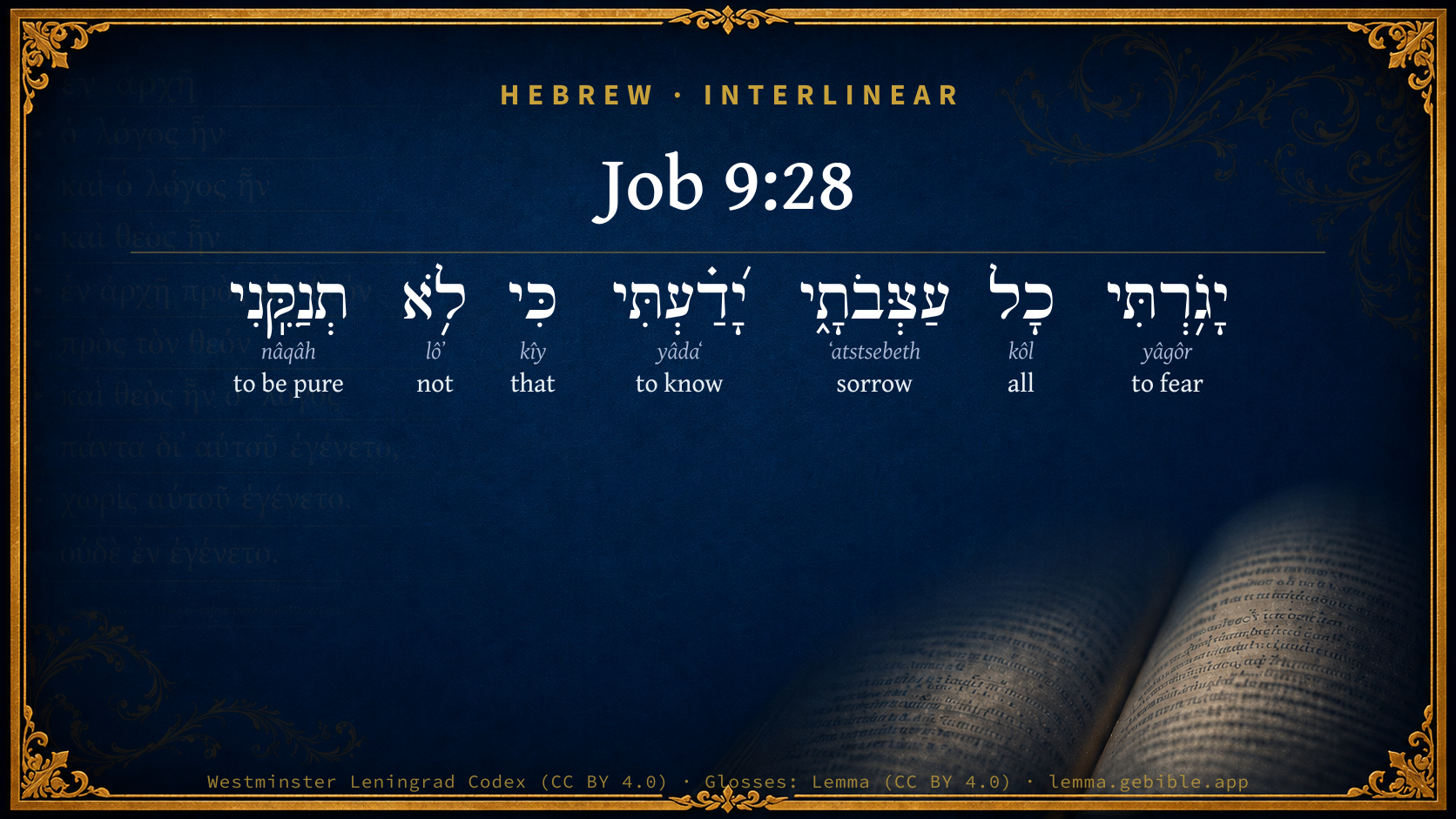
Job 9:28

Hebrew (Westminster Leningrad Codex) Job 9:28 appears in the Hebrew Old Testament. The text above is from the Westminster Leningrad Codex. Each word links to its Strong’s number, a concise gloss, and parsing drawn from the Open Scriptures Hebrew Bible morphology. Click any word for its full Brown-Driver-Briggs (BDB) entry.
Download image
Cite this verse

Job 9:28 (World English Bible). Public Domain. Lemma interlinear Bible study tool, https://lemma.gebible.app/v/job/9/28.

Show BibTeX & RIS
BibTeX
RIS
English Translation
I am afraid of all my sorrows, I know that you will not hold me innocent.
World English Bible · Public Domain
Highlights
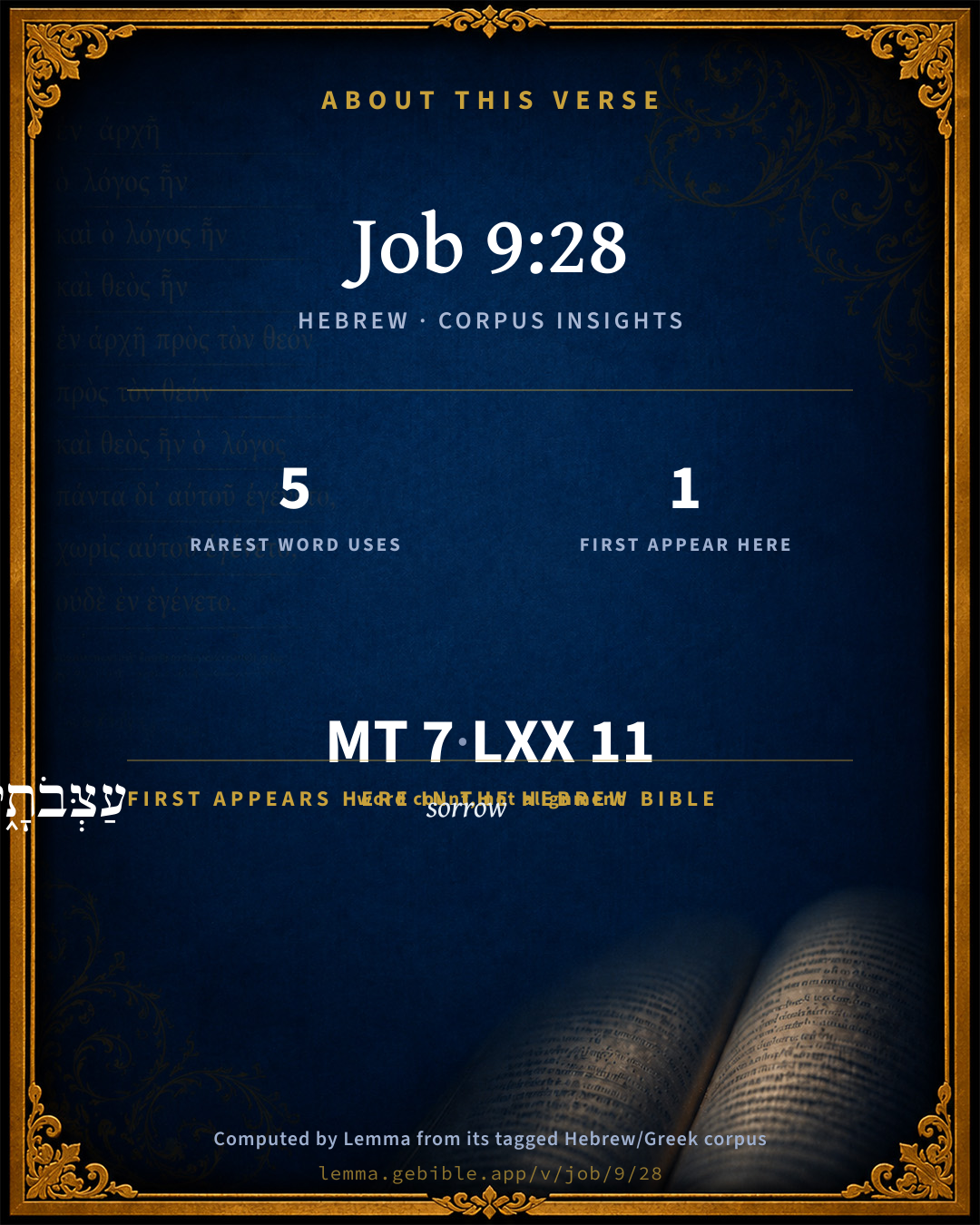
  • 1 first appearance in the Hebrew Bible
Full analysis ↓
Download a study sheet

One document with this verse’s original text, its word-by-word gloss line, the meaning frame, cross-references with their text, attributed commentary, and full source and license credits — printable, and it pastes into notes with its structure intact.

This verse Autodidact and up

Study sheet (.html) Plain text (.txt)

A passage Seminary Student

Up to 50 verses in one chapter. A passage sheet keeps up to 6 commentary sources and 12 cross-references per verse, in the order this page ranks them, and says so on the sheet whenever that leaves anything out. Ask for a single verse and you get the Autodidact verse sheet above.

Everything on this page stays free to read, with no account — the sheet is a download of what is already on screen, not access to it.

Want to remove ads? Support Godless Engineer
Compare translations 3

The same verse in 3 English versions, stacked beneath the original-language interlinear above. Click any original word for its lexicon entry.

Each is an independent rendering of the whole verse — the interlinear is not word-aligned to these translations.

Highlighted words mark where these versions differ — a whole-verse word diff, not a word-by-word alignment.

  • World English Bible Public Domain
    I am afraid of all my sorrows, I know that you will not hold me innocent.
  • King James Version Public Domain
    I am afraid of all my sorrows, I know that thou wilt not hold me innocent.
  • unfoldingWord Literal Text CC BY-SA 4.0
    I would fear all my sorrows; I know that you would not acquit me.

unfoldingWord Literal Text — © unfoldingWord, licensed CC BY-SA 4.0. Word-aligned USFM3 via Door43 (git.door43.org/unfoldingWord/en_ult).

Versions to compare (up to 4)

3 of 4 selected

Show all 18 translations

Every available English version of this verse, each an independent rendering of the whole verse.

  • World English Bible Public Domain
    I am afraid of all my sorrows, I know that you will not hold me innocent.
  • Berean Standard Bible Public Domain
    I would still dread all my sufferings; I know that You will not acquit me.
  • Majority Standard Bible Public Domain
    I would still dread all my sufferings; I know that You will not acquit me.
  • King James Version Public Domain
    I am afraid of all my sorrows, I know that thou wilt not hold me innocent.
  • American Standard Version (1901) Public Domain
    I am afraid of all my sorrows, I know that thou wilt not hold me innocent.
  • Revised Version (1885) Public Domain
    I am afraid of all my sorrows, I know that thou wilt not hold me innocent.
  • Geneva Bible (1599) Public Domain
    Then I am afrayd of all my sorowes, knowing that thou wilt not iudge me innocent.
  • Douay-Rheims (1899) Public Domain
    I feared all my works, knowing that thou didst not spare the offender.
  • Young's Literal Translation Public Domain
    I have been afraid of all my griefs, I have known that Thou dost not acquit me.
  • Literal Standard Version CC BY-SA 4.0
    I have been afraid of all my griefs, || I have known that You do not acquit me.
  • Unlocked Literal Bible CC BY-SA 4.0
    I would be afraid of all my sorrows because I know that you will not consider me innocent.
  • unfoldingWord Literal Text CC BY-SA 4.0
    I would fear all my sorrows; I know that you would not acquit me.
  • Darby Bible Public Domain
    I am afraid of all my sorrows; I know that thou wilt not hold me innocent.
  • World Messianic Bible Public Domain
    I am afraid of all my sorrows. I know that you will not hold me innocent.
  • Webster's Bible Public Domain
    I am afraid of all my sorrows, I know that thou wilt not hold me innocent.
  • Free Bible Version CC BY-SA 4.0
    I would still be terrified at all my suffering because you, God, will not say I'm innocent.
  • Bible in Basic English Public Domain
    I go in fear of all my pains; I am certain that I will not be free from sin in your eyes.
  • JPS Tanakh (1917) Public Domain
    I am afraid of all my pains, I know that Thou wilt not hold me guiltless.

Literal Standard Version (2020), Covenant Press — licensed CC BY-SA 4.0. Text via the HelloAO Bible API (eBible.org). Unlocked Literal Bible (unfoldingWord) — licensed CC BY-SA 4.0. Text via the HelloAO Bible API (eBible.org). unfoldingWord Literal Text — © unfoldingWord, licensed CC BY-SA 4.0. Word-aligned USFM3 via Door43 (git.door43.org/unfoldingWord/en_ult). Free Bible Version, Dr. Jonathan Gallagher — licensed CC BY-SA 4.0. Text via the HelloAO Bible API (eBible.org).

Word by word

More ways to search: Search by grammar → Find every occurrence → Compare this word →

Practice this passage: Drill this verse → Learn its vocabulary →

About this verse

These counts appear in no published source. They are computed here, from the morphology-tagged text and Lemma’s own curated glosses. What Lemma adds →

7
words
7
distinct lemmas
Wisdom
section

Notable vocabulary

The rarest word here is יָגֹ֥רְתִּי to fear H3025 — appearing just 5 times in the whole Hebrew Bible.

First appearance in Scripture

This word makes its first canonical appearance in the Hebrew Bible here:

  • עַצְּבֹתָ֑י sorrow H6094

Shared distinctive vocabulary

יָגֹ֥רְתִּי to fear H3025 occurs in 5 verses of the Hebrew Bible. Also found in:

Grammatical profile

  • 3 verbs
  • 2 nouns
  • 1 conjunction
  • 1 particle

Verb forms

  • יָגֹ֥רְתִּי Qal · Perfect
  • יָ֝דַ֗עְתִּי Qal · Perfect
  • תְנַקֵּֽנִי Piel · Imperfect

Hebrew & Septuagint length

In English translation the verse runs 16 words from the Hebrew and 18 from the Septuagint (LXX English) — closely comparable.

A rough comparison of the two English renderings, which tokenize alike — not a word-level alignment.

Word counts can differ between the Hebrew and the Greek without any difference in meaning — e.g. the Hebrew direct-object marker אֵת has no separate Greek word, and Greek often adds the article ὁ.

In the original languages it is 7 Hebrew tokens and 11 Greek tokens — but the two are counted differently (Hebrew bundles its prefixes and suffixes into one token; the Greek is in lemma form), so that isn’t a like-for-like length.

Cross-references

11

Topical passages linked to Job 9:28 in the Treasury of Scripture Knowledge — connected by theme and wording, ordered by reader-vote popularity; previews shown in the World English Bible.

  • Psalms 119:120 My flesh trembles for fear of you. I am afraid of your judgments.
  • Job 3:25 For the thing which I fear comes on me, That which I am afraid of comes to me.
  • Job 7:21 Why do you not pardon my disobedience, and take away my iniquity? For now shall I lie down in the dust. You will seek me diligently, but I shall not be."
  • Job 9:2 "Truly I know that it is so, But how can man be just with God?
  • Job 9:20–21 Though I am righteous, my own mouth shall condemn me. Though I am blameless, it shall prove me perverse.
  • Job 10:14 If I sin, then you mark me. You will not acquit me from my iniquity.
  • Job 14:16 But now you number my steps. Don't you watch over my sin?
  • Job 21:6 When I remember, I am troubled. Horror takes hold of my flesh.
  • Psalms 88:15–16 I am afflicted and ready to die from my youth up. While I suffer your terrors, I am distracted.
  • Psalms 130:3 If you, Yah, kept a record of sins, Lord, who could stand?
  • Exodus 20:7 "You shall not take the name of Yahweh your God in vain, for Yahweh will not hold him guiltless who takes his name in vain.

Cross-references courtesy of OpenBible.info (CC BY 4.0).

Hebrew and Greek witnesses Masoretic Hebrew ↔ Greek Septuagint

The same verse in the two great witnesses to the Old Testament, shown verse-for-verse.

These are two independent witnesses, not word-aligned to each other, and the Septuagint is shown in lemma (dictionary) form.

Hebrew Job 9:28 Masoretic · Westminster Leningrad Codex

יָגֹ֥רְתִּי כָל עַצְּבֹתָ֑י יָ֝דַ֗עְתִּי כִּי לֹ֥א תְנַקֵּֽנִי

I am afraid of all my sorrows, I know that you will not hold me innocent.

World English Bible · Public Domain

Greek LXX Job 9:28 Septuagint · lemma form

σείω πᾶς ὁ μέλος οἶδα γάρ ὅτι οὐ ἀθῷος ἐγώ ἐάω

I quake in all my limbs, for I know that you will not leave me alone as innocent.

LXX2012 (modern English Septuagint) · Public Domain

Hebrew: Westminster Leningrad Codex (CC BY 4.0). Greek: Septuagint (public domain); English from LXX2012 (modern English Septuagint) (Public Domain). How the Septuagint differs from the Hebrew →

Commentary

Notes on Job 9:28 from classic Christian and Jewish commentators (each source and its license shown beneath its notes). The classic Christian expositions comment on the surrounding passage and are grouped to its opening verse, so a note may address several verses; the Jewish commentaries on the Tanakh (Rashi and others) are per-verse, so they appear only where the commentator wrote on this verse.

Lemma curates 59 commentaries, every one of them public domain or Creative Commons licensed, each selected and text-cleaned for this edition rather than reprinted as found. About our sources →

John Gill's Exposition

If I be wicked, why then labour I in vain? If he was that wicked person, that hypocrite, Bildad and his other friends took him to be, it was in vain for him to make his supplications to God, as they advised him; so Gersom gives the sense of the words; since God hears not sinners, such as live in sin, regard iniquity in their hearts, and practise it in their lives, at least secretly, as it was suggested Job did; if he was such an one, it must be all lost labour to pray to God to show favour to him, and deliver him out of his troubles, since he might reasonably expect he would shut his eyes and stop his ears at such a man, and regard not his cries; seeking to him must be in vain; prayer may be fitly enough expressed by labour, it is a striving and wrestling with God, and especially when it is constant, importunate, and fervent: but rather the sense is, that if he was a wicked man in the account of God, or was dealt with as one; if God would not hold him innocent, as he asserts in the latter part of Job 9:28; then it was a vain thing to labour the point in the vindication of himself; since he could never think of succeeding against God, so wise and powerful, so holy, just, and pure. The word "if" is not in the original text, and may be left out, and the words be rendered, "I am wicked" (l); not in any notorious manner, as having lived a scandalous life, or been guilty of some gross enormities, as his friends insinuated, but in common with other men; he was born a sinner, had been a transgressor from the womb, and though he was renewed and sanctified by the spirit of God, yet sin dwelt in him, and through the infirmity of the flesh he was daily sinning in thought, word, or deed; nor did he expect it would be otherwise with him while in this world; yea, it was impossible for him to be without sin, as Bar Tzemach observes to be the sense of the phrase; and therefore if God would not clear him, or hold him innocent, unless he was entirely free from sin, as it was labouring in vain to attain to such perfection, so it must be to no purpose, and is what he chiefly intends, to attempt to vindicate himself before God: or "I shall be wicked", or "ungodly" (m); I shall be treated as such not only by his friends, who would reckon him a very wicked man so long as those afflictions continued on him, let him say what he would; but by the Lord himself, who he believed would never release him from them as long as he lived, which in the eye of men would be a tacit condemnation of him; so the Targum,"I shall be condemned,''and therefore it was labour in vain, striving against the stream, to go about to vindicate himself; nor was it possible that he could make himself out so clear and pure and perfect, that such an holy Being as God was could find no fault in him, in whose sight the heavens, and the inhabitants of them, were not clean; this is further evinced in the following words.

(l) "impius sum", V. L. Pagninus; so Schmidt. (m) "Ego impius ero", Montanus, Mercerus, Bolducius; "ego reus ero", Codurcus; "equidem improbus ero", Schultens.

John Gill's Exposition of the Whole Bible (1746–1763) — public domain (CC PDM 1.0). Text via the HelloAO Bible API.

Trapp's Complete Commentary

John Trapp

Job 9:28 I am afraid of all my sorrows, I know that thou wilt not hold me innocent.

Ver. 28. I am afraid of all my sorrows] That come thronging thick about me, and terrify me; they will surely be doubled and trebled upon me; hence my sorrow is incurable; if I should resolve never so much against it, I should break my resolution, and fall to fresh complaints, Psa 39:1; Psa 39:3. Hic vides, saith Lavater. Here we may see how little is to be ascribed to man’s freewill in the things of God, since it is not in our power to comfort and cheer up ourselves under afflictions, though we would never so fain.

I know that thou wilt not hold me innocent] But wilt hold me guilty, and accordingly punish me. This was the language of Job’s fear; had his faith been in heart, it would have quelled and killed such distrustful fears, and have gathered one contrary out of another, life out of death, assurance of deliverance out of deepest distresses, Deu 32:36 2Ki 14:26, going into captivity was a sign of Israel’s returning out of captivity.

John Trapp, A Commentary or Exposition upon All the Books of the Old and New Testament (1647–1656) — public domain. Text from a community e-Sword module.

Tyndale Open Study Notes

Tyndale Open Resources

9:28 The word you makes it clear that this is a prayer, although the phrase O God is not explicit in the Hebrew.

Tyndale Open Study Notes — © Tyndale Open Resources, licensed CC BY-SA 4.0. Text via the HelloAO Bible API.

Jamieson, Fausset & Brown

Robert Jamieson, A. R. Fausset & David Brown

The apodosis to Job 9:27 --"If I say, &c." "I still am afraid of all my sorrows (returning), for I know that thou wilt (dost) (by removing my sufferings) not hold or declare me innocent. How then can I leave off my heaviness?"

Jamieson, Fausset & Brown — Commentary Critical and Explanatory on the Whole Bible (1871) — public domain (CC PDM 1.0). Text via the HelloAO Bible API.

Adam Clarke's Commentary

Verse 28. I am afraid of all my sorrows] Coverdale translates, after the Vulgate, Then am I afrayed of all my workes. Even were I to cease from complaining, I fear lest not one of my works, however well intentioned, would stand thy scrutiny, or meet with thy approbation.

Thou wilt not hold me innocent.] Coverdale, after the Vulgate, For I knowe thou favourest not an evil doer; but this is not the sense of the original: Thou wilt not acquit me so as to take away my afflictions from me.

Adam Clarke's Commentary on the Bible (1810–1826) — public domain. Text from a community e-Sword/MySword module.

The Cambridge Bible for Schools and Colleges

gen. ed. J. J. S. Perowne

28. As Job’s afflictions were the proof of his guilt in the estimation of God, “to hold him innocent” means to remove his afflictions, as the first clause suggests.

The Cambridge Bible for Schools and Colleges (gen. ed. J. J. S. Perowne; Cambridge University Press, 1878–1918) — public domain. Text from a community e-Sword module.

Albert Barnes' Notes on the Bible

I am afraid of all my sorrows - My fears return. I dread the continuance of my griefs, and cannot close my eye to them.

Thou wilt not hold me innocent - God will not remove my sorrows so as to furnish the evidence that I am innocent. My sufferings continue, and with them continue all the evidence on which my friends rely that I am a guilty man. In such a state of things, how can I be otherwise than sad? He was held to be guilty; he was suffering in such a way as to afford them the proof that he was so, and how could he be cheerful?

Albert Barnes' Notes on the Bible (1834–1885) — public domain. Text from a community e-Sword/MySword module.

Haydock's Catholic Bible Commentary

Works. Hebrew, "sorrows." I dread their increase, and fear impatience. Even in the midst of prosperity, Job offered sacrifice, lest the sins of his children should be laid to his charge.

George Leo Haydock (1774–1849), Haydock's Catholic Family Bible and Commentary, 1859 edition — public domain. Excludes Psalms (Douay-Rheims chapter numbering differs from Protestant) and Deuterocanonical books (Catholic canon only).

Matthew Poole's English Annotations

My sorrows; or, my pains and griefs. I find all such endeavours vain; for if my griefs be suspended for a little time, yet my fears continue.

I know that thou wilt not hold me innocent; I plainly perceive that my changing my note is to no purpose; for thou, O God, (to whom he makes a sudden apostrophe, as he doth also Job 9:31) wilt not clear my innocency, by removing those afflictions which make them judge me guilty of some peat crime. Words proceeding from great impatience and despair of relief.

Matthew Poole's English Annotations on the Holy Bible (1683–1685) — public domain. Text from a community e-Sword/MySword module.

The Pulpit Commentary

I am afraid of all my sorrows (see the comment on ver. 27). I know that thou wilt not hold me innocent. The worst of all Job"s sorrows is the sense of alienation from God, which his unexampled sufferings have wrought in him. Though unconscious of having deserved them, he still, not unnaturally, looks upon them as marks of God s displeasure, proofs that God does not regard him as innocent.

The Pulpit Commentary (1880–1919), ed. H.D.M. Spence-Jones & Joseph S. Exell — public domain. Text from a community e-Sword module.

John Wesley's Explanatory Notes

Afraid - I find all such endeavours vain; for if my griefs be suspended for a time, yet my fears continue. Will not - I plainly perceive thou, O God, (to whom he makes a sudden address, as he afflictions which make them judge me guilty of some great crime. Words proceeding from despair and impatience.

John Wesley, Explanatory Notes Upon the Whole Bible (1754–1765) — public domain. Text via the GEBible commentary corpus.

Rashi

Rabbi Shlomo Yitzchaki (Rashi)

I will gather in all my sadness that it not let me cry out.

I know that You will not declare me innocent of my iniquity, so as not to requite me.

Rashi on the Tanakh — English translations: “The Judaica Press complete Tanach with Rashi, translated by A. J. Rosenberg” (CC BY 4.0); “Pentateuch with Rashi's commentary by M. Rosenbaum and A.M. Silbermann, 1929-1934” (public domain); “The Metsudah Tanach series, Lakewood, N.J” (CC BY 4.0); and “The Book of Joshua, Metsudah Publications, 1997” (CC BY 4.0). Text via Sefaria.

Lesson kit

Teaching starters — assembled from the data on this page, not authored interpretation. Every prompt links to the verse data it draws on. Edit before teaching.

Job, in the Wisdom, opens this verse with 7 words (7 distinct Hebrew lemmas). Its most distinctive word is yâgôr (“to fear”). A historical commentator’s framing appears above. Read the whole chapter for the surrounding context.

Discussion questions

  1. What does “to fear” (yâgôr) contribute to the verse as a whole?
  2. The word “sorrow” first appears here in Scripture. What is being introduced at this debut?
  3. Deuteronomy 9:19 shares the word «to fear» with this verse. How do the two illuminate each other?
  4. The translations on this page render this verse differently — a whole-verse word diff, not a word-by-word alignment. What might account for the different wordings?
  5. The verb «יָגֹ֥רְתִּי» is Qal Perfect. How does its form color the action?
  6. Reading how John Gill's Exposition and Trapp's Complete Commentary read this verse, where do the two commentators agree and where do they part?

Things to notice

Reading settings

Reading text

Shown beneath each verse's original-language words.

Old Testament
Old Testament edition

Read the OT as the Masoretic Hebrew (MT) or the Greek Septuagint (LXX).

English shown for the Greek Septuagint (in the Hebrew ↔ Greek comparison).

Comparing translations? Open the Compare panel on any verse page to stack up to four side by side.