
2 Chronicles 2:13

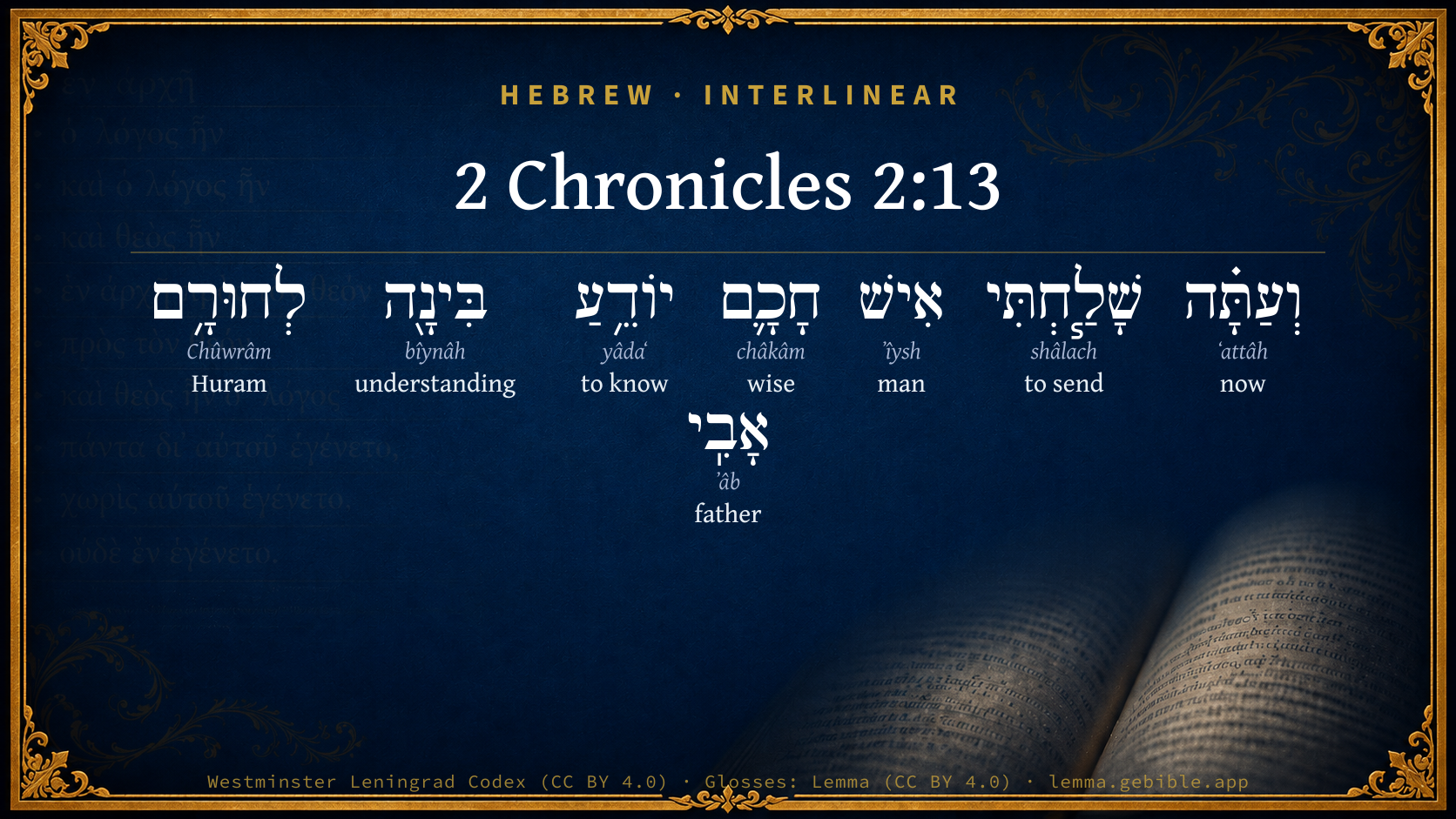
Hebrew (Westminster Leningrad Codex) 2 Chronicles 2:13 appears in the Hebrew Old Testament. The text above is from the Westminster Leningrad Codex. Each word links to its Strong’s number, a concise gloss, and parsing drawn from the Open Scriptures Hebrew Bible morphology. Click any word for its full Brown-Driver-Briggs (BDB) entry.
Download image
Cite this verse

2 Chronicles 2:13 (World English Bible). Public Domain. Lemma interlinear Bible study tool, https://lemma.gebible.app/v/2-chronicles/2/13.

Show BibTeX & RIS
BibTeX
RIS
English Translation
Now I have sent a skillful man, endowed with understanding, of Huram my father's,
World English Bible · Public Domain
Download a study sheet

One document with this verse’s original text, its word-by-word gloss line, the meaning frame, cross-references with their text, attributed commentary, and full source and license credits — printable, and it pastes into notes with its structure intact.

This verse Autodidact and up

Study sheet (.html) Plain text (.txt)

A passage Seminary Student

Up to 50 verses in one chapter. A passage sheet keeps up to 6 commentary sources and 12 cross-references per verse, in the order this page ranks them, and says so on the sheet whenever that leaves anything out. Ask for a single verse and you get the Autodidact verse sheet above.

Everything on this page stays free to read, with no account — the sheet is a download of what is already on screen, not access to it.

Want to remove ads? Support Godless Engineer
Compare translations 3

The same verse in 3 English versions, stacked beneath the original-language interlinear above. Click any original word for its lexicon entry.

Each is an independent rendering of the whole verse — the interlinear is not word-aligned to these translations.

Highlighted words mark where these versions differ — a whole-verse word diff, not a word-by-word alignment.

  • World English Bible Public Domain
    Now I have sent a skillful man, endowed with understanding, of Huram my father's,
  • King James Version Public Domain
    And now I have sent a cunning man, endued with understanding, of Huram my father's,
  • unfoldingWord Literal Text CC BY-SA 4.0
    And now, I have sent a wise man, knowing understanding, Huram-Abi,

unfoldingWord Literal Text — © unfoldingWord, licensed CC BY-SA 4.0. Word-aligned USFM3 via Door43 (git.door43.org/unfoldingWord/en_ult).

Versions to compare (up to 4)

3 of 4 selected

Show all 18 translations

Every available English version of this verse, each an independent rendering of the whole verse.

  • World English Bible Public Domain
    Now I have sent a skillful man, endowed with understanding, of Huram my father's,
  • Berean Standard Bible Public Domain
    So now I am sending you Huram-abi, a skillful man endowed with creativity.
  • Majority Standard Bible Public Domain
    So now I am sending you Huram-abi, a skillful man endowed with creativity.
  • King James Version Public Domain
    And now I have sent a cunning man, endued with understanding, of Huram my father's,
  • American Standard Version (1901) Public Domain
    And now I have sent a skilful man, endued with understanding, of Huram my father's,
  • Revised Version (1885) Public Domain
    And now I have sent a cunning man, endued with understanding, of Huram my father’s,
  • Geneva Bible (1599) Public Domain
    Now therefore I haue sent a wise man, and of vnderstanding of my father Hurams,
  • Douay-Rheims (1899) Public Domain
    I therefore have sent thee my father Hiram, a wise and most skilful man,
  • Young's Literal Translation Public Domain
    `And now, I have sent a wise man having understanding, of Huram my father,
  • Literal Standard Version CC BY-SA 4.0
    And now, I have sent a wise man having understanding, of [my] father Huram
  • Unlocked Literal Bible CC BY-SA 4.0
    Now I have sent a skillful man, Huram-Abi, who is gifted with understanding.
  • unfoldingWord Literal Text CC BY-SA 4.0
    And now, I have sent a wise man, knowing understanding, Huram-Abi,
  • Darby Bible Public Domain
    And now, I send a skilful man, endued with understanding, Huram Abi,
  • World Messianic Bible Public Domain
    Now I have sent a skillful man, endowed with understanding, Huram-abi,
  • Webster's Bible Public Domain
    And now I have sent a skillful man, endued with understanding, of Huram my father's,
  • Free Bible Version CC BY-SA 4.0
    I'm sending you Hiram-Abi, a master craftsman who knows and understands what he's doing.
  • Bible in Basic English Public Domain
    And now I am sending you a wise and expert man, Huram who is as my father,
  • JPS Tanakh (1917) Public Domain
    (2-12) And now I have sent a skilful man, endued with understanding, even Huram my master craftsman,

Literal Standard Version (2020), Covenant Press — licensed CC BY-SA 4.0. Text via the HelloAO Bible API (eBible.org). Unlocked Literal Bible (unfoldingWord) — licensed CC BY-SA 4.0. Text via the HelloAO Bible API (eBible.org). unfoldingWord Literal Text — © unfoldingWord, licensed CC BY-SA 4.0. Word-aligned USFM3 via Door43 (git.door43.org/unfoldingWord/en_ult). Free Bible Version, Dr. Jonathan Gallagher — licensed CC BY-SA 4.0. Text via the HelloAO Bible API (eBible.org).

Word by word

More ways to search: Search by grammar → Find every occurrence → Compare this word →

Practice this passage: Drill this verse → Learn its vocabulary →

About this verse

These counts appear in no published source. They are computed here, from the morphology-tagged text and Lemma’s own curated glosses. What Lemma adds →

8
words
8
distinct lemmas
Historical
section

Notable vocabulary

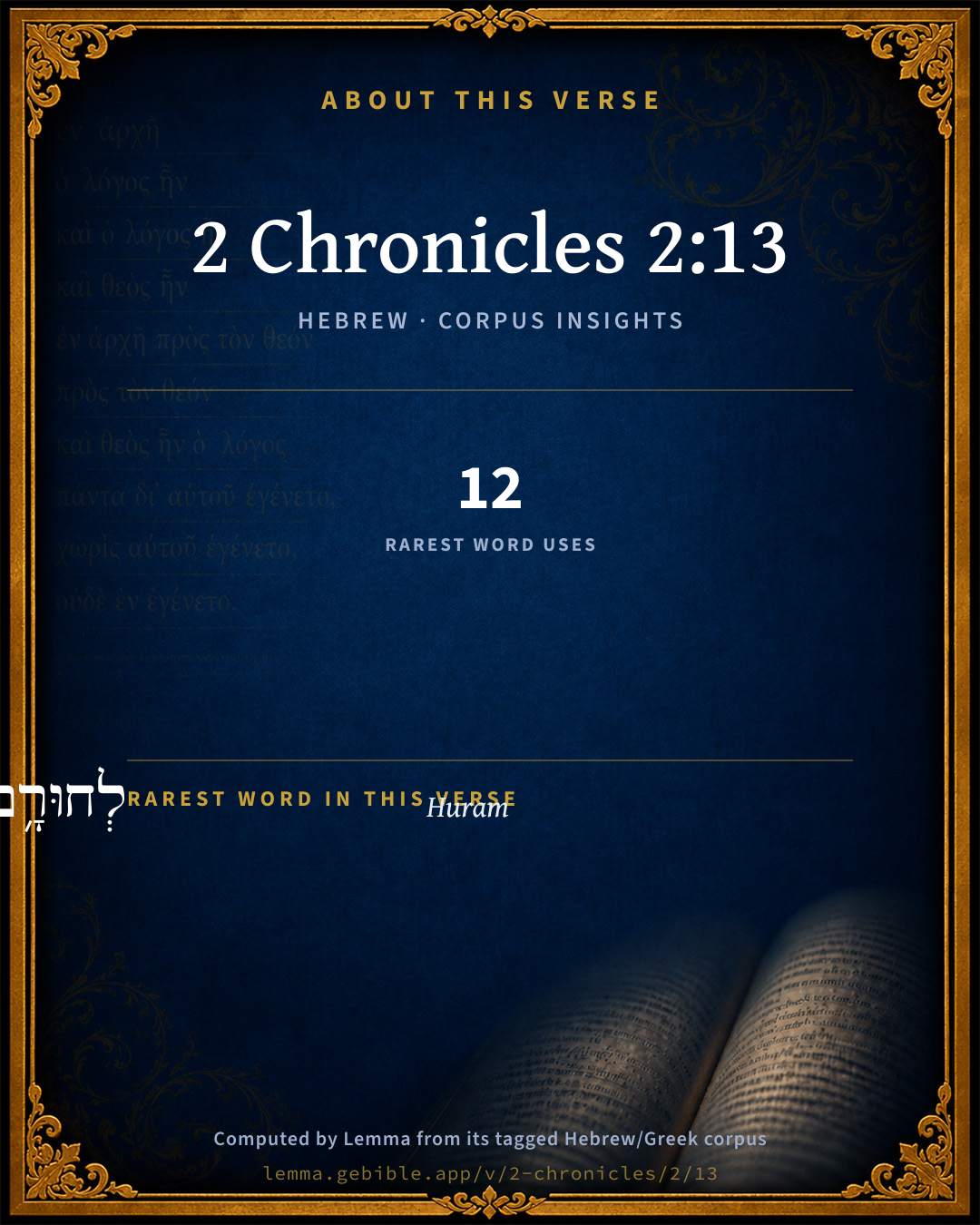
The rarest word here is לְחוּרָ֥ם Huram H2361 — appearing just 12 times in the whole Hebrew Bible.

Shared distinctive vocabulary

לְחוּרָ֥ם Huram H2361 occurs in 11 verses of the Hebrew Bible. Also found in:

Grammatical profile

  • 2 verbs
  • 4 nouns
  • 1 adjective
  • 1 adverb

Verb forms

  • שָׁלַ֧חְתִּי Qal · Perfect
  • יוֹדֵ֥עַ Qal · Participle Active

Hebrew & Septuagint length

In English translation the verse runs 14 words from the Hebrew and 17 from the Septuagint (LXX English) — closely comparable.

A rough comparison of the two English renderings, which tokenize alike — not a word-level alignment.

Word counts can differ between the Hebrew and the Greek without any difference in meaning — e.g. the Hebrew direct-object marker אֵת has no separate Greek word, and Greek often adds the article ὁ.

Cross-references

1

Topical passages linked to 2 Chronicles 2:13 in the Treasury of Scripture Knowledge — connected by theme and wording, ordered by reader-vote popularity; previews shown in the World English Bible.

  • 2 Chronicles 4:16 The pots also, and the shovels, and the flesh-hooks, and all the vessels of it, did Huram his father make for king Solomon for the house of Yahweh of bright brass.

Cross-references courtesy of OpenBible.info (CC BY 4.0).

Hebrew and Greek witnesses Masoretic Hebrew ↔ Greek Septuagint

The same verse in the two great witnesses to the Old Testament, shown verse-for-verse.

These are two independent witnesses, not word-aligned to each other, and the Septuagint is shown in lemma (dictionary) form.

Hebrew 2 Chronicles 2:13 Masoretic · Westminster Leningrad Codex

וְעַתָּ֗ה שָׁלַ֧חְתִּי אִישׁ חָכָ֛ם יוֹדֵ֥עַ בִּינָ֖ה לְחוּרָ֥ם אָבִֽי

Now I have sent a skillful man, endowed with understanding, of Huram my father's,

World English Bible · Public Domain

Greek LXX 2 Chronicles 2:13 Septuagint · lemma form

ὁ μήτηρ αὐτός ἀπό θυγάτηρ δαν καί ὁ πατήρ αὐτός ἀνήρ τύριος εἶδον ποιέω ἐν χρυσίον καί ἐν ἀργύριον καί ἐν χαλκοῦς καί ἐν σίδηρος ἐν λίθος καί ξύλον καί ὑφαίνω ἐν ὁ πορφύρα καί ἐν ὁ ὑάκινθος καί ἐν ὁ βύσσος καί ἐν ὁ κόκκινος καί γλύφω γλυφή καί διανοέομαι πᾶς διανόησις ὅσος ἄν δίδωμι αὐτός μετά ὁ σοφός σύ καί σοφός δαυίδ κύριος ἐγώ πατήρ σύ

And now I have sent you a wise and understanding man who belonged to Chiram my father

LXX2012 (modern English Septuagint) · Public Domain

On this verse, Ellicott's Commentary for English Readers discusses the Septuagint’s reading. Read the note in Commentary ↓

Hebrew: Westminster Leningrad Codex (CC BY 4.0). Greek: Septuagint (public domain); English from LXX2012 (modern English Septuagint) (Public Domain). How the Septuagint differs from the Hebrew →

Commentary

Notes on 2 Chronicles 2:13 from classic Christian and Jewish commentators (each source and its license shown beneath its notes). The classic Christian expositions comment on the surrounding passage and are grouped to its opening verse, so a note may address several verses; the Jewish commentaries on the Tanakh (Rashi and others) are per-verse, so they appear only where the commentator wrote on this verse.

Lemma curates 59 commentaries, every one of them public domain or Creative Commons licensed, each selected and text-cleaned for this edition rather than reprinted as found. About our sources →

Trapp's Complete Commentary

John Trapp

2Ch 2:13 And now I have sent a cunning man, endued with understanding, of Huram my father’s,

Ver. 13. Of Huram my father,] i.e., His servant and architect. The Vulgate hath it, Hiram my father, i.e., one whom, for his virtue, wisdom, and industry, I honour as a father.

John Trapp, A Commentary or Exposition upon All the Books of the Old and New Testament (1647–1656) — public domain. Text from a community e-Sword module.

Tyndale Open Study Notes

Tyndale Open Resources

2:13-14 The skill and knowledge of Huram-abi, a master (literally wise) craftsman, was required for building the Temple. Huram-abi had expertise in metals (gold, silver, bronze, and iron), in stone and wood, and in textiles (purple, blue, and scarlet cloth and fine linen). Similarly, God had chosen Bezalel as the master craftsman of the Tabernacle and had endowed him with wisdom to carry out the work (Exod 31:1-5).

Tyndale Open Study Notes — © Tyndale Open Resources, licensed CC BY-SA 4.0. Text via the HelloAO Bible API.

Jamieson, Fausset & Brown

Robert Jamieson, A. R. Fausset & David Brown

I have sent a cunning man--(See on 1Ki. 7:13-51).

Jamieson, Fausset & Brown — Commentary Critical and Explanatory on the Whole Bible (1871) — public domain (CC PDM 1.0). Text via the HelloAO Bible API.

Adam Clarke's Commentary

Verse 13. I have sent a conning man] His name appears to have been Hiram, or Hiram Abi: see the notes on 1Kg 7:13-14.

Adam Clarke's Commentary on the Bible (1810–1826) — public domain. Text from a community e-Sword/MySword module.

Ellicott's Commentary for English Readers

(13) Endued with understanding.—See the same phrase in 1Ch_12:32.

Of Huram my father’s.—Rather, Huram my father—i.e., master, preceptor, as in 2Ch_4:16, where Huram is called the “father” of Solomon. (Comp. Gen_45:8; Jdg_17:10; Jdg_18:19. So LXX. and Vulgate; Syriac omits.)

A Bible Commentary for English Readers, edited by Charles John Ellicott (1878–1897) — public domain. Text from a community e-Sword module.

The Cambridge Bible for Schools and Colleges

gen. ed. J. J. S. Perowne

13. I have sent] According to 1Ki_7:13 Solomon himself sent and fetched Hiram the artificer.

of Huram my father’s) Better as R.V. mg., even Huram my father. Huram the king calls Huram the artificer my father as a title of honour. Cp. 2Ch_4:16.

The Cambridge Bible for Schools and Colleges (gen. ed. J. J. S. Perowne; Cambridge University Press, 1878–1918) — public domain. Text from a community e-Sword module.

John Gill's Exposition

The son of a woman of the daughters of Dan,.... Here follows an account of the descent of the artificer, and of his skill in working; of what seeming disagreement there may be in this account, with that in Kg1 7:14; see Gill on Kg1 7:14.

.

2 Chronicles 2:15

ch2 2:15

ch2 2:15

ch2 2:15Now therefore, the wheat, and the barley, the oil, and the wine, which my lord hath spoken of,.... In his letter to him, Ch2 2:10 as for the phrase "my lord", which some think is used, because Hiram was tributary to Solomon, it may only be a respectful way of speaking:

let him send unto his servants; Hiram accepted thereof as a proper reward for the work of his servants.

John Gill's Exposition of the Whole Bible (1746–1763) — public domain (CC PDM 1.0). Text via the HelloAO Bible API.

Albert Barnes' Notes on the Bible

Of Huram my father’s - A wrong translation. Huram here is the workman sent by the king of Tyre and not the king of Tyre’s father (see 1Ki 5:1 note). The words in the original are Huram Abi, and the latter word is now commonly thought to be either a proper name or an epithet of honor, e. g., my master-workman.

Albert Barnes' Notes on the Bible (1834–1885) — public domain. Text from a community e-Sword/MySword module.

Haydock's Catholic Bible Commentary

Father. Hebrew Abi, is considered by some as the surname of Hiram. (Pagnin, &c.) --- But he might have that title in consideration of his great skill, as Solomon gives it him, chap. iv. 16. We use master in the same sense. Septuagint have, "servant," (Greek: paida) except the Roman edition, which agrees with the Hebrew and reads, Greek: patera. (Calmet) --- Protestants, "of Huram, my father’s;" (Haydock) supply servant, or architect. (Tirinus)

George Leo Haydock (1774–1849), Haydock's Catholic Family Bible and Commentary, 1859 edition — public domain. Excludes Psalms (Douay-Rheims chapter numbering differs from Protestant) and Deuterocanonical books (Catholic canon only).

Matthew Poole's English Annotations

i.e. Who was my father’s chief workman. Or, Huram Abi, a man so called; the prefix lamed being here only a note of the accusative case. See more on 2Ch 4:16.

Matthew Poole's English Annotations on the Holy Bible (1683–1685) — public domain. Text from a community e-Sword/MySword module.

Whedon's Commentary on the Bible

Daniel D. Whedon

13. Of Huram my father’s — The of ( לin the Hebrew being here merely the sign of the accusative) should be omitted, and the word rendered my father taken as a part of Huram’s name. Thus: I have sent a cunning man… Huram-Abi. If, however, it be preferred to translate the word, Abi, my father, it is to be taken in the sense of my master; that is, my master-workman. Comp. 2Ch_4:16, and Gen_45:8. See note on 1Ki_7:13-14.

Daniel D. Whedon (gen. ed.), Commentary on the Old and New Testaments (1874–1909) — public domain. Text from a community e-Sword module.

The Pulpit Commentary

Of Huram my father"s. The words of 2Ch_4:11, 16 would invest these with suspicion, if nothing that occurred before did, as e.g. the parallel passage. (1Ki_7:13, 1Ki_7:14, 1Ki_7:40) There can be no doubt from these passages that the name Huram of this verse is the name of the workman sent (the lamed prefixed being only the objective sign), not the supposed name of King Hiram"s father, which, as already seen, was Abibaal. But the following word translated "my father" (ybia;) is less easily explained; (2Ch_4:16) (his father") is quite sufficient to negative the rendering" father" altogether. In our text altogether inappropriate, it may be called there altogether impossible. It has been proposed to render it as a proper name Abi, or as an affix of honour, Ab, equal to "master." However, Gesenius (in Lexicon,sub roe. ba (6), which see) furnishes a signification, "chief counsellor," which (taking it to mean chief counsellor, or as it were expert, chief referee, or even only foreman in such matters as might be in question) would well suit all the passages, and remove all difficulty.

Vers. 13-18.

Lessons from the labourers.

The interesting particulars we have of the labours of building the temple give us a variety of suggestions.

I THE VALUE OF A WISE INTERMINGLING.

1. Of blood. The principal architect and engineer supplied by King Hiram was a man of mixed blood; his father was a man of Tyro, but his mother was a Jewess, (see 1Ki_7:14) and he appears to have been a man of unusual ability. The mixture of races is proved to be of a very distinct advantage, and we may be very thankful that the discords and contentions of our early history resulted in the mingling of the virtues of Saxon, Celt, and Roman in the English of our own time.

2. Of labour. "I have sent a cunning man.., to find out every device with thy cunning men" (ver. 14). International exchange and co-operation are of immense value, and will prove to be more and more so as the nations open their doors, and all peoples meet and mingle together (see homily on vers. 2, 3, 7-10).

II A BENEFICENT APPEAL TO OUR INTELLIGENCE. (Ver. 14.) In the variety of material with which God has supplied us we find a striking instance of his creative kindness. It is conceivable that he might have placed us on a planet which had little elemental variety, and which did not therefore admit of many combinations. But on this earth there is practically no limit to the variety of productions, by the putting forth of our observation, ingenuity, and skill. Herein we have very much more, and very much better, than a provision for our comforts; we have an effective appeal to our intelligence, a constant development of our intellectual powers, an elevation of our manhood. It is a rich and noble home, furnished with everything that meets the needs of our complex nature, in which our heavenly Father has placed us.

III THE POWER WE POSSESS OVER THE ELEMENTS OF NATURE. (Ver. 16.) At that time and in that country men had learned to hew down the tall trees, to cut and carve them into what size and shape they liked, to carry them across the land, and to employ the sea as a highway. "We will bring it to thee in flotes by sea." The sea, with its depth and breadth, with its swelling billows and its fearful storms, may well have been regarded at first as an impassable barrier between land and land, as a decisive limit put upon our progress. But we have made it a common highway on which to travel, by which to transport our treasures, and we can map our route and calculate our time with nearly as much regularity as on the still and solid land. Indeed, we can rule the elements of nature much more readily and constantly than we can govern the forces within our own breast. These too often baffle our skill and defeat our purpose. Our greatest difficulty and truest triumph is in turning to good account the elements of our own human nature.

IV AN UNCONSCIOUS ANTICIPATION OF GOSPEL BREADTH. (Vers. 17, 18.) Solomon employed "the strangers" to do the triple work, here specified, in the temple-building. Moreover, he had recourse to the King of Tyre and to his "cunning workmen." So that we have Gentiles as well as Jews engaged in this work which we may regard as the work of the Lord. Between that event and the present time there was to come a long period of exclusiveness which manifested itself in most ungracious forms in the days of our Lord. But this co-operation of those without and those within the sacred pale is predictive of the glorious breadth of these later times, when, in Christ Jesus, there is neither Jew nor Gentile, barbarian nor Soythian, bend nor free. There is an absolutely open way to the kingdom of God, and an equally open gate into the broad field of holy usefulness. C.

The Pulpit Commentary (1880–1919), ed. H.D.M. Spence-Jones & Joseph S. Exell — public domain. Text from a community e-Sword module.

unfoldingWord translationNotes

Door43 World Missions Community

gifted with understanding

The abstract noun "understanding" can be stated as "understands" or "wise." AT: "who understand many things" or "who is very wise" (See: Abstract Nouns)

Huram-Abi

This is the name of a man. (See: How to Translate Names)

He is skilled at work in gold ... crimson wool

Translate many of these words as you did in 2 Chronicles 2:7.

fine linen

"high quality cloth" or "the best cloth"

He is the son of a woman of the daughters of Dan

"His mother is from the tribe of Dan" or "His mother is a descendant of Dan"

translationWords

send

Dan

works

lord

unfoldingWord translationNotes — © Distant Shores Media and the Door43 World Missions Community, licensed CC BY-SA 4.0. Source: git.door43.org/Door43/en_tn.

Rashi

Rabbi Shlomo Yitzchaki (Rashi)

the son of a woman She was a widow.

of the daughters of Dan of the tribe of Dan.

and his father was a Tyrian man He was a Jew who lived in Tyre, on the model of (II Sam. 6:10): “Obed-Edom the Gittite,” who lived in Gath, and who was a Levite. In I Kings (7:14), it is written: “He was a widow’s son, of the tribe of Naphtali, and his father was a Tyrian man.” His mother was from Dan, and his father was from Naphtali. Now why was it necessary to trace his genealogy, from which tribe his father and mother were? This is what is written (Gen. 30:6): “God judged me,” and also (ibid. 8): “I have fought a divine struggle, etc.” Rachel said, “I twisted cords; I went through contortions until I was able to compare to my sister Leah. If Leah will boast of her descendant Bezalel, who will make the Tabernacle, he will require one of the sons of Dan to participate in his work, as it is written (38: 23): ‘And with him was Oholiab the son of Ahisamach of the tribe of Dan.’ Now if Solomon, the descendant of my sister, will build the Temple, some of the sons of Dan and Naphtali will have to participate with him.”

and his father was a Tyrian man [This comes] to teach you that even if his mother is a widow, a person must adopt his father’s trade and sustain his mother. (So I heard from Rabbi Solomon the son of Levi of Monteuille, the son of Rabbi Moshe Hadarshan’s sister.)

Rashi on the Tanakh — English translations: “The Judaica Press complete Tanach with Rashi, translated by A. J. Rosenberg” (CC BY 4.0); “Pentateuch with Rashi's commentary by M. Rosenbaum and A.M. Silbermann, 1929-1934” (public domain); “The Metsudah Tanach series, Lakewood, N.J” (CC BY 4.0); and “The Book of Joshua, Metsudah Publications, 1997” (CC BY 4.0). Text via Sefaria.

Lesson kit

Teaching starters — assembled from the data on this page, not authored interpretation. Every prompt links to the verse data it draws on. Edit before teaching.

2 Chronicles, in the Historical, opens this verse with 8 words (8 distinct Hebrew lemmas). Its most distinctive word is Chûwrâm (“Huram”). A historical commentator’s framing appears above. Read the whole chapter for the surrounding context.

Discussion questions

  1. What does “Huram” (Chûwrâm) contribute to the verse as a whole?
  2. 1 Chronicles 8:5 shares the word «Huram» with this verse. How do the two illuminate each other?
  3. These translations render this verse differently. What is at stake in choosing one wording over another?
  4. The verb «שָׁלַ֧חְתִּי» is Qal Perfect. How does its form color the action?
  5. Reading how Trapp's Complete Commentary and Tyndale Open Study Notes read this verse, where do the two commentators agree and where do they part?

Things to notice

Reading settings

Reading text

Shown beneath each verse's original-language words.

Old Testament
Old Testament edition

Read the OT as the Masoretic Hebrew (MT) or the Greek Septuagint (LXX).

English shown for the Greek Septuagint (in the Hebrew ↔ Greek comparison).

Comparing translations? Open the Compare panel on any verse page to stack up to four side by side.