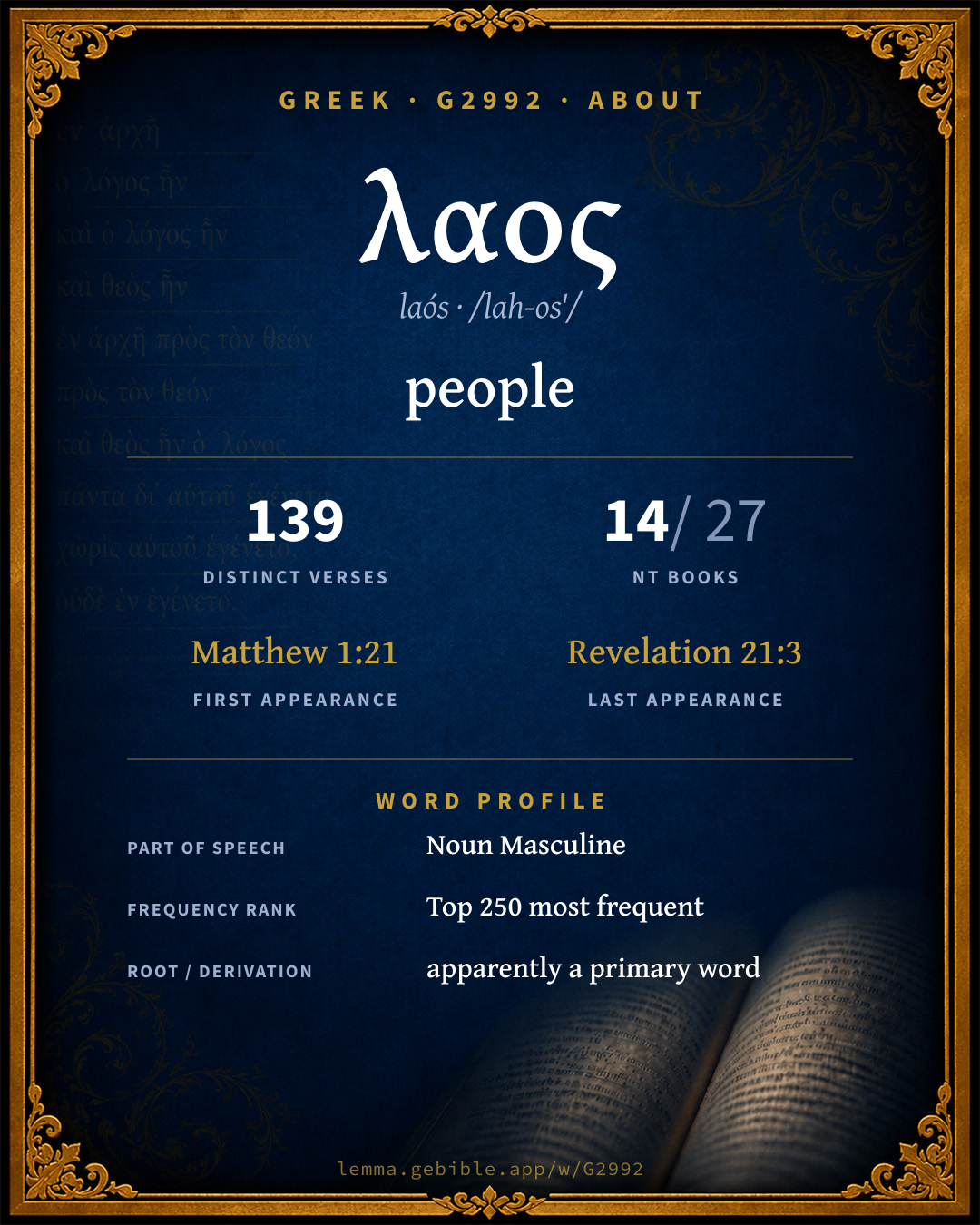
λαός
people
also: people group, tribe, nation fuller range ↓
Full lexicon entry — Thayer's Greek Lexicon
From Thayer's Greek Lexicon
Where this word appears
See every Accusative-case word in the Greek New Testament →
Grammar key — what these labels mean
Part of speech
- Noun
- A naming word — a person, place, thing, or idea.
Case
- Accusative
- The case of the direct object and of extent.
- Genitive
- The case of source, possession, or “of” — answers “whose / from what.”
- Dative
- The case of the indirect object, means, or location — “to / for / with / in.”
- Nominative
- The case of the subject (and the predicate nominative).
Gender
- Masculine
- Grammatically masculine.
Number
- Singular
- One.
- Plural
- More than one.
Grammatical forms
- Noun, Accusative, Singular, Masculine 45 times (31%)
- Noun, Genitive, Singular, Masculine 38 times (27%)
- Noun, Dative, Singular, Masculine 26 times (18%)
- Noun, Nominative, Singular, Masculine 25 times (17%)
- Noun, Nominative, Plural, Masculine 4 times (3%)
- Noun, Genitive, Plural, Masculine 3 times (2%)
- Noun, Dative, Plural, Masculine 2 times (1%)
Parsed forms decoded from the imported morphology (Robinson–Tischendorf, public domain), counted across 143 parsed occurrences — not distinct verses.
Every verse where G2992 appears — 139 distinct verses across 14 books. Click any verse to open its interlinear word-by-word view. Verse text shown in the World English Bible for context — . Each verse’s Greek form is shown with its reference; the English is not keyword-highlighted, since the data carries no word-level English alignment. Use “Compare translations” on any verse to read it across multiple English versions. This concordance covers the Greek New Testament; Septuagint (Greek Old Testament) occurrences of this word are not indexed here.
Matthew 14 verses
- Matthew 1:21 λαὸν n acc sg masc She shall bring forth a son. You shall call his name Jesus, for it is he who shall save his people from their sins."
- Matthew 2:4 λαοῦ n gen sg masc Gathering together all the chief priests and scribes of the people, he asked them where the Christ would be born.
- Matthew 2:6 λαόν n acc sg masc 'You Bethlehem, land of Judah, Are in no way least among the princes of Judah: For out of you shall come forth a governor, Who shall shepherd my people, Israel.'"
- Matthew 4:16 λαὸς n nom sg masc The people who sat in darkness saw a great light, To those who sat in the region and shadow of death, To them light has dawned."
- Matthew 4:23 λαῷ n dat sg masc Jesus went about in all Galilee, teaching in their synagogues, preaching the Gospel of the Kingdom, and healing every disease and every sickness among the people.
- Matthew 13:15 λαοῦ n gen sg masc For this people's heart has grown callous, Their ears are dull of hearing, They have closed their eyes; Or else perhaps they might perceive with their eyes, Hear with their ears, Understand with their heart, And should turn again; And I would heal them.'
- Matthew 15:8 λαὸς n nom sg masc 'These people draw near to me with their mouth, And honor me with their lips; But their heart is far from me.
- Matthew 21:23 λαοῦ n gen sg masc When he had come into the temple, the chief priests and the elders of the people came to him as he was teaching, and said, "By what authority do you do these things? Who gave you this authority?"
- Matthew 26:3 λαοῦ n gen sg masc Then the chief priests, the scribes, and the elders of the people were gathered together in the court of the high priest, who was called Caiaphas.
- Matthew 26:5 λαῷ n dat sg masc But they said, "Not during the feast, lest a riot occur among the people."
- Matthew 26:47 λαοῦ n gen sg masc While he was still speaking, behold, Judas, one of the twelve, came, and with him a great multitude with swords and clubs, from the chief priest and elders of the people.
- Matthew 27:1 λαοῦ n gen sg masc Now when morning had come, all the chief priests and the elders of the people took counsel against Jesus to put him to death:
- Matthew 27:25 λαὸς n nom sg masc All the people answered, "May his blood be on us, and on our children!"
- Matthew 27:64 λαῷ n dat sg masc Command therefore that the tomb be made secure until the third day, lest perhaps his disciples come at night and steal him away, and tell the people, 'He is risen from the dead;' and the last deception will be worse than the first."
Mark 3 verses
- Mark 7:6 λαὸς n nom sg masc He answered them, "Well did Isaiah prophesy of you hypocrites, as it is written, 'This people honors me with their lips, But their heart is far from me.
- Mark 11:32 λαόν n acc sg masc If we should say, 'From men'"--they feared the people, for all held John to really be a prophet.
- Mark 14:2 λαοῦ n gen sg masc For they said, "Not during the feast, because there might be a riot of the people."
Luke 36 verses
- Luke 1:10 λαοῦ n gen sg masc The whole multitude of the people were praying outside at the hour of incense.
- Luke 1:17 λαὸν n acc sg masc He will go before him in the spirit and power of Elijah, 'to turn the hearts of the fathers to the children,' and the disobedient to the wisdom of the just; to make ready a people prepared for the Lord."
- Luke 1:21 λαὸς n nom sg masc The people were waiting for Zacharias, and they marveled that he delayed in the temple.
- Luke 1:68 λαῷ n dat sg masc "Blessed be the Lord, the God of Israel, For he has visited and worked redemption for his people;
- Luke 1:77 λαῷ n dat sg masc To give knowledge of salvation to his people by the remission of their sins,
- Luke 2:10 λαῷ n dat sg masc The angel said to them, "Don't be afraid, for behold, I bring you good news of great joy which will be to all the people.
- Luke 2:31 λαῶν n gen pl masc Which you have prepared before the face of all peoples;
- Luke 2:32 λαοῦ n gen sg masc A light for revelation to the Gentiles, And the glory of your people Israel."
- Luke 3:15 λαοῦ n gen sg masc As the people were in expectation, and all men reasoned in their hearts concerning John, whether perhaps he was the Christ,
- Luke 3:18 λαόν n acc sg masc Then with many other exhortations he preached good news to the people,
- Luke 3:21 λαὸν n acc sg masc Now it happened, when all the people were baptized, Jesus also had been baptized, and was praying. The sky was opened,
- Luke 6:17 λαοῦ n gen sg masc He came down with them, and stood on a level place, with a crowd of his disciples, and a great number of the people from all Judea and Jerusalem, and the sea coast of Tyre and Sidon, who came to hear him and to be healed of their diseases;
- Luke 7:1 λαοῦ n gen sg masc After he had finished speaking in the hearing of the people, he entered into Capernaum.
- Luke 7:16 λαὸν n acc sg masc Fear took hold of all, and they glorified God, saying, "A great prophet has arisen among us!" and, "God has visited his people!"
- Luke 7:29 λαὸς n nom sg masc When all the people and the tax collectors heard this, they declared God to be just, having been baptized with John's baptism.
- Luke 8:47 λαοῦ n gen sg masc When the woman saw that she was not hidden, she came trembling, and falling down before him declared to him in the presence of all the people the reason why she had touched him, and how she was healed immediately.
- Luke 9:13 λαὸν n acc sg masc But he said to them, "You give them something to eat." They said, "We have no more than five loaves and two fish, unless we should go and buy food for all these people."
- Luke 18:43 λαὸς n nom sg masc Immediately he received his sight, and followed him, glorifying God. All the people, when they saw it, praised God.
- Luke 19:47 λαοῦ n gen sg masc He was teaching daily in the temple, but the chief priests and the scribes and the leading men among the people sought to destroy him.
- Luke 19:48 λαὸς n nom sg masc They couldn't find what they might do, for all the people hung on to every word that he said.
- Luke 20:1 λαὸν n acc sg masc It happened on one of those days, as he was teaching the people in the temple and preaching the Gospel, that the priests and scribes came to him with the elders.
- Luke 20:6 λαὸς n nom sg masc But if we say, 'From men,' all the people will stone us, for they are persuaded that John was a prophet."
- Luke 20:9 λαὸν n acc sg masc He began to tell the people this parable. "A man planted a vineyard, and rented it out to some farmers, and went into another country for a long time.
- Luke 20:19 λαόν n acc sg masc The chief priests and the scribes sought to lay hands on Him that very hour, but they feared the people--for they knew He had spoken this parable against them.
- Luke 20:26 λαοῦ n gen sg masc They weren't able to trap him in his words before the people. They marveled at his answer, and were silent.
- Luke 20:45 λαοῦ n gen sg masc In the hearing of all the people, he said to his disciples,
- Luke 21:23 λαῷ n dat sg masc Woe to those who are pregnant and to those who nurse infants in those days! For there will be great distress in the land, and wrath to this people.
- Luke 21:38 λαὸς n nom sg masc All the people came early in the morning to him in the temple to hear him.
- Luke 22:2 λαόν n acc sg masc The chief priests and the scribes sought how they might put him to death, for they feared the people.
- Luke 22:66 λαοῦ n gen sg masc As soon as it was day, the assembly of the elders of the people was gathered together, both chief priests and scribes, and they led him away into their council, saying,
- Luke 23:5 λαόν n acc sg masc But they insisted, saying, "He stirs up the people, teaching throughout all Judea, beginning from Galilee even to this place."
- Luke 23:13 λαὸν n acc sg masc Pilate called together the chief priests and the rulers and the people,
- Luke 23:14 λαόν n acc sg masc and said to them, "You brought this man to me as one that perverts the people, and see, I have examined him before you, and found no basis for a charge against this man concerning those things of which you accuse him.
- Luke 23:27 λαοῦ n gen sg masc A great multitude of the people followed him, including women who also mourned and lamented him.
- Luke 23:35 λαὸς n nom sg masc The people stood watching. The rulers with them also scoffed at him, saying, "He saved others. Let him save himself, if this is the Christ of God, his chosen one!"
- Luke 24:19 λαοῦ n gen sg masc He said to them, "What things?" They said to him, "The things concerning Jesus, the Nazarene, who was a prophet mighty in deed and word before God and all the people;
John 3 verses
- John 8:2 λαὸς n nom sg masc Now very early in the morning, he came again into the temple, and all the people came to him. He sat down, and taught them.
- John 11:50 λαοῦ n gen sg masc nor do you consider that it is advantageous for us that one man should die for the people, and that the whole nation not perish."
- John 18:14 λαοῦ n gen sg masc Now it was Caiaphas who advised the Jews that it was expedient that one man should perish for the people.
Acts 47 verses
- Acts 2:47 λαόν n acc sg masc praising God, and having favor with all the people. The Lord added to the assembly day by day those who were being saved.
- Acts 3:9 λαὸς n nom sg masc All the people saw him walking and praising God.
- Acts 3:11 λαὸς n nom sg masc As the lame man who was healed held on to Peter and John, all the people ran together to them in the porch that is called Solomon's, greatly wondering.
- Acts 3:12 λαόν n acc sg masc When Peter saw it, he responded to the people, "You men of Israel, why do you marvel at this man? Why do you fasten your eyes on us, as though by our own power or godliness we had made him walk?
- Acts 3:23 λαοῦ n gen sg masc It will be, that every soul that will not listen to that prophet will be utterly destroyed from among the people.'
- Acts 4:1 λαὸν n acc sg masc As they spoke to the people, the priests and the captain of the temple and the Sadducees came to them,
- Acts 4:2 λαὸν n acc sg masc being upset because they taught the people and proclaimed in Jesus the resurrection from the dead.
- Acts 4:8 λαοῦ n gen sg masc Then Peter, filled with the Holy Spirit, said to them, "You rulers of the people, and elders of Israel,
- Acts 4:10 λαῷ n dat sg masc be it known to you all, and to all the people of Israel, that in the name of Jesus Christ of Nazareth, whom you crucified, whom God raised from the dead, in him does this man stand here before you whole.
- Acts 4:17 λαόν n acc sg masc But so that this spreads no further among the people, let's threaten them, that from now on they don't speak to anyone in this name."
- Acts 4:21 λαόν n acc sg masc When they had further threatened them, they let them go, finding no way to punish them, because of the people; for everyone glorified God for that which was done.
- Acts 4:25 λαοὶ n nom pl masc who by the mouth of your servant, David, said, 'Why do the nations rage, And the peoples plot a vain thing?
- Acts 4:27 λαοῖς n dat pl masc For truly, in this city against your holy servant, Jesus, whom you anointed, both Herod and Pontius Pilate, with the Gentiles and the people of Israel, were gathered together
- Acts 5:12 λαῷ n dat sg masc By the hands of the apostles many signs and wonders were done among the people. They were all with one accord in Solomon's porch.
- Acts 5:13 λαός n nom sg masc None of the rest dared to join them, however the people honored them.
- Acts 5:20 λαῷ n dat sg masc "Go stand and speak in the temple to the people all the words of this life."
- Acts 5:25 λαόν n acc sg masc One came and told them, "Behold, the men whom you put in prison are in the temple, standing and teaching the people."
- Acts 5:26 λαόν n acc sg masc Then the captain went with the officers, and brought them without violence, for they were afraid that the people might stone them.
- Acts 5:34 λαῷ n dat sg masc But one stood up in the council, a Pharisee named Gamaliel, a teacher of the law, honored by all the people, and commanded to put the apostles out for a little while.
- Acts 5:37 λαὸν n acc sg masc After this man, Judas of Galilee rose up in the days of the enrollment, and drew away some people after him. He also perished, and all, as many as obeyed him, were scattered abroad.
- Acts 6:8 λαῷ n dat sg masc Stephen, full of faith and power, performed great wonders and signs among the people.
- Acts 6:12 λαὸν n acc sg masc They stirred up the people, the elders, and the scribes, and came against him and seized him, and brought him in to the council,
- Acts 7:17 λαὸς n nom sg masc "But as the time of the promise came close which God had sworn to Abraham, the people grew and multiplied in Egypt,
- Acts 7:34 λαοῦ n gen sg masc I have surely seen the affliction of my people that is in Egypt, and have heard their groaning. I have come down to deliver them. Now come, I will send you into Egypt.'
- Acts 10:2 λαῷ n dat sg masc a devout man, and one who feared God with all his house, who gave gifts for the needy generously to the people, and always prayed to God.
- Acts 10:41 λαῷ n dat sg masc not to all the people, but to witnesses who were chosen before by God, to us, who ate and drank with him after he rose from the dead.
- Acts 10:42 λαῷ n dat sg masc He charged us to preach to the people and to testify that this is he who is appointed by God as the Judge of the living and the dead.
- Acts 12:4 λαῷ n dat sg masc When he had arrested him, he put him in prison, and delivered him to four squads of four soldiers each to guard him, intending to bring him out to the people after the Passover.
- Acts 12:11 λαοῦ n gen sg masc When Peter had come to himself, he said, "Now I truly know that the Lord has sent out his angel and delivered me out of the hand of Herod, and from everything the Jewish people were expecting."
- Acts 13:15 λαόν n acc sg masc After the reading of the law and the prophets, the rulers of the synagogue sent to them, saying, "Brothers, if you have any word of exhortation for the people, speak."
- Acts 13:17 λαοῦ λαὸν n gen sg masc n acc sg masc The God of this people chose our fathers, and exalted the people when they stayed as aliens in the land of Egypt, and with an uplifted arm, he led them out of it.
- Acts 13:24 λαῷ n dat sg masc before his coming, when John had first preached the baptism of repentance to Israel.
- Acts 13:31 λαόν n acc sg masc and he was seen for many days by those who came up with him from Galilee to Jerusalem, who are his witnesses to the people.
- Acts 15:14 λαὸν n acc sg masc Simeon has reported how God first visited the Gentiles, to take out of them a people for his name.
- Acts 18:10 λαός n nom sg masc for I am with you, and no one will attack you to harm you, for I have many people in this city."
- Acts 19:4 λαῷ n dat sg masc Paul said, "John indeed baptized with the baptism of repentance, saying to the people that they should believe in the one who would come after him, that is, in Jesus."
- Acts 21:28 λαοῦ n gen sg masc crying out, "Men of Israel, help! This is the man who teaches all men everywhere against the people, and the law, and this place. Moreover, he also brought Greeks into the temple, and has defiled this holy place!"
- Acts 21:30 λαοῦ n gen sg masc All the city was moved, and the people ran together. They seized Paul and dragged him out of the temple. Immediately the doors were shut.
- Acts 21:36 λαοῦ n gen sg masc for the multitude of the people followed after, crying out, "Away with him!"
- Acts 21:39 λαόν n acc sg masc But Paul said, "I am a Jew, from Tarsus in Cilicia, a citizen of no insignificant city. I beg you, allow me to speak to the people."
- Acts 21:40 λαῷ n dat sg masc When he had given him permission, Paul, standing on the stairs, beckoned with his hand to the people. When there was a great silence, he spoke to them in the Hebrew language, saying,
- Acts 23:5 λαοῦ n gen sg masc Paul said, "I didn't know, brothers, that he was high priest. For it is written, 'You shall not speak evil of a ruler of your people.'"
- Acts 26:17 λαοῦ n gen sg masc delivering you from the people, and from the Gentiles, to whom I send you,
- Acts 26:23 λαῷ n dat sg masc how the Christ must suffer, and how, by the resurrection of the dead, he would be first to proclaim light both to these people and to the Gentiles."
- Acts 28:17 λαῷ n dat sg masc It happened that after three days Paul called together those who were the leaders of the Jews. When they had come together, he said to them, "I, brothers, though I had done nothing against the people, or the customs of our fathers, still was delivered prisoner from Jerusalem into the hands of the Romans,
- Acts 28:26 λαὸν n acc sg masc saying, 'Go to this people, and say, In hearing, you will hear, But will in no way understand. In seeing, you will see, But will in no way perceive.
- Acts 28:27 λαοῦ n gen sg masc For this people's heart has grown callous. Their ears are dull of hearing. Their eyes they have closed. Lest they should see with their eyes, Hear with their ears, Understand with their heart, And would turn again, And I would heal them.'
Romans 7 verses
- Romans 9:25 λαόν λαόν n acc sg masc n acc sg masc As he says also in Hosea, "I will call them 'my people,' which were not my people; And her 'beloved,' who was not beloved."
- Romans 9:26 λαός n nom sg masc "It will be that in the place where it was said to them, 'You are not my people,' There they will be called 'children of the living God.'"
- Romans 10:21 λαὸν n acc sg masc But as to Israel he says, "All day long I stretched out my hands to a disobedient and contrary people."
- Romans 11:1 λαὸν n acc sg masc I ask then, Did God reject his people? May it never be! For I also am an Israelite, a descendant of Abraham, of the tribe of Benjamin.
- Romans 11:2 λαὸν n acc sg masc God didn't reject his people, which he foreknew. Or don't you know what the Scripture says about Elijah? How he pleads with God against Israel:
- Romans 15:10 λαοῦ n gen sg masc Again he says, "Rejoice, you Gentiles, with his people."
- Romans 15:11 λαοί n nom pl masc Again, "Praise the Lord, all you Gentiles! Let all the peoples praise him."
1 Corinthians 2 verses
- 1 Corinthians 10:7 λαὸς n nom sg masc Neither be idolaters, as some of them were. As it is written, "The people sat down to eat and drink, and rose up to play."
- 1 Corinthians 14:21 λαῷ n dat sg masc In the law it is written, "By men of strange languages and by the lips of strangers I will speak to this people. Not even thus will they hear me, says the Lord."
2 Corinthians 1 verse
Titus 1 verse
Hebrews 12 verses
- Hebrews 2:17 λαοῦ n gen sg masc Therefore he was obligated in all things to be made like his brothers, that he might become a merciful and faithful high priest in things pertaining to God, to make atonement for the sins of the people.
- Hebrews 4:9 λαῷ n dat sg masc There remains therefore a Sabbath rest for the people of God.
- Hebrews 5:3 λαοῦ n gen sg masc Because of this, he must offer sacrifices for sins for the people, as well as for himself.
- Hebrews 7:5 λαὸν n acc sg masc They indeed of the sons of Levi who receive the priest's office have a commandment to take tithes of the people according to the law, that is, of their brothers, though these have come out of the loins of Abraham,
- Hebrews 7:11 λαὸς n nom sg masc Now if there was perfection through the Levitical priesthood (for under it the people have received the law), what further need was there for another priest to arise after the order of Melchizedek, and not be called after the order of Aaron?
- Hebrews 7:27 λαοῦ n gen sg masc who doesn't need, like those high priests, to daily offer up sacrifices, first for his own sins, and then for the sins of the people. For this he did once for all, when he offered up himself.
- Hebrews 8:10 λαόν n acc sg masc "For this is the covenant that I will make with the house of Israel. After those days," says the Lord; "I will put my laws into their mind, I will also write them on their heart. I will be to them a God, And they will be to me a people.
- Hebrews 9:7 λαοῦ n gen sg masc but into the second the high priest alone, once in the year, not without blood, which he offers for himself, and for the errors of the people.
- Hebrews 9:19 λαῷ λαὸν n dat sg masc n acc sg masc For when every commandment had been spoken by Moses to all the people according to the law, he took the blood of the calves and the goats, with water and scarlet wool and hyssop, and sprinkled both the book itself and all the people,
- Hebrews 10:30 λαὸν n acc sg masc For we know him who said, "Vengeance belongs to me," says the Lord, "I will repay." Again, "The Lord will judge his people."
- Hebrews 11:25 λαῷ n dat sg masc choosing rather to share ill treatment with God's people, than to enjoy the pleasures of sin for a time;
- Hebrews 13:12 λαόν n acc sg masc Therefore Jesus also, that he might sanctify the people through his own blood, suffered outside of the gate.
1 Peter 2 verses
- 1 Peter 2:9 λαὸς n nom sg masc But you are a chosen race, a royal priesthood, a holy nation, a people for God's own possession, that you may show forth the excellencies of him who called you out of darkness into his marvelous light:
- 1 Peter 2:10 λαὸς λαὸς n nom sg masc n nom sg masc who in time past were no people, but now are God's people, who had not obtained mercy, but now have obtained mercy.
2 Peter 1 verse
Jude 1 verse
Revelation 9 verses
- Revelation 5:9 λαοῦ n gen sg masc They sang a new song, saying, "You are worthy to take the book, And to open its seals: For you were killed, And bought us for God with your blood, Out of every tribe, language, people, and nation,
- Revelation 7:9 λαῶν n gen pl masc After these things I looked, and behold, a great multitude, which no man could number, out of every nation and of all tribes, peoples, and languages, standing before the throne and before the Lamb, dressed in white robes, with palm branches in their hands.
- Revelation 10:11 λαοῖς n dat pl masc They told me, "You must prophesy again over many peoples, nations, languages, and kings."
- Revelation 11:9 λαῶν n gen pl masc From among the peoples, tribes, languages, and nations people will look at their dead bodies for three and a half days, and will not allow their dead bodies to be laid in a tomb.
- Revelation 13:7 λαὸν n acc sg masc It was given to him to make war with the saints, and to overcome them. Authority over every tribe, people, language, and nation was given to him.
- Revelation 14:6 λαόν n acc sg masc I saw an angel flying in mid heaven, having an eternal Gospel to proclaim to those who dwell on the earth, and to every nation, tribe, language, and people.
- Revelation 17:15 λαοὶ n nom pl masc He said to me, "The waters which you saw, where the prostitute sits, are peoples, multitudes, nations, and languages.
- Revelation 18:4 λαός n nom sg masc I heard another voice from heaven, saying, "Come out of her, my people, that you have no participation in her sins, and that you don't receive of her plagues,
- Revelation 21:3 λαοὶ n nom pl masc I heard a loud voice out of heaven saying, "Behold, God's dwelling is with people, and he will dwell with them, and they will be his people, and God himself will be with them as their God.
About this entry
At a glance — auto-summarized from this page’s data, not written by a person. Every figure links to its source below. This summary describes the numbers; it doesn’t interpret them.
The Greek noun λαος centers on the idea of “people.” Its earliest occurrence is Matthew 1:21. Spanning 139 verses in 14 books, it ranks among the common words of the Greek New Testament. Acts dominates its distribution — 47 of 139 verses. Lexicons map it across 2 senses — beyond “people” it also covers “people group”, “tribe”, and “nation”. Dig into 139-verse concordance and the renderings breakdown below.
Gloss history
Strong's 1890 vs modern scholarship
About this word
Strong's G2992 catalogs a Greek word from the Greek New Testament.
These counts are not copied from any lexicon or concordance. They are computed here, from the morphology-tagged Greek New Testament. What Lemma adds →
- 139
- distinct verses
- The word appears in 139 distinct verses.
- 14 / 27
- NT books
- The word appears in 14 of 27 New Testament books.
- #115
- by frequency
- Top 250 most frequent Greek words (rank 115 of 5,347 Greek words by occurrence).
View all 139 occurrences in the concordance →
By section of the New Testament
By traditional corpus
Conventional, traditional groupings — biblical authorship is debated, so this is a traditional corpus grouping, not an authorship claim. Some books belong to more than one corpus (Luke is in both the Gospels and the Lukan corpus, and so on), so these shares overlap and need not total 100%. Each figure is a share of the word’s 139 distinct verses.
- Lukan (Luke–Acts) 83 verses · 60%
- Gospels 56 verses · 40%
- Johannine 12 verses · 9%
- Hebrews 12 verses · 9%
- Pauline corpus 11 verses · 8%
- Revelation 9 verses · 6%
- General (Catholic) Epistles 4 verses · 3%
How translations render this word
Counts come from each version’s own published word-to-Strong’s tagging or interlinear alignment — an approximate guide to how each version renders this word, not a word-level alignment the data otherwise carries. Because each total is that version’s own tagged count, the per-version totals vary from one another and need not match the appearance or distinct-verse counts above. These counts may also differ from a printed concordance because Lemma counts each distinctly tagged rendering and does not collapse phrase taggings into a single head-word total. This is a fixed set of word-tagged versions (KJV, ASV, BSB, ULT) and does not change with the reading translation you choose elsewhere. Each version’s license is shown beside its name below (and on Sources).
- King James Version: People 138×, People's 2×, Peoples 2×
- American Standard Version: People 121×, Peoples 9×, Of 3×
- Berean Standard Bible: People 129×, Peoples 5×, People’s 2×
- unfoldingWord Literal Text: People 137×, To 8×, Of 6×
King James Version Public Domain
Renders G2992 across 143 tagged occurrences — most commonly:
Plus 1 rendering that appears only once — usually multi-word phrases or single function words the recovered tagging swept in, not distinct renderings.
American Standard Version Public Domain
Renders G2992 across 144 tagged occurrences — most commonly:
Plus 9 renderings that appear only once — usually multi-word phrases or single function words the recovered tagging swept in, not distinct renderings.
Berean Standard Bible Public Domain
Renders G2992 across 139 tagged occurrences — most commonly:
Plus 3 renderings that appear only once — usually multi-word phrases or single function words the recovered tagging swept in, not distinct renderings. Not rendered by a distinct English word in 2 further occurrences.
unfoldingWord Literal Text CC BY-SA 4.0
Renders G2992 across 162 tagged occurrences — most commonly:
Plus 2 renderings that appear only once — usually multi-word phrases or single function words the recovered tagging swept in, not distinct renderings.
Senses in Thayer's
The 2 senses Thayer's distinguishes for this word, in lexicon order (not ranked by frequency or importance). The full entry — with sub-senses — is in the Lexicon Entry tab.
- a people, people group, tribe, nation, all those who are of the same stock and language
- of a great part of the population gathered together anywhere
Word origin
Origin: apparently a primary word
Apparently a primary word; a people (in general; thus differing from G1218 which denotes one´ s own populace): - people.
— Strong’s Exhaustive Concordance (1890), public domain.
Forms in the corpus
The 10 distinct written forms G2992 takes in the Greek New Testament, most frequent first — each parse links to that case’s occurrences in the concordance.
| Form | Parsing | Example | Uses |
|---|---|---|---|
| λαοῦ laoû | Noun, Genitive, Singular, Masculine | Matthew 2:4 | 38 |
| λαῷ laō̂ | Noun, Dative, Singular, Masculine | Matthew 4:23 | 26 |
| λαὸν laòn | Noun, Accusative, Singular, Masculine | Matthew 1:21 | 24 |
| λαόν laón | Noun, Accusative, Singular, Masculine | Matthew 2:6 | 21 |
| λαὸς laòs | Noun, Nominative, Singular, Masculine | Matthew 4:16 | 20 |
| λαός laós | Noun, Nominative, Singular, Masculine | Acts 5:13 | 5 |
| λαοὶ laoì | Noun, Nominative, Plural, Masculine | Acts 4:25 | 3 |
| λαῶν laō̂n | Noun, Genitive, Plural, Masculine | Luke 2:31 | 3 |
| λαοῖς laoîs | Noun, Dative, Plural, Masculine | Acts 4:27 | 2 |
| λαοί laoí | Noun, Nominative, Plural, Masculine | Romans 15:11 | 1 |
Same root — word family
Other Thayer's entries built from the same root as G2992, grouped by Strong’s listed origin. These share a root / origin per the lexicon — not necessarily a shared meaning. Each links to that word’s own entry.
Derived from this word
Proper names from this root
People and places named from this root — a name, not an additional meaning of the word.
Compare all same-root words → 1 of the same-root words is a proper name (a person or place). They share a root, not necessarily a meaning.
Septuagint usage
The same Greek word λαος appears 1,696 times in the Greek Old Testament (Septuagint), across 1,499 verses in 37 books.
- 1,696
- LXX occurrences
- Tagged occurrences of this Greek word in the Septuagint.
- 1,499
- verses
- Distinct Septuagint verses containing this word.
- 37 / 39
- OT books
- The word appears in 37 of the 39 Old Testament books.
Sample Septuagint occurrences
- Genesis 14:16 λαός
- Exodus 1:20 λαός
- Leviticus 4:3 λαός
- Numbers 5:21 λαός
- Deuteronomy 2:4 λαός
- Joshua 1:2 λαός
- Judges 1:16 λαός
- Ruth 1:6 λαός
- 1 Samuel 2:8 λαός
- 2 Samuel 1:2 λαός
- 1 Kings 1:39 λαός
- 2 Kings 3:7 λαός
Septuagint occurrences (same lexeme)
Every verse where the same Strong’s number (G2992) appears in the Greek Septuagint — showing the first 50 of 1,499. Verse text shown in the World English Bible for context; the Greek form is the matched word — the English is not keyword-highlighted.
- Genesis 14:16 λαός He brought back all the goods, and also brought back his relative, Lot, and his goods, and the women also, and the people.
- Genesis 19:4 λαός But before they lay down, the men of the city, the men of Sodom, surrounded the house, both young and old, all the people from every quarter.
- Genesis 23:7 λαός Abraham rose up, and bowed himself to the people of the land, even to the children of Heth.
- Genesis 23:12 λαός Abraham bowed himself down before the people of the land.
- Genesis 23:13 λαός He spoke to Ephron in the audience of the people of the land, saying, "But if you will, please hear me. I will give the price of the field. Take it from me, and I will bury my dead there."
- Genesis 25:8 λαός Abraham gave up the spirit, and died in a good old age, an old man, and full of years, and was gathered to his people.
- Genesis 25:23 λαός Yahweh said to her, Two nations are in your womb, Two peoples will be separated from your body. The one people will be stronger than the other people. The elder will serve the younger.
- Genesis 26:11 λαός Abimelech charged all the people, saying, "He who touches this man or his wife will surely be put to death."
- Genesis 32:8 λαός and he said, "If Esau comes to the one company, and strikes it, then the company which is left will escape."
- Genesis 33:15 λαός Esau said, "Let me now leave with you some of the folk who are with me." He said, "Why? Let me find favor in the sight of my lord."
- Genesis 34:22 λαός Only on this condition will the men consent to us to dwell with us, to become one people, if every male among us be circumcised, as they are circumcised.
- Genesis 35:6 λαός So Jacob came to Luz, which is in the land of Canaan (the same is Bethel), he and all the people who were with him.
- Genesis 41:40 λαός You shall be over my house, and according to your word will all my people be ruled. Only in the throne I will be greater than you."
- Genesis 41:55 λαός When all the land of Egypt was famished, the people cried to Pharaoh for bread, and Pharaoh said to all the Egyptians, "Go to Joseph. What he says to you, do."
- Genesis 42:6 λαός Joseph was the governor over the land. It was he who sold to all the people of the land. Joseph's brothers came, and bowed themselves down to him with their faces to the earth.
- Genesis 47:21 λαός As for the people, he moved them to the cities from one end of the border of Egypt even to the other end of it.
- Genesis 48:19 λαός His father refused, and said, "I know, my son, I know. He also will become a people, and he also will be great. However, his younger brother will be greater than he, and his seed will become a multitude of nations."
- Genesis 49:16 λαός "Dan will judge his people, As one of the tribes of Israel.
- Genesis 49:29 λαός He charged them, and said to them, "I am to be gathered to my people. Bury me with my fathers in the cave that is in the field of Ephron the Hittite,
- Genesis 49:33 λαός When Jacob made an end of charging his sons, he gathered up his feet into the bed, and yielded up the spirit, and was gathered to his people.
- Genesis 50:20 λαός As for you, you meant evil against me, but God meant it for good, to bring to pass, as it is this day, to save many people alive.
- Exodus 1:20 λαός God dealt well with the midwives, and the people multiplied, and grew very mighty.
- Exodus 1:22 λαός Pharaoh charged all his people, saying, "You shall cast every son who is born into the river, and every daughter you shall save alive."
- Exodus 3:7 λαός Yahweh said, "I have surely seen the affliction of my people who are in Egypt, and have heard their cry because of their taskmasters, for I know their sorrows.
- Exodus 3:10 λαός Come now therefore, and I will send you to Pharaoh, that you may bring forth my people, the children of Israel, out of Egypt."
- Exodus 3:12 λαός He said, "Certainly I will be with you. This will be the token to you, that I have sent you: when you have brought forth the people out of Egypt, you shall serve God on this mountain."
- Exodus 3:21 λαός I will give this people favor in the sight of the Egyptians, and it will happen that when you go, you shall not go empty-handed.
- Exodus 4:16 λαός He will be your spokesman to the people; and it will happen, that he will be to you a mouth, and you will be to him as God.
- Exodus 4:21 λαός Yahweh said to Moses, "When you go back into Egypt, see that you do before Pharaoh all the wonders which I have put in your hand, but I will harden his heart and he will not let the people go.
- Exodus 4:23 λαός and I have said to you, "Let my son go, that he may serve me;" and you have refused to let him go. Behold, I will kill your son, your firstborn.'"
- Exodus 4:30 λαός Aaron spoke all the words which Yahweh had spoken to Moses, and did the signs in the sight of the people.
- Exodus 4:31 λαός The people believed, and when they heard that Yahweh had visited the children of Israel, and that he had seen their affliction, then they bowed their heads and worshiped.
- Exodus 5:1 λαός Afterward Moses and Aaron came, and said to Pharaoh, "This is what Yahweh, the God of Israel, says, 'Let my people go, that they may hold a feast to me in the wilderness.'"
- Exodus 5:4 λαός The king of Egypt said to them, "Why do you, Moses and Aaron, take the people from their work? Get back to your burdens!"
- Exodus 5:5 λαός Pharaoh said, "Behold, the people of the land are now many, and you make them rest from their burdens."
- Exodus 5:6 λαός The same day Pharaoh commanded the taskmasters of the people, and their officers, saying,
- Exodus 5:7 λαός "You shall no longer give the people straw to make brick, as before. Let them go and gather straw for themselves.
- Exodus 5:10 λαός The taskmasters of the people went out, and their officers, and they spoke to the people, saying, This is what Pharaoh says: "I will not give you straw.
- Exodus 5:12 λαός So the people were scattered abroad throughout all the land of Egypt to gather stubble for straw.
- Exodus 5:16 λαός No straw is given to your servants, and they tell us, 'Make brick!' and, behold, your servants are beaten; but the fault is in your own people."
- Exodus 5:22 λαός Moses returned to Yahweh, and said, "Lord, why have you brought trouble on this people? Why is it that you have sent me?
- Exodus 5:23 λαός For since I came to Pharaoh to speak in your name, he has brought trouble on this people; neither have you delivered your people at all."
- Exodus 6:7 λαός and I will take you to me for a people, and I will be to you a God; and you shall know that I am Yahweh your God, who brings you out from under the burdens of the Egyptians.
- Exodus 7:4 λαός But Pharaoh will not listen to you, and I will lay my hand on Egypt, and bring forth my hosts, my people the children of Israel, out of the land of Egypt by great judgments.
- Exodus 7:14 λαός Yahweh said to Moses, "Pharaoh's heart is stubborn. He refuses to let the people go.
- Exodus 7:16 λαός You shall tell him, 'Yahweh, the God of the Hebrews, has sent me to you, saying, "Let my people go, that they may serve me in the wilderness:" and, behold, until now you haven't listened.
- Exodus 7:26 λαός
- Exodus 7:28 λαός
- Exodus 7:29 λαός
- Exodus 8:4 λαός and the frogs shall come up both on you, and on your people, and on all your servants.'"
These are occurrences of the same Greek lexeme (G2992) in the Septuagint — not a translation of any one Hebrew word. The store carries no word-level Hebrew↔Greek alignment, so no Hebrew original is asserted here. Counts come from the recovered LXX Strong's tagging — high-frequency vocabulary is well covered, while rare or late forms may be untagged — so they reflect tagged occurrences and may slightly undercount.