Acts 3:9

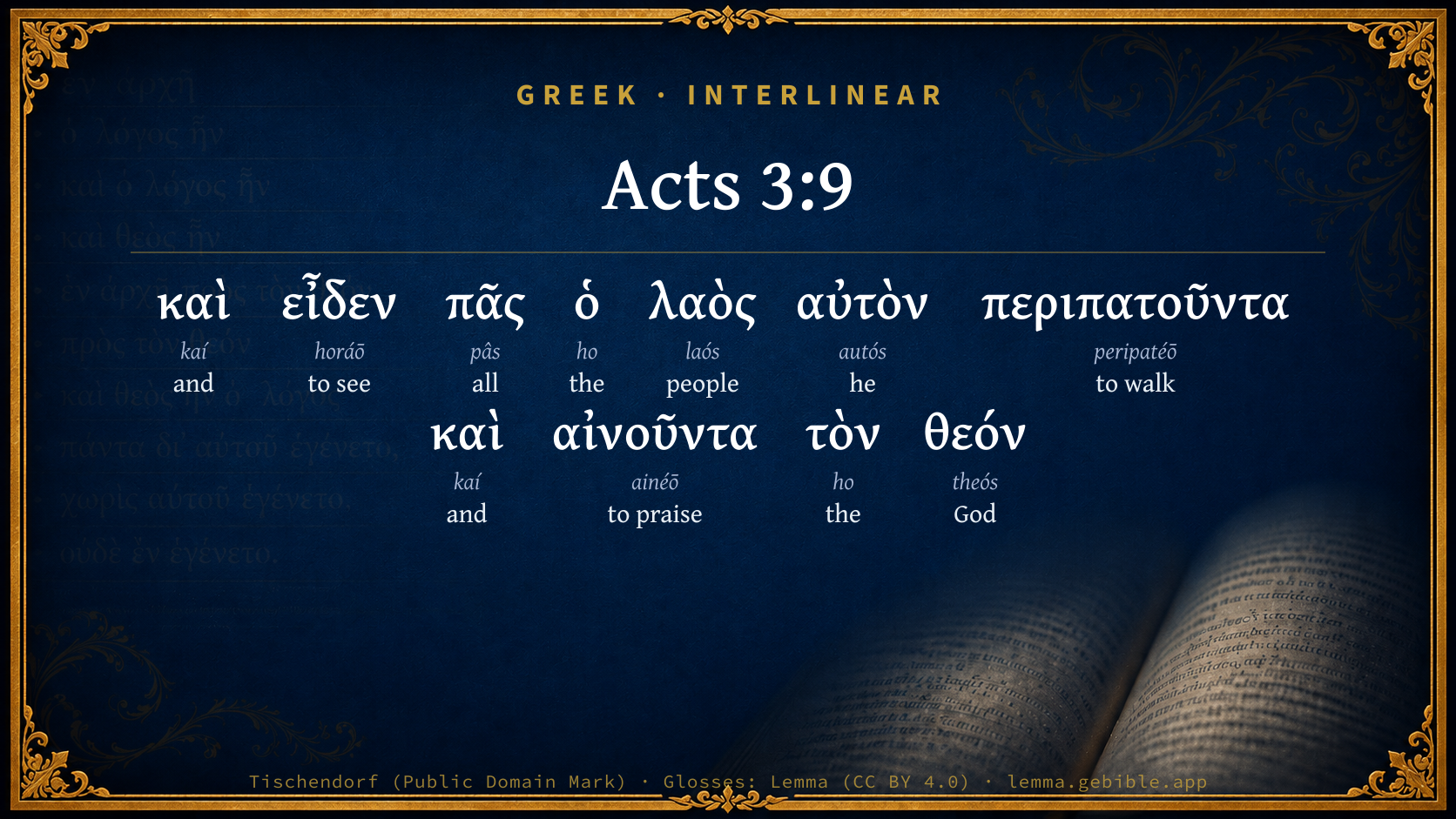
Greek (Tischendorf 8th ed.) Acts 3:9 appears in the Greek New Testament. The text above is from the Tischendorf 8th edition. Each word links to its Strong’s number and a concise gloss. Click any word for its full Thayer’s Greek Lexicon entry.
Download image
Cite this verse

Acts 3:9 (World English Bible). Public Domain. Lemma interlinear Bible study tool, https://lemma.gebible.app/v/acts/3/9.

Show BibTeX & RIS
BibTeX
RIS
English Translation
All the people saw him walking and praising God.
World English Bible · Public Domain
Download a study sheet

One document with this verse’s original text, its word-by-word gloss line, the meaning frame, cross-references with their text, attributed commentary, and full source and license credits — printable, and it pastes into notes with its structure intact.

This verse Autodidact and up

Study sheet (.html) Plain text (.txt)

A passage Seminary Student

Up to 50 verses in one chapter. A passage sheet keeps up to 6 commentary sources and 12 cross-references per verse, in the order this page ranks them, and says so on the sheet whenever that leaves anything out. Ask for a single verse and you get the Autodidact verse sheet above.

Everything on this page stays free to read, with no account — the sheet is a download of what is already on screen, not access to it.

Want to remove ads? Support Godless Engineer
Compare translations 3

The same verse in 3 English versions, stacked beneath the original-language interlinear above. Click any original word for its lexicon entry.

Each is an independent rendering of the whole verse — the interlinear is not word-aligned to these translations.

Highlighted words mark where these versions differ — a whole-verse word diff, not a word-by-word alignment.

  • World English Bible Public Domain
    All the people saw him walking and praising God.
  • King James Version Public Domain
    And all the people saw him walking and praising God:
  • unfoldingWord Literal Text CC BY-SA 4.0
    And all the people saw him walking and praising God.

unfoldingWord Literal Text — © unfoldingWord, licensed CC BY-SA 4.0. Word-aligned USFM3 via Door43 (git.door43.org/unfoldingWord/en_ult).

Versions to compare (up to 4)

3 of 4 selected

Show all 19 translations

Every available English version of this verse, each an independent rendering of the whole verse.

  • World English Bible Public Domain
    All the people saw him walking and praising God.
  • Berean Standard Bible Public Domain
    When all the people saw him walking and praising God,
  • Majority Standard Bible Public Domain
    When all the people saw him walking and praising God,
  • King James Version Public Domain
    And all the people saw him walking and praising God:
  • American Standard Version (1901) Public Domain
    And all the people saw him walking and praising God:
  • Revised Version (1885) Public Domain
    And all the people saw him walking and praising God:
  • Geneva Bible (1599) Public Domain
    And all the people sawe him walke, and praysing God.
  • Douay-Rheims (1899) Public Domain
    And all the people saw him walking and praising God.
  • Young's Literal Translation Public Domain
    and all the people saw him walking and praising God,
  • Literal Standard Version CC BY-SA 4.0
    and all the people saw him walking and praising God,
  • Unlocked Literal Bible CC BY-SA 4.0
    All the people saw him walking and praising God.
  • unfoldingWord Literal Text CC BY-SA 4.0
    And all the people saw him walking and praising God.
  • Darby Bible Public Domain
    And all the people saw him walking and praising God;
  • World Messianic Bible Public Domain
    All the people saw him walking and praising God.
  • Webster's Bible Public Domain
    And all the people saw him walking and praising God:
  • Free Bible Version CC BY-SA 4.0
    Everyone there saw him walking around and praising God.
  • Bible in Basic English Public Domain
    And all the people saw him walking and praising God:
  • Text-Critical English NT CC BY 4.0
    When all the people saw him walking and praising God,
  • Tyndale New Testament (1534) Public Domain
    And all the people sawe him walke and laude God.

Literal Standard Version (2020), Covenant Press — licensed CC BY-SA 4.0. Text via the HelloAO Bible API (eBible.org). Unlocked Literal Bible (unfoldingWord) — licensed CC BY-SA 4.0. Text via the HelloAO Bible API (eBible.org). unfoldingWord Literal Text — © unfoldingWord, licensed CC BY-SA 4.0. Word-aligned USFM3 via Door43 (git.door43.org/unfoldingWord/en_ult). Free Bible Version, Dr. Jonathan Gallagher — licensed CC BY-SA 4.0. Text via the HelloAO Bible API (eBible.org).

Word by word

More ways to search: Search by grammar → Find every occurrence → Compare this word →

Practice this passage: Drill this verse → Learn its vocabulary →

About this verse

These counts appear in no published source. They are computed here, from the morphology-tagged text and Lemma’s own curated glosses. What Lemma adds →

11
words
9
distinct lemmas
Acts
section

Notable vocabulary

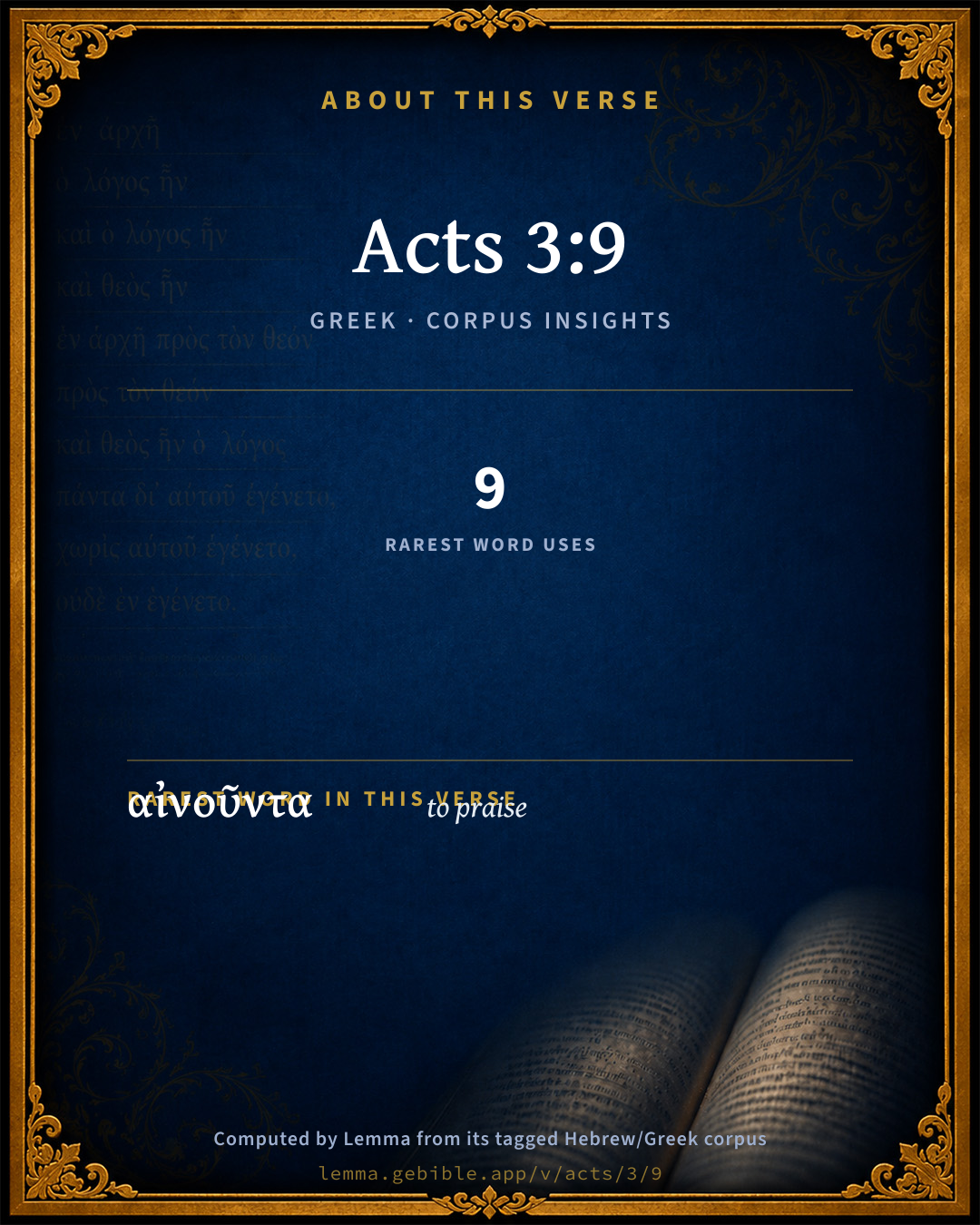
The rarest word here is αἰνοῦντα to praise G134 — appearing just 9 times in the whole Greek New Testament.

Shared distinctive vocabulary

αἰνοῦντα to praise G134 occurs in 9 verses of the Greek New Testament. Also found in:

Repetition

Words recur within this verse:

Cross-references

5

Topical passages linked to Acts 3:9 in the Treasury of Scripture Knowledge — connected by theme and wording, ordered by reader-vote popularity; previews shown in the World English Bible.

  • Luke 13:17 As he said these things, all his adversaries were disappointed, and all the multitude rejoiced for all the glorious things that were done by him.
  • Acts 4:16 saying, "What shall we do to these men? Because indeed a notable miracle has been done through them, as can be plainly seen by all who dwell in Jerusalem, and we can't deny it.
  • Acts 4:21 When they had further threatened them, they let them go, finding no way to punish them, because of the people; for everyone glorified God for that which was done.
  • Mark 2:11–12 "I tell you, arise, take up your mat, and go to your house."
  • Acts 14:11 When the multitude saw what Paul had done, they lifted up their voice, saying in the language of Lycaonia, "The gods have come down to us in the likeness of men!"

Cross-references courtesy of OpenBible.info (CC BY 4.0).

Commentary

Notes on Acts 3:9 from classic Christian and Jewish commentators (each source and its license shown beneath its notes). The classic Christian expositions comment on the surrounding passage and are grouped to its opening verse, so a note may address several verses; the Jewish commentaries on the Tanakh (Rashi and others) are per-verse, so they appear only where the commentator wrote on this verse.

Lemma curates 59 commentaries, every one of them public domain or Creative Commons licensed, each selected and text-cleaned for this edition rather than reprinted as found. About our sources →

Joseph Benson's Commentary

Act 3:9-11. And all the people — Who were there present; saw him walking — In the court of the temple; and heard him praising God — In this uncommon ecstasy of delight; and they knew that it was he which sat for alms at the Beautiful gate, &c. — He had sat there so long, that they all knew him; and for that reason he was chosen to be a vessel of mercy. Now they were not so perverse as to make any doubt whether he was the same man that had sat begging, as the Pharisees had questioned concerning the blind man that Christ cured, Joh 9:18; for they saw him walking and praising God, and probably took notice of a change in his mind, for he was now as loud in praising God, as he had used to be in begging relief. And they were filled with wonder and amazement — Greek, θαμβους και εκστασεως, with astonishment and ecstasy; they felt emotions, resembling those of the person healed; at that which had happened to him — At the miracle wrought for him. It is worth observing here, that this effect appears to have been produced by the late effusion of the Spirit; the people, at least those in Jerusalem, were more affected with the miracles which the apostles wrought, than they had been with those of the same kind that had been performed by Christ himself. And as the lame man held Peter and John — Full of gratitude for the great blessing he had received through their instrumentality; and while he walked on between them, sometimes, probably, taking hold of them by the hand; and sometimes embracing them as his great benefactors; all the people — In the neighbouring parts; ran together unto them — Some only to gratify their curiosity with the sight of men that had such power; others, perhaps, with a desire to hear them preach, concluding that the doctrine must needs be of divine origin, which had thus a divine confirmation: in the porch that is called Solomon’s — A spacious and celebrated portico of the temple. See note on Joh 10:23. Hither the people flocked to see this great sight.

Joseph Benson's Commentary on the Old and New Testaments (1811–1818) — public domain. Text from a community e-Sword module.

Jamieson, Fausset & Brown

Robert Jamieson, A. R. Fausset & David Brown

all the people saw him, &c.--as they assembled at the hour of public prayer, in the temple courts; so that the miracle had the utmost publicity.

Jamieson, Fausset & Brown — Commentary Critical and Explanatory on the Whole Bible (1871) — public domain (CC PDM 1.0). Text via the HelloAO Bible API.

Adam Clarke's Commentary

Verse 9. And all the people saw him] The miracle was wrought in the most public manner, and in the most public place, and in a place where the best judgment could be formed of it; for, as it was a Divine operation, the priests, c., were the most proper persons to judge of it and under their notice it was now wrought.

Adam Clarke's Commentary on the Bible (1810–1826) — public domain. Text from a community e-Sword/MySword module.

John Calvin's Commentaries

9. And all the people saw. He beginneth now to declare the fruit of the miracle, to wit, that the cripple began to show his thankfulness by praising God, and that all the people were brought into great wondering. And here is a double fruit. For he which was healed doth acknowledge and set forth the benefit of God; on the other side, the people is moved, and the fame is spread abroad, many come to see it. And whereas Luke saith that they were filled with wondering, it doth only declare a preparation, which a more full proceeding (and going forward) did at length follow. For it was necessary that they should go forward, because this their wondering had served to no end of itself, but did rather make them astonied and amazed, than bring them (from their own proceedings) unto God.

Therefore it was, as it were, the foundation of the building which was to come, in that the people was touched with amazedness. For if we pass over the works of God contemptibly or carelessly, we shall never be able to profit by them. Furthermore, this place doth teach us what miracles do work of themselves in men; to wit, that they breed a confused amazedness. For although the Lord doth call us straightway unto himself, by showing plainly his goodness and power there, yet such is the weakness of our nature, that we stumble or faint in the midway, until such time as we be holpen by doctrine.

Let us, therefore, learn reverently to consider the works of God, that the wondering at them may make an entrance for doctrine. For when doctrine is cold and unprofitable with us, God doth justly punish our unthankfulness by this means, because we have despised the glory of his works. Again, because we are not so quick of sight, that we can see so much in the works of God alone, as is sufficient, let us learn to join therewithal the help of doctrine. To be brief, the one ought not to be separated from the other. Which thing experience doth sufficiently teach us. For hereby it came to pass that the world did so wickedly abuse miracles.

The Papists do object unto us miracles again and again. Let us suppose that they be true, whereof they make such boast, yet do they greatly err in this, that they wrest them to a wrong end; to wit, that they may darken the name of God, and infect the pure truth of the gospel with their inventions. For whence come so many superstitious worshippings of saints, save only from the abuse of miracles? For when any miracle is wrought, men must needs be moved. And because they are deaf when they should hear the Word, and do not mark what God cloth mean, Satan doth craftily take an occasion of superstition by our amazedness. As, for example, I will acknowledge the power of God in a miracle. If it were wrought by Peter, Satan will by and by put this in my head, and will say thus: Dost thou not see that this is a man of God? therefore thou dost owe unto him divine honor. The same thing had befallen the Jews when they were amazed, unless Peter’s sermon had called them back into the right way. But in Popery, where none did call them back or reprove them, the preposterous wondering of men did easily get the upper hand. Wherefore, we must so much the more seek for medicine out of the Word, that doctrine may direct us unto the right end, being lifted up with the miracles.

John Calvin's Commentaries (1540-1563) — public domain. Text from the Calvin Translation Society English edition (1840s-50s) via the Christian Classics Ethereal Library (ccel.org). Calvin's coverage is partial (roughly two-thirds of the Bible); uncommented books and verses are honest gaps, never fabricated. The 19th-century editor's footnotes and remarks are omitted so the notes are faithfully Calvin's own voice.

The Cambridge Bible for Schools and Colleges

gen. ed. J. J. S. Perowne

9. all the people saw him] There was abundance of testimony to the reality of the cure, and that by many persons who had seen the cripple for years. This the Jewish authorities (Act_4:16) admit.

The Cambridge Bible for Schools and Colleges (gen. ed. J. J. S. Perowne; Cambridge University Press, 1878–1918) — public domain. Text from a community e-Sword module.

John Gill's Exposition

And all the people,.... That were in the temple,

saw him walking; who before lay on a couch, or on the ground, and was so lame, that he was obliged to be carried;

and praising God; for this miraculous cure. The Arabic version renders it, "saw him walking to praise God": that is, entering into the temple with the apostles, in order to offer up the sacrifice of praise to God there.

John Gill's Exposition of the Whole Bible (1746–1763) — public domain (CC PDM 1.0). Text via the HelloAO Bible API.

Trapp's Complete Commentary

John Trapp

9 And all the people saw him walking and praising God:

Ver. 9. Praising God] Not the apostles. We may pay the messenger, but return thanks chiefly to the sender.

John Trapp, A Commentary or Exposition upon All the Books of the Old and New Testament (1647–1656) — public domain. Text from a community e-Sword module.

Albert Barnes' Notes on the Bible

And all the people ... - The people who had been accustomed to see him sit in a public place.

And they knew ... - In this they could not be deceived; they had seen him a long time, and now they saw the same man expressing his praise to God for complete recovery. The particulars in this miracle are the following, and they are as far as possible from any appearance of imposture:

1. The man had been afficated from a child. This was known to all the people. At this time he was 40 years of age, Act 4:22.

2. He was not an impostor. If he had pretended lameness, it is wonderful that he had not been detected before, and not have been suffered to occupy a place thus in the temple.

3. The apostles had no agency in placing him there. They had not seen him before. There was manifestly no collusion or agreement with him to attempt to impose on the people.

4. The man himself was convinced of the miracle, and did not doubt that the power by which he had been healed was of God.

5. The people were convinced of the same thing. They saw the effects; they had known him well; they had had every opportunity to know that he was diseased, and they were now satisfied that he was restored. There was no possibility of deception in the case. It was not merely the friends of Jesus that saw this; not those who had an interest in the miracle, but those who had been his enemies, and who had just before been engaged in putting him to death. Let this miracle be compared, in these particulars, with those pretended miracles which have been affirmed to have been performed in defense of other systems of religion, and it will be seen at once that in these there is every appearance of sincerity, honesty, and truth; in them, every mark of deception, fraud, and imposition. (See Paley’s “Evidences of Christianity,” proposition ii. chapter ii.)

Albert Barnes' Notes on the Bible (1834–1885) — public domain. Text from a community e-Sword/MySword module.

Matthew Poole's English Annotations

This miracle was so publicly done, that none could deny the matter of fact; which the enemies of the gospel are forced to confess, Act 4:16.

Matthew Poole's English Annotations on the Holy Bible (1683–1685) — public domain. Text from a community e-Sword/MySword module.

Whedon's Commentary on the Bible

Daniel D. Whedon

9. All the people—Even within the holy court a general attention, not of a disorderly populace, but of the worshippers in Jerusalem, rests upon the happy, restless shouter.

Daniel D. Whedon (gen. ed.), Commentary on the Old and New Testaments (1874–1909) — public domain. Text from a community e-Sword module.

Burkitt's Expository Notes on the New Testament

William Burkitt

Observe here, 1. As soon as ever the poor cripple received strength, all the people beheld him praising and blessing God.-

Learn hence, That the very first appearances of the power and mercy of God, towards ourselves or any of ours, should put us upon the works of praise and rejoicing. We truly say, "Better late than never;" but it is best to be early in every good work, especially in the noblest and most angelical work; namely, that of thanksgiving and praise. My voice shalt thou hear, says David, betimes in the morning: my praying voice, my praising voice.

Observe, 2. The influence and effect that this miracle had upon the minds of the multitude. ; it occasioned wonder, but did not produce faith. They wondered, but not believed. Miracles will confirm faith, but not alone beget it. The Spirit’s extraordinary works may produce astonishment; but it is the work of the Spirit that must produce faith.

Observe, 3. How the apostle abaseth himself and his fellow disciples, that he might exalt Christ; he will not suffer the least part of the praise and glory of this miracle to stick to their own fingers, but gives it all to Christ. Think not that we by pure power and holiness have made this man to walk. The Jews had a conceit, that extraordinary holiness would enable a man to work miracles: The apostle denies it: For though there be a great difference betwixt miraculous faith and justifying faith, ye true justifying faith has a miracle in it, though not so obvious to sense, requiring the same power to work it in us, which raised up Christ from the dead, Eph 1:20.

Learn hence, That Christ’s power, not is apostles’ holiness, was the cause of all the miracles that were wrought by them. Why look you so earnestly upon us, as though by our holiness we had made this man to walk? Through faith in his name, is this man made strong, Act 3:16.

William Burkitt's Expository Notes on the New Testament (1700–1703) — public domain. Text from a community e-Sword module.

McGarvey & Pendleton's Commentaries

J. W. McGarvey

See notes on verse 1

J. W. McGarvey (with Philip Y. Pendleton), Commentaries on the New Testament (The Fourfold Gospel, 1914; Acts; and the epistles) — public domain. Text from a community e-Sword/MySword module.

The People's New Testament

B. W. Johnson

9, 10. The people … were filled with wonder. They had often seen the lame beggar, but now saw him “walking, and leaping and praising God,” and did not know how he had been healed.

B. W. Johnson's The People's New Testament with Notes (1889–1891) — public domain. Electronic text from the Christian Classics Ethereal Library (CCEL) ThML edition.

unfoldingWord translationNotes

Door43 World Missions Community

noticed that it was the man

"realized that it was the man" or "recognized him as the man"

the Beautiful Gate

This was the name of one of the entrances to the temple area. See how you translated a similar phrase in Acts 3:2.

they were filled with wonder and amazement

Here the words "wonder" and "amazement" share similar meanings and emphasize the intensity of the people's amazement. AT: "they were extremely amazed" (See: Doublet)

translationWords

praise

God

alms

gate

amazed

unfoldingWord translationNotes — © Distant Shores Media and the Door43 World Missions Community, licensed CC BY-SA 4.0. Source: git.door43.org/Door43/en_tn.

Cambridge Greek Testament for Schools and Colleges

9. πᾶς ὁ λαός, all the people. There was no lack of testimony to the reality of the cure. Many of the witnesses must have known the cripple for years. The Jewish authorities (Act 4:16) admit the unimpeachable character of the evidence.

Cambridge Greek Testament for Schools and Colleges (Cambridge University Press, 1896; 21 vols, various authors incl. Carr, Maclear, Plummer, Farrar, Lumby, Moule, M. R. James, Simcox) — public domain. Text from a community e-Sword module.

Lesson kit

Teaching starters — assembled from the data on this page, not authored interpretation. Every prompt links to the verse data it draws on. Edit before teaching.

Acts, in the Acts, opens this verse with 11 words (9 distinct Greek lemmas). Its most distinctive word is ainéō (“to praise”). A historical commentator’s framing appears above. Read the whole chapter for the surrounding context.

Discussion questions

  1. How does “to praise” (ainéō) shape what this verse is saying?
  2. How does Luke 2:13, which shares the word «to praise», read alongside this verse?
  3. What does the repetition of “and” (2× in this one verse) do in this verse?
  4. Compare how Joseph Benson's Commentary and Jamieson, Fausset & Brown read this verse. Where do they agree or differ?

Things to notice

Reading settings

Reading text

Shown beneath each verse's original-language words.

Old Testament
Old Testament edition

Read the OT as the Masoretic Hebrew (MT) or the Greek Septuagint (LXX).

English shown for the Greek Septuagint (in the Hebrew ↔ Greek comparison).

Comparing translations? Open the Compare panel on any verse page to stack up to four side by side.