Acts 5:20

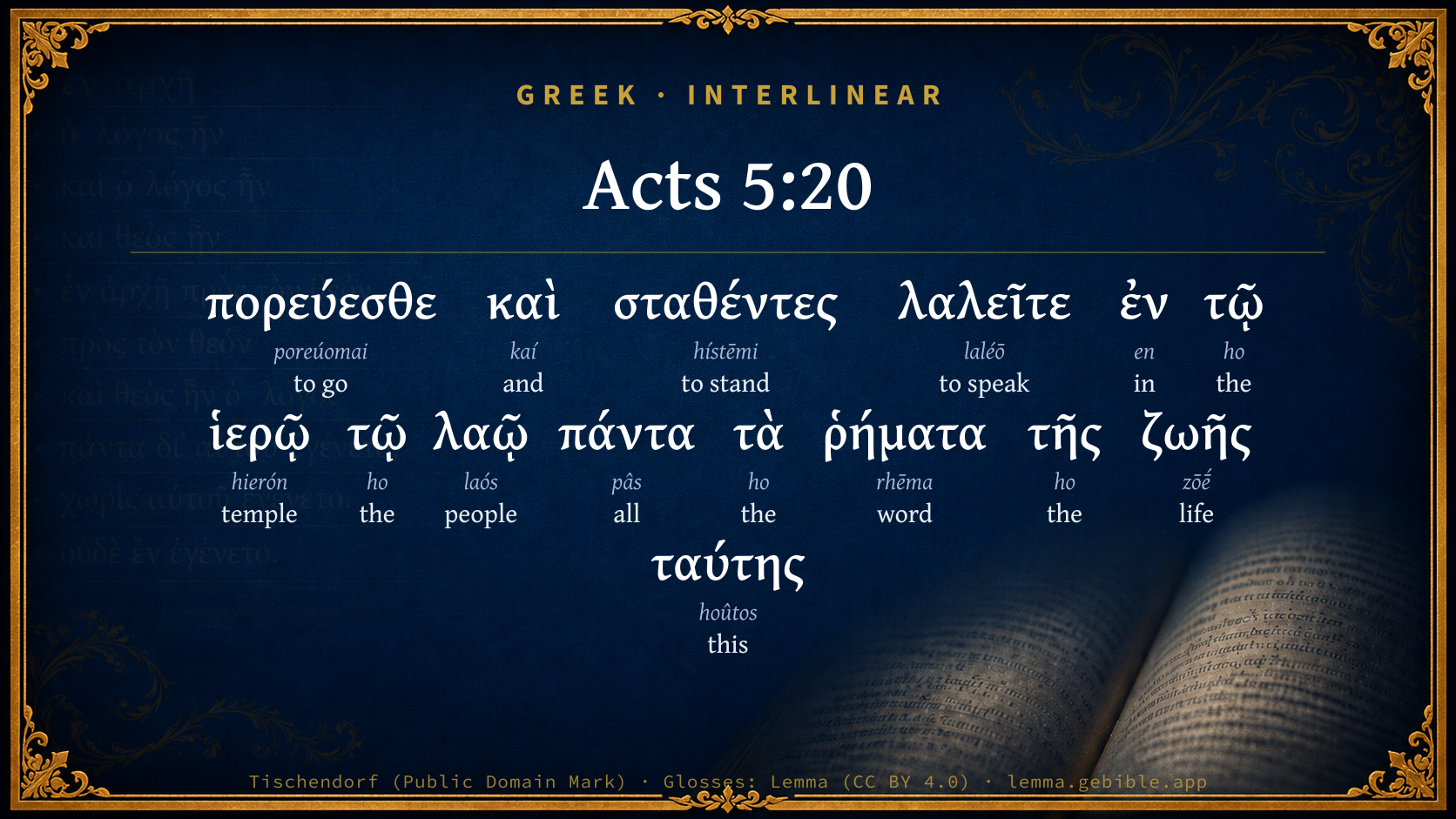
Greek (Tischendorf 8th ed.) Acts 5:20 appears in the Greek New Testament. The text above is from the Tischendorf 8th edition. Each word links to its Strong’s number and a concise gloss. Click any word for its full Thayer’s Greek Lexicon entry.
Download image
Cite this verse

Acts 5:20 (World English Bible). Public Domain. Lemma interlinear Bible study tool, https://lemma.gebible.app/v/acts/5/20.

Show BibTeX & RIS
BibTeX
RIS
English Translation
"Go stand and speak in the temple to the people all the words of this life."
World English Bible · Public Domain
Download a study sheet

One document with this verse’s original text, its word-by-word gloss line, the meaning frame, cross-references with their text, attributed commentary, and full source and license credits — printable, and it pastes into notes with its structure intact.

This verse Autodidact and up

Study sheet (.html) Plain text (.txt)

A passage Seminary Student

Up to 50 verses in one chapter. A passage sheet keeps up to 6 commentary sources and 12 cross-references per verse, in the order this page ranks them, and says so on the sheet whenever that leaves anything out. Ask for a single verse and you get the Autodidact verse sheet above.

Everything on this page stays free to read, with no account — the sheet is a download of what is already on screen, not access to it.

Want to remove ads? Support Godless Engineer
Compare translations 3

The same verse in 3 English versions, stacked beneath the original-language interlinear above. Click any original word for its lexicon entry.

Each is an independent rendering of the whole verse — the interlinear is not word-aligned to these translations.

Highlighted words mark where these versions differ — a whole-verse word diff, not a word-by-word alignment.

  • World English Bible Public Domain
    "Go stand and speak in the temple to the people all the words of this life."
  • King James Version Public Domain
    Go, stand and speak in the temple to the people all the words of this life.
  • unfoldingWord Literal Text CC BY-SA 4.0
    “Go and, standing in the temple, speak to the people all the words of this life.”

unfoldingWord Literal Text — © unfoldingWord, licensed CC BY-SA 4.0. Word-aligned USFM3 via Door43 (git.door43.org/unfoldingWord/en_ult).

Versions to compare (up to 4)

3 of 4 selected

Show all 19 translations

Every available English version of this verse, each an independent rendering of the whole verse.

  • World English Bible Public Domain
    "Go stand and speak in the temple to the people all the words of this life."
  • Berean Standard Bible Public Domain
    “Go, stand in the temple courts and tell the people the full message of this new life.”
  • Majority Standard Bible Public Domain
    “Go, stand in the temple courts and tell the people the full message of this new life.”
  • King James Version Public Domain
    Go, stand and speak in the temple to the people all the words of this life.
  • American Standard Version (1901) Public Domain
    Go ye, and stand and speak in the temple to the people all the words of this Life.
  • Revised Version (1885) Public Domain
    Go ye, and stand and speak in the temple to the people all the words of this Life.
  • Geneva Bible (1599) Public Domain
    Go your way, and stand in the Temple, and speake to the people, all the wordes of this life.
  • Douay-Rheims (1899) Public Domain
    Go, and standing speak in the temple to the people all the words of this life.
  • Young's Literal Translation Public Domain
    `Go on, and standing, speak in the temple to the people all the sayings of this life;'
  • Literal Standard Version CC BY-SA 4.0
    “Go on, and standing, speak in the temple to the people all the sayings of this life”;
  • Unlocked Literal Bible CC BY-SA 4.0
    “Go, stand in the temple and speak to the people all the words of this life.”
  • unfoldingWord Literal Text CC BY-SA 4.0
    “Go and, standing in the temple, speak to the people all the words of this life.”
  • Darby Bible Public Domain
    Go ye and stand and speak in the temple to the people all the words of this life.
  • World Messianic Bible Public Domain
    “Go stand and speak in the temple to the people all the words of this life.”
  • Webster's Bible Public Domain
    Go, stand and speak in the temple to the people all the words of this life.
  • Free Bible Version CC BY-SA 4.0
    “Go to the Temple and tell the people everything about this new way of life!” he told them.
  • Bible in Basic English Public Domain
    Go, take your place in the Temple and give the people all the teaching about this Life.
  • Text-Critical English NT CC BY 4.0
    “Go stand in the temple courts and tell the people everything about this new life.”
  • Tyndale New Testament (1534) Public Domain
    goo steppe forthe and speake in the temple to the people all the wordes of this lyfe.

Literal Standard Version (2020), Covenant Press — licensed CC BY-SA 4.0. Text via the HelloAO Bible API (eBible.org). Unlocked Literal Bible (unfoldingWord) — licensed CC BY-SA 4.0. Text via the HelloAO Bible API (eBible.org). unfoldingWord Literal Text — © unfoldingWord, licensed CC BY-SA 4.0. Word-aligned USFM3 via Door43 (git.door43.org/unfoldingWord/en_ult). Free Bible Version, Dr. Jonathan Gallagher — licensed CC BY-SA 4.0. Text via the HelloAO Bible API (eBible.org).

Word by word

More ways to search: Search by grammar → Find every occurrence → Compare this word →

Practice this passage: Drill this verse → Learn its vocabulary →

ῥήματα
rhēma
G4487
“word”
Noun, Accusative, Plural, Neuter
Part of Speech
Noun
Case
Accusative
Number
Plural
Gender
Neuter
Full Thayer's Definition

Origin: from G4483

TDNT: 05:09,5

1. that which is or has been uttered by the living voice, thing spoken, word a. any sound produced by the voice and having definite meaning b. speech, discourse 1. what one has said c. a series of words joined together into a sentence (a declaration of one's mind made in words) 1. an utterance 2. a saying of any sort as a message, a narrative 1c d. concerning some occurrence 2. subject matter of speech, thing spoken of a. so far forth as it is a matter of narration b. so far as it is a matter of command c. a matter of dispute, case at law
  1. πορεύεσθε poreúomai G4198 “to go” Verb, Present, Middle or Passive deponent, Imperative, 2nd person, Plural
  2. καὶ kaí G2532 “and” Conjunction
  3. σταθέντες hístēmi G2476 “to stand” Verb, Aorist, Passive, Participle, Nominative, Plural, Masculine
  4. λαλεῖτε laléō G2980 “to speak” Verb, Present, Active, Imperative, 2nd person, Plural
  5. ἐν en G1722 “in” Preposition
  6. τῷ ho G3588 “the” Article, Dative, Singular, Neuter
  7. ἱερῷ hierón G2411 “temple” Noun, Dative, Singular, Neuter
  8. τῷ ho G3588 “the” Article, Dative, Singular, Masculine
  9. λαῷ laós G2992 “people” Noun, Dative, Singular, Masculine
  10. πάντα pâs G3956 “all” Adjective, Accusative, Plural, Neuter
  11. τὰ ho G3588 “the” Article, Accusative, Plural, Neuter
  12. τῆς ho G3588 “the” Article, Genitive, Singular, Feminine
  13. ζωῆς zōḗ G2222 “life” Noun, Genitive, Singular, Feminine
  14. ταύτης hoûtos G3778 “this” Demonstrative pronoun, Genitive, Singular, Feminine

About this verse

These counts appear in no published source. They are computed here, from the morphology-tagged text and Lemma’s own curated glosses. What Lemma adds →

15
words
12
distinct lemmas
Acts
section

Repetition

A word recurs within this verse:

Cross-references

18

Topical passages linked to Acts 5:20 in the Treasury of Scripture Knowledge — connected by theme and wording, ordered by reader-vote popularity; previews shown in the World English Bible.

  • John 6:63 It is the spirit who gives life. The flesh profits nothing. The words that I speak to you are spirit, and are life.
  • John 6:68 Simon Peter answered him, "Lord, to whom would we go? You have the words of eternal life.
  • 1 John 5:11–12 The testimony is this, that God gave to us eternal life, and this life is in his Son.
  • Matthew 21:23 When he had come into the temple, the chief priests and the elders of the people came to him as he was teaching, and said, "By what authority do you do these things? Who gave you this authority?"
  • 1 John 1:1–3 That which was from the beginning, that which we have heard, that which we have seen with our eyes, that which we saw, and our hands touched, concerning the Word of life
  • John 12:50 I know that his commandment is eternal life. The things therefore which I speak, even as the Father has said to me, so I speak."
  • John 17:3 This is eternal life, that they should know you, the only true God, and him whom you sent, Jesus Christ.
  • Jeremiah 36:10 Then read Baruch in the book the words of Jeremiah in the house of Yahweh, in the chamber of Gemariah the son of Shaphan, the scribe, in the upper court, at the entry of the new gate of Yahweh's house, in the ears of all the people.
  • John 18:20 Jesus answered him, "I spoke openly to the world. I always taught in synagogues, and in the temple, where the Jews always meet. I said nothing in secret.
  • Acts 11:14 who will speak to you words by which you will be saved, you and all your house.'
  • Isaiah 58:1 Cry aloud, don't spare, lift up your voice like a trumpet, and declare to my people their disobedience, and to the house of Jacob their sins.
  • Jeremiah 7:2 Stand in the gate of Yahweh's house, and proclaim there this word, and say, Hear the word of Yahweh, all you of Judah, who enter in at these gates to worship Yahweh.
  • Jeremiah 19:14–15 Then came Jeremiah from Topheth, where Yahweh had sent him to prophesy; and he stood in the court of Yahweh's house, and said to all the people:
  • Jeremiah 20:2–3 Then Pashhur struck Jeremiah the prophet, and put him in the stocks that were in the upper gate of Benjamin, which was in the house of Yahweh.
  • Jeremiah 22:1–2 Thus said Yahweh: Go down to the house of the king of Judah, and speak there this word,
  • Jeremiah 26:2 Thus says Yahweh: Stand in the court of Yahweh's house, and speak to all the cities of Judah, which come to worship in Yahweh's house, all the words that I command you to speak to them; don't diminish a word.
  • Exodus 24:3 Moses came and told the people all the words of Yahweh, and all the ordinances; and all the people answered with one voice, and said, "All the words which Yahweh has spoken will we do."
  • John 17:8 for the words which you have given me I have given to them, and they received them, and knew for sure that I came forth from you, and they have believed that you sent me.

Cross-references courtesy of OpenBible.info (CC BY 4.0).

Commentary

Notes on Acts 5:20 from classic Christian and Jewish commentators (each source and its license shown beneath its notes). The classic Christian expositions comment on the surrounding passage and are grouped to its opening verse, so a note may address several verses; the Jewish commentaries on the Tanakh (Rashi and others) are per-verse, so they appear only where the commentator wrote on this verse.

Lemma curates 59 commentaries, every one of them public domain or Creative Commons licensed, each selected and text-cleaned for this edition rather than reprinted as found. About our sources →

Bengel's Gnomon

Johann Albrecht Bengel

Act 5:20. Πορεύεσθε, go) at once.—σταθέντες, standing) most freely.—ἐν τῷ ἱερῷ, in the temple) in public, as before.—τῷ λαῷ, to the people) whereas the rulers do not wish them to hear.—πάντα, all) without any curtailment.—τὰ ῥήματα τῆς ζωῆς ταυτῆς, the words of this life) That is, these words of life. With this comp. Act 5:32. So among the Hebrews the adjective often is connected with the latter of the two substantives. Comp. ch. Act 13:26, “The word of this salvation.” The words of life, Joh 6:68 (” Lord, Thou hast the words of eternal life”), are to be proclaimed without fear, viz. the words concerning the life of Christ and of believers.

Bengel's Gnomon of the New Testament — English translation (T&T Clark, Edinburgh, 1860) — public domain. Text from a community e-Sword module.

Expositor's Greek Testament

ed. W. Robertson Nicoll

Act 5:20 . Πορεύεσθε : characteristic of St. Luke both in Gospel and Acts. The word appears here in Acts for the first time, and it is found in St. Luke’s Gospel about fifty times, and in this book nearly forty (Friedrich, Lekebusch). σταθέντες , Act 2:14 , on this pictorial use of the word, see Page’s note, and Friedrich, Das Lucasevangelium , p. 42; so also ἀναστάς , ἐπιστάς , ἐγερθείς , καθίσας , στραφείς here it intimates the boldness with which the Apostles were to proclaim their message. ἐν τῷ ἱερῷ : they were to speak not only boldly but publicly. τῆς ζωῆς ταύτης ( cf. Act 13:26 , τῆς σωτηρίας ταύτης , and Rom 7:24 ), i.e. , the life to which the whole Apostolic preaching referred, the life which the Sadducees denied, bestowed by Him who was Himself the Resurrection and the Life, cf. Act 3:15 , Act 4:12 . This or a similar explanation is accepted by Holtzmann, Wendt, Weiss, Zöckler, Blass. On the attempt to explain the words as simply = these words of life, see Winer-Moulton, xxxiv. 3, b. , and see also Grimm, sub v. ῥῆμα .

The Expositor's Greek Testament, edited by W. Robertson Nicoll (1897–1910) — public domain. Text from a community e-Sword module.

Geneva Bible (1599)

Geneva Bible translators

God doth therefore deliver his, that they may more stoutly provoke his enemies.

Words, whereby the way unto life is showed.

Geneva Bible (1599) marginal notes — public domain. Text via Bolls.life.

Jamieson, Fausset & Brown

Robert Jamieson, A. R. Fausset & David Brown

all the words of this life--beautiful expression for that Life in the Risen One which was the burden of their preaching!

Jamieson, Fausset & Brown — Commentary Critical and Explanatory on the Whole Bible (1871) — public domain (CC PDM 1.0). Text via the HelloAO Bible API.

Adam Clarke's Commentary

Verse 20. All the words of this life.] All the doctrines of life eternal, founded on the word, death, and resurrection of Christ Jesus. This is another periphrasis for Gospel. Go to the temple-the most public place, and speak to the people-who come there to worship according to the law, the words of this life-the whole doctrine of salvation from sin and death; and show that the law is fulfilled in the sacrifice of Jesus, and that, by his resurrection, he has brought life and immortality to light.

Adam Clarke's Commentary on the Bible (1810–1826) — public domain. Text from a community e-Sword/MySword module.

John Calvin's Commentaries

20. Speak in the temple. This is the end of their deliverance, that they employ themselves stoutly in preaching the gospel, and provoke their enemies courageously, until they die valiantly. For they were put to death at length when the hand of God ceased, after that they had finished their course; but now the Lord openeth the prison for them, that they may be at liberty to fulfill their function. That is worth the marking, because we see many men, who, after they have escaped out of persecution, do afterwards keep silence, as if they had done their duty towards God, (and were no more to be troubled;) other some, also, do escape away by denying Christ; but the Lord doth deliver his children, not to the end they may cease off from the course which they have begun, but rather that they may be the more zealous afterward. The apostles might have objected, It is better to keep silence for a time, forasmuch as we cannot speak one word without danger; we are now apprehended for one only sermon, how much more shall the fury of our enemies be inflamed hereafter, if they shall see us make no end of speaking? But because they knew that they were to live and to die to the Lord, they do not refuse to do that which the Lord commanded; so we must always mark what function the Lord enjoineth us. There will many things meet us oftentimes, which may discourage us, unless being content with the commandment of God alone, we do our duty, committing the success to him.

The words of this life. A singular commendation of the gospel, that it is a lively doctrine, bringing salvation unto men; for the righteousness of God is revealed unto us in it, (Romans 1:17;) and in it Christ offereth himself unto us with the sacrifice of his death, with the Spirit of regeneration, with the earnest of our adoption. And this is spoken expressly to the apostles, to the end they may the more courageously enter all manner of combats for the gospel, forasmuch as they hear that they are ministers of eternal salvation. The demonstrative is added for the more certainty, as if the angel did point out life with his finger, as assuredly we need not to seek the same far, when we have the word in our mouth and in our heart; unless peradventure some man had rather take it by hypallage, the words of this life, for these words, which I do not reject, yet that former sense me thinks is better, for it was a new revelation of Christ wherein they had life present.

John Calvin's Commentaries (1540-1563) — public domain. Text from the Calvin Translation Society English edition (1840s-50s) via the Christian Classics Ethereal Library (ccel.org). Calvin's coverage is partial (roughly two-thirds of the Bible); uncommented books and verses are honest gaps, never fabricated. The 19th-century editor's footnotes and remarks are omitted so the notes are faithfully Calvin's own voice.

Ellicott's Commentary for English Readers

(20) All the words of this life.—The use of the demonstrative pronoun is significant. The “life in Christ” which the Apostles preach is that eternal life which consists in knowing God (Joh_17:1), and in which the angels are sharers.

A Bible Commentary for English Readers, edited by Charles John Ellicott (1878–1897) — public domain. Text from a community e-Sword module.

The Cambridge Bible for Schools and Colleges

gen. ed. J. J. S. Perowne

20. Go, stand and speak in the temple] There is a conjunction in the Greek which is not here expressed. Render, Go ye and stand and speak.

There was to be no attempt made to conceal their escape. They were to go back to the same place where their most frequent teachings had been given before, and they were to continue the same teaching. They are not directed to appeal to the multitude for sympathy, nor to try and excite any feeling against those who had arrested them.

to the people all the words of this life] Here we have another of the words by which St Luke emphasizes in the most natural manner the point at issue between the Sadducees and the Apostles.

this life] i.e. this future life, the promise of which has received its first fulfilment in the resurrection of Jesus. This was the teaching which the Sadducees could not tolerate, but which in spite of opposition was to be persisted in.

The Cambridge Bible for Schools and Colleges (gen. ed. J. J. S. Perowne; Cambridge University Press, 1878–1918) — public domain. Text from a community e-Sword module.

John Gill's Exposition

And when they heard that,.... Or "his word", as the Arabic version supplies; that is, the word of the angel, the orders enjoined them by him, to go to the temple, and there preach the Gospel; this clause is left out in the Syriac version:

they entered into the temple early in the morning; they were obedient to the command of the angel, believing him to be a messenger of God, who declared his will, which they readily complied with, and were indeed eager of doing it; and therefore early in the morning, as soon as ever the temple doors were opened, and there were any people got together, they went in:

and taught; as the Ethiopic version adds, "the people, this word of life"; the doctrine or doctrines of the Gospel which the angel had bid them teach:

but the high priest came, and they that were with him: as before, to the place where the sanhedrim used to meet; either the chamber Gazith, or the shops, or some other place in Jerusalem; See Gill on Act 4:15.

and called the council together; the sanhedrim, consisting of seventy one, which usually met at the time of the morning daily sacrifice; perhaps on this occasion they might be called together sooner, and everyone of them summoned to attend; for otherwise it was not necessary that every particular member should be present, but when there was any business of importance which required it, they were all gathered together (o):

and all the senate of the children of Israel; or the elders, as the Vulgate Latin, Syriac, and Arabic versions read, the rest of the elders of the city, besides those of the great sanhedrim. Dr. Lightfoot thinks, that the two other sanhedrim, or courts of judicature in Jerusalem, which consisted of twenty three persons apiece, are designed; and who, as he rightly observes from Maimonides (p), sat the one in the gate of the court, the other in the gate of the mountain of the house; so that all the courts in Jerusalem were called together at this time; and if they all met, they made up a hundred and seventeen men:

and sent to the prison to have them brought; that is, "the apostles", as the Syriac version reads. The sense is, that the high priest, and those that were with him at the same time that they convened all the courts of judicature in Jerusalem together, sent their officers to the prison, to fetch the apostles; or else the sanhedrim, and senate of Israel being met, they ordered their officers to go to the common jail, and bring the apostles before them, to be examined, tried, and judged by them.

(o) Maimon. Hilchot Sanhedrin, c. 2. sect. 1, 2. (p) Maimon. Hilchot Sanhedrin, c. 1. sect. 2.

John Gill's Exposition of the Whole Bible (1746–1763) — public domain (CC PDM 1.0). Text via the HelloAO Bible API.

Trapp's Complete Commentary

John Trapp

20 Go, stand and speak in the temple to the people all the words of this life.

Ver. 20. Stand and speak] Stand close to the work, stir not a foot, start not a hair’s breadth.

John Trapp, A Commentary or Exposition upon All the Books of the Old and New Testament (1647–1656) — public domain. Text from a community e-Sword module.

Albert Barnes' Notes on the Bible

In the temple - In a public and conspicuous place. In this way there would be a most striking exhibition of their boldness; a proof that “God” had delivered them, and a manifestation of their purpose to obey God rather than man.

All the words - All the doctrines. Compare Joh 6:68, “Thou hast the words of eternal life.”

Of this life - Pertaining to life, to the eternal life which they taught through the resurrection of Jesus. The word “life” is used sometimes to express “the whole of religion,” as opposed to the spiritual “death” of sin. See Joh 1:4; Joh 3:36. Their deliverance from prison was not that they might be idle, and escape to a place of safety. Again they were to engage in the toils and perils which they had just before encountered. God delivers us from dangers sometimes that we may plunge “into” new dangers; he preserves us from one form of calamity that we may be tried in some new furnace of affliction; he calls us to encounter trials simply “because” he demands it, and as an expression of gratitude to him for his gracious interposition.

Albert Barnes' Notes on the Bible (1834–1885) — public domain. Text from a community e-Sword/MySword module.

Matthew Poole's English Annotations

Stand; the word implies courage and stedfastness of mind, as well as such a posture of the body.

All the words; without preferring some acceptable truths before others more ungrateful, if necessary towards their salvation. Christ for a time did limit them; they might not tell any that he was Jesus the Christ, Mat 16:20, nor the vision which they had seen in his transfiguration, Mat 17:9. Now this prohibition is taken off. Thus the sun does not shine in his full glory all at once.

This life; some admit of an hypallage, and join the pronoun to the other substantive, reading in this place, these words of life; and the rather because by this life is ordinarily understood the present, temporary life, as in 1Co 15:19; but there needs not this translatitious sense; by this life, the angel might very well understand eternal life and salvation, for that was it which the Sadducees denied, and for the preaching of which life the apostles were imprisoned.

Matthew Poole's English Annotations on the Holy Bible (1683–1685) — public domain. Text from a community e-Sword/MySword module.

Whedon's Commentary on the Bible

Daniel D. Whedon

20. Go—A new commission from God assuring them that a higher power than high priests and Sanhedrins was on their side.

Stand—A sublime word for these apostles occupying the post of danger for the salvation of the world.

In the temple—In the very citadel of the persecution, at the very spot of their arrest, on the very pedestal of their former address to the nation of old Israel.

This life—Such a life as the world never knew before. So in Act_13:26, word of this salvation; and Rom_7:24, body of this death.

Daniel D. Whedon (gen. ed.), Commentary on the Old and New Testaments (1874–1909) — public domain. Text from a community e-Sword module.

The Pulpit Commentary

Go ye for go, A.V. In the temple; not in the house, but in the courts. The words of this Life; i.e. this life which is in Christ, whom ye preach, through his resurrection from the dead. (comp. Joh_6:68, "Thou hast the words of eternal life;" see too the whole chapter and 1Jn_1:1-3)

The Church"s mission to the world.

stand and speak," etc. Acts of apostles the model for acts of God"s people always. Lessons on relation of the Church and the world. Gospel began to lay hold of the masses. Envy and hatred of the Sadducean party, because a religion which lifted up the people, they thought, would lower the wealthy and ease-loving. We must expect social difficulties as the kingdom of righteousness spreads, but the angel"s message is the rule of all times; while opportunity offers, stand and speak, not your own message, but "all the words of this life." While we listen to the angel"s words, we should keep our eye fixed on the unveiled secret of Divine strength delivering and protecting all true-hearted preachers of Christ"s truth.

I THE GREAT COMMISSION. "Speak... to the people.

1. Copy the example of the Master. "Common people heard him gladly.

2. Best on the adaptation of the gospel to the people"s wants. They are deceived by false teachers, run after false remedies.

3. Take courage by the facts of the early history of Christianity. All moral prowess from the people. Illustrate in the course of Christianity in the Roman empire from the cottage to the throne. In the Reformation, especially in England. Lollards. Luther. Preaching of the revivalists in the eighteenth and present centuries.

4. Note the events. The future in the hands of the people. Speak to them of Christ; for their power is great, and they may abuse it to the destruction of society. Babel-greatness must end in confusion and misery.

5. Consider the responsibility of Christians. Believe, and therefore speak; silence is shame. Activity is the hope of the Church, the cure of its strifes and the uprooting of its doubts.

II THE GREAT MESSAGE, "All the words of this life.

1. Reality life. Men"s daily struggle is about life. Yet the world full of delusions about life. This life! That life! We invite the people to live the true life, Christ"s life, the life that death cannot touch.

2. Announcement. "Words of this life." We proclaim facts, a Divine Person, a life that can be described by example, confirmed by testimony, studied in the written pages. Religion no dream of enthusiasts, no mere sentiment floating like a cloud in the air, no empty ritualism, but words of life translated into action.

3. Philanthropy. All the words." Different from mere human teachers with their reservations and selfishness. Philosophers taught for money. Christ says, "Speak all to the people freely." Religion in the hands of priests has made the people enemies, but this new message in the temple would shake down the wails of superstition, prejudice, and pride, and build up a new humanity. In our message we must put so much heart that the people see we give them all that we have, because we love their souls first and their earthly interests as included in their spiritual welfare.

4. Aggression. "Go, stand in the temple;" Be not afraid of their faces." Bold policy always the wisest in spiritual things. Special necessity that the desecrated temple should witness the faithfulness of Christ"s messengers. False religion the great obstacle to progress of the gospel. People misunderstand the message; think of priests as their enemies; have reason to think so. The gospel does not reject what is good in other systems, but plants itself in the midst of the world as it is; finds in the temple of the old religion a standing-place from which to preach the new tidings. Every fresh instance of Divine interposition should embolden us. You are free now, go to the work again. In all fields of labor discouragement must be absolutely excluded. Follow the angels of God, and they will point to new platforms. We shall speak with fresh power if we refuse to be thwarted by opposition or put out of countenance by suffering. R.

The theme of themes: the angel"s charge.

speak, of this life." There can be no doubt as to what is essentially the reference in this expression used by the angel. But whence the angel, so to say, borrowed it admits of a thought and a question. The angel speaks of the life involved in the fact of the Resurrection that fact so unwelcome to the pinched, impoverished Sadducees, who now were the leading persecutors of the apostles. However great the single fact of the resurrection of Jesus, its greatness is magnified by some infinite number, when we regard it as an earnest and "first fruits" of very much in its train.

Had it been a unique fact, and been designed to remain so, it would have been shorn of the crown of its glory. Solitary grandeur and majesty must necessarily have robbed it of its power to thrill unnumbered millions with hope and joy, and to point all humanity to the one quarter from which light arises to it. And probably the simplest will be the best account of the angel"s naming it this life." "Go, stand and speak in the temple to the people all the words of this life," viz. the life which has been the unceasing theme now for some days, of your thought, your one unbroken affection, and your testimony. We have here an angel"s charge. Let us notice of what it is made up. The angel urges

I THAT THE LIFE WHICH IS TO SUPERSEDE THE PRESENT LIFE OF EARTH IS NOW TO RE THE BURDEN OF THE APOSTLES" PREACHING. Some persons object to the prominence given in preaching to what is to come and the circle of subjects involved therein. They think it unnatural, artificial. However, not to do this is to put off again the unspeakable advantages of revelation. That the practical duty of the present life should be preached by the Christian preacher is a truism. That it should be preached without the light of the eternal future, and what is most distinctive of it revealed in Scripture, is to turn the back on the priceless gift of revelation. Hence come the mightiest of living practical impulses for right, for elevated, for holy life on earth. The mind stirs with a new and wondering gaze; the imagination is divinely tempted not to be either deluded in the nature of what it takes hold upon or defrauded in the measure of it; and the heart is reached to its deepest wants. The infinitely enlarged horizon that comes of the revelation of eternal life does neither affect nor for a moment wish to alter the foundations of moral truth and of duty. But it does throw a light and color and interest into the very midst of them, and for the mass of mankind first brings them into the class of acknowledged practical forces. At any time machinery is one thing, and motive force another. Christ"s destruction of the boundary view death, and his illimitable extension of the boundary view onward to eternal life, legitimately make the very essence (not at all of the foundations of morality, but) of a very large part of the force of his appeal to mankind. The angel"s charge is dead contrary to anything looking in the direction of affecting to be able to dispense with his method or to throw it at all into the shade. And the centuries that have passed since the angel released the apostles at early dawn from prison, and bade them go and preach "the words of this life," have vindicated his charge. The preaching that has been filled with moral aphorisms has been dead and barren of force. That which has reverently but confidently dealt with the tremendous realities of the great future unseen unseen except by the light of revelation and faith has been the preaching that has been fruitful of influence and has shown changed hearts and changed lives.

II THAT "THIS LIFE" SHALL BE THE SUBJECT OF UNIVERSAL APPEAL TO "THE PEOPLE." The distinguishing facts or doctrines of Christianity know no distinction of esoteric and exoteric. They are what may be understood of the people, and they are what may be trusted to the people. Sadducees and others, not a few who would profess themselves conversant with these higher matters of life and its outlook, are putting from them their grand opportunity. But to "the people," "the gospel," "the words of this life," are preached. The gospel is to try its genius and its force among them, and then it tries it ever, not altogether in vain. It is to be noticed that this crowning doctrine or fact of the future life or eternal life is

(1) to be announced in closest connection with the personal history of Jesus Christ with his Resurrection; and

(2) that it is to be announced with all the fullness and variety of which it may admitAll the words of this life" are to be enlarged on without stint:

(a) what it is in its own intrinsic self,

(b) what it is as gained for man by Christ,

(c) what it is as illustrated by Christ"s own resurrection.

III THAT THE APPEAL SHALL BE FEARLESSLY MADE BY MEN, MERE MEN, MEN UNASSISTED BY ANY EARTHLY POWER AND EXPOSED TO ALL EARTHLY DANGERS. Jesus Christ has done his work, so far as the part of it on earth was concerned. Angels, it clearly appears, have their share too in furthering the work of Christ on earth. But their share is of a more indirect kind. When Jesus goes, men, feeble, erring, sinful men, are called to take up the work, are honored to take it up. Let this mean what it may, and harmonize with what it may or may not, the fact merits probably more thought than all it has yet received. And if it is to be rightly estimated, equal regard must be paid to two facts

(1) that man is to be the worker, and that

(2) the man who is thus to work is to be one "called" and one qualified by the Holy Spirit. Thus called and thus equipped within, he is to "go, and stand," as though in unassisted strength, and to stand in the place of courted and solemn observation, in the publicity of" the temple," and to take heed that he "speak to the people all the words of this life. B.

The Pulpit Commentary (1880–1919), ed. H.D.M. Spence-Jones & Joseph S. Exell — public domain. Text from a community e-Sword module.

John Wesley's Explanatory Notes

The words of this - That is, these words of life: words which show the way to life everlasting.

John Wesley, Explanatory Notes Upon the Whole Bible (1754–1765) — public domain. Text via the GEBible commentary corpus.

McGarvey & Pendleton's Commentaries

J. W. McGarvey

See notes on verse 19

J. W. McGarvey (with Philip Y. Pendleton), Commentaries on the New Testament (The Fourfold Gospel, 1914; Acts; and the epistles) — public domain. Text from a community e-Sword/MySword module.

The People's New Testament

B. W. Johnson

20. Go, stand and speak in the temple. They were to return at once to their interrupted work. It would give a powerful impulse for the imprisoned preachers to be at their place and work the next morning. This life. The eternal life denied by the Sadducees.

B. W. Johnson's The People's New Testament with Notes (1889–1891) — public domain. Electronic text from the Christian Classics Ethereal Library (CCEL) ThML edition.

Cambridge Greek Testament for Schools and Colleges

20. πορεύεσθε καὶ σταθέντες κ.τ.λ., go ye and stand and speak. There was to be no attempt made to conceal their escape. They were to go back to the same place where their most frequent teachings had been given before, and were to continue the same teaching. They are not directed to appeal to the multitude for sympathy, nor to try and excite any feeling against those who had arrested them.

τὰ ῥήματα τῆς ζωῆς ταύτης. This has been explained as if it meant no more than ‘these words of life’ (see Winer-Moulton, pp. 297, 298). But this weakens the sense immensely. The Apostles were to preach this new life through the resurrection. It was Christ’s own message (Joh 11:25) ‘I am the Resurrection and the Life.’ It was the words of this life which the Sadducees could not away with. But spite of all opposition the same teaching about the life to come is to be persisted in.

Cambridge Greek Testament for Schools and Colleges (Cambridge University Press, 1896; 21 vols, various authors incl. Carr, Maclear, Plummer, Farrar, Lumby, Moule, M. R. James, Simcox) — public domain. Text from a community e-Sword module.

Alford’s Greek Testament

Henry Alford

20.] τῆς ζωῆς ταύτης, an unusual expression, seems to refer to the peculiar nature of the enmity shewn towards them by the Saddueees, for preaching the ἀνάστασις ζωῆς—‘of this life, which they call in question.’ Or perhaps τ. ζ. τ. may import the religion of Jesus having its issue in life. A similar expression, ὁ λόγος τῆς σωτηρίας ταύτης, occurs ch. 13:26. See also Rom 7:24. But beware of assuming in either of these passages the use of the figure called by the grammarians hypallage, so that τὰ ῥ. τῆς ζ. ταύτης = τὰ ῥήματα ταῦτα τῆς ζωῆς: for thus the sense is enervated, and the peculiar reference in each case lost. The indiscriminate application of these supposed figures of speech has been, and continues to be, one of the worst foes of sound exegesis.

The deliverance, here granted to all the Apostles, was again vouchsafed to Peter in ch. 12, and is there related more in detail. It is there a minute touch of truth, that he should mistake for a dream (ver. 9) what he saw: having lain so long in prison, and his mind naturally dwelling on this his former miraculous liberation.

Henry Alford, The Greek Testament (1849–1861) — public domain. Text from a community e-Sword module.

Vincent's Word Studies in the New Testament

Marvin R. Vincent

Stand. Compare ch. 2 14; and see on Luk 18:11; Luk 19:8.

Of this life. The eternal life which Christ revealed. It is a peculiar use of the phrase, which is commonly employed in contrast with the life to come, as 1Co 14:19. Compare Joh 6:63, 68. Not equivalent to these words of life.

Marvin R. Vincent, Word Studies in the New Testament (1887–1900) — public domain. Text from a community e-Sword/MySword module.

Lesson kit

Teaching starters — assembled from the data on this page, not authored interpretation. Every prompt links to the verse data it draws on. Edit before teaching.

Acts, in the Acts, opens this verse with 15 words (12 distinct Greek lemmas). Its most distinctive word is rhēma (“word”). A historical commentator’s framing appears above. Read the whole chapter for the surrounding context.

Discussion questions

  1. What does “word” (rhēma) contribute to the verse as a whole?
  2. John 6:63 shares this passage’s theme. How do the two illuminate each other?
  3. “the” occurs 4× in this one verse. What is the effect of the repetition?
  4. These translations render this verse differently; the difference is in the English rendering, not the original. What questions does that raise?
  5. Reading how Bengel's Gnomon and Expositor's Greek Testament read this verse, where do the two commentators agree and where do they part?

Things to notice

Reading settings

Reading text

Shown beneath each verse's original-language words.

Old Testament
Old Testament edition

Read the OT as the Masoretic Hebrew (MT) or the Greek Septuagint (LXX).

English shown for the Greek Septuagint (in the Hebrew ↔ Greek comparison).

Comparing translations? Open the Compare panel on any verse page to stack up to four side by side.