
Exodus 7:16

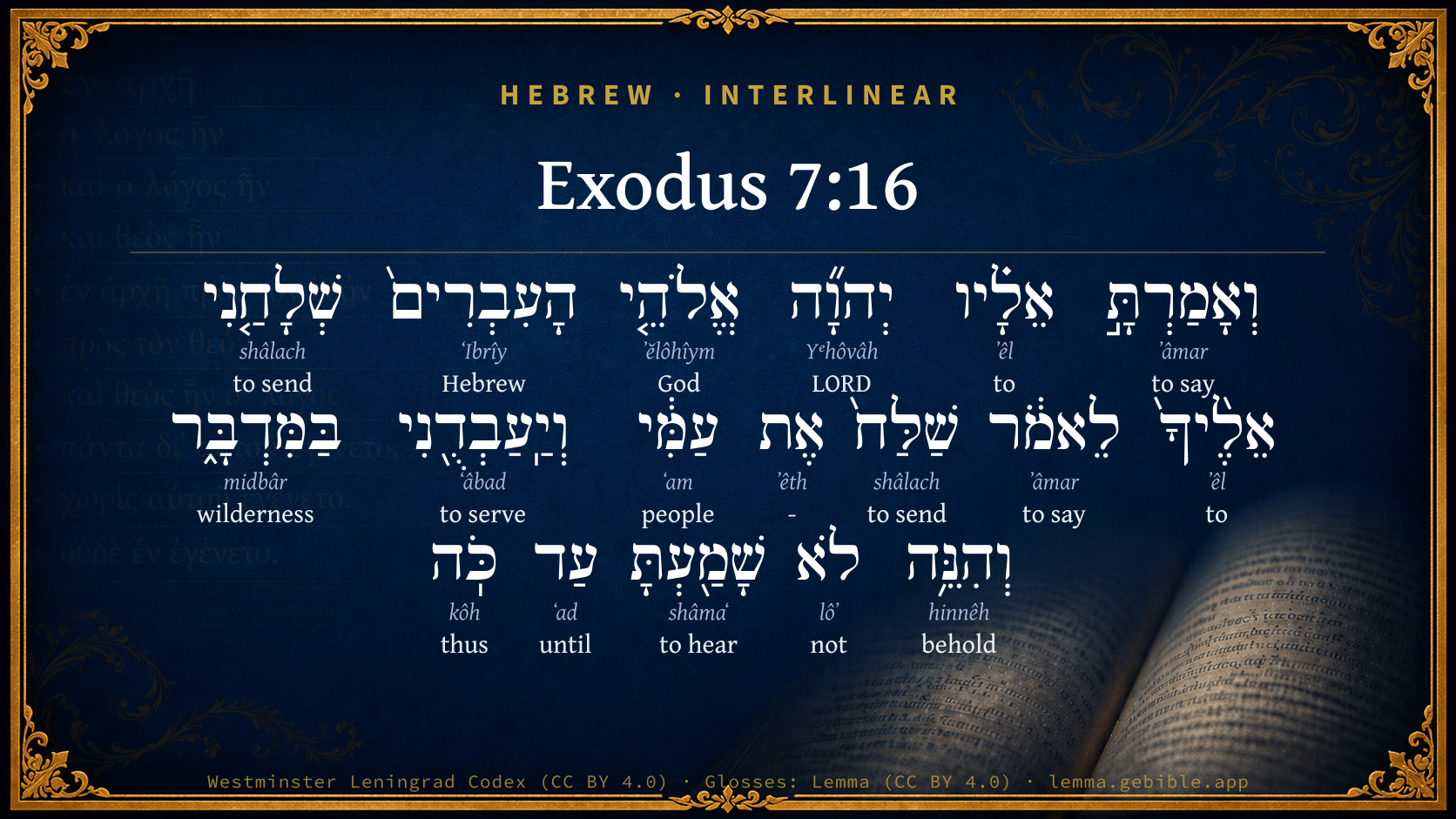
Hebrew (Westminster Leningrad Codex) Exodus 7:16 appears in the Hebrew Old Testament. The text above is from the Westminster Leningrad Codex. Each word links to its Strong’s number, a concise gloss, and parsing drawn from the Open Scriptures Hebrew Bible morphology. Click any word for its full Brown-Driver-Briggs (BDB) entry.
Download image
Cite this verse

Exodus 7:16 (World English Bible). Public Domain. Lemma interlinear Bible study tool, https://lemma.gebible.app/v/exodus/7/16.

Show BibTeX & RIS
BibTeX
RIS
English Translation
You shall tell him, 'Yahweh, the God of the Hebrews, has sent me to you, saying, "Let my people go, that they may serve me in the wilderness:" and, behold, until now you haven't listened.
World English Bible · Public Domain
Download a study sheet

One document with this verse’s original text, its word-by-word gloss line, the meaning frame, cross-references with their text, attributed commentary, and full source and license credits — printable, and it pastes into notes with its structure intact.

This verse Autodidact and up

Study sheet (.html) Plain text (.txt)

A passage Seminary Student

Up to 50 verses in one chapter. A passage sheet keeps up to 6 commentary sources and 12 cross-references per verse, in the order this page ranks them, and says so on the sheet whenever that leaves anything out. Ask for a single verse and you get the Autodidact verse sheet above.

Everything on this page stays free to read, with no account — the sheet is a download of what is already on screen, not access to it.

Want to remove ads? Support Godless Engineer
Compare translations 3

The same verse in 3 English versions, stacked beneath the original-language interlinear above. Click any original word for its lexicon entry.

Each is an independent rendering of the whole verse — the interlinear is not word-aligned to these translations.

Highlighted words mark where these versions differ — a whole-verse word diff, not a word-by-word alignment.

  • World English Bible Public Domain
    You shall tell him, 'Yahweh, the God of the Hebrews, has sent me to you, saying, "Let my people go, that they may serve me in the wilderness:" and, behold, until now you haven't listened.
  • King James Version Public Domain
    And thou shalt say unto him, The LORD God of the Hebrews hath sent me unto thee, saying, Let my people go, that they may serve me in the wilderness: and, behold, hitherto thou wouldest not hear.
  • unfoldingWord Literal Text CC BY-SA 4.0
    And say to him, ‘Yahweh, the God of the Hebrews, has sent me to you to say, “Let my people go, and they will serve me in the wilderness. And behold, until now, you have not listened.”

unfoldingWord Literal Text — © unfoldingWord, licensed CC BY-SA 4.0. Word-aligned USFM3 via Door43 (git.door43.org/unfoldingWord/en_ult).

Versions to compare (up to 4)

3 of 4 selected

Show all 18 translations

Every available English version of this verse, each an independent rendering of the whole verse.

  • World English Bible Public Domain
    You shall tell him, 'Yahweh, the God of the Hebrews, has sent me to you, saying, "Let my people go, that they may serve me in the wilderness:" and, behold, until now you haven't listened.
  • Berean Standard Bible Public Domain
    Then say to him, ‘The LORD, the God of the Hebrews, has sent me to tell you: Let My people go, so that they may worship Me in the wilderness. But you have not listened until now.
  • Majority Standard Bible Public Domain
    Then say to him, ‘The LORD, the God of the Hebrews, has sent me to tell you: Let My people go, so that they may worship Me in the wilderness. But until now you have not listened.
  • King James Version Public Domain
    And thou shalt say unto him, The LORD God of the Hebrews hath sent me unto thee, saying, Let my people go, that they may serve me in the wilderness: and, behold, hitherto thou wouldest not hear.
  • American Standard Version (1901) Public Domain
    And thou shalt say unto him, Jehovah, the God of the Hebrews, hath sent me unto thee, saying, Let my people go, that they may serve me in the wilderness: and, behold, hitherto thou hast not hearkened.
  • Revised Version (1885) Public Domain
    And thou shalt say unto him, The LORD, the God of the Hebrews, hath sent me unto thee, saying, Let my people go, that they may serve me in the wilderness: and, behold, hitherto thou hast not hearkened.
  • Geneva Bible (1599) Public Domain
    And thou shalt say vnto him, The Lord God of the Ebrewes hath sent me vnto thee, saying, Let my people goe, that they may serue mee in the wildernesse: and beholde, hitherto thou wouldest not heare.
  • Douay-Rheims (1899) Public Domain
    And thou shalt say to him: The Lord God of the Hebrews sent me to thee saying: Let my people go to sacrifice to me in the desert: and hitherto thou wouldst not hear.
  • Young's Literal Translation Public Domain
    and thou hast said unto him: Jehovah, God of the Hebrews, hath sent me unto thee, saying, Send My people away, and they serve Me in the wilderness; and lo, thou hast not hearkened hitherto.
  • Literal Standard Version CC BY-SA 4.0
    and you have said to him: YHWH, God of the Hebrews, has sent me to you, saying, Send My people away, and they serve Me in the wilderness; and behold, you have not listened until now.
  • Unlocked Literal Bible CC BY-SA 4.0
    Say to him, 'Yahweh, the God of the Hebrews, has sent me to you to say, “Let my people go, so that they may worship me in the wilderness. Until now you have not listened.”
  • unfoldingWord Literal Text CC BY-SA 4.0
    And say to him, ‘Yahweh, the God of the Hebrews, has sent me to you to say, “Let my people go, and they will serve me in the wilderness. And behold, until now, you have not listened.”
  • Darby Bible Public Domain
    And say unto him, Jehovah the God of the Hebrews has sent me to thee, saying, Let my people go, that they may serve me in the wilderness; but behold, hitherto thou hast not hearkened.
  • World Messianic Bible Public Domain
    You shall tell him, ‘The LORD, the God of the Hebrews, has sent me to you, saying, “Let my people go, that they may serve me in the wilderness. Behold, until now you haven’t listened.”
  • Webster's Bible Public Domain
    And thou shalt say to him, The LORD God of the Hebrews hath sent me to thee, saying, Let my people go, that they may serve me in the wilderness: and behold, hitherto thou wouldest not hear.
  • Free Bible Version CC BY-SA 4.0
    Tell him: The Lord, the God of the Hebrews, has sent me to say to you, ‘Let my people go, so that they can worship me in the desert. But you have not listened up until now.
  • Bible in Basic English Public Domain
    And say to him, The Lord, the God of the Hebrews, has sent me to you, saying, Let my people go so that they may give me worship in the waste land; but up to now you have not given ear to his words.
  • JPS Tanakh (1917) Public Domain
    And thou shalt say unto him: The LORD, the God of the Hebrews, hath sent me unto thee, saying: Let My people go, that they may serve Me in the wilderness; and, behold, hitherto thou hast not hearkened;

Literal Standard Version (2020), Covenant Press — licensed CC BY-SA 4.0. Text via the HelloAO Bible API (eBible.org). Unlocked Literal Bible (unfoldingWord) — licensed CC BY-SA 4.0. Text via the HelloAO Bible API (eBible.org). unfoldingWord Literal Text — © unfoldingWord, licensed CC BY-SA 4.0. Word-aligned USFM3 via Door43 (git.door43.org/unfoldingWord/en_ult). Free Bible Version, Dr. Jonathan Gallagher — licensed CC BY-SA 4.0. Text via the HelloAO Bible API (eBible.org).

Word by word

More ways to search: Search by grammar → Find every occurrence → Compare this word →

Practice this passage: Drill this verse → Learn its vocabulary →

הָעִבְרִים֙
ʻIbrîy
H5680
“the · Hebrews”
Particle, Definite Article + Noun, Gentilic, Masculine, Plural, Absolute
Part of Speech
Particle + Noun
Type
Gentilic
Gender
Masculine
Number
Plural
State
Absolute
Full BDB Definition

Origin: patronymic from H5677

TWOT: None

Hebrew = "one from beyond" - a designation of the patriarchs and the Israelites (noun proper) - a designation of the patriarchs and the Israelites (adjective)
  1. וְאָמַרְתָּ֣ ʼâmar H559 “and · to say” Conjunction + Verb, Qal, Sequential Perfect, 2nd Person, Masculine, Singular
  2. אֵלָ֗יו ʼêl H413 “to · him” Preposition + Suffix, Personal, 3rd Person, Masculine, Singular
  3. יְהוָ֞ה Yᵉhôvâh H3068 “LORD” Noun, Proper
  4. אֱלֹהֵ֤י ʼĕlôhîym H430 “God(s) of” Noun, Common, Masculine, Plural, Construct
  5. שְׁלָחַ֤נִי shâlach H7971 “to send · me” Verb, Qal, Perfect, 3rd Person, Masculine, Singular + Suffix, Personal, 1st Person, Common, Singular
  6. אֵלֶ֨יךָ֙ ʼêl H413 “to · you” Preposition + Suffix, Personal, 2nd Person, Masculine, Singular
  7. לֵאמֹ֔ר ʼâmar H559 “to say” Preposition + Verb, Qal, Infinitive Construct
  8. שַׁלַּח֙ shâlach H7971 “send” Verb, Piel, Imperative, 2nd Person, Masculine, Singular
  9. אֶת ʼêth H853 “-” Particle, Direct Object
  10. עַמִּ֔י ʻam H5971 “people · my” Noun, Common, Masculine, Singular, Construct + Suffix, Personal, 1st Person, Common, Singular
  11. וְיַֽעַבְדֻ֖נִי ʻâbad H5647 “and · to serve · me” Conjunction + Verb, Qal, Imperfect, 3rd Person, Masculine, Plural + Suffix, Personal, 1st Person, Common, Singular
  12. בַּמִּדְבָּ֑ר midbâr H4057 “in/at the · wilderness” Preposition, Determined + Noun, Common, Masculine, Singular, Absolute
  13. וְהִנֵּ֥ה hinnêh H2009 “and · behold” Conjunction + Particle, Demonstrative
  14. לֹא lôʼ H3808 “not” Particle, Negative
  15. שָׁמַ֖עְתָּ shâmaʻ H8085 “to hear” Verb, Qal, Perfect, 2nd Person, Masculine, Singular
  16. עַד ʻad H5704 “until” Preposition
  17. כֹּֽה kôh H3541 “thus” Adverb

About this verse

These counts appear in no published source. They are computed here, from the morphology-tagged text and Lemma’s own curated glosses. What Lemma adds →

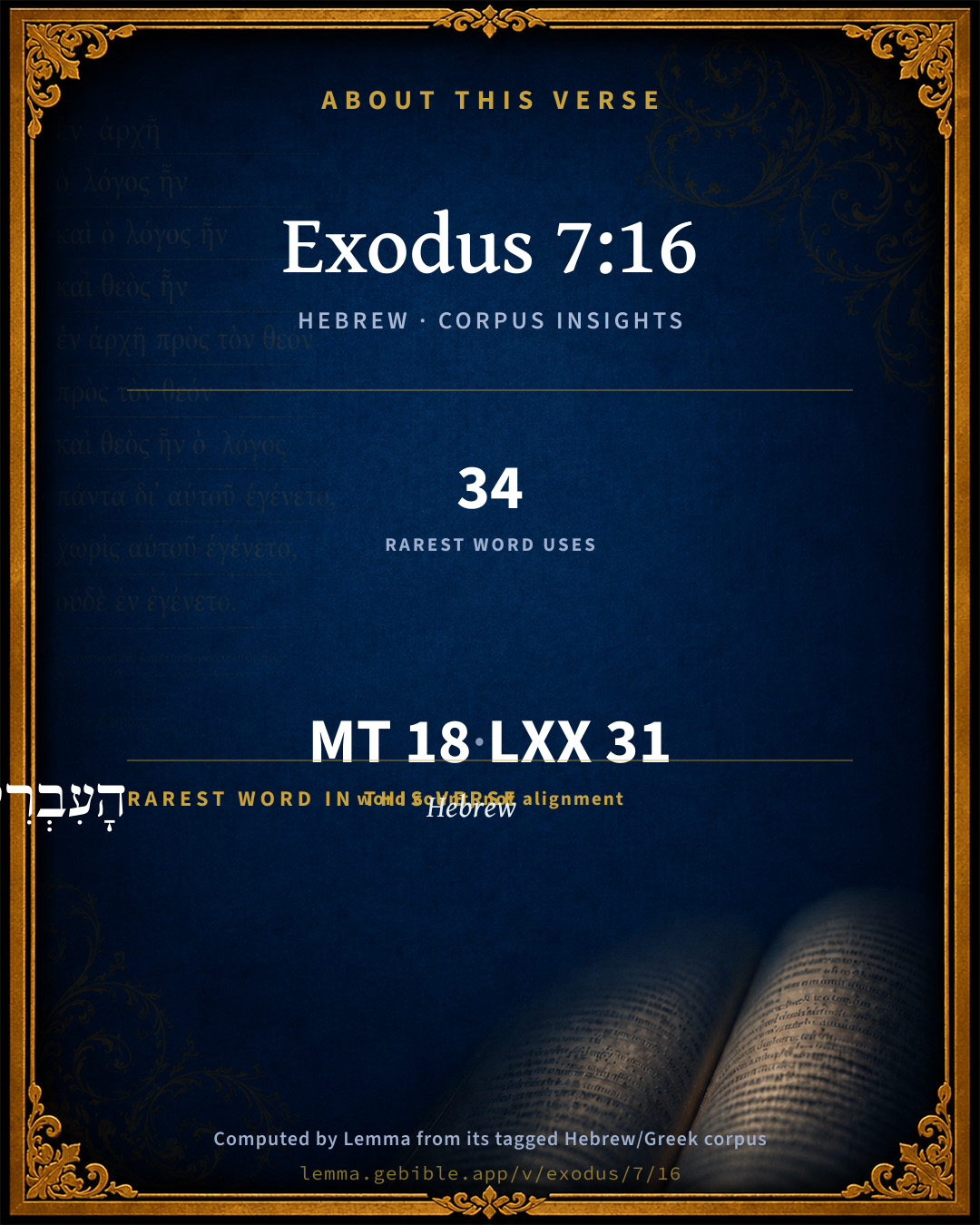
18
words
15
distinct lemmas
Pentateuch
section

Shared distinctive vocabulary

הָעִבְרִים֙ Hebrew H5680 occurs in 32 verses of the Hebrew Bible. Also found in:

Grammatical profile

  • 6 verbs
  • 5 nouns
  • 3 prepositions
  • 1 adverb
  • 3 particles

Verb forms

  • וְאָמַרְתָּ֣ Qal · Sequential Perfect
  • שְׁלָחַ֤נִי Qal · Perfect
  • לֵאמֹ֔ר Qal · Infinitive Construct
  • שַׁלַּח֙ Piel · Imperative
  • וְיַֽעַבְדֻ֖נִי Qal · Imperfect
  • שָׁמַ֖עְתָּ Qal · Perfect

Repetition

Words recur within this verse — often emphatic in Hebrew:

  • וְאָמַרְתָּ֣ to say H559 ×2
  • שְׁלָחַ֤נִי to send H7971 ×2
  • אֵלָ֗יו to H413 ×2

Hebrew & Septuagint length

In English translation the verse runs 35 words from the Hebrew and 37 from the Septuagint (LXX English) — closely comparable.

A rough comparison of the two English renderings, which tokenize alike — not a word-level alignment.

Word counts can differ between the Hebrew and the Greek without any difference in meaning — e.g. the Hebrew direct-object marker אֵת has no separate Greek word, and Greek often adds the article ὁ.

In the original languages it is 18 Hebrew tokens and 31 Greek tokens — but the two are counted differently (Hebrew bundles its prefixes and suffixes into one token; the Greek is in lemma form), so that isn’t a like-for-like length.

Cross-references

14

Topical passages linked to Exodus 7:16 in the Treasury of Scripture Knowledge — connected by theme and wording, ordered by reader-vote popularity; previews shown in the World English Bible.

  • Exodus 3:18 They will listen to your voice, and you shall come, you and the elders of Israel, to the king of Egypt, and you shall tell him, 'Yahweh, the God of the Hebrews, has met with us. Now please let us go three days' journey into the wilderness, that we may sacrifice to Yahweh, our God.'
  • Exodus 9:1 Then Yahweh said to Moses, "Go in to Pharaoh, and tell him, 'This is what Yahweh, the God of the Hebrews, says: "Let my people go, that they may serve me.
  • Exodus 9:13 Yahweh said to Moses, "Rise up early in the morning, and stand before Pharaoh, and tell him, 'This is what Yahweh, the God of the Hebrews, says: "Let my people go, that they may serve me.
  • Exodus 3:12 He said, "Certainly I will be with you. This will be the token to you, that I have sent you: when you have brought forth the people out of Egypt, you shall serve God on this mountain."
  • Exodus 5:1–3 Afterward Moses and Aaron came, and said to Pharaoh, "This is what Yahweh, the God of Israel, says, 'Let my people go, that they may hold a feast to me in the wilderness.'"
  • Exodus 8:1 Yahweh spoke to Moses, Go in to Pharaoh, and tell him, "This is what Yahweh says, 'Let my people go, that they may serve me.
  • Exodus 8:20 Yahweh said to Moses, "Rise up early in the morning, and stand before Pharaoh; behold, he comes forth to the water; and tell him, 'This is what Yahweh says, "Let my people go, that they may serve me.
  • Exodus 10:3 Moses and Aaron went in to Pharaoh, and said to him, "This is what Yahweh, the God of the Hebrews, says: 'How long will you refuse to humble yourself before me? Let my people go, that they may serve me.
  • Exodus 13:15 and it happened, when Pharaoh would hardly let us go, that Yahweh killed all the firstborn in the land of Egypt, both the firstborn of man, and the firstborn of animal. Therefore I sacrifice to Yahweh all that opens the womb, being males; but all the firstborn of my sons I redeem.'
  • Exodus 14:5 It was told the king of Egypt that the people had fled; and the heart of Pharaoh and of his servants was changed towards the people, and they said, "What is this we have done, that we have let Israel go from serving us?"
  • 1 Samuel 4:6–9 When the Philistines heard the noise of the shout, they said, What means the noise of this great shout in the camp of the Hebrews? They understood that the ark of Yahweh was come into the camp.
  • Isaiah 45:13 I have raised him up in righteousness, and I will make straight all his ways: he shall build my city, and he shall let my exiles go free, not for price nor reward, says Yahweh of Hosts.
  • Jeremiah 50:33 Thus says Yahweh of hosts: The children of Israel and the children of Judah are oppressed together; and all who took them captive hold them fast; they refuse to let them go.
  • Acts 4:21–23 When they had further threatened them, they let them go, finding no way to punish them, because of the people; for everyone glorified God for that which was done.

Cross-references courtesy of OpenBible.info (CC BY 4.0).

Hebrew and Greek witnesses Masoretic Hebrew ↔ Greek Septuagint

The same verse in the two great witnesses to the Old Testament, shown verse-for-verse.

These are two independent witnesses, not word-aligned to each other, and the Septuagint is shown in lemma (dictionary) form.

Hebrew Exodus 7:16 Masoretic · Westminster Leningrad Codex

וְאָמַרְתָּ֣ אֵלָ֗יו יְהוָ֞ה אֱלֹהֵ֤י הָעִבְרִים֙ שְׁלָחַ֤נִי אֵלֶ֨יךָ֙ לֵאמֹ֔ר שַׁלַּח֙ אֶת עַמִּ֔י וְיַֽעַבְדֻ֖נִי בַּמִּדְבָּ֑ר וְהִנֵּ֥ה לֹא שָׁמַ֖עְתָּ עַד כֹּֽה

You shall tell him, 'Yahweh, the God of the Hebrews, has sent me to you, saying, "Let my people go, that they may serve me in the wilderness:" and, behold, until now you haven't listened.

World English Bible · Public Domain

Greek LXX Exodus 7:16 Septuagint · lemma form

καί εἶπον πρός αὐτός κύριος ὁ θεός ὁ εβραῖος ἀποστέλλω ἐγώ πρός σύ λέγω ἐκ ἀποστέλλω ὁ λαός ἐγώ ἵνα ἐγώ λατρεύω ἐν ὁ ἔρημος καί ἰδού οὐ εἰςἀκούω ἕως οὗτος

And you shall say to him, The Lord God of the Hebrews has sent me to you, saying, Send my people away, that they may serve me in the wilderness, and, behold, hitherto you have not listened.

LXX2012 (modern English Septuagint) · Public Domain

Hebrew: Westminster Leningrad Codex (CC BY 4.0). Greek: Septuagint (public domain); English from LXX2012 (modern English Septuagint) (Public Domain). How the Septuagint differs from the Hebrew →

Targum (Aramaic paraphrase)

2

The Targum is the ancient Jewish Aramaic paraphrase of the Hebrew Scriptures — an interpretive translation, not the Hebrew text itself. Onkelos (literal) and Pseudo-Jonathan (expansive) render the Torah, and Jonathan the Prophets. Coverage is partial: where no permissively-licensed English translation exists for a verse, only the Aramaic is shown. This is verse-level text, not a word-by-word alignment to the Hebrew.

  1. Targum Onkelos Torah (Genesis–Deuteronomy)
    וְתֵימַר לֵהּ יְיָ אֱלָהָא דִיהוּדָאֵי שַׁלְחַנִי לְוָתָךְ לְמֵימַר שַׁלַח יָת עַמִי וְיִפְלְחוּן קֳדָמַי בְּמַדְבְּרָא וְהָא לָא קַבִּלְתָּא עַד כְּעָן:

    (no public-domain English translation for this verse)

    Targum Onkelos — Aramaic: “Onkelos Genesis” (public domain); “Onkelos Exodus” (public domain); “Onkelos Leviticus” (public domain); “Onkelos Numbers” (public domain); “Onkelos Deuteronomy” (public domain). English: “Sefaria Community Translation” (CC0 1.0 (public-domain dedication)); “J.W. Etheridge. The Targums of Onkelos and Jonathan Ben Uzziel on the Pentateuch. London: Longmans, Green, 1862” (public domain). Text via Sefaria.

  2. Targum Pseudo-Jonathan Torah (Genesis–Deuteronomy)
    וְתֵימַר לֵיהּ יְיָ אֱלָהָא דִיהוּדָאֵי שַׁדְרַנִי לְוָתָךְ לְמֵימַר פְּטוֹר יַת עַמִי וְיִפְלְחוּן קֳדָמַי בְּמַדְבְּרָא וְהָא לָא קַבֵּילְתָּ עַד כְּדוּן

    And thou shalt say to him, The Lord God of the Jehudaee hath sent me unto thee, saying Release My people, that they may serve Me in the desert; and, behold, as yet thou bast not hearkened.

    Targum Pseudo-Jonathan — Aramaic: “Targum Jonathan on Genesis” (public domain); “Targum Jonathan on Exodus” (public domain); “Targum Jonathan on Leviticus” (public domain); “Targum Jonathan on Numbers” (public domain); “Targum Jonathan on Deuteronomy” (public domain). English: “The Targum of Jonathan ben Uzziel, trans. J. W. Etheridge, London, 1862” (public domain). Text via Sefaria.

Commentary

Notes on Exodus 7:16 from classic Christian and Jewish commentators (each source and its license shown beneath its notes). The classic Christian expositions comment on the surrounding passage and are grouped to its opening verse, so a note may address several verses; the Jewish commentaries on the Tanakh (Rashi and others) are per-verse, so they appear only where the commentator wrote on this verse.

Lemma curates 59 commentaries, every one of them public domain or Creative Commons licensed, each selected and text-cleaned for this edition rather than reprinted as found. About our sources →

Trapp's Complete Commentary

John Trapp

Exo 7:16 And thou shalt say unto him, The LORD God of the Hebrews hath sent me unto thee, saying, Let my people go, that they may serve me in the wilderness: and, behold, hitherto thou wouldest not hear.

Ver. 16. Hitherto thou wouldest not hear.] Indeed, he could not hear; as little as those Jews could believe Christ’s miracles, Joh 12:37. "Therefore they could not believe," saith the text, "because that Isaiah had said, He hath blinded their eyes, and hardened their hearts," &c.

John Trapp, A Commentary or Exposition upon All the Books of the Old and New Testament (1647–1656) — public domain. Text from a community e-Sword module.

Ellicott's Commentary for English Readers

(16) The Lord God of the Hebrews.—Heb., Jehovah, the God of the Hebrews. On the first application made to him by Moses and Aaron, Pharaoh had professed not to know who Jehovah was (Exo_5:2). To prevent his again doing so, Moses is ordered to give both name and title.

Hath sent me—Rather, sent me.

Let my people go.—Comp. Exo_5:1. The reference is to Moses’ first appearance before Pharaoh, and the message then delivered.

Thou wouldest not hear.—Rather, thou hast not heard: i.e., thou hast not obeyed.

A Bible Commentary for English Readers, edited by Charles John Ellicott (1878–1897) — public domain. Text from a community e-Sword module.

The Cambridge Bible for Schools and Colleges

gen. ed. J. J. S. Perowne

16. The demand to be made of the Pharaoh. The terms, as elsewhere in J (Exo_8:1; Exo_8:20, Exo_9:1; Exo_9:13, Exo_10:3): see p. 56.

The Cambridge Bible for Schools and Colleges (gen. ed. J. J. S. Perowne; Cambridge University Press, 1878–1918) — public domain. Text from a community e-Sword module.

John Gill's Exposition

And thou shalt say unto him,.... Upon meeting him:

the Lord God of the Hebrews hath sent me unto thee; still appearing in the character of the ambassador of Jehovah, the God of the children of Israel:

saying, let my people go, that they may serve me in the wilderness; the demand is once more renewed, before any punishment is inflicted for refusal, that the patience and forbearance of God might be the more visible, and his judgments appear the more righteous when inflicted, as well as Pharaoh be left more inexcusable. The reason of the demand is observed:

that they may serve me; keep a feast, and sacrifice to him, as is before expressed, and the place where is pointed at:

in the wilderness; at Sinai, in Arabia, where were the mountains of Sinai and Horeb; but the time of their service is not here expressed, as elsewhere, namely, three days:

and, behold, hitherto thou wouldest not hear; and obey the voice of the Lord, upbraiding him with his disobedience, and the hardness of his heart; but signifying it was not now too late, though it was advisable to be quick, or the blow would be given, and the plagues inflicted.

John Gill's Exposition of the Whole Bible (1746–1763) — public domain (CC PDM 1.0). Text via the HelloAO Bible API.

The Pulpit Commentary

The Lord God hath sent me unto thee. Rather, "sent me unto thee." The reference is to the original sending. (Exo_5:1) Thou wouldest not hear. Literally, "Thou hast not heard," i.e. up to this time thou hast not obeyed the command given to thee.

The Pulpit Commentary (1880–1919), ed. H.D.M. Spence-Jones & Joseph S. Exell — public domain. Text from a community e-Sword module.

unfoldingWord translationNotes

Door43 World Missions Community

Say to him

"Say to Pharaoh"

strike the water

"hit the water"

translationWords

Yahweh

Hebrew

worship

desert

Nile River

blood

die

Egypt

unfoldingWord translationNotes — © Distant Shores Media and the Door43 World Missions Community, licensed CC BY-SA 4.0. Source: git.door43.org/Door43/en_tn.

Rashi

Rabbi Shlomo Yitzchaki (Rashi)

עד כה means UNTIL NOW. A Midrashic explanation (taking this sentence to mean, “thou wilt not hearken until (עד) thou hearest the word “כה”) is: until thou hearest from me the announcement of the slaughter of the first-born, which I will begin with the words, (Exodus 11:4) “Thus (כה) saith the Lord, About midnight etc.”

Rashi on the Tanakh — English translations: “The Judaica Press complete Tanach with Rashi, translated by A. J. Rosenberg” (CC BY 4.0); “Pentateuch with Rashi's commentary by M. Rosenbaum and A.M. Silbermann, 1929-1934” (public domain); “The Metsudah Tanach series, Lakewood, N.J” (CC BY 4.0); and “The Book of Joshua, Metsudah Publications, 1997” (CC BY 4.0). Text via Sefaria.

Ramban (Nachmanides)

Rabbi Moshe ben Nachman (Ramban / Nachmanides)

AND, BEHOLD, HITHERTO THOU HAST NOT HEARKENED. Because this was one of the [ten] plagues and henceforth He will begin to smite him, He therefore said to him that it was his wickedness which was responsible for the bringing of the punishment upon him since he hearkened not to the command of his Creator. Now at this time, [i.e., when the warning about the first plague was given to him], Pharaoh did not declare to Moses and Aaron that he will neither hearken to G-d’s words nor let the people go. It was only at the first time [when they came before him] that he said, I know not the Eternal, and moreover I will not let Israel go. At present, he did not rebuke them; he only heard their words and remained silent, for since they performed the wonder of the serpent before him and Aaron’s rod swallowed up their rods, he was already afraid of the plagues, except that during the first plagues he attempted that the magicians do likewise, that is, by means of deeds of sorcery. Thus he was afraid, and yet he hardened his heart. This is the sense of the expression, And Pharaoh’s heart was hardened.

Ramban (Nachmanides) on the Tanakh — English translation: “Commentary on the Torah by Ramban (Nachmanides). Translated and annotated by Charles B. Chavel. New York, Shilo Pub. House, 1971-1976” (CC BY 4.0). Text via Sefaria.

Lesson kit

Teaching starters — assembled from the data on this page, not authored interpretation. Every prompt links to the verse data it draws on. Edit before teaching.

Exodus, in the Pentateuch, opens this verse with 18 words (15 distinct Hebrew lemmas). Its most distinctive word is ʻIbrîy (“Hebrew”). A historical commentator’s framing appears above. Read the whole chapter for the surrounding context.

Discussion questions

  1. The word ʻIbrîy carries the sense “Hebrew.” How does it shape the verse?
  2. Genesis 14:13 shares the word «Hebrew» with this verse. How do the two illuminate each other?
  3. “to say” occurs 2× in this one verse. What is the effect of the repetition?
  4. The translations on this page render this verse differently — a whole-verse word diff, not a word-by-word alignment. What might account for the different wordings?
  5. The verb «וְאָמַרְתָּ֣» is Qal Sequential Perfect. How does its form color the action?
  6. Reading how Trapp's Complete Commentary and Ellicott's Commentary for English Readers read this verse, where do the two commentators agree and where do they part?

Things to notice

Reading settings

Reading text

Shown beneath each verse's original-language words.

Old Testament
Old Testament edition

Read the OT as the Masoretic Hebrew (MT) or the Greek Septuagint (LXX).

English shown for the Greek Septuagint (in the Hebrew ↔ Greek comparison).

Comparing translations? Open the Compare panel on any verse page to stack up to four side by side.