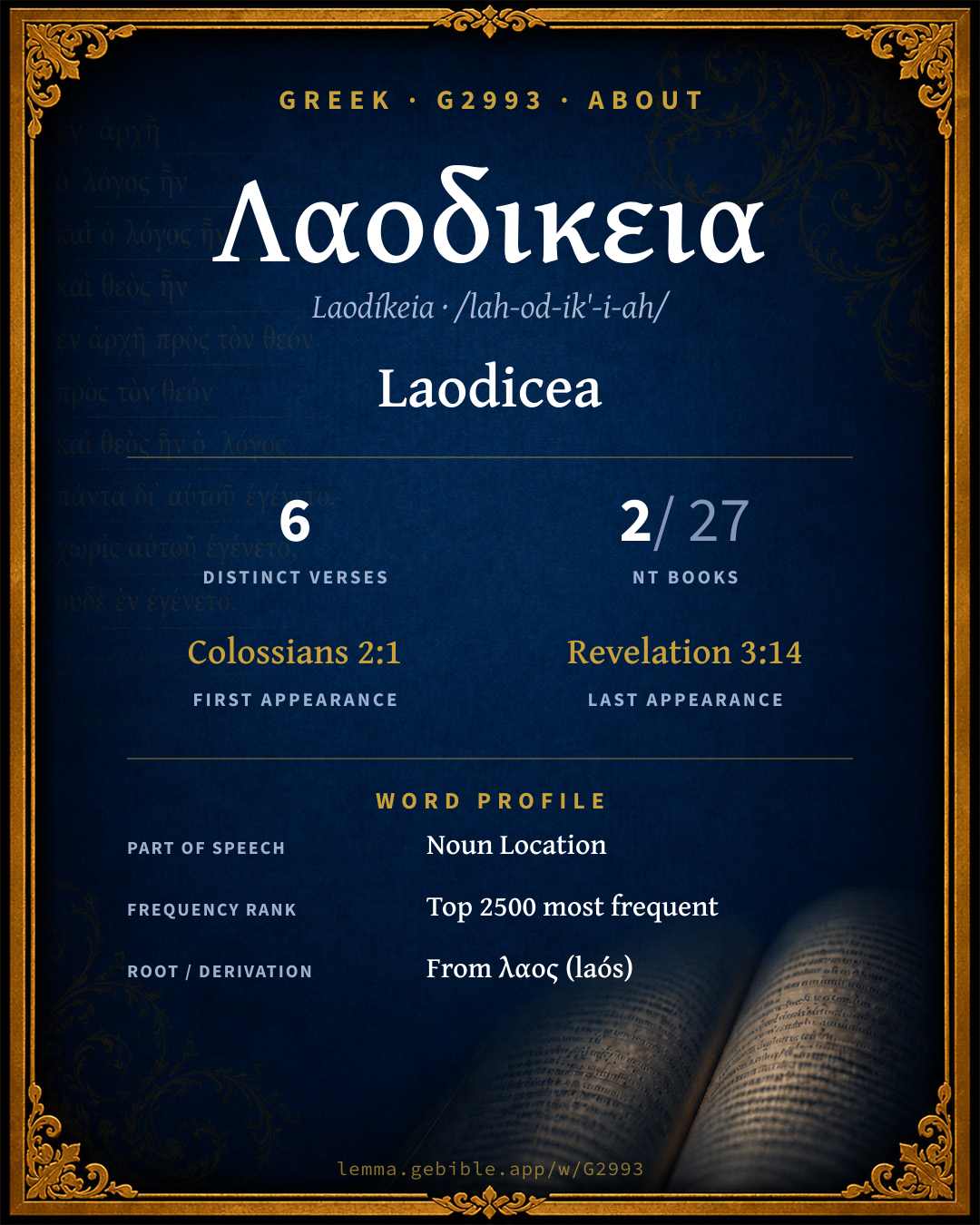
Λαοδίκεια
Laodicea
Thayer's lists 2 entries for ‘Laodicea’ fuller range ↓
Full lexicon entry — Thayer's Greek Lexicon
From Thayer's Greek Lexicon
Where this word appears
See every Dative-case word in the Greek New Testament →
Grammar key — what these labels mean
Part of speech
- Noun
- A naming word — a person, place, thing, or idea.
Case
- Dative
- The case of the indirect object, means, or location — “to / for / with / in.”
- Accusative
- The case of the direct object and of extent.
- Genitive
- The case of source, possession, or “of” — answers “whose / from what.”
Gender
- Feminine
- Grammatically feminine.
Number
- Singular
- One.
Grammatical forms
- Noun, Dative, Singular, Feminine 4 times (67%)
- Noun, Accusative, Singular, Feminine 1 time (17%)
- Noun, Genitive, Singular, Feminine 1 time (17%)
Parsed forms decoded from the imported morphology (Robinson–Tischendorf, public domain), counted across 6 parsed occurrences — not distinct verses.
Every verse where G2993 appears — 6 distinct verses across 2 books. Click any verse to open its interlinear word-by-word view. Verse text shown in the World English Bible for context — . Each verse’s Greek form is shown with its reference; the English is not keyword-highlighted, since the data carries no word-level English alignment. Use “Compare translations” on any verse to read it across multiple English versions. This concordance covers the Greek New Testament; Septuagint (Greek Old Testament) occurrences of this word are not indexed here.
Colossians 4 verses
- Colossians 2:1 Λαοδικίᾳ n dat sg fem For I desire to have you know how greatly I struggle for you, and for those at Laodicea, and for as many as have not seen my face in the flesh;
- Colossians 4:13 Λαοδικίᾳ n dat sg fem For I testify about him, that he has great zeal for you, and for those in Laodicea, and for those in Hierapolis.
- Colossians 4:15 Λαοδικίᾳ n dat sg fem Greet the brothers who are in Laodicea, and Nymphas, and the assembly that is in his house.
- Colossians 4:16 Λαοδικίας n gen sg fem When this letter has been read among you, cause it to be read also in the assembly of the Laodiceans; and that you also read the letter from Laodicea.
Revelation 2 verses
- Revelation 1:11 Λαοδίκιαν n acc sg fem saying, "What you see, write in a book and send to the seven assemblies: to Ephesus, Smyrna, Pergamum, Thyatira, Sardis, Philadelphia, and to Laodicea."
- Revelation 3:14 Λαοδικίᾳ n dat sg fem "To the angel of the assembly in Laodicea write: "The Amen, the Faithful and True Witness, the Head of God's creation, says these things:
About this entry
At a glance — auto-summarized from this page’s data, not written by a person. Every figure links to its source below. This summary describes the numbers; it doesn’t interpret them.
“Laodicea” is the headline sense of the Greek name Λαοδικεια (Laodíkeia). More than two-thirds of its appearances fall in Colossians. It appears 6 verses across 2 books of the Greek New Testament, among its uncommon vocabulary. First canonically at Colossians 2:1, it enters the text early. The sections below give every occurrence and version rendering.
Gloss history
Strong's 1890 vs modern scholarship
About this word
Strong's G2993 catalogs a Greek word from the Greek New Testament.
These counts are not copied from any lexicon or concordance. They are computed here, from the morphology-tagged Greek New Testament. What Lemma adds →
- 6
- distinct verses
- The word appears in 6 distinct verses.
- 2 / 27
- NT books
- The word appears in 2 of 27 New Testament books.
- #1,476
- by frequency
- Top 2500 most frequent Greek words (rank 1,476 of 5,347 Greek words by occurrence).
View all 6 occurrences in the concordance →
Most concentrated in
- Colossians 4 verses 67%
- Revelation 2 verses 33%
By section of the New Testament
By traditional corpus
Conventional, traditional groupings — biblical authorship is debated, so this is a traditional corpus grouping, not an authorship claim. Some books belong to more than one corpus (Luke is in both the Gospels and the Lukan corpus, and so on), so these shares overlap and need not total 100%. Each figure is a share of the word’s 6 distinct verses.
- Pauline corpus 4 verses · 67%
- Johannine 2 verses · 33%
- Revelation 2 verses · 33%
How translations render this word
Counts come from each version’s own published word-to-Strong’s tagging or interlinear alignment — an approximate guide to how each version renders this word, not a word-level alignment the data otherwise carries. Because each total is that version’s own tagged count, the per-version totals vary from one another and need not match the appearance or distinct-verse counts above. These counts may also differ from a printed concordance because Lemma counts each distinctly tagged rendering and does not collapse phrase taggings into a single head-word total. This is a fixed set of word-tagged versions (KJV, ASV, BSB, ULT) and does not change with the reading translation you choose elsewhere. Each version’s license is shown beside its name below (and on Sources).
- King James Version: Laodicea 5×
- American Standard Version: Laodicea 5×
- Berean Standard Bible: Laodicea 6×
- unfoldingWord Literal Text: Laodicea 6×
King James Version Public Domain
Renders G2993 across 5 tagged occurrences — most commonly:
American Standard Version Public Domain
Renders G2993 across 5 tagged occurrences — most commonly:
Berean Standard Bible Public Domain
Renders G2993 across 6 tagged occurrences — most commonly:
unfoldingWord Literal Text CC BY-SA 4.0
Renders G2993 across 6 tagged occurrences — most commonly:
Senses in Thayer's
The 2 senses Thayer's distinguishes for this word, in lexicon order (not ranked by frequency or importance). The full entry — with sub-senses — is in the Lexicon Entry tab.
- Laodicea = "justice of the people"
- a city of Phrygia…
Word origin
Derived from λαος (laós) (G2992) — people.
Forms in the corpus
The 3 distinct written forms G2993 takes in the Greek New Testament, most frequent first — each parse links to that case’s occurrences in the concordance.
| Form | Parsing | Example | Uses |
|---|---|---|---|
| Λαοδικίᾳ Laodikía | Noun, Dative, Singular, Feminine | Colossians 2:1 | 4 |
| Λαοδίκιαν Laodíkian | Noun, Accusative, Singular, Feminine | Revelation 1:11 | 1 |
| Λαοδικίας Laodikías | Noun, Genitive, Singular, Feminine | Colossians 4:16 | 1 |
Same root — word family
Other Thayer's entries built from the same root as G2993, grouped by Strong’s listed origin. These share a root / origin per the lexicon — not necessarily a shared meaning. Each links to that word’s own entry.
Derives from
Shares the same root
Proper names from this root
People and places named from this root — a name, not an additional meaning of the word.
Compare all same-root words → 1 of the same-root words is a proper name (a person or place). They share a root, not necessarily a meaning.
Bible dictionary
Public-domain dictionary articles matched to this entry by name (Laodicea). A biblical name can be shared by more than one person or place, so an article may treat several.
Easton's Bible Dictionary · M. G. Easton, 1897
The city of this name mentioned in Scripture lay on the confines of Phrygia and Lydia, about 40 miles east of Ephesus (Rev. 3:14), on the banks of the Lycus. It was originally called Diospolis and then Rhoas, but afterwards Laodicea, from Laodice, the wife of Antiochus II., king of Syria, who rebuilt it. It was one of the most important and flourishing cities of Asia Minor. At a very early period it became one of the chief seats of Christianity (Col. 2:1; 4:15; Rev. 1:11, etc.). It is now a deserted place, called by the Turks Eski-hissar or "old castle."
Smith's Bible Dictionary · William Smith, 1863
(justice of the people), a town in the Roman province of Asia situated in the valley of the Maeander, on a small river called the Lycus, with Colossae and Hierapolis a few miles distant to the west. Built, or rather rebuilt, by one of the Seleucid monarchs, and named in honor of his wife, Laodicea became under the Roman government a place of some importance. Its trade was considerable; it lay on the line of a great road; and it was the seat of a conventus . From the third chapter and seventeenth verse of Revelation we should gather it was a place of great wealth. Christianity was introduced into Laodicea, not, however, as it would seem, through the direct agency of St. Paul. We have good reason for believing that when, in writing from Rome to the Christians of Colossae, he sent a greeting to those of Laodicea, he had not personally visited either place. But the preaching of the gospel at Ephesus, (Acts 18:19; Acts 19:41) must inevitably have resulted in the formation of churches in the neighboring cities, especially where Jews were settled; and there were Jews in Laodicea. In subsequent times it became a Christian city of eminence, the see of bishop and a meeting-place of councils. The Mohammedan invaders destroyed it, and it is now a scene of utter desolation, as was prophesied in (Revelation 3:14-22) and the extensive ruins near Denislu justify all that we read of Laodicea in Greek and Roman writers. Another biblical subject of interest is connected with Laodicea. From (Colossians 4:16) it appears that St. Paul wrote a letter to this place when he wrote the letter to Colossae. Ussher's view is that it was the same as the Epistle to the Ephesians, which was a circular letter sent to Laodicea among other places. The apocryphal Epistola ad Laodicenses is a late and clumsy forgery.
Hitchcock's Bible Names Dictionary · Roswell D. Hitchcock, 1869
just people
Classic public-domain reference works; full attribution on Sources.