Acts 10:42

Greek (Tischendorf 8th ed.) Acts 10:42 appears in the Greek New Testament. The text above is from the Tischendorf 8th edition. Each word links to its Strong’s number and a concise gloss. Click any word for its full Thayer’s Greek Lexicon entry.
Download image
Cite this verse

Acts 10:42 (World English Bible). Public Domain. Lemma interlinear Bible study tool, https://lemma.gebible.app/v/acts/10/42.

Show BibTeX & RIS
BibTeX
RIS
English Translation
He charged us to preach to the people and to testify that this is he who is appointed by God as the Judge of the living and the dead.
World English Bible · Public Domain
Download a study sheet

One document with this verse’s original text, its word-by-word gloss line, the meaning frame, cross-references with their text, attributed commentary, and full source and license credits — printable, and it pastes into notes with its structure intact.

This verse Autodidact and up

Study sheet (.html) Plain text (.txt)

A passage Seminary Student

Up to 50 verses in one chapter. A passage sheet keeps up to 6 commentary sources and 12 cross-references per verse, in the order this page ranks them, and says so on the sheet whenever that leaves anything out. Ask for a single verse and you get the Autodidact verse sheet above.

Everything on this page stays free to read, with no account — the sheet is a download of what is already on screen, not access to it.

Want to remove ads? Support Godless Engineer
Compare translations 3

The same verse in 3 English versions, stacked beneath the original-language interlinear above. Click any original word for its lexicon entry.

Each is an independent rendering of the whole verse — the interlinear is not word-aligned to these translations.

Highlighted words mark where these versions differ — a whole-verse word diff, not a word-by-word alignment.

  • World English Bible Public Domain
    He charged us to preach to the people and to testify that this is he who is appointed by God as the Judge of the living and the dead.
  • King James Version Public Domain
    And he commanded us to preach unto the people, and to testify that it is he which was ordained of God to be the Judge of quick and dead.
  • unfoldingWord Literal Text CC BY-SA 4.0
    And he commanded us to announce to the people and to testify that he is the one chosen by God as a Judge of the living and the dead.

unfoldingWord Literal Text — © unfoldingWord, licensed CC BY-SA 4.0. Word-aligned USFM3 via Door43 (git.door43.org/unfoldingWord/en_ult).

Versions to compare (up to 4)

3 of 4 selected

Show all 19 translations

Every available English version of this verse, each an independent rendering of the whole verse.

  • World English Bible Public Domain
    He charged us to preach to the people and to testify that this is he who is appointed by God as the Judge of the living and the dead.
  • Berean Standard Bible Public Domain
    And He commanded us to preach to the people and to testify that He is the One appointed by God to judge the living and the dead.
  • Majority Standard Bible Public Domain
    And He commanded us to preach to the people and to testify that He is the One appointed by God to judge the living and the dead.
  • King James Version Public Domain
    And he commanded us to preach unto the people, and to testify that it is he which was ordained of God to be the Judge of quick and dead.
  • American Standard Version (1901) Public Domain
    And he charged us to preach unto the people, and to testify that this is he who is ordained of God `to be' the Judge of the living and the dead.
  • Revised Version (1885) Public Domain
    And he charged us to preach unto the people, and to testify that this is he which is ordained of God to be the Judge of quick and dead.
  • Geneva Bible (1599) Public Domain
    And he commanded vs to preach vnto the people, and to testifie, that it is he that is ordained of God a iudge of quicke and dead.
  • Douay-Rheims (1899) Public Domain
    And he commanded us to preach to the people, and to testify that it is he who was appointed by God, to be judge of the living and of the dead.
  • Young's Literal Translation Public Domain
    and he commanded us to preach to the people, and to testify fully that it is he who hath been ordained by God judge of living and dead --
  • Literal Standard Version CC BY-SA 4.0
    and He commanded us to preach to the people, and to fully testify that it is He who has been ordained judge of living and dead by God—
  • Unlocked Literal Bible CC BY-SA 4.0
    He commanded us to proclaim to the people and to testify that this is the one who has been chosen by God to be the Judge of the living and the dead.
  • unfoldingWord Literal Text CC BY-SA 4.0
    And he commanded us to announce to the people and to testify that he is the one chosen by God as a Judge of the living and the dead.
  • Darby Bible Public Domain
    And he commanded us to preach to the people, and to testify that *he* it is who was determinately appointed of God [to be] judge of living and dead.
  • World Messianic Bible Public Domain
    He commanded us to proclaim to the people and to testify that this is he who is appointed by God as the Judge of the living and the dead.
  • Webster's Bible Public Domain
    And he commanded us to preach to the people, and to testify that it is he who was ordained by God to be the Judge of the living and the dead.
  • Free Bible Version CC BY-SA 4.0
    He gave us the responsibility of publicly telling this to the people, to testify that he is the one God chose as the Judge of the living and the dead.
  • Bible in Basic English Public Domain
    And he gave us orders to give news of this to the people, and to give public witness that this is he whom God has made judge of the living and the dead.
  • Text-Critical English NT CC BY 4.0
    He commanded us to preach to the people and to testify that he is the one who has been appointed by God as judge of the living and the dead.
  • Tyndale New Testament (1534) Public Domain
    And he commaunded vs to preache vnto the people and testifie that it is he that is ordened of God a iudge of quycke and deed.

Literal Standard Version (2020), Covenant Press — licensed CC BY-SA 4.0. Text via the HelloAO Bible API (eBible.org). Unlocked Literal Bible (unfoldingWord) — licensed CC BY-SA 4.0. Text via the HelloAO Bible API (eBible.org). unfoldingWord Literal Text — © unfoldingWord, licensed CC BY-SA 4.0. Word-aligned USFM3 via Door43 (git.door43.org/unfoldingWord/en_ult). Free Bible Version, Dr. Jonathan Gallagher — licensed CC BY-SA 4.0. Text via the HelloAO Bible API (eBible.org).

Word by word

More ways to search: Search by grammar → Find every occurrence → Compare this word →

Practice this passage: Drill this verse → Learn its vocabulary →

ὡρισμένος
horízō
G3724
“to appoint”
Verb, Perfect, Passive, Participle, Nominative, Singular, Masculine
Part of Speech
Verb
Tense
Perfect
Voice
Passive
Mood
Participle
Case
Nominative
Number
Singular
Gender
Masculine
Full Thayer's Definition

Origin: from G3725

TDNT: 12:32,7

1. to define a. to mark out the boundaries or limits (of any place or thing) 1b to determine, appoint 1. that which has been determined, acc. to appointment, decree 2. to ordain, determine, appoint
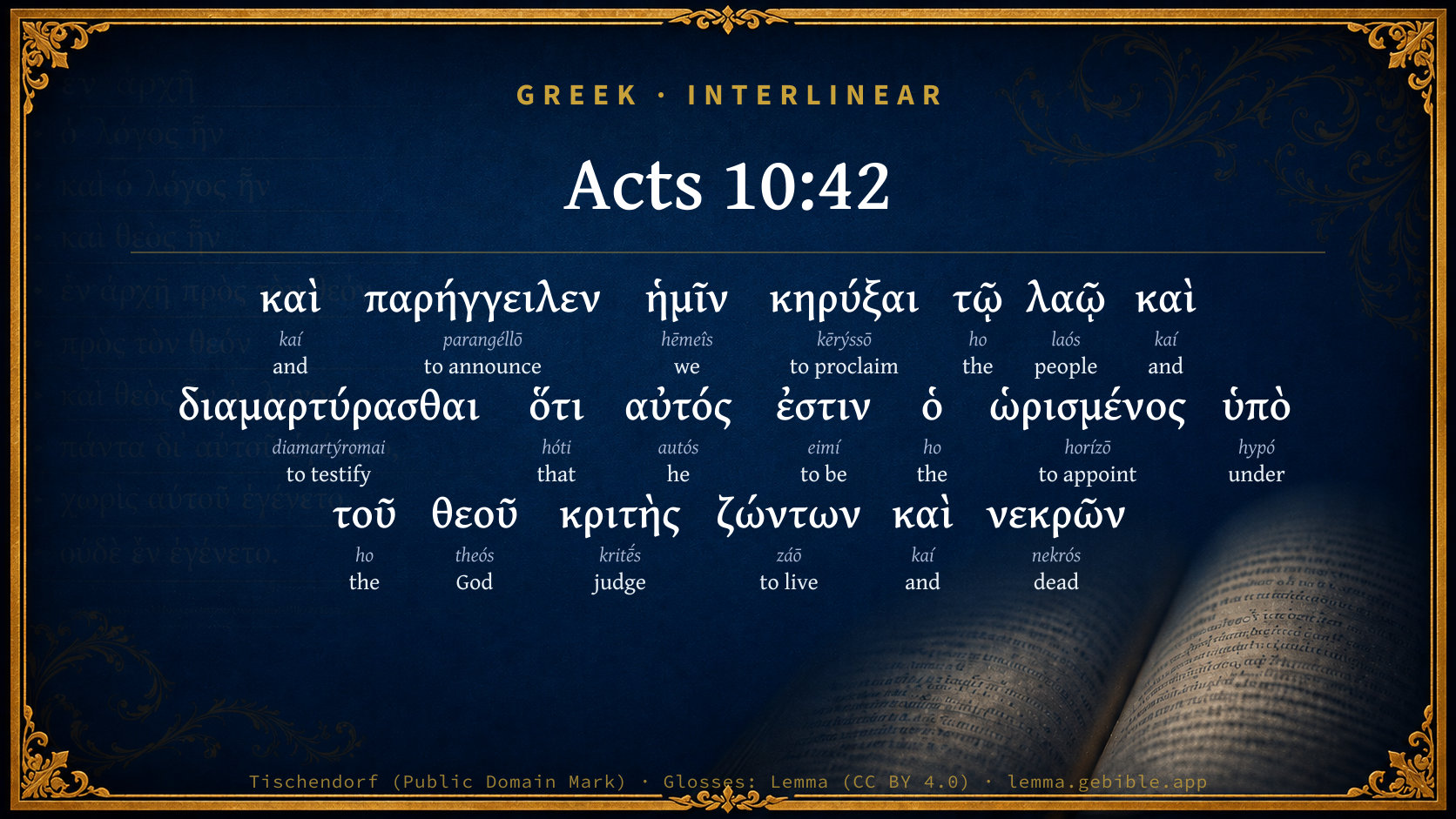
  1. καὶ kaí G2532 “and” Conjunction
  2. παρήγγειλεν parangéllō G3853 “to announce” Verb, Aorist, Active, Indicative, 3rd person, Singular
  3. ἡμῖν hēmeîs G2249 “we” Personal pronoun, 1st person, Dative, Plural
  4. κηρύξαι kērýssō G2784 “to proclaim” Verb, Aorist, Active, Infinitive
  5. τῷ ho G3588 “the” Article, Dative, Singular, Masculine
  6. λαῷ laós G2992 “people” Noun, Dative, Singular, Masculine
  7. καὶ kaí G2532 “and” Conjunction
  8. διαμαρτύρασθαι diamartýromai G1263 “to testify” Verb, Aorist, Middle deponent, Infinitive
  9. ὅτι hóti G3754 “that” Conjunction
  10. αὐτός autós G846 “he” Personal pronoun, Nominative, Singular, Masculine
  11. ἐστιν eimí G1510 “to be” Verb, Present, Active, Indicative, 3rd person, Singular
  12. ὁ ho G3588 “the” Article, Nominative, Singular, Masculine
  13. ὑπὸ hypó G5259 “under” Preposition
  14. τοῦ ho G3588 “the” Article, Genitive, Singular, Masculine
  15. θεοῦ theós G2316 “God” Noun, Genitive, Singular, Masculine
  16. κριτὴς kritḗs G2923 “judge” Noun, Nominative, Singular, Masculine
  17. ζώντων záō G2198 “to live” Verb, Present, Active, Participle, Genitive, Plural, Masculine
  18. καὶ kaí G2532 “and” Conjunction
  19. νεκρῶν nekrós G3498 “dead” Adjective, Genitive, Plural, Masculine

About this verse

These counts appear in no published source. They are computed here, from the morphology-tagged text and Lemma’s own curated glosses. What Lemma adds →

20
words
16
distinct lemmas
Acts
section

Notable vocabulary

The rarest word here is ὡρισμένος to appoint G3724 — appearing just 8 times in the whole Greek New Testament.

Shared distinctive vocabulary

ὡρισμένος to appoint G3724 occurs in 8 verses of the Greek New Testament. Also found in:

Repetition

Words recur within this verse:

Cross-references

20

Topical passages linked to Acts 10:42 in the Treasury of Scripture Knowledge — connected by theme and wording, ordered by reader-vote popularity; previews shown in the World English Bible.

  • 2 Corinthians 5:10 For we must all be revealed before the judgment seat of Christ; that each one may receive the things in the body, according to what he has done, whether good or bad.
  • 2 Timothy 4:1 I charge you therefore before God and the Lord Jesus Christ, who will judge the living and the dead at his appearing and his Kingdom:
  • 1 Peter 4:5 who will give account to him who is ready to judge the living and the dead.
  • Romans 14:9–10 For to this end Christ died, rose, and lived again, that he might be Lord of both the dead and the living.
  • Acts 17:31 because he has appointed a day in which he will judge the world in righteousness by the man whom he has ordained; of which he has given assurance to all men, in that he has raised him from the dead."
  • Matthew 28:19–20 Therefore go, and make disciples of all nations, baptizing them in the name of the Father and of the Son and of the Holy Spirit,
  • Revelation 20:11–15 I saw a great white throne, and him who sat on it, from whose face the earth and the heaven fled away. There was found no place for them.
  • Revelation 22:12 "Behold, I come quickly. My reward is with me, to repay to each man according to his work.
  • Matthew 25:31–46 "But when the Son of Man comes in his glory, and all the holy angels with him, then he will sit on the throne of his glory.
  • Mark 16:15–16 He said to them, "Go into all the world, and preach the Gospel to the whole creation.
  • Acts 1:2 until the day in which he was received up, after he had given commandment through the Holy Spirit to the apostles whom he had chosen.
  • Acts 4:19–20 But Peter and John answered them, "Whether it is right in the sight of God to listen to you rather than to God, judge for yourselves,
  • Luke 24:47–48 and that repentance and remission of sins should be preached in his name to all the nations, beginning at Jerusalem.
  • John 5:22–29 For the Father judges no one, but he has given all judgment to the Son,
  • John 21:21–22 Peter seeing him, said to Jesus, "Lord, what about this man?"
  • Acts 1:8 But you will receive power when the Holy Spirit has come upon you. You will be witnesses to me in Jerusalem, in all Judea and Samaria, and to the uttermost parts of the earth."
  • Acts 5:20 "Go stand and speak in the temple to the people all the words of this life."
  • Acts 5:29–32 But Peter and the apostles answered, "We must obey God rather than men.
  • 2 Timothy 4:8 From now on, there is stored up for me the crown of righteousness, which the Lord, the righteous judge, will give to me on that day; and not to me only, but also to all those who have loved his appearing.
  • Revelation 1:7 Behold, he is coming with the clouds, and every eye will see him, including those who pierced him. All the tribes of the earth will mourn over him. Even so, Amen.

Cross-references courtesy of OpenBible.info (CC BY 4.0).

Commentary

Notes on Acts 10:42 from classic Christian and Jewish commentators (each source and its license shown beneath its notes). The classic Christian expositions comment on the surrounding passage and are grouped to its opening verse, so a note may address several verses; the Jewish commentaries on the Tanakh (Rashi and others) are per-verse, so they appear only where the commentator wrote on this verse.

Lemma curates 59 commentaries, every one of them public domain or Creative Commons licensed, each selected and text-cleaned for this edition rather than reprinted as found. About our sources →

Bengel's Gnomon

Johann Albrecht Bengel

Act 10:42. Παρήγγειλεν ἡμῖν, He enjoined us) viz. God: ch. Act 5:29, “We ought to obey God rather than men.”—τῷ λαῷ, unto the people) Answering to the beginning of Act 10:41.—διαμερτύρασθαι, to testify) Understand, even to the Gentiles: ch. Act 1:8; Mat 28:19.—αὐτὸς, it is He Himself).—ὡρισμένος, ordained) by an immoveable decree.—κριτὴς, judge) This name expresses by Synecdoche (a part for the whole) all the glory of Christ, and in relation to believers it denotes the crowning consummation of the benefits of Christ: 2Ti 4:8, with which comp. Heb 12:23. He will judge even the Jews, who condemned Him; even the Romans, who held the Cæsarean seat of the government of Judea; even the dead, from among whom He rose again, and who are about to rise again in their own proper time; 1Pe 4:5. [Comp. ch. Act 17:31. So the Lord Jesus also testified of Himself as the Judge, before that He made mention of His own ascension; Joh 5:22, “The Father judgeth no man, but hath committed all judgment unto the Son.”—V. g.]

Bengel's Gnomon of the New Testament — English translation (T&T Clark, Edinburgh, 1860) — public domain. Text from a community e-Sword module.

Meyer's Critical & Exegetical Commentary

Heinrich August Wilhelm Meyer

Act_10:42. Τῷ λαῷ] can only denote the Jewish people, seeing that the context speaks of no other (Act_10:41), and cannot include the Gentiles also (Kuinoel). But the contents of ὅτι … νεκρῶν is so different from Mat_28:20 (also Act_1:8), that there must be here assumed a reference to another expression of the Risen One (for He is the subject of παρήγγ.) unknown to us.

ὅτι αὐτός ἐστιν … νεκρῶν] that He (no other) is the Judge ordained by God (in His decree) over living (who are alive at the Parousia, 1Th_4:17; 1Co_15:51-52) and dead (who shall then be already dead). Comp. 2Ti_4:1; 1Pe_4:5. Incorrectly Olshausen (resting on Mat_22:32!) understands by ζώντων κ. νεκρ. the spiritually living and dead. This meaning would require to be suggested by the context, but is here quite foreign to it. Comp. Rom_14:19-20; Act_17:31.

Meyer — Critical and Exegetical Commentary on the New Testament — English translation by Peter Christie, edited by Frederick Crombie (T&T Clark, 1880) — public domain. Text from a community e-Sword module.

Expositor's Greek Testament

ed. W. Robertson Nicoll

Act 10:42 . παρήγγειλεν : charged us, see on Act 1:4 . διαμαρτύρ ., see above on Act 2:40 , Act 8:25 . ὁ ὡρισμένος , see Act 2:23 , cf. Act 17:31 , in a strikingly similar statement by St. Paul at Athens. St. Peter and St. Paul are both at one in their witness to the Resurrection of the Christ on the third day, and also in their witness to His appointment as the future Judge of mankind. This startling claim made by St. Peter with reference to Jesus of Nazareth, with Whom he had lived on terms of closest human intimacy, and in Whose death he might well have seen the destruction of all his hopes, is a further evidence of the change which had passed over the Apostle, a change which could only be accounted for by the belief that this same Jesus was risen and declared to be the Son of God with power; cf. Enoch xli. 9, edition Charles; Witness of the Epistles , p. 403. κριτὴς ζ . καὶ ν ., cf. 1Pe 4:5 ; the words point back to the universal lordship of Christ over Jew and Gentile alike, Act 10:36 , cf. Rom 14:9 .

The Expositor's Greek Testament, edited by W. Robertson Nicoll (1897–1910) — public domain. Text from a community e-Sword module.

Adam Clarke's Commentary

Verse 42. And he commanded us to preach] By thus assuring them that Jesus Christ was appointed to judge the world, he at once showed them the necessity of subjection to him, that they might stand in the day of his appearing.

The Judge of quick and dead.] The word quick we retain from our ancient mother tongue, the Saxon [Anglo-Saxon], to live, hence [A.S.] and [A.S.], life, and [A.S.], grass; and from this our quicks, quick-set hedges, fences made of living thorns, c. By quick and dead we are to understand:

1. All that had lived from the foundation of the world till that time and all that were then alive.

2. All that should be found alive at the day of judgment, as well as all that had died previously.

Adam Clarke's Commentary on the Bible (1810–1826) — public domain. Text from a community e-Sword/MySword module.

John Calvin's Commentaries

42. And he commanded us. He beginneth in this place to intreat of the kingdom of Christ, when he saith that Christ did rise again for this cause, that he may once judge the world. For by the same right are the government of heaven and earth, and the perpetual government of the Church, due to him. He saith that he shall be judge of quick and dead; because, when as the dead shall rise again, others also, who shall then remain alive, shall be changed in a moment, as Paul teacheth in the fifteenth chapter of the First Epistle to the Corinthians, (1 Corinthians 15:51, 52,) and in the First to the Thessalonians, and the fourth chapter, (1 Thessalonians 4:17.) In the word testify there is great weight; because, as men are naturally inclined unto unbelief, the simple preaching of the gospel should not be so effectual, unless the Lord should establish it with strong protestations. And chiefly, every one of us doth feel in himself too much what a hard matter it is both to lift up our minds to hope for the coming of Christ, which are entangled in earthly snares, and also continually to keep them fixed in this meditation, seeing they cease not with their lightness to be carried hither and thither continually.

John Calvin's Commentaries (1540-1563) — public domain. Text from the Calvin Translation Society English edition (1840s-50s) via the Christian Classics Ethereal Library (ccel.org). Calvin's coverage is partial (roughly two-thirds of the Bible); uncommented books and verses are honest gaps, never fabricated. The 19th-century editor's footnotes and remarks are omitted so the notes are faithfully Calvin's own voice.

Ellicott's Commentary for English Readers

(42) And he commanded us to preach unto the people. No such command is found in terms in the Gospel narratives of the words of the risen Lord, but it is partly implied in Mat_28:18-20, and is covered by the general teaching as to the things of the kingdom of God in Act_1:3. It is interesting to note that St. Peter and St. Paul agree in thus connecting the Resurrection with the assurance that He who had risen was to be the future Judge of all men. (Comp. Act_17:31.)

Which was ordained.—More accurately, which has been ordained.

A Bible Commentary for English Readers, edited by Charles John Ellicott (1878–1897) — public domain. Text from a community e-Sword module.

The Cambridge Bible for Schools and Colleges

gen. ed. J. J. S. Perowne

42. And he commanded us to preach unto the people] This was among the commandments alluded to Act_1:2. Compare the charge given by Christ, Mat_28:19, where the wide commission “Go ye, teach all nations,” is one that anticipated the preaching of the Gospel not only to Cornelius, but to all other Gentiles.

that it is he which was ordained of God to be the Judge of quick and dead] Cp. Christ’s words to the Jews (Joh_5:22; Joh_5:27), “For the Father judgeth no man, but hath committed all judgment unto the Son,” “and hath given him authority to execute judgment also, because he is the Son of man.”

The Cambridge Bible for Schools and Colleges (gen. ed. J. J. S. Perowne; Cambridge University Press, 1878–1918) — public domain. Text from a community e-Sword module.

John Gill's Exposition

And he commanded us, to preach unto the people,.... Not only of the Jews, but of the Gentiles; to all nations, to the whole world, and every creature; for the apostle seems to refer to the commission given to him, and the rest of the apostles, after Christ's resurrection, Mat 28:19.

And to testify that it is he which was ordained of God, to be the Judge of quick and dead: the preaching of the Gospel is a testification of Christ, or a bearing a testimony for him; and among the rest to this truth, that he was from all eternity in the council and covenant of grace; appointed by God to have all power in heaven and in earth; and not only to judge and govern his church and people on earth, but to be the Judge of all men at the last day, of such who will be found alive at his coming, and of those that are dead; who will be raised again, and stand before his judgment seat, to receive their proper sentence; and though this is not expressed in the commission given the apostles, yet is implied therein; Mat 28:18 That there will be a general judgment at the last day is certain, from the reason of things; from the relation of creatures to God as their Creator, to whom they are accountable for their conduct and actions; from the justice of God, which requires it, which does not take place in the present state of things; and it has a testimony in the consciences of men, which the most daring of infidels, at times, show by the fears they are possessed of about it; and it is abundantly clear from revelation, from the writings of the Old and New Testament; from whence it appears that it is future, it is yet to come; that it is certain, being appointed by God, though the time to men is uncertain; that it will be universal, and reach to all men, righteous and wicked, quick and dead, and to all actions, good and bad, open and secret; and that it will be a righteous one, and be administered according to the strictest rules of justice and equity; and that it is an eternal one; not that it will be ever carrying on, but will issue in the determination of the states of men to all eternity: now Christ he is appointed to do this work, he was ordained to unto it in the purposes of God from everlasting; this was settled in the covenant between them; and for the execution of which, he has all power and authority given him as Mediator: and for it he is every way qualified: he is of great and infinite majesty, being the mighty God; of great sagacity and wisdom, having, as Mediator, the spirit of wisdom and knowledge upon him, whereby he is of quick understanding and discernment; and he is of great faithfulness and integrity, and will judge not after the sight of his eyes, and the hearing of his ears, but with righteousness and equity, and will do the thing that is right; and especially, inasmuch as he is omniscient, and knows the secrets of all hearts, and so capable of bringing every work into judgment, with every secret thing; and also omnipotent, and so able to raise the dead, summon all nations before him, separate the wicked and the righteous, and not only denounce the proper sentences upon them, but execute them.

John Gill's Exposition of the Whole Bible (1746–1763) — public domain (CC PDM 1.0). Text via the HelloAO Bible API.

Trapp's Complete Commentary

John Trapp

42 And he commanded us to preach unto the people, and to testify that it is he which was ordained of God to be the Judge of quick and dead.

Ver. 42. Ordained of God] Gr. ωρισμενος, determined, and by definitive sentence concluded.

John Trapp, A Commentary or Exposition upon All the Books of the Old and New Testament (1647–1656) — public domain. Text from a community e-Sword module.

Albert Barnes' Notes on the Bible

And he commanded us ... - ; Mat 28:19-20; Mar 16:15-16.

And to testify - To bear witness.

That it is he ... - See the notes on Joh 5:22-27. Compare the references in the margin.

Of quick - The living. The doctrine of the New Testament is, that those who are alive when the Lord Jesus shall return to judge the world, will be caught up in vast numbers like clouds, to meet him in the air, without seeing death, 1Th 4:16-17. Yet before this they will experience such a change in their bodies as shall fit them for the judgment and for their eternal residence - a change which will liken them to those who have died, and have risen from the dead. What this change will be, speculation may fancy, but the Bible has not revealed. See 1Co 15:52, “The dead shall be raised, and we shall be changed.”

Albert Barnes' Notes on the Bible (1834–1885) — public domain. Text from a community e-Sword/MySword module.

Haydock's Catholic Bible Commentary

The living and of the dead. This may be understood of the elect, who live by grace, and the reprobate, who are spiritually dead; or perhaps more literally, of those who shall be found living upon earth at the second coming of Christ, and of all who have died from the commencement of the world to the end of time. (St. Augustine, Enchirid[].)

George Leo Haydock (1774–1849), Haydock's Catholic Family Bible and Commentary, 1859 edition — public domain. Excludes Psalms (Douay-Rheims chapter numbering differs from Protestant) and Deuterocanonical books (Catholic canon only).

Matthew Poole's English Annotations

Our Saviour gave this charge to his apostles before his ascension, Mat 28:19; Mar 16:15; Luk 24:47; and foretold that they should execute this his charge, Act 1:8.

Ordained of God to be the Judge: that God hath ordained to judge the world by Jesus Christ, Scripture abundantly testifies, Joh 5:26,27; 2Ti 4:1; 1Pe 4:5. And this is here spoken of the apostle, and was given in charge by our Saviour to be principally preached of by them all, because the resurrection of Christ, and the glory of his kingdom in this world, is clouded by the blindness and hardness of men; as also, because it is of the greatest concernment unto all, that at any time hear the word of God, to be persuaded of this, that Christ, whose gospel and word they hear, will judge them according unto it.

Quick; such as shall be alive at the coming of our Lord to judgment, 1Th 4:15.

Matthew Poole's English Annotations on the Holy Bible (1683–1685) — public domain. Text from a community e-Sword/MySword module.

Whedon's Commentary on the Bible

Daniel D. Whedon

42. Quick—Living. Those who are living when Christ comes, and those who are then dead; the former to put on the resurrection nature by a change, without death; the latter to be raised from the dead.

Daniel D. Whedon (gen. ed.), Commentary on the Old and New Testaments (1874–1909) — public domain. Text from a community e-Sword module.

The Pulpit Commentary

Charged for commanded, A.V.; this is he which is for it is he which was, A.V. To be the Judge, etc. This statement involves the resurrection of the dead. (comp. Joh_5:21-29; Rev_20:11, Rev_20:12) It is easy to see how the creeds would be formed from the repetition of short doctrinal statements like this. (see 1Co_15:3, 1Co_15:4)

The Savior"s charge to his ministers.

commanded us to preach unto the people." No secrets in the Christian religion. Apostles witnesses for the sake of others. The key opened the door, and then was flung away. Baptism of the Holy Ghost preceded the universal message.

I THE DIVINEST WORK OF GOD"S PEOPLE TO PREACH.

1. The greatness of the work rests upon the greatness of the necessity. Teaching can never be dispensed with. The root of a true faith is knowledge. Popular ignorance immeasurable.

2. No ritualistic display can supersede preaching. Nor is devotion the whole of worship. As a moral force, Christianity must be preached to men, both conscience and heart.

3. Preaching is the most simple and pure channel of connection from soul to soul. The Spirit flows through the Word.

II THE CHIEF AIM OF GOD"S MINISTERS MUST BE TO REACH THE PEOPLE.

1. No sophistry should blind us to the fact that the proclamation of gospel truth is the first duty of Christians.

2. The Word preached must be the Word which is adapted to the people, life power like that of evangelical truth.

3. Churches must guard against being "at ease in Zion." Edification is best aimed at through aggressive efforts on the surrounding population. Intellectual preaching must be subordinated to popular wants. An educated ministry is the want of the times, but the education, like all other means employed, must be full of the Holy Ghost.

III THE MASTER"S COMMISSION THE SUPPORT OF THE CHURCH"S HOPES.

1. Direct charge must silence all questioning and all speculation.

2. Jesus Christ reads the future. Let the commander give the orders. Then his predictions of victory will be fulfilled.

3. The reflex action of zealous fulfillment of the charge on the Church"s own faith and experience. These who do much for the people the happiest Christians, the most assured believers. The triumphs of practical Christianity will be its best evidence. What are we doing, both as individuals and as Churches, to preach to the people? R.

The Pulpit Commentary (1880–1919), ed. H.D.M. Spence-Jones & Joseph S. Exell — public domain. Text from a community e-Sword module.

John Wesley's Explanatory Notes

It is he who is ordained by God the Judge of the living and the dead - Of all men, whether they are alive at his coming, or had died before it. This was declaring to them, in the strongest terms, how entirely their happiness depended on a timely and humble subjection to him who was to be their final Judge.

John Wesley, Explanatory Notes Upon the Whole Bible (1754–1765) — public domain. Text via the GEBible commentary corpus.

McGarvey & Pendleton's Commentaries

J. W. McGarvey

42, 43. Having now followed the career of Jesus from the beginning to his resurrection and exhibition of himself alive to the witnesses, Peter proceeds in regular order to the next historical fact, the giving of the apostolic commission. (42) " And he commanded us to preach to the people, and to testify that it is he who is ordained by God the judge of the living and the dead. (43) To him all the prophets testify that every one who believes in him shall, through his name, receive remission of sins. "

The declaration that every one who believes in him shall receive remission of sins has been construed as proof that remission of sins is dependent on faith only. But the fact that Peter is here stating what Jesus commanded the apostles to preach should prevent such a construction of his words; for, in the commission to which he refers, immersion is connected with faith, as a condition of pardon. His words must be construed consistently with this fact. There is no difficulty in doing this, for it is a common apostolic usage to employ faith as an equivalent for the conditions of pardon. To deny that immersion is for remission of sins, because, in a condensed statement like this, it is not specifically mentioned, is not less subversive of the truth than to deny that repentance is a condition because it is not mentioned. It is not sufficient to reply to this, that repentance was always implied in genuine faith; for it certainly was not more uniformly attendant upon faith than was immersion. It would be difficult to find, in apostolic times, a penitent believer who was not immersed, without unnecessary delay, as a genuine believer who was not penitent. All believers who repented were invariably immersed. Of course, we exclude from this remark all cases which occurred previous to the date of the commission.

If any one, dissatisfied with this explanation, is disposed to insist that Peter's declaration, that every one who believes in Jesus shall receive remission of sins, must include those-if any there be-who believe, but are not immersed, we have but to show the absurdity of the assumption by referring to a parallel case in which there can be no dispute. The Apostle John says: " Whosoever shall confess that Jesus is the Son of God, God dwells in him, and he in God." He who would conclude from this remark, that the only condition of communion with God is to confess that Jesus is his Son, subverts the truth no more than he who makes the assumption in question; for the universality of the declaration is the same in both, and there is no limitation expressed in either.

There is no one fact more distinctly stated in Acts that that believers should repent and be immersed for the remission of sins: hence, there can scarcely be a grosser perversion of the word of God than to construe other statements of the Scripture so as to deny the truth of this. A condition of pardon once stated can never be set aside by any less than express divine authority.

It should be observed, further, that the statement in question is not absolutely that "every one who believes in him shall receive remission of sins;" but that he shall receive it " through his name. " The expression, "through his name," was not thrown in here at random; for the inspired apostles never spoke at random. It has a well-defined meaning, and was intended to qualify the sentence of which it forms a part. What we receive through his name certainly can not reach us until we attain some connection with his name. But we are immersed into his name with that of the Father and the Holy Spirit; hence it is at the time of this immersion, that the believer receives remission of sins through his name.

J. W. McGarvey (with Philip Y. Pendleton), Commentaries on the New Testament (The Fourfold Gospel, 1914; Acts; and the epistles) — public domain. Text from a community e-Sword/MySword module.

The People's New Testament

B. W. Johnson

42. He commanded us to preach. In the Great Commission.

B. W. Johnson's The People's New Testament with Notes (1889–1891) — public domain. Electronic text from the Christian Classics Ethereal Library (CCEL) ThML edition.

unfoldingWord translationNotes

Door43 World Missions Community

Connecting Statement:

Peter finishes his speech to everyone in the house of Cornelius, which he began in Acts 10:34.

General Information:

Here the word "us" includes Peter and believers. It excludes his audience. (See: Exclusive and Inclusive "We")

that this is the one who has been chosen by God

This can be stated in active form. AT: "that God chose this Jesus" (See: Active or Passive)

the living and the dead

This refers to people who are still living and people who have died. AT: "the people who are alive and the people who are dead" (See: Nominal Adjectives)

It is to him that all the prophets bear witness

"All the prophets bear witness to Jesus"

everyone who believes in him shall receive forgiveness of sins

This could be stated in active form. AT: "God will forgive the sins of everyone who believes in Jesus because of what Jesus has done" (See: Active or Passive)

through his name

Here "his name" refers to the actions of Jesus. His name means God who saves. AT: "through what Jesus has done for them" (See: Metonymy)

translationWords

preach

judge, judges

life

die

prophet

testimony

believe

receive

forgive

sin

unfoldingWord translationNotes — © Distant Shores Media and the Door43 World Missions Community, licensed CC BY-SA 4.0. Source: git.door43.org/Door43/en_tn.

Cambridge Greek Testament for Schools and Colleges

42. καὶ παρήγγειλεν ἡμῖν κηρύξαι τῷ λαῷ, and He commanded us to proclaim to the people. This was among the commandments alluded to Act 1:2. Compare the charge given by Christ, Mat 28:19, where the wide commission ‘Go ye, teach all nations,’ is one that anticipated the preaching of the Gospel not only to Cornelius, but to all other Gentiles.

ὅτι αὐτός ἐστιν ὁ ὡρισμένος κ.τ.λ., that it is He which was ordained of God to be the Judge of quick and dead. Of this the Apostles could testify for they had heard it from Christ’s own lips. Cf. His words to the Jews (Joh 5:22; Joh 5:27), ‘For the Father judgeth no man, but hath committed all judgment unto the Son,’ ‘and hath given Him authority to execute judgment also, because he is the Son of man.’

Cambridge Greek Testament for Schools and Colleges (Cambridge University Press, 1896; 21 vols, various authors incl. Carr, Maclear, Plummer, Farrar, Lumby, Moule, M. R. James, Simcox) — public domain. Text from a community e-Sword module.

Alford’s Greek Testament

Henry Alford

42. τῷ λαῷ] Here as elsewhere (ver. 2; Joh 11:50 al. fr.), the Jewish people: that was all which, in the apostolic mind, up to this time, the command had absolutely enjoined. The further unfolding of the Gospel had all been brought about over and above this first injunction. Ch. 1:8 is no obstacle to this interpretation; for although literally fulfilled by the leadings of Providence, as related in this book, they did not so understand it when spoken.

κριτ. ζ. κ. νεκρ.] So also Paul, ch. 17:31, preaching to Gentiles, brings forward the appointment of a Judge over all men as the central point of his teaching. This expression gives at once a universality to the office and mission of Christ, which prepares the way for the great truth declared in the next verse.

It is impossible that the living and dead here can mean (as the Augsburg Catechism, and Olshausen) the righteous and sinners:—a canon of interpretation which should constantly be borne in mind is, that a figurative sense of words is never admissible, except when required by the context. Thus, in the passage of Joh 5:25 (where see notes), the sense of νεκροί is determined to be figurative by the addition of καὶ νῦν ἐστιν after ὥρα, no such addition occurring in ver. 28, where the literally dead, οἱ ἐν τοῖς μνημείοις, are mentioned.

Henry Alford, The Greek Testament (1849–1861) — public domain. Text from a community e-Sword module.

Vincent's Word Studies in the New Testament

Marvin R. Vincent

Testify [διαμαρτυρασθαι] . See on ch. Act 2:40.

Remission. See on Luk 3:3; Jas 5:15.

Marvin R. Vincent, Word Studies in the New Testament (1887–1900) — public domain. Text from a community e-Sword/MySword module.

Lesson kit

Teaching starters — assembled from the data on this page, not authored interpretation. Every prompt links to the verse data it draws on. Edit before teaching.

Acts, in the Acts, opens this verse with 20 words (16 distinct Greek lemmas). Its most distinctive word is horízō (“to appoint”). A historical commentator’s framing appears above. Read the whole chapter for the surrounding context.

Discussion questions

  1. What does “to appoint” (horízō) contribute to the verse as a whole?
  2. Luke 22:22 shares the word «to appoint» with this verse. How do the two illuminate each other?
  3. “and” occurs 3× in this one verse. What is the effect of the repetition?
  4. These translations render this verse differently. What is at stake in choosing one wording over another?
  5. Reading how Bengel's Gnomon and Meyer's Critical & Exegetical Commentary read this verse, where do the two commentators agree and where do they part?

Things to notice

Reading settings

Reading text

Shown beneath each verse's original-language words.

Old Testament
Old Testament edition

Read the OT as the Masoretic Hebrew (MT) or the Greek Septuagint (LXX).

English shown for the Greek Septuagint (in the Hebrew ↔ Greek comparison).

Comparing translations? Open the Compare panel on any verse page to stack up to four side by side.