Acts 19:4

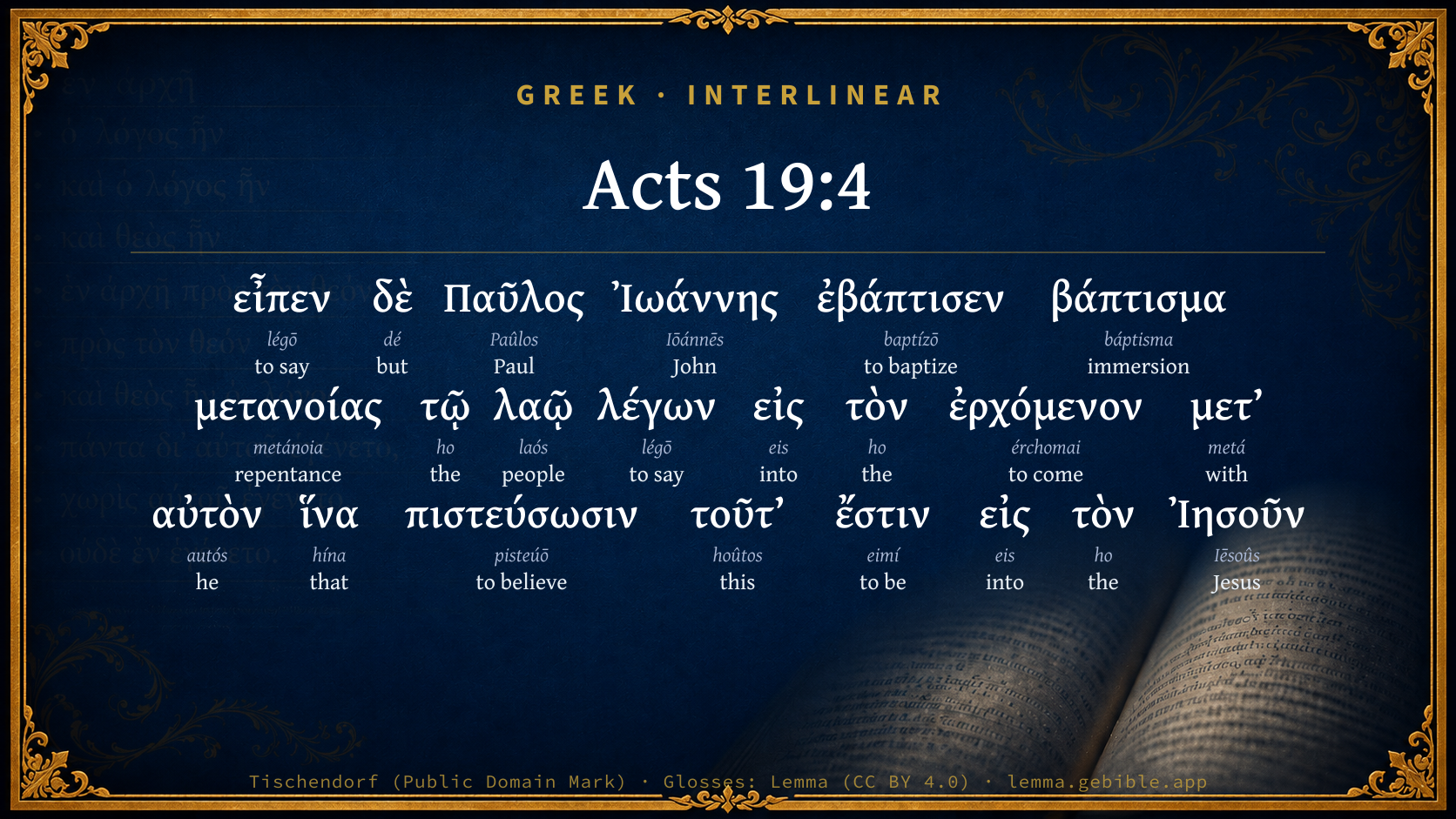
Greek (Tischendorf 8th ed.) Acts 19:4 appears in the Greek New Testament. The text above is from the Tischendorf 8th edition. Each word links to its Strong’s number and a concise gloss. Click any word for its full Thayer’s Greek Lexicon entry.
Download image
Cite this verse

Acts 19:4 (World English Bible). Public Domain. Lemma interlinear Bible study tool, https://lemma.gebible.app/v/acts/19/4.

Show BibTeX & RIS
BibTeX
RIS
English Translation
Paul said, "John indeed baptized with the baptism of repentance, saying to the people that they should believe in the one who would come after him, that is, in Jesus."
World English Bible · Public Domain
Download a study sheet

One document with this verse’s original text, its word-by-word gloss line, the meaning frame, cross-references with their text, attributed commentary, and full source and license credits — printable, and it pastes into notes with its structure intact.

This verse Autodidact and up

Study sheet (.html) Plain text (.txt)

A passage Seminary Student

Up to 50 verses in one chapter. A passage sheet keeps up to 6 commentary sources and 12 cross-references per verse, in the order this page ranks them, and says so on the sheet whenever that leaves anything out. Ask for a single verse and you get the Autodidact verse sheet above.

Everything on this page stays free to read, with no account — the sheet is a download of what is already on screen, not access to it.

Want to remove ads? Support Godless Engineer
Compare translations 3

The same verse in 3 English versions, stacked beneath the original-language interlinear above. Click any original word for its lexicon entry.

Each is an independent rendering of the whole verse — the interlinear is not word-aligned to these translations.

Highlighted words mark where these versions differ — a whole-verse word diff, not a word-by-word alignment.

  • World English Bible Public Domain
    Paul said, "John indeed baptized with the baptism of repentance, saying to the people that they should believe in the one who would come after him, that is, in Jesus."
  • King James Version Public Domain
    Then said Paul, John verily baptized with the baptism of repentance, saying unto the people, that they should believe on him which should come after him, that is, on Christ Jesus.
  • unfoldingWord Literal Text CC BY-SA 4.0
    But Paul replied, “John baptized a baptism of repentance, saying to the people that they should believe in the one coming after him, that is, in Jesus.”

unfoldingWord Literal Text — © unfoldingWord, licensed CC BY-SA 4.0. Word-aligned USFM3 via Door43 (git.door43.org/unfoldingWord/en_ult).

Versions to compare (up to 4)

3 of 4 selected

Show all 19 translations

Every available English version of this verse, each an independent rendering of the whole verse.

  • World English Bible Public Domain
    Paul said, "John indeed baptized with the baptism of repentance, saying to the people that they should believe in the one who would come after him, that is, in Jesus."
  • Berean Standard Bible Public Domain
    Paul explained: “John’s baptism was a baptism of repentance. He told the people to believe in the One coming after him, that is, in Jesus.”
  • Majority Standard Bible Public Domain
    Paul explained: “John’s baptism was indeed a baptism of repentance. He told the people to believe in the One coming after him, that is, in Christ Jesus.”
  • King James Version Public Domain
    Then said Paul, John verily baptized with the baptism of repentance, saying unto the people, that they should believe on him which should come after him, that is, on Christ Jesus.
  • American Standard Version (1901) Public Domain
    And Paul said, John baptized with the baptism of repentance, saying unto the people that they should believe on him that should come after him, that is, on Jesus.
  • Revised Version (1885) Public Domain
    And Paul said, John baptized with the baptism of repentance, saying unto the people, that they should believe on him which should come after him, that is, on Jesus.
  • Geneva Bible (1599) Public Domain
    Then saide Paul, Iohn verely baptized with the baptisme of repentance, saying vnto the people, that they shoulde beleeue in him, which should come after him, that is, in Christ Iesus.
  • Douay-Rheims (1899) Public Domain
    Then Paul said: John baptized the people with the baptism of penance, saying: That they should believe in him who was to come after him, that is to say, in Jesus.
  • Young's Literal Translation Public Domain
    And Paul said, `John, indeed, did baptize with a baptism of reformation, saying to the people that in him who is coming after him they should believe -- that is, in the Christ -- Jesus;'
  • Literal Standard Version CC BY-SA 4.0
    And Paul said, “John, indeed, immersed with an immersion of conversion, saying to the people that they should believe in Him who is coming after him—that is, in the Christ—Jesus”;
  • Unlocked Literal Bible CC BY-SA 4.0
    So Paul replied, “John baptized with the baptism of repentance. He told the people that they should believe in the one who would come after him, that is, in Jesus.”
  • unfoldingWord Literal Text CC BY-SA 4.0
    But Paul replied, “John baptized a baptism of repentance, saying to the people that they should believe in the one coming after him, that is, in Jesus.”
  • Darby Bible Public Domain
    And Paul said, John indeed baptised [with] the baptism of repentance, saying to the people that they should believe on him that was coming after him, that is, on Jesus.
  • World Messianic Bible Public Domain
    Paul said, “Yochanan indeed immersed with the immersion of repentance, saying to the people that they should believe in the one who would come after him, that is, in Messiah Yeshua.”
  • Webster's Bible Public Domain
    Then said Paul, John verily baptized with the baptism of repentance, saying to the people, That they should believe on him who should come after him, that is, on Christ Jesus.
  • Free Bible Version CC BY-SA 4.0
    “John baptized with the baptism of repentance,” said Paul. He told the people that they should trust in the one who would come after him—that is, they should trust in Jesus.
  • Bible in Basic English Public Domain
    And Paul said, John gave a baptism which goes with a change of heart, saying to the people that they were to have faith in him who was coming after him, that is, in Jesus.
  • Text-Critical English NT CC BY 4.0
    Then Paul said, “John baptized with a baptism of repentance, telling the people to believe in the one who was to come after him, that is, in Christ Jesus.”
  • Tyndale New Testament (1534) Public Domain
    Then sayde Paul: Iohn verely baptised with the baptism of repentaunce sayinge vnto the people that they shuld beleve on him which shuld come after him: that is on Christ Iesus.

Literal Standard Version (2020), Covenant Press — licensed CC BY-SA 4.0. Text via the HelloAO Bible API (eBible.org). Unlocked Literal Bible (unfoldingWord) — licensed CC BY-SA 4.0. Text via the HelloAO Bible API (eBible.org). unfoldingWord Literal Text — © unfoldingWord, licensed CC BY-SA 4.0. Word-aligned USFM3 via Door43 (git.door43.org/unfoldingWord/en_ult). Free Bible Version, Dr. Jonathan Gallagher — licensed CC BY-SA 4.0. Text via the HelloAO Bible API (eBible.org).

Word by word

More ways to search: Search by grammar → Find every occurrence → Compare this word →

Practice this passage: Drill this verse → Learn its vocabulary →

βάπτισμα
báptisma
G908
“immersion”
Noun, Accusative, Singular, Neuter
Part of Speech
Noun
Case
Accusative
Number
Singular
Gender
Neuter
Full Thayer's Definition

Origin: from G907

TDNT: 10:05,9

1. immersion, submersion a. of calamities and afflictions with which one is quite overwhelmed b. of John's baptism, that purification rite by which men on confessing their sins were bound to spiritual reformation, obtained the pardon of their past sins and became qualified for the benefits of the Messiah's kingdom soon to be set up. This was valid Christian baptism, as this was the only baptism the apostles received and it is not recorded anywhere that they were ever rebaptised after Pentecost. c. of Christian baptism; a rite of immersion in water as commanded by Christ, by which one after confessing his sins and professing his faith in Christ, having been born again by the Holy Spirit unto a new life, identifies publicly with the fellowship of Christ and the church. In Rom. 6:3 Paul states we are "baptised unto death" meaning that weare not only dead to our former ways, but they are buried. To returnto them is as unthinkable for a Christian as for one to dig up a deadcorpse! In Moslem countries a new believer has little trouble withMoslems until he is publicly baptised. It is then, that the Moslems'know he means business, and then the persecution starts. See alsodiscussion of baptism under No. 907.
  1. εἶπεν légō G3004 “to say” Verb, Aorist, Active, Indicative, 3rd person, Singular
  2. δὲ dé G1161 “but” Conjunction
  3. Παῦλος Paûlos G3972 “Paul” Noun, Nominative, Singular, Masculine
  4. Ἰωάννης Iōánnēs G2491 “John” Noun, Nominative, Singular, Masculine
  5. ἐβάπτισεν baptízō G907 “to baptize” Verb, Aorist, Active, Indicative, 3rd person, Singular
  6. μετανοίας metánoia G3341 “repentance” Noun, Genitive, Singular, Feminine
  7. τῷ ho G3588 “the” Article, Dative, Singular, Masculine
  8. λαῷ laós G2992 “people” Noun, Dative, Singular, Masculine
  9. λέγων légō G3004 “to say” Verb, Present, Active, Participle, Nominative, Singular, Masculine
  10. εἰς eis G1519 “into” Preposition
  11. τὸν ho G3588 “the” Article, Accusative, Singular, Masculine
  12. ἐρχόμενον érchomai G2064 “to come” Verb, Present, Middle or Passive deponent, Participle, Accusative, Singular, Masculine
  13. μετ’ metá G3326 “with” Preposition
  14. αὐτὸν autós G846 “he” Personal pronoun, Accusative, Singular, Masculine
  15. ἵνα hína G2443 “that” Conjunction
  16. πιστεύσωσιν pisteúō G4100 “to believe” Verb, Aorist, Active, Subjunctive, 3rd person, Plural
  17. τοῦτ’ hoûtos G3778 “this” Demonstrative pronoun, Nominative, Singular, Neuter
  18. ἔστιν eimí G1510 “to be” Verb, Present, Active, Indicative, 3rd person, Singular
  19. εἰς eis G1519 “into” Preposition
  20. τὸν ho G3588 “the” Article, Accusative, Singular, Masculine
  21. Ἰησοῦν Iēsoûs G2424 “Jesus” Noun, Accusative, Singular, Masculine

About this verse

These counts appear in no published source. They are computed here, from the morphology-tagged text and Lemma’s own curated glosses. What Lemma adds →

22
words
18
distinct lemmas
Acts
section

Notable vocabulary

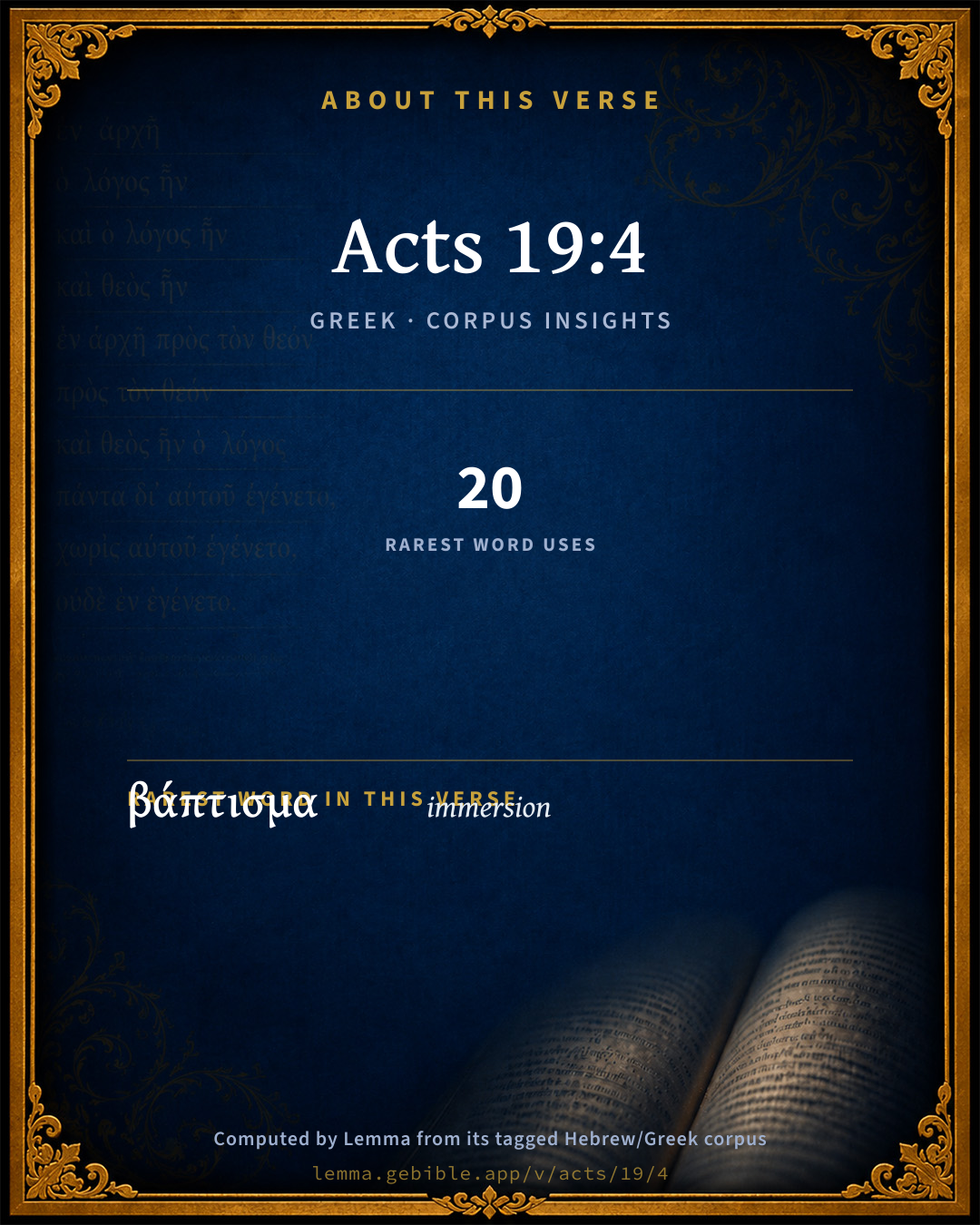
The rarest word here is βάπτισμα immersion G908 — appearing just 20 times in the whole Greek New Testament.

Shared distinctive vocabulary

βάπτισμα immersion G908 occurs in 20 verses of the Greek New Testament. Also found in:

Repetition

Words recur within this verse:

Cross-references

15

Topical passages linked to Acts 19:4 in the Treasury of Scripture Knowledge — connected by theme and wording, ordered by reader-vote popularity; previews shown in the World English Bible.

  • John 1:29–34 The next day, he saw Jesus coming to him, and said, "Behold, the Lamb of God, who takes away the sin of the world!
  • Acts 1:5 For John indeed baptized in water, but you will be baptized in the Holy Spirit not many days from now."
  • Acts 11:16 I remembered the word of the Lord, how he said, 'John indeed baptized in water, but you will be baptized in the Holy Spirit.'
  • Luke 3:16–18 John answered them all, "I indeed baptize you with water, but he comes who is mightier than I, the latchet of whose sandals I am not worthy to loosen. He will baptize you in the Holy Spirit and fire,
  • John 1:7 The same came as a witness, that he might testify about the light, that all might believe through him.
  • John 1:27 He is the one who comes after me, who is preferred before me, whose sandal strap I'm not worthy to loosen."
  • John 3:28–36 You yourselves testify that I said, 'I am not the Christ,' but, 'I have been sent before him.'
  • Acts 13:23–25 From this man's seed, God has brought salvation to Israel according to his promise,
  • Matthew 3:11–12 I indeed baptize you in water for repentance, but he who comes after me is mightier than I, whose shoes I am not worthy to carry. He will baptize you in the Holy Spirit.
  • Matthew 11:3–5 and said to him, "Are you he who comes, or should we look for another?"
  • Matthew 21:25–32 The baptism of John, where was it from? From heaven or from men?" They reasoned with themselves, saying, "If we say, 'From heaven,' he will ask us, 'Why then did you not believe him?'
  • Mark 1:1–12 The beginning of the Gospel of Jesus Christ, the Son of God.
  • Luke 1:76–79 And you, child, will be called a prophet of the Most High, For you will go before the face of the Lord to make ready his ways,
  • John 1:15 John testified about him. He cried out, saying, "This was he of whom I said, 'He who comes after me has surpassed me, for he was before me.'"
  • John 5:33–35 You have sent to John, and he has testified to the truth.

Cross-references courtesy of OpenBible.info (CC BY 4.0).

Where the printed editions differ

1 variant

Places in this verse where the major printed Greek editions disagree on the wording in a way that affects the translation — a comparison of editions, not a manuscript-by-manuscript collation. The editions are the modern critical texts (Nestlé-Aland 28/27, SBL, Westcott-Hort, Tregelles, Tyndale House) and the traditional texts behind the KJV (the Textus Receptus and the Byzantine/Majority text). It is not a claim about which reading is original.

  1. Extra text
    Χριστὸν

    “Christ”

    In TRByz Not in NA28NA27TynSBLWHTreg

    Χριστὸν (Christon) 'Christ' is only in traditional manuscripts (TR+Byz)

Textual data: Translators Amalgamated Greek New Testament (STEPBible TAGNT) · CC BY 4.0.

Commentary

Notes on Acts 19:4 from classic Christian and Jewish commentators (each source and its license shown beneath its notes). The classic Christian expositions comment on the surrounding passage and are grouped to its opening verse, so a note may address several verses; the Jewish commentaries on the Tanakh (Rashi and others) are per-verse, so they appear only where the commentator wrote on this verse.

Lemma curates 59 commentaries, every one of them public domain or Creative Commons licensed, each selected and text-cleaned for this edition rather than reprinted as found. About our sources →

Bengel's Gnomon

Johann Albrecht Bengel

Act 19:4. Ἰωάννης, John) After this passage, no mention occurs of John the Baptist in the New Testament. Here at last (at this particular point) he wholly gives place to Christ. This was a great performance of Paul.—μετʼ αὐτὸν) after him.—τουτέστιν εἰς τὸν Χριστὸν Ἰησοῦν, that is, on Christ Jesus[111]) So Paul explained the testimony of John the Baptist.

[111] The word Χοιστὸν, according to the margin of both Editions and the Germ. Vers., ought to be omitted.—E. B.

The word is omitted by ABE Vulg. Memph. and later Syr. Dd read Χριστὸν alone. Rec. Text, without very ancient authority, joins the the two, Χριστὸν Ιησοῦν.—E. and T.

Bengel's Gnomon of the New Testament — English translation (T&T Clark, Edinburgh, 1860) — public domain. Text from a community e-Sword module.

Meyer's Critical & Exegetical Commentary

Heinrich August Wilhelm Meyer

Act_19:4. Μέν] See on Act_1:1. Instead of following it up by an apodosis, such as: but Jesus is the coming One, on whom John by his baptism bound men to believe, Paul already inserts this idea by τοῦτ. ἔστιν εἰς τ. Ἰ. into the sentence begun by μέν, and, abandoning the μέν, entirely omits to continue the construction by δέ.

ἐβάπτ. βάπτ. μεταν.] he baptized (administered) a baptism (which obliged) to repentance. See Mar_1:4. On the combination of βαπτίζω with a cognate noun, comp. Luk_7:29; Luk_12:50; Mar_10:38.

εἰς τ. ἐρχ.] is with great emphasis prefixed to the ἴνα. Comp. on Gal_2:10; Eph_3:18.

ἵνα πιστ.] is to be understood purely in the sense of design; saying to the people: (that he administered a baptism of repentance) in order that they should believe on Him who was to come after him, i.e. on Jesus. This terse information concerning the connection of the baptism of John, which they had received, with Jesus, decided these disciples to receive Christian baptism. The determining element lay in τοῦτʼ ἔστιν εἰς τὸν Ἰησοῦν, which Paul must have more precisely explained to them, and by which they were transplanted from their hitherto indistinct and non-living faith into the condition of a full fides explicitafrom the morning dawn of faith to the bright daylight of the same.

Meyer — Critical and Exegetical Commentary on the New Testament — English translation by Peter Christie, edited by Frederick Crombie (T&T Clark, 1880) — public domain. Text from a community e-Sword module.

Expositor's Greek Testament

ed. W. Robertson Nicoll

Act 19:4 . εἰς τὸν ἐρχ : placed first before ἵνα , perhaps for emphasis. The phrase had been a favourite one with the Baptist ( cf. Mat 3:1 ). John’s own words showed that his Baptism was insufficient. ἵνα may express both the purport and the purpose (so Alford).

The Expositor's Greek Testament, edited by W. Robertson Nicoll (1897–1910) — public domain. Text from a community e-Sword module.

Jamieson, Fausset & Brown

Robert Jamieson, A. R. Fausset & David Brown

Then said Paul, John . . . baptized with the baptism of repentance--water unto repentance.

saying unto the people, that they should believe on him which should come after him--that is, who should baptize with the Holy Ghost. The point of contrast is not between John and Christ personally, but between the water baptism of John unto repentance, and the promised baptism of the Spirit from the hands of his coming Master unto new life. As to all the facts, or at least the significancy, of this baptism, which made the whole life and work of Christ another thing from what it was conceived to be before it was vouchsafed, these simple disciples were unenlightened.

Jamieson, Fausset & Brown — Commentary Critical and Explanatory on the Whole Bible (1871) — public domain (CC PDM 1.0). Text via the HelloAO Bible API.

Adam Clarke's Commentary

Verse 4. That they should believe on him which should come after] John baptized them with the baptism of repentance; this was common to all the baptisms administered by the Jews to proselytes; but telling them that they should believe on him who was coming, was peculiar to John's baptism.

Adam Clarke's Commentary on the Bible (1810–1826) — public domain. Text from a community e-Sword/MySword module.

John Calvin's Commentaries

4. John truly Paul’s admonition tended to this end, that these men being convict of their ignorance might desire to go forward. He saith that John preached of Christ who was to come. Therefore he sent out his disciples, that running in the course they might go towards Christ who was not as yet revealed. Wherefore, to the end these men may not flatter themselves, and refuse to go forward, he showeth that they be yet far from the mark. For the feeling of want doth enforce men to desire that which is as yet lacking. The sum cometh to this end, as if Paul had said Before Christ was glorified, this power of his did not appear in the world; when he was ascended into heaven he would have his kingdom to flourish thus. Therefore the graces of the Spirit were much less shed out when John was as yet in the course of his embassage, which do now declare that Christ sitteth at the right hand of his Father forasmuch as he had not as then openly showed himself to be the Redeemer of the world. Therefore know ye that you must go farther forward; because ye be far from the mark. So that he doth plainly show that the faith of the godly who had been taught by John ought to have looked unto Christ who was to come, lest these men should stand still being newly entered, without going any farther.

And even by this also are we taught that the baptism of John was a token of repentance and remission of sins and that our baptism at this day doth not differ any thing from it, save only that Christ is already revealed, and in his death and resurrection our salvation is made perfect: and so baptism was brought unto his [its] effect; because out of that fountain of Christ’s death and resurrection whereof I have spoken, floweth repentance, and thither is faith referred again that it may thence fet [seek] free righteousness. In sum, Paul showeth plainly that that was the baptism of regeneration and renovation as is ours. And because both purging and newness of life doth flow from Christ alone he saith that it was grounded in his faith, by which words we be also taught, that hereupon dependeth all the force of baptism, that we lay hold upon by faith in Christ whatsoever baptism doth figure; so far off is it, that the outward sign doth derogate from or diminish the grace of Christ any iota.

John Calvin's Commentaries (1540-1563) — public domain. Text from the Calvin Translation Society English edition (1840s-50s) via the Christian Classics Ethereal Library (ccel.org). Calvin's coverage is partial (roughly two-thirds of the Bible); uncommented books and verses are honest gaps, never fabricated. The 19th-century editor's footnotes and remarks are omitted so the notes are faithfully Calvin's own voice.

Ellicott's Commentary for English Readers

(4) John verily baptized with the baptism of repentance.—The words may fairly be regarded as giving the summary of what was actually a fuller teaching. The distinctive point in it was that the baptism of John was, by his own declaration, simply provisional and preparatory. He taught his disciples to believe in Jesus, and belief implied obedience, and obedience baptism in His name. It is not without significance that the list of elementary doctrines in Heb_6:1-4, addressed, we may believe, by Apollos to those who had once been his disciples, includes what those who are now before us might have learnt from him in their spiritual childhood, and that he then passes on to describe the higher state of those who had been “illumined,” and had “tasted of the heavenly gift,” and been made “partakers of the Holy Ghost” (Heb_6:4-6).

A Bible Commentary for English Readers, edited by Charles John Ellicott (1878–1897) — public domain. Text from a community e-Sword module.

The Cambridge Bible for Schools and Colleges

gen. ed. J. J. S. Perowne

4. Then said Paul, John verily baptized with the baptism of repentance] More simply, And Paul said. The best MSS. omit the word for “verily.” Such was John’s description of his own baptism (Mat_3:11), but after the day of Pentecost the language of the Christian preacher (Act_2:38) is, “Repent and be baptized in the name of Jesus Christ for the remission of sins, and ye shall receive the gift of the Holy Ghost.” These Ephesian disciples knew nothing of baptism for the remission of sins, or of the other sacrament of the Lord’s Supper, nor of the gift of the Spirit to the church, nor of the doctrines of faith in Christ and salvation by grace through faith.

saying unto the people, that they should believe] The demand for faith makes the difference between the preaching of Christ and the preaching of John. The latter said “Prepare by repentance for the coming King,” Christ says (and John also spake of this) “Believe on me, for I am He that should come.”

on him which should come after him, that is, on Christ Jesus] The oldest MSS. omit “Christ.” In his preaching John had constantly used the phrase “He that cometh after me.” This was the stage of instruction at which these disciples had arrived. They knew that John spake of one who was to come. St Paul’s teaching made clear to them that this was Jesus. The closing words of the sentence are a condensation of all the explanations by which the Apostle convinced them, that Jesus, whom he preached, was the prophet whom John announced. St Luke does not anywhere give speeches or arguments in extenso, but only so much as is needed to explain the results which he describes

The Cambridge Bible for Schools and Colleges (gen. ed. J. J. S. Perowne; Cambridge University Press, 1878–1918) — public domain. Text from a community e-Sword module.

John Gill's Exposition

Then said Paul,.... In reply to their answer, understanding them that they were baptized by John, he takes it up, and gives an account of John's baptism: showing how agreeable it was, and that it was the same baptism with the baptism of Christ, being administered in his name:

John verily baptized with the baptism of repentance; which required repentance antecedent to it, and was a fruit and effect, and so an evidence of it:

saying unto the people; the people of the Jews, the common people, the multitude that attended on his ministry:

that they should believe on him, which should come after him, that is, on Jesus Christ; so that he preached faith in Christ, as well as repentance towards God; and made the one as well as the other a necessary prerequisite unto baptism; which shows, that his baptism and Christian baptism are the same.

John Gill's Exposition of the Whole Bible (1746–1763) — public domain (CC PDM 1.0). Text via the HelloAO Bible API.

Trapp's Complete Commentary

John Trapp

4 Then said Paul, John verily baptized with the baptism of repentance, saying unto the people, that they should believe on him which should come after him, that is, on Christ Jesus.

Ver. 4. John verily baptized with the baptism of repentance] That is, he taught the doctrine of repentance: {See Trapp on "Act 19:5"} It is not to be thought that those were by Paul re-baptized who were formerly baptized by John; for if that had been necessary, Christ would have baptized his disciples again: but he baptized none himself, Joh 4:1-2; and they baptized not themselves.

John Trapp, A Commentary or Exposition upon All the Books of the Old and New Testament (1647–1656) — public domain. Text from a community e-Sword module.

Albert Barnes' Notes on the Bible

John verily baptized - John did indeed baptize.

With the baptism of repentance - Having special reference to repentance, or as a profession that they did repent of their sins. See the notes on Mat 3:6.

Saying unto the people - The design of his preaching was to tarn the people from their sins, and to prepare them for the coming of the Messiah. He therefore directed their attention principally to him that was to come, Joh 1:15, Joh 1:22-27.

That is, on Christ Jesus - These are the words of Paul, explaining what John taught. John taught them to believe in the Messiah, and Paul now showed them that the Messiah was Jesus of Nazareth. The argument of Paul is, that it was highly proper for them now to profess publicly that Saviour to whom John had borne such explicit testimony. “Jesus is the Messiah for whom John came to prepare the way; and as you have em braced John’s doctrine, you ought now publicly to acknowledge that Redeemer by baptism in his name.

Albert Barnes' Notes on the Bible (1834–1885) — public domain. Text from a community e-Sword/MySword module.

Matthew Poole's English Annotations

The baptism of repentance; at which the Baptist did exhort them to repentance, and they by it were obliged to repent; by which is manifest, that the baptism of John and of Christ (which he commanded) are one and the same. John’s baptism did respect Christ, and oblige the baptized to believe in him, as also to repent; and more, it was a seal unto them of the remission of their sins, as is expressly observed, Mar 1:4; so that the baptism of John, and the baptism of the apostles afterward, had the same sign and the same thing signified in them both (the inward and outward part, the heavenly and earthly part, were the same in both); as also they had both the same end; and therefore they were both the same. Add to this, that unless the Baptist’s and the apostles’ baptism were the same, Christ and his members (the church) are not baptized with the same baptism. It must be acknowledged that there are some circumstances in which they differ; John’s baptism respected Christ to come; that is, in the exercise of his ministry (which was not so fully exercised till after John’s death); but especially, those great things (his death, resurrection, and ascension, &c.) were to come after John’s time, which now are accomplished.

On Christ Jesus; including the Father and the Holy Ghost, and mentioning Christ, to difference his baptisms from the several baptizings and washings then in use.

Matthew Poole's English Annotations on the Holy Bible (1683–1685) — public domain. Text from a community e-Sword/MySword module.

Whedon's Commentary on the Bible

Daniel D. Whedon

4. Baptism of repentance—John’s baptism when received obligated the people to repent anew of sin in expectation of a soon-coming Messiah. By accepting the rite they acknowledged the obligation and the expectation. Yet when Messiah came he required a new baptism, obligating a consecration to him, whereby the Spirit of promise would be poured out upon them, and they be emancipated into the full liberty of the sons of God.

Christ Jesus—Messiah Jesus. John’s baptism obligated faith in the Messiah; John’s testimony obligated faith in Jesus as Messiah. (See notes on Joh_1:19-42.) The Gospel of the apostle John, indeed, written by him at this same Ephesus, clearly indicates in its first chapter the need, from the great number of Johnites in that locality, of a clear testimony that the Baptist himself did most explicitly affirm Jesus to be the Messiah.

Daniel D. Whedon (gen. ed.), Commentary on the Old and New Testaments (1874–1909) — public domain. Text from a community e-Sword module.

The Pulpit Commentary

And Paul said for then said Paul, A.V.; John for John verily, A.V. and T.R.; Jesus for Christ Jesus, A.V. and T.R. The baptism of repentance. See Luk_3:3, etc., and for the difference between John"s baptism and that of Christ, Luk_3:16. Him which should some after (Luk_3:16; Joh_3:28; Mar_1:7)

The Pulpit Commentary (1880–1919), ed. H.D.M. Spence-Jones & Joseph S. Exell — public domain. Text from a community e-Sword module.

John Wesley's Explanatory Notes

John baptized - That is, the whole baptism and preaching of John pointed at Christ. After this John is mentioned no more in the New Testament. Here he gives way to Christ altogether.

John Wesley, Explanatory Notes Upon the Whole Bible (1754–1765) — public domain. Text via the GEBible commentary corpus.

Godbey's Commentary on the New Testament

William B. Godbey

4. Here we find that the baptism of John was a seal and confirmation of repentance. Do not forget that repentance and regeneration are inseparable. You may have much human repentance without regeneration; but God’s repentance is always “unto life.”

William B. Godbey, Commentary on the New Testament (1896–1900) — public domain. Text from a community e-Sword module.

McGarvey & Pendleton's Commentaries

J. W. McGarvey

See notes on verse 1

J. W. McGarvey (with Philip Y. Pendleton), Commentaries on the New Testament (The Fourfold Gospel, 1914; Acts; and the epistles) — public domain. Text from a community e-Sword/MySword module.

The People's New Testament

B. W. Johnson

4. John verily baptized. His baptism was (1) of Repentance; (2) of Faith in a coming Savior. Christian baptism is (1) of Repentance; (2) of Faith in a Savior that has come, died, risen, and been exalted to the heavens; (3) is into the name of the Father, and the Son, and the Holy Spirit; (4) enjoys not only the promise of remission of sins, but of the gift of the Holy Spirit.

B. W. Johnson's The People's New Testament with Notes (1889–1891) — public domain. Electronic text from the Christian Classics Ethereal Library (CCEL) ThML edition.

Cambridge Greek Testament for Schools and Colleges

4. Χριστὸν omitted with אABE. Not represented in Vulg.

4. εἶπεν δὲ Παῦλος, Ἰωάννης ἐβάπτισεν βάπτισμα μετανοίας, and Paul said, John baptized with the baptism of repentance. Such was John’s description of his own baptism (Mat 3:11), but after the day of Pentecost the language of the Christian preacher (Act 2:38) is, ‘Repent and be baptized in the name of Jesus Christ for the remission of sins, and ye shall receive the gift of the Holy Ghost.’ These Ephesian disciples knew nothing of baptism for the remission of sins, or of the other sacrament of the Lord’s Supper, nor of the gift of the Spirit to the Church, nor of the doctrines of faith in Christ and salvation by grace through faith.

βάπτισμα μετανοίας, found Mar 1:4; Luk 3:3; Act 13:24, is explained by βαπτίζειν εἰς μετάνοιαν of Mat 3:11. The baptized were pledged to amendment of life, and to a preparation for the coming Messiah.

εἰς τὸν ἐρχόμενον μετ’ αὐτόν, κ.τ.λ., on Him which should come after him, that is, on Jesus. In his preaching John had constantly used the phrase ‘He that cometh after me.’ This was the stage of instruction at which these disciples had arrived. They knew that John spake of one who was to come. St Paul’s teaching made clear to them that this was Jesus. The closing words of the sentence (εἰς τὸν Ἰησοῦν) are a condensation of all the explanations by which the Apostle convinced them that Jesus, whom he preached, was the prophet whom John announced. St Luke does not anywhere give speeches or arguments in extenso, but only so much as is needed to explain the results which he describes.

Cambridge Greek Testament for Schools and Colleges (Cambridge University Press, 1896; 21 vols, various authors incl. Carr, Maclear, Plummer, Farrar, Lumby, Moule, M. R. James, Simcox) — public domain. Text from a community e-Sword module.

Alford’s Greek Testament

Henry Alford

4. εἰς τ. ἐρχ … ἵνα π.] This peculiar inversion of words, see reff., seems to mark the hand of Paul. ἵνα does not give (as Meyer) the mere purpose of his baptism (saying that he baptized in order that …), but combines, as in similar uses of προσεύχομαι ἵνα and the like, the purport and purpose together: ‘He commanded them that they should (purport)—and he spoke to them, that they might (purpose).’ See this discussed in note on 1Co 14:13.

Henry Alford, The Greek Testament (1849–1861) — public domain. Text from a community e-Sword module.

Lesson kit

Teaching starters — assembled from the data on this page, not authored interpretation. Every prompt links to the verse data it draws on. Edit before teaching.

Acts, in the Acts, opens this verse with 22 words (18 distinct Greek lemmas). Its most distinctive word is báptisma (“immersion”). A historical commentator’s framing appears above. Read the whole chapter for the surrounding context.

Discussion questions

  1. How does “immersion” (báptisma) shape what this verse is saying?
  2. How does Matthew 3:7, which shares the word «immersion», read alongside this verse?
  3. What does the repetition of “to say” (2× in this one verse) do in this verse?
  4. These translations render this verse differently; the difference is in the English rendering, not the original. What questions does that raise?
  5. Compare how Bengel's Gnomon and Meyer's Critical & Exegetical Commentary read this verse. Where do they agree or differ?

Things to notice

Reading settings

Reading text

Shown beneath each verse's original-language words.

Old Testament
Old Testament edition

Read the OT as the Masoretic Hebrew (MT) or the Greek Septuagint (LXX).

English shown for the Greek Septuagint (in the Hebrew ↔ Greek comparison).

Comparing translations? Open the Compare panel on any verse page to stack up to four side by side.