
Exodus 3:12

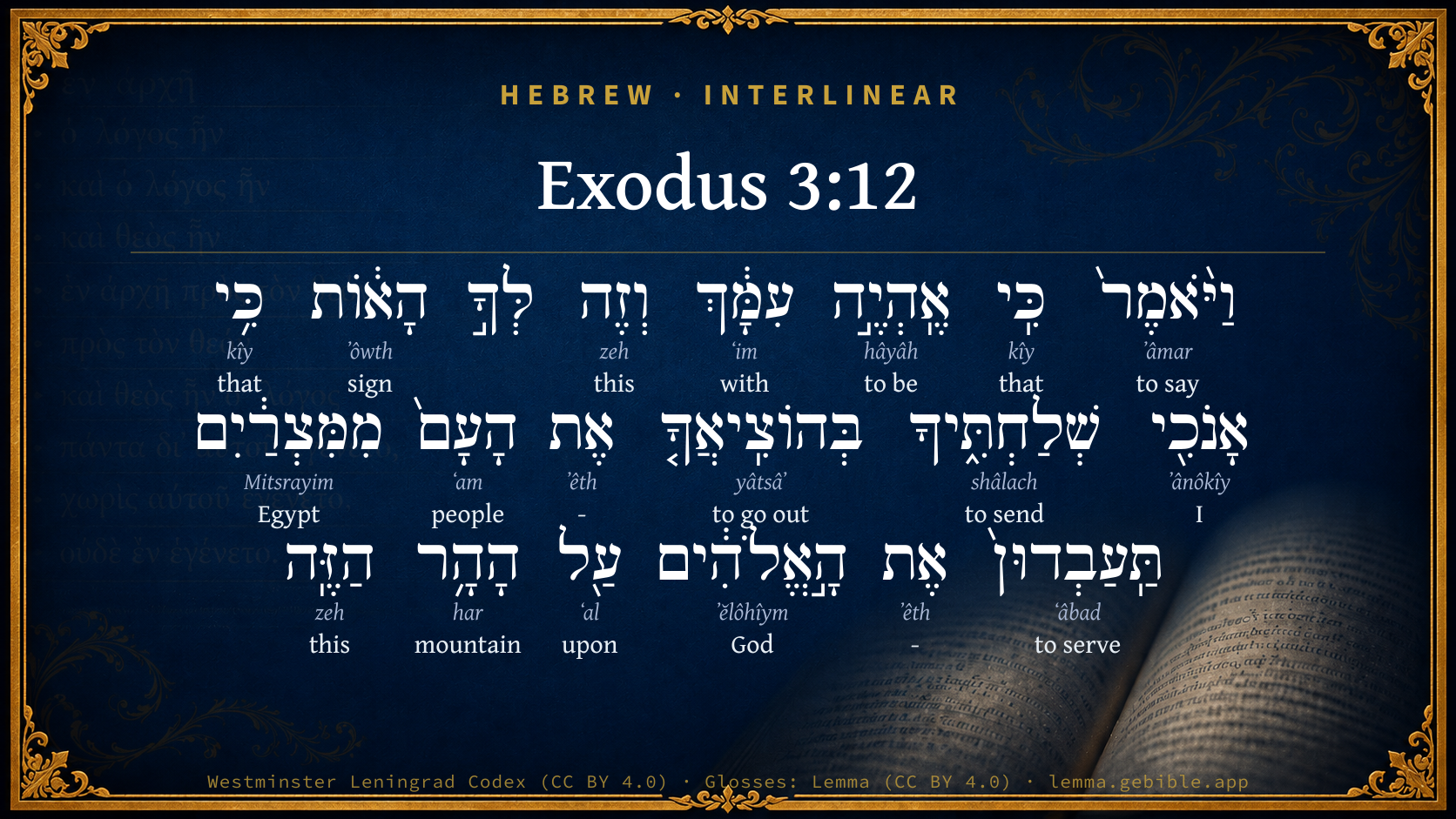
Hebrew (Westminster Leningrad Codex) Exodus 3:12 appears in the Hebrew Old Testament. The text above is from the Westminster Leningrad Codex. Each word links to its Strong’s number, a concise gloss, and parsing drawn from the Open Scriptures Hebrew Bible morphology. Click any word for its full Brown-Driver-Briggs (BDB) entry.
Download image
Cite this verse

Exodus 3:12 (World English Bible). Public Domain. Lemma interlinear Bible study tool, https://lemma.gebible.app/v/exodus/3/12.

Show BibTeX & RIS
BibTeX
RIS
English Translation
He said, "Certainly I will be with you. This will be the token to you, that I have sent you: when you have brought forth the people out of Egypt, you shall serve God on this mountain."
World English Bible · Public Domain
Download a study sheet

One document with this verse’s original text, its word-by-word gloss line, the meaning frame, cross-references with their text, attributed commentary, and full source and license credits — printable, and it pastes into notes with its structure intact.

This verse Autodidact and up

Study sheet (.html) Plain text (.txt)

A passage Seminary Student

Up to 50 verses in one chapter. A passage sheet keeps up to 6 commentary sources and 12 cross-references per verse, in the order this page ranks them, and says so on the sheet whenever that leaves anything out. Ask for a single verse and you get the Autodidact verse sheet above.

Everything on this page stays free to read, with no account — the sheet is a download of what is already on screen, not access to it.

Want to remove ads? Support Godless Engineer
Compare translations 3

The same verse in 3 English versions, stacked beneath the original-language interlinear above. Click any original word for its lexicon entry.

Each is an independent rendering of the whole verse — the interlinear is not word-aligned to these translations.

Highlighted words mark where these versions differ — a whole-verse word diff, not a word-by-word alignment.

  • World English Bible Public Domain
    He said, "Certainly I will be with you. This will be the token to you, that I have sent you: when you have brought forth the people out of Egypt, you shall serve God on this mountain."
  • King James Version Public Domain
    And he said, Certainly I will be with thee; and this shall be a token unto thee, that I have sent thee: When thou hast brought forth the people out of Egypt, ye shall serve God upon this mountain.
  • unfoldingWord Literal Text CC BY-SA 4.0
    And he said, “I shall certainly be with you, and this will be the sign for you that I have sent you: when you bring the people out from Egypt, you all will serve God on this mountain.”

unfoldingWord Literal Text — © unfoldingWord, licensed CC BY-SA 4.0. Word-aligned USFM3 via Door43 (git.door43.org/unfoldingWord/en_ult).

Versions to compare (up to 4)

3 of 4 selected

Show all 18 translations

Every available English version of this verse, each an independent rendering of the whole verse.

  • World English Bible Public Domain
    He said, "Certainly I will be with you. This will be the token to you, that I have sent you: when you have brought forth the people out of Egypt, you shall serve God on this mountain."
  • Berean Standard Bible Public Domain
    “I will surely be with you,” God said, “and this will be the sign to you that I have sent you: When you have brought the people out of Egypt, all of you will worship God on this mountain.”
  • Majority Standard Bible Public Domain
    “I will surely be with you,” God said, “and this will be the sign to you that I have sent you: When you have brought the people out of Egypt, all of you will worship God on this mountain.”
  • King James Version Public Domain
    And he said, Certainly I will be with thee; and this shall be a token unto thee, that I have sent thee: When thou hast brought forth the people out of Egypt, ye shall serve God upon this mountain.
  • American Standard Version (1901) Public Domain
    And he said, Certainly I will be with thee; and this shall be the token unto thee, that I have sent thee: when thou hast brought forth the people out of Egypt, ye shall serve God upon this mountain.
  • Revised Version (1885) Public Domain
    And he said, Certainly I will be with thee; and this shall be the token unto thee, that I have sent thee: when thou hast brought forth the people out of Egypt, ye shall serve God upon this mountain.
  • Geneva Bible (1599) Public Domain
    And he answered, Certainely I will be with thee: and this shall be a token vnto thee, that I haue sent thee, After that thou hast brought the people out of Egypt, ye shall serue God vpon this Mountaine.
  • Douay-Rheims (1899) Public Domain
    And he said to him: I will be with thee: and this thou shalt have for a sign, that I have sent thee: When thou shalt have brought my people out of Egypt, thou shalt offer sacrifice to God upon this mountain.
  • Young's Literal Translation Public Domain
    and He saith, `Because I am with thee, and this `is' to thee the sign that I have sent thee: in thy bringing out the people from Egypt -- ye do serve God on this mount.'
  • Literal Standard Version CC BY-SA 4.0
    And He says, “Because I am with you, and this [is] the sign to you that I have sent you: in your bringing out the people from Egypt—you serve God on this mountain.”
  • Unlocked Literal Bible CC BY-SA 4.0
    God replied, “I will certainly be with you. This will be a sign to you that I have sent you. When you have brought the people out of Egypt, you will worship me on this mountain.”
  • unfoldingWord Literal Text CC BY-SA 4.0
    And he said, “I shall certainly be with you, and this will be the sign for you that I have sent you: when you bring the people out from Egypt, you all will serve God on this mountain.”
  • Darby Bible Public Domain
    And he said, For I will be with thee; and this shall be the sign to thee that I have sent thee: when thou hast brought forth the people out of Egypt, ye shall serve God upon this mountain.
  • World Messianic Bible Public Domain
    He said, “Certainly I will be with you. This will be the token to you, that I have sent you: when you have brought the people out of Egypt, you shall serve God on this mountain.”
  • Webster's Bible Public Domain
    And he said, Certainly I will be with thee; and this shall be a token to thee, that I have sent thee: When thou hast brought forth the people out of Egypt, ye shall serve God upon this mountain.
  • Free Bible Version CC BY-SA 4.0
    “I'll be with you,” the Lord replied, “and this will be the sign that it is really me who is sending you: when you have led the people out of Egypt, you will worship God at this very mountain.”
  • Bible in Basic English Public Domain
    And he said, Truly I will be with you; and this will be the sign to you that I have sent you: when you have taken the children of Israel out of Egypt, you will give worship to God on this mountain.
  • JPS Tanakh (1917) Public Domain
    And He said: 'Certainly I will be with thee; and this shall be the token unto thee, that I have sent thee: when thou hast brought forth the people out of Egypt, ye shall serve God upon this mountain.'

Literal Standard Version (2020), Covenant Press — licensed CC BY-SA 4.0. Text via the HelloAO Bible API (eBible.org). Unlocked Literal Bible (unfoldingWord) — licensed CC BY-SA 4.0. Text via the HelloAO Bible API (eBible.org). unfoldingWord Literal Text — © unfoldingWord, licensed CC BY-SA 4.0. Word-aligned USFM3 via Door43 (git.door43.org/unfoldingWord/en_ult). Free Bible Version, Dr. Jonathan Gallagher — licensed CC BY-SA 4.0. Text via the HelloAO Bible API (eBible.org).

Word by word

More ways to search: Search by grammar → Find every occurrence → Compare this word →

Practice this passage: Drill this verse → Learn its vocabulary →

הָא֔וֹת
ʼôwth
H226
“the · sign”
Particle, Definite Article + Noun, Common, Both, Singular, Absolute
Part of Speech
Particle + Noun
Type
Common
Gender
Both
Number
Singular
State
Absolute
Full BDB Definition

Origin: probably from H225 (in the sense of appearing)

TWOT: 41a

sign, signal - a distinguishing mark - banner - remembrance - miraculous sign - omen - warning - token, ensign, standard, miracle, proof
  1. וַיֹּ֨אמֶר֙ ʼâmar H559 “and · to say” Conjunction + Verb, Qal, Sequential Imperfect, 3rd Person, Masculine, Singular
  2. כִּֽי kîy H3588 “that” Conjunction
  3. אֶֽהְיֶ֣ה hâyâh H1961 “to be” Verb, Qal, Imperfect, 1st Person, Common, Singular
  4. עִמָּ֔ךְ ʻim H5973 “with · you” Preposition + Suffix, Personal, 2nd Person, Feminine, Singular
  5. וְזֶה zeh H2088 “and · this” Conjunction + Pronoun, Demonstrative, Masculine, Singular
  6. כִּ֥י kîy H3588 “that” Conjunction
  7. אָנֹכִ֖י ʼânôkîy H595 “I” Pronoun, Personal, 1st Person, Common, Singular
  8. שְׁלַחְתִּ֑יךָ shâlach H7971 “to send · you” Verb, Qal, Perfect, 1st Person, Common, Singular + Suffix, Personal, 2nd Person, Masculine, Singular
  9. בְּהוֹצִֽיאֲךָ֤ yâtsâʼ H3318 “in/at · to go out · you” Preposition + Verb, Hiphil, Infinitive Construct + Suffix, Personal, 2nd Person, Masculine, Singular
  10. אֶת ʼêth H853 “-” Particle, Direct Object
  11. הָעָם֙ ʻam H5971 “the · people” Particle, Definite Article + Noun, Common, Masculine, Singular, Absolute
  12. מִמִּצְרַ֔יִם Mitsrayim H4714 “from · Egypt” Preposition + Noun, Proper
  13. תַּֽעַבְדוּן֙ ʻâbad H5647 “to serve” Verb, Qal, Imperfect, 2nd Person, Masculine, Plural + Suffix, n
  14. אֶת ʼêth H853 “-” Particle, Direct Object
  15. הָ֣אֱלֹהִ֔ים ʼĕlôhîym H430 “the · God(s)” Particle, Definite Article + Noun, Common, Masculine, Plural, Absolute
  16. עַ֖ל ʻal H5921 “upon” Preposition
  17. הָהָ֥ר har H2022 “the · mountain” Particle, Definite Article + Noun, Common, Masculine, Singular, Absolute
  18. הַזֶּֽה zeh H2088 “the · this” Particle, Definite Article + Pronoun, Demonstrative, Masculine, Singular

About this verse

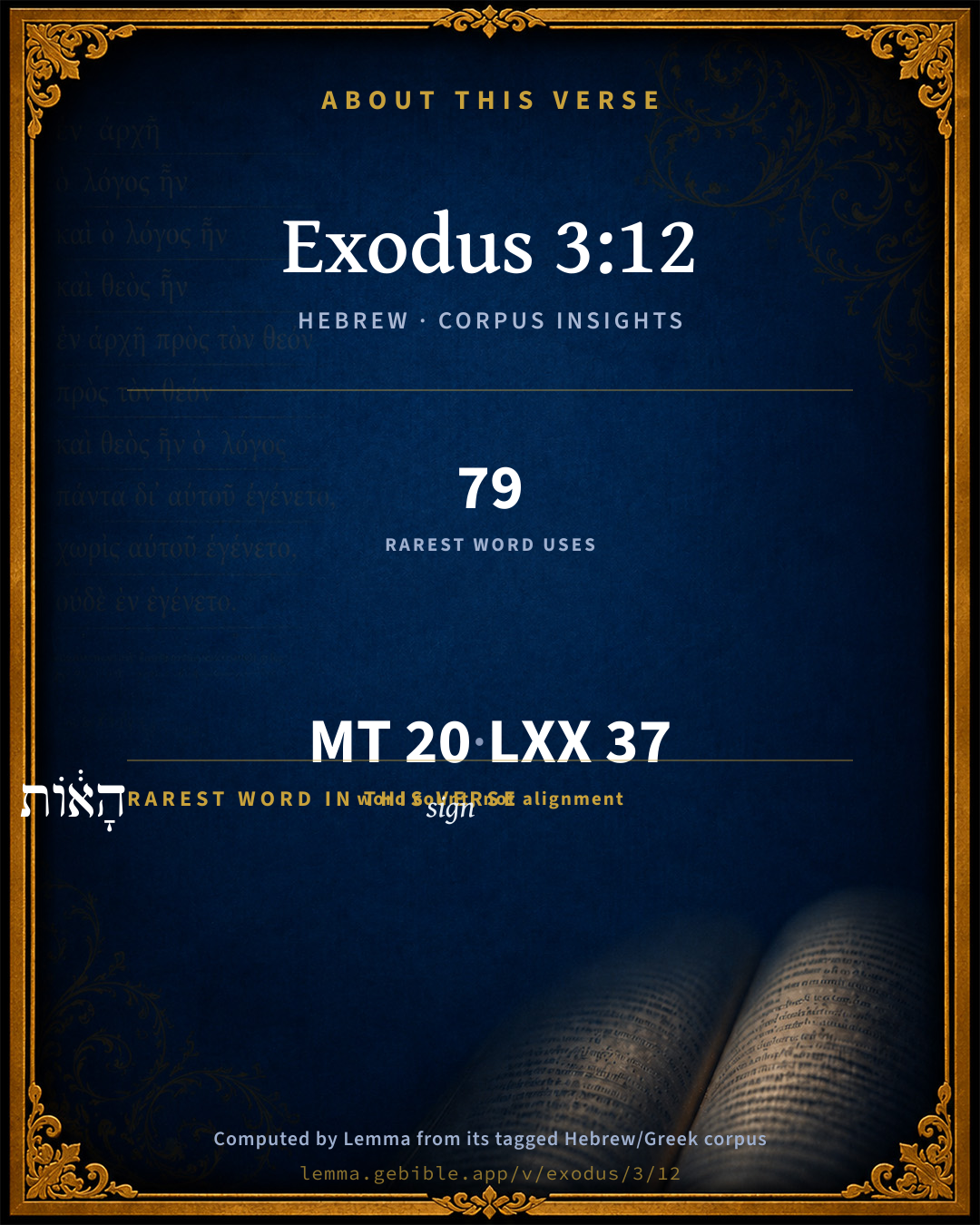
These counts appear in no published source. They are computed here, from the morphology-tagged text and Lemma’s own curated glosses. What Lemma adds →

20
words
16
distinct lemmas
Pentateuch
section

Grammatical profile

  • 5 verbs
  • 5 nouns
  • 3 pronouns
  • 3 prepositions
  • 2 conjunctions
  • 2 particles

Verb forms

  • וַיֹּ֨אמֶר֙ Qal · Sequential Imperfect
  • אֶֽהְיֶ֣ה Qal · Imperfect
  • שְׁלַחְתִּ֑יךָ Qal · Perfect
  • בְּהוֹצִֽיאֲךָ֤ Hiphil · Infinitive Construct
  • תַּֽעַבְדוּן֙ Qal · Imperfect

Repetition

Words recur within this verse — often emphatic in Hebrew:

  • כִּֽי that H3588 ×2
  • וְזֶה this H2088 ×2

Hebrew & Septuagint length

In English translation the verse runs 37 words from the Hebrew and 42 from the Septuagint (LXX English) — closely comparable.

A rough comparison of the two English renderings, which tokenize alike — not a word-level alignment.

Word counts can differ between the Hebrew and the Greek without any difference in meaning — e.g. the Hebrew direct-object marker אֵת has no separate Greek word, and Greek often adds the article ὁ.

In the original languages it is 20 Hebrew tokens and 37 Greek tokens — but the two are counted differently (Hebrew bundles its prefixes and suffixes into one token; the Greek is in lemma form), so that isn’t a like-for-like length.

Cross-references

28

Topical passages linked to Exodus 3:12 in the Treasury of Scripture Knowledge — connected by theme and wording, ordered by reader-vote popularity; previews shown in the World English Bible.

  • Joshua 1:5 There shall not any man be able to stand before you all the days of your life. As I was with Moses, so I will be with you; I will not fail you, nor forsake you.
  • Romans 8:31 What then shall we say about these things? If God is for us, who can be against us?
  • Deuteronomy 31:23 He gave Joshua the son of Nun a charge, and said, Be strong and of good courage; for you shall bring the children of Israel into the land which I swore to them: and I will be with you.
  • Isaiah 41:10 Don't you be afraid, for I am with you; don't be dismayed, for I am your God; I will strengthen you; yes, I will help you; yes, I will uphold you with the right hand of my righteousness.
  • Genesis 31:3 Yahweh said to Jacob, "Return to the land of your fathers, and to your relatives, and I will be with you."
  • Exodus 4:12 Now therefore go, and I will be with your mouth, and teach you what you shall speak."
  • Exodus 4:15 You shall speak to him, and put the words in his mouth. I will be with your mouth, and with his mouth, and will teach you what you shall do.
  • Matthew 28:20 teaching them to observe all things that I commanded you. Behold, I am with you always, even to the end of the age." Amen.
  • Isaiah 43:2 When you pass through the waters, I will be with you; and through the rivers, they shall not overflow you: when you walk through the fire, you shall not be burned, neither shall the flame kindle on you.
  • Acts 11:21 The hand of the Lord was with them, and a great number believed and turned to the Lord.
  • Exodus 4:1–9 Moses answered, "But, behold, they will not believe me, nor listen to my voice; for they will say, 'Yahweh has not appeared to you.'"
  • Hebrews 13:5 Be free from the love of money, content with such things as you have, for he has said, "I will in no way leave you, neither will I in any way forsake you."
  • Mark 16:20 They went out, and preached everywhere, the Lord working with them, and confirming the word by the signs that followed. Amen.
  • Exodus 19:1–25 In the third month after the children of Israel had gone forth out of the land of Egypt, on that same day they came into the wilderness of Sinai.
  • Judges 7:11 and you shall hear what they say; and afterward shall your hands be strengthened to go down into the camp. Then went he down with Purah his servant to the outermost part of the armed men who were in the camp.
  • Psalms 86:17 Show me a sign of your goodness, That those who hate me may see it, and be shamed, Because you, Yahweh, have helped me, and comforted me.
  • Isaiah 7:14 Therefore the Lord himself will give you a sign. Behold, the virgin will conceive, and bear a son, and shall call his name Immanuel.
  • Isaiah 37:30 This shall be the sign to you: you shall eat this year that which grows of itself, and in the second year that which springs of the same; and in the third year sow you, and reap, and plant vineyards, and eat the fruit of it.
  • Genesis 15:1 After these things the word of Yahweh came to Abram in a vision, saying, "Don't be afraid, Abram. I am your shield, your exceedingly great reward."
  • Judges 6:17 He said to him, If now I have found favor in your sight, then show me a sign that it is you who talk with me.
  • Judges 6:21 Then the angel of Yahweh put forth the end of the staff that was in his hand, and touched the flesh and the unleavened cakes; and there went up fire out of the rock, and consumed the flesh and the unleavened cakes; and the angel of Yahweh departed out of his sight.
  • Judges 6:36–40 Gideon said to God, If you will save Israel by my hand, as you have spoken,
  • Jeremiah 43:9–10 Take great stones in your hand, and hide them in mortar in the brick work, which is at the entry of Pharaoh's house in Tahpanhes, in the sight of the men of Judah;
  • Jeremiah 51:63–64 It shall be, when you have made an end of reading this book, that you shall bind a stone to it, and cast it into the midst of the Euphrates:
  • Numbers 1:1–10 Yahweh spoke to Moses in the wilderness of Sinai, in the Tent of Meeting, on the first day of the second month, in the second year after they had come out of the land of Egypt, saying,
  • Leviticus 1:1–17 Yahweh called to Moses, and spoke to him out of the Tent of Meeting, saying,
  • Genesis 15:8 He said, "Lord Yahweh, how will I know that I will inherit it?"
  • Judges 7:13–14 When Gideon had come, behold, there was a man telling a dream to his fellow; and he said, Behold, I dreamed a dream; and, behold, a cake of barley bread tumbled into the camp of Midian, and came to the tent, and struck it so that it fell, and turned it upside down, so that the tent lay flat.

Cross-references courtesy of OpenBible.info (CC BY 4.0).

Hebrew and Greek witnesses Masoretic Hebrew ↔ Greek Septuagint

The same verse in the two great witnesses to the Old Testament, shown verse-for-verse.

These are two independent witnesses, not word-aligned to each other, and the Septuagint is shown in lemma (dictionary) form.

Hebrew Exodus 3:12 Masoretic · Westminster Leningrad Codex

וַיֹּ֨אמֶר֙ כִּֽי אֶֽהְיֶ֣ה עִמָּ֔ךְ וְזֶה לְּךָ֣ הָא֔וֹת כִּ֥י אָנֹכִ֖י שְׁלַחְתִּ֑יךָ בְּהוֹצִֽיאֲךָ֤ אֶת הָעָם֙ מִמִּצְרַ֔יִם תַּֽעַבְדוּן֙ אֶת הָ֣אֱלֹהִ֔ים עַ֖ל הָהָ֥ר הַזֶּֽה

He said, "Certainly I will be with you. This will be the token to you, that I have sent you: when you have brought forth the people out of Egypt, you shall serve God on this mountain."

World English Bible · Public Domain

Greek LXX Exodus 3:12 Septuagint · lemma form

εἶπον δέ ὁ θεός μωυσῆς λέγω ὅτι εἰμί μετά σύ καί οὗτος σύ ὁ σημεῖον ὅτι ἐγώ σύ ἐκ ἀποστέλλω ἐν ὁ ἐκἄγω σύ ὁ λαός ἐγώ ἐκ αἴγυπτος καί λατρεύω ὁ θεός ἐν ὁ ὄρος οὗτος

And God spoke to Moses, saying, I will be with you, and this shall be the sign to you that I shall send you forth, —when you bring out my people out of Egypt, then you⌃ shall serve God in this mountain.

LXX2012 (modern English Septuagint) · Public Domain

Hebrew: Westminster Leningrad Codex (CC BY 4.0). Greek: Septuagint (public domain); English from LXX2012 (modern English Septuagint) (Public Domain). How the Septuagint differs from the Hebrew →

Targum (Aramaic paraphrase)

2

The Targum is the ancient Jewish Aramaic paraphrase of the Hebrew Scriptures — an interpretive translation, not the Hebrew text itself. Onkelos (literal) and Pseudo-Jonathan (expansive) render the Torah, and Jonathan the Prophets. Coverage is partial: where no permissively-licensed English translation exists for a verse, only the Aramaic is shown. This is verse-level text, not a word-by-word alignment to the Hebrew.

  1. Targum Onkelos Torah (Genesis–Deuteronomy)
    וַאֲמַר אֲרֵי יְהֵי מֵימְרִי בְסַעְדָךְ וְדֵין לָךְ אָתָא אֲרֵי אֲנָא שְׁלַחְתָּךְ בְּאַפָּקוּתָךְ יָת עַמָא מִמִצְרַיִם תִּפְלְחוּן קֳדָם יְיָ עַל טוּרָא הָדֵין:

    (no public-domain English translation for this verse)

    Targum Onkelos — Aramaic: “Onkelos Genesis” (public domain); “Onkelos Exodus” (public domain); “Onkelos Leviticus” (public domain); “Onkelos Numbers” (public domain); “Onkelos Deuteronomy” (public domain). English: “Sefaria Community Translation” (CC0 1.0 (public-domain dedication)); “J.W. Etheridge. The Targums of Onkelos and Jonathan Ben Uzziel on the Pentateuch. London: Longmans, Green, 1862” (public domain). Text via Sefaria.

  2. Targum Pseudo-Jonathan Torah (Genesis–Deuteronomy)
    וַאֲמַר אֲרוּם יְהֵי מֵימְרִי בְּסַעְדָךְ וְדֵין לָךְ סִימָנָא דַאֲנָא שַׁדְרָתָךְ בְּהַנְפּוּקָתָךְ יַת עַמָא מִמִצְרַיִם תְּפַלְחוּן קֳדָם יְיָ דִתְקַבְּלוּן יַת אוֹרַיְיתִי עַל טַוְורָא הָדֵין

    But He said, Therefore My Word shall be for thy help; and this shall be the sign to thee that I have sent thee: when thou hast, brought the people forth from Mizraim, ye shall worship before the Lord, because ye shall have received the Law upon this mountain.

    Targum Pseudo-Jonathan — Aramaic: “Targum Jonathan on Genesis” (public domain); “Targum Jonathan on Exodus” (public domain); “Targum Jonathan on Leviticus” (public domain); “Targum Jonathan on Numbers” (public domain); “Targum Jonathan on Deuteronomy” (public domain). English: “The Targum of Jonathan ben Uzziel, trans. J. W. Etheridge, London, 1862” (public domain). Text via Sefaria.

Commentary

Notes on Exodus 3:12 from classic Christian and Jewish commentators (each source and its license shown beneath its notes). The classic Christian expositions comment on the surrounding passage and are grouped to its opening verse, so a note may address several verses; the Jewish commentaries on the Tanakh (Rashi and others) are per-verse, so they appear only where the commentator wrote on this verse.

Lemma curates 59 commentaries, every one of them public domain or Creative Commons licensed, each selected and text-cleaned for this edition rather than reprinted as found. About our sources →

Trapp's Complete Commentary

John Trapp

Exo 3:12 And he said, Certainly I will be with thee; and this [shall be] a token unto thee, that I have sent thee: When thou hast brought forth the people out of Egypt, ye shall serve God upon this mountain.

Ver. 12. This shall be a token unto thee.] So he had a double sign, for his fuller and further corn firmation: that of the burning bush, for the present; this of serving God at Horeb, for the future.

John Trapp, A Commentary or Exposition upon All the Books of the Old and New Testament (1647–1656) — public domain. Text from a community e-Sword module.

The Biblical Illustrator

Joseph S. Exell

Exo_3:12

Certainly I will be with thee.

The guarantee of success

Take this assurance as applying to the whole service of sanctified life, and it entitles us to draw four practical inferences.

I. Certainly I will be with thee.--then man is servant not master He should know his place, or he can never keep it. As servant, he should--

1. Constantly consult his Master.

2. Constantly speak in the name of his Master.

3. Constantly be jealous of the honour of his Master.

II. Certainly I will be with thee.--then the work must succeed. What is the guarantee of success?

1. Not human cleverness; ministers may be clever, so may churches, etc.; we may have learned sermons, able sermons, ingenious sermons, etc.

2. Not skilful organisation. Cards, bazaars, registers, circulars, etc., all useless as ends.

3. The word of the Lord is the guarantee of success. The mouth of the Lord hath spoken it. My word shall not return unto Me void.

III. Certainly I will be with thee.--then the servant is to be received for the masters sake. He that receiveth you receiveth Me, and he that receiveth Me receiveth Him that sent Me. The true minister carries a blessing with him. The Romans were to receive Phoebe in the Lord. What a lesson to ministers--they are representatives of God!

IV. Certainly I will be with thee.--then there need be no lack of grace or power. If any man lack wisdom, etc. Lo, I am with you alway, etc. Ye have not because ye ask not, or because ye ask amiss. The servants may take counsel of one another, but not to the interruption of continuous and trustful prayer to the Master.

1. God is with His servants for their comfort.

2. For their guidance.

3. For their safety.

Application: Notice--

1. The individuality of the promise, I will be with thee--with the one man.

2. The emphasis of the premise--Certainly. Who is with us in our life-ministry? (J. Parker, D. D.)

The Divine companionship realised by the good in the service of the Christian life

I. It was considerate. Promise made when most needed-at time of weakness.

II. It was emphatic. Leaving no room for doubt.

III. It was sympathetic. With thee. Not I will follow thee--not I will go before thee-not I will be near thee--but with thee--as a companion to cheer thy soul; as a friend-to give thee counsel; as a God--to make thee victorious. How can a mission fail when God is with the worker? (J. S. Exell, M. A.)

Gods presence with His ministers

The mission of Moses resembles that of every Christian minister, in that--

I. He was sent to his brethren.

II. When he went to them, he found them in a state of bondage and oppression; their spirits crushed, their minds degraded.

III. He found that he only provoked them by his endeavours to deliver them.

IV. Promises were given to support him under his disappointments. View the promise in the way of--

1. Encouragement. God will be with every minister--

(1) As a guide;

(2) To strengthen and support him under trial;

(3) To comfort and console him.

2. Caution. While each pastor rests on the consolation of this privilege, he must not forget the call to watchfulness and holiness which is inseparably connected with it. (H. Raikes, M. A.)

God is with His ministers

When I first entered the ministry, twenty years ago, I was filled with an enthusiasm that was as fresh as it was inexperienced in the work of winning souls. I felt sure, when I began to preach, that all the world would hear and be converted. The gospel was so simple; the news so good; the grace of Christ so precious--that I could think of nothing else but that my hearers would at once give themselves to Christ. I was under the impression that the reason people were not converted in greater numbers was that the preachers did not make the gospel simple and plain. This I supposed that I could do. Alas, I was as ignorant as Moses when he made his first attempt to save his brethren. I did not know what the bondage was, though I myself had been delivered. I did not realize the darkness of the unrenewed mind, the enmity of the unrenewed heart. I did not know the strength of the chain with which Satan has bound souls. But, like Melancthon, who had a similar thought, I found that old Adam was stronger than young Pentecost; and I confess that to this hour, though I have been in the work for twenty years, I never sit down by the side of an unconverted man, woman, or child, to attempt to lead them to Christ, without a certain sense of fear. My insufficiency always comes before me when I think of what is involved in this work. To persuade a man to reform his life, to give up certain sins and hurtful lusts, is comparatively easy: but to convert a sinner to God is difficult work indeed; and without the aid of the Divine Spirit it is impossible for man to effect it. What answer have we to give to this honest shrinking from a difficult work? Let us hear how God answered Moses: Certainly I will be with thee. As though He had said, Why, Moses, you did not expect that I was going to send you down to Egypt alone, to deliver My people? Have you forgotten that I said I had come down to deliver? You indeed are to be My instrument; but I will be with you to make you mighty, and to bring the apparently impossible work to pass. This puts the work in a new light. If God goes with us to the work, then can we undertake anything. When Jesus said, Go ye into all the world, and make disciples of all nations, He did not forget to say, Lo, I am with you alway. (G. F. Pentecost, D. D.)

The invisible but ever-present God

God thus puts Himself apparently into a secondary position. Moses is to stand at the front, and, so far as publicity is concerned, to incur the whole responsibility of the proposed movement. It was easy for Moses to say that he was prompted of God to make certain representations to Israel and Pharaoh, but how were they to be convinced that Moses was servant and not master? This is the difficulty of all the highest service of life, namely, that the spiritual is invisible, and yet omnipotent; public attention is fixed upon the human agent, and professions of spiritual inspiration and impulse are treated with distrust, if not with contempt, by the most of mankind. It is the invisible Christ who is with the Church. Were He present manifestly, it is supposed that greater results would accrue from Christian service; but the supposition must be mistaken, inasmuch as He to whom such service is infinitely dearer than it ever can be to ourselves has determined the manner of Christian evangelisation. What, then, is the great duty and privilege of the Church? It is to realize the presence and influence of the Invisible. The Church is actually to see the Unseen. There is another vision beside the vision of the body; faith itself is sight; and where faith is complete, there is a consciousness of Gods presence throughout our life and service which amounts to a distinct vision of Gods personal presence and government. (J. Parker, D. D.)

The spirit of destiny

Moses has been, as it were, audibly and visibly called to service and invested with authority. A keen pleasure would seem to attach to experiences of that kind. Surely it was a blessed thing to speak face to face with God, and to go straight away from the communing to do the work which had been prescribed. The directness of the interview, the absence of all second causes and instrumentalities, has about it a solemnity which profoundly affects the heart. But is my destiny less Divine because it has been revealed to me under conditions which seem to separate widely between the Creator and the creature? Has God only one method of working in revealing to a man what that mans work in life is intended to be? We do not always see the fountain; sometimes we have to be content to drink at the stream. The danger is lest we imagine the stream created itself, forgetting in our irreligion and folly that the stream is impossible apart from the fountain. A man is sometimes awakened to his destiny by his fellow-men. In other cases a mans destiny seems to be determined by what he calls his circumstances or his environment. But why this wide and circuitous way of putting the case to the mind? We do not depose God by mistaking the origin of our action; we do but show the poorness of our own judgment, or the want of justice which impoverishes our lives of their best qualities. Every man should put to himself the question--What is my destiny? What does God mean me to be and do in the world? (J. Parker, D. D.)

The presence of God

In the early days of the Theological Seminary at Alleghany, it was often in great need of money. Once, in a time of extremity, the Rev. Dr. Francis Herren, President of the Board of Directors, the Rev. Dr. Elisha P. Swift, also a director, and Rev. Jos. Patterson, met to devise some way of relief. With all their faith, the first-mentioned brethren were greatly dejected, We have no one to help us, said one of them. No one! replied Mr. Patterson, warmly: Why! I know of a thousand here. The two looked astonished. He continued, Is not Dr. Herren a cipher? is not Dr. Swift a cipher? am not I a cipher? But Jesus Christ is surely One. And if we put one before three ciphers, does it not make a thousand? They took new courage, went to that One who is able to help, and did not pray in vain.

Christs presence promised

Chrysostom beautifully says, for our comfort: I have a pledge from Christ--have His note of hand--which is my support, my refuge and haven; and though the world should rage, to this security I cling. How reads it? Lo, I am with you alway, even unto the end of the world. If Christ be with me, what shall I fear? If He is mine, all the powers of earth to me are nothing more than a spiders web.

The Biblical Illustrator, edited by Joseph S. Exell (c. 1880s–1900s) — public domain. Text from a community e-Sword module.

Joseph Benson's Commentary

Exo 3:12. Certainly I will be with thee — Those that are weak in themselves, yet may do wonders, being strong in the Lord, and in the power of his might. God’s presence puts wisdom and strength into the weak and foolish, and is enough to answer all objections.

Joseph Benson's Commentary on the Old and New Testaments (1811–1818) — public domain. Text from a community e-Sword module.

Tyndale Open Study Notes

Tyndale Open Resources

3:12 In the Bible, a sign often occurred after a person or a nation had already had to decide whether to act in faith or not (see Isa 7:14). A sign cannot create faith where there is none (see Matt 12:39; 16:4). Rather, it encourages the one who has exercised the faith he or she already has.

Tyndale Open Study Notes — © Tyndale Open Resources, licensed CC BY-SA 4.0. Text via the HelloAO Bible API.

Geneva Bible (1599)

Geneva Bible translators

Neither fear thine own weakness, nor Pharaoh’s tyranny.

Geneva Bible (1599) marginal notes — public domain. Text via Bolls.life.

Adam Clarke's Commentary

Verse 12. Certainly I will be with thee] This great event shall not be left to thy wisdom and to thy power; my counsel shall direct thee, and my power shall bring all these mighty things to pass.

And this shall be a token] Literally, And THIS to thee for a sign, i.e., this miraculous manifestation of the burning bush shall be a proof that I have sent thee; or, My being with thee, to encourage thy heart, strengthen thy hands, and enable thee to work miracles, shall be to thyself and to others the evidence of thy Divine mission.

Ye shall serve God upon this mountain.] This was not the sign, but God shows him, that in their return from Egypt they should take this mountain in their way, and should worship him in this place. There may be a prophetic allusion here to the giving of the law on Mount Sinai. As Moses received his commands here, so likewise should the Israelites receive theirs in the same place. After all, the Divine Being seems to testify a partial predilection for this mountain, for reasons that are not expressed. See Clarke on Ex 3:5.

Adam Clarke's Commentary on the Bible (1810–1826) — public domain. Text from a community e-Sword/MySword module.

Ellicott's Commentary for English Readers

(12) Certainly I will be with thee.—Heb., since I will be with thee. An answer addressed not to the thing said, but to the thing meant. Moses meant to urge that he was unfit for the mission. God’s reply is, “Not unfit, since I will be with thee.” I will supply all thy defects, make good all thy shortcomings. “My strength is made perfect in weakness.”

This shall be a token unto thee.—It is in accordance with the Divine economy to give men "tokens,” which are future, and appeal to faith only, (Comp. 1Sa_2:34; 2Ki_19:27.)

A Bible Commentary for English Readers, edited by Charles John Ellicott (1878–1897) — public domain. Text from a community e-Sword module.

The Cambridge Bible for Schools and Colleges

gen. ed. J. J. S. Perowne

12. In reply God assures him that He will be with him and support him: cf. Gen_28:15; Gen_31:3; Jos_1:5; Jos_3:7; and especially Jdg_6:16. ‘Certainly,’ like ‘Surely’ in Jud. l.c., is better omitted: the Heb. ki is like the Greek ὅτι recitativum (Lex. 471b b).

token] The word usually rendered ‘sign,’ as Exo_4:8; Exo_4:17, Isa_7:11, &c. The word means here evidence or proof, as Jdg_6:17, 1Sa_14:10, 2Ki_20:9 : and with reference to something not to be realised immediately, 1Sa_2:34, Isa_7:11; Isa_37:30. The promise, given with all assurance, that the liberated people would worship God on the very mountain on which he was standing, though its full cogency could not be perceived till it was fulfilled, was a guarantee to Moses that God had really sent him.

that I have sent thee] The pron. is emphatic.

upon this mountain] The mountain which is God’s abode: cf. v. 1, Exo_19:3 a, 4b.

The Cambridge Bible for Schools and Colleges (gen. ed. J. J. S. Perowne; Cambridge University Press, 1878–1918) — public domain. Text from a community e-Sword module.

John Gill's Exposition

And he said, certainly I will be with thee,.... To encourage and strengthen him; to protect, defend, and preserve him, and to succeed and prosper him; to give him credit and respect with the people of Israel, and influence over Pharaoh to prevail upon him at length to let Israel go:

and this shall be a token unto thee that I have sent thee; not the promise now made, nor the vision he had seen, but what follows:

when thou hast brought forth the people out of Egypt, ye shall serve God upon this mountain: Mount Horeb or Sinai, as they did at the time of the giving of the law on it, when an altar was built upon a hill, and they offered burnt offerings and peace offerings, Exo 24:4 and this was a sign, "a posteriori", confirming the divine mission of Moses; and besides the promise of this, on which Moses might depend, being made by the Lord, assured him of success, that he should bring the children of Israel out of Egypt, since he and they would serve the Lord together at this mountain, and from whence he might conclude he had a mission and commission from God. Of a like kind is the sign or token given of the deliverance of Jerusalem from the army of Sennacherib, Isa 37:30.

John Gill's Exposition of the Whole Bible (1746–1763) — public domain (CC PDM 1.0). Text via the HelloAO Bible API.

Albert Barnes' Notes on the Bible

A token unto thee - Or the sign. The word means a declaration or promise of God, which rests absolutely on His word, and demands faith. The promise that God would have the people serve Him in that place was an assurance, if fully believed, that all intervening obstacles would be removed by His power.

Albert Barnes' Notes on the Bible (1834–1885) — public domain. Text from a community e-Sword/MySword module.

Haydock's Catholic Bible Commentary

A sign. Moses had modestly represented his own inability to perform so great a work, and such God generally selects. He encourages them therefore with a sign, to the splendour of which he was then a witness; and with another, which should appear in future, to convince him and all the world, that the undertaking was from God, when they should see him offering sacrifice in that place, out of the reach of Pharao, chap. xxiv. 3. Thus a future event is assigned to Achaz and Ezechias, as a sign of something that was to happen first. (Isaias vii; 4 Kings xix. 29.) Perhaps the sign here appointed is the presence of God enabling Moses to work miracles. (Menochius)

George Leo Haydock (1774–1849), Haydock's Catholic Family Bible and Commentary, 1859 edition — public domain. Excludes Psalms (Douay-Rheims chapter numbering differs from Protestant) and Deuterocanonical books (Catholic canon only).

Matthew Poole's English Annotations

This shall be a token unto thee; either,

1. This vision; or,

2. The fulfilling of this promise, that

I will be with thee by signs and wonders, and a strong hand; or rather,

3. This which here follows, that he and Israel should serve God there. Signs indeed are commonly given from things past or present, but sometimes from things to come, as here, and 1Sa 2:34; Isa 7:13,14; 9:6, &c.

Quest. How could Moses be confirmed in his present calling and work by a thing yet to come?

Answer. Such signs, if they were single, and the only evidences of a man’s calling, might leave some ground for suspicion; but when they are accompanied with other signs, as it is here and in the other places produced, they are of great use for the corroboration of a man’s faith. Moses was otherwise assured of the presence, and power, and faithfulness of that God who spake to him, and was to expect more assurances that God would be with him to help him in and carry him through his work. And as an evidence that this work of bringing Israel out of Egypt should be completed, he gives him a promise that he should serve God in that place; which promise coming from God, he knew to be as infallibly certain, as if it were already come to pass, and therefore this was an apt mean to strengthen his faith in his present undertaking.

Matthew Poole's English Annotations on the Holy Bible (1683–1685) — public domain. Text from a community e-Sword/MySword module.

Whedon's Commentary on the Bible

Daniel D. Whedon

12. The Lord does not deny his servant’s weakness, but promises to reveal through it his strength.

Upon this mountain — The bush was probably upon the Sinai mount of the Horeb range, on which Jehovah afterward descended in fire. This (burning bramble) shall be a token — Rather, is a token. The verse is often read as if the subsequent success of his mission to Pharaoh, and the consequent worship upon Sinai, were to be regarded as the tokens that he had been sent. Success itself was an obvious token then, but the hesitating Moses wants a present sign. The flaming bramble shrub was the token that he would bring Israel to the flaming bramble mount.

Daniel D. Whedon (gen. ed.), Commentary on the Old and New Testaments (1874–1909) — public domain. Text from a community e-Sword module.

The Pulpit Commentary

Certainly I will be with thee. Literally, Since I will be with thee." Moses had excused himself on the ground of unfitness. God replies wilt not be unfit, since I will be with thee I will supply thydeficiencies I will impart all the qualities thou needestand this shall be a sign unto thee of my power and faithfulness this shall assure thee that I am not sending thee upon a fruitless errand it is determined in my counsels that not only shalt thou succeed, and lead the people out, but after that, when thou hast so done thou and they together shall serve me on this mountain." The "sign" was one which appealed to faith only, like that given to Hezekiah by Isaiah, (1Ki_19:2-9) but, if accepted, it gave a full assurance the second step involved the first the end implied the means if Moses was of a certainty to bring the Israelites to Sinai, he must first lead them out of Egypt he must in some way or other triumph over all the difficulties which would beset the undertaking.

The Pulpit Commentary (1880–1919), ed. H.D.M. Spence-Jones & Joseph S. Exell — public domain. Text from a community e-Sword module.

John Wesley's Explanatory Notes

Certainly I will be with thee - Those that are weak in themselves, yet may do wonders being strong in the Lord, and in the power of his might. God's presence puts wisdom and strength into the weak and foolish, and is enough to answer all objections.

John Wesley, Explanatory Notes Upon the Whole Bible (1754–1765) — public domain. Text via the GEBible commentary corpus.

Rashi

Rabbi Shlomo Yitzchaki (Rashi)

ויאמר כי אהיה עמך AND HE SAID, BECAUSE I WILL BE WITH THEE — He answered his first question first and his last question last: as regards what thou hast said, “Who am I that I should go unto Pharaoh?” i. e. of what importance am I to speak with kings, I reply, it is not an undertaking of yours, but it is partly mine for “I” will be with thee”, וזה AND THIS — i. e. the sight which thou hast witnessed in the bush, לך האות כי אנכי שלחתיך SHALL BE A SIGN UNTO THEE, BECAUSE (כי) “I” HAVE SENT THEE and “I” am competent to save: just as thou hast seen the bush carrying out the mission I laid upon it and it was not consumed, so go thou too on the mission I entrust to thee and thou shalt suffer no harm. And as regards thy question: What merit have the Israelites that they should go forth from Egypt? — I reply that I have a great purpose in this, My bringing them forth, for they are destined to accept the Torah upon this mountain at the expiration of three months after they leave Egypt (cf. Exodus Rabbah 3:4). Another explanation is: כי אהיה עמך FOR I WILL BE WITH THEE and thou wilt therefore succeed, וזה AND THIS — viz., the fact that thou wilt succeed in thy mission לך האות WILL BE A SIGN UNTO THEE with respect to another promise: for I promise thee that when thou hast brought them forth from Egypt ye will serve Me upon this mountain — i. e. that ye will receive the Torah upon it. This is the merit which is an advocate for Israel. An exactly similar use of the word אות, where something that will happen in the future is to serve as an אות in regard to an event that will transpire in the more distant future we find elsewhere: (Isaiah 37:30.) “And this shall be a sign unto thee — for ye shall eat this year that which groweth of itself etc.” (the passage proceeds to state that after a few years the devastated land will have regained its former fertility) — this, i. e, the fall of Sennacherib promised in the preceding section of that chapter shall be a sign to thee in respect to another promise: for your land is now barren of fruits, but I will bless that which grows of itself and the land shall bring forth fruits in abundance.

Rashi on the Tanakh — English translations: “The Judaica Press complete Tanach with Rashi, translated by A. J. Rosenberg” (CC BY 4.0); “Pentateuch with Rashi's commentary by M. Rosenbaum and A.M. Silbermann, 1929-1934” (public domain); “The Metsudah Tanach series, Lakewood, N.J” (CC BY 4.0); and “The Book of Joshua, Metsudah Publications, 1997” (CC BY 4.0). Text via Sefaria.

Ramban (Nachmanides)

Rabbi Moshe ben Nachman (Ramban / Nachmanides)

AND HE SAID: BECAUSE I WILL BE WITH THEE; AND THIS SHALL BE THE TOKEN UNTO THEE, THAT I HAVE SENT THEE: WHEN THOU HAST BROUGHT FORTH THE PEOPLE OUT OF EGYPT, YE SHALL SERVE G-D UPON THIS MOUNTAIN. Explanations of this verse are numerous. The correct interpretation in line with the simple meaning of Scripture is that the Holy One, blessed be He, had said two things to Moses. [First], He would come down to deliver them out of the hand of the Egyptians. This might mean that He will deliver them out of their hands while they will remain in the land of Goshen itself or in some place nearby. Therefore, He further promised to bring them up out of that entire land to the place of the Canaanite. But Moses was fearful of both [promises], saying, “Who am I, that I should go unto Pharaoh? I am but a humble person, a keeper of the flock, and he is a great king. If I will tell him to let the people go altogether, he will kill me.” This is similar in meaning to that which Samuel said. And if Saul hear it, he will kill me. And Moses said further, “Who am I … that I should bring forth the children of Israel out of Egypt, as Thou didst tell me to bring them up to the land of Canaan. Surely this great nation is a wise and understanding people, and they will not hold me in sufficient esteem to go after me to the land of nations greater and mightier than they, Verse 38. as Thou hadst said, to bring them up … unto a good and large land … unto the place of the Canaanite. The delivery from the hand of Pharaoh — whether he will listen and lighten his yoke from upon them and thus deliver them [from bondage], or drive them out of his land against their will — is not dependent on them. Besides, they themselves will listen to any one on this matter — for what man is there who would not want to go out from unparalleled cruel bondage — but they will not give heed to go up to the land of Canaan.” Such indeed was the case. The war against those nations [in the land of Canaan] was hard on them from beginning to end, and they feared it while still in Egypt and later when they were in the desert. This then was the fear of Moses our teacher, of Pharaoh, and his apprehension of the children of Israel.And the Eternal answered him on both matters. He said to him: “Do not fear Pharaoh for I will be with thee to save thee. And this shall be the token unto thee for the people that I have sent thee to them, for when thou hast brought forth the people out of Egypt, ye shall serve G-d upon this mountain. From then on, they will take upon themselves the worship of G-d and walk in His commandments, and they will also believe in thee forever, and they will run after thee wherever thou shalt command them [to go]. Now I have revealed Myself to thee on this mountain in a flame of fire, for so it will be in front of all the people when they will serve Me on this mountain.”Thus in that which he saw, there was a sign for Moses that he should not fear Pharaoh since G-d assured him his deliverance. For Israel it was to be a sign that they should not fear the nations upon their coming to Mount Sinai, for to go out from Egypt — with Pharaoh’s consent — to a nearby place a three days’ journey, they would surely give heed and do so whether willingly or unwillingly. By way of the Truth, [the mystic lore of the Cabala], ‘V’zeh’ (And this) shall be the token unto thee, is like the verse, ‘Zeh li’ (I have now been) twenty years in thy house, to me is twenty years.” Rabbeinu Bachya ben Asher here intimates that Ramban’s intent is to be understood in the light of the verse, ‘Zeh’ (This) is my G-d, and I will glorify Him (further, 15:2). See my Hebrew commentary here on Ramban, p. 290. thus alluding to the verses, Because I will be with thee, and behold there is a sign unto thee, the sign of the covenant that “I will be with thee always,” just as it is intimated in the verse, As for Me, behold, My covenant is with thee. “It is I who send you that you should serve G-d upon this mountain, and then I too will go up in the midst of this people into the place which I have prepared.”

Ramban (Nachmanides) on the Tanakh — English translation: “Commentary on the Torah by Ramban (Nachmanides). Translated and annotated by Charles B. Chavel. New York, Shilo Pub. House, 1971-1976” (CC BY 4.0). Text via Sefaria.

Lesson kit

Teaching starters — assembled from the data on this page, not authored interpretation. Every prompt links to the verse data it draws on. Edit before teaching.

Exodus, in the Pentateuch, opens this verse with 20 words (16 distinct Hebrew lemmas). Its most distinctive word is ʼôwth (“sign”). A historical commentator’s framing appears above. Read the whole chapter for the surrounding context.

Discussion questions

  1. The word ʼôwth carries the sense “sign.” How does it shape the verse?
  2. Joshua 1:5 shares this passage’s theme. How do the two illuminate each other?
  3. “that” occurs 2× in this one verse. What is the effect of the repetition?
  4. The translations on this page render this verse differently — a whole-verse word diff, not a word-by-word alignment. What might account for the different wordings?
  5. The verb «וַיֹּ֨אמֶר֙» is Qal Sequential Imperfect. How does its form color the action?
  6. Reading how Trapp's Complete Commentary and The Biblical Illustrator read this verse, where do the two commentators agree and where do they part?

Things to notice

Reading settings

Reading text

Shown beneath each verse's original-language words.

Old Testament
Old Testament edition

Read the OT as the Masoretic Hebrew (MT) or the Greek Septuagint (LXX).

English shown for the Greek Septuagint (in the Hebrew ↔ Greek comparison).

Comparing translations? Open the Compare panel on any verse page to stack up to four side by side.