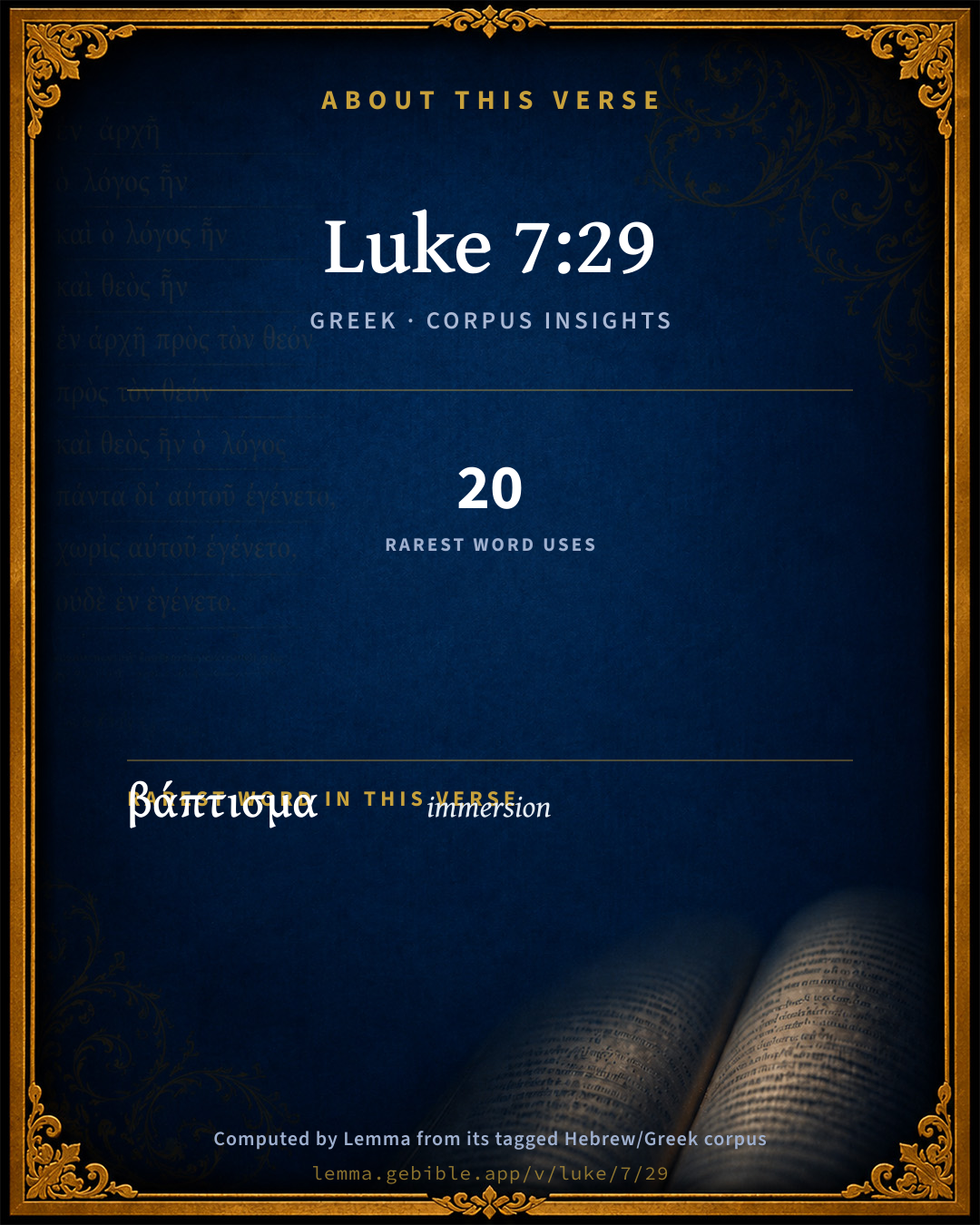
Luke 7:29

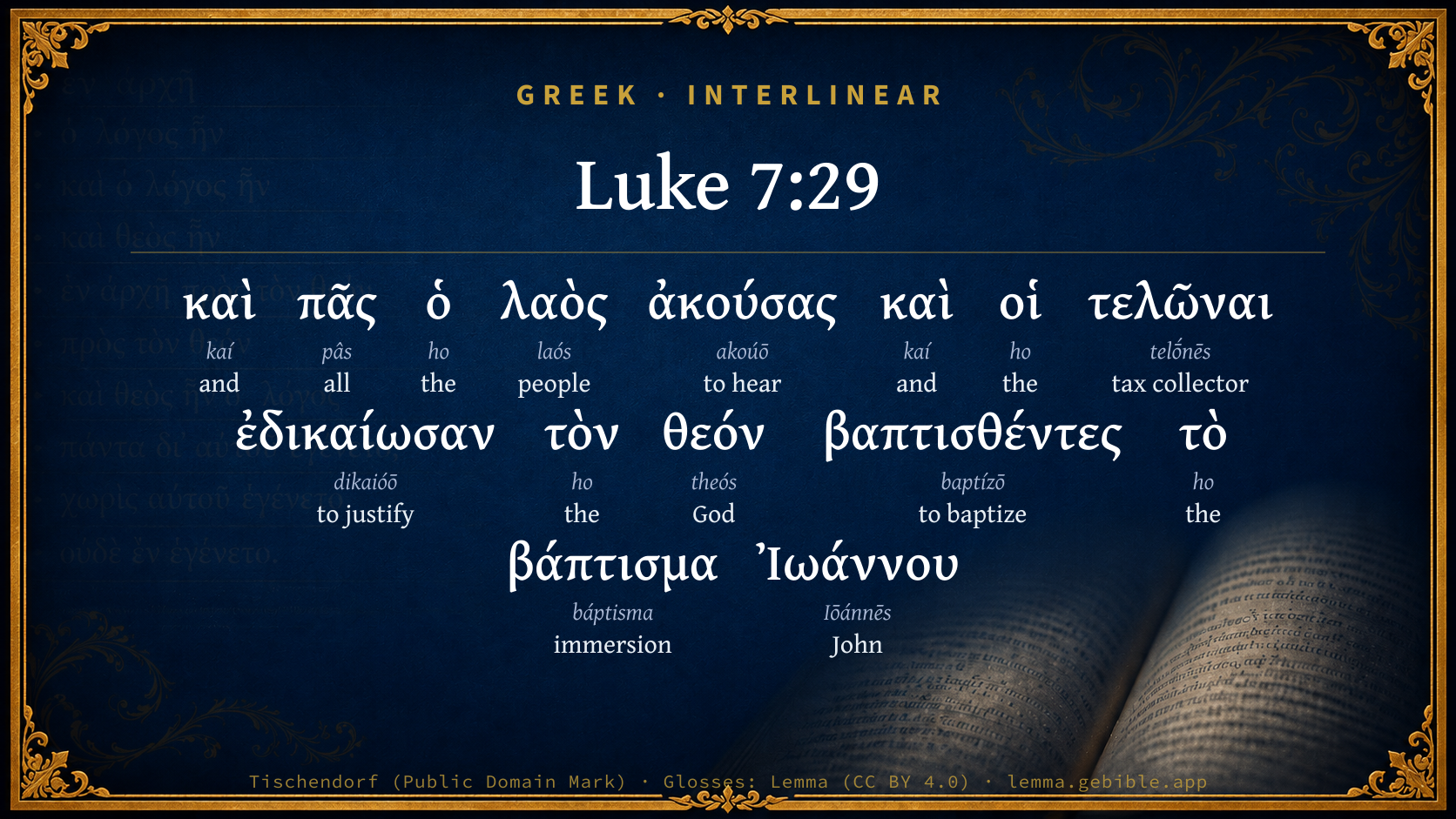
Greek (Tischendorf 8th ed.) Luke 7:29 appears in the Greek New Testament. The text above is from the Tischendorf 8th edition. Each word links to its Strong’s number and a concise gloss. Click any word for its full Thayer’s Greek Lexicon entry.
Download image
Cite this verse

Luke 7:29 (World English Bible). Public Domain. Lemma interlinear Bible study tool, https://lemma.gebible.app/v/luke/7/29.

Show BibTeX & RIS
BibTeX
RIS
English Translation
When all the people and the tax collectors heard this, they declared God to be just, having been baptized with John's baptism.
World English Bible · Public Domain
Download a study sheet

One document with this verse’s original text, its word-by-word gloss line, the meaning frame, cross-references with their text, attributed commentary, and full source and license credits — printable, and it pastes into notes with its structure intact.

This verse Autodidact and up

Study sheet (.html) Plain text (.txt)

A passage Seminary Student

Up to 50 verses in one chapter. A passage sheet keeps up to 6 commentary sources and 12 cross-references per verse, in the order this page ranks them, and says so on the sheet whenever that leaves anything out. Ask for a single verse and you get the Autodidact verse sheet above.

Everything on this page stays free to read, with no account — the sheet is a download of what is already on screen, not access to it.

Want to remove ads? Support Godless Engineer
Compare translations 3

The same verse in 3 English versions, stacked beneath the original-language interlinear above. Click any original word for its lexicon entry.

Each is an independent rendering of the whole verse — the interlinear is not word-aligned to these translations.

Highlighted words mark where these versions differ — a whole-verse word diff, not a word-by-word alignment.

  • World English Bible Public Domain
    When all the people and the tax collectors heard this, they declared God to be just, having been baptized with John's baptism.
  • King James Version Public Domain
    And all the people that heard him, and the publicans, justified God, being baptized with the baptism of John.
  • unfoldingWord Literal Text CC BY-SA 4.0
    (And all the people having heard, including the tax collectors, declared God to be righteous, having been baptized with the baptism of John.

unfoldingWord Literal Text — © unfoldingWord, licensed CC BY-SA 4.0. Word-aligned USFM3 via Door43 (git.door43.org/unfoldingWord/en_ult).

Versions to compare (up to 4)

3 of 4 selected

Show all 19 translations

Every available English version of this verse, each an independent rendering of the whole verse.

  • World English Bible Public Domain
    When all the people and the tax collectors heard this, they declared God to be just, having been baptized with John's baptism.
  • Berean Standard Bible Public Domain
    All the people who heard this, even the tax collectors, acknowledged God’s justice. For they had received the baptism of John.
  • Majority Standard Bible Public Domain
    All the people who heard this, even the tax collectors, acknowledged God’s justice. For they had received the baptism of John.
  • King James Version Public Domain
    And all the people that heard him, and the publicans, justified God, being baptized with the baptism of John.
  • American Standard Version (1901) Public Domain
    And all the people when they heard, and the publicans, justified God, being baptized with the baptism of John.
  • Revised Version (1885) Public Domain
    And all the people when they heard, and the publicans, justified God, being baptized with the baptism of John.
  • Geneva Bible (1599) Public Domain
    Then all the people that heard, and the Publicanes iustified God, being baptized with the baptisme of Iohn.
  • Douay-Rheims (1899) Public Domain
    And all the people hearing, and the publicans, justified God, being baptized with John's baptism.
  • Young's Literal Translation Public Domain
    And all the people having heard, and the tax-gatherers, declared God righteous, having been baptized with the baptism of John,
  • Literal Standard Version CC BY-SA 4.0
    And all the people having heard, and the tax collectors, declared God righteous, having been immersed with the immersion of John,
  • Unlocked Literal Bible CC BY-SA 4.0
    (When all the people heard this, including the tax collectors, they declared that God is righteous, because they had been baptized with the baptism of John.
  • unfoldingWord Literal Text CC BY-SA 4.0
    (And all the people having heard, including the tax collectors, declared God to be righteous, having been baptized with the baptism of John.
  • Darby Bible Public Domain
    (And all the people who heard [it], and the tax-gatherers, justified God, having been baptised with the baptism of John;
  • World Messianic Bible Public Domain
    When all the people and the tax collectors heard this, they declared God to be just, having been immersed with Yochanan’s immersion.
  • Webster's Bible Public Domain
    And all the people that heard him, and the publicans, justified God, being baptized with the baptism of John.
  • Free Bible Version CC BY-SA 4.0
    When they heard him, all of them—even the tax collectors—followed what God said was good and right, for they had been baptized by John.
  • Bible in Basic English Public Domain
    (And all the people, and the tax-farmers, to whom John had given baptism, when they had knowledge of these things, gave glory to God.
  • Text-Critical English NT CC BY 4.0
    (When all the people heard this, including the tax collectors, they affirmed that God's way was right, because they had been baptized with the baptism of John.
  • Tyndale New Testament (1534) Public Domain
    And all the people that hearde and the publicans iustified God and were baptised with the baptism of Iohn.

Literal Standard Version (2020), Covenant Press — licensed CC BY-SA 4.0. Text via the HelloAO Bible API (eBible.org). Unlocked Literal Bible (unfoldingWord) — licensed CC BY-SA 4.0. Text via the HelloAO Bible API (eBible.org). unfoldingWord Literal Text — © unfoldingWord, licensed CC BY-SA 4.0. Word-aligned USFM3 via Door43 (git.door43.org/unfoldingWord/en_ult). Free Bible Version, Dr. Jonathan Gallagher — licensed CC BY-SA 4.0. Text via the HelloAO Bible API (eBible.org).

Word by word

More ways to search: Search by grammar → Find every occurrence → Compare this word →

Practice this passage: Drill this verse → Learn its vocabulary →

βάπτισμα
báptisma
G908
“immersion”
Noun, Accusative, Singular, Neuter
Part of Speech
Noun
Case
Accusative
Number
Singular
Gender
Neuter
Full Thayer's Definition

Origin: from G907

TDNT: 10:05,9

1. immersion, submersion a. of calamities and afflictions with which one is quite overwhelmed b. of John's baptism, that purification rite by which men on confessing their sins were bound to spiritual reformation, obtained the pardon of their past sins and became qualified for the benefits of the Messiah's kingdom soon to be set up. This was valid Christian baptism, as this was the only baptism the apostles received and it is not recorded anywhere that they were ever rebaptised after Pentecost. c. of Christian baptism; a rite of immersion in water as commanded by Christ, by which one after confessing his sins and professing his faith in Christ, having been born again by the Holy Spirit unto a new life, identifies publicly with the fellowship of Christ and the church. In Rom. 6:3 Paul states we are "baptised unto death" meaning that weare not only dead to our former ways, but they are buried. To returnto them is as unthinkable for a Christian as for one to dig up a deadcorpse! In Moslem countries a new believer has little trouble withMoslems until he is publicly baptised. It is then, that the Moslems'know he means business, and then the persecution starts. See alsodiscussion of baptism under No. 907.
  1. καὶ kaí G2532 “and” Conjunction
  2. πᾶς pâs G3956 “all” Adjective, Nominative, Singular, Masculine
  3. ὁ ho G3588 “the” Article, Nominative, Singular, Masculine
  4. λαὸς laós G2992 “people” Noun, Nominative, Singular, Masculine
  5. ἀκούσας akoúō G191 “to hear” Verb, Aorist, Active, Participle, Nominative, Singular, Masculine
  6. καὶ kaí G2532 “and” Conjunction
  7. οἱ ho G3588 “the” Article, Nominative, Plural, Masculine
  8. τελῶναι telṓnēs G5057 “tax collector” Noun, Nominative, Plural, Masculine
  9. ἐδικαίωσαν dikaióō G1344 “to justify” Verb, Aorist, Active, Indicative, 3rd person, Plural
  10. τὸν ho G3588 “the” Article, Accusative, Singular, Masculine
  11. θεόν theós G2316 “God” Noun, Accusative, Singular, Masculine
  12. βαπτισθέντες baptízō G907 “to baptize” Verb, Aorist, Passive, Participle, Nominative, Plural, Masculine
  13. τὸ ho G3588 “the” Article, Accusative, Singular, Neuter
  14. Ἰωάννου Iōánnēs G2491 “John” Noun, Genitive, Singular, Masculine

About this verse

These counts appear in no published source. They are computed here, from the morphology-tagged text and Lemma’s own curated glosses. What Lemma adds →

15
words
11
distinct lemmas
Gospels
section

Notable vocabulary

The rarest word here is βάπτισμα immersion G908 — appearing just 20 times in the whole Greek New Testament.

Shared distinctive vocabulary

βάπτισμα immersion G908 occurs in 20 verses of the Greek New Testament. Also found in:

Repetition

Words recur within this verse:

Cross-references

12

Topical passages linked to Luke 7:29 in the Treasury of Scripture Knowledge — connected by theme and wording, ordered by reader-vote popularity; previews shown in the World English Bible.

  • Luke 3:12 Tax collectors also came to be baptized, and they said to him, "Teacher, what must we do?"
  • Luke 7:35 Wisdom is justified by all her children."
  • Psalms 51:4 Against you, and you only, have I sinned, And done that which is evil in your sight; That you may be proved right when you speak, And justified when you judge.
  • Matthew 3:5–6 Then people from Jerusalem, all of Judea, and all the region around the Jordan went out to him.
  • Matthew 21:31–32 Which of the two did the will of his father?" They said to him, "The first." Jesus said to them, "Most assuredly I tell you that the tax collectors and the prostitutes are entering into the Kingdom of God before you.
  • Acts 18:25 This man had been instructed in the way of the Lord; and being fervent in spirit, he spoke and taught accurately the things concerning Jesus, although he knew only the baptism of John.
  • Acts 19:3 He said, "Into what then were you baptized?" They said, "Into John's baptism."
  • Romans 10:3 For being ignorant of God's righteousness, and seeking to establish their own righteousness, they didn't subject themselves to the righteousness of God.
  • Revelation 15:3 They sang the song of Moses, the servant of God, and the song of the Lamb, saying, "Great and marvelous are your works, Lord God, the Almighty; Righteous and true are your ways, you King of the nations.
  • Revelation 16:5 I heard the angel of the waters saying, "You are righteous, who are and who were, you Holy One, because you have judged these things.
  • Judges 1:7 Adoni-bezek said, "Seventy kings, having their thumbs and their great toes cut off, gathered [their food] under my table: as I have done, so God has requited me." They brought him to Jerusalem, and he died there.
  • Romans 3:4–6 May it never be! Yes, let God be found true, but every man a liar. As it is written, "That you might be justified in your words, And might prevail when you come into judgment."

Cross-references courtesy of OpenBible.info (CC BY 4.0).

Commentary

Notes on Luke 7:29 from classic Christian and Jewish commentators (each source and its license shown beneath its notes). The classic Christian expositions comment on the surrounding passage and are grouped to its opening verse, so a note may address several verses; the Jewish commentaries on the Tanakh (Rashi and others) are per-verse, so they appear only where the commentator wrote on this verse.

Lemma curates 59 commentaries, every one of them public domain or Creative Commons licensed, each selected and text-cleaned for this edition rather than reprinted as found. About our sources →

Joseph Benson's Commentary

Luk 7:29-35. And all the people — That were present, and the publicans in particular, when they heard this discourse, having been formerly baptized with the baptism of John, justified God — Owned his wisdom and mercy, in having called them to repentance by John’s ministry, and prepared them for him that was to come. But the Pharisees and lawyers — The good, learned, honourable men; rejected the counsel of God against themselves — That is, to their own prejudice. They made void God’s gracious and merciful design, with regard to themselves; or disappointed all the methods of his love, and would receive no benefit from them. By calling the gospel the counsel of God, the grandest idea of it possible is given. It is nothing less than the result of the deep consideration and deliberation of God; for which reason the crime of men’s rejecting it is very atrocious. Now, to show these Pharisees and lawyers the perverseness of their disposition, in resisting the evidence of John’s mission, and the gracious design of God in calling them to repentance by his ministry, he told them they were like children at play, who never do what their companions desire them, but are so froward and perverse that no contrivance can be found to please them. It is plain, our Lord means that they were like the children complained of, not like those that made the complaint. Whereunto shall I liken, &c. — See this passage elucidated in the note on Mat 11:16-19. We have piped unto you, and ye have not danced, &c. — The application of this proverb to the Pharisees our Lord justified by observing, that the Divine Wisdom had tried every method proper for converting them, but in vain. For, first of all, the Baptist was sent unto them in the stern dignity of their ancient prophets, so that it was natural to think they would have reverenced him; nevertheless, they rejected him altogether. John came neither eating bread, as others do, nor drinking wine — But living on locusts, and honey, and water, in the wilderness; and ye say, He hath a devil — He acts like a wild, distracted demoniac, whom an evil spirit drives from the society of men. Such, it seems, was the pride and malice of the Pharisees, that, when they found their own ostentatious and hypocritical mortifications utterly eclipsed by the real austerities of this holy man’s life, they impudently affirmed that his living in deserts, his shunning the company of men, the coarseness of his clothing, the abstemiousness of his diet, with other severities which he practised, were all the effects of madness, or religious melancholy. The Son of man came eating and drinking — The severity of John’s ministry proving unsuccessful, with respect to the conversion of the scribes and Pharisees, God sent his own Son to address and conduct himself toward them in a more free and familiar manner: but neither was this method successful in bringing them to repentance and newness of life. They said, Behold a gluttonous man, &c. — Ungratefully injuring his character for that humanity and condescension, which they should rather have applauded. But Wisdom is justified in all her children — The children of wisdom are those who are truly wise, wise unto salvation, and who prove themselves to be so by a sincere and ardent love of truth and goodness, of wisdom, piety, and virtue; and the wisdom of God in all these dispensations, these various ways of calling sinners to repentance, and in all the methods of his divine providence, however offensive they may be to wicked men, are readily owned and heartily approved of by all these, See on Mat 11:19.

Joseph Benson's Commentary on the Old and New Testaments (1811–1818) — public domain. Text from a community e-Sword module.

Bengel's Gnomon

Johann Albrecht Bengel

Luk 7:29. Καὶ πᾶς, and all) Luke sets forth what the people did, and what on the other hand the Pharisees did, in order that he may show, why Jesus spake at the one time those things which are joined together by both verses.[73] A similar division of the sentence is to be seen, Mat 9:6.[74]—ἈΚΟΎΣΑς, having heard) John.—καὶ) and [that is] especially the publicans, whom others had most despaired of as irreclaimable.—ἐδικαίωσαν, justified) They approved and submitted to the ordinance of God, the baptism of repentance, as being just. The same verb occurs presently, Luk 7:35.

[73] i.e. The things spoken Luk 7:24-28, which refer to the multitude (τοὺς ὄχλους; in Luk 7:24, answering to ὁ λαὸς, Luk 7:29), are joined with those spoken Luk 7:31-35, in reference to the Pharisees and lawyers (Luk 7:30), by the pair of verses, 29, 30, introduced parenthetically by way of explanation.—ED. and TRANSL.

[74] Where similarly the writer introduces, parenthetically, a necessary remark of his own between the former and latter parts of Christ’s words.—ED. and TRANSL.

Bengel's Gnomon of the New Testament — English translation (T&T Clark, Edinburgh, 1860) — public domain. Text from a community e-Sword module.

Expositor's Greek Testament

ed. W. Robertson Nicoll

Luk 7:29-30 are best taken as a historical reflection by the evangelist. Its prosaic character, as compared with what goes before and comes after, compels this conclusion, as even Hahn admits. Then its absence from Mt.’s account points in the same direction. It has for its aim to indicate to what extent the popular judgment had endorsed the estimate just offered by Jesus. The whole people, even the publicans, had, by submitting to be baptised by John, acknowledged his legitimacy and power as a prophet of God, and so “justified” ( ἐδικαίωσαν ) God in sending him as the herald of the coming Messianic Kingdom and King, i.e. , recognised him as the fit man for so high a vocation. To be strictly correct he is obliged, contrary to his wont, to refer to the Pharisees and lawyers as exceptions, describing them as making void, frustrating ( ἠθέτησαν , cf. Gal 2:21 ) the counsel of God with reference to themselves. The two words ἐδικ . and ἠθέτ . are antithetic, and help to define each other. The latter meaning to treat with contempt and so set aside, the former must mean to approve God’s counsel or ordinance in the mission of the Baptist. Kypke renders: laudarunt Deum , citing numerous instances of this sense from the Psalt. Solom. εἰς ἑαυτοὺς after ἠθέτησαν has been variously rendered = “against themselves” (A. V [76] ) and = “for themselves,” i.e. , in so far as they were concerned (R. V [77] ; “quantum ab eis pendebat,” Bornemann). But the latter would require τὸ εἰς ἑαυτούς . The meaning is plain enough. God’s counsel very specially concerned the Pharisees and lawyers, for none in Israel more needed to repent than they. Therefore the phrase = they frustrated God’s counsel (in John’s mission), which was for (concerned) the whole Jewish people, and its religious leaders very particularly.

[76] Authorised Version.

[77] Revised Version.

The Expositor's Greek Testament, edited by W. Robertson Nicoll (1897–1910) — public domain. Text from a community e-Sword module.

Godet's Commentaries

Frédéric Louis Godet

Vers. 29 and 30. Retrospective Survey of the Ministry of John.—“And all the people that heard Him, and the publicans, justified God, being baptized with the baptism of John. 30. But the Pharisees and lawyers rejected the counsel of God against themselves [the Pharisees and scribes rendered God’s design vain in their case. M. Godet’s trans.], being not baptized of him.”

These verses form the transition from the testimony which Jesus has just borne to John, to the application which He desires to make to the persons present. He attributes to the ministry of John a twofold result: a general movement amongst the lower classes of the people, Luk 7:29; an open opposition on the part of the rulers who determine the fate of the nation, Luk 7:30. Several interpreters (Knapp, Neander) have been led by the historical form of these verses to regard them as a reflection of the evangelist introduced into the discourse of Jesus. But such a mention of a fact interrupting a discourse would be unexampled. In any case it would be indicated, and the resumption of the discourse pointed out in Luk 7:31; the formula, And the Lord said, at the commencement of this verse, is not authentic. Had John been still at liberty, the words all that heard might, strictly speaking, have referred to a fact which had taken place at that time, to a resolution which His hearers had formed to go and be baptized by John that very hour. But John was no longer baptizing (Luk 3:19-20; Mat 11:2). These words are therefore the continuation of the discourse. The meaning of Jesus is: John’s greatness (28b is only a parenthesis) was thoroughly understood by the people; for a time they did homage to his mission, whilst (δέ, Luk 7:30) the rulers rejected him. And thus it is that, notwithstanding the eagerness of the people in seeking baptism from John, his ministry has nevertheless turned out a decided failure, in regard to the nation as such, owing to the opposition of its leaders. The object understood after all that heard is John the Baptist and his preaching. To justify God is to recognise and proclaim by word and deed the excellence of His ways for the salvation of men. The expression: they have annulled for themselves the divine decree, signifies that, although man cannot foil God’s plan for the world, he may render it vain for himself.

On this conduct of the rulers, see Luk 3:7. The indirect reproof addressed by Jesus to the Pharisee Nicodemus (Joh 3:5) for having neglected the baptism of water, coincides in a remarkable manner with this passage in Luke.

In place of these two verses, we find in Matthew (Mat 11:12-15) a passage containing the following thoughts: The appearing of John was the close of the legal and prophetical dispensation; and the opening of the Messianic kingdom took place immediately after. Only, men must know how to use a holy violence in order to enter into it (Luk 7:12-13). John was therefore the expected Elijah: Blessed is he who understands it (Luk 7:14; Luk 7:13)! These last two verses occur again in Mat 17:12, where they are brought in more naturally; it is probable that some similarity in the ideas led the compiler to place them here. As to Luk 7:12-13, they are placed by Luke in a wholly different and very obscure connection, Luk 16:16. According to Holtzmann, it would be Matthew who faithfully reproduces here the common source, the Logia; while Luke, not thinking the connection satisfactory, substitutes for this passage from the Logia another taken from the proto-Mark, which Matthew introduces at Luk 21:31-32. Since, however, he was unwilling to lose the passage omitted here, he gives it another place, in a very incomprehensible context, it is true, but with a reversal of the order of the two verses, in order to make the connection more intelligible. Holtzmann quite prides himself on this explanation, and exclaims: “All the difficulties are solved....This example is very instructive as showing the way in which such difficulties should be treated” (pp. 143-5). The only thing proved, in our opinion, is, that by attempting to explain the origin of the Syn. by such manipulations we become lost in a labyrinth of improbabilities. Luke, forsooth, took the passage Mat 5:12-15 (Matthew) away from its context, because the connection did not appear to him satisfactory, and inserted this same passage in his own Gospel, Luk 16:16, in a context where it becomes more unintelligible still! Is it not much more natural to suppose that Matthew’s discourse was originally composed for a collection of Logia, in which it bore the title: On John the Baptist, and that the compiler collected under this head all the words known to him which Jesus had uttered at different times on this subject? As to Luke, he follows his own sources of information, which, as he has told us, faithfully represent the oral tradition, and which furnish evidence of their accuracy at every fresh test.

Gess endeavours, it is true, to prove the superiority of Matthew’s text. The violent (Mat 11:12) would be, according to him, the messengers of John the Baptist, thus designated on account of the abruptness with which they had put their question to Jesus before all the people. And Jesus declared this zeal laudable in comparison with the indifference shown by the people (Luk 7:31-35). But, 1. How could Jesus say of the disciples of John that they were forcing an entrance into the kingdom, whilst they frequently assumed a hostile attitude towards Him (Mat 9:14; Joh 3:26)? 2. There would be no proportion between the gravity of this saying thus understood, and that of the declarations which precede and follow it upon the end of the prophetic and the opening of the Messianic era.

Frédéric Louis Godet — Commentaries on Luke, John, Romans, and 1 Corinthians — English translation (T&T Clark, Edinburgh, 1870s–1890s) — public domain. Text from a community e-Sword module.

Geneva Bible (1599)

Geneva Bible translators

Said that he was just, good, faithful, and merciful.

Geneva Bible (1599) marginal notes — public domain. Text via Bolls.life.

Jamieson, Fausset & Brown

Robert Jamieson, A. R. Fausset & David Brown

THE BAPTIST'S MESSAGE THE REPLY, AND CONSEQUENT DISCOURSE. (Luke 7:18-35)

And all the people that heard--"on hearing (this)." These are the observations of the Evangelist, not of our Lord.

and the publicans--a striking clause.

justified God, being baptized, &c.--rather, "having been baptized." The meaning is, They acknowledged the divine wisdom of such a preparatory ministry as John's, in leading them to Him who now spake to them (see Luk 1:16-17); whereas the Pharisees and lawyers, true to themselves in refusing the baptism of John, set at naught also the merciful design of God in the Saviour Himself, to their own destruction.

Jamieson, Fausset & Brown — Commentary Critical and Explanatory on the Whole Bible (1871) — public domain (CC PDM 1.0). Text via the HelloAO Bible API.

Adam Clarke's Commentary

Verse 29. Justified God] Or, declared God to be just - εδικαιωσαν τον Θεον. The sense is this: John preached that the Divine wrath was coming upon the Jews, from which they might flee by repentance, Lu 3:7. The Jews, therefore, who were baptized by him, with the baptism of repentance, did thereby acknowledge that it is but justice in God to punish them for their wickedness unless they repented, and were baptized in token of it. Bp. PEARCE proves that this is the sense in which the word δικαιοω is used here and in Ps 51:4, compared with Job 32:2, and by this evangelist again in Lu 10:29, and Lu 16:15.

Adam Clarke's Commentary on the Bible (1810–1826) — public domain. Text from a community e-Sword/MySword module.

Ellicott's Commentary for English Readers

(29) And all the people that heard him . . .—Here the reports begin to vary, St. Luke omitting what we find in St. Matthew as to “the kingdom of heaven suffering violence;” and St. Luke interposing a statement, probably intended for his Gentile readers, as to the effect produced by the preaching of the Baptist on the two classes who stood at opposite extremes of the social and religious life of Judæa.

Justified God.—Better, perhaps, acknowledged God as righteous. The word is commonly applied in this sense to man rather than to God; but it appears so used in the quotation in Rom_3:4 from the LXX. version of Psa_51:4. Here it has a special significance in connection with the statement that follows in Luk_7:35, that “wisdom is justified of all her children.”

A Bible Commentary for English Readers, edited by Charles John Ellicott (1878–1897) — public domain. Text from a community e-Sword module.

The Cambridge Bible for Schools and Colleges

gen. ed. J. J. S. Perowne

29. justified God] i.e. they bore witness that God was just; see Luk_7:35, comp. Psa_51:4, “that Thou mightest be justified when Thou speakest, and be clear when Thou art judged,” and Rom_3:26. St Luke has already made prominent mention of the publicans at the baptism of Joh_3:12.

The Cambridge Bible for Schools and Colleges (gen. ed. J. J. S. Perowne; Cambridge University Press, 1878–1918) — public domain. Text from a community e-Sword module.

John Gill's Exposition

They are like to children,.... The Pharisees and lawyers, who rejected the counsel of God, and the baptism of John, were like to "children"; not for innocence, simplicity, meekness, and humility; their characters were the reverse; but rather, for their ignorance, and want of understanding, their folly and weakness; nor are they here compared to the children that piped and mourned, but to those surly and ill natured ones, who made no answer to those that did. They, together with Christ, and John the Baptist, are in general likened to children,

sitting in the market place; where children were wont to be, there being a variety of persons and things to be seen; and which may design the temple, or the synagogues, or any place of concourse, where the Pharisees met, with John, Christ, and their disciples:

and calling one to another, and saying; they that were good natured, and more disposed to mirth and innocent diversions:

we have piped unto you, and ye have not danced; we have mourned to you, and ye have not wept: they imitated the pipers at weddings, expecting their companions would have danced, as was usually done by the others, when the pipe was played upon; and they mimicked the mourning women at funerals, expecting their fellows would have made as though they had wept; whereas they would do neither, showing a dislike both to the one and to the other. The children that imitated the pipers, represent Christ and his disciples, who delivered the joyful sound of the Gospel; and the children that acted the part of the mourners, signify John the Baptist, and his disciples, who preached the doctrine of repentance; and the children that would not join with, nor make any answer to the one, or the other, intend the Scribes and Pharisees, who were not pleased with either of them, as the following words show; See Gill on Mat 11:16. See Gill on Mat 11:17.

John Gill's Exposition of the Whole Bible (1746–1763) — public domain (CC PDM 1.0). Text via the HelloAO Bible API.

Trapp's Complete Commentary

John Trapp

29 And all the people that heard him, and the publicans, justified God, being baptized with the baptism of John.

Ver. 29. Justified God] i.e. They glorified his word, Act 13:48, and acknowledged, his righteousness, repenting of their sins, and believing John’s and Christ’s testimony, which the Pharisees so pertinaciously rejected, and so deservedly perished. For as wine, a strong remedy against hemlock, yet mingled with it doubleth the force of the poison; so it is with the word when mingled with unbelief, and cast away with contempt.

John Trapp, A Commentary or Exposition upon All the Books of the Old and New Testament (1647–1656) — public domain. Text from a community e-Sword module.

Haydock's Catholic Bible Commentary

Justified God; i.e. feared and worshipped God, as just, merciful, &c. (Witham) --- There are only two different sets of men, who glorified God for the baptism of John, and these seemed the most remote from works of piety; viz. the ignorant multitude, who scarcely knew the law; and the publicans, who were in general the most avaricious of mortals, and were looked upon as public sinners. If the preaching of the Baptist had such an effect upon these men; what kind of hearts must not the Scribes had had, who, with all the advantage of the knowledge of the law, still refused to believe? This verifies the saying of our Lord, in St. Matthew chap. xxi. 31: Amen, I say unto you, that the publicans and harlots shall go into the kingdom of heaven before you. (Maldonatus) --- God has hidden these things from the wise and prudent, and has revealed them to little ones; (St. Luke, x. 21.) for so it hat seemed good in his sight (Luke, x. 21.)

George Leo Haydock (1774–1849), Haydock's Catholic Family Bible and Commentary, 1859 edition — public domain. Excludes Psalms (Douay-Rheims chapter numbering differs from Protestant) and Deuterocanonical books (Catholic canon only).

Matthew Poole's English Annotations

Matthew hath not this addition to our Saviour’s commendation of John, but it is of great use to introduce our Saviour’s following discourse. The evangelist here divideth the hearers into two sorts.

The first were the common people and the publicans; the former were despised by the Jewish doctors and rabbis, as a rude, illiterate sort of people; the latter, as a notoriously wicked sort.

The second sort were the Pharisees and the lawyers; of the former, he saith, that they,

being baptized with the baptism of John, justified God, that is, they owned, and publicly declared, and predicated the goodness and justice of God; they approved of what God had done, and blessed his name for sending amongst them such a prophet as John was, they owned and received him, and were baptized by him. Whoso believeth the message which God sendeth, and obeyeth it, he justifieth God; he that doth not, accuses and condemneth God: see Joh 3:33; 1Jo 5:10.

But the Pharisees and lawyers, that is, the scribes; not the scribes of the people, (they were but actuaries, or public notaries), but the scribes of the law, whose office it was to interpret and give the sense of the law.

These rejected; — the word sometimes signifies to despise, Luk 10:16; 1Th 4:8; Heb 10:28; sometimes to disannul, as Gal 3:15; sometimes to reject, as Mar 6:26; 7:9. It is here interpreted by those words, being not baptized of him. We must understand the sense of ηθετησαν by considering what is here meant by βουλην του Yεου, the counsel of God, which some will understand concerning the purpose of God within himself; others, concerning his revealed will, his counsel as revealed to us. The matter seemeth to me but a strife about a word, which is sometimes taken in one sense, sometimes in another. The will of God is but one, only as every one of us keep some part of our mind to ourselves, and reveal other parts of it to our servants and children; so God, who hath determined and willed all events, concealeth some part of it from his creatures, and revealeth another part of it to them. It is the will of God that this, and that, and the other person should believe and be saved. He revealeth as to this thus much of his will, that whose believers shall be saved; but for that other part of his will, that this, and that, or the other man shall believe, this he concealeth, till he gives them a power to believe, and to receive the gospel, and then his will in this particular is revealed. Supposing then we here understand by βουλην του θεου, God’s secret purpose to be understood, how is it proved that it must be understood of his secret purpose for their salvation? Why should it not be understood of the secret purpose and counsel of God to give them the means of life and salvation? God from all eternity purposed to give the Jews the ministry of John the Baptist and Christ, as means for their salvation, not which should be certainly effective of it, but that should have such a tendency towards it as without their own refusing, and opposing them, it should have been effective, and was in their own nature a proper means in order to it: they reject and refuse it; by this they rejected the counsel of God, the effect of his counsel, and so judged themselves unworthy of eternal life, by neglecting, despising, and rejecting the use of that means, which was the product of an eternal purpose to send them such means.

This counsel of God is said to be rejected towards or against themselves: take it as God’s act, it was towards themselves, that is, for their good; if we refer it to their act of rejection, or refusal, it was against themselves, a judging of themselves unworthy of eternal life. We cannot in this place translate it disannul, or frustrate, as Gal 3:15, understanding it as to the Divine act; for who can frustrate or disannul the will or purpose of man, as to an act of his own, within his power to purpose? Though indeed as to the event it may be disannulled, as to any good effect as to another, if it be made to depend upon the action of another.

Besides, what need any further explication of this phrase, of rejecting the counsel of God against themselves, than what followeth, being not baptized of him, that is, not receiving John’s doctrine of repentance for the remission of sins, and bringing forth fruits worthy of amendment of life, nor submitting to baptism as a testimony of such repentance; for the baptism of John in Scripture signifieth his whole administration, the doctrine he preached, as well as the ordinance of baptism by him administered; and so must be interpreted where our Saviour asked the Pharisees whether John’s baptism was from earth or from heaven, and they durst not say from heaven, lest Christ should have asked them, why then they believed him not? They were not baptized of him, is the same thing with, They would be none of his disciples.

Matthew Poole's English Annotations on the Holy Bible (1683–1685) — public domain. Text from a community e-Sword/MySword module.

The Pulpit Commentary

And all the people that heard him, and the publicans, justified God. This is not, as many expositors have assumed, a statement of St. Luke"s own as to the effect of John"s preaching on varied classes of his hearers, but the words are still the words of Jesus; it is a continuation of his eulogy of the Baptist. He says here that the people, "the folk," listened gladly to him; they were persuaded in great numbers of the necessity of a changed life, and were in consequence baptized by him. The meaning of the term, "justified God," is that these, the common folk, by their actions and ready acceptance of the great reformer-preacher, thus publicly declared that they acknowledged the wisdom and goodness of God in this his work through the Baptist; but, as is stated in the next verse

The Pulpit Commentary (1880–1919), ed. H.D.M. Spence-Jones & Joseph S. Exell — public domain. Text from a community e-Sword module.

John Wesley's Explanatory Notes

And all the people - Our Lord continues his discourse: justified God - Owned his wisdom and mercy in thus calling them to repentance, and preparing them for Him that was to come.

John Wesley, Explanatory Notes Upon the Whole Bible (1754–1765) — public domain. Text via the GEBible commentary corpus.

Burkitt's Expository Notes on the New Testament

William Burkitt

These words are our Saviour’s farther commendation of John the Baptist; he tells us, that John had two sorts of hearers.

1. The common people and publicans.

2. The Pharisees and lawyers: and declares the different effect which John’s ministry had upon these two different sorts of persons.

As to the former, the common people and the publicans: the common people were accounted by the Jewish doctors as the dregs of mankind, an ignorant and rude mob; the publicans were esteemed notoriously wicked, guilty of great injustice, oppression, and extortion; yet these vile persons were converted sooner than the knowing men of the time, the self-justifying Pharisees and lawyers; for it is said, The publicans were baptized of John, and justified God; that is, they looked upon John as a prophet sent of God; they owned his ministry, received his message, and submitted to his baptism. Those who believe the message that God sends, and obeys it, justifies God; they that do not believe and obey, accuse and condemn God.

But of the others it is said, namely, of the Pharisees and lawyers, That they rejected the counsel of God against themselves; that is, the revealed will of God: refusing to be baptized of him. This rejecting the counsel of God we are guilty of, when we have low and undervaluing thoughts of Christ and his gospel, when we are ashamed, in times of persecution, to own and profess him, when we stop our ears to the voice of his ministers and messengers, when we submit not ourselves to the reasonable laws and commands of Christ; and this rejection of Christ at the great day, will render our condition worse than the condition of Heathens, that never heard of a Saviour; than the condition of Jews, which cruciifed their Saviour; yea, than the condition of devils, for whom a Saviour never was intended.

Lord! Where shall we appear, if we either reject or neglect thy great salvation!

The chief thing then observable here, is this, that in rejecting John’s baptism and ministry, they are said to reject the counsel of God towards themselves, that is, the gracious design of God in calling them to repentance, by John’s ministry; by which refusal they declared, that they approved not of God’s counsel as just and right in calling them to repentance, who were such zealots for the law, and so unblameable in their conversation, that it became a proverb amongst them, that if but two persons went to heaven, one of them must be a Pharisee. They therefore judged it an incongruous thing to call such righteous persons to repentance, as they took themselves to be, and to threaten them with ruin who were so dear to God: but the publicans and common people, being conscious to themselves of their sin and guilt, did approve of this counsel which God sent them by his messenger, and submitted to this baptism of repentance, for the remission of sins, to which God by the Baptist now called them.

William Burkitt's Expository Notes on the New Testament (1700–1703) — public domain. Text from a community e-Sword module.

unfoldingWord translationNotes

Door43 World Missions Community

General Information:

Luke, the author of this book, comments on how people responded to John and Jesus.

When all the people ... baptism of John

This verse could be reordered to be more clear. AT: "When all the people who had been baptized by John, including the tax collectors, heard this, they declared that God is righteous"

they declared that God is righteous

"they said that God had shown himself to be righteous" or "they declared that God had acted righteously"

because they had been baptized with the baptism of John

This can be stated in active form. AT: "because they had let John baptize them" or "because John had baptized them" (See: Active or Passive)

rejected God's purpose for themselves

"rejected what God wanted them to do" or "chose to disobey what God told them"

they had not been baptized by John

This can be stated in active form. AT: "they did not let John baptize them" or "they rejected John's baptism" (See: Active or Passive)

translationWords

tax

declare

God

righteous

baptize

John (the Baptist)

Pharisee

scribe

reject

unfoldingWord translationNotes — © Distant Shores Media and the Door43 World Missions Community, licensed CC BY-SA 4.0. Source: git.door43.org/Door43/en_tn.

Cambridge Greek Testament for Schools and Colleges

29. ἐδικαίωσαν τὸν θεόν. They bore witness that God was just; see Luk 7:35. Comp. Psa 51:4, “that Thou mightest be justified when Thou speakest, and be clear when Thou art judged,” and Rom 3:26. St Luke has already made prominent mention of the publicans at the baptism of John, Luk 3:12.

Cambridge Greek Testament for Schools and Colleges (Cambridge University Press, 1896; 21 vols, various authors incl. Carr, Maclear, Plummer, Farrar, Lumby, Moule, M. R. James, Simcox) — public domain. Text from a community e-Sword module.

International Critical Commentary

29. πᾶς ὁ λαὸς ἀκούσας. “All the people, when they heard” the preaching of the Baptist. Note the πᾶς, and see small print on 1:66.

ἐδικαίωσαν τὸν Θεὸν, βαπτισθέντες. “Admitted the righteousness of God (in making these claims upon them and granting them these opportunities) by being baptized.” Their accepting baptism was an acknowledgment of His justice. See on ver. 35 and the detached note on the word δίκαιος and its cognates, Rom 1:17.

International Critical Commentary — older volumes (1896–1929), various authors — public domain. Text from a community e-Sword module.

Vincent's Word Studies in the New Testament

Marvin R. Vincent

Justified God. Declaring, by being baptized, that God 's will concerning John's baptism was right.

Marvin R. Vincent, Word Studies in the New Testament (1887–1900) — public domain. Text from a community e-Sword/MySword module.

Lesson kit

Teaching starters — assembled from the data on this page, not authored interpretation. Every prompt links to the verse data it draws on. Edit before teaching.

Luke, in the Gospels, opens this verse with 15 words (11 distinct Greek lemmas). Its most distinctive word is báptisma (“immersion”). A historical commentator’s framing appears above. Read the whole chapter for the surrounding context.

Discussion questions

  1. The word báptisma carries the sense “immersion.” How does it shape the verse?
  2. How does Matthew 3:7, which shares the word «immersion», read alongside this verse?
  3. What does the repetition of “the” (4× in this one verse) do in this verse?
  4. The translations on this page render this verse differently — a whole-verse word diff, not a word-by-word alignment. What might account for the different wordings?
  5. Compare how Joseph Benson's Commentary and Bengel's Gnomon read this verse. Where do they agree or differ?

Things to notice

Reading settings

Reading text

Shown beneath each verse's original-language words.

Old Testament
Old Testament edition

Read the OT as the Masoretic Hebrew (MT) or the Greek Septuagint (LXX).

English shown for the Greek Septuagint (in the Hebrew ↔ Greek comparison).

Comparing translations? Open the Compare panel on any verse page to stack up to four side by side.