Luke 22:2

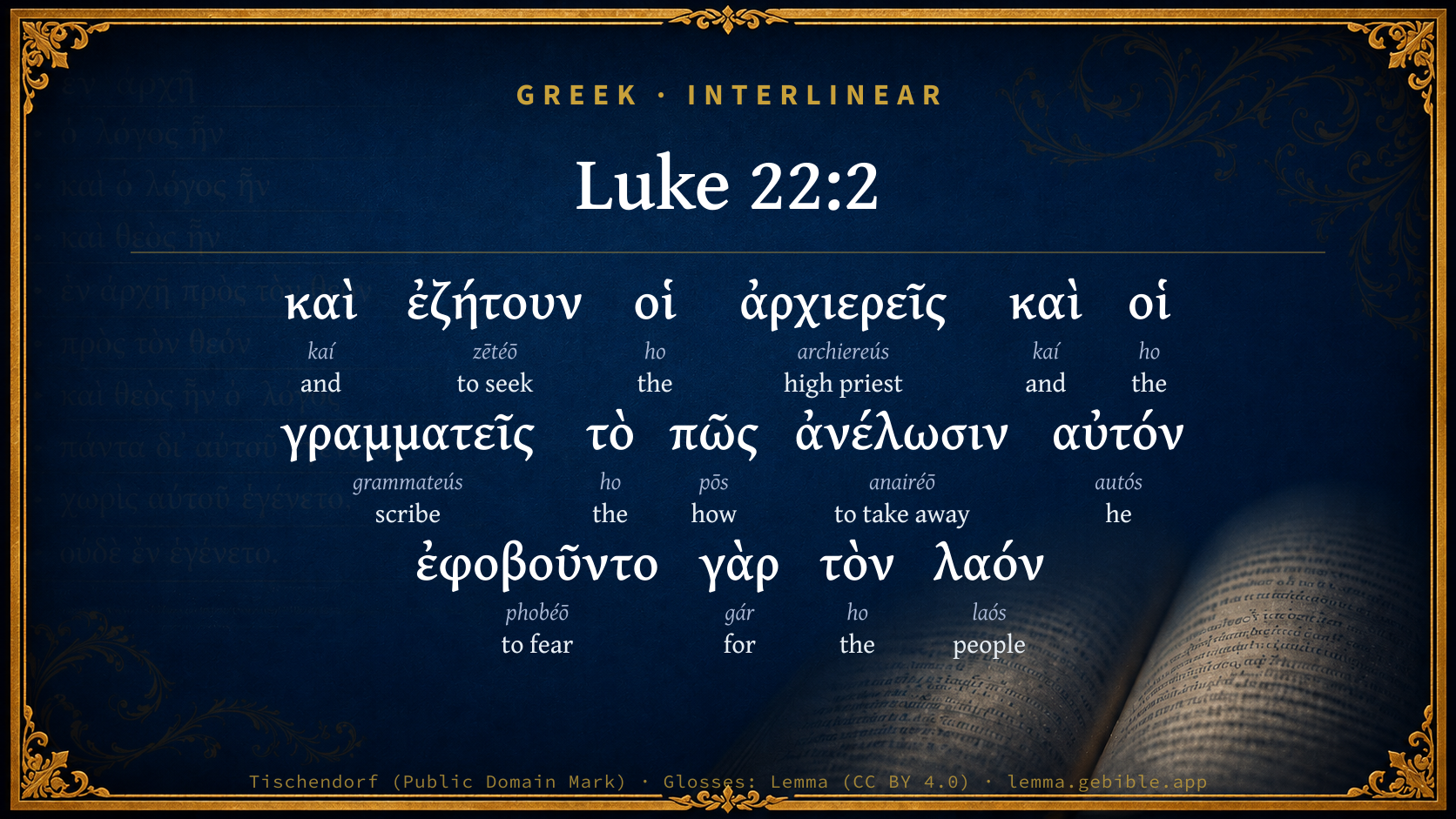
Greek (Tischendorf 8th ed.) Luke 22:2 appears in the Greek New Testament. The text above is from the Tischendorf 8th edition. Each word links to its Strong’s number and a concise gloss. Click any word for its full Thayer’s Greek Lexicon entry.
Download image
Cite this verse

Luke 22:2 (World English Bible). Public Domain. Lemma interlinear Bible study tool, https://lemma.gebible.app/v/luke/22/2.

Show BibTeX & RIS
BibTeX
RIS
English Translation
The chief priests and the scribes sought how they might put him to death, for they feared the people.
World English Bible · Public Domain
Download a study sheet

One document with this verse’s original text, its word-by-word gloss line, the meaning frame, cross-references with their text, attributed commentary, and full source and license credits — printable, and it pastes into notes with its structure intact.

This verse Autodidact and up

Study sheet (.html) Plain text (.txt)

A passage Seminary Student

Up to 50 verses in one chapter. A passage sheet keeps up to 6 commentary sources and 12 cross-references per verse, in the order this page ranks them, and says so on the sheet whenever that leaves anything out. Ask for a single verse and you get the Autodidact verse sheet above.

Everything on this page stays free to read, with no account — the sheet is a download of what is already on screen, not access to it.

Want to remove ads? Support Godless Engineer
Compare translations 3

The same verse in 3 English versions, stacked beneath the original-language interlinear above. Click any original word for its lexicon entry.

Each is an independent rendering of the whole verse — the interlinear is not word-aligned to these translations.

Highlighted words mark where these versions differ — a whole-verse word diff, not a word-by-word alignment.

  • World English Bible Public Domain
    The chief priests and the scribes sought how they might put him to death, for they feared the people.
  • King James Version Public Domain
    And the chief priests and scribes sought how they might kill him; for they feared the people.
  • unfoldingWord Literal Text CC BY-SA 4.0
    And the chief priests and the scribes were seeking how they might kill him, for they were fearing the people.

unfoldingWord Literal Text — © unfoldingWord, licensed CC BY-SA 4.0. Word-aligned USFM3 via Door43 (git.door43.org/unfoldingWord/en_ult).

Versions to compare (up to 4)

3 of 4 selected

Show all 19 translations

Every available English version of this verse, each an independent rendering of the whole verse.

  • World English Bible Public Domain
    The chief priests and the scribes sought how they might put him to death, for they feared the people.
  • Berean Standard Bible Public Domain
    and the chief priests and scribes were looking for a way to put Jesus to death; for they feared the people.
  • Majority Standard Bible Public Domain
    and the chief priests and scribes were looking for a way to put Jesus to death, for they feared the people.
  • King James Version Public Domain
    And the chief priests and scribes sought how they might kill him; for they feared the people.
  • American Standard Version (1901) Public Domain
    And the chief priests and the scribes sought how they might put him to death; for they feared the people.
  • Revised Version (1885) Public Domain
    And the chief priests and the scribes sought how they might put him to death; for they feared the people.
  • Geneva Bible (1599) Public Domain
    And the hie Priests and Scribes sought how they might kill him: for they feared the people.
  • Douay-Rheims (1899) Public Domain
    And the chief priests and the scribes sought how they might put Jesus to death: but they feared the people.
  • Young's Literal Translation Public Domain
    and the chief priests and the scribes were seeking how they may take him up, for they were afraid of the people.
  • Literal Standard Version CC BY-SA 4.0
    and the chief priests and the scribes were seeking how they may take Him up, for they were afraid of the people.
  • Unlocked Literal Bible CC BY-SA 4.0
    The chief priests and the scribes discussed how they could put Jesus to death, for they were afraid of the people.
  • unfoldingWord Literal Text CC BY-SA 4.0
    And the chief priests and the scribes were seeking how they might kill him, for they were fearing the people.
  • Darby Bible Public Domain
    and the chief priests and the scribes sought how they might kill him; for they feared the people.
  • World Messianic Bible Public Domain
    The chief priests and the scribes sought how they might put him to death, for they feared the people.
  • Webster's Bible Public Domain
    And the chief priests and scribes sought how they might kill him: for they feared the people.
  • Free Bible Version CC BY-SA 4.0
    The chief priests and religious teachers were looking for a way to kill Jesus, but were afraid of what the people would do.
  • Bible in Basic English Public Domain
    And the chief priests and the scribes were looking for a chance to put him to death, but they went in fear of the people.
  • Text-Critical English NT CC BY 4.0
    and the chief priests and the scribes were looking for a way to get rid of Jesus quietly, for they were afraid of the people.
  • Tyndale New Testament (1534) Public Domain
    and the hye prestes and Scribes sought how to kyll him but they feared the people.

Literal Standard Version (2020), Covenant Press — licensed CC BY-SA 4.0. Text via the HelloAO Bible API (eBible.org). Unlocked Literal Bible (unfoldingWord) — licensed CC BY-SA 4.0. Text via the HelloAO Bible API (eBible.org). unfoldingWord Literal Text — © unfoldingWord, licensed CC BY-SA 4.0. Word-aligned USFM3 via Door43 (git.door43.org/unfoldingWord/en_ult). Free Bible Version, Dr. Jonathan Gallagher — licensed CC BY-SA 4.0. Text via the HelloAO Bible API (eBible.org).

Word by word

More ways to search: Search by grammar → Find every occurrence → Compare this word →

Practice this passage: Drill this verse → Learn its vocabulary →

ἀνέλωσιν
anairéō
G337
“to take away”
Verb, Aorist, Active, Subjunctive, 3rd person, Plural
Part of Speech
Verb
Tense
Aorist
Voice
Active
Mood
Subjunctive
Person
3rd person
Number
Plural
Full Thayer's Definition

Origin: from G303 and (the active of) G138

TDNT: None

1. to take up, to lift up (from the ground) a. to take up for myself as mine b. to own (an exposed infant) 2. to take away, abolish a. to do away with or abrogate customs or ordinances b. to put out of the way, kill slay a man
  1. καὶ kaí G2532 “and” Conjunction
  2. ἐζήτουν zētéō G2212 “to seek” Verb, Imperfect, Active, Indicative, 3rd person, Plural
  3. οἱ ho G3588 “the” Article, Nominative, Plural, Masculine
  4. ἀρχιερεῖς archiereús G749 “high priest” Noun, Nominative, Plural, Masculine
  5. καὶ kaí G2532 “and” Conjunction
  6. οἱ ho G3588 “the” Article, Nominative, Plural, Masculine
  7. γραμματεῖς grammateús G1122 “scribe” Noun, Nominative, Plural, Masculine
  8. τὸ ho G3588 “the” Article, Accusative, Singular, Neuter
  9. πῶς pōs G4459 “how” Adverb, Interrogative
  10. αὐτόν autós G846 “he” Personal pronoun, Accusative, Singular, Masculine
  11. ἐφοβοῦντο phobéō G5399 “to fear” Verb, Imperfect, Middle or Passive deponent, Indicative, 3rd person, Plural
  12. γὰρ gár G1063 “for” Conjunction
  13. τὸν ho G3588 “the” Article, Accusative, Singular, Masculine
  14. λαόν laós G2992 “people” Noun, Accusative, Singular, Masculine

About this verse

These counts appear in no published source. They are computed here, from the morphology-tagged text and Lemma’s own curated glosses. What Lemma adds →

15
words
11
distinct lemmas
Gospels
section

Notable vocabulary

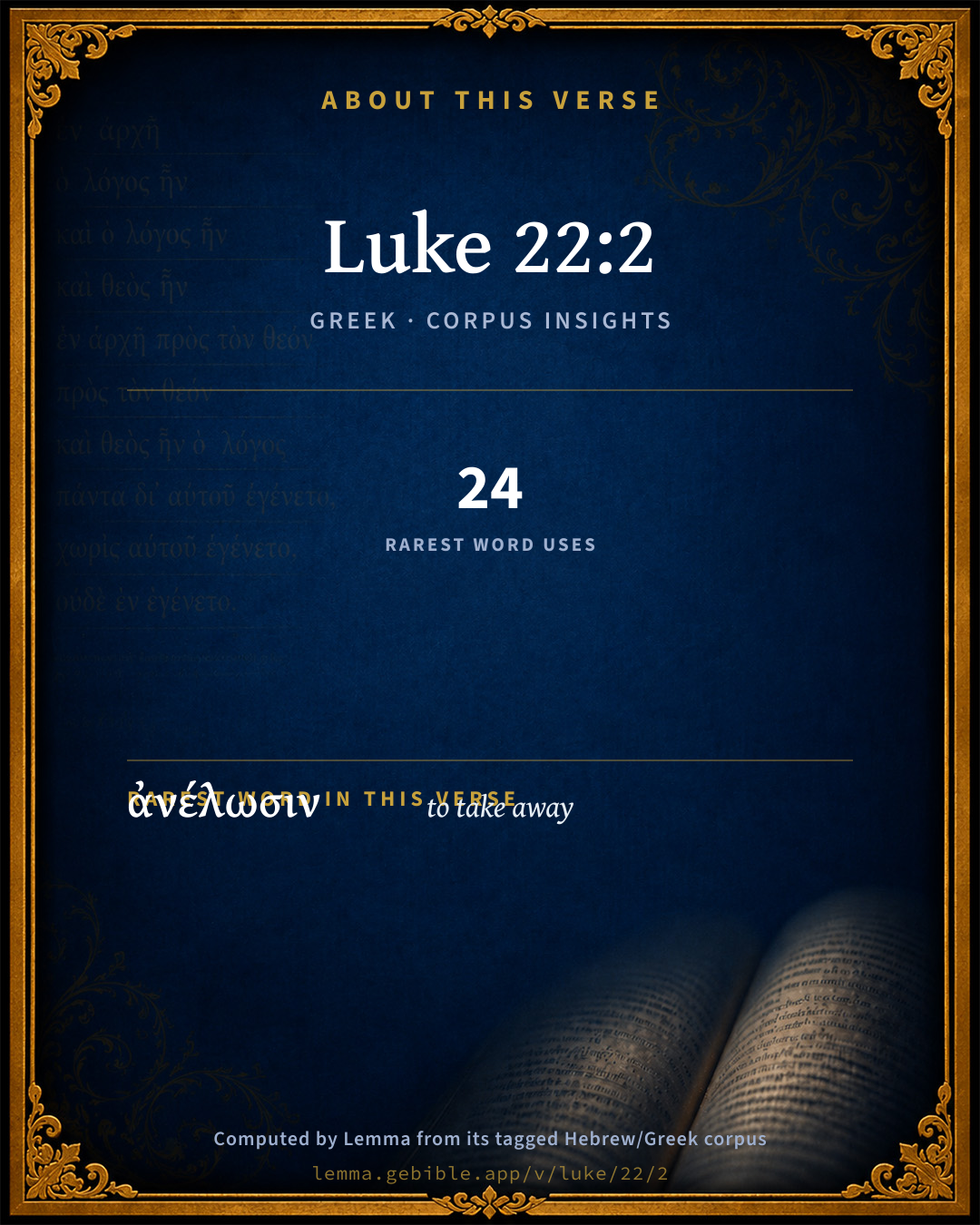
The rarest word here is ἀνέλωσιν to take away G337 — appearing just 24 times in the whole Greek New Testament.

Shared distinctive vocabulary

ἀνέλωσιν to take away G337 occurs in 23 verses of the Greek New Testament. Also found in:

Repetition

Words recur within this verse:

Cross-references

10

Topical passages linked to Luke 22:2 in the Treasury of Scripture Knowledge — connected by theme and wording, ordered by reader-vote popularity; previews shown in the World English Bible.

  • John 11:47–53 The chief priests therefore and the Pharisees gathered a council, and said, "What are we doing? For this man does many signs.
  • Psalms 2:1–5 Why do the nations rage, And the peoples plot a vain thing?
  • Matthew 12:14 But the Pharisees went out, and conspired against him, how they might destroy him.
  • Matthew 21:45–46 When the chief priests and the Pharisees heard his parables, they perceived that he spoke about them.
  • Matthew 26:3–5 Then the chief priests, the scribes, and the elders of the people were gathered together in the court of the high priest, who was called Caiaphas.
  • Luke 19:47–48 He was teaching daily in the temple, but the chief priests and the scribes and the leading men among the people sought to destroy him.
  • Luke 20:19 The chief priests and the scribes sought to lay hands on Him that very hour, but they feared the people--for they knew He had spoken this parable against them.
  • John 11:57 Now the chief priests and the Pharisees had commanded that if anyone knew where he was, he should report it, that they might seize him.
  • Matthew 21:38 But the farmers, when they saw the son, said among themselves, 'This is the heir. Come, let's kill him, and seize his inheritance.'
  • Acts 4:27 For truly, in this city against your holy servant, Jesus, whom you anointed, both Herod and Pontius Pilate, with the Gentiles and the people of Israel, were gathered together

Cross-references courtesy of OpenBible.info (CC BY 4.0).

Commentary

Notes on Luke 22:2 from classic Christian and Jewish commentators (each source and its license shown beneath its notes). The classic Christian expositions comment on the surrounding passage and are grouped to its opening verse, so a note may address several verses; the Jewish commentaries on the Tanakh (Rashi and others) are per-verse, so they appear only where the commentator wrote on this verse.

Lemma curates 59 commentaries, every one of them public domain or Creative Commons licensed, each selected and text-cleaned for this edition rather than reprinted as found. About our sources →

Bengel's Gnomon

Johann Albrecht Bengel

Luk 22:2. [Καὶ ἐζήτουν, and the chief priests sought) Judas ‘sought’ the same thing, Luk 22:6. A most wicked pursuit.—V. g.]—γὰρ, for) This assigns the cause why they had to ‘seek’ suitable means and a favourable opportunity (πῶς ἀνέλωσιν αὐτὸν, how they might kill Him). [Most wretched (pitiful) fear, succeeded by atrocious joy, Luk 22:5.—V. g.]

Bengel's Gnomon of the New Testament — English translation (T&T Clark, Edinburgh, 1860) — public domain. Text from a community e-Sword module.

Expositor's Greek Testament

ed. W. Robertson Nicoll

Luk 22:2 . τὸ πῶς , the how, that was the puzzle; that Jesus should be put out of the way by death ( ἀνέλωσιν α .); some how was a settled matter. Cf. Luk 19:48 ( τὸ τί , etc.). ἐφοβοῦντο γάρ τ . λ .: their fear of the people explains why the how was so perplexing a matter. The popularity of Jesus was very embarrassing.

The Expositor's Greek Testament, edited by W. Robertson Nicoll (1897–1910) — public domain. Text from a community e-Sword module.

Adam Clarke's Commentary

Verse 2. They feared the people.] The great mass of the people seem to have been convinced that Christ was at least a prophet sent from God; and it is likely they kept steady in their attachment to him. The multitude, who are represented as clamouring for his blood at the crucifixion, appear to have been a mere mob, formed out of the creatures of the chief priests and Pharisees.

Adam Clarke's Commentary on the Bible (1810–1826) — public domain. Text from a community e-Sword/MySword module.

The Cambridge Bible for Schools and Colleges

gen. ed. J. J. S. Perowne

2. the chief priests and scribes] Their humiliation and defeat before the people—the immense and divine superiority of the wisdom of Jesus so publicly displayed—had at last aroused them into irreconcilable hostility. It is very noticeable that the Pharisees, as a distinct party, now vanish entirely into the background. They are scarcely mentioned again except in Mat_27:62.

sought] Rather, were seeking. The word involves a continuous effort, and probably includes the memorable meeting in the Palace of Caiaphas, which is traditionally placed on the ‘Hill of Evil Counsel,’ but was probably close to the Temple precincts. They seem to have come on that occasion, in consequence of the advice of Caiaphas, to three conclusions. (1) To put Jesus to death; (2) to do it as secretly as possible; and (3) not to do it during the Feast, so as to avoid the chance of tumults on the part of the Galilaean pilgrims. If this meeting was on Tuesday evening, at the very time that they were deciding not to kill Jesus (Psa_2:2) for more than eight days—and it was unusual to put to death during the Passover, Act_12:4—He, seated on the slopes of Olivet, was telling His disciples that before the Passover He should be slain, Mat_26:1-5.

The Cambridge Bible for Schools and Colleges (gen. ed. J. J. S. Perowne; Cambridge University Press, 1878–1918) — public domain. Text from a community e-Sword module.

John Gill's Exposition

And the chief priests and Scribes,.... Matthew adds, "and the elders of the people"; which made up the great sanhedrim and council of the nation; these met together, not in their usual place the temple, but at the palace of Caiaphas, the high priest; see Mat 24:3.

And sought how they might kill him; that is, "Jesus", as the Vulgate Latin and Ethiopic versions read; they had determined before, upon the advice of Caiaphas, to put him to death, and very likely had fixed what kind of death he should die; see Joh 11:49 and now they consult together, of the manner of bringing it about, and at what time; and the majority were not for doing it on a feast day, when there was a great concourse of people, but with more privacy:

for they feared the people: which were now in great multitudes with him, who came along with him, from Galilee, and other parts; and had hosanna'd him into the city, and still abode with him, and their numbers were increasing; and the sanhedrim were aware, that at the passover there would be still a greater company of people from all parts of the land; and they might conclude, that he would have a large number of his friends come out of Galilee, where he had been for the most part teaching, and working miracles; and they were afraid, should they lay hold on him publicly, the people would rise and stone them; at least would rescue him out of their hands, and disappoint them of their designs.

John Gill's Exposition of the Whole Bible (1746–1763) — public domain (CC PDM 1.0). Text via the HelloAO Bible API.

Trapp's Complete Commentary

John Trapp

2 And the chief priests and scribes sought how they might kill him; for they feared the people.

Ver. 2. How they might kill him] Not put him to death as judges, but kill him as cutthroats, ανελωσι. So Act 2:23.

John Trapp, A Commentary or Exposition upon All the Books of the Old and New Testament (1647–1656) — public domain. Text from a community e-Sword module.

The Pulpit Commentary

And the chief priests and scribes sought how they might kill him; for they feared the people. The determination, long maturing, had, during the last few days of public teaching, been come to on the part of the Sanhedrin. They had determined to put the dangerous public Teacher to death. The bitter hatred on the part of the Jewish rulers had been gradually growing in intensity during the two years and a half of the public ministry of Jesus of Nazareth. The raising of Lazarus seems to have finally decided the governing body with as little delay as possible to compass the Reformer"s death. The temporary withdrawal of the Lord after the great miracle deferred their purpose for a season; after, however, a retirement for a few weeks, Jesus appeared again, shortly before the Passover, and taught publicly in the temple, at a season when Jerusalem was crowded with pilgrims arriving for the great feast. Never had his teaching excited such interest, never had it stirred up such burning opposition as at this juncture. This decided the Jewish rulers to carry out their design on the life of the Galilaean Teacher with as little delay as possible. The only thing that perplexed them was how this could safely be accomplished, owing to the favor in which he was held by the people, especially by the crowds of pilgrims from the provinces then in Jerusalem.

HOMILIES BY W. CLARKSON Ver. 2. Piety, pedantry, and formalism.

Of all those who in any and every way were responsible for the death of Jesus Christ, the largest share of guilt lies at the door of the religious leaders of the time. The Roman soldiers were only the immediate instruments of it; the Jewish populace were only the blind agents of it; but these scribes and chief priests were the guilty instigators of it: they brought it about. It was they who first conceived the idea; it was they who suggested and urged it; it was they who ceased not to agitate and direct until the dark deed was done. How came they to go so far astray? How came it to pass that while "all the people came early in the morning to him in the temple for to hear him", (Luk_21:38) thus bearing witness to the sincerity of their discipleship and their desire to know the truth he taught, they, the leaders of the land scribes who were familiar with every letter of the Law, priests who were daily occupied in the services of the sanctuary, learned doctors, and pious ministrants were actively and earnestly compassing his death? The fact is that

I RELIGIOUS PEDANTRY MAY BE VERY LEARNED, AND YET WHOLLY WRONG. These men knew their Scriptures with a fullness and nicety of detail that surpasses the knowledge we have of our sacred writings; and they had also a perfect familiarity with the teachings of traditional lore. They despised the ignorance of the common people in these respects. (see Joh_7:47) Yet they were not wise with the wisdom of God; they entirely failed to understand the Divine will and the way to eternal life. The religion they taught and lived was utterly heartless; it was a service without any soul in it, a mechanism without any life in it; it was an elaborate error, a great and sad misconception of the mind of God; it was a surrender of freedom that did man no good and gave God no pleasure; it was a toilsome and torturing imposition that neither satisfied the intellect, nor cleansed the heart, nor elevated the life. And it so perverted the judgment that, when the Truth himself came to reveal the Father, these learned bat unwise leaders, instead of being eager to hear him like the people, (Luk_21:38) were "seeking how they might kill him.

II RELIGIOUS FORMALISM WILL GO TO GREAT LENGTHS OF WRONG-DOING. If the scribes were men of pedantry, the chief priests represented the evil and error of religious formalism; and the latter were in no way behind the former in either spiritual blindness or malevolence. They, too, failed to recognize their Messiah, and were actively engaged in compassing his murder. In every age and land religious formalism has been blind and cruel; it has failed to recognize the reformer when he has come to speak in God"s name; and it has been forward to accuse and to slay him. Such has been its spirit and its course, that the home of love and mercy has been converted into the hotbed of hatred and of cruelty. It is another illustration of the truth that the corruption of the best becomes the worst of all; the piety that runs into ordinances, utterances, abstinences, formalities, will in time degenerate into utter error and shameful wrong. This is a truth which applies to many more Churches than one; it is, indeed, more or less applicable to all religious circles. There lies a deep-seated tendency in our nature which accounts for the facts in our Lord"s time and in every age since then. Let us, therefore, learn that

III TRUE PIETY IS FOUND IN RECTITUDE OF HEART AND LIFE. Not in holding and professing certain correct formulae; not in going through certain ceremonies or observing a number of rules and regulations. These have their place in the kingdom of God, but they do not by any means assure us of our place in it. It is rightness of heart toward God our Father and our Savior, and consequent integrity of life, which make us to "stand before God" as his loyal subjects now, and will make us "worthy to stand before the Son of man" when he shall call us to his nearer presence. C.

The Pulpit Commentary (1880–1919), ed. H.D.M. Spence-Jones & Joseph S. Exell — public domain. Text from a community e-Sword module.

Cambridge Greek Testament for Schools and Colleges

2. ἐζήτουν. ‘Were seeking.’ The word involves a continuous effort, and probably includes the memorable meeting in the Palace of Caiaphas, which is traditionally placed on the ‘Hill of Evil Counsel,’ but was probably close to the Temple precincts. They seem to have come on that occasion, in consequence of the advice of Caiaphas, to three conclusions. (1) To put Jesus to death; (2) to do it as secretly as possible; and (3) not to do it during the Feast, so as to avoid the chance of tumults on the part of the Galilaean pilgrims. If this meeting was on Tuesday evening, at the very time that they were deciding not to kill Jesus (Psa 2:2) for more than eight days—and it was unusual to put to death during the Passover, Act 12:4—He, seated on the slopes of Olivet, was telling His disciples that before the Passover He should be slain, Mat 26:1-5.

οἱ ἀρχιερεῖς καὶ οἱ γραμματεῖς. Their humiliation and defeat before the people—the divine superiority of the wisdom of Jesus so publicly displayed—had at last aroused them into irreconcilable hostility. It is very noticeable that the Pharisees, as a distinct party, now vanish entirely into the background. They are scarcely mentioned again except in Mat 27:62.

τὸ πῶς ἀνέλωσιν αὐτόν. Having decided ‘to do away with Him’ they now only considered the most feasible plan. Ἀναιρέω, vaguely rendered ‘kill’ in the A. V[378], is common in St Luke (twice in the Gospel, nineteen times in the Acts), but elsewhere only occurs in the N.T. in Mat 2:16, and in another sense in Heb 2:9 (the reading in 2Th 2:8 is uncertain).

[378] A. V. Authorised Version.

ἐφοβοῦντο τὸν λαόν. The crowds which listened to Jesus (Luk 21:38) shewed that He had friends among the multitude.

Cambridge Greek Testament for Schools and Colleges (Cambridge University Press, 1896; 21 vols, various authors incl. Carr, Maclear, Plummer, Farrar, Lumby, Moule, M. R. James, Simcox) — public domain. Text from a community e-Sword module.

Alford’s Greek Testament

Henry Alford

2.] Conspiracy of the Jewish authorities to kill Jesus. Mat 26:1-5.Mar 14:1Mar 14:1, Mar 14:2. The account of Matt. is the fullest: see notes there. The words here give us a mere compendium of what took place.

Henry Alford, The Greek Testament (1849–1861) — public domain. Text from a community e-Sword module.

International Critical Commentary

2. ἐζήτουν … τὸ πῶς. “They continued seeking as to the method”: comp. 19:47, 48, and for the τό see on 1:62. tells us that they held a meeting in the house of Caiaphas.

ἀνέλωσιν. Another of Lk.’s favourite words. Here, 23:32, and eighteen times in the Acts it has the special meaning of “remove, slay”: so also 2Th 2:8, where the reading is doubtful. This meaning is common in LXX (Gen 4:15; Exo 2:14, Exo 2:15, Exo 2:21:29, etc.) and in class. Grk. Except Mat 2:16; 2Th 2:8, and Heb 10:9 (where see Wsctt.), it occurs only in Lk. With ἐφοβοῦντο comp. 20:19, 19:48, 21:38.

International Critical Commentary — older volumes (1896–1929), various authors — public domain. Text from a community e-Sword module.

Vincent's Word Studies in the New Testament

Marvin R. Vincent

Sought. Imperfect, were seeking, contemporaneously with the approach of the feast.

Kill [ανελωσιν] . Lit., to take up and carry off, and so to make way with.

Marvin R. Vincent, Word Studies in the New Testament (1887–1900) — public domain. Text from a community e-Sword/MySword module.

Lesson kit

Teaching starters — assembled from the data on this page, not authored interpretation. Every prompt links to the verse data it draws on. Edit before teaching.

Luke, in the Gospels, opens this verse with 15 words (11 distinct Greek lemmas). Its most distinctive word is anairéō (“to take away”). A historical commentator’s framing appears above. Read the whole chapter for the surrounding context.

Discussion questions

  1. What does “to take away” (anairéō) contribute to the verse as a whole?
  2. How does Matthew 2:16, which shares the word «to take away», read alongside this verse?
  3. What does the repetition of “the” (4× in this one verse) do in this verse?
  4. These translations render this verse differently. What is at stake in choosing one wording over another?
  5. Compare how Bengel's Gnomon and Expositor's Greek Testament read this verse. Where do they agree or differ?

Things to notice

Reading settings

Reading text

Shown beneath each verse's original-language words.

Old Testament
Old Testament edition

Read the OT as the Masoretic Hebrew (MT) or the Greek Septuagint (LXX).

English shown for the Greek Septuagint (in the Hebrew ↔ Greek comparison).

Comparing translations? Open the Compare panel on any verse page to stack up to four side by side.