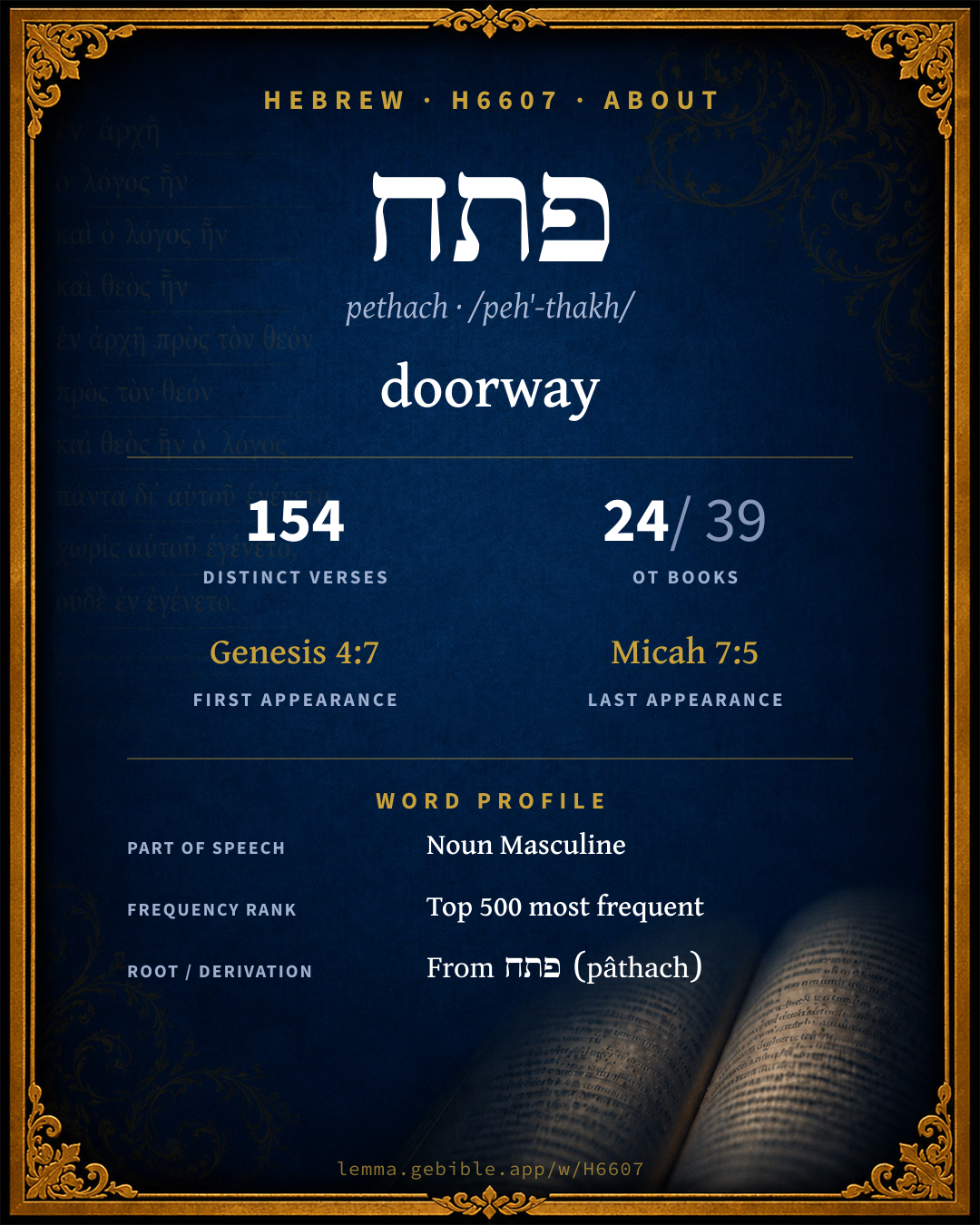
פֶּ֫תַח
doorway
Full lexicon entry — Brown-Driver-Briggs (BDB)
From Brown-Driver-Briggs (BDB)
Where this word appears
See every Construct-state word in the Hebrew Bible →
Grammar key — what these labels mean
Part of speech
- Noun
- A naming word — a person, place, thing, or idea.
Noun type
- Common
- A common noun — a general class of person, place, or thing (“king,” “city,” “water”), not a specific name.
State
- Construct
- A noun bound to a following noun in a possessive / “of” relationship (the construct chain).
- Absolute
- The independent form of a noun, not bound to a following word.
Gender
- Masculine
- Grammatically masculine.
Number
- Singular
- One.
- Plural
- More than one (in Hebrew, generally three or more).
137 distinct verses where H6607 appears in the Construct state, across 24 books. Filtered view — show all forms. Click any verse to open its interlinear word-by-word view. Verse text shown in the World English Bible for context — . Each verse’s Hebrew form is shown with its reference; the English is not keyword-highlighted, since the data carries no word-level English alignment. Use “Compare translations” on any verse to read it across multiple English versions. This concordance covers the Hebrew Bible; Septuagint (Greek Old Testament) occurrences are not indexed here.
Genesis 7 verses
- Genesis 6:16 וּ/פֶ֥תַח conj + n c ms cs You shall make a roof in the ark, and to a cubit shall you finish it upward. You shall set the door of the ark in the side of it. You shall make it with lower, second, and third levels.
- Genesis 18:1 פֶּֽתַח n c ms cs Yahweh appeared to him by the oaks of Mamre, as he sat in the tent door in the heat of the day.
- Genesis 18:2 מִ/פֶּ֣תַח prep + n c ms cs He lifted up his eyes and looked, and saw that three men stood opposite him. When he saw them, he ran to meet them from the tent door, and bowed himself to the earth,
- Genesis 18:10 פֶּ֥תַח n c ms cs He said, "I will certainly return to you when the season comes round. Behold, Sarah your wife will have a son." Sarah heard in the tent door, which was behind him.
- Genesis 19:11 פֶּ֣תַח הַ/פָּֽתַח n c ms cs ptcl def.art + n c ms They struck the men who were at the door of the house with blindness, both small and great, so that they wearied themselves to find the door.
- Genesis 38:14 בְּ/פֶ֣תַח prep + n c ms cs She took off of her the garments of her widowhood, and covered herself with her veil, and wrapped herself, and sat in the gate of Enaim, which is by the way to Timnah; for she saw that Shelah was grown up, and she wasn't given to him as a wife.
- Genesis 43:19 פֶּ֥תַח n c ms cs They came near to the steward of Joseph's house, and they spoke to him at the door of the house,
Exodus 17 verses
- Exodus 12:22 מִ/פֶּֽתַח prep + n c ms cs You shall take a bunch of hyssop, and dip it in the blood that is in the basin, and strike the lintel and the two side-posts with the blood that is in the basin; and none of you shall go out of the door of his house until the morning.
- Exodus 26:36 לְ/פֶ֣תַח prep + n c ms cs "You shall make a screen for the door of the Tent, of blue, and purple, and scarlet, and fine twined linen, the work of the embroiderer.
- Exodus 29:4 פֶּ֖תַח n c ms cs You shall bring Aaron and his sons to the door of the tent of meeting, and shall wash them with water.
- Exodus 29:11 פֶּ֖תַח n c ms cs You shall kill the bull before Yahweh, at the door of the tent of meeting.
- Exodus 29:32 פֶּ֖תַח n c ms cs Aaron and his sons shall eat the flesh of the ram, and the bread that is in the basket, at the door of the tent of meeting.
- Exodus 29:42 פֶּ֥תַח n c ms cs It shall be a continual burnt offering throughout your generations at the door of the tent of meeting before Yahweh, where I will meet with you, to speak there to you.
- Exodus 33:8 פֶּ֣תַח n c ms cs It happened that when Moses went out to the Tent, that all the people rose up, and stood, everyone at their tent door, and watched Moses, until he had gone into the Tent.
- Exodus 33:9 פֶּ֣תַח n c ms cs It happened, when Moses entered into the Tent, that the pillar of cloud descended, stood at the door of the Tent, and spoke with Moses.
- Exodus 33:10 פֶּ֣תַח פֶּ֥תַח n c ms cs n c ms cs All the people saw the pillar of cloud stand at the door of the Tent, and all the people rose up and worshiped, everyone at their tent door.
- Exodus 35:15 הַ/פֶּ֖תַח לְ/פֶ֥תַח ptcl def.art + n c ms prep + n c ms cs and the altar of incense with its poles, the anointing oil, the sweet incense, the screen for the door, at the door of the tent;
- Exodus 36:37 לְ/פֶ֣תַח prep + n c ms cs He made a screen for the door of the tent, of blue, purple, scarlet, and fine twined linen, the work of an embroiderer;
- Exodus 38:8 פֶּ֖תַח n c ms cs He made the basin of brass, and its base of brass, out of the mirrors of the ministering women who ministered at the door of the tent of meeting.
- Exodus 38:30 פֶּ֚תַח n c ms cs With this he made the sockets to the door of the tent of meeting, the brazen altar, the brazen grating for it, all the vessels of the altar,
- Exodus 39:38 פֶּ֥תַח n c ms cs the golden altar, the anointing oil, the sweet incense, the screen for the door of the Tent,
- Exodus 40:6 פֶּ֖תַח n c ms cs You shall set the altar of burnt offering before the door of the tent of the tent of meeting.
- Exodus 40:12 פֶּ֖תַח n c ms cs You shall bring Aaron and his sons to the door of the tent of meeting, and shall wash them with water.
- Exodus 40:29 פֶּ֖תַח n c ms cs He set the altar of burnt offering at the door of the tent of the tent of meeting, and offered on it the burnt offering and the meal-offering, as Yahweh commanded Moses.
Leviticus 24 verses
- Leviticus 1:3 פֶּ֝תַח n c ms cs "'If his offering is a burnt offering from the herd, he shall offer a male without blemish. He shall offer it at the door of the Tent of Meeting, that he may be accepted before Yahweh.
- Leviticus 1:5 פֶּ֖תַח n c ms cs He shall kill the bull before Yahweh. Aaron's sons, the priests, shall present the blood and sprinkle the blood around on the altar that is at the door of the Tent of Meeting.
- Leviticus 3:2 פֶּ֖תַח n c ms cs He shall lay his hand on the head of his offering, and kill it at the door of the tent of meeting: and Aaron's sons the priests shall sprinkle the blood on the altar round about.
- Leviticus 4:4 פֶּ֛תַח n c ms cs He shall bring the bull to the door of the Tent of Meeting before Yahweh; and he shall lay his hand on the head of the bull, and kill the bull before Yahweh.
- Leviticus 4:7 פֶּ֖תַח n c ms cs The priest shall put some of the blood on the horns of the altar of sweet incense before Yahweh, which is in the tent of meeting; and he shall pour out all the blood of the bull out at the base of the altar of burnt offering, which is at the door of the Tent of Meeting.
- Leviticus 4:18 פֶּ֖תַח n c ms cs He shall put some of the blood on the horns of the altar which is before Yahweh, that is in the Tent of Meeting; and the rest of the blood he shall pour out at the base of the altar of burnt offering, which is at the door of the Tent of Meeting.
- Leviticus 8:3 פֶּ֖תַח n c ms cs and assemble all the congregation at the door of the Tent of Meeting."
- Leviticus 8:4 פֶּ֖תַח n c ms cs Moses did as Yahweh commanded him; and the congregation was assembled at the door of the Tent of Meeting.
- Leviticus 8:31 פֶּ֣תַח n c ms cs Moses said to Aaron and to his sons, "Boil the flesh at the door of the Tent of Meeting, and there eat it and the bread that is in the basket of consecration, as I commanded, saying, 'Aaron and his sons shall eat it.'
- Leviticus 8:33 וּ/מִ/פֶּתַח֩ conj + prep + n c ms cs You shall not go out from the door of the Tent of Meeting seven days, until the days of your consecration are fulfilled: for he shall consecrate you seven days.
- Leviticus 8:35 וּ/פֶתַח֩ conj + n c ms cs At the door of the Tent of Meeting you shall stay day and night seven days, and keep the charge of Yahweh, that you don't die: for so I am commanded."
- Leviticus 10:7 וּ/מִ/פֶּתַח֩ conj + prep + n c ms cs You shall not go out from the door of the Tent of Meeting, lest you die; for the anointing oil of Yahweh is on you." They did according to the word of Moses.
- Leviticus 12:6 פֶּ֥תַח n c ms cs "'When the days of her purification are completed, for a son, or for a daughter, she shall bring to the priest at the door of the Tent of Meeting, a year old lamb for a burnt offering, and a young pigeon, or a turtledove, for a sin offering:
- Leviticus 14:11 פֶּ֖תַח n c ms cs The priest who cleanses him shall set the man who is to be cleansed, and those things, before Yahweh, at the door of the Tent of Meeting.
- Leviticus 14:23 פֶּ֥תַח n c ms cs "On the eighth day he shall bring them for his cleansing to the priest, to the door of the Tent of Meeting, before Yahweh.
- Leviticus 14:38 פֶּ֣תַח n c ms cs then the priest shall go out of the house to the door of the house, and shut up the house seven days.
- Leviticus 15:14 פֶּ֨תַח֙ n c ms cs "'On the eighth day he shall take two turtledoves, or two young pigeons, and come before Yahweh to the door of the Tent of Meeting, and give them to the priest:
- Leviticus 15:29 פֶּ֖תַח n c ms cs On the eighth day she shall take two turtledoves, or two young pigeons, and bring them to the priest, to the door of the Tent of Meeting.
- Leviticus 16:7 פֶּ֖תַח n c ms cs He shall take the two goats, and set them before Yahweh at the door of the Tent of Meeting.
- Leviticus 17:4 פֶּ֜תַח n c ms cs and hasn't brought it to the door of the Tent of Meeting, to offer it as an offering to Yahweh before the tabernacle of Yahweh: blood shall be imputed to that man. He has shed blood; and that man shall be cut off from among his people.
- Leviticus 17:5 פֶּ֛תַח n c ms cs This is to the end that the children of Israel may bring their sacrifices, which they sacrifice in the open field, that they may bring them to Yahweh, to the door of the Tent of Meeting, to the priest, and sacrifice them for sacrifices of peace offerings to Yahweh.
- Leviticus 17:6 פֶּ֖תַח n c ms cs The priest shall sprinkle the blood on the altar of Yahweh at the door of the Tent of Meeting, and burn the fat for a sweet savor to Yahweh.
- Leviticus 17:9 פֶּ֜תַח n c ms cs and doesn't bring it to the door of the Tent of Meeting, to sacrifice it to Yahweh; that man shall be cut off from his people.
- Leviticus 19:21 פֶּ֖תַח n c ms cs He shall bring his trespass offering to Yahweh, to the door of the Tent of Meeting, even a ram for a trespass offering.
Numbers 17 verses
- Numbers 3:25 פֶּ֖תַח n c ms cs The charge of the sons of Gershon in the Tent of Meeting shall be the tabernacle, and the tent, its covering, and the screen for the door of the Tent of Meeting,
- Numbers 3:26 פֶּ֣תַח n c ms cs and the hangings of the court, and the screen for the door of the court, which is by the tabernacle, and around the altar, and its cords for all of its service.
- Numbers 4:25 פֶּ֖תַח n c ms cs they shall carry the curtains of the tabernacle, and the Tent of Meeting, its covering, and the covering of sealskin that is above on it, and the screen for the door of the Tent of Meeting,
- Numbers 4:26 פֶּ֣תַח n c ms cs and the hangings of the court, and the screen for the door of the gate of the court, which is by the tabernacle and around the altar, and their cords, and all the instruments of their service, and whatever shall be done with them. Therein shall they serve.
- Numbers 6:10 פֶּ֖תַח n c ms cs On the eighth day he shall bring two turtledoves or two young pigeons to the priest, to the door of the Tent of Meeting.
- Numbers 6:13 פֶּ֖תַח n c ms cs "This is the law of the Nazirite: when the days of his separation are fulfilled, he shall be brought to the door of the Tent of Meeting,
- Numbers 6:18 פֶּ֛תַח n c ms cs The Nazirite shall shave the head of his separation at the door of the Tent of Meeting, and shall take the hair of the head of his separation, and put it on the fire which is under the sacrifice of peace offerings.
- Numbers 10:3 פֶּ֖תַח n c ms cs When they shall blow them, all the congregation shall gather themselves to you at the door of the tent of meeting.
- Numbers 11:10 לְ/פֶ֣תַח prep + n c ms cs Moses heard the people weeping throughout their families, every man at the door of his tent: and the anger of Yahweh was kindled greatly; and Moses was displeased.
- Numbers 12:5 פֶּ֣תַח n c ms cs Yahweh came down in a pillar of cloud, and stood at the door of the Tent, and called Aaron and Miriam; and they both came forth.
- Numbers 16:18 פֶּ֛תַח n c ms cs They took every man his censer, and put fire in them, and laid incense thereon, and stood at the door of the tent of meeting with Moses and Aaron.
- Numbers 16:19 פֶּ֖תַח n c ms cs Korah assembled all the congregation against them to the door of the tent of meeting: and the glory of Yahweh appeared to all the congregation.
- Numbers 16:27 פֶּ֚תַח n c ms cs So they got them up from the tent of Korah, Dathan, and Abiram, on every side: and Dathan and Abiram came out, and stood at the door of their tents, and their wives, and their sons, and their little ones.
- Numbers 16:50 פֶּ֖תַח n c ms cs Aaron returned to Moses to the door of the tent of meeting: and the plague was stayed.
- Numbers 20:6 פֶּ֨תַח֙ n c ms cs Moses and Aaron went from the presence of the assembly to the door of the tent of meeting, and fell on their faces: and the glory of Yahweh appeared to them.
- Numbers 25:6 פֶּ֖תַח n c ms cs Behold, one of the children of Israel came and brought to his brothers a Midianite woman in the sight of Moses, and in the sight of all the congregation of the children of Israel, while they were weeping at the door of the tent of meeting.
- Numbers 27:2 פֶּ֥תַח n c ms cs They stood before Moses, and before Eleazar the priest, and before the princes and all the congregation, at the door of the tent of meeting, saying,
Deuteronomy 2 verses
- Deuteronomy 22:21 פֶּ֣תַח n c ms cs then they shall bring out the young lady to the door of her father's house, and the men of her city shall stone her to death with stones, because she has done folly in Israel, to play the prostitute in her father's house: so shall you put away the evil from the midst of you.
- Deuteronomy 31:15 פֶּ֥תַח n c ms cs Yahweh appeared in the Tent in a pillar of cloud: and the pillar of cloud stood over the door of the Tent.
Joshua 3 verses
- Joshua 8:29 פֶּ֨תַח֙ n c ms cs The king of Ai he hanged on a tree until the evening: and at the going down of the sun Joshua commanded, and they took his body down from the tree, and cast it at the entrance of the gate of the city, and raised thereon a great heap of stones, to this day.
- Joshua 19:51 פֶּ֖תַח n c ms cs These are the inheritances, which Eleazar the priest, and Joshua the son of Nun, and the heads of the fathers' [houses] of the tribes of the children of Israel, distributed for inheritance by lot in Shiloh before Yahweh, at the door of the tent of meeting. So they made an end of dividing the land.
- Joshua 20:4 פֶּ֚תַח n c ms cs He shall flee to one of those cities, and shall stand at the entrance of the gate of the city, and declare his cause in the ears of the elders of that city; and they shall take him into the city to them, and give him a place, that he may dwell among them.
Judges 9 verses
- Judges 4:20 פֶּ֣תַח n c ms cs He said to her, Stand in the door of the tent, and it shall be, when any man does come and inquire of you, and say, Is there any man here? that you shall say, No.
- Judges 9:35 פֶּ֖תַח n c ms cs Gaal the son of Ebed went out, and stood in the entrance of the gate of the city: and Abimelech rose up, and the people who were with him, from the ambush.
- Judges 9:40 פֶּ֥תַח n c ms cs Abimelech chased him, and he fled before him, and there fell many wounded, even to the entrance of the gate.
- Judges 9:44 פֶּ֖תַח n c ms cs Abimelech, and the companies that were with him, rushed forward, and stood in the entrance of the gate of the city: and the two companies rushed on all who were in the field, and struck them.
- Judges 9:52 פֶּ֥תַח n c ms cs Abimelech came to the tower, and fought against it, and drew near to the door of the tower to burn it with fire.
- Judges 18:16 פֶּ֣תַח n c ms cs The six hundred men girt with their weapons of war, who were of the children of Dan, stood by the entrance of the gate.
- Judges 18:17 פֶּ֣תַח n c ms cs The five men who went to spy out the land went up, and came in there, and took the engraved image, and the ephod, and the teraphim, and the molten image: and the priest stood by the entrance of the gate with the six hundred men girt with weapons of war.
- Judges 19:26 פֶּ֧תַח n c ms cs Then came the woman in the dawning of the day, and fell down at the door of the man's house where her lord was, until it was light.
- Judges 19:27 פֶּ֣תַח n c ms cs Her lord rose up in the morning, and opened the doors of the house, and went out to go his way; and, behold, the woman his concubine was fallen down at the door of the house, with her hands on the threshold.
1 Samuel 1 verse
2 Samuel 3 verses
- 2 Samuel 10:8 פֶּ֣תַח n c ms cs The children of Ammon came out, and put the battle in array at the entrance of the gate: and the Syrians of Zobah and of Rehob, and the men of Tob and Maacah, were by themselves in the field.
- 2 Samuel 11:9 פֶּ֚תַח n c ms cs But Uriah slept at the door of the king's house with all the servants of his lord, and didn't go down to his house.
- 2 Samuel 11:23 פֶּ֥תַח n c ms cs The messenger said to David, The men prevailed against us, and came out to us into the field, and we were on them even to the entrance of the gate.
1 Kings 7 verses
- 1 Kings 6:8 פֶּ֗תַח n c ms cs The door for the middle side-chambers was in the right side of the house: and they went up by winding stairs into the middle [story], and out of the middle into the third.
- 1 Kings 6:31 פֶּ֣תַח n c ms cs For the entrance of the oracle he made doors of olive-wood: the lintel [and] door-posts were a fifth part [of the wall].
- 1 Kings 6:33 לְ/פֶ֥תַח prep + n c ms cs So also made he for the entrance of the temple door-posts of olive-wood, out of a fourth part [of the wall];
- 1 Kings 14:27 פֶּ֖תַח n c ms cs King Rehoboam made in their place shields of brass, and committed them to the hands of the captains of the guard, who kept the door of the king's house.
- 1 Kings 17:10 פֶּ֣תַח n c ms cs So he arose and went to Zarephath; and when he came to the gate of the city, behold, a widow was there gathering sticks: and he called to her, and said, Please get me a little water in a vessel, that I may drink.
- 1 Kings 19:13 פֶּ֣תַח n c ms cs It was so, when Elijah heard it, that he wrapped his face in his mantle, and went out, and stood in the entrance of the cave. Behold, there came a voice to him, and said, What are you doing here, Elijah?
- 1 Kings 22:10 פֶּ֖תַח n c ms cs Now the king of Israel and Jehoshaphat the king of Judah were sitting each on his throne, arrayed in their robes, in an open place at the entrance of the gate of Samaria; and all the prophets were prophesying before them.
2 Kings 4 verses
- 2 Kings 5:9 פֶּֽתַח n c ms cs So Naaman came with his horses and with his chariots, and stood at the door of the house of Elisha.
- 2 Kings 7:3 פֶּ֣תַח n c ms cs Now there were four leprous men at the entrance of the gate: and they said one to another, Why sit we here until we die?
- 2 Kings 10:8 פֶּ֥תַח n c ms cs There came a messenger, and told him, saying, They have brought the heads of the king's sons. He said, Lay you them in two heaps at the entrance of the gate until the morning.
- 2 Kings 23:8 פֶּ֜תַח n c ms cs He brought all the priests out of the cities of Judah, and defiled the high places where the priests had burned incense, from Geba to Beersheba; and he broke down the high places of the gates that were at the entrance of the gate of Joshua the governor of the city, which were on a man's left hand at the gate of the city.
1 Chronicles 1 verse
2 Chronicles 3 verses
- 2 Chronicles 4:22 וּ/פֶ֣תַח conj + n c ms cs and the snuffers, and the basins, and the spoons, and the fire pans, of pure gold: and as for the entry of the house, the inner doors of it for the most holy place, and the doors of the house, [to wit], of the temple, were of gold.
- 2 Chronicles 12:10 פֶּ֖תַח n c ms cs King Rehoboam made in their place shields of brass, and committed them to the hands of the captains of the guard, who kept the door of the king's house.
- 2 Chronicles 18:9 פֶּ֖תַח n c ms cs Now the king of Israel and Jehoshaphat the king of Judah sat each on his throne, arrayed in their robes, and they were sitting in an open place at the entrance of the gate of Samaria; and all the prophets were prophesying before them.
Nehemiah 2 verses
- Nehemiah 3:20 פֶּ֨תַח֙ n c ms cs After him Baruch the son of Zabbai earnestly repaired another portion, from the turning [of the wall] to the door of the house of Eliashib the high priest.
- Nehemiah 3:21 מִ/פֶּ֨תַח֙ prep + n c ms cs After him repaired Meremoth the son of Uriah the son of Hakkoz another portion, from the door of the house of Eliashib even to the end of the house of Eliashib.
Esther 1 verse
Job 1 verse
Psalms 2 verses
Proverbs 5 verses
- Proverbs 1:21 בְּ/פִתְחֵ֖י prep + n c mp cs She calls at the head of noisy places. At the entrance of the city gates, she utters her words:
- Proverbs 5:8 פֶּ֥תַח n c ms cs Remove your way far from her. Don't come near the door of her house,
- Proverbs 8:34 פְּתָחָֽ/י n c mp cs + sfx pers 1cs Blessed is the man who hears me, Watching daily at my gates, Waiting at my door posts.
- Proverbs 9:14 לְ/פֶ֣תַח prep + n c ms cs She sits at the door of her house, On a seat in the high places of the city,
- Proverbs 17:19 פִּ֝תְח֗/וֹ n c ms cs + sfx pers 3ms He who loves disobedience loves strife. One who builds a high gate seeks destruction.
Song of Solomon 1 verse
Isaiah 2 verses
Jeremiah 5 verses
- Jeremiah 1:15 פֶּ֣תַח n c ms cs For, behold, I will call all the families of the kingdoms of the north, says Yahweh; and they shall come, and they shall set everyone his throne at the entrance of the gates of Jerusalem, and against all the walls of it round about, and against all the cities of Judah.
- Jeremiah 19:2 פֶּ֖תַח n c ms cs and go forth to the valley of the son of Hinnom, which is by the entry of the gate Harsith, and proclaim there the words that I shall tell you;
- Jeremiah 26:10 בְּ/פֶ֥תַח prep + n c ms cs When the princes of Judah heard these things, they came up from the king's house to the house of Yahweh; and they sat in the entry of the new gate of Yahweh's [house].
- Jeremiah 36:10 פֶּ֣תַח n c ms cs Then read Baruch in the book the words of Jeremiah in the house of Yahweh, in the chamber of Gemariah the son of Shaphan, the scribe, in the upper court, at the entry of the new gate of Yahweh's house, in the ears of all the people.
- Jeremiah 43:9 בְּ/פֶ֥תַח prep + n c ms cs Take great stones in your hand, and hide them in mortar in the brick work, which is at the entry of Pharaoh's house in Tahpanhes, in the sight of the men of Judah;
Ezekiel 17 verses
- Ezekiel 8:3 פֶּ֜תַח n c ms cs He put forth the form of a hand, and took me by a lock of my head; and the Spirit lifted me up between earth and the sky, and brought me in the visions of God to Jerusalem, to the door of the gate of the inner [court] that looks toward the north; where was the seat of the image of jealousy, which provokes to jealousy.
- Ezekiel 8:7 פֶּ֣תַח n c ms cs He brought me to the door of the court; and when I looked, behold, a hole in the wall.
- Ezekiel 8:14 פֶּ֨תַח֙ n c ms cs Then he brought me to the door of the gate of Yahweh's house which was toward the north; and see, there sat the women weeping for Tammuz.
- Ezekiel 8:16 פֶ֜תַח n c ms cs He brought me into the inner court of Yahweh's house; and see, at the door of the temple of Yahweh, between the porch and the altar, were about twenty-five men, with their backs toward the temple of Yahweh, and their faces toward the east; and they were worshipping the sun toward the east.
- Ezekiel 10:19 פֶּ֣תַח n c ms cs The cherubim lifted up their wings, and mounted up from the earth in my sight when they went forth, and the wheels beside them: and they stood at the door of the east gate of Yahweh's house; and the glory of the God of Israel was over them above.
- Ezekiel 11:1 בְּ/פֶ֣תַח prep + n c ms cs Moreover the Spirit lifted me up, and brought me to the east gate of Yahweh's house, which looks eastward: and see, at the door of the gate twenty-five men; and I saw in the midst of them Jaazaniah the son of Azzur, and Pelatiah the son of Benaiah, princes of the people.
- Ezekiel 33:30 וּ/בְ/פִתְחֵ֖י conj + prep + n c mp cs As for you, son of man, the children of your people talk of you by the walls and in the doors of the houses, and speak one to another, everyone to his brother, saying, Please come and hear what is the word that comes forth from Yahweh.
- Ezekiel 40:11 פֶּֽתַח n c ms cs He measured the breadth of the opening of the gate, ten cubits; and the length of the gate, thirteen cubits;
- Ezekiel 40:38 וּ/פִתְחָ֔/הּ conj + n c ms cs + sfx pers 3fs A chamber with the door of it was by the posts at the gates; there they washed the burnt offering.
- Ezekiel 40:40 לְ/פֶ֨תַח֙ prep + n c ms cs On the [one] side outside, as one goes up to the entry of the gate toward the north, were two tables; and on the other side, which belonged to the porch of the gate, were two tables.
- Ezekiel 41:11 וּ/פֶ֤תַח פֶּ֤תַח וּ/פֶ֥תַח conj + n c ms cs n c ms conj + n c ms The doors of the side-chambers were toward [the place] that was left, one door toward the north, and another door toward the south: and the breadth of the place that was left was five cubits round about.
- Ezekiel 42:2 פֶּ֖תַח n c ms cs Before the length of one hundred cubits was the north door, and the breadth was fifty cubits.
- Ezekiel 42:4 וּ/פִתְחֵי/הֶ֖ם conj + n c mp cs + sfx pers 3mp Before the chambers was a walk of ten cubits' breadth inward, a way of one cubit; and their doors were toward the north.
- Ezekiel 42:11 וּ/כְ/פִתְחֵי/הֶֽן conj + prep + n c mp cs + sfx pers 3fp The way before them was like the appearance of [the way of] the chambers which were toward the north; according to their length so was their breadth: and all their exits were both according to their fashions, and according to their doors.
- Ezekiel 42:12 וּ/כְ/פִתְחֵ֣י פֶּ֖תַח conj + prep + n c mp cs n c ms According to the doors of the chambers that were toward the south was a door at the head of the way, even the way directly before the wall toward the east, as one enters into them.
- Ezekiel 46:3 פֶּ֚תַח n c ms cs The people of the land shall worship at the door of that gate before Yahweh on the Sabbaths and on the new moons.
- Ezekiel 47:1 פֶּ֣תַח n c ms cs He brought me back to the door of the house; and, behold, waters issued out from under the threshold of the house eastward; (for the forefront of the house was toward the east;) and the waters came down from under, from the right side of the house, on the south of the altar.
Hosea 1 verse
Micah 2 verses
- Micah 5:6 בִּ/פְתָחֶ֑י/הָ prep + n c mp cs + sfx pers 3fs They will rule the land of Assyria with the sword, And the land of Nimrod in its gates. He will deliver us from the Assyrian, When he invades our land, And when he marches within our border.
- Micah 7:5 פִּתְחֵי n c mp cs Don't trust in a neighbor. Don't put confidence in a friend. With the woman lying in your embrace, Be careful of the words of your mouth!
About this entry
At a glance — auto-summarized from this page’s data, not written by a person. Every figure links to its source below. This summary describes the numbers; it doesn’t interpret them.
“doorway” is the headline sense of the Hebrew noun פתח (pethach). Translators differ — “door” in the King James Version, then “entrance” (Berean Standard Bible) and “entrance of” (unfoldingWord Literal Text), as the renderings breakdown shows. It turns up in 154 verses across 24 books, a common footprint. First canonically at Genesis 4:7, it enters the text early. From the same root come פתח, מפתח and מפתח. The sections below give every sense, occurrence, and version rendering.
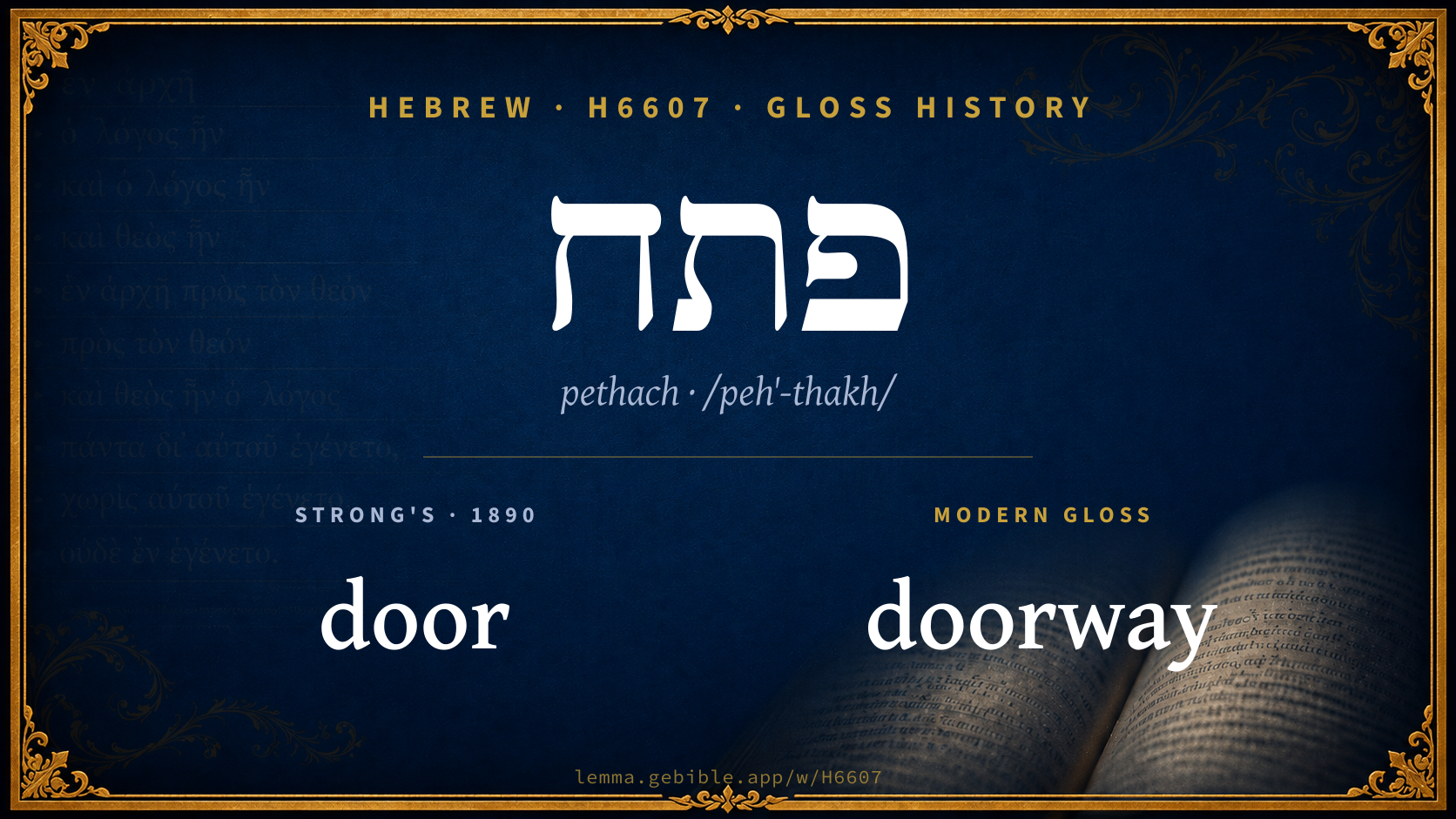
Gloss history
Strong's 1890 vs modern scholarship
About this word
Strong's H6607 catalogs a Hebrew word from the Hebrew Old Testament.
These counts are not copied from any lexicon or concordance. They are computed here, from the morphology-tagged Hebrew Old Testament. What Lemma adds →
- 154
- distinct verses
- The word appears in 154 distinct verses.
- 24 / 39
- OT books
- The word appears in 24 of 39 Old Testament books.
- #279
- by frequency
- Top 500 most frequent Hebrew words (rank 279 of 8,640 Hebrew words by occurrence).
View all 154 occurrences in the concordance →
By section of the Old Testament
By traditional corpus
Conventional, traditional groupings — biblical authorship is debated, so this is a traditional corpus grouping, not an authorship claim. Each share is this word’s portion of its verses in that division of the Hebrew canon. Each figure is a share of the word’s 154 distinct verses.
- Torah (Pentateuch) 72 verses · 47%
- Prophets (Nevi'im) 63 verses · 41%
- Writings (Ketuvim) 19 verses · 12%
How translations render this word
Counts come from each version’s own published word-to-Strong’s tagging or interlinear alignment — an approximate guide to how each version renders this word, not a word-level alignment the data otherwise carries. Because each total is that version’s own tagged count, the per-version totals vary from one another and need not match the appearance or distinct-verse counts above. These counts may also differ from a printed concordance because Lemma counts each distinctly tagged rendering and does not collapse phrase taggings into a single head-word total. This is a fixed set of word-tagged versions (KJV, ASV, BSB, ULT) and does not change with the reading translation you choose elsewhere. Each version’s license is shown beside its name below (and on Sources).
- King James Version: Door 99×, Entering 9×, Doors 8×
- American Standard Version: Door 88×, Entrance 19×, Doors 9×
- Berean Standard Bible: Entrance 107×, Door 14×, Doorway 13×
- unfoldingWord Literal Text: Entrance of 69×, Opening of 18×, Entrance 12×
King James Version Public Domain
Renders H6607 across 163 tagged occurrences — most commonly:
Plus 23 renderings that appear only once — usually multi-word phrases or single function words the recovered tagging swept in, not distinct renderings.
American Standard Version Public Domain
Renders H6607 across 162 tagged occurrences — most commonly:
Plus 28 renderings that appear only once — usually multi-word phrases or single function words the recovered tagging swept in, not distinct renderings.
Berean Standard Bible Public Domain
Renders H6607 across 157 tagged occurrences — most commonly:
Plus 9 renderings that appear only once — usually multi-word phrases or single function words the recovered tagging swept in, not distinct renderings. Not rendered by a distinct English word in 6 further occurrences.
unfoldingWord Literal Text CC BY-SA 4.0
Renders H6607 across 165 tagged occurrences — most commonly:
Plus other, less common renderings. Plus 13 renderings that appear only once — usually multi-word phrases or single function words the recovered tagging swept in, not distinct renderings.
Senses in BDB
The 1 sense BDB distinguishes for this word, in lexicon order (not ranked by frequency or importance). The full entry — with sub-senses — is in the Lexicon Entry tab.
- opening, doorway, entrance
Word origin
n.m. Ez 8:8 (f. 2 S 17:9 but We reads אַחַד for אַחַת, and so AlbrZAW xvi (1896), 86) opening, doorway, entrance;—abs. פ׳ Gn 4:7 +, פָּ֑תַח 19:11 +, הַפֶּ֫תְחָה v 6; cstr. פֶּתַח 18:1 +; sf. פִּתְחוֹ Pr 17:19, פִּתְחָהּ Ez 40:38; pl. פְּתָחִים 1 K 7:5; Pr 8:3; cstr. פִּתְחֵי ψ 24:7 +; sf. פְּתָחָ֑י Pr 8:34, etc.;—doorway of nomad’s tent, פ׳ הָאֹהֶל Gn 18:1, 2, 10 (J); Ex 33:8, 10(E); Nu 11:10; 16:27 (JE); Ju 4:20, cf. (without הָאֹהֶל) Gn 4:7 (in fig.), Jb 31:9, 34; of sacred tent, פ׳ הָאֹהֶל Ex 33:9, 10; 26:36; 36:37; 39:38 (P); Nu 12:5 (E); Dt 31:15, usually (P) פ׳ אֹהֶל מוֹעֵד Ex 29:4 + 6 times Ex + 40:6, 29 (פ׳ מִשְׁכַּן אֹהֶל מ׳), Lv 1:3 + 22 times Lv, Nu 3:25 + 11 times Nu, Jos 19:51; 1 S 2:22; cf. 1 Ch 9:21; פ׳ הַמִּשְׁכָּן Ex 35:15; cf. 40:5, 28 (all P); of court Nu 3:26 cf. 4:26 and (of temple) Ez 8:7; doorway of (private) house Gn 19:6, 11(×2) + 22 times, cf. Ct 7:14; in Pr 17:19 Frankenb Toy read פִּיו for פִּתְחוֹ; of temple 1 K 6:33; Ez 8:16, so פ׳ הַבַּית Ez 47:1; 2 Ch 4:22; פֵ׳ הַדְּבִיר 1 K 6:31, פ׳ הַצֵלָע v 8 Ez 41:11 cf. v 11(×2); pl. 1 K 7:5; various doorways in Ezek.’s temple Ez 40:13(×2) + 13 times 40–42 (v. also infr.); doorway of ark Gn 6:16 (P); of tower Ju 9:52; in wall Ez 8:8; opening (mouth) of cave 1 K 19:13; פ׳ הַשַּׁעַר opening, i.e. doorway, of gate Ez 40:11; of city פ׳ שַׁעַר הָעִיר, i.e. the outer aperture of the gate Jos 8:29; 20:4; Ju 9:35, 44; Je 1:15 (pl.), cf. 19:2; 1 K 22:10 = 2 Ch 18:9; 2 K 23:8; Pr 1:21; so פ׳ הַשַּׁעַר Ju 9:40; 2 S 10:8; 11:23; 2 K 7:3; 10:3, and (of farm or village) Ju 18:16, 17; so פ׳ הָעִיר 1 K 17:10; 1 Ch 19:6 (= 2 S 10:8 supr.), cf. Gn 38:14; pl. of city gates themselves (poet.) Is 3:26 (personif.), פ׳ נְדִיבִים 13:2; פִּתְחֵי עוֹלָם ψ 24:7, 9 (‖ שְׁעָרִים); cf. fig. שְׁמֹר פִּתְחֵי־פִיךָ Mi 7:5; also פ׳ שַׁעַר בֵּית י׳ Je 36:10; Ez 8:14; 10:19 cf. 8:3; 11:1; 40:4; 46:3, פ׳ שׁ׳ י׳ Je 26:10; פְּתָחֶיהָ Mi 5:6 of entrances to a country; fig. פ׳ תִּקְוָה Ho 2:17 doorway of hope.
— Brown-Driver-Briggs (Oxford 1906, public domain), digitized via Sefaria, supplemented by the OpenScriptures HebrewLexicon (CC BY 4.0). See Sources.
Derived from פתח (pâthach) (H6605) — to open.
Jastrow Dictionary
A second Hebrew/Aramaic lexicon for comparison, covering Aramaic and post-biblical (Talmudic, Targumic, Midrashic) usage that the biblical-Hebrew BDB does not. Matched by lemma rather than by Strong’s number, so a lemma may carry more than one Jastrow headword (shown separately below), and the entries cover usage well beyond the Bible.
פָּתַח
- (b. h.)
- 1. to open, begin. Y. Ber. VI, end, 10ᵈ על כל … שהיה פוֹתֵהַ וכ׳ over each cask as he opened it he said the benediction &c. Sabb. 104ᵃ, a. e. פּוֹתְחִין לו (Var. פְּתָחִין), v. טָמֵא I. Ib. 48ᵃ מתירין … אבל לא פותחין you may untie the neck-hole of a shirt, but not cut it open (on the Sabbath). Y. Taan. I, 64ᵇ top (ref. to Is. XLV, 8) כנקבה … פוֹתַחַת וכ׳ like the female that opens for the male. Ned. III, 4 לא יִפְתַּח לו בנדר he must not begin (offer his willingness) to make a vow (in order to escape robbery &c., v. נָדַר); a. v. fr.—Part. pass. פָּתוּחַ; פְּתוּחָה; pl. פְּתוּחִים, פְּתוּחִין; פְּתוּחוֹת. Yeb. 71ᵇ, a. e. נסתם הפ׳, v. סָתַם. Snh. 94ᵃ, v. סָתַם (v. מנצפ"ך). Meg. 3ᵃ, פ׳ באמצע, v. סָתַם. Erub. IV, 6 שלש חצירות הפ׳ זו לזו ופ׳ וכ׳ three courts opening into (communicating with) one another and into the publicroad; a. v. fr.—פתח פתוח, v. פֶּתַח.—Esp. (פרשה) פְּתוּחָה a paragraph in the Torah beginning with a new, indented line, opp. סתומה. Treat. Sof’rim I, 14 איזהו פ׳ כל שלא וכ׳ what is an open paragraph? Such as does not begin at the beginning of a line, וכמה … ותהא נקראת פ׳ and how much space must one leave … for a paragraph to be called open?; a. fr.—Trnsf. [to open the door to,] to introduce (into learning). Y. M. Kat. III, 83ᵇ top איזהו רבו כל שפ׳ לו תחלה who is called one’s (special) teacher? He who was the first to initiate him; a. e.—Esp. to open an opportunity for retracting a vow, to suggest reasons which, if known at the time, would have prevented the person from making the vow, v. חֲרָטָה. Ned. IX, 1 פותחין לאדם בכבוך וכ׳ the judges offer suggestions taken from the respect due to parents (saying, if you had known that this vow cast a reflection on your father &c.). Ib. רִפְתְּחוּ לו בכבוד המקום why not suggest to him the reverence due to the Lord (‘if you had known that he who makes a vow is considered an evil-doer &c.’)? Ib. 4 פותחין לו מן הכתוב וכ׳ we offer suggestions to him from what is written in the Law, saying to him, if you had known that (in fulfilling that vow) you would transgress the law forbidding revenge &c.; a. fr.—B. Kam. 27ᵃ פ׳ בכד וסיים בחבית the Mishnah begins with kad and closes with ḥabith! Ber. 10ᵃ פ׳ בה באשרי וכ׳, v. סוּם I h. Gen. R. s. 84 אתה פָתַחְתָּ תחלה בהצלת וכ׳ thou wast the first man to speak of saving life; אתה פתחת בתשובה וכ׳ thou wast the first to do repentance, … one of thy descendants shall rise and be the first (prophet) to call for repentance; a. fr.—Esp. to open a lecture with a (Biblical) text. Pesik. Aḥăré, p. 170ᵃ ר׳ לוי פ׳ וכ׳ R. Levi took up the text (Ps. LXXV, 5) &c. Gen. R. s. 1; a. v. fr.—Pesik. R. s. 33 [an editorial gloss] פ׳ בכל אלו הפרשיות the author takes his texts from all those (quoted) passages. e.g. Isaiah 45:8
- 2. to explain, speak plainly. Shek. V, 1; Men. 65ᵃ (ref. to פתחיה as identical with מרדכי) he was named Pethahia, שהיה פותח דברים ודורשן וכ׳ (not בדברים) because he explained words and interpreted them (etymologically) and knew seventy languages.—Part. pass. as ab. Sifré Aḥăré, beg., v. סָתַם.
- 1. to be opened. Yeb. 71ᵇ, a. e., v. סָתַם. R. Hash. 16ᵇ שלשה … נִפְתָּחִין בר"ה three books are opened (for recording) on the New Year’s Day. B. Bath. 125ᵇ, v. סוּם I, Nithpa. Pesik. R. l. c. להִיפָּתֵחַ to have one’s bowels opened, v. פְּסִיעָה; a. fr.—Ib. [editorial gloss] ונ׳ עוד שם בפרשת וכ׳ and furthermore this section (Is. LXI, 1) was used as the opening text; a. fr.—Esp. to have one’s eyes opened, to become seeing. Pesik. R. s. 42 כשילדה שדה כל סומא … נ׳ when Sarah gave birth, every blind person in the world was restored to sight; a. e. e.g. Isaiah 61:1
- 1. to open. Ib. פי׳ הפילקיות he opened the prisons. Par. III, 8 ועושין … ומְפַתְּחִין בה חלונות they piled wood in the shape of a tower and opened windows in it. Zeb. 88ᵇ רימונים שלא פִיתְּחוּ פיהן (Ms. K. a. R. 2 נִפְתְּחוּ; Ms. R. 1 נִתְפַּתְּחוּ, v. Rabb. D. S. a. l. note 5) pomegranates which have not yet burst open; a. e.
- 2. to engrave. Y. Ab. Zar. III, 43ᵇ bot פי׳ בה פיתוחים if he cut designs into it.
- 3. to dig, break ground. Pirké d’R. El. ch. XXVIII; Gen. R. s. 76 כשיצמד … יְפַתְּחוּ וישדדו וכ׳ when an ox and a cow are harnessed together, they will break and harrow all valleys.
- 1. to be opened, v. supra. Pesik. R. s. 31 נִתְפַּתְּחוּ בדם they (their cavities) were opened with (discharged) blood; a. e.
- 2. to be cut into, graven. Tosef. Sot. XV, 1; Y. ib. IX, 24ᵇ וכיון … היו מִתְפַּתְּחוֹת לפניו וכ׳ and when they let it (the Shamir, v. שָׁמִיר) look at the stones, they were engraven before it like the (wax-covered) tablets &c.—[Y. Kil. VII, beg. 30ᵈ מתפתחת R. S. to Kil. VIII, 1, v. פִּתְפֵּת.]
פְּתַח
- Targ. Deut. XV, 11. Targ. Is. XIV, 17; a. fr.—Part. pass. פְּתִיחַ; f. פְּתִיחָא; pl. פְּתִיחִין, פְּתִיחַיָּא; פְּתִיחָן a) open. Targ. Num. XIX, 15. Targ. Josh. VIII, 17; a. fr.—b) seeing, v. פְּתִיהַ.—Taan. 24ᵃ אתיא למִיפְתַּח … ולא מִיפְּתַח וכ׳ she came to open the door …, but it could not be opened on account of the wheat pressing against it. Gitt. 69ᵇ לִיפְתַּה הביתא וכ׳ let him open a keg of wine &c. B. Kam. 112ᵇ כגון דפָתְחוּ ליה בדיניה וכ׳ when they (the court) have opened his case (written a warrant, v. פְּתִיחָא II) and sent for him. Ned. 28ᵃ מיפתח הוא דלא יפתח וכ׳ he dare not offer to make oath (in order to escape robbery &c.), but make a vow, he may. Num. R. s. 9 תרעא דלא פתיח וכ׳, v. אָסֵי; a. fr.—Ned. 22ᵃ אע"ג דפ׳ … אנן לא פַתְחִינָן וכ׳ although R. Y. offered such a suggestion for retracting a vow, we must not do so; ולא פתחינן בהדא וכ׳ nor do we offer that other suggestion &c.; a. e.
- same. Lam. R. to I, 1 רבתי, beg. א׳ ליה ביתיה וכ׳ he opened his house to him, and he entered.
- same. Targ. Is. XLV, 1. Ib. XLII, 7.—Part. pass. מְפַתַּח open-eyed, able to see. Lev. R. s. 22 חד סמי וחד מפ׳ (Koh. R. to V, 8 פתיח) one was blind, and the other could see.
- 1. to be opened; to be released. Targ. O. Gen. III, 5; 7. Targ. Job XII, 14; a. fr.—Gitt. 69ᵃ bot. לאִיפַּתּוּחֵי וכ׳ (Rashi לפתיחי, read: לפַתּוּחֵי Pa.) that the boil may open, let somebody blow &c. Ib.ᵇ, v. צְפִירְתָּא; Pes. 42ᵇ; a. e.—Esp. to be restored to sight. Lev. R. l. c. דין דהוה סמי א׳ וכ׳ he who was blind recovered sight &c., v. סְמֵי; Koh. R. l. c. Ib. אִיתְפַּתְּחַת the she-ass recovered &c.; a. e.
פַּתָּח
- (פָּתַח Pi.
- 2. engraver. Pl. פַּתָּחִים. Y. Shek. IV, 48ᵃ top פַּתָּחֵי אבנים (Ms. M. מְפַתְּחֵי) stone engravers.
פִּתֵּחַ
- , v. פִּיתֵּחַ
פֶּתַח
- opening, door, gate. Keth. IV, 3 (ref. to Deut. XXII, 21) אין לה לא פ׳ בית האב וכ׳ if she (the faithless betrothed) has no paternal house door. Y. Sabb. VII, 9ᶜ top ניכר הוא … על פִּיתְחָהּ של תירה it can be seen that this man has never passed the gate of the Law (never studied). Koh. R. to III, 11 זה הפ׳ פתוח עד התהום this gate (verse used as introductory text, v. פָּתַח) opens to the deep, i.e. leads to deep reflection. Gen. R. s. 85 (ref. to פתח עינים, Gen. XXXVIII, 14) תלה עיניה בפ׳ שכל העינים וכ׳ she lifted up her eyes to the gate to which all eyes are directed (she prayed to the Lord). Gen. R. s. 38 פתח … פ׳ של תשובה the Lord opened to them the gate of repentance; a. fr.—Euphem. פ׳ פָּתוּחַ absence of virginity Keth. 9ᵇ טענת פ׳ פ׳, contrad. to טענת דמים, v. דָּם. Ib. 9ᵃ ופ׳ פ׳ כשני עדים דמי and the husband’s statement that lie found ‘the gate open’ is like a statement of two witnesses (to make her forbidden to him as a faithless betrothed); a. fr.—Trnsf. a) an opening for retracting a vow, a suggestion, v. פָּתַח. Gen. R. s. 91 למאה … מצא להם פ׳ for one hundred and fifty Nazarites he found causes for absolution; a. fr.—b) the starting time of menstruation. Arakh. II, 1 אין פ׳ בטועה וכ׳ for a woman that has lost the account of a prolonged flux, there is no new starting point within either less than seven or more than seventeen days. Ib. 8ᵃ פִּתְחָהּ שבעה עשר her sure starting point is after seventeen days; a. fr.—Pl. פְּתָחִים, פְּתָחִין. B. Bath. IX, 1 ישאלו על הפ׳ let them go begging at the doors; Keth. XIII, 3 יחזרו על הפ׳. Cant. R. to V, 2 פתחו לי פתח … ואני פותח לכם פ׳ וכ׳ make for me one opening for return as wide as the point of a needle, and I shall open for you gates through which wagons and coaches can pass; a. fr.—Ab. III, 18 פִּתְחֵי נדה the calculations concerning starting points of menstruants (v. supra). e.g. Deuteronomy 22:21
A Dictionary of the Targumim, the Talmud Babli and Yerushalmi, and the Midrashic Literature (Marcus Jastrow; London, Luzac, 1903) — Public Domain. Digitized via Sefaria. Digitized via Sefaria. Full attribution on Sources.
Forms in the corpus
The 54 distinct written forms H6607 takes in the Hebrew Bible, most frequent first — each parse links to that state’s occurrences in the concordance. Hebrew forms include their vowel points and cantillation, so a single lemma takes many written forms.
Same root — word family
Other BDB entries built from the same root as H6607, grouped by Strong’s listed origin. These share a root / origin per the lexicon — not necessarily a shared meaning. Each links to that word’s own entry.
Derives from
Shares the same root
- מפתח maphtêach H4668 key
- מפתח miphtâch H4669 opening
- פתוח pittûwach H6603 engraving
- פתח pᵉthach H6606 to open
- פתח pêthach H6608 opening
- פתחה pᵉthichâh H6609 sword
- פתחון pithchôwn H6610 opening
Proper names from this root
People and places named from this root — a name, not an additional meaning of the word.
- יפתח Yiphtâch H3316 Jephthah
- יפתחאל Yiphtach-ʼêl H3317 Jiphthah-el
- נפתוח Nephtôwach H5318 Nephtoah
- פתחיה Pᵉthachyâh H6611 Pethahiah
Compare all same-root words → Showing 4 of 13 — not the complete family. 4 of the same-root words are proper names (people or places). They share a root, not necessarily a meaning.
Septuagint verse parallels
This word appears in 146 verses that also exist in the Greek Old Testament (Septuagint), out of the 154 Hebrew verses it occurs in. You can read those verses in Greek by switching the Old Testament edition to the Septuagint.
Read these verses in the Septuagint
- Genesis 4:7
- Exodus 12:22
- Leviticus 1:3
- Numbers 3:25
- Deuteronomy 22:21
- Joshua 8:29
- Judges 4:20
- 1 Samuel 2:22
- 2 Samuel 10:8
- 1 Kings 6:8
- 2 Kings 4:15
- 1 Chronicles 9:21
This is a verse-level parallel only — the same verses exist in both the Hebrew and Greek Old Testaments. No word-level Hebrew↔Greek correspondence is claimed: the data carries no such alignment, so no Greek word is shown as this Hebrew word’s translation. Coverage is not total — the Septuagint omits the deuterocanon and renumbers the Psalms, so some Hebrew verses have no direct Greek parallel.