
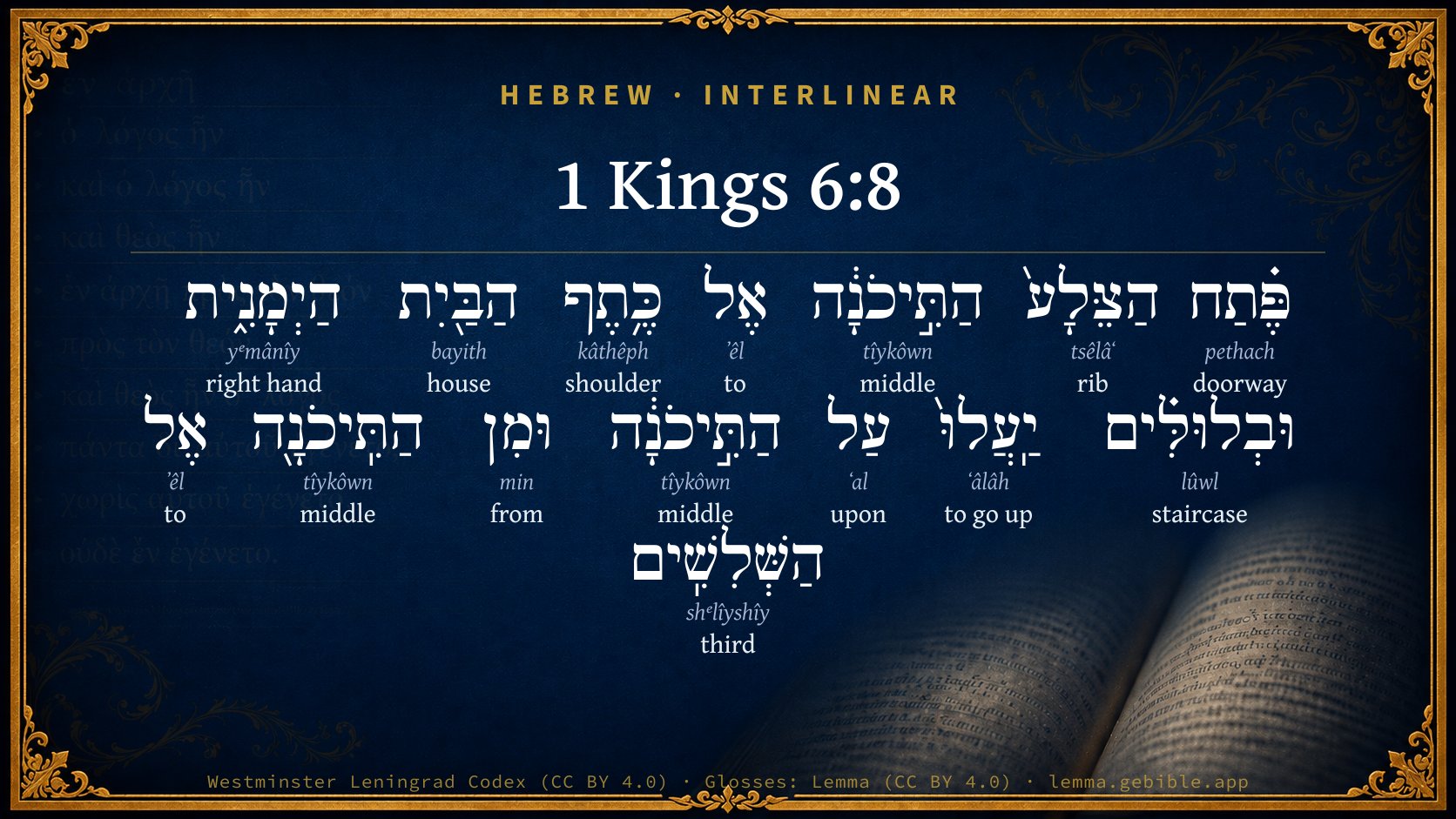
1 Kings 6:8

Hebrew (Westminster Leningrad Codex) 1 Kings 6:8 appears in the Hebrew Old Testament. The text above is from the Westminster Leningrad Codex. Each word links to its Strong’s number, a concise gloss, and parsing drawn from the Open Scriptures Hebrew Bible morphology. Click any word for its full Brown-Driver-Briggs (BDB) entry.
Download image
Cite this verse

1 Kings 6:8 (World English Bible). Public Domain. Lemma interlinear Bible study tool, https://lemma.gebible.app/v/1-kings/6/8.

Show BibTeX & RIS
BibTeX
RIS
English Translation
The door for the middle side-chambers was in the right side of the house: and they went up by winding stairs into the middle [story], and out of the middle into the third.
World English Bible · Public Domain
Highlights
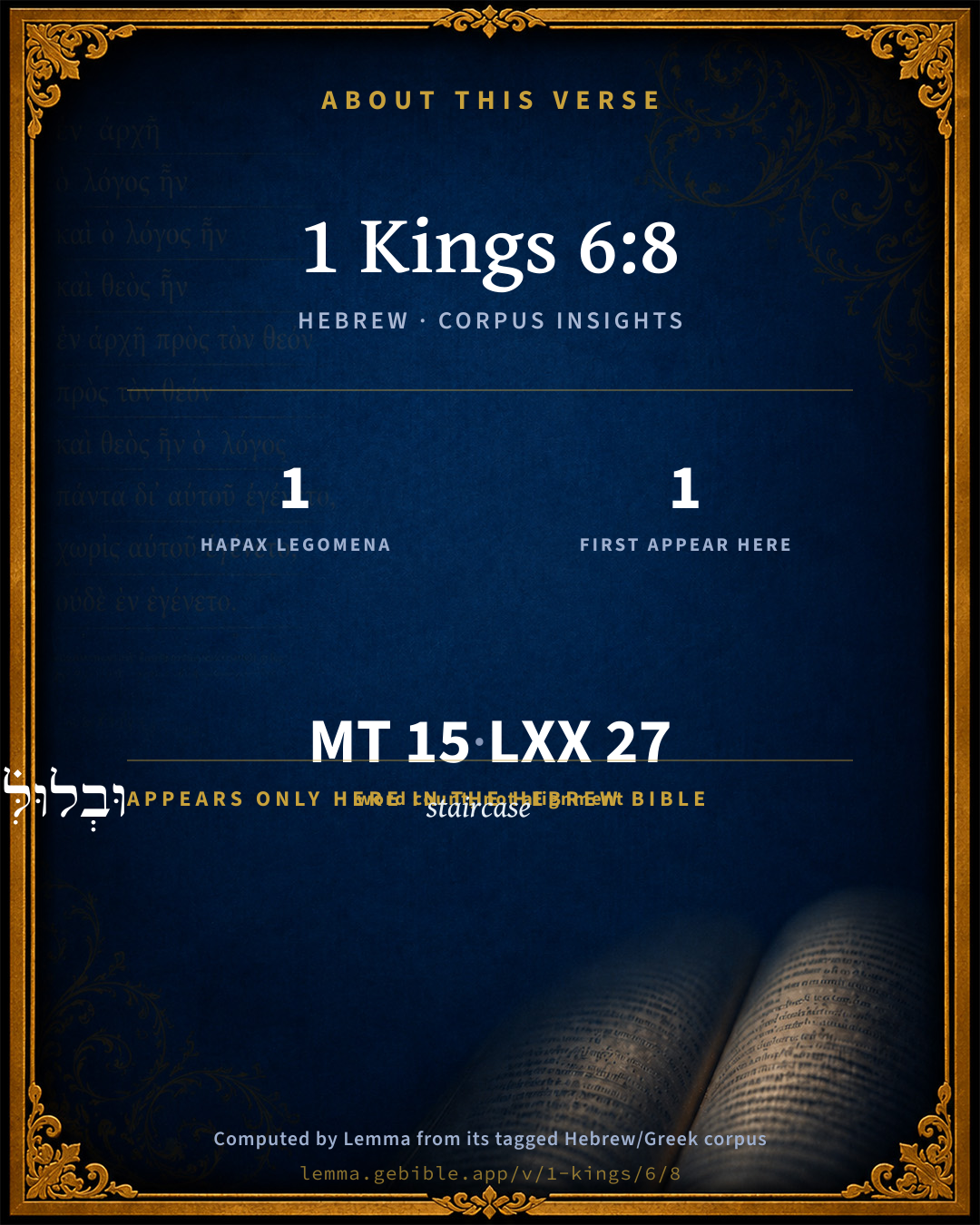
  • 1 hapax legomenon — only here in the Hebrew Bible
  • 1 first appearance in the Hebrew Bible
Full analysis ↓
Download a study sheet

One document with this verse’s original text, its word-by-word gloss line, the meaning frame, cross-references with their text, attributed commentary, and full source and license credits — printable, and it pastes into notes with its structure intact.

This verse Autodidact and up

Study sheet (.html) Plain text (.txt)

A passage Seminary Student

Up to 50 verses in one chapter. A passage sheet keeps up to 6 commentary sources and 12 cross-references per verse, in the order this page ranks them, and says so on the sheet whenever that leaves anything out. Ask for a single verse and you get the Autodidact verse sheet above.

Everything on this page stays free to read, with no account — the sheet is a download of what is already on screen, not access to it.

Want to remove ads? Support Godless Engineer
Compare translations 3

The same verse in 3 English versions, stacked beneath the original-language interlinear above. Click any original word for its lexicon entry.

Each is an independent rendering of the whole verse — the interlinear is not word-aligned to these translations.

Highlighted words mark where these versions differ — a whole-verse word diff, not a word-by-word alignment.

  • World English Bible Public Domain
    The door for the middle side-chambers was in the right side of the house: and they went up by winding stairs into the middle [story], and out of the middle into the third.
  • King James Version Public Domain
    The door for the middle chamber was in the right side of the house: and they went up with winding stairs into the middle chamber, and out of the middle into the third.
  • unfoldingWord Literal Text CC BY-SA 4.0
    The entrance of the middle chamber to the shoulder of the house the right, and they went up by stairs onto the middle, and from the middle to the third.

unfoldingWord Literal Text — © unfoldingWord, licensed CC BY-SA 4.0. Word-aligned USFM3 via Door43 (git.door43.org/unfoldingWord/en_ult).

Versions to compare (up to 4)

3 of 4 selected

Show all 18 translations

Every available English version of this verse, each an independent rendering of the whole verse.

  • World English Bible Public Domain
    The door for the middle side-chambers was in the right side of the house: and they went up by winding stairs into the middle [story], and out of the middle into the third.
  • Berean Standard Bible Public Domain
    The entrance to the bottom floor was on the south side of the temple. A stairway led up to the middle level, and from there to the third floor.
  • Majority Standard Bible Public Domain
    The entrance to the bottom floor was on the south side of the temple. A stairway led up to the middle level, and from there to the third floor.
  • King James Version Public Domain
    The door for the middle chamber was in the right side of the house: and they went up with winding stairs into the middle chamber, and out of the middle into the third.
  • American Standard Version (1901) Public Domain
    The door for the middle side-chambers was in the right side of the house: and they went up by winding stairs into the middle `story', and out of the middle into the third.
  • Revised Version (1885) Public Domain
    The door for the middle side-chambers was in the right side of the house: and they went up by winding stairs into the middle chambers, and out of the middle into the third.
  • Geneva Bible (1599) Public Domain
    The doore of the middle chamber was in the right side of the house, and men went vp with winding stayres into the middlemost, and out of the middlemost into the third.
  • Douay-Rheims (1899) Public Domain
    The door for the middle side was on the right hand of the house: and by winding stairs they went up to the middle room, and from the middle to the third.
  • Young's Literal Translation Public Domain
    The opening of the middle side `is' at the right shoulder of the house, and with windings they go up on the middle one, and from the middle one unto the third.
  • Literal Standard Version CC BY-SA 4.0
    The opening of the middle side [is] at the right shoulder of the house, and with windings they go up on the middle one, and from the middle one to the third.
  • Unlocked Literal Bible CC BY-SA 4.0
    On the south side of the temple there was an entrance at the ground level, then one went up by stairs to the middle level, and from the middle to the third level.
  • unfoldingWord Literal Text CC BY-SA 4.0
    The entrance of the middle chamber to the shoulder of the house the right, and they went up by stairs onto the middle, and from the middle to the third.
  • Darby Bible Public Domain
    The entrance to the side-chambers of the middle [floor] was in the right side of the house; and they went up by winding stairs into the middle [floor], and out of the middle into the third.
  • World Messianic Bible Public Domain
    The door for the middle side rooms was in the right side of the house. They went up by winding stairs into the middle floor, and out of the middle into the third.
  • Webster's Bible Public Domain
    The door for the middle chamber was in the right side of the house: and they went up with winding stairs into the middle chamber, and out of the middle into the third;
  • Free Bible Version CC BY-SA 4.0
    The entrance to the ground floor was on the south side of the Temple. Stairs led to the first floor, and then on to the second floor.
  • Bible in Basic English Public Domain
    The door to the lowest side rooms was in the right side of the house; and they went up by twisting steps into the middle rooms, and from the middle into the third.
  • JPS Tanakh (1917) Public Domain
    The door for the lowest row of chambers was in the right side of the house and they went up by winding stairs into the middle row, and out of the middle into the third.

Literal Standard Version (2020), Covenant Press — licensed CC BY-SA 4.0. Text via the HelloAO Bible API (eBible.org). Unlocked Literal Bible (unfoldingWord) — licensed CC BY-SA 4.0. Text via the HelloAO Bible API (eBible.org). unfoldingWord Literal Text — © unfoldingWord, licensed CC BY-SA 4.0. Word-aligned USFM3 via Door43 (git.door43.org/unfoldingWord/en_ult). Free Bible Version, Dr. Jonathan Gallagher — licensed CC BY-SA 4.0. Text via the HelloAO Bible API (eBible.org).

Word by word

More ways to search: Search by grammar → Find every occurrence → Compare this word →

Practice this passage: Drill this verse → Learn its vocabulary →

וּבְלוּלִּ֗ים
lûwl
H3883
“and · in/at · staircases”
Conjunction + Preposition + Noun, Common, Masculine, Plural, Absolute
Part of Speech
Conjunction + Preposition + Noun
Type
Common
Gender
Masculine
Number
Plural
State
Absolute
Full BDB Definition

Origin: from an unused root meaning to fold back

TWOT: 1094

staircase, winding stair, shaft or enclosed space with steps or ladder
  1. פֶּ֗תַח pethach H6607 “doorway of” Noun, Common, Masculine, Singular, Construct
  2. הַצֵּלָע֙ tsêlâʻ H6763 “the · rib” Particle, Definite Article + Noun, Common, Both, Singular, Absolute
  3. הַתִּ֣יכֹנָ֔ה tîykôwn H8484 “the · middle” Particle, Definite Article + Adjective, Adjective, Feminine, Singular, Absolute
  4. אֶל ʼêl H413 “to” Preposition
  5. כֶּ֥תֶף kâthêph H3802 “shoulder of” Noun, Common, Feminine, Singular, Construct
  6. הַבַּ֖יִת bayith H1004 “the · house” Particle, Definite Article + Noun, Common, Masculine, Singular, Absolute
  7. הַיְמָנִ֑ית yᵉmânîy H3233 “the · right hand” Particle, Definite Article + Adjective, Adjective, Feminine, Singular, Absolute
  8. יַֽעֲלוּ֙ ʻâlâh H5927 “to go up” Verb, Qal, Imperfect, 3rd Person, Masculine, Plural
  9. עַל ʻal H5921 “upon” Preposition
  10. הַתִּ֣יכֹנָ֔ה tîykôwn H8484 “the · middle” Particle, Definite Article + Adjective, Adjective, Feminine, Singular, Absolute
  11. וּמִן min H4480 “and · from” Conjunction + Preposition
  12. הַתִּֽיכֹנָ֖ה tîykôwn H8484 “the · middle” Particle, Definite Article + Adjective, Adjective, Feminine, Singular, Absolute
  13. אֶל ʼêl H413 “to” Preposition
  14. הַשְּׁלִשִֽׁים shᵉlîyshîy H7992 “the · third” Particle, Definite Article + Adjective, Ordinal number, Masculine, Plural, Absolute

About this verse

These counts appear in no published source. They are computed here, from the morphology-tagged text and Lemma’s own curated glosses. What Lemma adds →

15
words
12
distinct lemmas
Historical
section

Notable vocabulary

1 hapax legomenon — a word that appears only here in the entire Hebrew Bible:

  • וּבְלוּלִּ֗ים staircase H3883

First appearance in Scripture

This word makes its first canonical appearance in the Hebrew Bible here:

  • וּבְלוּלִּ֗ים staircase H3883

Shared distinctive vocabulary

הַתִּ֣יכֹנָ֔ה middle H8484 occurs in 9 verses of the Hebrew Bible. Also found in:

Grammatical profile

  • 1 verb
  • 5 nouns
  • 5 adjectives
  • 4 prepositions

Verb forms

  • יַֽעֲלוּ֙ Qal · Imperfect

Repetition

Words recur within this verse — often emphatic in Hebrew:

  • הַתִּ֣יכֹנָ֔ה middle H8484 ×3
  • אֶל to H413 ×2

Hebrew & Septuagint length

In English translation the verse runs 33 words from the Hebrew and 33 from the Septuagint (LXX English) — the same length.

A rough comparison of the two English renderings, which tokenize alike — not a word-level alignment.

Word counts can differ between the Hebrew and the Greek without any difference in meaning — e.g. the Hebrew direct-object marker אֵת has no separate Greek word, and Greek often adds the article ὁ.

In the original languages it is 15 Hebrew tokens and 27 Greek tokens — but the two are counted differently (Hebrew bundles its prefixes and suffixes into one token; the Greek is in lemma form), so that isn’t a like-for-like length.

Cross-references

1

Topical passages linked to 1 Kings 6:8 in the Treasury of Scripture Knowledge — connected by theme and wording, ordered by reader-vote popularity; previews shown in the World English Bible.

  • Ezekiel 41:6–7 The side-chambers were in three stories, one over another, and thirty in order; and they entered into the wall which belonged to the house for the side-chambers round about, that they might have hold [therein], and not have hold in the wall of the house.

Cross-references courtesy of OpenBible.info (CC BY 4.0).

Hebrew and Greek witnesses Masoretic Hebrew ↔ Greek Septuagint

The same verse in the two great witnesses to the Old Testament, shown verse-for-verse.

These are two independent witnesses, not word-aligned to each other, and the Septuagint is shown in lemma (dictionary) form.

Hebrew 1 Kings 6:8 Masoretic · Westminster Leningrad Codex

פֶּ֗תַח הַצֵּלָע֙ הַתִּ֣יכֹנָ֔ה אֶל כֶּ֥תֶף הַבַּ֖יִת הַיְמָנִ֑ית וּבְלוּלִּ֗ים יַֽעֲלוּ֙ עַל הַתִּ֣יכֹנָ֔ה וּמִן הַתִּֽיכֹנָ֖ה אֶל הַשְּׁלִשִֽׁים

The door for the middle side-chambers was in the right side of the house: and they went up by winding stairs into the middle [story], and out of the middle into the third.

World English Bible · Public Domain

Greek LXX 1 Kings 6:8 Septuagint · lemma form

καί ὁ πυλών ὁ πλευρά ὁ ὑποκάτωθεν ὑπό ὁ ὠμία ὁ οἶκος ὁ δεξιός καί ἑλικτός ἀνάβασις εἰς ὁ μέσος καί ἐκ ὁ μέσος ἐπί ὁ τριώροφος

And the porch of the under side was below the right wing of the house, and there was a winding ascent into the middle chamber, and from the middle to the third story.

LXX2012 (modern English Septuagint) · Public Domain

On this verse, The Cambridge Bible for Schools and Colleges discusses the Septuagint’s reading. Read the note in Commentary ↓

Hebrew: Westminster Leningrad Codex (CC BY 4.0). Greek: Septuagint (public domain); English from LXX2012 (modern English Septuagint) (Public Domain). How the Septuagint differs from the Hebrew →

Targum (Aramaic paraphrase)

1

The Targum is the ancient Jewish Aramaic paraphrase of the Hebrew Scriptures — an interpretive translation, not the Hebrew text itself. Onkelos (literal) and Pseudo-Jonathan (expansive) render the Torah, and Jonathan the Prophets. Coverage is partial: where no permissively-licensed English translation exists for a verse, only the Aramaic is shown. This is verse-level text, not a word-by-word alignment to the Hebrew.

  1. Targum Jonathan Prophets (Joshua–Malachi)
    תַּרְעָא דִמְחִיצָתָא אַרְעִיתָא פְּתִיחַ לְעִבַּר בֵּיתָא מִיָמִינָא וּבִמְסִבָּתָא סַלְקִין מִן אַרְעִיתָא לְעִילִיתָא בְּאוֹרַח מְצִיעֵיתָא:

    (no public-domain English translation for this verse)

    Targum Jonathan — Aramaic: “Mikraot Gedolot” (public domain). English: “Sefaria Community Translation” (CC0 1.0 (public-domain dedication)); “London "Chaldee Paraphrase," 1871” (public domain). Text via Sefaria.

Commentary

Notes on 1 Kings 6:8 from classic Christian and Jewish commentators (each source and its license shown beneath its notes). The classic Christian expositions comment on the surrounding passage and are grouped to its opening verse, so a note may address several verses; the Jewish commentaries on the Tanakh (Rashi and others) are per-verse, so they appear only where the commentator wrote on this verse.

Lemma curates 59 commentaries, every one of them public domain or Creative Commons licensed, each selected and text-cleaned for this edition rather than reprinted as found. About our sources →

Trapp's Complete Commentary

John Trapp

1Ki 6:8 The door for the middle chamber [was] in the right side of the house: and they went up with winding stairs into the middle [chamber], and out of the middle into the third.

Ver. 8. And they went up with winding stairs.] We must also aspire to perfection: there should be continual ascensions in our hearts, neither may we rest till we have set our feet upon the battlements of heaven. See St Paul’s eagerness, Php 3:12-14.

John Trapp, A Commentary or Exposition upon All the Books of the Old and New Testament (1647–1656) — public domain. Text from a community e-Sword module.

Joseph Benson's Commentary

1Ki 6:8. The door for the middle chamber — That is, by which they entered to go up into the middle row of chambers; was in the right side — That is, in the south side, called the right side, because, when a man looks toward the east, the south is on his right hand. There was another door on the left, or the north side, leading to the chambers on that side. They went up with winding stairs — Without the wall, leading up to the gallery, out of which they went into the several chambers. Into the middle chamber — Or, rather, into the middle story, or row of chambers; and so in the following words, out of the middle story: for these stairs could not lead up into each of the chambers, nor was it needful, but only into the story, which was sufficient for the use of all the chambers.

Joseph Benson's Commentary on the Old and New Testaments (1811–1818) — public domain. Text from a community e-Sword module.

Geneva Bible (1599)

Geneva Bible translators

Or, Gallery.

Geneva Bible (1599) marginal notes — public domain. Text via Bolls.life.

The Cambridge Bible for Schools and Colleges

gen. ed. J. J. S. Perowne

8. The door for the middle chamber] R.V. middle side-chambers. The LXX. and Targum here give ‘lowest’ instead of ‘middle;’ doubtless because otherwise there is no mode of access to the lower side-chambers specified. The manner of reaching the middle story is sufficiently indicated in the next clause. On the contrary the compiler of Kings may have considered that there was no need to mention any entrance to the lower row of chambers. That would be a matter of course, and there may have been more than one, but the place and way of reaching the other two flights of rooms did need notice. There may also have been some access from the lowest side chambers into the Temple, if these chambers were used for storing the sacred oil and other provisions for the service.

in the right side of the house] The word rendered ‘side’ is literally shoulder, and may indicate that part of the building nearest the porch, which would be considered the face of the Temple.

The Cambridge Bible for Schools and Colleges (gen. ed. J. J. S. Perowne; Cambridge University Press, 1878–1918) — public domain. Text from a community e-Sword module.

John Gill's Exposition

The door of the middle chamber was in the right side of the house,.... The south side of it:

and they went up with winding stairs into the middle chamber; which were outside the chambers, and which winded about for the sake of taking up less room, and which led up to the door of the middle chamber, on the south of which they went into it; according to the Vulgate Latin and Tigurine versions, they went up in the forth of a cockle, or the shell of a snail; in like manner as was the ascent of the temple of Pan at Alexandria, as Strabo (u) relates:

and out of the middle into the third; the third chamber, and by winding stairs up to that; and the like might be on the north side, though not expressed, and on the west: the Jews say (w), that in the second temple, these winding stairs went from the northeast to the northwest, whereby they went up to the roof of the chambers, and so to the south and west; with this compare Eze 41:7; and which may represent the windings and turnings of God's people in this present state, their many afflictions and tribulations, through which they pass from one state to another.

(u) Geograph. l. 17. p. 547. (w) Misn. Middot, c. 4. sect. 5. See Lightfoot's Prospect of the Temple, &c. c. 12. p. 1071.

John Gill's Exposition of the Whole Bible (1746–1763) — public domain (CC PDM 1.0). Text via the HelloAO Bible API.

Albert Barnes' Notes on the Bible

The door for the middle chamber - i. e., the door which gave access to the mid-most “set of chambers.” The chambers on the ground-floor were possibly reached each by their own door in the outer wall of the lean-to. The middle and upper floors were reached by a single door in the right or south wall, from which a winding staircase ascended to the second tier, while another ascended from the second to the third. The door to the stairs was in the outer wall of the building, not in the wall between the chambers and the temple. That would have desecrated the temple far more than the insertion of beams.

Albert Barnes' Notes on the Bible (1834–1885) — public domain. Text from a community e-Sword/MySword module.

Haydock's Catholic Bible Commentary

Middle side. Septuagint, "lower story." (Calmet) --- "The door of the lower story (rib or side, Greek: pleuras; Chaldean, the lower appendage) was under the right wing of the house, and a winding staircase led to the middle, and from the middle to the third story. (Haydock) --- This sense is very clear. Hebrew intimates that the staircase was round like a screw, and was formed in the wall, at one end of the rooms. --- Right hand of those who entered the temple, or on the north; though the south is commonly thus designated. The doors opened into the porch, as the temple was not to be made a thoroughfare. (Calmet)

George Leo Haydock (1774–1849), Haydock's Catholic Family Bible and Commentary, 1859 edition — public domain. Excludes Psalms (Douay-Rheims chapter numbering differs from Protestant) and Deuterocanonical books (Catholic canon only).

Matthew Poole's English Annotations

The door for the middle chamber, i.e. by which they entered to go up to the middle chamber or chambers, to wit, such as were in the middle story.

In the right side, i.e. in the south side, called the right side here, and in the Hebrew text, Psa 89:12, and in other authors; because when a man looks towards the east, or sun-rising, which is esteemed the most glorious part of the heavens, and to which men most frequently look for divers reasons, the south is on his right hand; whereby it is implied that there was another door on the left, or the north side, leading to the chambers on that side, though for brevity sake it be not mentioned here.

With winding stairs; which were either,

1. Within the thickness of the temple wall, as many think; which is not probable, as tending to the great weakening of the wall; especially in the upper parts, where the wall was much narrower. And if such care was taken to preserve the walls entire and unbroken, that there might not be small holes made into it for the fastening of the beams of the chambers, 1Ki 6:6, it seems very absurd and incredible that there should be made such great breaches within them, as the stairs would require. Or rather,

2. Without the wall, and without the chambers too, as leading up to the gallery out of which they went into the several chambers.

Into the middle chamber, or rather, into the middle story, or row of chambers, and so in the following words, out of the middle story; for these stairs could not lead up into each of the chambers, nor was it needful or convenient it should do so, but only into the story, which was sufficient for the use of all the chambers.

Matthew Poole's English Annotations on the Holy Bible (1683–1685) — public domain. Text from a community e-Sword/MySword module.

Whedon's Commentary on the Bible

Daniel D. Whedon

8. The door for the middle chamber was in the right side — The middle chamber of the lower story is here meant. The right side of the house would be the south side, and is to be understood of a person facing the same way as the temple, namely, the east. So far as the scripture text gives us any information, this one door in the south side seems to have been the only entrance into all of the side-chambers. (D in plan.)

They went up — That is, persons who entered the upper stories went up these stairs.

Winding stairs — Marked s in plan.

Middle — That is, the middle chamber of the middle story.

Out of the middle into the third — Out of the middle chamber of the middle story into the middle chamber of the third story. So the staircase was not on the outside of the house, as is usual in the East, but on the inside. No mention is made of windows in the side-chambers, but this is naturally inferred from 1Ki_6:4, where see note.

Daniel D. Whedon (gen. ed.), Commentary on the Old and New Testaments (1874–1909) — public domain. Text from a community e-Sword module.

The Pulpit Commentary

After recording this interesting and singular fact, the historian resumes his description of the side building. The door or entrance, doorway, jtp as in ver. 31 for Heb. of the middle chamber generally understood to mean "the middle side chamber of the lower story." But this is by no means necessary, for

(1) lxe may signify the suite of rooms, i.e., the entire story or flat, as well as a single lean to or compartment, and

(2) hnko yTih is used in the next clause of the middle story. This has led Thenius, Keil, Ewald, Bahr, al. to substitute jnTj (following the LXX and Targum), which would give the sense of lower story" (as in Eze_41:7) Bahr says this "must necessarily be read." That this emendation has much in its favour must be allowed, but it seems also certain that we get a perfectly clear meaning from the text as it stands, viz., that "the door (leading to) the middle floor was (on the ground floor) on the right side," etc. It is hardly likely that all the compartments on the ground floor had only one approach, and the doors which communicated with them may well have been passed over as requiring no special notice. But the historian feels it necessary to state how the second and third stories were reached, and the staircase which led to them causes him to speak of the position of the door which opened upon it was in the right side Heb. shoulder. This word (ptK) almost implies that the door was in the external wall of the side structure, not in the wall of the holy place (as Bottcher, al. ) The fact that the floor joists were not inserted into the temple walls, as being inconsistent with the dignity of the sanctuary, makes it almost a certainty that there was no direct communication between the building and its dependance. It is very improbable that the walls of the house were anywhere broken through. The "right side" was the south side, (1Ki_7:39) i.e., the right, not as one faced the oracle, but, like the building, faced east. What was the exact position of the door, whether in the centre, or at either angle, it is impossible to say of the house: and they went up with winding stairs is only found here and in 2Ch 3. The staircase was obviously unlike those of most Eastern buildings, within the side structure. Even if the outer wall was five cubits thick, of which we have no proof, it is very doubtful whether the staircase would or could be constructed within it into Heb. upon the middle Chamber or story, and out of the middle into the third.

The Pulpit Commentary (1880–1919), ed. H.D.M. Spence-Jones & Joseph S. Exell — public domain. Text from a community e-Sword module.

John Wesley's Explanatory Notes

The door - That is, by which they entered to go up to the middle chamber or chambers; such as were in the middle story. Right side - That is, in the south-side, called the right side; because when a man looks towards the east, the south is on his right hand. There was another door on the left, or the north-side, leading to the chambers on that side. Winding stairs - Without the wall, leading up to the gallery out of which they went into the several chambers. Middle chamber - Or rather, into the middle story, or row of chambers; and so in the following words, out of the middle story: for these stair's could not lead up into each of the chambers; nor was it needful, but only into the story, which was sufficient for the use of all the chambers.

John Wesley, Explanatory Notes Upon the Whole Bible (1754–1765) — public domain. Text via the GEBible commentary corpus.

Rashi

Rabbi Shlomo Yitzchaki (Rashi)

The entrance of the bottom chamber was in the right side of the house. [Targum] Yonoson rendered תיכונה as the “bottom,” and not as “between” the upper and lower [ones], because the five chambers on the southern side had an opening to the outside in the bottom story. And this (is the meaning) “and by a winding stairway they went up to the middle [chamber].”

The bottom. [Targum] Yonoson rendered “the middle,” because these chambers were not open to the outside. There were three openings to each. Thus is this taught in Maseches Midos, “One was to the chamber on the right and one was to the chamber on the left and one to the chamber above.” And it teaches us here that one of the lower [chambers] on the southern wall had an opening to the outside and through that opening they entered all the chambers. And the “middle chamber” of the verse, is not the middle one between the upper and the lower [ones], but the middle one of the five chambers on the southern side which had an opening to the outside in the bottom story. And this is the meaning of, “and by a winding stairway they went up to the middle [chamber],” which was above it, signifying that the תיכונה chamber was below.

And by a winding stairway. [Targum] Yonoson rendered, a winding staircase [=מסיבתא], and that is called in our language [O.F.] vis, and in German, vindelstein, and the commonly used name is schvindel stieg. It is a structure of stone pillars made [in the form] of many stairs, and one who goes on them is likened to one spiraling around a column, ascending many amohs on it without needing the inclination of an ordinary ladder, because its spiral serves as its incline.

To the third. [שלישים means the same] as to the third [=שלישיים]

Rashi on the Tanakh — English translations: “The Judaica Press complete Tanach with Rashi, translated by A. J. Rosenberg” (CC BY 4.0); “Pentateuch with Rashi's commentary by M. Rosenbaum and A.M. Silbermann, 1929-1934” (public domain); “The Metsudah Tanach series, Lakewood, N.J” (CC BY 4.0); and “The Book of Joshua, Metsudah Publications, 1997” (CC BY 4.0). Text via Sefaria.

Lesson kit

Teaching starters — assembled from the data on this page, not authored interpretation. Every prompt links to the verse data it draws on. Edit before teaching.

1 Kings, in the Historical, opens this verse with 15 words (12 distinct Hebrew lemmas). Its most distinctive word is lûwl (“staircase”). A historical commentator’s framing appears above. Read the whole chapter for the surrounding context.

Discussion questions

  1. The word lûwl carries the sense “staircase.” How does it shape the verse?
  2. 1 word here appears nowhere else in the Hebrew Bible. Why might the author reach for such rare wording?
  3. This is the first place “staircase” appears in Scripture (first appears here). What does its debut here establish?
  4. How does Exodus 26:28, which shares the word «middle», read alongside this verse?
  5. What does the repetition of “middle” (3× in this one verse) do in this verse?
  6. These translations render this verse differently. What is at stake in choosing one wording over another?
  7. «יַֽעֲלוּ֙» is a Qal Imperfect verb. How does that grammatical form shape the action described?
  8. Compare how Trapp's Complete Commentary and Joseph Benson's Commentary read this verse. Where do they agree or differ?

Things to notice

  • 1 word in this verse appears nowhere else in the Hebrew Bible.
  • 1 word makes its first canonical appearance in Scripture here.
  • This verse counts 15 Hebrew ↔ 27 Greek words.
  • These translations choose different wording for 11 words in this verse.
  • “middle” occurs 3× in this single verse.

Reading settings

Reading text

Shown beneath each verse's original-language words.

Old Testament
Old Testament edition

Read the OT as the Masoretic Hebrew (MT) or the Greek Septuagint (LXX).

English shown for the Greek Septuagint (in the Hebrew ↔ Greek comparison).

Comparing translations? Open the Compare panel on any verse page to stack up to four side by side.