Song of Solomon 7:13

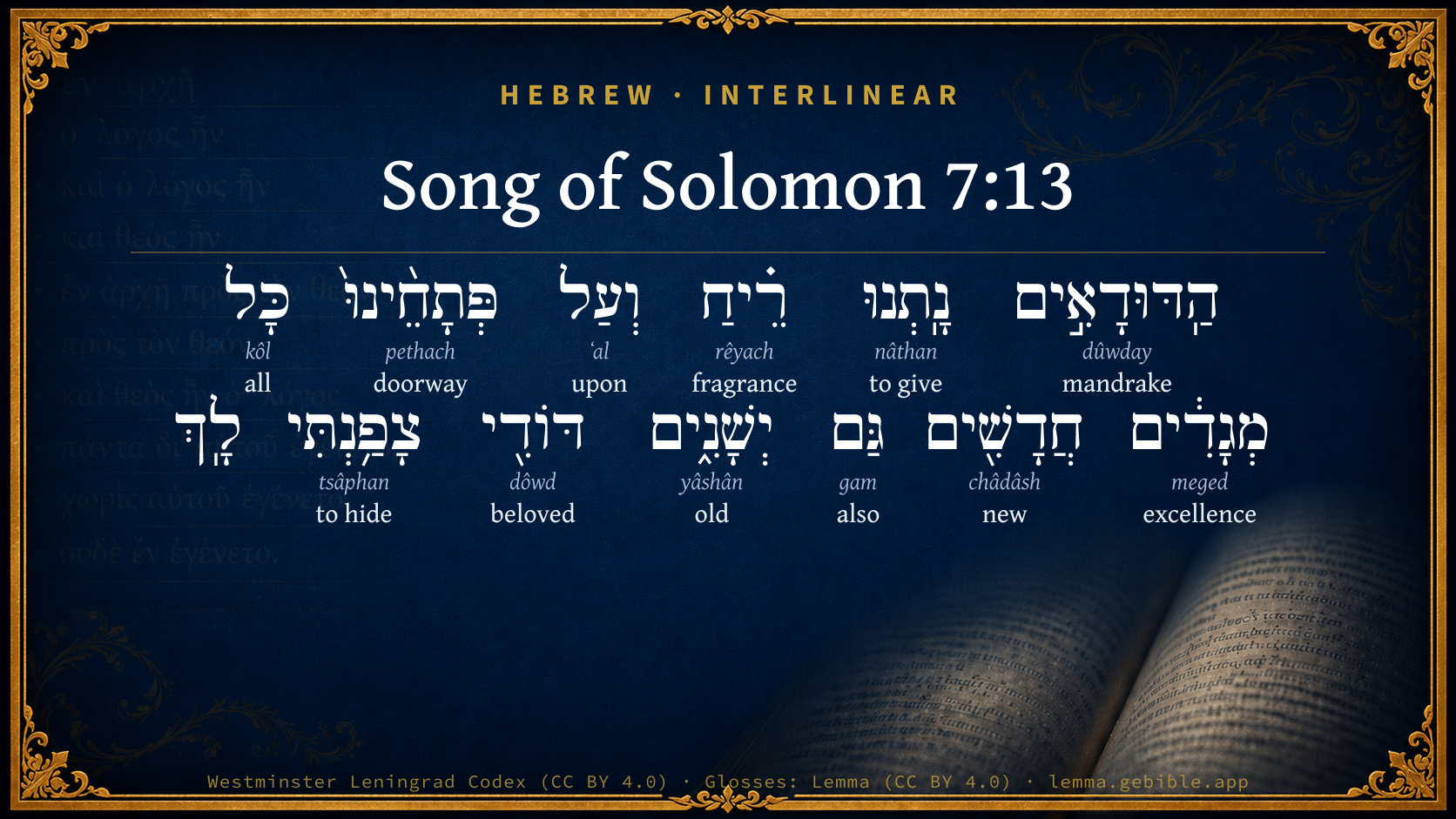
Hebrew (Westminster Leningrad Codex) Song of Solomon 7:13 appears in the Hebrew Old Testament. The text above is from the Westminster Leningrad Codex. Each word links to its Strong’s number, a concise gloss, and parsing drawn from the Open Scriptures Hebrew Bible morphology. Click any word for its full Brown-Driver-Briggs (BDB) entry.
Download image
Cite this verse

Song of Solomon 7:13 (World English Bible). Public Domain. Lemma interlinear Bible study tool, https://lemma.gebible.app/v/song-of-solomon/7/13.

Show BibTeX & RIS
BibTeX
RIS
English Translation
The mandrakes give forth fragrance. At our doors are all kinds of precious fruits, new and old, Which I have stored up for you, my beloved.
World English Bible · Public Domain
Download a study sheet

One document with this verse’s original text, its word-by-word gloss line, the meaning frame, cross-references with their text, attributed commentary, and full source and license credits — printable, and it pastes into notes with its structure intact.

This verse Autodidact and up

Study sheet (.html) Plain text (.txt)

A passage Seminary Student

Up to 50 verses in one chapter. A passage sheet keeps up to 6 commentary sources and 12 cross-references per verse, in the order this page ranks them, and says so on the sheet whenever that leaves anything out. Ask for a single verse and you get the Autodidact verse sheet above.

Everything on this page stays free to read, with no account — the sheet is a download of what is already on screen, not access to it.

Want to remove ads? Support Godless Engineer
Compare translations 3

The same verse in 3 English versions, stacked beneath the original-language interlinear above. Click any original word for its lexicon entry.

Each is an independent rendering of the whole verse — the interlinear is not word-aligned to these translations.

Highlighted words mark where these versions differ — a whole-verse word diff, not a word-by-word alignment.

  • World English Bible Public Domain
    The mandrakes give forth fragrance. At our doors are all kinds of precious fruits, new and old, Which I have stored up for you, my beloved.
  • King James Version Public Domain
    The mandrakes give a smell, and at our gates are all manner of pleasant fruits, new and old, which I have laid up for thee, O my beloved.
  • unfoldingWord Literal Text CC BY-SA 4.0
    The mandrakes give off a scent, and over our doors all choice fruits, new ones and also old ones. My beloved, I have stored up for you.

unfoldingWord Literal Text — © unfoldingWord, licensed CC BY-SA 4.0. Word-aligned USFM3 via Door43 (git.door43.org/unfoldingWord/en_ult).

Versions to compare (up to 4)

3 of 4 selected

Show all 18 translations

Every available English version of this verse, each an independent rendering of the whole verse.

  • World English Bible Public Domain
    The mandrakes give forth fragrance. At our doors are all kinds of precious fruits, new and old, Which I have stored up for you, my beloved.
  • Berean Standard Bible Public Domain
    The mandrakes send forth a fragrance, and at our door is every delicacy, new as well as old, that I have treasured up for you, my beloved.
  • Majority Standard Bible Public Domain
    The mandrakes send forth a fragrance, and at our door is every delicacy, new as well as old, that I have treasured up for you, my beloved.
  • King James Version Public Domain
    The mandrakes give a smell, and at our gates are all manner of pleasant fruits, new and old, which I have laid up for thee, O my beloved.
  • American Standard Version (1901) Public Domain
    The mandrakes give forth fragrance; And at our doors are all manner of precious fruits, new and old, Which I have laid up for thee, O my beloved.
  • Revised Version (1885) Public Domain
    The mandrakes give forth fragrance, and at our doors are all manner of precious fruits, new and old, which I have laid up for thee, O my beloved.
  • Geneva Bible (1599) Public Domain
    The mandrakes haue giuen a smelll, and in our gates are all sweete things, new and olde: my welbeloued, I haue kept them for thee.
  • Douay-Rheims (1899) Public Domain
    The mandrakes give a smell. In our gates are all fruits: the new and the old, my beloved, I have kept for thee.
  • Young's Literal Translation Public Domain
    The mandrakes have given fragrance, And at our openings all pleasant things, New, yea, old, my beloved, I laid up for thee!
  • Literal Standard Version CC BY-SA 4.0
    The mandrakes have given fragrance, || And at our openings all pleasant things, || New, indeed, old, my beloved, I laid up for you!
  • Unlocked Literal Bible CC BY-SA 4.0
    The mandrakes give off their fragrance; at the door where we are staying are all sorts of choice fruits, new and old, that I have stored up for you, my beloved.
  • unfoldingWord Literal Text CC BY-SA 4.0
    The mandrakes give off a scent, and over our doors all choice fruits, new ones and also old ones. My beloved, I have stored up for you.
  • Darby Bible Public Domain
    The mandrakes yield fragrance; And at our gates are all choice fruits, new and old: I have laid them up for thee, my beloved.
  • World Messianic Bible Public Domain
    The mandrakes produce fragrance. At our doors are all kinds of precious fruits, new and old, which I have stored up for you, my beloved.
  • Webster's Bible Public Domain
    The mandrakes give a smell, and at our gates are all manner of pleasant fruits, new and old, which I have laid up for thee, O my beloved.
  • Free Bible Version CC BY-SA 4.0
    The mandrakes give off their fragrant scent; we are surrounded by all kinds of delights, new as well as old, which I have saved up for you, my love.
  • Bible in Basic English Public Domain
    The mandrakes give out a sweet smell, and at our doors are all sorts of good fruits, new and old, which I have kept for my loved one.
  • JPS Tanakh (1917) Public Domain
    (7-14) The mandrakes give forth fragrance, and at our doors are all manner of precious fruits, new and old, which I have laid up for thee, O my beloved.

Literal Standard Version (2020), Covenant Press — licensed CC BY-SA 4.0. Text via the HelloAO Bible API (eBible.org). Unlocked Literal Bible (unfoldingWord) — licensed CC BY-SA 4.0. Text via the HelloAO Bible API (eBible.org). unfoldingWord Literal Text — © unfoldingWord, licensed CC BY-SA 4.0. Word-aligned USFM3 via Door43 (git.door43.org/unfoldingWord/en_ult). Free Bible Version, Dr. Jonathan Gallagher — licensed CC BY-SA 4.0. Text via the HelloAO Bible API (eBible.org).

Word by word

More ways to search: Search by grammar → Find every occurrence → Compare this word →

Practice this passage: Drill this verse → Learn its vocabulary →

הַֽדּוּדָאִ֣ים
dûwday
H1736
“the · mandrakes”
Particle, Definite Article + Noun, Common, Masculine, Plural, Absolute
Part of Speech
Particle + Noun
Type
Common
Gender
Masculine
Number
Plural
State
Absolute
Full BDB Definition

Origin: from H1731

TWOT: 410d

mandrake, love-apple - as exciting sexual desire, and favouring procreation
  1. נָֽתְנוּ nâthan H5414 “to give” Verb, Qal, Perfect, 3rd Person, Common, Plural
  2. רֵ֗יחַ rêyach H7381 “fragrance” Noun, Common, Masculine, Singular, Absolute
  3. וְעַל ʻal H5921 “and · upon” Conjunction + Preposition
  4. פְּתָחֵ֨ינוּ֙ pethach H6607 “doorways · our” Noun, Common, Masculine, Plural, Construct + Suffix, Personal, 1st Person, Common, Plural
  5. כָּל kôl H3605 “all of” Noun, Common, Masculine, Singular, Construct
  6. מְגָדִ֔ים meged H4022 “excellence” Noun, Common, Masculine, Plural, Absolute
  7. חֲדָשִׁ֖ים châdâsh H2319 “new” Adjective, Adjective, Masculine, Plural, Absolute
  8. גַּם gam H1571 “also” Particle, Accusative
  9. יְשָׁנִ֑ים yâshân H3465 “old” Adjective, Adjective, Masculine, Plural, Absolute
  10. דּוֹדִ֖י dôwd H1730 “beloved · my” Noun, Common, Masculine, Singular, Construct + Suffix, Personal, 1st Person, Common, Singular
  11. צָפַ֥נְתִּי tsâphan H6845 “to hide” Verb, Qal, Perfect, 1st Person, Common, Singular

About this verse

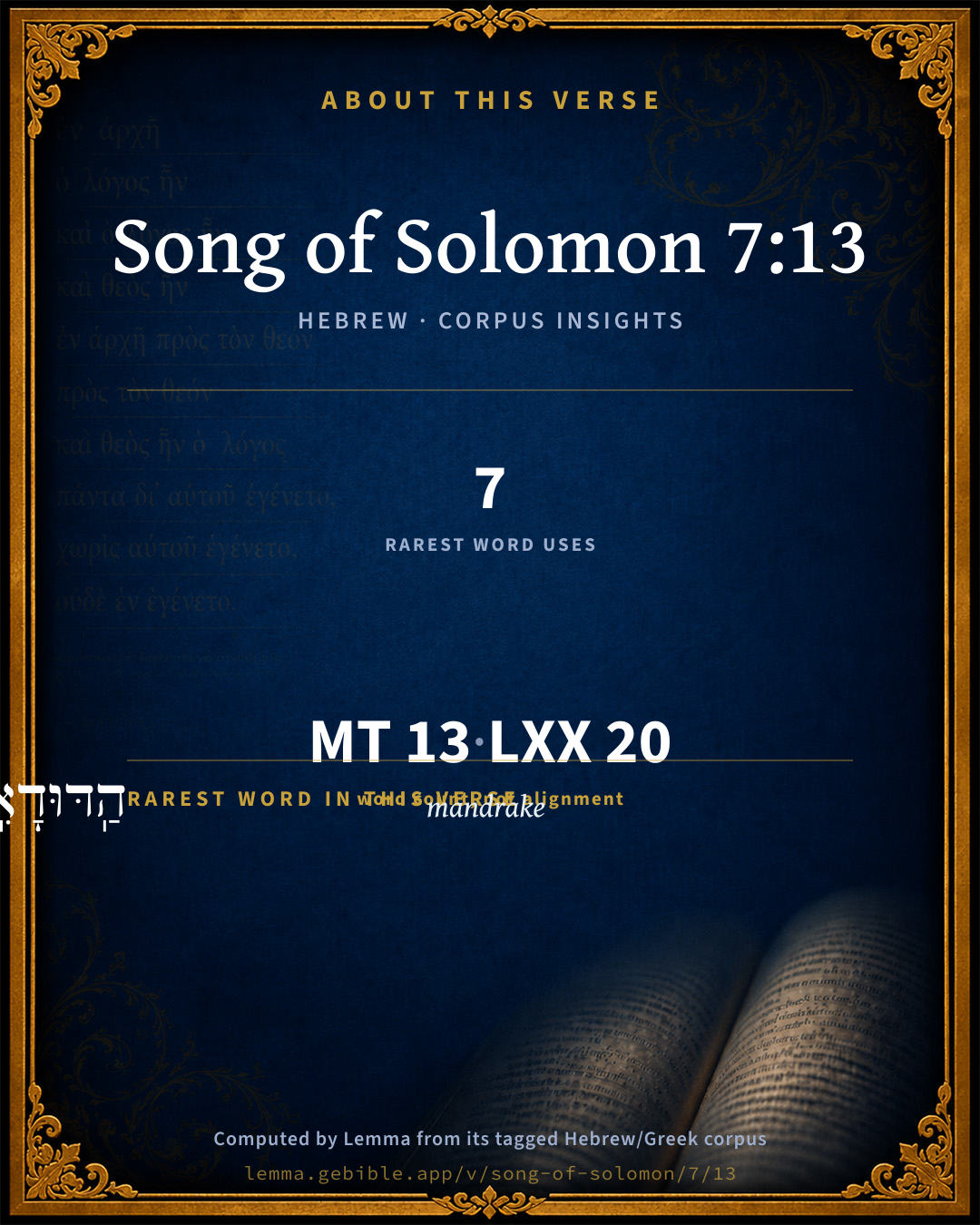
These counts appear in no published source. They are computed here, from the morphology-tagged text and Lemma’s own curated glosses. What Lemma adds →

13
words
12
distinct lemmas
Wisdom
section

Notable vocabulary

The rarest word here is הַֽדּוּדָאִ֣ים mandrake H1736 — appearing just 7 times in the whole Hebrew Bible.

Shared distinctive vocabulary

הַֽדּוּדָאִ֣ים mandrake H1736 occurs in 5 verses of the Hebrew Bible. Also found in:

Grammatical profile

  • 2 verbs
  • 6 nouns
  • 2 adjectives
  • 2 prepositions
  • 1 particle

Verb forms

  • נָֽתְנוּ Qal · Perfect
  • צָפַ֥נְתִּי Qal · Perfect

Hebrew & Septuagint length

In English translation the verse runs 26 words from the Hebrew and 28 from the Septuagint (LXX English) — closely comparable.

A rough comparison of the two English renderings, which tokenize alike — not a word-level alignment.

Word counts can differ between the Hebrew and the Greek without any difference in meaning — e.g. the Hebrew direct-object marker אֵת has no separate Greek word, and Greek often adds the article ὁ.

In the original languages it is 13 Hebrew tokens and 20 Greek tokens — but the two are counted differently (Hebrew bundles its prefixes and suffixes into one token; the Greek is in lemma form), so that isn’t a like-for-like length.

Cross-references

17

Topical passages linked to Song of Solomon 7:13 in the Treasury of Scripture Knowledge — connected by theme and wording, ordered by reader-vote popularity; previews shown in the World English Bible.

  • Genesis 30:14 Reuben went in the days of wheat harvest, and found mandrakes in the field, and brought them to his mother, Leah. Then Rachel said to Leah, "Please give me some of your son's mandrakes."
  • Matthew 13:52 He said to them, "Therefore, every scribe who has been made a disciple in the Kingdom of Heaven is like a man who is a householder, who brings out of his treasure new and old things."
  • Song of Solomon 4:13 Your shoots are an orchard of pomegranates, with precious fruits: Henna with spikenard plants,
  • Song of Solomon 4:16–5:1 Awake, north wind; and come, you south; Blow on my garden, that its spices may flow out. Let my beloved come into his garden, And taste his precious fruits. Lover
  • Isaiah 23:18 Her merchandise and her hire shall be holiness to Yahweh: it shall not be treasured nor laid up; for her merchandise shall be for those who dwell before Yahweh, to eat sufficiently, and for durable clothing.
  • Isaiah 60:6–7 The multitude of camels shall cover you, the dromedaries of Midian and Ephah; all they from Sheba shall come; they shall bring gold and frankincense, and shall proclaim the praises of Yahweh.
  • Matthew 25:40 "The King will answer them, 'Most assuredly I tell you, inasmuch as you did it to one of the least of these my brothers, you did it to me.'
  • John 15:8 "In this is my Father glorified, that you bear much fruit; and so you will be my disciples.
  • Romans 15:25–27 But now, I say, I am going to Jerusalem, serving the saints.
  • 1 Corinthians 2:9 But as it is written, "Things which an eye didn't see, and an ear didn't hear, Which didn't enter into the heart of man, These God has prepared for those who love him."
  • 1 Corinthians 8:8–9 But food will not commend us to God. For neither, if we don't eat, are we the worse; nor, if we eat, are we the better.
  • 1 Corinthians 16:2 On the first day of the week, let each one of you save, as he may prosper, that no collections be made when I come.
  • Galatians 5:22–23 But the fruit of the Spirit is love, joy, peace, patience, kindness, goodness, faithfulness,
  • Ephesians 5:9 for the fruit of the Spirit is in all goodness and righteousness and truth,
  • Philippians 1:11 being filled with the fruits of righteousness, which are through Jesus Christ, to the glory and praise of God.
  • Colossians 3:17 Whatever you do, in word or in deed, do all in the name of the Lord Jesus, giving thanks to God the Father, through him.
  • 1 Peter 4:11 If any man speaks, let it be as it were oracles of God. If any man serves, let it be as of the strength which God supplies, that in all things God may be glorified through Jesus Christ, to whom belong the glory and the dominion forever and ever. Amen.

Cross-references courtesy of OpenBible.info (CC BY 4.0).

Hebrew and Greek witnesses Masoretic Hebrew ↔ Greek Septuagint

The same verse in the two great witnesses to the Old Testament, shown verse-for-verse.

These are two independent witnesses, not word-aligned to each other, and the Septuagint is shown in lemma (dictionary) form.

Hebrew Song of Solomon 7:13 Masoretic · Westminster Leningrad Codex

הַֽדּוּדָאִ֣ים נָֽתְנוּ רֵ֗יחַ וְעַל פְּתָחֵ֨ינוּ֙ כָּל מְגָדִ֔ים חֲדָשִׁ֖ים גַּם יְשָׁנִ֑ים דּוֹדִ֖י צָפַ֥נְתִּי לָֽךְ

The mandrakes give forth fragrance. At our doors are all kinds of precious fruits, new and old, Which I have stored up for you, my beloved.

World English Bible · Public Domain

Greek LXX Song of Solomon 7:13 Septuagint · lemma form

ὀρθρίζω εἰς ἀμπελών ὁράω εἰ ἀνθέω ὁ ἄμπελος ἀνθέω ὁ κυπρισμός ἀνθέω ὁ ῥοά ἐκεῖ δίδωμι ὁ μαστός ἐγώ σύ

The mandrakes have given a smell, and at our doors are all kinds of choice fruits, new and old. O my kinsman, I have kept them for you.

LXX2012 (modern English Septuagint) · Public Domain

On this verse, The Cambridge Bible for Schools and Colleges discusses the Septuagint’s reading. Read the note in Commentary ↓

Hebrew: Westminster Leningrad Codex (CC BY 4.0). Greek: Septuagint (public domain); English from LXX2012 (modern English Septuagint) (Public Domain). How the Septuagint differs from the Hebrew →

Commentary

Notes on Song of Solomon 7:13 from classic Christian and Jewish commentators (each source and its license shown beneath its notes). The classic Christian expositions comment on the surrounding passage and are grouped to its opening verse, so a note may address several verses; the Jewish commentaries on the Tanakh (Rashi and others) are per-verse, so they appear only where the commentator wrote on this verse.

Lemma curates 59 commentaries, every one of them public domain or Creative Commons licensed, each selected and text-cleaned for this edition rather than reprinted as found. About our sources →

Trapp's Complete Commentary

John Trapp

Son 7:13 The mandrakes give a smell, and at our gates [are] all manner of pleasant [fruits], new and old, [which] I have laid up for thee, O my beloved.

Ver. 13. The mandrakes give a smell.] Loves and mandrakes grow both upon one Hebrew root and Tremellius renders it not mandrakes, but lovely flowers, yielding a savour pleasant to the eye, and sweet to the smell. The Chaldee paraphrast calleth it balsam. ( Legesis August. lib. xxii. contra Faust. Manichaeum, cap. lvi.; Jun. in Gen 30:14; Drus. in fine Comment. in Ruth). Aben Ezra saith that mandrakes are fragrant, and yield a pleasant savour; that they have head and hands like unto a man. But how they should be good to cause conception he wondereth, since by nature they are cold. Augustine saith that he made trial, and could not find any such operation to be in them, and that Rachel coveted them merely for their rarity, beauty, and sweetness. There is enough of these in the Church to draw all hearts unto her; but that many men have brawny breasts and horny heart strings.

And at our gates are all manner of pleasants] Or, Delicacies, precious and pleasant commodities whether fruits, metals, gems, jewels, quicquid in deliciis habetur, whatsoever is excellent and exquisite in any kind; this is the import of the Hebrew word. There is nothing of any worth but it is to be found in the Church. Her wise merchants, not content with the pearl of price, seek out other "goodly pearls," common gifts, which also have their use and excellence, {Mat 13:45-46} they "learn to maintain good works, or honest professions for necessary uses; these things are good and profitable to men" {Tit 3:8; Tit 3:14} Some think that the Holy Ghost here alludeth to the order of old, and still in use, of strawing the wedding house doors with sweet smelling flowers; others to the customs of those that have orchards, to lay up their fruits over the gate house.

New and old.] As a good storer, that hath plenty and variety wherewith to please all palates, new for delights, and old for wholesomeness. The good scribe, well instructed to the kingdom of heaven, "throweth out {a} of his treasury things new and old," - new for the unlearned, and old for the stronger stomach. Some delight in the sweetness of things, as in new wine. David tells them the Word is sweeter than live honey dropping from the honeycomb. Others say "the old is better," are all for profit, as elder people; he tells them there it is better than gold. {Psa 19:10} In the Church’s storehouse men shall be sure to meet with all that heart can wish, or need require.

Which I have laid up for thee, O my beloved!] Propter te, Domine, propter te, "Because of you, O God, because of you," is the Church’s motto. As all his springs are in her, and all his offices and efficacies for her, so all that she has and is, is only for him, and a great deal more she could beteem him. Let Ephraim, that "empty" vine, "bear fruit to himself," {Hos 10:1} and those hypocrites {Zec 7:5} fast to themselves; Christ’s hidden ones hide all for him, set up and seek him in all they do or suffer, are wholly devoted to his whole service. {b}

{a} εκβαλλει, {Mat 13:52} Extrudit copiose et alacriter.

{b} ει πλεον ειχον, πλεον δειδουν, dixit ille Graeculus Augusto.

John Trapp, A Commentary or Exposition upon All the Books of the Old and New Testament (1647–1656) — public domain. Text from a community e-Sword module.

Joseph Benson's Commentary

Son 7:13. The mandrakes — This Hebrew word is used Gen 30:14-15, and the signification of it is very much doubted and disputed by interpreters. The word here signifies sweet and pleasant flowers, and therefore if it be understood of mandrakes, they were of another sort than ours, as flowers of the same kind, in several climates, have very different natures and qualities. At our gates — Brought thither by divers persons to congratulate our nuptials. New and old fruits — Fruits of this year and of the former; which seems to be meant of the various fruits and operations of the Spirit, and degrees of grace in several believers.

Joseph Benson's Commentary on the Old and New Testaments (1811–1818) — public domain. Text from a community e-Sword module.

Tyndale Open Study Notes

Tyndale Open Resources

7:13 Mandrakes (Hebrew duda’im) were a Middle Eastern aphrodisiac (see Gen 30:14-16); the roots of the plant resemble a human torso. The word is a play on my lover (Hebrew dodi). • at our door: All sexual pleasures are available to them now, and she will share with him the delights she has saved for him alone. • new . . . old: She has in mind the sexual expressions they have already experienced, and new ones as well.

Tyndale Open Study Notes — © Tyndale Open Resources, licensed CC BY-SA 4.0. Text via the HelloAO Bible API.

Adam Clarke's Commentary

Verse 13. The mandrakes give a smell] See Clarke on Ge 30:14, where the mandrake is particularly described; from which this passage will receive considerable light. The reader is requested to consult it.

All manner of pleasant fruits] Fruits new and old; flowers and herbs of every kind which the season could yield. The literal sense, allowing for the concealing metaphors, is, I believe, of a widely different nature from what is generally given. But this must be left to the reader's sagacity and prudence.

Adam Clarke's Commentary on the Bible (1810–1826) — public domain. Text from a community e-Sword/MySword module.

Ellicott's Commentary for English Readers

(13) Mandrakes.—Heb. dûdaîm = love-apples. Suggested probably by the word loves immediately preceding, as well as the qualities ascribed to the plant, for which see Note, Gen_30:14.

A Bible Commentary for English Readers, edited by Charles John Ellicott (1878–1897) — public domain. Text from a community e-Sword module.

The Cambridge Bible for Schools and Colleges

gen. ed. J. J. S. Perowne

13. The mandrakes give a smell] Heb. had-dûdhâ îm (LXX, οἱ μανδραγόραι), lit. ‘love plants.’ The mandrake is fully described in Tristram, Nat. Hist. pp. 466 ff. It belongs to the family of plants to which the potato belongs. The flowers are cup-shaped, of a rich purple colour. The fruit has a peculiar but decidedly not unpleasant smell, and a pleasant, sweet taste. In Groser’s Script. Nat. Hist., Mariti is quoted to the following effect: “The fruit when ripe, in the beginning of May, is of the size and colour of a small apple, exceedingly ruddy and of a most agreeable odour. Our guide thought us fools for suspecting it to be unwholesome. He ate it freely himself, and it is generally valued by the inhabitants as exhilarating their spirits.” It is mentioned here as denoting the time of year, May, the time of the wheat harvest, or for its pleasant smell, not, as in Gen_30:14-16, as an aphrodisiac.

and at our gates are all manner of pleasant fruits] Rather, over our doors. This would seem to indicate that in village houses it was the custom to lay up fruits on shelves or in cupboards placed above the doorways.

pleasant fruits] or, as R.V., precious fruits. Cp. ch. Son_4:13; Son_4:16.

which I have laid up] This relative clause refers to the old fruits, as the new fruits were only now ripening. If Solomon were the bridegroom it is difficult to see how the shepherdess could have laid up fruits for him, as she had not been home since he carried her away.

The Cambridge Bible for Schools and Colleges (gen. ed. J. J. S. Perowne; Cambridge University Press, 1878–1918) — public domain. Text from a community e-Sword module.

Haydock's Catholic Bible Commentary

Mandrakes. Hebrew dodai comes from the same root as dodi, "my breasts or loves," ver. 12. (Haydock) --- It may denote oranges, as mandrakes are not spring-fruits, Genesis xxx. 14. (Calmet) --- Yet (Haydock) married women eagerly sought after mandrakes. Here they may signify such as are fit to gain souls to Christ. (Menochius) --- And the old. Or great abundance, Leviticus xxvi. 10., and Matthew xiii. 52. (Calmet) --- She acknowledges Christ to be the Saviour of all, under the Old and the New Testament. (Worthington) --- A doctor of the Church shews Christ in the prophets, and figures of the law, as well as manifested in the gospel. (Aponius, &c.) (Calmet)

George Leo Haydock (1774–1849), Haydock's Catholic Family Bible and Commentary, 1859 edition — public domain. Excludes Psalms (Douay-Rheims chapter numbering differs from Protestant) and Deuterocanonical books (Catholic canon only).

Matthew Poole's English Annotations

Mandrakes: this Hebrew word is used Gen 30:14,15, and the signification of it is very much doubted and disputed by interpreters; of which see my Latin Synopsis on that place. But this is certain, that the word signifies sweet and pleasant flowers; and therefore if it be understood of mandrakes, they were of another sort than ours, as it is no unusual thing for flowers of the same kind in several climates to have very differing natures and qualities.

At our gates; either,

1. Growing there upon the walls, or in gardens, or orchards, near the door of our dwellinghouse. Or rather,

2. Brought thither by divers persons to congratulate and adorn our nuptials, or laid up for our entertainment, as may be gathered from the nature of the fruits, which were not only new, and growing, but also old, and laid up, as it here follows.

Fruits new and old; fruits of this year and of the former, that the variety might delight; which seems to be spiritually meant of the various fruits and operations of the Spirit and degrees of grace in several believers.

Which I have laid up for thee; which have been produced by my ministry for thy service and glory.

Matthew Poole's English Annotations on the Holy Bible (1683–1685) — public domain. Text from a community e-Sword/MySword module.

Whedon's Commentary on the Bible

Daniel D. Whedon

13. The mandrakes give a smell — Mandrakes are a bright, ruddy, and fragrant fruit, like a small apple, agreeable and exhilarating.

At our gates — “In the garden near our door.” All these pleasures are described in lively anticipation. Her love has pruned and cherished many a plant that he might share its fruit.

Daniel D. Whedon (gen. ed.), Commentary on the Old and New Testaments (1874–1909) — public domain. Text from a community e-Sword module.

The Pulpit Commentary

The mandrakes give forth fragrance, and at our doors are all manner of precious fruits, new and old, which I have laid up for thee, O my beloved. The dudhai after the form Lulai, and connected probably with dwOD, are the "love flowers," the Mandragora officinalis (Linn.), whitish-green in colour, with yellow apples about the size of nutmegs; they belong to the order of Solanaceae, and both fruits and roots were employed as aphrodisiac, to promote love. We are, of course, reminded of Gen_30:14, where the LXX has, mhla, mandragorwn , when the son of Leah found mandrakes in vintage time. They produce their effect by their powerful and pleasant fragrance. They are said to be only rarely found in the neighbourhood of Jerusalem, but they were abundant in. Galilee, where Shulamith was brought up. The Arabs called them abd-el-salm, "servant of lovepostillon damour. We are not wrong in using that which is perfectly natural and simple for the cherishing and increasing of devout feeling. The three elements which coexist in true spiritual life are thought, feeling, and action. They support one another. A religion which is all impulse and emotion soon wears itself out, and is apt to end in spiritual vacuity and paralysis; but when thought and activity hold up and strengthen and guide feeling, then it is scarcely possible to endanger the soul. The heart should go out to Christ in a simple but fervent worship, especially in praise. There are no Christians who are more ready to devote themselves to good works than those who delight much in hearty and happy spiritual songs.

Garnered fruits.

When the bride invites the king to revisit the home of her childhood and the scenes of their early acquaintance and attachment, among other alluring representations she assures him that there will be found, laid up for his use by her thoughtful affection, all manner of precious fruits, new and old. A suitable emblem this of the gathered and garnered spiritual fruits which in this earthly life Christ"s people are expected to prepare for him at his coming, and which it will be their delight to offer to him as the expression of their grateful love. Properly understood, the main purpose of the Christian life is the growing, gathering, and garnering of precious fruits for the approval and service of the Lord.

I WHAT THESE FRUITS ARE.

1. They are the fruits of spiritual life and experience.

2. They are the "fruits of the Spirit the virtues especially Christian, fruits of righteousness, those qualities of character which are the peculiar growth of grace.

3. They are fruits of service; not things enjoyed so much as things achieved.

II WHY ARE THEY LAID UP FOR CHRIST? Because:

1. They are the fruit of his own garden, the growth which testifies to the care and culture of the Divine Husbandman.

2. They are of a nature to yield a peculiar satisfaction and pleasure to him.

3. They are such as he will use for his own purposes, and for the display of his own glory and praise. T.

The Pulpit Commentary (1880–1919), ed. H.D.M. Spence-Jones & Joseph S. Exell — public domain. Text from a community e-Sword module.

John Wesley's Explanatory Notes

Mandrakes - This Hebrew word is used Gen. xxx, 14, 15, and the signification of it is very much doubted and disputed by interpreters. The word here signifies sweet and pleasant flowers, and therefore if it be understood of mandrakes, they were of another sort than ours, as flowers of the same kind in several climates have very different natures and qualities. At our gates - Brought thither by divers persons to congratulate our nuptials. All fruits - Fruits of this year and of the former. Which seems to be meant of the various fruits and operations of the Spirit, and degrees of grace in several believers.

John Wesley, Explanatory Notes Upon the Whole Bible (1754–1765) — public domain. Text via the GEBible commentary corpus.

unfoldingWord translationNotes

Door43 World Missions Community

General Information:

The woman continues to speak to the man.

mandrakes

This is the name of plants that give off a strong but pleasant scent. The scent is slightly intoxicating and stimulating, which increases the desire to make love. (See: Translate Unknowns)

give off their fragrance

"produce their scent" or "smell very nice"

at the door

The doors belong to their house. AT: "above the entrances of our house" or "by the doors of our house" (See: Assumed Knowledge and Implicit Information)

are all sorts of choice fruits, new and old

"is every kind of the best fruit, both old fruit and new fruit"

stored up for you

"saved so I can give to you"

my beloved

This phrase refers to the man whom the woman loves. In some languages it may be more natural for her to refer to him as "my lover." See how you translated this in Song of Songs 1:13. AT: "my dear one" or "my lover"

translationWords

beloved

unfoldingWord translationNotes — © Distant Shores Media and the Door43 World Missions Community, licensed CC BY-SA 4.0. Source: git.door43.org/Door43/en_tn.

Rashi

Rabbi Shlomo Yitzchaki (Rashi)

Let us arise early to the vineyards These are the synagogues and the study halls.

let us see whether the vine has blossomed These are the students of the Torah.

the tiny grapes have developed When the blossom falls off and the grapes are discernible, that is the development of the סְמָדַר, and he compares the students of the Mishnah to them, because they provide pleasure by teaching Torah.

the pomegranates have lost their flowers when they become ripe, and the flower around them falls off. הֵנֵצוּ means its flower (נִצוּ), and he compares the Talmud students to them, who possess full wisdom and are fit to teach.

there I will give you my love There I will show You my glory and the glory of my sons and daughters.

Rashi on the Tanakh — English translations: “The Judaica Press complete Tanach with Rashi, translated by A. J. Rosenberg” (CC BY 4.0); “Pentateuch with Rashi's commentary by M. Rosenbaum and A.M. Silbermann, 1929-1934” (public domain); “The Metsudah Tanach series, Lakewood, N.J” (CC BY 4.0); and “The Book of Joshua, Metsudah Publications, 1997” (CC BY 4.0). Text via Sefaria.

Lesson kit

Teaching starters — assembled from the data on this page, not authored interpretation. Every prompt links to the verse data it draws on. Edit before teaching.

Song of Solomon, in the Wisdom, opens this verse with 13 words (12 distinct Hebrew lemmas). Its most distinctive word is dûwday (“mandrake”). A historical commentator’s framing appears above. Read the whole chapter for the surrounding context.

Discussion questions

  1. How does “mandrake” (dûwday) shape what this verse is saying?
  2. Genesis 30:14 shares the word «mandrake» with this verse. How do the two illuminate each other?
  3. The translations on this page render this verse differently — a whole-verse word diff, not a word-by-word alignment. What might account for the different wordings?
  4. The verb «נָֽתְנוּ» is Qal Perfect. How does its form color the action?
  5. Reading how Trapp's Complete Commentary and Joseph Benson's Commentary read this verse, where do the two commentators agree and where do they part?

Things to notice

Reading settings

Reading text

Shown beneath each verse's original-language words.

Old Testament
Old Testament edition

Read the OT as the Masoretic Hebrew (MT) or the Greek Septuagint (LXX).

English shown for the Greek Septuagint (in the Hebrew ↔ Greek comparison).

Comparing translations? Open the Compare panel on any verse page to stack up to four side by side.