
2 Chronicles 12:10

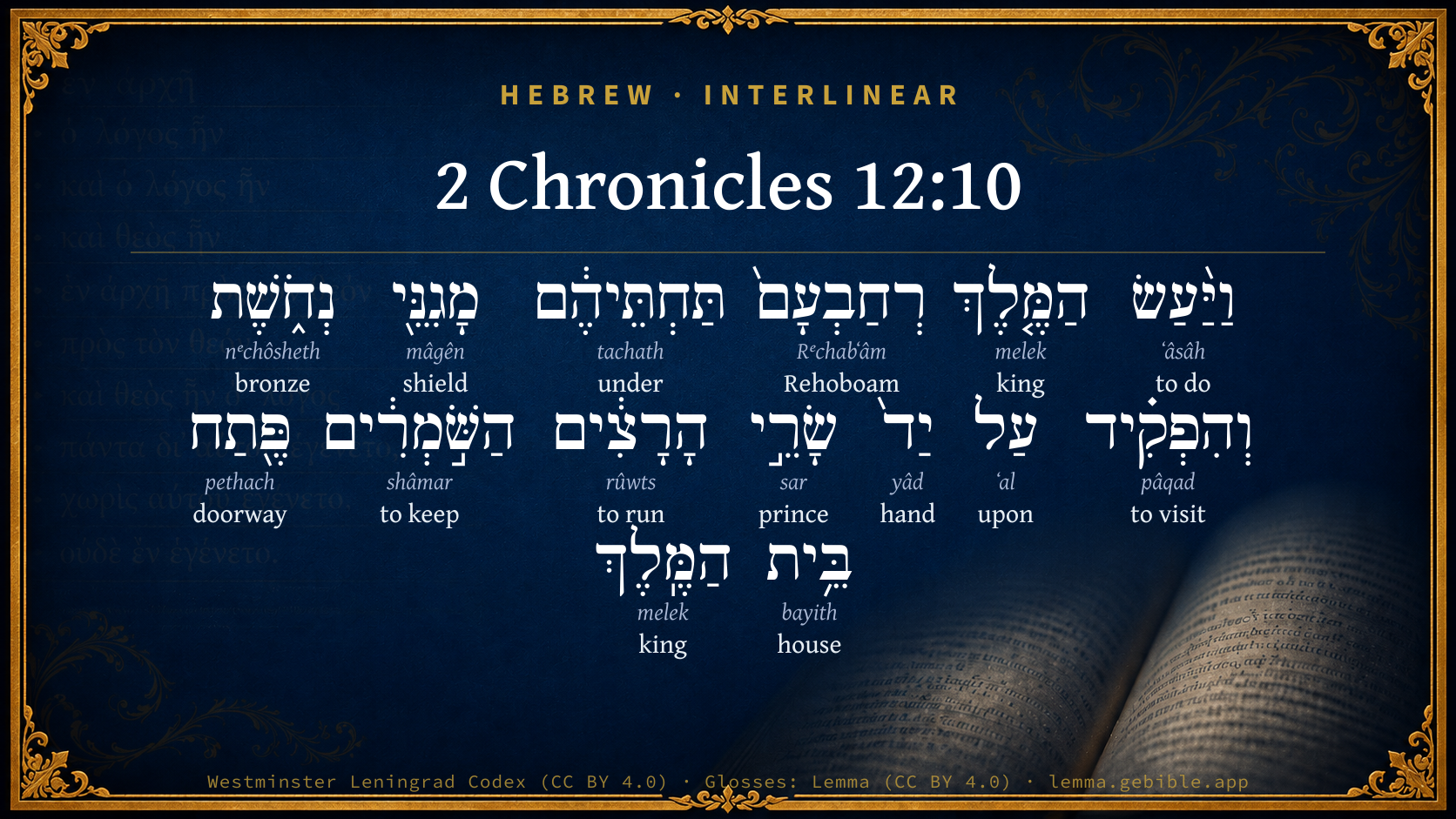
Hebrew (Westminster Leningrad Codex) 2 Chronicles 12:10 appears in the Hebrew Old Testament. The text above is from the Westminster Leningrad Codex. Each word links to its Strong’s number, a concise gloss, and parsing drawn from the Open Scriptures Hebrew Bible morphology. Click any word for its full Brown-Driver-Briggs (BDB) entry.
Download image
Cite this verse

2 Chronicles 12:10 (World English Bible). Public Domain. Lemma interlinear Bible study tool, https://lemma.gebible.app/v/2-chronicles/12/10.

Show BibTeX & RIS
BibTeX
RIS
English Translation
King Rehoboam made in their place shields of brass, and committed them to the hands of the captains of the guard, who kept the door of the king's house.
World English Bible · Public Domain
Download a study sheet

One document with this verse’s original text, its word-by-word gloss line, the meaning frame, cross-references with their text, attributed commentary, and full source and license credits — printable, and it pastes into notes with its structure intact.

This verse Autodidact and up

Study sheet (.html) Plain text (.txt)

A passage Seminary Student

Up to 50 verses in one chapter. A passage sheet keeps up to 6 commentary sources and 12 cross-references per verse, in the order this page ranks them, and says so on the sheet whenever that leaves anything out. Ask for a single verse and you get the Autodidact verse sheet above.

Everything on this page stays free to read, with no account — the sheet is a download of what is already on screen, not access to it.

Want to remove ads? Support Godless Engineer
Compare translations 3

The same verse in 3 English versions, stacked beneath the original-language interlinear above. Click any original word for its lexicon entry.

Each is an independent rendering of the whole verse — the interlinear is not word-aligned to these translations.

Highlighted words mark where these versions differ — a whole-verse word diff, not a word-by-word alignment.

  • World English Bible Public Domain
    King Rehoboam made in their place shields of brass, and committed them to the hands of the captains of the guard, who kept the door of the king's house.
  • King James Version Public Domain
    Instead of which king Rehoboam made shields of brass, and committed them to the hands of the chief of the guard, that kept the entrance of the king's house.
  • unfoldingWord Literal Text CC BY-SA 4.0
    And King Rehoboam made in their place shields of bronze, and he appointed over the hand of the chiefs of the runners, the keepers of the entrance of the house of the king.

unfoldingWord Literal Text — © unfoldingWord, licensed CC BY-SA 4.0. Word-aligned USFM3 via Door43 (git.door43.org/unfoldingWord/en_ult).

Versions to compare (up to 4)

3 of 4 selected

Show all 18 translations

Every available English version of this verse, each an independent rendering of the whole verse.

  • World English Bible Public Domain
    King Rehoboam made in their place shields of brass, and committed them to the hands of the captains of the guard, who kept the door of the king's house.
  • Berean Standard Bible Public Domain
    Then King Rehoboam made bronze shields in their place and committed them to the care of the captains of the guard on duty at the entrance to the royal palace.
  • Majority Standard Bible Public Domain
    Then King Rehoboam made bronze shields in their place and committed them to the care of the captains of the guard on duty at the entrance to the royal palace.
  • King James Version Public Domain
    Instead of which king Rehoboam made shields of brass, and committed them to the hands of the chief of the guard, that kept the entrance of the king's house.
  • American Standard Version (1901) Public Domain
    And king Rehoboam made in their stead shields of brass, and committed them to the hands of the captains of the guard, that kept the door of the king's house.
  • Revised Version (1885) Public Domain
    And king Rehoboam made in their stead shields of brass, and committed them to the hands of the captains of the guard, that kept the door of the king’s house.
  • Geneva Bible (1599) Public Domain
    In stead whereof King Rehoboam made shieldes of brasse, and committed them to the handes of the chiefe of the garde, that wayted at the doore of the Kings house.
  • Douay-Rheims (1899) Public Domain
    Instead of which the king made brazen ones, and delivered them to the captains of the shieldbearers, who guarded the entrance of the palace.
  • Young's Literal Translation Public Domain
    and king Rehoboam maketh in their stead shields of brass, and hath given `them' a charge on the hand of the heads of the runners who are keeping the opening of the house of the king;
  • Literal Standard Version CC BY-SA 4.0
    and King Rehoboam makes shields of bronze in their stead, and has given [them] a charge on the hand of the heads of the runners who are keeping the opening of the house of the king;
  • Unlocked Literal Bible CC BY-SA 4.0
    King Rehoboam made shields of bronze in their place and entrusted them into the hands of the commanders of the guard, who guarded the doors to the king's house.
  • unfoldingWord Literal Text CC BY-SA 4.0
    And King Rehoboam made in their place shields of bronze, and he appointed over the hand of the chiefs of the runners, the keepers of the entrance of the house of the king.
  • Darby Bible Public Domain
    And king Rehoboam made in their stead shields of bronze, and committed them to the hands of the chief of the couriers who kept the entrance of the king's house.
  • World Messianic Bible Public Domain
    King Rehoboam made shields of bronze in their place, and committed them to the hands of the captains of the guard, who kept the door of the king’s house.
  • Webster's Bible Public Domain
    Instead of which, king Rehoboam made shields of brass, and committed them to the hands of the chief of the guard, that kept the entrance of the king's house.
  • Free Bible Version CC BY-SA 4.0
    Later Rehoboam replaced them with bronze shields and gave them to be looked after by the commanders of the guard stationed at the entrance to the royal palace.
  • Bible in Basic English Public Domain
    And in their place King Rehoboam had other body-covers made of brass and gave them into the care of the captains of the armed men who were stationed at the door of the king's house.
  • JPS Tanakh (1917) Public Domain
    And king Rehoboam made in their stead shields of brass, and committed them to the hands of the captains of the guard, that kept the door of the king's house.

Literal Standard Version (2020), Covenant Press — licensed CC BY-SA 4.0. Text via the HelloAO Bible API (eBible.org). Unlocked Literal Bible (unfoldingWord) — licensed CC BY-SA 4.0. Text via the HelloAO Bible API (eBible.org). unfoldingWord Literal Text — © unfoldingWord, licensed CC BY-SA 4.0. Word-aligned USFM3 via Door43 (git.door43.org/unfoldingWord/en_ult). Free Bible Version, Dr. Jonathan Gallagher — licensed CC BY-SA 4.0. Text via the HelloAO Bible API (eBible.org).

Word by word

More ways to search: Search by grammar → Find every occurrence → Compare this word →

Practice this passage: Drill this verse → Learn its vocabulary →

רְחַבְעָם֙
Rᵉchabʻâm
H7346
“Rehoboam”
Noun, Proper
Part of Speech
Noun
Type
Proper
Full BDB Definition

Origin: from H7337 and H5971

TWOT: None

Rehoboam = "a people has enlarged" - son of Solomon and the 1st king of Judah after the split up of the kingdom of Israel
  1. וַיַּ֨עַשׂ ʻâsâh H6213 “and · to do” Conjunction + Verb, Qal, Sequential Imperfect, 3rd Person, Masculine, Singular
  2. הַמֶּ֤לֶךְ melek H4428 “the · king” Particle, Definite Article + Noun, Common, Masculine, Singular, Absolute
  3. תַּחְתֵּיהֶ֔ם tachath H8478 “under · them” Preposition + Suffix, Personal, 3rd Person, Masculine, Plural
  4. מָגִנֵּ֖י mâgên H4043 “shields of” Noun, Common, Both, Plural, Construct
  5. נְחֹ֑שֶׁת nᵉchôsheth H5178 “bronze” Noun, Common, Feminine, Singular, Absolute
  6. וְהִפְקִ֗יד pâqad H6485 “and · to visit” Conjunction + Verb, Hiphil, Perfect, 3rd Person, Masculine, Singular
  7. עַל ʻal H5921 “upon” Preposition
  8. יַד֙ yâd H3027 “hand of” Noun, Common, Both, Singular, Construct
  9. שָׂרֵ֣י sar H8269 “princes of” Noun, Common, Masculine, Plural, Construct
  10. הָרָצִ֔ים rûwts H7323 “the · running” Particle, Definite Article + Verb, Qal, Participle Active, Masculine, Plural, Absolute
  11. הַשֹּׁ֣מְרִ֔ים shâmar H8104 “the · keeping” Particle, Definite Article + Verb, Qal, Participle Active, Masculine, Plural, Absolute
  12. פֶּ֖תַח pethach H6607 “doorway of” Noun, Common, Masculine, Singular, Construct
  13. בֵּ֥ית bayith H1004 “house of” Noun, Common, Masculine, Singular, Construct
  14. הַמֶּֽלֶךְ melek H4428 “the · king” Particle, Definite Article + Noun, Common, Masculine, Singular, Absolute

About this verse

These counts appear in no published source. They are computed here, from the morphology-tagged text and Lemma’s own curated glosses. What Lemma adds →

15
words
14
distinct lemmas
Historical
section

Shared distinctive vocabulary

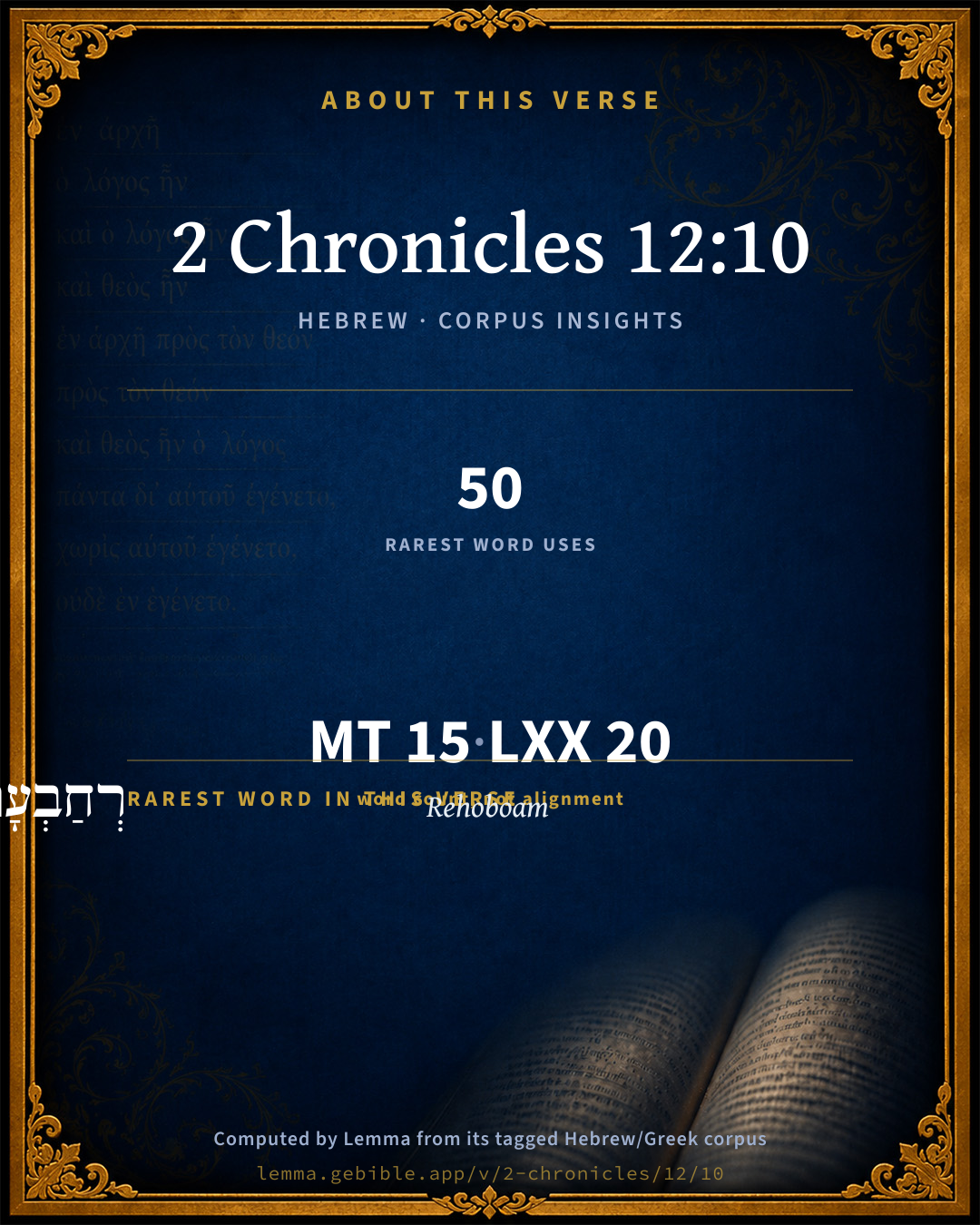
רְחַבְעָם֙ Rehoboam H7346 occurs in 41 verses of the Hebrew Bible. Also found in:

Grammatical profile

  • 4 verbs
  • 9 nouns
  • 2 prepositions

Verb forms

  • וַיַּ֨עַשׂ Qal · Sequential Imperfect
  • וְהִפְקִ֗יד Hiphil · Perfect
  • הָרָצִ֔ים Qal · Participle Active
  • הַשֹּׁ֣מְרִ֔ים Qal · Participle Active

Repetition

A word recurs within this verse — often emphatic in Hebrew:

  • הַמֶּ֤לֶךְ king H4428 ×2

Hebrew & Septuagint length

In English translation the verse runs 29 words from the Hebrew and 25 from the Septuagint (LXX English) — closely comparable.

A rough comparison of the two English renderings, which tokenize alike — not a word-level alignment.

Word counts can differ between the Hebrew and the Greek without any difference in meaning — e.g. the Hebrew direct-object marker אֵת has no separate Greek word, and Greek often adds the article ὁ.

In the original languages it is 15 Hebrew tokens and 20 Greek tokens — but the two are counted differently (Hebrew bundles its prefixes and suffixes into one token; the Greek is in lemma form), so that isn’t a like-for-like length.

Cross-references

6

Topical passages linked to 2 Chronicles 12:10 in the Treasury of Scripture Knowledge — connected by theme and wording, ordered by reader-vote popularity; previews shown in the World English Bible.

  • 2 Samuel 8:18 and Benaiah the son of Jehoiada [was over] the Cherethites and the Pelethites; and David's sons were chief ministers.
  • 2 Samuel 23:23 He was more honorable than the thirty, but he didn't attain to the [first] three. David set him over his guard.
  • 1 Kings 14:27 King Rehoboam made in their place shields of brass, and committed them to the hands of the captains of the guard, who kept the door of the king's house.
  • 1 Chronicles 11:25 Behold, he was more honorable than the thirty, but he didn't attain to the [first] three: and David set him over his guard.
  • Song of Solomon 3:7–8 Behold, it is Solomon's carriage! Sixty mighty men are around it, Of the mighty men of Israel.
  • Lamentations 4:1 How is the gold become dim! [how] is the most pure gold changed! The stones of the sanctuary are poured out at the head of every street.

Cross-references courtesy of OpenBible.info (CC BY 4.0).

Hebrew and Greek witnesses Masoretic Hebrew ↔ Greek Septuagint

The same verse in the two great witnesses to the Old Testament, shown verse-for-verse.

These are two independent witnesses, not word-aligned to each other, and the Septuagint is shown in lemma (dictionary) form.

Hebrew 2 Chronicles 12:10 Masoretic · Westminster Leningrad Codex

וַיַּ֨עַשׂ הַמֶּ֤לֶךְ רְחַבְעָם֙ תַּחְתֵּיהֶ֔ם מָגִנֵּ֖י נְחֹ֑שֶׁת וְהִפְקִ֗יד עַל יַד֙ שָׂרֵ֣י הָרָצִ֔ים הַשֹּׁ֣מְרִ֔ים פֶּ֖תַח בֵּ֥ית הַמֶּֽלֶךְ

King Rehoboam made in their place shields of brass, and committed them to the hands of the captains of the guard, who kept the door of the king's house.

World English Bible · Public Domain

Greek LXX 2 Chronicles 12:10 Septuagint · lemma form

καί ποιέω ροβοαμ θυρεός χαλκοῦς ἀντί αὐτός καί καταἵστημι ἐπί αὐτός σουσακιμ ἄρχων παρατρέχω ὁ φυλάσσω ὁ πυλών ὁ βασιλεύς

And king Roboam made brazen shields instead of them. And Susakim set over him captains of footmen, as keepers of the gate of the king.

LXX2012 (modern English Septuagint) · Public Domain

Hebrew: Westminster Leningrad Codex (CC BY 4.0). Greek: Septuagint (public domain); English from LXX2012 (modern English Septuagint) (Public Domain). How the Septuagint differs from the Hebrew →

Commentary

Notes on 2 Chronicles 12:10 from classic Christian and Jewish commentators (each source and its license shown beneath its notes). The classic Christian expositions comment on the surrounding passage and are grouped to its opening verse, so a note may address several verses; the Jewish commentaries on the Tanakh (Rashi and others) are per-verse, so they appear only where the commentator wrote on this verse.

Lemma curates 59 commentaries, every one of them public domain or Creative Commons licensed, each selected and text-cleaned for this edition rather than reprinted as found. About our sources →

Trapp's Complete Commentary

John Trapp

2Ch 12:10 Instead of which king Rehoboam made shields of brass, and committed [them] to the hands of the chief of the guard, that kept the entrance of the king’s house.

Ver. 10. Instead of which, &c.] See on 1Ki 14:27.

John Trapp, A Commentary or Exposition upon All the Books of the Old and New Testament (1647–1656) — public domain. Text from a community e-Sword module.

Ellicott's Commentary for English Readers

(10) Instead of which king Rehoboam made.—See Note on 1Ki_14:27, with which this verse coincides.

Chief of the guard.—Literally, captains of the runners, or couriers.

A Bible Commentary for English Readers, edited by Charles John Ellicott (1878–1897) — public domain. Text from a community e-Sword module.

The Cambridge Bible for Schools and Colleges

gen. ed. J. J. S. Perowne

10. the chief] R.V. the captains.

the guard] R.V. mg. (more literally) the runners. These derived their name from the duty of running before the king’s chariot to clear the way for him; cp. 2Sa_15:1; 1Ki_1:5.

The Cambridge Bible for Schools and Colleges (gen. ed. J. J. S. Perowne; Cambridge University Press, 1878–1918) — public domain. Text from a community e-Sword module.

Haydock's Catholic Bible Commentary

Bearers. Hebrew, "runners," as the guards attended the king on foot.

George Leo Haydock (1774–1849), Haydock's Catholic Family Bible and Commentary, 1859 edition — public domain. Excludes Psalms (Douay-Rheims chapter numbering differs from Protestant) and Deuterocanonical books (Catholic canon only).

The Pulpit Commentary

Instead of which King Rehoboam made shields of brass. A most humbling reversal of the glowing promise afterwards given, "For brass I will bring gold". (Isa_9:17)

Brazen shields for golden.

I A VIRTUE. To content one"s self with shields of brass when shields of gold cannot be got. "Be content with such things as ye have". (Heb_13:5)

II A HYPOCRISY. To pretend that brazen shields are golden, either:

1. To hide the truth, that our shields of gold have been stolen, lost, or never had an existence: "Beware ye of the leaven of the Pharisees," etc.; (Luk_12:1, Luk_12:2) or:

2. To keep up appearances, and so gratify our vanity by seeming richer or more socially exalted than we are: "Beware of the scribes, who desire to walk in long robes," etc,. (Luk_20:46)

III A SERMON

1. To such as serve God with brass when they should do so with gold an exhortation to liberality.

2. To those who serve God with the appearance ofgold when the inward reality is awanting a discourse upon sincerity.

3. To them who would serve God with gold but have only brass a promise of better days when Jehovah"s word shall be fulfilled, "For brass I will bring gold". W. (Isa_60:17)

The Pulpit Commentary (1880–1919), ed. H.D.M. Spence-Jones & Joseph S. Exell — public domain. Text from a community e-Sword module.

Rashi

Rabbi Shlomo Yitzchaki (Rashi)

and he entrusted them in the hands of the chiefs of the runners He took them from the house of the forest of Lebanon and entrusted them to the chiefs of the runners and afterwards they returned them to the chamber of the runners The room of the runners, i.e., to their place. Another explanation I heard from my mentor is that because he was afraid of the king of Egypt and the king of Israel, they would carry them [the shields] before him.

Rashi on the Tanakh — English translations: “The Judaica Press complete Tanach with Rashi, translated by A. J. Rosenberg” (CC BY 4.0); “Pentateuch with Rashi's commentary by M. Rosenbaum and A.M. Silbermann, 1929-1934” (public domain); “The Metsudah Tanach series, Lakewood, N.J” (CC BY 4.0); and “The Book of Joshua, Metsudah Publications, 1997” (CC BY 4.0). Text via Sefaria.

Lesson kit

Teaching starters — assembled from the data on this page, not authored interpretation. Every prompt links to the verse data it draws on. Edit before teaching.

2 Chronicles, in the Historical, opens this verse with 15 words (14 distinct Hebrew lemmas). Its most distinctive word is Rᵉchabʻâm (“Rehoboam”). A historical commentator’s framing appears above. Read the whole chapter for the surrounding context.

Discussion questions

  1. What does “Rehoboam” (Rᵉchabʻâm) contribute to the verse as a whole?
  2. 1 Kings 11:43 shares the word «Rehoboam» with this verse. How do the two illuminate each other?
  3. “king” occurs 2× in this one verse. What is the effect of the repetition?
  4. These translations render this verse differently. What is at stake in choosing one wording over another?
  5. The verb «וַיַּ֨עַשׂ» is Qal Sequential Imperfect. How does its form color the action?
  6. Reading how Trapp's Complete Commentary and Ellicott's Commentary for English Readers read this verse, where do the two commentators agree and where do they part?

Things to notice

Reading settings

Reading text

Shown beneath each verse's original-language words.

Old Testament
Old Testament edition

Read the OT as the Masoretic Hebrew (MT) or the Greek Septuagint (LXX).

English shown for the Greek Septuagint (in the Hebrew ↔ Greek comparison).

Comparing translations? Open the Compare panel on any verse page to stack up to four side by side.