
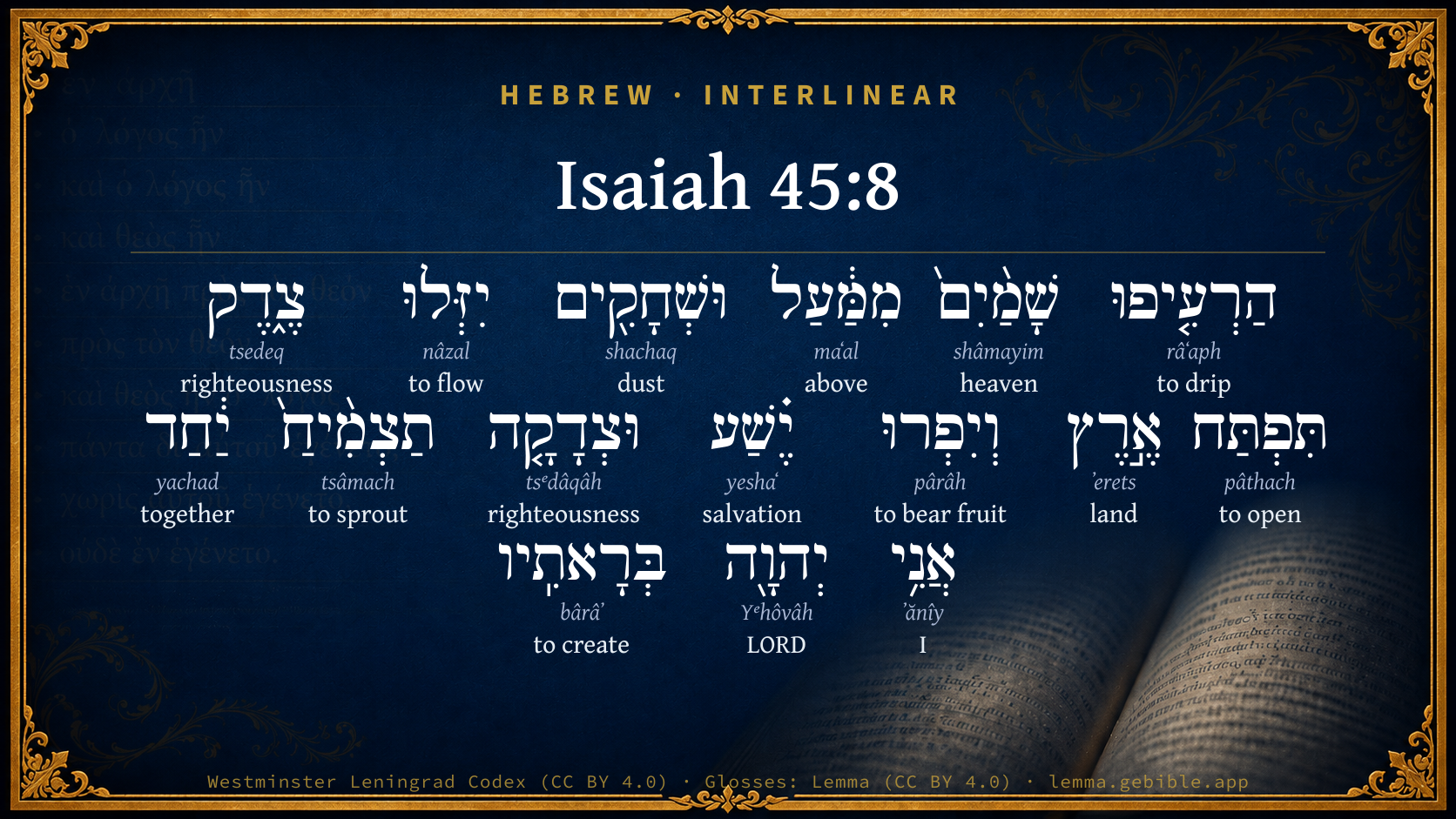
Isaiah 45:8

Hebrew (Westminster Leningrad Codex) Isaiah 45:8 appears in the Hebrew Old Testament. The text above is from the Westminster Leningrad Codex. Each word links to its Strong’s number, a concise gloss, and parsing drawn from the Open Scriptures Hebrew Bible morphology. Click any word for its full Brown-Driver-Briggs (BDB) entry.
Download image
Cite this verse

Isaiah 45:8 (World English Bible). Public Domain. Lemma interlinear Bible study tool, https://lemma.gebible.app/v/isaiah/45/8.

Show BibTeX & RIS
BibTeX
RIS
English Translation
Distil, you heavens, from above, and let the skies pour down righteousness: let the earth open, that it may bring forth salvation, and let it cause righteousness to spring up together; I, Yahweh, have created it.
World English Bible · Public Domain
Download a study sheet

One document with this verse’s original text, its word-by-word gloss line, the meaning frame, cross-references with their text, attributed commentary, and full source and license credits — printable, and it pastes into notes with its structure intact.

This verse Autodidact and up

Study sheet (.html) Plain text (.txt)

A passage Seminary Student

Up to 50 verses in one chapter. A passage sheet keeps up to 6 commentary sources and 12 cross-references per verse, in the order this page ranks them, and says so on the sheet whenever that leaves anything out. Ask for a single verse and you get the Autodidact verse sheet above.

Everything on this page stays free to read, with no account — the sheet is a download of what is already on screen, not access to it.

Want to remove ads? Support Godless Engineer
Compare translations 3

The same verse in 3 English versions, stacked beneath the original-language interlinear above. Click any original word for its lexicon entry.

Each is an independent rendering of the whole verse — the interlinear is not word-aligned to these translations.

Highlighted words mark where these versions differ — a whole-verse word diff, not a word-by-word alignment.

  • World English Bible Public Domain
    Distil, you heavens, from above, and let the skies pour down righteousness: let the earth open, that it may bring forth salvation, and let it cause righteousness to spring up together; I, Yahweh, have created it.
  • King James Version Public Domain
    Drop down, ye heavens, from above, and let the skies pour down righteousness: let the earth open, and let them bring forth salvation, and let righteousness spring up together; I the LORD have created it.
  • unfoldingWord Literal Text CC BY-SA 4.0
    Rain down from above, heavens, and let the skies pour down, righteousness. Let the earth open, and let them bear salvation, and let it make righteousness sprout together. I, Yahweh, have created it. q1

unfoldingWord Literal Text — © unfoldingWord, licensed CC BY-SA 4.0. Word-aligned USFM3 via Door43 (git.door43.org/unfoldingWord/en_ult).

Versions to compare (up to 4)

3 of 4 selected

Show all 18 translations

Every available English version of this verse, each an independent rendering of the whole verse.

  • World English Bible Public Domain
    Distil, you heavens, from above, and let the skies pour down righteousness: let the earth open, that it may bring forth salvation, and let it cause righteousness to spring up together; I, Yahweh, have created it.
  • Berean Standard Bible Public Domain
    Drip down, O heavens, from above, and let the skies pour down righteousness. Let the earth open up that salvation may sprout and righteousness spring up with it; I, the LORD, have created it.
  • Majority Standard Bible Public Domain
    Drip down, O heavens, from above, and let the skies pour down righteousness. Let the earth open up that salvation may sprout and righteousness spring up with it; I, the LORD, have created it.
  • King James Version Public Domain
    Drop down, ye heavens, from above, and let the skies pour down righteousness: let the earth open, and let them bring forth salvation, and let righteousness spring up together; I the LORD have created it.
  • American Standard Version (1901) Public Domain
    Distil, ye heavens, from above, and let the skies pour down righteousness: let the earth open, that it may bring forth salvation, and let it cause righteousness to spring up together; I, Jehovah, have created it.
  • Revised Version (1885) Public Domain
    Drop down, ye heavens, from above, and let the skies pour down righteousness: let the earth open, that they may bring forth salvation, and let her cause righteousness to spring up together; I the LORD have created it.
  • Geneva Bible (1599) Public Domain
    Ye heauens, send the dewe from aboue, and let the cloudes droppe downe righteousnesse: let the earth open, and let saluation and iustice growe foorth: let it bring them foorth together: I the Lord haue created him.
  • Douay-Rheims (1899) Public Domain
    Drop down dew, ye heavens, from above, and let the clouds rain the just: let the earth be opened, and bud forth a saviour: and let justice spring up together: I the Lord have created him.
  • Young's Literal Translation Public Domain
    Drop, ye heavens, from above, And clouds do cause righteousness to flow, Earth openeth, and they are fruitful, Salvation and righteousness spring up together, I, Jehovah, have prepared it.
  • Literal Standard Version CC BY-SA 4.0
    Drop, you heavens, from above, || And clouds cause righteousness to flow, || Earth opens, and they are fruitful, || Salvation and righteousness spring up together, || I, YHWH, have created it.
  • Unlocked Literal Bible CC BY-SA 4.0
    You heavens, rain down from above! Let the skies rain down righteousness. Let the earth absorb it, that salvation may sprout up, and righteousness spring up together with it. I, Yahweh, have created them both.
  • unfoldingWord Literal Text CC BY-SA 4.0
    Rain down from above, heavens, and let the skies pour down, righteousness. Let the earth open, and let them bear salvation, and let it make righteousness sprout together. I, Yahweh, have created it. q1
  • Darby Bible Public Domain
    Drop down, [ye] heavens, from above, and let the skies pour down righteousness; let the earth open, and let them bring forth salvation, and with it let righteousness spring up. I, Jehovah, have created it.
  • World Messianic Bible Public Domain
    Rain, you heavens, from above, and let the skies pour down righteousness. Let the earth open, that it may produce salvation, and let it cause righteousness to spring up with it. I, the LORD, have created it.
  • Webster's Bible Public Domain
    Drop down, ye heavens, from above, and let the skies pour down righteousness: let the earth open, and let them bring forth salvation, and let righteousness spring up together; I the LORD have created it.
  • Free Bible Version CC BY-SA 4.0
    Let the rain fall from the sky above, let goodness fall from the clouds, let the earth open up to receive goodness and salvation so they can grow together. I, the Lord, created them.
  • Bible in Basic English Public Domain
    Let righteousness come down, O heavens, from on high, and let the sky send it down like rain: let the earth be open to give the fruit of salvation, causing righteousness to come up with it; I the Lord have made it come about.
  • JPS Tanakh (1917) Public Domain
    Drop down, ye heavens, from above, and let the skies pour down righteousness; let the earth open, that they may bring forth salvation, and let her cause righteousness to spring up together; I the LORD have created it.

Literal Standard Version (2020), Covenant Press — licensed CC BY-SA 4.0. Text via the HelloAO Bible API (eBible.org). Unlocked Literal Bible (unfoldingWord) — licensed CC BY-SA 4.0. Text via the HelloAO Bible API (eBible.org). unfoldingWord Literal Text — © unfoldingWord, licensed CC BY-SA 4.0. Word-aligned USFM3 via Door43 (git.door43.org/unfoldingWord/en_ult). Free Bible Version, Dr. Jonathan Gallagher — licensed CC BY-SA 4.0. Text via the HelloAO Bible API (eBible.org).

Word by word

More ways to search: Search by grammar → Find every occurrence → Compare this word →

Practice this passage: Drill this verse → Learn its vocabulary →

הַרְעִ֤יפוּ
râʻaph
H7491
“drip”
Verb, Hiphil, Imperative, 2nd Person, Masculine, Plural
Part of Speech
Verb
Stem
Hiphil
Form
Imperative
Person
2nd Person
Gender
Masculine
Number
Plural
Full BDB Definition

Origin: a primitive root

TWOT: 2193

to trickle, drip - (Qal) to trickle, drip - (Hiphil) to trickle
  1. שָׁמַ֨יִם֙ shâmayim H8064 “heaven(s)” Noun, Common, Masculine, Plural, Absolute
  2. מִמַּ֔עַל maʻal H4605 “from · above” Preposition + Adverb
  3. וּשְׁחָקִ֖ים shachaq H7834 “and · clouds” Conjunction + Noun, Common, Masculine, Plural, Absolute
  4. יִזְּלוּ nâzal H5140 “to flow” Verb, Qal, Imperfect, 3rd Person, Masculine, Plural
  5. צֶ֑דֶק tsedeq H6664 “righteousness” Noun, Common, Masculine, Singular, Absolute
  6. תִּפְתַּח pâthach H6605 “to open” Verb, Qal, Imperfect, 3rd Person, Feminine, Singular
  7. אֶ֣רֶץ ʼerets H776 “land” Noun, Common, Both, Singular, Absolute
  8. וְיִפְרוּ pârâh H6509 “and · to bear fruit” Conjunction + Verb, Qal, Imperfect, 3rd Person, Masculine, Plural
  9. יֶ֗שַׁע yeshaʻ H3468 “salvation” Noun, Common, Masculine, Singular, Absolute
  10. וּצְדָקָ֤ה tsᵉdâqâh H6666 “and · righteousness” Conjunction + Noun, Common, Feminine, Singular, Absolute
  11. תַצְמִ֨יחַ֙ tsâmach H6779 “to sprout” Verb, Hiphil, Imperfect, 3rd Person, Feminine, Singular
  12. יַ֔חַד yachad H3162 “together” Adverb
  13. אֲנִ֥י ʼănîy H589 “I” Pronoun, Personal, 1st Person, Common, Singular
  14. יְהוָ֖ה Yᵉhôvâh H3068 “LORD” Noun, Proper
  15. בְּרָאתִֽיו bârâʼ H1254 “to create · him” Verb, Qal, Perfect, 1st Person, Common, Singular + Suffix, Personal, 3rd Person, Masculine, Singular

About this verse

These counts appear in no published source. They are computed here, from the morphology-tagged text and Lemma’s own curated glosses. What Lemma adds →

16
words
16
distinct lemmas
Prophets
section

Notable vocabulary

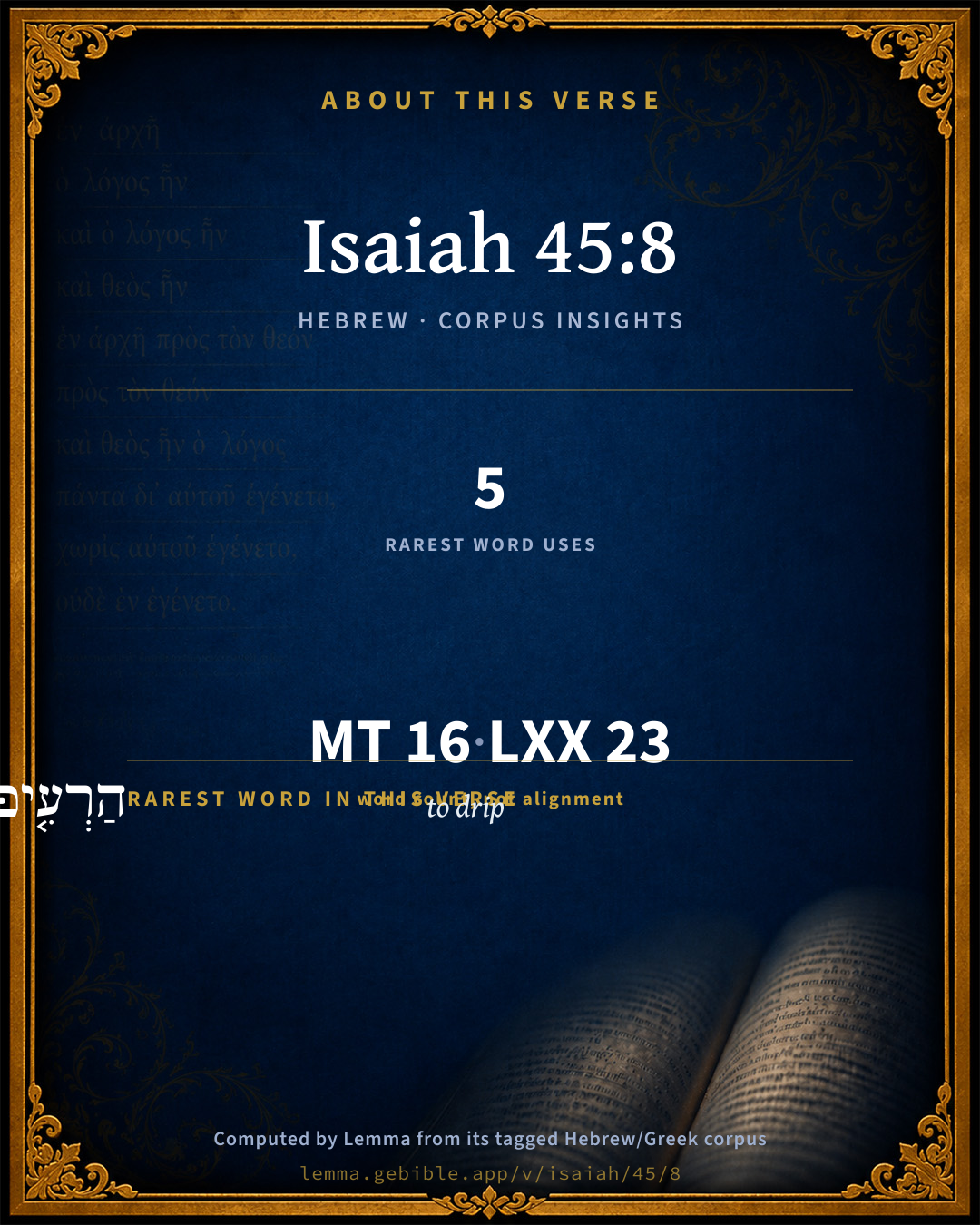
The rarest word here is הַרְעִ֤יפוּ to drip H7491 — appearing just 5 times in the whole Hebrew Bible.

Shared distinctive vocabulary

הַרְעִ֤יפוּ to drip H7491 occurs in 5 verses of the Hebrew Bible. Also found in:

Grammatical profile

  • 6 verbs
  • 7 nouns
  • 1 pronoun
  • 2 adverbs

Verb forms

  • הַרְעִ֤יפוּ Hiphil · Imperative
  • יִזְּלוּ Qal · Imperfect
  • תִּפְתַּח Qal · Imperfect
  • וְיִפְרוּ Qal · Imperfect
  • תַצְמִ֨יחַ֙ Hiphil · Imperfect
  • בְּרָאתִֽיו Qal · Perfect

Hebrew & Septuagint length

In English translation the verse runs 36 words from the Hebrew and 33 from the Septuagint (LXX English) — closely comparable.

A rough comparison of the two English renderings, which tokenize alike — not a word-level alignment.

Word counts can differ between the Hebrew and the Greek without any difference in meaning — e.g. the Hebrew direct-object marker אֵת has no separate Greek word, and Greek often adds the article ὁ.

In the original languages it is 16 Hebrew tokens and 23 Greek tokens — but the two are counted differently (Hebrew bundles its prefixes and suffixes into one token; the Greek is in lemma form), so that isn’t a like-for-like length.

Cross-references

24

Topical passages linked to Isaiah 45:8 in the Treasury of Scripture Knowledge — connected by theme and wording, ordered by reader-vote popularity; previews shown in the World English Bible.

  • Hosea 10:12 Sow to yourselves in righteousness, Reap according to kindness. Break up your fallow ground; For it is time to seek Yahweh, Until he comes and rains righteousness on you.
  • Isaiah 61:11 For as the earth brings forth its bud, and as the garden causes the things that are sown in it to spring forth; so the Lord Yahweh will cause righteousness and praise to spring forth before all the nations.
  • Psalms 72:6 He will come down like rain on the mown grass, As showers that water the earth.
  • 1 Corinthians 3:6–9 I planted. Apollos watered. But God gave the increase.
  • Isaiah 44:3 For I will pour water on him who is thirsty, and streams on the dry ground; I will pour my Spirit on your seed, and my blessing on your offspring:
  • Titus 3:3–6 For we were also once foolish, disobedient, deceived, serving various lusts and pleasures, living in malice and envy, hateful, and hating one another.
  • Joel 3:18 It will happen in that day, That the mountains will drop down sweet wine, The hills will flow with milk, All the brooks of Judah will flow with waters; And a fountain will come forth from the house of Yahweh, And will water the valley of Shittim.
  • Psalms 85:9–12 Surely his salvation is near those who fear him, That glory may dwell in our land.
  • Isaiah 4:2 In that day, Yahweh's branch will be beautiful and glorious, and the fruit of the land will be the beauty and glory of the survivors of Israel.
  • Isaiah 11:1 There shall come forth a shoot out of the stock of Jesse, and a branch out of his roots shall bear fruit.
  • Isaiah 32:15 until the Spirit be poured on us from on high, and the wilderness become a fruitful field, and the fruitful field be esteemed as a forest.
  • Psalms 72:3 The mountains shall bring prosperity to the people. The hills bring the fruit of righteousness.
  • Isaiah 53:2 For he grew up before him as a tender plant, and as a root out of a dry ground: he has no form nor comeliness; and when we see him, there is no beauty that we should desire him.
  • Isaiah 60:21 Your people also shall be all righteous; they shall inherit the land forever, the branch of my planting, the work of my hands, that I may be glorified.
  • Isaiah 65:17–18 For, behold, I create new heavens and a new earth; and the former things shall not be remembered, nor come into mind.
  • Hosea 14:5–8 I will be like the dew to Israel. He will blossom like the lily, And send down his roots like Lebanon.
  • Joel 2:28–29 "It will happen afterward, that I will pour out my Spirit on all flesh; And your sons and your daughters will prophesy. Your old men will dream dreams. Your young men will see visions.
  • Isaiah 61:3 to appoint to those who mourn in Zion, to give to them a garland for ashes, the oil of joy for mourning, the garment of praise for the spirit of heaviness; that they may be called trees of righteousness, the planting of Yahweh, that he may be glorified.
  • Isaiah 66:22 For as the new heavens and the new earth, which I will make, shall remain before me, says Yahweh, so shall your seed and your name remain.
  • Jeremiah 31:22 How long will you go here and there, you backsliding daughter? for Yahweh has created a new thing in the earth: a woman shall encompass a man.
  • Ezekiel 34:26 I will make them and the places round about my hill a blessing; and I will cause the shower to come down in its season; there shall be showers of blessing.
  • Acts 2:33 Being therefore exalted by the right hand of God, and having received from the Father the promise of the Holy Spirit, he has poured out this, which you now see and hear.
  • Ephesians 2:10 For we are his workmanship, created in Christ Jesus for good works, which God prepared before that we would walk in them.
  • Ephesians 4:24 and put on the new man, who in the likeness of God has been created in righteousness and holiness of truth.

Cross-references courtesy of OpenBible.info (CC BY 4.0).

Hebrew and Greek witnesses Masoretic Hebrew ↔ Greek Septuagint

The same verse in the two great witnesses to the Old Testament, shown verse-for-verse.

These are two independent witnesses, not word-aligned to each other, and the Septuagint is shown in lemma (dictionary) form.

Hebrew Isaiah 45:8 Masoretic · Westminster Leningrad Codex

הַרְעִ֤יפוּ שָׁמַ֨יִם֙ מִמַּ֔עַל וּשְׁחָקִ֖ים יִזְּלוּ צֶ֑דֶק תִּפְתַּח אֶ֣רֶץ וְיִפְרוּ יֶ֗שַׁע וּצְדָקָ֤ה תַצְמִ֨יחַ֙ יַ֔חַד אֲנִ֥י יְהוָ֖ה בְּרָאתִֽיו

Distil, you heavens, from above, and let the skies pour down righteousness: let the earth open, that it may bring forth salvation, and let it cause righteousness to spring up together; I, Yahweh, have created it.

World English Bible · Public Domain

Greek LXX Isaiah 45:8 Septuagint · lemma form

εὐφραίνω ὁ οὐρανός ἄνωθεν καί ὁ νεφέλη ῥαίνω δικαιοσύνη ἀνατέλλω ὁ γῆ ἔλεος καί δικαιοσύνη ἀνατέλλω ἅμα ἐγώ εἰμί κύριος ὁ κτίζω σύ

Let the heaven rejoice from above, and let the clouds rain righteousness: let the earth bring forth, and blossom with mercy, and bring forth righteousness likewise: I am the Lord that created you.

LXX2012 (modern English Septuagint) · Public Domain

On this verse, Adam Clarke's Commentary discusses the Septuagint’s reading. Read the note in Commentary ↓

Hebrew: Westminster Leningrad Codex (CC BY 4.0). Greek: Septuagint (public domain); English from LXX2012 (modern English Septuagint) (Public Domain). How the Septuagint differs from the Hebrew →

Targum (Aramaic paraphrase)

1

The Targum is the ancient Jewish Aramaic paraphrase of the Hebrew Scriptures — an interpretive translation, not the Hebrew text itself. Onkelos (literal) and Pseudo-Jonathan (expansive) render the Torah, and Jonathan the Prophets. Coverage is partial: where no permissively-licensed English translation exists for a verse, only the Aramaic is shown. This is verse-level text, not a word-by-word alignment to the Hebrew.

  1. Targum Jonathan Prophets (Joshua–Malachi)
    יְשַׁמְשׁוּן שְׁמַיָא מִלְעֵלָא וַעֲנָנַיָא יִגְדוּן טוּבָא תִּתְפְּתַח אַרְעָא וְיֵחוּן מֵתַיָא וּזְכוּתָא תִתְגְלֵי כַּחֲדָא אֲנָא יְיָ בְּרֵיתִינוּן:

    Let the heavens drop down from above, and the clouds flow with good, let the earth open itself, and the dead live, and let righteousness be revealed together; I the Lord have created them.

    Targum Jonathan — Aramaic: “Mikraot Gedolot” (public domain). English: “Sefaria Community Translation” (CC0 1.0 (public-domain dedication)); “London "Chaldee Paraphrase," 1871” (public domain). Text via Sefaria.

Commentary

Notes on Isaiah 45:8 from classic Christian and Jewish commentators (each source and its license shown beneath its notes). The classic Christian expositions comment on the surrounding passage and are grouped to its opening verse, so a note may address several verses; the Jewish commentaries on the Tanakh (Rashi and others) are per-verse, so they appear only where the commentator wrote on this verse.

Lemma curates 59 commentaries, every one of them public domain or Creative Commons licensed, each selected and text-cleaned for this edition rather than reprinted as found. About our sources →

Trapp's Complete Commentary

John Trapp

Isa 45:8 Drop down, ye heavens, from above, and let the skies pour down righteousness: let the earth open, and let them bring forth salvation, and let righteousness spring up together; I the LORD have created it.

Ver. 8. Drop down, ye heavens, from above.] A prayer of the poor captives in Babylon, say some, for a speedy performance of their promised deliverance; and this the rather because else Christ could not come of them, teach in their country, work miracles, and fulfil the office of a mediator, as the prophets had foretold. Whereunto God immediately answereth: I, the Lord, have created him, or will create him, that is, send him in due time, doubt ye not. Others make it a description of Cyrus’s just and happy reign; see the like of Solomon. {Psa 72:6-7} And indeed Cyrus is famous in heathen histories for his wisdom, justice, temperance, magnanimity, and liberality. It is not the custom of Cyrus to hoard up money, saith Xenophon, {a} for he taketh more delight in giving than in getting or possessing. But it seemeth rather to be a command from God of plenty and prosperity, opposite to that countermand. {Isa 5:6} The Papists apply it to Christ and his mother, and hence their roaring out of Rorate in their solemn service, a month before the feast of the nativity, and then they call for their carousing cups.

{a} Cyropaed., lib. viii.

John Trapp, A Commentary or Exposition upon All the Books of the Old and New Testament (1647–1656) — public domain. Text from a community e-Sword module.

The Biblical Illustrator

Joseph S. Exell

Isa_45:8

Drop down, ye heavens

Salvation comes of mans response to God

To the eye of the seer the earth lies open to heaven as a wide corn-land over which the clouds of heaven hang, the air breathes, and the sun sheds sheets of light.

Those clouds are big with righteousness, the special term used throughout this book of the faithfulness of Jehovah. At the call of prayer the skies pour down their precious treasure, and the earth opens every pore to receive the plentiful rain; presently every acre brings forth salvation, and righteousness springs up in the hearts of men, as their answer to the descent of the righteousness of God. It is the bridal of heaven and earth, a fulfilment of the prediction of the psalm: Truth springeth out of the earth; and righteousness hath looked down from heaven. The conception is one of surpassing beauty. The brooding of heaven; the response of earth. Deep calling unto deep. The nature of God originating and inspiring; the nature of man responding. And when the descending grace of God is thus received by the believing yearning heart of man, the result is salvation. As the margin of R.V. reads: Let the skies be fruitful in salvation, and let the earth cause righteousness to spring up together. The whole paragraph to the close of the chapter rings with salvation as its keynote. Does God hide Himself? He is the God of Israel, the Saviour. Are the makers of idols ashamed and confounded? Yet Israel is saved with an everlasting salvation. Are graven images held up to contempt? It is because they are gods that cannot save. Does God assert His unrivalled Deity? It is because He is a just God, and a Saviour. Are men bidden to look to Him, though they be far removed as the ends of the earth? It is that they may be saved. Primarily, no doubt, this salvation concerns the emancipation of the chosen people from the thraldom of Babylon, and their restoration to Jerusalem. He shall build My city; he shall let My exiles go free, not for price nor reward, saith the Lord of hosts. This deliverance, which is a type of the greater deliverance from the guilt and power of sin, was, in the fixed purpose of God, sure as the creation of the earth and man; guaranteed by the hands that stretched out the heavens, and by the word that commanded all their host. (F. B. Meyer, B. A.)

The Biblical Illustrator, edited by Joseph S. Exell (c. 1880s–1900s) — public domain. Text from a community e-Sword module.

Joseph Benson's Commentary

Isa 45:8. Drop down, ye heavens, from above, &c. — It appears from the last clause of this verse, that these are the words of Jehovah himself, commanding blessings to descend upon his people, and exhorting his people willingly and gratefully to receive them, and to walk worthy of them. The passage is strongly figurative, and Vitringa is of opinion, that it “refers primarily to the blessings consequent upon the deliverance from the Babylonish captivity; but secondarily, and in its more complete sense, to that righteousness and salvation liberally imparted to man by the grace of the Messiah.” The words may be thus paraphrased: Let the heavens drop down, or, they shall drop down, as it were, from above, &c. God’s righteous and gracious acts, done for his people, and his blessings conferred upon them, shall be as many and illustrious as if he rained them down from heaven. But let the earth open itself, both to receive those refreshing and fertilizing showers, and to bring forth those fruits which they might be reasonably expected to produce. And let them — The heavens and the earth conspiring together; bring forth salvation — The redemption and deliverance of God’s people from Babylon, by Cyrus, and from ignorance and error, sin and death, by the Messiah. And let righteousness spring up together — Together with salvation. Let the holiness of my people bear some proportion to their privileges and advantages, and the great things I have done for them. I the Lord have created it — I am the author, both of the salvation and of the righteousness which springs up together with it.

Joseph Benson's Commentary on the Old and New Testaments (1811–1818) — public domain. Text from a community e-Sword module.

The Preacher's Complete Homiletical Commentary

Joseph S. Exell (gen. ed.)

THE HEAVENS DROPPING RIGHTEOUSNESS

Isa_45:8. Drop down, ye heavens, &c.

There is a fulness in the language more than commensurate with the revival of the piety and temporal well-being of the Jews after their return to Canaan. It points to Gospel times; righteousness, and all the blessings of the Messiah’s reign, were to descend as copious showers and refreshing dews upon the earth … so that the desolate wilderness should suddenly become fertile (see vol. i. pp. 364, 399). The evangelic prophet invokes this. Such are the Divine promises. We may observe from the words under consideration—

I. That the Divine influence is requisite to the prosperity of religion in the heart of the believer, and in any Christian community. The moment the Church of Christ loses sight of this truth, that moment she becomes shorn of her strength. She goes a warfare at her own charges. With frail human power she attempts what Omnipotence alone can effect. In a work so great our mightiest efforts are powerless when unaided by Divine strength. This truth should be a settled principle in our hearts: “All evil is of myself. I inherit it from my birth,” &c. Sin robbed man to some extent of physical beauty, and does so now. The change in his mental and moral nature was equally great. Sin weakens and debases the powers of the soul. The understanding is blinded and the heart hardened through the deceitfulness of sin, or it would require Satanic wickedness for men to sin against God as they now do. Our sins are unspeakably greater than we can conceive of. All evil is from ourselves, and all good is from God. This is true of saint and sinner. Divine influence is requisite in the conviction of sin, and in the conversion of the sinner (H. E. I. 1477, 1400–1405). Their progress in the Divine life, conquest over every foe, &c., are derived from “the supply of the Spirit of Christ;” in whom they possess all spiritual blessings, and are now the “partakers of the grace of life,” and inheritors of the kingdom of glory.

II. That the resources of Divine grace, which God has promised to bestow in order to effect this prosperity, are abundant and inexhaustible. Such prosperity is eminently enjoyed where there are numerous conversions, and where the life of God in the hearts of His people is exemplified in every action by intense affection for one another, and their united continuous effort for man’s highest weal and the Redeemer’s glory. Everything revealed to us of the Divine character and purpose encourages such effort. The promises are pregnant with blessing. They reveal the purposes of Divine love, and warrant the most enlarged expectations and fervent appeals to God that He will “do as He has said.” His gracious and immutable purposes are the universal spread of the Gospel. God shall pour down righteousness, the earth shall receive the abundant blessing and bring forth salvation (Rev_11:15).

III. That human instrumentality is invariably employed, in co-operation with Divine agency, in achieving this prosperity. It is impossible to ascertain the precise point where human instrumentality and Divine agency meet, and how both are united to attain the same purpose. Our duty is to labour in dependence upon God. Would it be possible to find a Christian whose conversion was effected apart from human agency in some form or other? Every outpouring of the Spirit upon the world has been preceded by united supplication. Say not that human instrumentality is unimportant; nothing is so which God deems good to employ (1Co_1:21). When gracious influences come down like showers and refreshing dew, the sinner should open his heart to welcome the blessing.

IV. That such a consummation is to be devoutly desired and sought by the fervent and united prayers of His believing people. The salvation of sinners, and the happiness of believers, should prompt the prayer, “Drop down,” &c. Such a consummation would cause earth to bear a closer resemblance to heaven. “The whole earth shall be filled with His glory.”—T. Jowett, The Christian World, July 31, 1863.

The Preacher's Complete Homiletical Commentary (gen. ed. Joseph S. Exell; Funk & Wagnalls, c. 1892) — public domain (pre-1929). A full-Bible homiletical/sermon-outline anthology covering 65 of 66 books (2 John is absent from the source module). Text from a community e-Sword module.

Geneva Bible (1599)

Geneva Bible translators

I have appointed Cyrus to this use and purpose.

He comforteth the Jews, as if he would say, Though when ye look to the heavens and earth for succor, ye see nothing now but signs of God’s wrath, yet will cause them to bring forth most certain tokens of your deliverance, and of the performance of my promise: which is meant by righteousness.

Geneva Bible (1599) marginal notes — public domain. Text via Bolls.life.

Jamieson, Fausset & Brown

Robert Jamieson, A. R. Fausset & David Brown

Drop--namely, the fertilizing rain (Psa 65:12).

skies--clouds; lower than the "heavens."

righteousness--that is, the dews of the Holy Spirit, whereby "righteousness" shall "spring up." (See latter end of the verse).

earth--figuratively for the hearts of men on it, opened for receiving the truth by the Holy Ghost (Act 16:14).

them--the earth and the heavens. HORSLEY prefers: "Let the earth open, and let salvation and justice grow forth; let it bring them forth together; I the Lord have created him" (Isa 45:13). MAURER translates, "Let all kinds of salvation (prosperity) be fruitful" (Psa 72:3, Psa 72:6-7). The revival of religion after the return from Babylon suggests to the prophet the diffusion of Messiah's Gospel, especially in days still future; hence the elevation of the language to a pitch above what is applicable to the state of religion after the return.

Jamieson, Fausset & Brown — Commentary Critical and Explanatory on the Whole Bible (1871) — public domain (CC PDM 1.0). Text via the HelloAO Bible API.

Adam Clarke's Commentary

Verse 8. Drop down, ye heavens] The eighty-fifth psalm is a very elegant ode on the same subject with this part of Isaiah's prophecies, the restoration of Judah from captivity; and is, in the most beautiful part of it, a manifest imitation of this passage of the prophet: -

"Verily his salvation is nigh unto them that fear him,

That glory may dwell in our land.

Mercy and truth have met together;

Righteousness and peace have kissed each other.

Truth shall spring from the earth,

And righteousness shall look down from heaven.

Even JEHOVAH: will give that which is good,

And our land shall yield her produce.

Righteousness shall go before him,

And shall direct his footsteps in the way."

Ps 85:9-13.

See the notes on these verses.

These images of the dew and the rain descending from heaven and making the earth fruitful, employed by the prophet, and some of those nearly of the same kind which are used by the psalmist, may perhaps be primarily understood as designed to set forth in a splendid manner the happy state of God's people restored to their country, and flourishing in peace and plenty, in piety and virtue; but justice and salvation, mercy and truth, righteousness and peace, and glory dwelling in the land, cannot with any sort of propriety, in the one or the other, be interpreted as the consequences of that event; they must mean the blessings of the great redemption by Messiah.

Let the earth open, c.] Jonathan, in his Targum, refers this to the resurrection of the dead the earth shall be opened, ויחון מיתיא veyechon meiteiya, and the dead shall revive. A plain proof that the ancient Jews believed in a future state, and acknowledged the resurrection of the dead.

Let them bring forth salvation - "Let salvation produce her fruit"] For ויפרו vaiyiphru, the Septuagint, Vulgate, and Syriac read ויפרה vaiyiphrah; and one MS. has a rasure close after the latter ו vau, which probably was he at first.

Adam Clarke's Commentary on the Bible (1810–1826) — public domain. Text from a community e-Sword/MySword module.

Ellicott's Commentary for English Readers

(8) Let the skies pour down righteousness . . .—The vision is that of a new heaven and a new earth, in which righteousness is at once as the rain that falls from the one, and as the product of the other.

A Bible Commentary for English Readers, edited by Charles John Ellicott (1878–1897) — public domain. Text from a community e-Sword module.

The Cambridge Bible for Schools and Colleges

gen. ed. J. J. S. Perowne

8. A lyrical effusion, called forth by the thought of the blessings that will follow the triumph of the true religion. The heavens are represented as showering down gracious influences, which fructify the earth and cause it to bring forth the fruits of salvation. For the figure of the verse, cf. ch. Isa_55:10; Hos_2:21 f.; Psa_72:6; and esp. Psa_85:11 (“truth springs out of the earth, and righteousness looks down from heaven”).

Drop down] is a causative verb, the obj. being “righteousness” in the next line.

let them bring forth &c.] Rather: let salvation and […] spring forth; let her (the earth) cause righteousness to spring up. The plural verb causes some difficulty. A.V. (and R.V.) appear to take heavens and earth as subj.; but this is hardly possible, first because they belong to different distichs, and secondly, because the verb is always neuter (Deu_29:17 is no exception). Perhaps a word has been omitted from the text.

Two words are here used for righteousness, that which comes down from heaven is çedeq, that which springs from the earth is çìdâqâh. The figure might suggest that çedeq is the cause of which çìdâqâh is the effect; the former being the divine “right” which establishes salvation &c., and the latter the human order which is an element of it. But any such distinction is precarious. Salvation (yesha‘) which ordinarily means “deliverance” appears here to be used in its wider sense of “welfare,” like the kindred noun in Job_30:15 (“my welfare is passed away as a cloud”). See Introduction, p. xxviii [78].

[78] The idea of salvation has an instructive history. In Arabic the root wasi‘a means to be wide, roomy, spacious, &c.; and hence the Hebr. verb “to save” (which is the causative of this) means primarily “to make room for one,” “to give one freedom or space to move in.” Even in this form the word contains the germ of a valuable religious idea, salvation being essentially freedom for the normal expansion of man’s true life. In the O.T., however, it is always used with express reference to some pressure or impediment, the removal of which constitutes the essence of the act called salvation or the state of salvation which results from it (יֶשַׁע, יְשׁוּעָה, תְּשׁוּעָה). In the earlier literature these names have mostly a secular and political application, denoting “succour” in a military sense, or (more frequently) “victory.” The religious sense grew naturally out of this. At all times it was recognised that Jehovah is the source of deliverance or victory; but at least from the time of the Exile the centre of gravity of the idea was shifted from the temporal act of deliverance to the partly spiritual blessings which were secured by it. Salvation becomes (as in this prophecy) a comprehensive term for that decisive vindication of Israel’s cause which was the foundation of all national well-being. At the same time “these words seldom, if ever, express a spiritual state exclusively; their common theological sense in Hebrew is that of a material deliverance attended by spiritual blessings” (see Driver, Notes on Samuel, p. 90).

The Cambridge Bible for Schools and Colleges (gen. ed. J. J. S. Perowne; Cambridge University Press, 1878–1918) — public domain. Text from a community e-Sword module.

John Gill's Exposition

Drop down, ye heavens, from above, and let the skies pour down righteousness,.... Or, "the righteous One", as the Vulgate Latin version; the Lord our righteousness, Christ the author of righteousness, who was to bring in an everlasting one; and whose coming was to be, and was, as the rain, as the former and latter rain to the earth, Hos 6:3, and who came from heaven to earth to fulfil all righteousness; and with him came an abundance of blessings of rich grace, even all spiritual blessings, peace, pardon, righteousness, salvation, and eternal life, which were poured down from above upon the sons of men; thus the Holy Ghost, the spirit of prophecy, proceeds at once from Cyrus to Christ, from the type to the antitype, from the temporal redemption of the Jews to the spiritual redemption of the Lord's people; and these words are to be considered, not as a petition of the prophet, or of the church, for the coming of Christ, and salvation by him; but a promise and prophecy of it. Aben Ezra and Kimchi take them to be an address to the angels of heaven to assist in the affair of the salvation of Israel; these did drop down or descend, even a great multitude of them, at the incarnation of Christ, and published the good tidings of good things that came by him:

let the earth open, and let them bring forth salvation; or the "Saviour", as the Vulgate Latin version; Christ the author of salvation, who was appointed to be the salvation or Saviour of his people, who came to effect it, and has obtained it; heaven and earth were both concerned in bringing forth this "fruit" of righteousness and salvation, as the word (o) rendered "bring forth" signifies; see Isa 4:2. Christ was the Lord from heaven, and yet made of a woman in the lowest parts of the earth: Christ, who is the "truth", sprung "out of the earth"; and he, who is the author of "righteousness", looked down from heaven, Psa 85:11 and it follows: "let righteousness spring up together"; or "bud forth" (p) as a branch; one of the names of the Messiah, frequent in prophecy:

I the Lord have created it; or that, both righteousness and salvation; or Christ as man, the author of both, whom God appointed, and raised up, and sent to be the Redeemer and Saviour of his people. The Targum interprets this of the resurrection of the dead, paraphrasing the whole thus;

"let the heavens from above minister, and the clouds flow with good; let the earth open, and the dead revive; and let righteousness be revealed together; I the Lord have created them.''

(o) "fructificent", Vatablus; "edant fractum salutis"; Junius & Tremellius. (p) "germinare faciet", Pagninus, Montanus, Vatablus, "progerminet germen", Vitringa.

John Gill's Exposition of the Whole Bible (1746–1763) — public domain (CC PDM 1.0). Text via the HelloAO Bible API.

Albert Barnes' Notes on the Bible

Drop down, ye heavens, from above - That is, as a result of the benefits that shall follow from the rescue of the people from their captivity and exile. The mind of the prophet is carried forward to future times, and he sees effects from that interposition, as striking as if the heavens should distil righteousness; and sees the prevalence of piety and happiness as if they should string out of the earth. It may be designed primarily to denote the happy results of their return to their own land, and the peace and prosperity which would ensue. But there is a beauty and elevation in the language which is better applicable to the remote and distant consequences of their return - the coming and reign of the Messiah. The figure is that of the rain and dew descending from heaven, and watering, the earth, and producing fertility and beauty; and the idea is, that piety and peace would prevail in a manner resembling the verdure of the fields under such rains and dews. A figure remarkably similar to this is employed by the Psalmist Psa 85:11-12 :

Truth shall spring out of the earth;

And righteousness shall look down from heaven.

Yea, the Lord shall give that which is good -

And our land shall yield her increase.

The phrase, ‘drop down, ye heavens, from above,’ means, pour forth, or distil, as the clouds distil, or drop down the rain or dew Psa 45:12-13. It is appropriately applied to rain or dew, and here means that righteousness would be as abundant as if poured down like dews or showers from heaven. The Septuagint however, render it, ‘Let the heavens above be glad,’ but evidently erroneously.

And let the skies - The word used here (שׁחקים shechaqiym) is derived from the verb שׁצק shâchaq, “to rub,” pound fine, or beat in pieces; and is then applied to dust (see Isa 40:15); to a thin cloud; a cloud of dust; and then to clouds in general Job 36:28; Job 37:18; Job 38:37. The sense here is, that righteousness should be poured down like rain from the clouds of heaven; that is, it should be abundant, and should prevail on the earth.

Pour down righteousness - The result of the deliverance from the captivity shall be, that righteousness shall be abundant. During the captivity they had been far away from their native land; the temple was destroyed; the fire had ceased to burn on the altars; the praises of God had ceased to be celebrated in his courts; and all the means by which piety had been nourished had been withdrawn. This state of things was strikingly similar to the earth when the rain is witcheld, and all verdure droops and dies. But after the return from the exile, righteousness would abound under the re-establishment of the temple service and the means of grace. Nor can there be any doubt, I think, that the mind of the prophet was also fixed on the prevalence of religion which would yet take place under the Messiah, whose coming, though remotely, would be one of the results of the return from the exile, and of whose advent, that return would be so strikingly emblematic.

Let the earth open - As it does when the showers descend and render it mellow, and when it brings forth grass and plants and fruits.

And let them bring forth salvation - The Chaldee renders this, ‘Let the earth open, and the dead revive, and righteousness be revealed at the same time.’ The idea is, let the earth and the heavens produce righteousness, or become fruitful in producing salvation. Salvation shall abound as if it descended like showers and dews, and as if the fertile earth everywhere produced it. Vitringa supposes that it means that the hearts of people would be opened and prepared for repentance and the reception of the truth by the Holy Spirit, as the earth is made mellow and adapted to the reception of seed by the rain and dew.

And let righteousness spring up together - Let it at the same time germinate as a plant does. It shall spring forth like green grass, and like flowers and plants in the well-watered earth. The language in the verse is figurative, and very beautiful. The idea is, that peace, prosperity, and righteousness start up like the fruits of the earth when it is well watered with the dews anti rains of heaven; that the land and world would be clothed in moral loveliness; and that the fruits of salvation would be abundant everywhere. That there was a partial fulfillment of this on the return to the land of Canaan, there can be no doubt. The Jews were, for a time at least, much more distinguished for piety than they had been before. Idolatry ceased; the temple was rebuilt; the worship of God was re-established; and the nation enjoyed unaccustomed prosperity. But there is a richness and fullness in the language which is not met by anything that occurred in the return from the exile; and it doubtless receives its entire fulfillment only under that more important deliverance of which the return from Babylon was but the emblem. As referred to the Messiah, and to his reign, may we not regard it as descriptive of the following things?

1. The prevalence and diffusion of the knowledge of salvation under his own preaching and that of the apostles. Religion was revived throughout Judea, and spread with vast rapidity throughout almost the whole of the known world. It seemed as if the very heavens shed down righteousness on all lands, and the earth, so long barren and sterile, brought forth the fruits of salvation. Every country partook of the benefits of the descending showers of grace, and the moral world put on a new aspect - like the earth after descending dews and rains.

2. It is beautifully descriptive of a revival of religion like that on the day of Pentecost. In such scenes, it seems as if the very heavens ‘poured down’ righteousness. A church smiles under its influence like parched and barren fields under rains and dews, and society puts on an aspect of loveliness like the earth after copious showers. Salvation seems to start forth with the beauty of the green grass, or of the unfolding buds, producing leaves and flowers and abundant fruits. There cannot be found anywhere a more beautiful description of a genuine revival of pure religion than in this verse.

3. It is descriptive, doubtless, of what is yet to take place in the better days which are to succeed the present, when the knowledge of the Lord shall fill the earth. All the earth shall be blessed, as if descending showers should produce universal fertility, and every land, now desolate, barren, sterile, and horrid by sin, shall become ‘like a well-watered garden’ in reference to salvation.

Albert Barnes' Notes on the Bible (1834–1885) — public domain. Text from a community e-Sword/MySword module.

Haydock's Catholic Bible Commentary

Saviour. Thus the ancient saints thirsted for the coming of Christ. His figure is styled the just, chap. xli. 2, 25. --- Him. Christ, born of the virgin, in time, and of God from all eternity. I have appointed Cyrus to be his precursor, to set the captives free. (Calmet) --- He has been spoken of before. But now the prophet turns to Christ alone, who built his Church on a rock. (Worthington) --- Cyrus had not a right faith in God, and Zorobabel was himself set free, and was not king. (St. Jerome)

George Leo Haydock (1774–1849), Haydock's Catholic Family Bible and Commentary, 1859 edition — public domain. Excludes Psalms (Douay-Rheims chapter numbering differs from Protestant) and Deuterocanonical books (Catholic canon only).

Matthew Poole's English Annotations

Let the skies pour down righteousness; the righteous and gracious acts of God for his people shall be so many and illustrious, as if God rained down showers of righteousness out of heaven.

Let the earth open; open itself, either to receive those showers of righteousness to be poured down from heaven, or to bring forth those fruits which might be expected from such showers.

Let them, the heavens and the earth conspiring together,

bring forth salvation; the redemption of God’s people.

Let righteousness spring up together; together with salvation. Whereas persons or people are sometimes delivered from their troubles by unjust courses, this shall be effected with righteousness, both on God’s part, who will hereby assert his own justice and faithfulness to his people; and on Cyrus’s part, who will do a most righteous and worthy action in rescuing a righteous and oppressed nation from cruel tyrants and oppressors.

I the Lord have created it; this great work of salvation, and righteousness; whereof, though Cyrus is the instrument, I am the chief author.

Matthew Poole's English Annotations on the Holy Bible (1683–1685) — public domain. Text from a community e-Sword/MySword module.

Whedon's Commentary on the Bible

Daniel D. Whedon

8. Pour down righteousness — The first sign of transition from Cyrus to Messiah’s days. God has been elaborately revealed as the true God; there is no allowing the idea, moreover, that he is a rival with the conception of a Magian deity born of the light, and a contender, half-and-half, in a system of dualism. Full conviction ought at this stage to have been furnished that he is the one pure, sole Sovereign of the universe, or there is none. And now the prophet goes off in rapture that Jehovah is, still further, the God of all righteousness, which distils like dew and pours like rain upon the face of the earth. The world, too, through divine ordering, is ready to receive righteousness whether in drops or showers. This transition is to Messianic times; and this figure shows provision for salvation to all, whether gradual or more rapid, and copious to all who are ready to take it as freely offered.

Daniel D. Whedon (gen. ed.), Commentary on the Old and New Testaments (1874–1909) — public domain. Text from a community e-Sword module.

The Pulpit Commentary

THE BLESSED RESULTS OF ISRAEL"S DELIVERANCE. The restoration of Israel to their own land will be followed by a great increase of righteousness and salvation. They will be, as it were, showered down abundantly from heaven, while at the same time they will spring in profusion from earth"s bosom. Jehovah, who has caused the deliverance, will also cause these results to follow from it.

Drop down, ye heavens; literally, distil, ye heavens; (comp. Deu 32:1Jo Deu 36:28) or rain down on the thirsty earth your gracious influences. Let righteousness, or God"s law of right, descend afresh from the skies as a boon to mankind a boon for which they have been long waiting. And... let the earth open. Let earth make due response, opening her gentle besom, as she does in spring (comp. Aprilis from aperio), and blossoming with human righteousness, the fruit and evidence of salvation. To the prophet"s rapt gaze the excellence of the post-Captivity times, when all idolatry had been put away, seemed, in comparison with earlier ages, the reign of justice and truth upon earth. I the Lord have created it; i.e. "I, Jehovah, have wrought the change by the larger outpouring of my Spirit". (comp. Isa_43:3)

The Pulpit Commentary (1880–1919), ed. H.D.M. Spence-Jones & Joseph S. Exell — public domain. Text from a community e-Sword module.

John Wesley's Explanatory Notes

Drop - The righteous and gracious acts of God for his people, shall be so many, as if God rained showers of righteousness out of heaven. Open - Open itself to bring forth those fruits which may be expected from such showers. Them - The heavens and the earth conspiring together. Together - Together with salvation. It - This great work of salvation and righteousness; whereof, tho' Cyrus is the instrument, I am the author.

John Wesley, Explanatory Notes Upon the Whole Bible (1754–1765) — public domain. Text via the GEBible commentary corpus.

Keil & Delitzsch

C. F. Keil & F. Delitzsch

In the prospect of this ultimate and saving purpose of the mission of Cyrus, viz., the redemption of Israel and the conversion of the heathen, heaven and earth are now summoned to bring forth and pour down spiritual blessings in heavenly gifts, according to the will and in the power of Jehovah, who has in view a new spiritual creation. "Cause to trickle down, ye heavens above, and let the blue sky rain down righteousness; let the earth open, and let salvation blossom, and righteousness; let them sprout together: I Jehovah have created it." What the heavens are to cause to trickle down, follows as the object to יזּלוּ. And what is to flower when the earth opens (pâthach as in Psa 106:17; compare aprilis and the Neo-Greek anoixis, spring), is salvation and righteousness. But tzedek (righteousness) is immediately afterwards the object of a new verb; so that וּצדקה ישׁע, which are thought of as combined, as the word יחד (together) shows, are uncoupled in the actual expression. Knobel expresses a different opinion, and assumes that ישׁע is regarded as a collective noun, and therefore construed with a plural, like אמרּה in Psa 119:103, and חמדה in Hag 2:7. But the use of yachad (together) favours the other interpretation. The suffix of בּראתיו points to this fulness of righteousness and salvation. It is a creation of Jehovah Himself. Heaven and earth, when co-operating to effect this, are endowed with their capacity through Him from whom cometh every good and perfect gift, and obey now, as at the first, His creative fiat. This "rorate caeli desuper et nubes pluant justum," as the Vulgate renders it, is justly regarded as an old advent cry.

Keil & Delitzsch — Biblical Commentary on the Old Testament (1861–1891) — public domain (CC PDM 1.0). Text via the HelloAO Bible API. (Old Testament only.)

J. A. Alexander on Isaiah

Joseph Addison Alexander

“Drop (or distil) ye heavens from above, and let the clouds pour out righteousness; let the earth open, and let salvation and righteousness grow, let her bring (them) forth together. I Jehovah have created it.” There is a singular equivoque in the common version of the first clause, ‘drop down ye heavens from above’, which might seem to be a call upon the skies to fall, if the sense were not determined by the parallel expression. The prediction of events in the form of a command is peculiarly frequent in Isaiah’s later prophecies. The manifestation of God’s righteousness, including His fidelity to His engagements, is constantly recognized in Scripture as one chief end of His dispensations.

Joseph Addison Alexander, The Prophecies of Isaiah (1846–1847; New York: Scribner, 1870–1878) — public domain. Text from a community e-Sword module.

Kretzmann's Popular Commentary

Paul E. Kretzmann

Rebuking the Reprobate People

v. 8. Drop down, ye heavens, from above, in fertilizing rain, and let the skies, the clouds of the firmament, pour down righteousness, the fullness of spiritual salvation. Let the earth open and let them bring forth salvation, that coming down from above being eagerly received by the earth, and let righteousness spring up together, in luxuriant growth; I, the Lord, have created it. The reference is to faith and its fruits as brought forth under the influence of the Word of God’s grace and mercy, especially in Messianic times—the ideal condition in the world. But Israel, full of doubt and mistrust on account of the misery of its captivity, murmured against God in spite of His promise of deliverance. This attitude the Lord takes into account in this section.

v. 9. Woe unto him that striveth with his Maker, an individual person trying to call the great God of heaven and earth to account! Let the potsherd strive with the potsherds of the earth, that is, man with his equal. Shall the clay say to him that fashioneth it, arguing with the potter, What makest thou? or thy work, He hath no hands? not possessing enough strength and skill to produce something worthwhile. The very idea of such an occurrence is preposterous, but the murmuring of the people against the Lord no less so. The Lord therefore rebukes this presumption in a solemn statement.

v. 10. Woe unto him that saith unto his father, What begettest thou? or to the woman, What hast thou brought forth? Applied to the Lord, these questions would challenge both His authority and His power. Therefore He now makes a majestic statement concerning His glory amid supremacy.

v. 11. Thus saith the Lord, the Holy One of Israel, and his Maker, He who has chosen and established Israel as His peculiar people, Ask Me of things to come concerning My Sons and concerning the work of My hands command ye me, literally, "The future demand of Me; concerning My Sons and the creatures of My hands command Me!" Will they dare to go to this extent? Has this pass been reached? It is the very strongest condemnation of Israel’s presumption.

v. 12. I have made the earth and created man upon it, making him with His own hands; I, even My hands, have stretched out the heavens, like a great tent, and all their host have I commanded, His omnipotence as well as his wisdom being in evidence everywhere.

v. 13. I have raised him, Cyrus, up in righteousness, in accordance with His covenant with Israel, and I will direct all his ways, removing all obstructions which might hinder him; he shall build My city, Jerusalem, and he shall let go My captives, the exiled Jews, not for price nor reward, saith the Lord of hosts. When Cyrus issued His decree concerning the return of the Jews to their country, he acted under the impulse of the divine will; for God directs the conduct of men everywhere, so that they act in accordance with His will.

Paul E. Kretzmann, Popular Commentary of the Bible (1921–1924) — public domain. Text from a community e-Sword module.

Rashi

Rabbi Shlomo Yitzchaki (Rashi)

Cause the heavens to drip Righteousness, mentioned in the verse, is the object of the dripping and the pouring. Make the heavens drip righteousness and the skies shall pour righteousness, i.e., from Me shall come the righteousness to benefit them from the heavens.

created it I created this thing.

Rashi on the Tanakh — English translations: “The Judaica Press complete Tanach with Rashi, translated by A. J. Rosenberg” (CC BY 4.0); “Pentateuch with Rashi's commentary by M. Rosenbaum and A.M. Silbermann, 1929-1934” (public domain); “The Metsudah Tanach series, Lakewood, N.J” (CC BY 4.0); and “The Book of Joshua, Metsudah Publications, 1997” (CC BY 4.0). Text via Sefaria.

Ibn Ezra

Rabbi Abraham ibn Ezra

Drop down. This is a command to the angels that they shall drop righteousness, and cause salvation and truth to succeed.

אני יי בראתיו I, the Lord, have created for him, have created righteousness for Cyrus; he will establish righteousness in the world.

Ibn Ezra on the Tanakh — English translations: “Sefaria Community Translation” (CC0 1.0 (public-domain dedication)); “Yalkut, Sifsei Chachomim Chumash, Metsudah Publications, 2009” (CC BY 4.0); and “Commentary of Ibn Ezra on Isaiah - trans. by M. Friedlander, 1873” (public domain). Text via Sefaria.

Lesson kit

Teaching starters — assembled from the data on this page, not authored interpretation. Every prompt links to the verse data it draws on. Edit before teaching.

Isaiah, in the Prophets, opens this verse with 16 words (16 distinct Hebrew lemmas). Its most distinctive word is râʻaph (“to drip”). A historical commentator’s framing appears above. Read the whole chapter for the surrounding context.

Discussion questions

  1. How does “to drip” (râʻaph) shape what this verse is saying?
  2. Job 36:28 shares the word «to drip» with this verse. How do the two illuminate each other?
  3. These translations render this verse differently. What is at stake in choosing one wording over another?
  4. The verb «הַרְעִ֤יפוּ» is Hiphil Imperative. How does its form color the action?
  5. Reading how Trapp's Complete Commentary and The Biblical Illustrator read this verse, where do the two commentators agree and where do they part?

Things to notice

Reading settings

Reading text

Shown beneath each verse's original-language words.

Old Testament
Old Testament edition

Read the OT as the Masoretic Hebrew (MT) or the Greek Septuagint (LXX).

English shown for the Greek Septuagint (in the Hebrew ↔ Greek comparison).

Comparing translations? Open the Compare panel on any verse page to stack up to four side by side.