Ezekiel 42:4

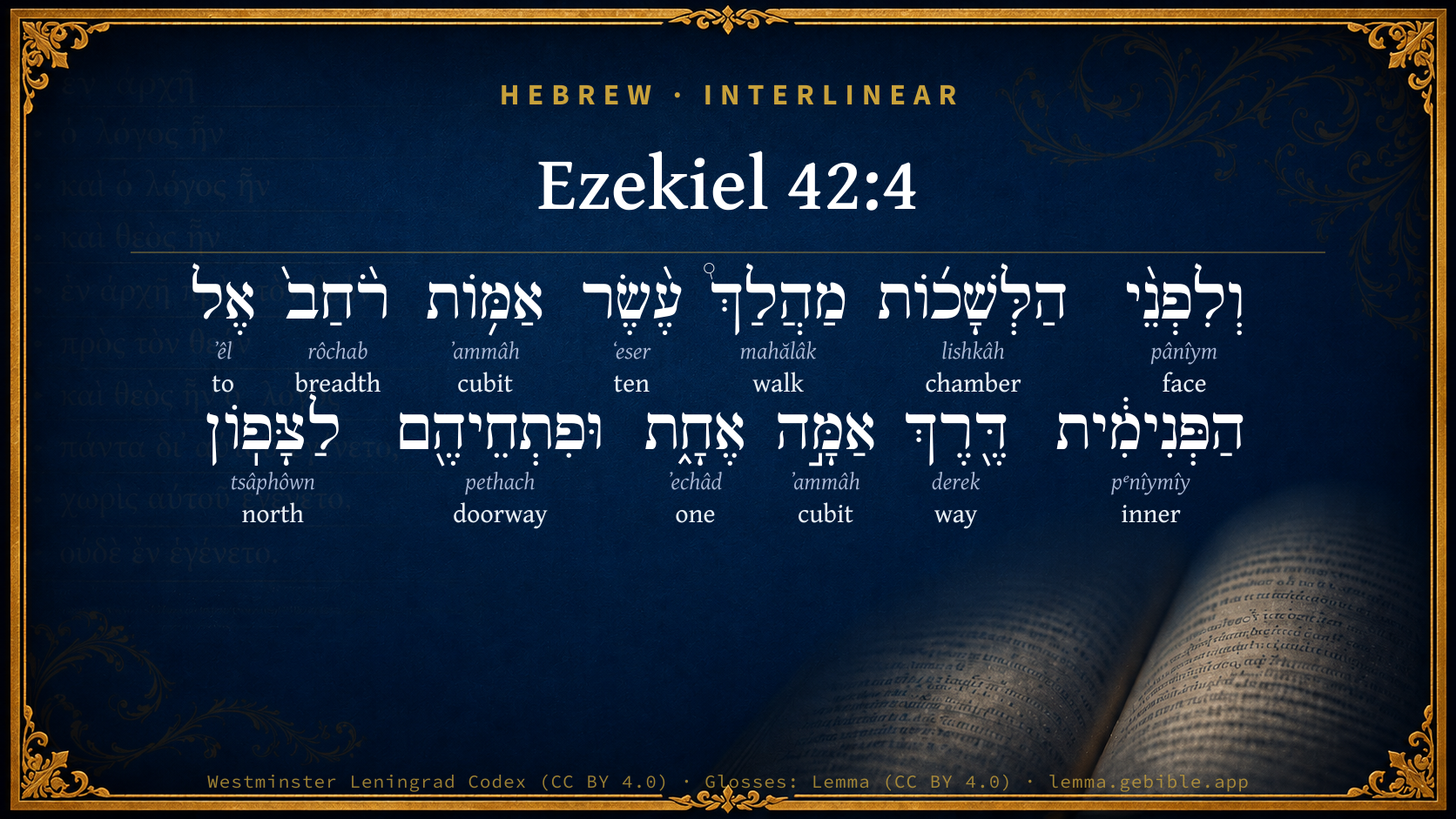
Hebrew (Westminster Leningrad Codex) Ezekiel 42:4 appears in the Hebrew Old Testament. The text above is from the Westminster Leningrad Codex. Each word links to its Strong’s number, a concise gloss, and parsing drawn from the Open Scriptures Hebrew Bible morphology. Click any word for its full Brown-Driver-Briggs (BDB) entry.
Download image
Cite this verse

Ezekiel 42:4 (World English Bible). Public Domain. Lemma interlinear Bible study tool, https://lemma.gebible.app/v/ezekiel/42/4.

Show BibTeX & RIS
BibTeX
RIS
English Translation
Before the chambers was a walk of ten cubits' breadth inward, a way of one cubit; and their doors were toward the north.
World English Bible · Public Domain
Download a study sheet

One document with this verse’s original text, its word-by-word gloss line, the meaning frame, cross-references with their text, attributed commentary, and full source and license credits — printable, and it pastes into notes with its structure intact.

This verse Autodidact and up

Study sheet (.html) Plain text (.txt)

A passage Seminary Student

Up to 50 verses in one chapter. A passage sheet keeps up to 6 commentary sources and 12 cross-references per verse, in the order this page ranks them, and says so on the sheet whenever that leaves anything out. Ask for a single verse and you get the Autodidact verse sheet above.

Everything on this page stays free to read, with no account — the sheet is a download of what is already on screen, not access to it.

Want to remove ads? Support Godless Engineer
Compare translations 3

The same verse in 3 English versions, stacked beneath the original-language interlinear above. Click any original word for its lexicon entry.

Each is an independent rendering of the whole verse — the interlinear is not word-aligned to these translations.

Highlighted words mark where these versions differ — a whole-verse word diff, not a word-by-word alignment.

  • World English Bible Public Domain
    Before the chambers was a walk of ten cubits' breadth inward, a way of one cubit; and their doors were toward the north.
  • King James Version Public Domain
    And before the chambers was a walk to ten cubits breadth inward, a way of one cubit; and their doors toward the north.
  • unfoldingWord Literal Text CC BY-SA 4.0
    A passage ten cubits in width and one hundred cubits in length ran in front of the rooms. The rooms’ doors were toward the north.

unfoldingWord Literal Text — © unfoldingWord, licensed CC BY-SA 4.0. Word-aligned USFM3 via Door43 (git.door43.org/unfoldingWord/en_ult).

Versions to compare (up to 4)

3 of 4 selected

Show all 18 translations

Every available English version of this verse, each an independent rendering of the whole verse.

  • World English Bible Public Domain
    Before the chambers was a walk of ten cubits' breadth inward, a way of one cubit; and their doors were toward the north.
  • Berean Standard Bible Public Domain
    In front of the chambers was an inner walkway ten cubits wide and a hundred cubits long. Their doors were on the north.
  • Majority Standard Bible Public Domain
    In front of the chambers was an inner walkway ten cubits wide and a hundred cubits long. Their doors were on the north.
  • King James Version Public Domain
    And before the chambers was a walk to ten cubits breadth inward, a way of one cubit; and their doors toward the north.
  • American Standard Version (1901) Public Domain
    And before the chambers was a walk of ten cubits' breadth inward, a way of one cubit; and their doors were toward the north.
  • Revised Version (1885) Public Domain
    And before the chambers was a walk of ten cubits breadth inward, a way of one cubit; and their doors were toward the north.
  • Geneva Bible (1599) Public Domain
    And before the chambers was a gallery of ten cubites wide, and within was a way of one cubite, and their doores towarde the North.
  • Douay-Rheims (1899) Public Domain
    And before the chambers was a walk ten cubits broad, looking to the inner parts of a way of one cubit. And their doors were toward the north.
  • Young's Literal Translation Public Domain
    And at the front of the chambers `is' a walk of ten cubits in breadth unto the inner part, a way of one cubit, and their openings `are' at the north.
  • Literal Standard Version CC BY-SA 4.0
    And at the front of the chambers [is] a walk of ten cubits in breadth to the inner part, a way of one cubit, and their openings [are] at the north.
  • Unlocked Literal Bible CC BY-SA 4.0
    A passage ten cubits in width and one hundred cubits in length ran in front of the rooms. The rooms' doors were toward the north.
  • unfoldingWord Literal Text CC BY-SA 4.0
    A passage ten cubits in width and one hundred cubits in length ran in front of the rooms. The rooms’ doors were toward the north.
  • Darby Bible Public Domain
    and before the cells was a walk of ten cubits in breadth, [and] a way of a hundred cubits inward; and their entries were toward the north.
  • World Messianic Bible Public Domain
    Before the rooms was a walk of ten cubits’ width inward, a way of one cubit; and their doors were toward the north.
  • Webster's Bible Public Domain
    And before the chambers was a walk of ten cubits breadth inward, a way of one cubit; and their doors towards the north.
  • Free Bible Version CC BY-SA 4.0
    In front of the rooms was an inside walkway ten cubits wide and a hundred cubits long. Their doors opened to the north.
  • Bible in Basic English Public Domain
    And in front of the rooms was a walk, ten cubits wide and a hundred cubits long; and their doors were facing north.
  • JPS Tanakh (1917) Public Domain
    And before the chambers was a walk of ten cubits breadth inward, a way of one cubit; and their doors were toward the north.

Literal Standard Version (2020), Covenant Press — licensed CC BY-SA 4.0. Text via the HelloAO Bible API (eBible.org). Unlocked Literal Bible (unfoldingWord) — licensed CC BY-SA 4.0. Text via the HelloAO Bible API (eBible.org). unfoldingWord Literal Text — © unfoldingWord, licensed CC BY-SA 4.0. Word-aligned USFM3 via Door43 (git.door43.org/unfoldingWord/en_ult). Free Bible Version, Dr. Jonathan Gallagher — licensed CC BY-SA 4.0. Text via the HelloAO Bible API (eBible.org).

Word by word

More ways to search: Search by grammar → Find every occurrence → Compare this word →

Practice this passage: Drill this verse → Learn its vocabulary →

מַהֲלַךְ֩
mahălâk
H4109
“walk of”
Noun, Common, Masculine, Singular, Construct
Part of Speech
Noun
Type
Common
Gender
Masculine
Number
Singular
State
Construct
Full BDB Definition

Origin: from H1980

TWOT: 498d

walk, journey, going, place to walk - walk - journey - goings, free access
  1. וְלִפְנֵ֨י pânîym H6440 “and · to/for · face(s) of” Conjunction + Preposition + Noun, Common, Both, Plural, Construct
  2. הַלְּשָׁכ֜וֹת lishkâh H3957 “the · chambers” Particle, Definite Article + Noun, Common, Feminine, Plural, Absolute
  3. עֶ֨שֶׂר ʻeser H6235 “ten” Adjective, Cardinal number, Feminine, Singular, Absolute
  4. אַמּ֥וֹת ʼammâh H520 “cubits” Noun, Common, Feminine, Plural, Absolute
  5. רֹ֨חַב֙ rôchab H7341 “breadth” Noun, Common, Masculine, Singular, Absolute
  6. אֶל ʼêl H413 “to” Preposition
  7. הַפְּנִימִ֔ית pᵉnîymîy H6442 “the · inner” Particle, Definite Article + Adjective, Adjective, Feminine, Singular, Absolute
  8. דֶּ֖רֶךְ derek H1870 “way of” Noun, Common, Both, Singular, Construct
  9. אַמָּ֣ה ʼammâh H520 “cubit” Noun, Common, Feminine, Singular, Absolute
  10. אֶחָ֑ת ʼechâd H259 “one” Adjective, Cardinal number, Feminine, Singular, Absolute
  11. וּפִתְחֵיהֶ֖ם pethach H6607 “and · doorways · their” Conjunction + Noun, Common, Masculine, Plural, Construct + Suffix, Personal, 3rd Person, Masculine, Plural
  12. לַצָּפֽוֹן tsâphôwn H6828 “to/for the · north” Preposition, Determined + Noun, Common, Feminine, Singular, Absolute

About this verse

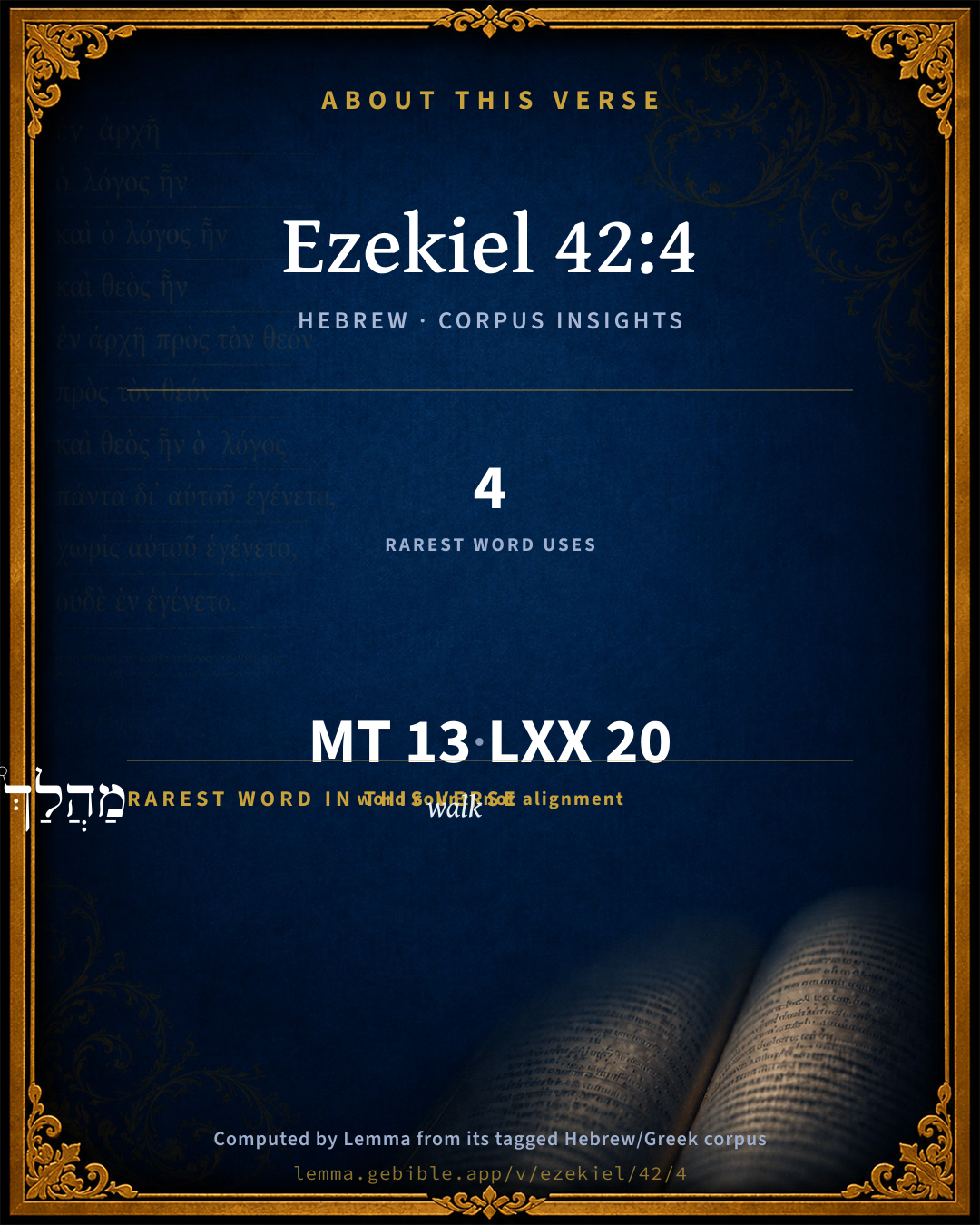
These counts appear in no published source. They are computed here, from the morphology-tagged text and Lemma’s own curated glosses. What Lemma adds →

13
words
12
distinct lemmas
Prophets
section

Notable vocabulary

The rarest word here is מַהֲלַךְ֩ walk H4109 — appearing just 4 times in the whole Hebrew Bible.

Shared distinctive vocabulary

מַהֲלַךְ֩ walk H4109 occurs in 4 verses of the Hebrew Bible. Also found in:

Grammatical profile

  • 9 nouns
  • 3 adjectives
  • 1 preposition

Repetition

A word recurs within this verse — often emphatic in Hebrew:

  • אַמּ֥וֹת cubit H520 ×2

Hebrew & Septuagint length

In English translation the verse runs 23 words from the Hebrew and 25 from the Septuagint (LXX English) — closely comparable.

A rough comparison of the two English renderings, which tokenize alike — not a word-level alignment.

Word counts can differ between the Hebrew and the Greek without any difference in meaning — e.g. the Hebrew direct-object marker אֵת has no separate Greek word, and Greek often adds the article ὁ.

In the original languages it is 13 Hebrew tokens and 20 Greek tokens — but the two are counted differently (Hebrew bundles its prefixes and suffixes into one token; the Greek is in lemma form), so that isn’t a like-for-like length.

Cross-references

3

Topical passages linked to Ezekiel 42:4 in the Treasury of Scripture Knowledge — connected by theme and wording, ordered by reader-vote popularity; previews shown in the World English Bible.

  • Ezekiel 46:19 Then he brought me through the entry, which was at the side of the gate, into the holy chambers for the priests, which looked toward the north: and, behold, there was a place on the hinder part westward.
  • Matthew 7:14 How narrow is the gate, and restricted is the way that leads to life! Few are those who find it.
  • Luke 13:24 "Strive to enter in by the narrow door, for many, I tell you, will seek to enter in, and will not be able.

Cross-references courtesy of OpenBible.info (CC BY 4.0).

Hebrew and Greek witnesses Masoretic Hebrew ↔ Greek Septuagint

The same verse in the two great witnesses to the Old Testament, shown verse-for-verse.

These are two independent witnesses, not word-aligned to each other, and the Septuagint is shown in lemma (dictionary) form.

Hebrew Ezekiel 42:4 Masoretic · Westminster Leningrad Codex

וְלִפְנֵ֨י הַלְּשָׁכ֜וֹת מַהֲלַךְ֩ עֶ֨שֶׂר אַמּ֥וֹת רֹ֨חַב֙ אֶל הַפְּנִימִ֔ית דֶּ֖רֶךְ אַמָּ֣ה אֶחָ֑ת וּפִתְחֵיהֶ֖ם לַצָּפֽוֹן

Before the chambers was a walk of ten cubits' breadth inward, a way of one cubit; and their doors were toward the north.

World English Bible · Public Domain

Greek LXX Ezekiel 42:4 Septuagint · lemma form

καί κατέναντι ὁ ἐξέδρα περίπατος πηχύς δέκα ὁ πλάτος ἐπί πῆχυς ἑκατόν ὁ μῆκος καί ὁ θύρωμα αὐτός πρός βορέας

And in front of the chambers was a walk ten cubits in breadth, the length reaching to one hundred cubits; and their doors were northward.

LXX2012 (modern English Septuagint) · Public Domain

On this verse, The Cambridge Bible for Schools and Colleges discusses the Septuagint’s reading. Read the note in Commentary ↓

Hebrew: Westminster Leningrad Codex (CC BY 4.0). Greek: Septuagint (public domain); English from LXX2012 (modern English Septuagint) (Public Domain). How the Septuagint differs from the Hebrew →

Targum (Aramaic paraphrase)

1

The Targum is the ancient Jewish Aramaic paraphrase of the Hebrew Scriptures — an interpretive translation, not the Hebrew text itself. Onkelos (literal) and Pseudo-Jonathan (expansive) render the Torah, and Jonathan the Prophets. Coverage is partial: where no permissively-licensed English translation exists for a verse, only the Aramaic is shown. This is verse-level text, not a word-by-word alignment to the Hebrew.

  1. Targum Jonathan Prophets (Joshua–Malachi)
    וְקָדָם לִשְׁכָּתָא מַהֲלַךְ עֲסַר אַמִין פּוּתְיָא לְגָיו אוֹרַח אַמְתָא חֲדָא וְתַרְעֵיהֶן פְּתִיחִין לְצִפּוּנָא:

    (no public-domain English translation for this verse)

    Targum Jonathan — Aramaic: “Mikraot Gedolot” (public domain). English: “Sefaria Community Translation” (CC0 1.0 (public-domain dedication)); “London "Chaldee Paraphrase," 1871” (public domain). Text via Sefaria.

Commentary

Notes on Ezekiel 42:4 from classic Christian and Jewish commentators (each source and its license shown beneath its notes). The classic Christian expositions comment on the surrounding passage and are grouped to its opening verse, so a note may address several verses; the Jewish commentaries on the Tanakh (Rashi and others) are per-verse, so they appear only where the commentator wrote on this verse.

Lemma curates 59 commentaries, every one of them public domain or Creative Commons licensed, each selected and text-cleaned for this edition rather than reprinted as found. About our sources →

Trapp's Complete Commentary

John Trapp

Eze 42:4 And before the chambers [was] a walk of ten cubits breadth inward, a way of one cubit; and their doors toward the north.

Ver. 4. A way of one cubit.] A narrow way, but such as led them into spacious walks of ten cubits’ breadth inward. "Strait is the gate, and narrow the way, that leadeth unto life eternal"; {Mat 7:14} but they that hit it, hold it, shall once walk arm in arm with angels. {Zec 3:7; see the note there} "Through many tribulations we must enter into God’s kingdom"; {Act 14:22} but there God shall set our feet in a large room. {as Psa 31:8} We shall walk at liberty on the everlasting mountains. Let it be remembered that this narrow way is but short, it is but of one cubit, &c.

John Trapp, A Commentary or Exposition upon All the Books of the Old and New Testament (1647–1656) — public domain. Text from a community e-Sword module.

Adam Clarke's Commentary

Verse 4. A walk of ten cubits' breadth inward] This seems to have been a sort of parapet.

Adam Clarke's Commentary on the Bible (1810–1826) — public domain. Text from a community e-Sword/MySword module.

Ellicott's Commentary for English Readers

(4) A walk of ten cubits breadth inward.—The meaning of this clause depends upon that of the next, “a way of one cubit.” There is every reason to suppose here an error of the text, and that one cubit should be one hundred, as it reads in the Greek. The change requires only a transposition of the first letters in one word, and a consequent alteration of one letter in the other. Exactly the same transposition has occurred in Eze_42:16, where it is corrected in the margin of the Hebrew, and properly translated “five hundred” instead of “five cubits.” One cannot conceive of a walk or an entrance of one cubit (twenty inches) serving any useful purpose. Assuming this change, the meaning will be that a walk (see Plan II., K [Eze_40:44-49]) of 10 cubits wide and 100 long led to the entrance of the chambers. That this was on the north is plain from its being expressly said that the door was on the north. It may seem surprising that this should have been in the outer court, but a glance at the plan in connection with what is said below will explain the reason of the arrangement. The length of the walk, 100 cubits, just reaches to the steps of the north gate of the inner court. It will be remembered that in Eze_40:39-43 this was described as the place for killing and preparing the sacrifices. Now, only the fat and kidneys of the sin and trespass and peace offerings were burnt upon the altar; the whole of the former (ordinarily) and the priests’ portion of the latter were to be carried to this chamber (Eze_42:13). The walk was therefore placed in the best possible situation.

A Bible Commentary for English Readers, edited by Charles John Ellicott (1878–1897) — public domain. Text from a community e-Sword module.

The Cambridge Bible for Schools and Colleges

gen. ed. J. J. S. Perowne

4. inward] i. e. between the two wings (Fig. 3, O). Or possibly: (leading) into the inner court.

a way of one cubit] A mere error of transcription for: a length of 100 cubits. So LXX., Syr. In Eze_42:16 “cubit” and “hundred” (both having the same three letters) have again been confused. The doors of the chambers were to the N., i.e. opened upon this passage of 10 cubits, between the wings.

The Cambridge Bible for Schools and Colleges (gen. ed. J. J. S. Perowne; Cambridge University Press, 1878–1918) — public domain. Text from a community e-Sword module.

John Gill's Exposition

And before the chambers was a walk of ten cubits' breadth inward,.... That is, within side, or between the two rows of chambers, there was a walk of this breadth, for those that lodged in the chambers to walk in for their pleasure and profit, and to converse with one another. Such who by these "chambers" understand places of retirement for private devotion, or the duties of the closet, which fit and prepare for public worship, as these chambers were near and in sight of the temple, so by this walk then Christian conference and conversation is intended; and shows, that the whole of religious time is not to be spent between the church and the chamber; but some part of it should be allotted for spiritual discourse, about gracious experiences, the truths of the Gospel, and the duties of religion; but as chambers design churches, this walk denotes the outward walk and conversation of the saints; which should be according to the rule of God's word, as becomes the Gospel, and worthy of the calling wherewith they are called. Starckius applies this to the decalogue or ten commandments, which is a broad way, Psa 119:32 and the moral law, as in the hands of Christ, is a rule of walk and conversation to believers under the Gospel: and besides, there "was a way of one cubit"; which led into the chambers, and out of them into the broad walk: this is a narrow way, as Christ is said to be, Mat 7:14 and whoever profess faith in him, and in this way enter into a Gospel church state, and into the kingdom of heaven, must be attended with much affliction and persecution, and pass through many tribulations; and there being both a broad walk and a narrow way, and these lying near one another, and a passage from the one to the other, may denote that the churches and people of God are sometimes in prosperity, and sometimes in adversity; one while they walk at liberty, as in a large place; and at other times in great straits and difficulties:

and their doors toward the north; that is, the doors of that row of chambers nearest the temple; these opened to the north into the walk of ten cubits; though one would think that the row opposite to them, their doors must be to the south, into the broad walk between them; unless this is to be understood of the doors that opened into the way of one cubit, and were to the north in both rows; but then the way of one cubit could not in both lead into the broad walk.

John Gill's Exposition of the Whole Bible (1746–1763) — public domain (CC PDM 1.0). Text via the HelloAO Bible API.

Albert Barnes' Notes on the Bible

Or, In the front “of the chambers” was a gangway “of ten cubits” breadth (leading) “inward,” a path “of one cubit, and their doors toward the north.” The “gangway” had stairs to the upper stories, while along the north front of the building there was a kerb of one cubit, as before the guard-chambers Eze 40:12, on which kerb the north doors (leading to the basement) opened. Others follow the Septuagint “And opposite the chambers a walk 10 cubits in width to 100 cubits in length.”

Albert Barnes' Notes on the Bible (1834–1885) — public domain. Text from a community e-Sword/MySword module.

Haydock's Catholic Bible Commentary

One cubit, projecting out perhaps for seats, or for the pilasters.

George Leo Haydock (1774–1849), Haydock's Catholic Family Bible and Commentary, 1859 edition — public domain. Excludes Psalms (Douay-Rheims chapter numbering differs from Protestant) and Deuterocanonical books (Catholic canon only).

Matthew Poole's English Annotations

This row of chambers had on the south side, or inward, a walk of ten cubits broad, which my between the wall on which these chambers were built, and the twenty cubits’ space; possibly it might be some cloister, running along the wall on the inside. Before the galleries, probably, was a ledge of one cubit broad, running the whole length from east to west, called here a way, though not designed for any to walk on it: such ledges we see in many great houses. Every chamber door opened to the north; and so the entrance into these chambers was through the gallery, which looked to the pavement of the outer court.

Matthew Poole's English Annotations on the Holy Bible (1683–1685) — public domain. Text from a community e-Sword/MySword module.

Whedon's Commentary on the Bible

Daniel D. Whedon

4-12. Toy renders: “In front of the chamber was a passageway ten cubits wide and one hundred cubits long. (See O, chart facing page 209.) Their doors were on the north. The upper chambers were smaller than the others, the galleries diminishing their size in comparison with the lower and middle. They were built in three stories and had no pillars like the pillars of the outer halls; hence the upper stories were smaller than the lower and middle. The outer wall bounding the chambers on the side of the outer court in front of the chambers was fifty cubits long — that is, the length of the chamber building on the outer court was fifty cubits — while in front of the temple it was one hundred cubits. Below these chambers was the entrance way on the east, when they were approached from the outer court at the beginning of the outer wall.”

Daniel D. Whedon (gen. ed.), Commentary on the Old and New Testaments (1874–1909) — public domain. Text from a community e-Sword module.

The Pulpit Commentary

Before the chambers a walk. Whether this walk ran along the longer, i.e. northern, or in front of the eastern side of the chambers, and how it stood related to the way, which is likewise mentioned in connection with the chambers, are litigated questions. The LXX identifies the two, and understands a way in front of the chambers of ten cubits broad and a hundred cubits long. Ewald and Keil so far agree with the LXX as to change the one cubit way into a hundred-cubit way; but whereas Ewald thinks of a passage ten cubits broad and a hundred cubits long, running from west to east between two sets of chambers, Keil speaks of a walk of ten cubits broad and a hundred cubits long in front of the cells, extending into a way of equal breadth and length, leading westward into the inner court. Havernick"s, Hengstenberg"s, and Kliefoth"s idea, favored by Schroder, and probably the best, is that of a walk of ten cubits in front of the cells, and a way of one cubit leading into them from the walk. Dr. Currey reverses this, and makes a walk of ten cubits leading inward, and a way, or kerb, of one cubit in front. Plumptre agrees that the passage leading into the chambers was ten cubits broad, but regards the one cubit as denoting the thickness of the wall separating the walk from the interior of the chambers.

HOMILIES BY W. CLARKSON

Vers. 4-14Separation and society.

What did those "chambers" mean, of which we read so much in this vision? Their immediate use, as intimated to the prophet, is given in the thirteenth and fourteenth verses. They were for the personal accommodation of the priests; that they might there, in a place which was nowise profane but thoroughly holy, eat that part of the sacrifices which fell to their share; and that they might there robe and unrobe, so as to serve in sacred vestments and mingle with the people in ordinary dress. Their object, therefore, was to maintain the separateness or sanctity of the priests. It has been suggested that they also answered this general purpose by constituting places for sacred retirement and devotion; possibly for the accommodation of those who, like Anna the prophetess, "departed not from the temple, night or day". (Luk_2:37) Those who were to minister in the temple were to be provided with rooms which were separated from the commerce and the strife of the outer world, where there would be nothing to contaminate or interrupt. But what meant the "walk of ten cubits breadth" (ver. 4)? Was not this for society, as the chambers were for separation? Matthew Henry suggests that these "walks of five yards broad were for those that had lodgings in the chambers, that there they might meet for conversation, might walk and talk together for their mutual edification, might communicate their knowledge and experiences; for," he adds with characteristic good sense, "we are not to spend all our time between the church and the chamber." We learn

I THE DUTY AND THE PRIVILEGE OF SEPARATION.

1. That which is obligatory and constant; viz. to be separate in spirit and in sympathy from sin; to stand apart, in spirit, from all that is in any way unchristian.

2. That which is obligatory and frequent; viz. to separate ourselves much and generally from the society of the sinful. Jesus Christ was thus "separate from sinners". (Heb_7:26) It is the sacred duty of most good men, and of all the young, to keep aloof from the vicious and profane; to decline the society, and firmly to refuse the friendship, of those who fear not God and whose conduct is unprincipled and deleterious.

3. That which is wise and occasional; viz. to retire into the seclusion of the quiet chamber, where there is no disturbing voice to prevent our close communion with the Father and Savior of our spirits.

II THE SERVICE OF SOCIETY. There are truths to be learned and there are influences to be gained in solitude which cannot be secured in society; but, on the other hand, there is a service which only society can render us. To meet men and to know them as they are living their daily life of toil and struggle; to come into close contact with their difficulties, their doubts, their joys, and their sorrows; to exchange ideas with them; to learn what their experience and their wisdom have to teach us, and to convey to them what we ourselves have learned in the solitary place; to be in the world, and still above it; this is not only the true triumph of Christian principle, it is the fair and open opportunity of Christian usefulness. C.

The Pulpit Commentary (1880–1919), ed. H.D.M. Spence-Jones & Joseph S. Exell — public domain. Text from a community e-Sword module.

John Wesley's Explanatory Notes

A way - Before the galleries probably, was a ledge of one cubit broad, running the whole length from east to west, called here a way, though not designed for any to walk on it.

John Wesley, Explanatory Notes Upon the Whole Bible (1754–1765) — public domain. Text via the GEBible commentary corpus.

unfoldingWord translationNotes

Door43 World Missions Community

ten cubits ... one hundred cubits

Each long cubit was about 54 centimeters. See how you translated this in Ezekiel 40:5. AT: "10 cubits ... 100 cubits" or "about 5.4 meters ... about 54 meters" (See: Biblical Distance)

smaller in size compared to the rooms

"smaller than the rooms"

translationWords

column

unfoldingWord translationNotes — © Distant Shores Media and the Door43 World Missions Community, licensed CC BY-SA 4.0. Source: git.door43.org/Door43/en_tn.

Rashi

Rabbi Shlomo Yitzchaki (Rashi)

And before the chambers was a walk of ten cubits width to the innermost one, a pathway of one cubit It appears to me that since the interior of [each side of] the Outer [Court] was one hundred [cubits] wide from north to south, and of these, the chambers were [occupying a] fifty [cubit] width, and before them was a fifty [cubit] space on the north - here is [already accounted for] the entire width of the Court. It is thus found that the entire width of the [Inner] Court was blocked off, i.e., there was no space between the chambers and the extremity of the depository for the knives, and there was no passageway through which to enter the twenty [cubit] space between the chambers and the cells; The twenty cubit space that intervened between the cells and the chambers consisted of the fifteen cubits that were behind the depository for the knives, and five cubits in addition to them. Now if you ask, “If so, there is a space of five cubits between the corner of [the depository for] the knives and the corner of the chambers?” [I will answer that] the thickness of the wall that intervenes between the Inner Court and the Outer Court blocks him from east to west. For its thickness is six cubits, and its end terminates at the corner [formed by] the end of the one hundred [cubit] length of the Inner Court [meeting] with the corner of the depository of the knives. Therefore, there can be no passageway to that space of twenty [cubits], either in the Inner [Court] or in the Outer [Court] unless there would be a diagonal entrance [inserted] - where the end of the wall between the two courts terminates - in the thickness of the wall, a cubit [wide], enough for a man to enter. One would enter into the five cubit space that is between the [the depository for] the knives and the wall of the Chamber, and [then] walk through that space, toward the west, ten cubits. There, the extension of the depository for the knives terminates, and one enters the twenty [cubits] wide space. This is the meaning of what it says, “a walk of ten cubits width [going] to the innermost one, a way of one cubit.” For he enters it by way of an entrance of one cubit, which [starts to] enter diagonally at the end of the wall. Now why does he call it “a walk of...width”? Should he not say, “a walk of ten cubits length”? Because regarding the housing for the knives, it refers to the width, since the housing for the knives is fifteen cubits from north to south and only ten cubits from east to west.

and their entrances were to the north And the entrances of these chambers were to the north. I found [the following]: And this is the meaning of the northern entrance written above. There he stated it briefly, and here is its explanation.

Rashi on the Tanakh — English translations: “The Judaica Press complete Tanach with Rashi, translated by A. J. Rosenberg” (CC BY 4.0); “Pentateuch with Rashi's commentary by M. Rosenbaum and A.M. Silbermann, 1929-1934” (public domain); “The Metsudah Tanach series, Lakewood, N.J” (CC BY 4.0); and “The Book of Joshua, Metsudah Publications, 1997” (CC BY 4.0). Text via Sefaria.

Lesson kit

Teaching starters — assembled from the data on this page, not authored interpretation. Every prompt links to the verse data it draws on. Edit before teaching.

Ezekiel, in the Prophets, opens this verse with 13 words (12 distinct Hebrew lemmas). Its most distinctive word is mahălâk (“walk”). A historical commentator’s framing appears above. Read the whole chapter for the surrounding context.

Discussion questions

  1. How does “walk” (mahălâk) shape what this verse is saying?
  2. How does Nehemiah 2:6, which shares the word «walk», read alongside this verse?
  3. What does the repetition of “cubit” (2× in this one verse) do in this verse?
  4. These translations render this verse differently; the difference is in the English rendering, not the original. What questions does that raise?
  5. Compare how Trapp's Complete Commentary and Adam Clarke's Commentary read this verse. Where do they agree or differ?

Things to notice

Reading settings

Reading text

Shown beneath each verse's original-language words.

Old Testament
Old Testament edition

Read the OT as the Masoretic Hebrew (MT) or the Greek Septuagint (LXX).

English shown for the Greek Septuagint (in the Hebrew ↔ Greek comparison).

Comparing translations? Open the Compare panel on any verse page to stack up to four side by side.