
Ezekiel 42:12

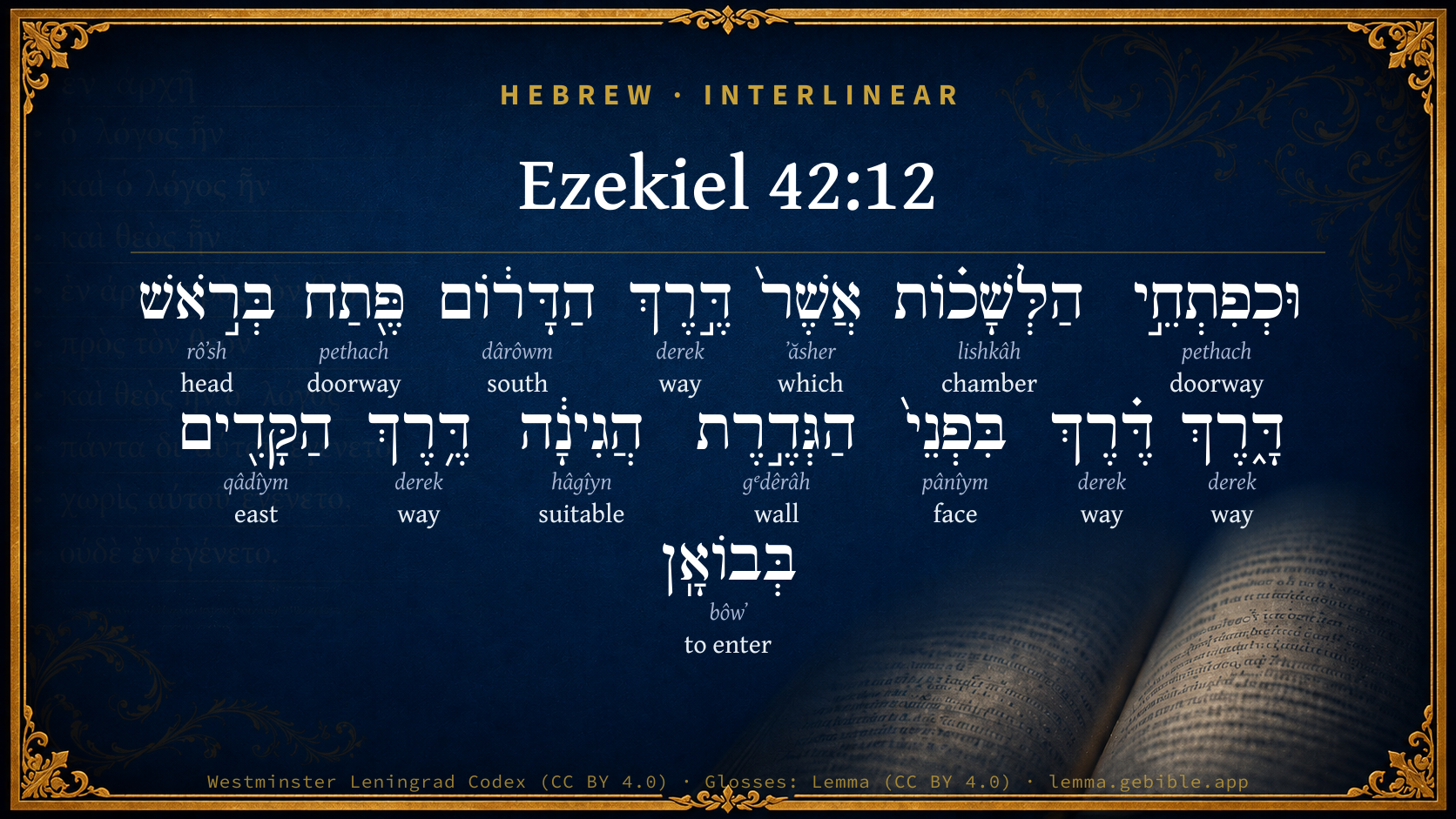
Hebrew (Westminster Leningrad Codex) Ezekiel 42:12 appears in the Hebrew Old Testament. The text above is from the Westminster Leningrad Codex. Each word links to its Strong’s number, a concise gloss, and parsing drawn from the Open Scriptures Hebrew Bible morphology. Click any word for its full Brown-Driver-Briggs (BDB) entry.
Download image
Cite this verse

Ezekiel 42:12 (World English Bible). Public Domain. Lemma interlinear Bible study tool, https://lemma.gebible.app/v/ezekiel/42/12.

Show BibTeX & RIS
BibTeX
RIS
English Translation
According to the doors of the chambers that were toward the south was a door at the head of the way, even the way directly before the wall toward the east, as one enters into them.
World English Bible · Public Domain
Highlights
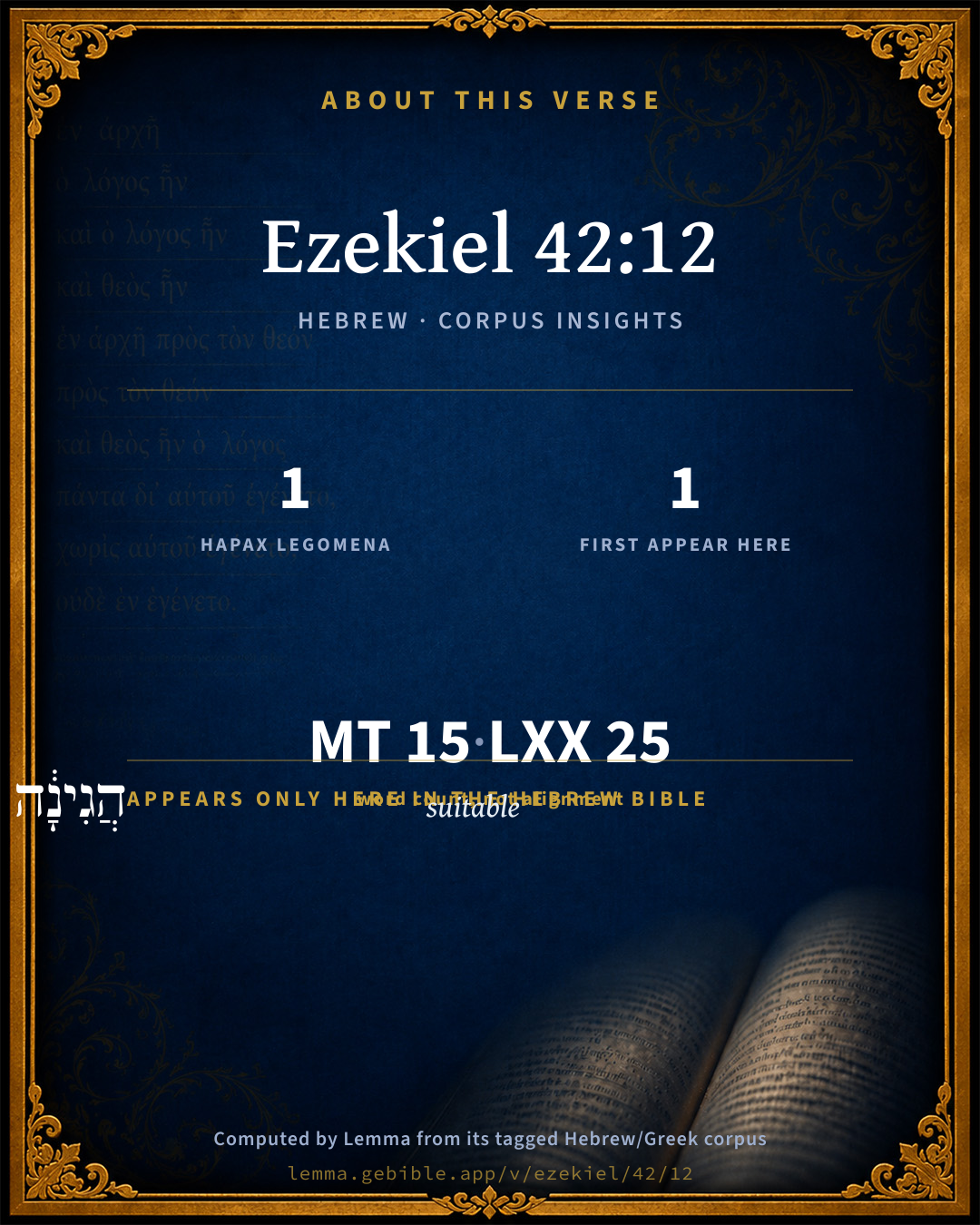
  • 1 hapax legomenon — only here in the Hebrew Bible
  • 1 first appearance in the Hebrew Bible
Full analysis ↓
Download a study sheet

One document with this verse’s original text, its word-by-word gloss line, the meaning frame, cross-references with their text, attributed commentary, and full source and license credits — printable, and it pastes into notes with its structure intact.

This verse Autodidact and up

Study sheet (.html) Plain text (.txt)

A passage Seminary Student

Up to 50 verses in one chapter. A passage sheet keeps up to 6 commentary sources and 12 cross-references per verse, in the order this page ranks them, and says so on the sheet whenever that leaves anything out. Ask for a single verse and you get the Autodidact verse sheet above.

Everything on this page stays free to read, with no account — the sheet is a download of what is already on screen, not access to it.

Want to remove ads? Support Godless Engineer
Compare translations 3

The same verse in 3 English versions, stacked beneath the original-language interlinear above. Click any original word for its lexicon entry.

Each is an independent rendering of the whole verse — the interlinear is not word-aligned to these translations.

Highlighted words mark where these versions differ — a whole-verse word diff, not a word-by-word alignment.

  • World English Bible Public Domain
    According to the doors of the chambers that were toward the south was a door at the head of the way, even the way directly before the wall toward the east, as one enters into them.
  • King James Version Public Domain
    And according to the doors of the chambers that were toward the south was a door in the head of the way, even the way directly before the wall toward the east, as one entereth into them.
  • unfoldingWord Literal Text CC BY-SA 4.0
    On the south side were doors into rooms that were just the same as on the north side. A passage on the inside had a door at its head, and the passage opened into the various rooms. On the east side there was a doorway into the passage at one end.

unfoldingWord Literal Text — © unfoldingWord, licensed CC BY-SA 4.0. Word-aligned USFM3 via Door43 (git.door43.org/unfoldingWord/en_ult).

Versions to compare (up to 4)

3 of 4 selected

Show all 18 translations

Every available English version of this verse, each an independent rendering of the whole verse.

  • World English Bible Public Domain
    According to the doors of the chambers that were toward the south was a door at the head of the way, even the way directly before the wall toward the east, as one enters into them.
  • Berean Standard Bible Public Domain
    And corresponding to the doors of the chambers that were facing south, there was a door in front of the walkway that was parallel to the wall extending eastward.
  • Majority Standard Bible Public Domain
    And corresponding to the doors of the chambers that were facing south, there was a door in front of the walkway that was parallel to the wall extending eastward.
  • King James Version Public Domain
    And according to the doors of the chambers that were toward the south was a door in the head of the way, even the way directly before the wall toward the east, as one entereth into them.
  • American Standard Version (1901) Public Domain
    And according to the doors of the chambers that were toward the south was a door at the head of the way, even the way directly before the wall toward the east, as one entereth into them.
  • Revised Version (1885) Public Domain
    And according to the doors of the chambers that were toward the south was a door in the head of the way, even the way directly before the wall toward the east, as one entereth into them.
  • Geneva Bible (1599) Public Domain
    And according to ye doores of ye chambers that were towarde the South, was a doore in the corner of the way, euen the way directly before the wall toward the East, as one entreth.
  • Douay-Rheims (1899) Public Domain
    According to the doors of the chambers that were towards the south: there was a door in the head of the way, which way was before the porch, separated towards the east as one entereth in.
  • Young's Literal Translation Public Domain
    And according to the openings of the chambers that `are' southward `is' an opening at the head of the way, the way directly in the front of the wall eastward in entering them.
  • Literal Standard Version CC BY-SA 4.0
    And according to the openings of the chambers that [are] southward [is] an opening at the head of the way, the way directly in the front of the wall eastward in entering them.
  • Unlocked Literal Bible CC BY-SA 4.0
    On the south side were doors into rooms that were just the same as on the north side. A passage on the inside had a door at its head, and the passage opened into the various rooms. On the east side there was a doorway into the passage at one end.
  • unfoldingWord Literal Text CC BY-SA 4.0
    On the south side were doors into rooms that were just the same as on the north side. A passage on the inside had a door at its head, and the passage opened into the various rooms. On the east side there was a doorway into the passage at one end.
  • Darby Bible Public Domain
    And according to the doors of the cells that were toward the south there was a door at the head of the way, the way directly before the corresponding wall toward the east as one entereth into them.
  • World Messianic Bible Public Domain
    Like the doors of the rooms that were toward the south was a door at the head of the way, even the way directly before the wall toward the east, as one enters into them.
  • Webster's Bible Public Domain
    And according to the doors of the chambers that were towards the south was a door in the head of the way, even the way directly before the wall towards the east, as one entereth into them.
  • Free Bible Version CC BY-SA 4.0
    Similarly there was an entrance under the rooms on the south side of the building, coming from the east side.
  • Bible in Basic English Public Domain
    And under the rooms on the south was a door at the head of the outer wall in the direction of the east as one goes in.
  • JPS Tanakh (1917) Public Domain
    so were also the doors of the chambers that were toward the south, there was a door in the head of the way, even the way directly before the wall, toward the way from the east, as one entereth into them.

Literal Standard Version (2020), Covenant Press — licensed CC BY-SA 4.0. Text via the HelloAO Bible API (eBible.org). Unlocked Literal Bible (unfoldingWord) — licensed CC BY-SA 4.0. Text via the HelloAO Bible API (eBible.org). unfoldingWord Literal Text — © unfoldingWord, licensed CC BY-SA 4.0. Word-aligned USFM3 via Door43 (git.door43.org/unfoldingWord/en_ult). Free Bible Version, Dr. Jonathan Gallagher — licensed CC BY-SA 4.0. Text via the HelloAO Bible API (eBible.org).

Word by word

More ways to search: Search by grammar → Find every occurrence → Compare this word →

Practice this passage: Drill this verse → Learn its vocabulary →

הֲגִינָ֔ה
hâgîyn
H1903
“suitable”
Noun, Common, Feminine, Singular, Absolute
Part of Speech
Noun
Type
Common
Gender
Feminine
Number
Singular
State
Absolute
Full BDB Definition

Origin: of uncertain derivation

TWOT: 469a

appropriate, suitable - (CLBL) directly ahead of
  1. וּכְפִתְחֵ֣י pethach H6607 “and · like/as · doorways of” Conjunction + Preposition + Noun, Common, Masculine, Plural, Construct
  2. הַלְּשָׁכ֗וֹת lishkâh H3957 “the · chambers” Particle, Definite Article + Noun, Common, Feminine, Plural, Absolute
  3. אֲשֶׁר֙ ʼăsher H834 “which” Particle, Relative
  4. דֶּ֣רֶךְ derek H1870 “way of” Noun, Common, Both, Singular, Construct
  5. הַדָּר֔וֹם dârôwm H1864 “the · south” Particle, Definite Article + Noun, Common, Masculine, Singular, Absolute
  6. פֶּ֖תַח pethach H6607 “doorway” Noun, Common, Masculine, Singular, Absolute
  7. בְּרֹ֣אשׁ rôʼsh H7218 “in/at · head of” Preposition + Noun, Common, Masculine, Singular, Construct
  8. דָּ֑רֶךְ derek H1870 “way” Noun, Common, Both, Singular, Absolute
  9. דֶּ֗רֶךְ derek H1870 “way” Noun, Common, Both, Singular, Absolute
  10. בִּפְנֵי֙ pânîym H6440 “in/at · face(s) of” Preposition + Noun, Common, Both, Plural, Construct
  11. הַגְּדֶ֣רֶת gᵉdêrâh H1448 “the · wall” Particle, Definite Article + Noun, Common, Feminine, Singular, Absolute
  12. דֶּ֥רֶךְ derek H1870 “way of” Noun, Common, Both, Singular, Construct
  13. הַקָּדִ֖ים qâdîym H6921 “the · east” Particle, Definite Article + Noun, Common, Masculine, Singular, Absolute
  14. בְּבוֹאָֽן bôwʼ H935 “in/at · to enter · them” Preposition + Verb, Qal, Infinitive Construct + Suffix, Personal, 3rd Person, Feminine, Plural

About this verse

These counts appear in no published source. They are computed here, from the morphology-tagged text and Lemma’s own curated glosses. What Lemma adds →

15
words
11
distinct lemmas
Prophets
section

Notable vocabulary

1 hapax legomenon — a word that appears only here in the entire Hebrew Bible:

  • הֲגִינָ֔ה suitable H1903

First appearance in Scripture

This word makes its first canonical appearance in the Hebrew Bible here:

  • הֲגִינָ֔ה suitable H1903

Shared distinctive vocabulary

הַגְּדֶ֣רֶת wall H1448 occurs in 11 verses of the Hebrew Bible. Also found in:

Grammatical profile

  • 1 verb
  • 13 nouns
  • 1 particle

Verb forms

  • בְּבוֹאָֽן Qal · Infinitive Construct

Repetition

Words recur within this verse — often emphatic in Hebrew:

  • דֶּ֣רֶךְ way H1870 ×4
  • וּכְפִתְחֵ֣י doorway H6607 ×2

Hebrew & Septuagint length

In English translation the verse runs 36 words from the Hebrew and 39 from the Septuagint (LXX English) — closely comparable.

A rough comparison of the two English renderings, which tokenize alike — not a word-level alignment.

Word counts can differ between the Hebrew and the Greek without any difference in meaning — e.g. the Hebrew direct-object marker אֵת has no separate Greek word, and Greek often adds the article ὁ.

In the original languages it is 15 Hebrew tokens and 25 Greek tokens — but the two are counted differently (Hebrew bundles its prefixes and suffixes into one token; the Greek is in lemma form), so that isn’t a like-for-like length.

Hebrew and Greek witnesses Masoretic Hebrew ↔ Greek Septuagint

The same verse in the two great witnesses to the Old Testament, shown verse-for-verse.

These are two independent witnesses, not word-aligned to each other, and the Septuagint is shown in lemma (dictionary) form.

Hebrew Ezekiel 42:12 Masoretic · Westminster Leningrad Codex

וּכְפִתְחֵ֣י הַלְּשָׁכ֗וֹת אֲשֶׁר֙ דֶּ֣רֶךְ הַדָּר֔וֹם פֶּ֖תַח בְּרֹ֣אשׁ דָּ֑רֶךְ דֶּ֗רֶךְ בִּפְנֵי֙ הַגְּדֶ֣רֶת הֲגִינָ֔ה דֶּ֥רֶךְ הַקָּדִ֖ים בְּבוֹאָֽן

According to the doors of the chambers that were toward the south was a door at the head of the way, even the way directly before the wall toward the east, as one enters into them.

World English Bible · Public Domain

Greek LXX Ezekiel 42:12 Septuagint · lemma form

ὁ ἐξέδρα ὁ πρός νότος καί κατά ὁ θύρωμα ἀπό ἀρχή ὁ περίπατος ὡς ἐπί φῶς διάστημα κάλαμος καί κατά ἀνατολή ὁ εἰςπορεύομαι διά αὐτός

So were the measures of the chambers toward the south, and according to the doors at the entrance of the walk, as it were the distance of a reed for light, and eastward as one went in by them.

LXX2012 (modern English Septuagint) · Public Domain

On this verse, The Cambridge Bible for Schools and Colleges discusses the Septuagint’s reading. Read the note in Commentary ↓

Hebrew: Westminster Leningrad Codex (CC BY 4.0). Greek: Septuagint (public domain); English from LXX2012 (modern English Septuagint) (Public Domain). How the Septuagint differs from the Hebrew →

Targum (Aramaic paraphrase)

1

The Targum is the ancient Jewish Aramaic paraphrase of the Hebrew Scriptures — an interpretive translation, not the Hebrew text itself. Onkelos (literal) and Pseudo-Jonathan (expansive) render the Torah, and Jonathan the Prophets. Coverage is partial: where no permissively-licensed English translation exists for a verse, only the Aramaic is shown. This is verse-level text, not a word-by-word alignment to the Hebrew.

  1. Targum Jonathan Prophets (Joshua–Malachi)
    וּכְתַרְעֵי לִשְׁכָּתָא דִפְתִיחַ לְאוֹרַח דָרוֹמָא תְּרַע בְּרֵישׁ אוֹרַח אוֹרַח קֳדָם דוּכַן לֵיוָאַי אוֹרַח מַדִינְחָא בְּמַעֲלָנָהָן:

    (no public-domain English translation for this verse)

    Targum Jonathan — Aramaic: “Mikraot Gedolot” (public domain). English: “Sefaria Community Translation” (CC0 1.0 (public-domain dedication)); “London "Chaldee Paraphrase," 1871” (public domain). Text via Sefaria.

Commentary

Notes on Ezekiel 42:12 from classic Christian and Jewish commentators (each source and its license shown beneath its notes). The classic Christian expositions comment on the surrounding passage and are grouped to its opening verse, so a note may address several verses; the Jewish commentaries on the Tanakh (Rashi and others) are per-verse, so they appear only where the commentator wrote on this verse.

Lemma curates 59 commentaries, every one of them public domain or Creative Commons licensed, each selected and text-cleaned for this edition rather than reprinted as found. About our sources →

The Cambridge Bible for Schools and Colleges

gen. ed. J. J. S. Perowne

12. As the text reads it is easiest to attach the last words of Eze_42:11 to Eze_42:12. The sense resulting from this change is not very natural. Possibly Eze_42:11 should end as A.V., in which case Eze_42:12 must be amended: and the doors of the chambers were toward the south. In this point they differed from the other chambers, the doors of which were towards the north (Eze_42:4).

The term rendered “corresponding” is quite unknown. In the Targ. and post-biblical Heb. a similar word appears to mean suitable, excellent—the appropriate wall. The word is no doubt corrupt. LXX. “reed.”

The Cambridge Bible for Schools and Colleges (gen. ed. J. J. S. Perowne; Cambridge University Press, 1878–1918) — public domain. Text from a community e-Sword module.

Ellicott's Commentary for English Readers

(12) “So were the doors of the chambers which were toward the south, a door at the head of the way, the way over against the corresponding (?) wall, the way as one enters from the east.” The word here translated corresponding occurs only in this place, and is of doubtful signification; but the word for wall is the same as in Eze_42:7, and there can be no doubt that it refers to the screen-wall to the east of the chambers. The way from the porch of the gate to the inner court was directly “over against” the passage between this wall and the chambers, and in fact joined it at right angles.

This closes the somewhat obscure and difficult description of these chambers, where we do not have, as in the other cases, any similar construction in the ancient Temple to guide the interpreter. It would seem altogether probable that there must have been an additional entrance to these chambers from the space at the side of or behind the Temple, for the convenience of the priests in changing their garments. Perhaps there was such an entrance to the second storey, which must have been about on the same level with the Temple court, but is not mentioned because only the plan of the lower storey is described.

A Bible Commentary for English Readers, edited by Charles John Ellicott (1878–1897) — public domain. Text from a community e-Sword module.

John Gill's Exposition

And according to the doors of the chambers that were toward the south,.... That is, the doors of these eastern chambers were exactly like to the doors of the southern chambers, as well as to the northern ones:

was a door in the head of the way; or beginning of the way; the door opened into the way of one cubit, and that led into the walk of ten cubits; and such a way and walk were before these eastern chambers as were before the southern and northern ones:

even the way directly before the wall toward the east, as one entereth into them: or, "also a way before the wall direct, a way to the east, as one goes into them" (b); which seems to describe such a way from under these eastern chambers as were from under the northern or southern chambers, Eze 42:9.

(b) "viae, inquam, quae erat ante maceriam rectam orientem versus, qua venitar ad illas", Junius & Tremellius; Piscator; "via ante maceriam recta, via orientis in introitu illarum", Cocceius, Starckius.

John Gill's Exposition of the Whole Bible (1746–1763) — public domain (CC PDM 1.0). Text via the HelloAO Bible API.

Matthew Poole's English Annotations

This verse is a particular description of the door and way that, from the east end of this south building, did lead either under the buildings, or through some part of them toward the west point, as before; such a way from the north buildings did lead to the south, nor do I think necessary to speak more of the words.

Matthew Poole's English Annotations on the Holy Bible (1683–1685) — public domain. Text from a community e-Sword/MySword module.

Rashi

Rabbi Shlomo Yitzchaki (Rashi)

And as the entrances of the chambers that are toward the way of the south the eastern entrances of the chambers. For in the south, too, there were chambers separated from the southern cells by twenty cubits (as it is written) above (41:10): “And between the chambers was a [space] twenty cubits wide surrounding the House, round about.”

an entrance at the beginning of the pathway The eastern chambers had an entrance at the beginning of the pathway, and the pathway was before the wall of the musicians. Jonathan renders: the platform of the Levites. The expression הַגְּדֶרֶת הֲגִינָה means a stone wall structure made like steps upon which the musicians and the choristers stood.

the way of the east For the platform was in the east, as it is written in (II Chron. 5:12) in the chapter commencing: “was completed”: “And the Levites who sang, all of them - Asaph, Heman, Jeduthun, etc., stood east of the altar.”

Rashi on the Tanakh — English translations: “The Judaica Press complete Tanach with Rashi, translated by A. J. Rosenberg” (CC BY 4.0); “Pentateuch with Rashi's commentary by M. Rosenbaum and A.M. Silbermann, 1929-1934” (public domain); “The Metsudah Tanach series, Lakewood, N.J” (CC BY 4.0); and “The Book of Joshua, Metsudah Publications, 1997” (CC BY 4.0). Text via Sefaria.

Lesson kit

Teaching starters — assembled from the data on this page, not authored interpretation. Every prompt links to the verse data it draws on. Edit before teaching.

Ezekiel, in the Prophets, opens this verse with 15 words (11 distinct Hebrew lemmas). Its most distinctive word is hâgîyn (“suitable”). A historical commentator’s framing appears above. Read the whole chapter for the surrounding context.

Discussion questions

  1. The word hâgîyn carries the sense “suitable.” How does it shape the verse?
  2. This verse holds 1 word here found nowhere else in the Hebrew Bible. What might the rare word draw attention to?
  3. The word “suitable” first appears here in Scripture. What is being introduced at this debut?
  4. Numbers 32:16 shares the word «wall» with this verse. How do the two illuminate each other?
  5. “way” occurs 4× in this one verse. What is the effect of the repetition?
  6. These translations render this verse differently; the difference is in the English rendering, not the original. What questions does that raise?
  7. The verb «בְּבוֹאָֽן» is Qal Infinitive Construct. How does its form color the action?
  8. Reading how The Cambridge Bible for Schools and Colleges and Ellicott's Commentary for English Readers read this verse, where do the two commentators agree and where do they part?

Things to notice

  • 1 word in this verse appears nowhere else in the Hebrew Bible.
  • 1 word makes its first canonical appearance in Scripture here.
  • This verse counts 15 Hebrew ↔ 25 Greek words.
  • These translations choose different wording for 23 words in this verse.
  • “way” occurs 4× in this single verse.

Reading settings

Reading text

Shown beneath each verse's original-language words.

Old Testament
Old Testament edition

Read the OT as the Masoretic Hebrew (MT) or the Greek Septuagint (LXX).

English shown for the Greek Septuagint (in the Hebrew ↔ Greek comparison).

Comparing translations? Open the Compare panel on any verse page to stack up to four side by side.