
Ezekiel 8:7

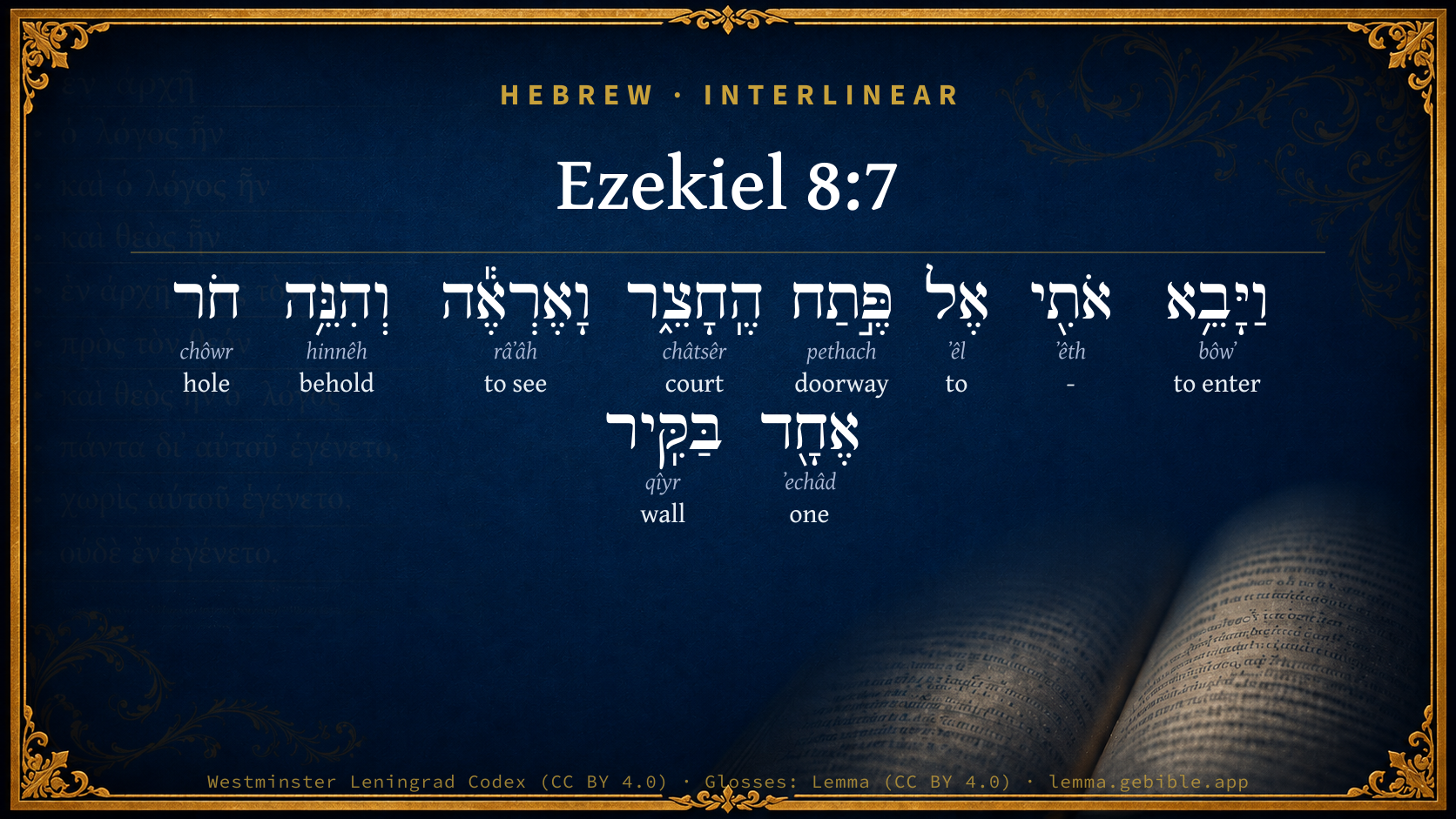
Hebrew (Westminster Leningrad Codex) Ezekiel 8:7 appears in the Hebrew Old Testament. The text above is from the Westminster Leningrad Codex. Each word links to its Strong’s number, a concise gloss, and parsing drawn from the Open Scriptures Hebrew Bible morphology. Click any word for its full Brown-Driver-Briggs (BDB) entry.
Download image
Cite this verse

Ezekiel 8:7 (World English Bible). Public Domain. Lemma interlinear Bible study tool, https://lemma.gebible.app/v/ezekiel/8/7.

Show BibTeX & RIS
BibTeX
RIS
English Translation
He brought me to the door of the court; and when I looked, behold, a hole in the wall.
World English Bible · Public Domain
Download a study sheet

One document with this verse’s original text, its word-by-word gloss line, the meaning frame, cross-references with their text, attributed commentary, and full source and license credits — printable, and it pastes into notes with its structure intact.

This verse Autodidact and up

Study sheet (.html) Plain text (.txt)

A passage Seminary Student

Up to 50 verses in one chapter. A passage sheet keeps up to 6 commentary sources and 12 cross-references per verse, in the order this page ranks them, and says so on the sheet whenever that leaves anything out. Ask for a single verse and you get the Autodidact verse sheet above.

Everything on this page stays free to read, with no account — the sheet is a download of what is already on screen, not access to it.

Want to remove ads? Support Godless Engineer
Compare translations 3

The same verse in 3 English versions, stacked beneath the original-language interlinear above. Click any original word for its lexicon entry.

Each is an independent rendering of the whole verse — the interlinear is not word-aligned to these translations.

Highlighted words mark where these versions differ — a whole-verse word diff, not a word-by-word alignment.

  • World English Bible Public Domain
    He brought me to the door of the court; and when I looked, behold, a hole in the wall.
  • King James Version Public Domain
    And he brought me to the door of the court; and when I looked, behold a hole in the wall.
  • unfoldingWord Literal Text CC BY-SA 4.0
    Then he brought me to the doorway of the courtyard, and I looked, and there was a hole in the wall.

unfoldingWord Literal Text — © unfoldingWord, licensed CC BY-SA 4.0. Word-aligned USFM3 via Door43 (git.door43.org/unfoldingWord/en_ult).

Versions to compare (up to 4)

3 of 4 selected

Show all 18 translations

Every available English version of this verse, each an independent rendering of the whole verse.

  • World English Bible Public Domain
    He brought me to the door of the court; and when I looked, behold, a hole in the wall.
  • Berean Standard Bible Public Domain
    Then He brought me to the entrance to the court, and I looked and saw a hole in the wall.
  • Majority Standard Bible Public Domain
    Then He brought me to the entrance to the court, and I looked and saw a hole in the wall.
  • King James Version Public Domain
    And he brought me to the door of the court; and when I looked, behold a hole in the wall.
  • American Standard Version (1901) Public Domain
    And he brought me to the door of the court; and when I looked, behold, a hole in the wall.
  • Revised Version (1885) Public Domain
    And he brought me to the door of the court; and when I looked, behold a hole in the wall.
  • Geneva Bible (1599) Public Domain
    And he caused me to enter at the gate of the court: and when I looked, beholde, an hole was in the wall.
  • Douay-Rheims (1899) Public Domain
    And he brought me in to the door of the court: and I saw, and behold a hole in the wall.
  • Young's Literal Translation Public Domain
    And He bringeth me in unto an opening of the court, and I look, and lo, a hole in the wall;
  • Literal Standard Version CC BY-SA 4.0
    And He brings me to an opening of the court, and I look, and behold, a hole in the wall;
  • Unlocked Literal Bible CC BY-SA 4.0
    Then he brought me to the doorway of the courtyard, and I looked, and there was a hole in the wall.
  • unfoldingWord Literal Text CC BY-SA 4.0
    Then he brought me to the doorway of the courtyard, and I looked, and there was a hole in the wall.
  • Darby Bible Public Domain
    And he brought me to the entry of the court, and I looked, and behold, a hole in the wall.
  • World Messianic Bible Public Domain
    He brought me to the door of the court; and when I looked, behold, a hole in the wall.
  • Webster's Bible Public Domain
    And he brought me to the door of the court; and when I looked, behold a hole in the wall.
  • Free Bible Version CC BY-SA 4.0
    He took me to the entrance to the Temple courtyard. As I looked around, I saw a hole in the wall.
  • Bible in Basic English Public Domain
    And he took me to the door of the open place; and looking, I saw a hole in the wall.
  • JPS Tanakh (1917) Public Domain
    And He brought me to the door of the court; and when I looked, behold a hole in the wall.

Literal Standard Version (2020), Covenant Press — licensed CC BY-SA 4.0. Text via the HelloAO Bible API (eBible.org). Unlocked Literal Bible (unfoldingWord) — licensed CC BY-SA 4.0. Text via the HelloAO Bible API (eBible.org). unfoldingWord Literal Text — © unfoldingWord, licensed CC BY-SA 4.0. Word-aligned USFM3 via Door43 (git.door43.org/unfoldingWord/en_ult). Free Bible Version, Dr. Jonathan Gallagher — licensed CC BY-SA 4.0. Text via the HelloAO Bible API (eBible.org).

Word by word

More ways to search: Search by grammar → Find every occurrence → Compare this word →

Practice this passage: Drill this verse → Learn its vocabulary →

About this verse

These counts appear in no published source. They are computed here, from the morphology-tagged text and Lemma’s own curated glosses. What Lemma adds →

10
words
10
distinct lemmas
Prophets
section

Notable vocabulary

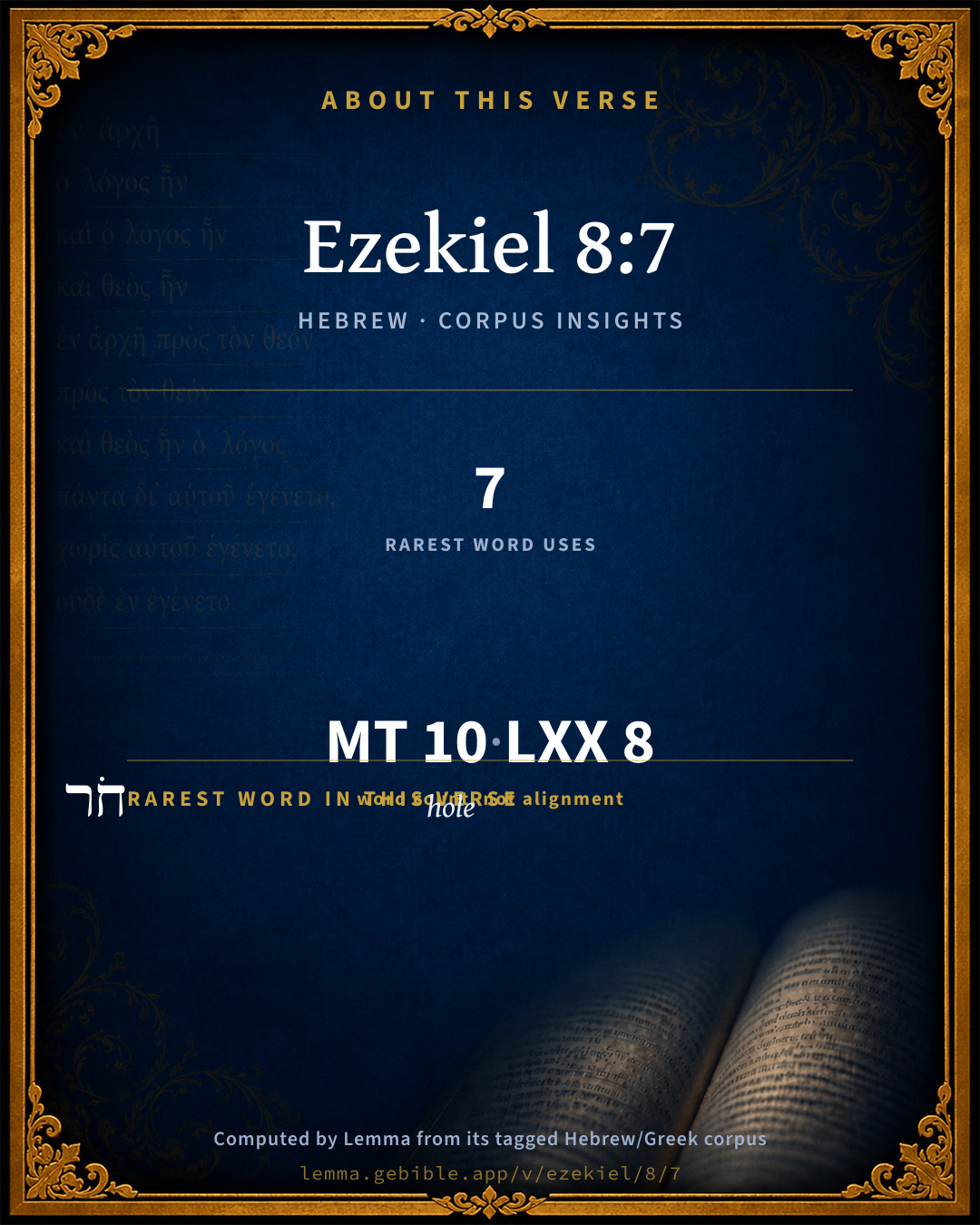
The rarest word here is חֹר hole H2356 — appearing just 7 times in the whole Hebrew Bible.

Shared distinctive vocabulary

חֹר hole H2356 occurs in 7 verses of the Hebrew Bible. Also found in:

Grammatical profile

  • 2 verbs
  • 4 nouns
  • 1 adjective
  • 1 preposition
  • 2 particles

Verb forms

  • וַיָּבֵ֥א Hiphil · Sequential Imperfect
  • וָאֶרְאֶ֕ה Qal · Sequential Imperfect

Hebrew & Septuagint length

In English translation the verse runs 19 words from the Hebrew and 10 from the Septuagint (LXX English) — the Septuagint runs noticeably shorter here. See the side-by-side →

A rough comparison of the two English renderings, which tokenize alike — not a word-level alignment.

Word counts can differ between the Hebrew and the Greek without any difference in meaning — e.g. the Hebrew direct-object marker אֵת has no separate Greek word, and Greek often adds the article ὁ.

In the original languages it is 10 Hebrew tokens and 8 Greek tokens — but the two are counted differently (Hebrew bundles its prefixes and suffixes into one token; the Greek is in lemma form), so that isn’t a like-for-like length.

Cross-references

2

Topical passages linked to Ezekiel 8:7 in the Treasury of Scripture Knowledge — connected by theme and wording, ordered by reader-vote popularity; previews shown in the World English Bible.

  • 1 Kings 7:12 The great court round about had three courses of hewn stone, and a course of cedar beams; like as the inner court of the house of Yahweh, and the porch of the house.
  • 2 Kings 21:5 He built altars for all the host of the sky in the two courts of the house of Yahweh.

Cross-references courtesy of OpenBible.info (CC BY 4.0).

Hebrew and Greek witnesses Masoretic Hebrew ↔ Greek Septuagint

The same verse in the two great witnesses to the Old Testament, shown verse-for-verse.

Here the Septuagint runs noticeably shorter than the Hebrew — LXX2012 (modern English Septuagint) 10 words vs World English Bible 19. A rough length comparison of the two English translations, not a word-level alignment — read both below.

These are two independent witnesses, not word-aligned to each other, and the Septuagint is shown in lemma (dictionary) form.

Hebrew Ezekiel 8:7 Masoretic · Westminster Leningrad Codex

וַיָּבֵ֥א אֹתִ֖י אֶל פֶּ֣תַח הֶֽחָצֵ֑ר וָאֶרְאֶ֕ה וְהִנֵּ֥ה חֹר אֶחָ֖ד בַּקִּֽיר

He brought me to the door of the court; and when I looked, behold, a hole in the wall.

World English Bible · Public Domain

Greek LXX Ezekiel 8:7 Septuagint · lemma form

καί εἰςἄγω ἐγώ ἐπί ὁ πρόθυρον ὁ αὐλή

And he brought me to the porch of the court.

LXX2012 (modern English Septuagint) · Public Domain

On this verse, The Cambridge Bible for Schools and Colleges discusses the Septuagint’s reading. Read the note in Commentary ↓

Hebrew: Westminster Leningrad Codex (CC BY 4.0). Greek: Septuagint (public domain); English from LXX2012 (modern English Septuagint) (Public Domain). How the Septuagint differs from the Hebrew →

Targum (Aramaic paraphrase)

1

The Targum is the ancient Jewish Aramaic paraphrase of the Hebrew Scriptures — an interpretive translation, not the Hebrew text itself. Onkelos (literal) and Pseudo-Jonathan (expansive) render the Torah, and Jonathan the Prophets. Coverage is partial: where no permissively-licensed English translation exists for a verse, only the Aramaic is shown. This is verse-level text, not a word-by-word alignment to the Hebrew.

  1. Targum Jonathan Prophets (Joshua–Malachi)
    וְאָעֵיל יָתִי לִתְרַע דָרָתָא וַחֲזֵית וְהָא חוֹרָא חַד בְּכוֹתְלָא:

    (no public-domain English translation for this verse)

    Targum Jonathan — Aramaic: “Mikraot Gedolot” (public domain). English: “Sefaria Community Translation” (CC0 1.0 (public-domain dedication)); “London "Chaldee Paraphrase," 1871” (public domain). Text via Sefaria.

Commentary

Notes on Ezekiel 8:7 from classic Christian and Jewish commentators (each source and its license shown beneath its notes). The classic Christian expositions comment on the surrounding passage and are grouped to its opening verse, so a note may address several verses; the Jewish commentaries on the Tanakh (Rashi and others) are per-verse, so they appear only where the commentator wrote on this verse.

Lemma curates 59 commentaries, every one of them public domain or Creative Commons licensed, each selected and text-cleaned for this edition rather than reprinted as found. About our sources →

Matthew Henry's Commentary

We have here a further discovery of the abominations that were committed at Jerusalem, and within the confines of the temple, too. Now observe,

I. How this discovery is made. God, in vision, brought Ezekiel to the door of the court, the outer court, along the sides of which the priests' lodgings were. God could have introduced him at first into the chambers of imagery, but he brings him to them by degrees, partly to employ his own industry in searching out these mysteries of iniquity, and partly to make him sensible with what care and caution those idolaters concealed their idolatries. Before the priests' apartments they had run up a wall, to make them the more private, that they might not lie open to the observation of those who passed by - a shrews sign that they did something which they had reason to be ashamed of. He that doth evil hates the light. They were not willing that those who saw them in God's house should see them in their own, lest they should see them contradict themselves and undo in private what they did in public. But, behold, a hole in the wall, (Eze 8:7), a spy-hole, by which you might see that which would give cause to suspect them. When hypocrites screen themselves behind the wall of an external profession, and with it think to conceal their wickedness from the eye of the world and carry on their designs the more successfully, it is hard for them to manage it with so much art by that there is some hole or other left in the wall, something that betrays them, to those who look diligently, not to be what they pretend to be. The ass's ears in the fable appeared from under the lion's skin. This hole in the wall Ezekiel made wider, and behold a door, v. 8. This door he goes in by into the treasury, or some of the apartments of the priests, and sees the wicked abominations that they do there, v. 9. Note, Those that would discover the mystery of iniquity in others, or in themselves, must accomplish a diligent search; for Satan has his wiles, and depths, and devices, which we should not be ignorant of, and the heart is deceitful above all things; in the examining of it therefore we are concerned to be very strict.

II. What the discovery is. It is a very melancholy one. 1. He sees a chamber set round with idolatrous pictures (Eze 8:10): All the idols of the house of Israel, which they had borrowed from the neighbouring nations, were portrayed upon the wall round about, even the vilest of them, the forms of creeping things, which they worshipped, and beasts, even abominable ones, which are poisonous and venomous; at least they were abominable when they were worshipped. This was a sort of panthenon, a collection of all the idols together which they paid their devotions to. Though the second commandment, in the letter of it, forbids only graven images, yet painted ones are as bad and as dangerous. 2. He sees this chamber filled with idolatrous worshippers (Eze 8:11): There were seventy men of the elders of Israel offering incense to these painted idols. here was a great number of idolaters strengthening one another's hands in this wickedness; though it was in a private chamber, and the meeting industriously concealed, yet here were seventy men engaged in it. I doubt these elders were many more than those in Babylon that sat before the prophet in his house, Eze 8:1. They were seventy men, the number of the great Sanhedrim, or chief council of the nation, and, we have reason to fear, the same men; for they were the ancients of the house of Israel, not only in age, but in office, who were bound, by the duty of their place, to restrain and punish idolatry and to destroy and abolish all superstitious images wherever they found them; yet these were those that did themselves worship them in private, so undermining that religion which in public they professed to own and promote only because by it they held their preferments. They had every man his censer in his hand; so fond were they of the idolatrous service that they would all be their own priests, and very prodigal they were of their perfumes in honour of these images, for a thick cloud of incense went up, that filled the room. O that the zeal of these idolaters might shame the worshippers of the true God out of their indifference to his service! The prophet took particular notice of one whom he knew, who stood in the midst of these idolaters, as chief among them, being perhaps president of the great council at this time or most forward in this wickedness. No wonder the people were corrupt when the elders were so. The sins of leaders are leading sins.

III. What the remark is that made upon it (Eze 8:12): "Son of man, hast thou seen this? Couldst thou have imagined that there was such wickedness committed?" It is here observed concerning it, 1. That it was done in the dark; for sinful works are works of darkness. They concealed it, lest they should lose their places, or at least their credit. There is a great deal of secret wickedness in the world, which the day will declare, the day of the revelation of the righteous judgment of God. 2. That this one idolatrous chapel was but a specimen of many the like. Here they met together, to worship their images in concert, but, it should seem, they had every man the chamber of his imagery besides, a room in his own house for this purpose, in which every man gratified his own fancy with such pictures as he liked best. Idolaters had their household gods, and their family worship of them in private, which is a shame to those who call themselves Christians and yet have no church in their house, no worship of God in their family. Had they chambers of imagery, and shall not we have chambers of devotion? 3. That atheism was at the bottom of their idolatry. They worship images in the dark, the images of the gods of other nations, and they say, "Jehovah, the God of Israel, whom we should serve, seeth us not. Jehovah hath forsaken the earth, and we may worship what God we will; he regards us not." (1.) They think themselves out of God's sight: They say, The Lord seeth us not. They imagined, because the matter was carried on so closely that men could not discover it, nor did any of their neighbours suspect them to be idolaters, that therefore it was hidden from the eye of God; as if there were any darkness, or shadow of death, where the workers of iniquity may hide themselves. Note, A practical disbelief of God's omniscience is at the bottom of our treacherous departures from him; but the church argues justly, as to this very sin of idolatry (Psa 44:20, Psa 44:21), If we have forgotten the name of our God, and stretched forth our hand to a strange god, will not God search this out? No doubt he will. (2.) They think themselves out of God's care: "The Lord has forsaken the earth, and looks not after the affairs of it; and then we may as well worship any other god as him." Or, "He has forsaken our land, and left it to be a prey to its enemies; and therefore it is time for us to look out for some other god, to whom to commit the protection of it. Our one God cannot, or will not, deliver us; and therefore let us have many." This was a blasphemous reflection upon God, as if he had forsaken them first, else they would not have forsaken him. Note, Those are ripe indeed for ruin who have arrived at such a pitch of impudence as to lay the blame of their sins upon God himself.

Matthew Henry's Commentary on the Whole Bible (1708–1710) — public domain (CC PDM 1.0). Text via the HelloAO Bible API.

Trapp's Complete Commentary

John Trapp

Eze 8:7 And he brought me to the door of the court; and when I looked, behold a hole in the wall.

Ver. 7. And he brought me.] Mystagogus ille angelus. that angel who showed the sacred places.

To the door of the court.] Of the priests’ court.

A hole in the wall.] Which should have been kept in better repair.

John Trapp, A Commentary or Exposition upon All the Books of the Old and New Testament (1647–1656) — public domain. Text from a community e-Sword module.

Joseph Benson's Commentary

Eze 8:7-11. And he brought me to the door of the court — This, Dr. Lightfoot understands of the east gate of the inner court, called the gate of Nicanor, over which was the council chamber, where the sanhedrim used to meet, and in some of the rooms near it they secretly practised idolatry, as God discovered to the prophet, Eze 8:11. Behold a hole in the wall — Through which I could look in, and see what abominations were committing there. Then he said, Dig now in the wall — This, and what follows, was done only by vision, during the prophet’s trance or ecstasy, while the elders sat before him. And when I had digged in the wall, behold a door — A private door, by which the elders entered into the chambers of their imagery, to perform idolatrous worship to the images. And he said unto me, Go in, &c. — To give me the fullest conviction, I not only looked through the hole, mentioned Eze 8:7, but went into the very room where these idolatries were committed. Behold the abominations that they do here — Hebrew, are doing here: even under the approach of judgments, and under the walls of my temple. So I went in, and behold every form of creeping things — It is probable that they imitated the Egyptians in this kind of idolatry; for the Egyptians used to worship several kinds of beasts and reptiles. According to Diodorus Siculus, 50. 1. p. 59, edit. Wess., (referred to by Secker,) “round the room in Thebes, where the body of King Osymanduas seemed to be buried, a multitude of chambers were built, which had elegant paintings of all the beasts sacred in Egypt.” It is not unlikely they imagined they evaded the law against setting up any image to worship, by having them only portrayed, or painted, on the wall; or, at least, that it was not so great an offence; for the Jewish people in general seem to have had little regard to any thing but the strict letter of the law, not regarding the spirit of it. However, as to objects for worship, pictures were prohibited, as well as carved images, as appears from Num 33:52. And there stood before them seventy men of the ancients, &c. — Heads of the tribes or families, or, at least, principal men, (according to the number of the sanhedrim,) who ought to have been examples of true religion, not ringleaders in idolatry. By this the prophet was given to see, that it was not the vulgar, or the poor and ignorant only that were guilty of idolatry, but the leading men of the nation, and those of the greatest knowledge, power, and influence, who were superior to, and had the direction of the common people; so that it was properly a national guilt, and, as such, loudly called for national punishment. And in the midst of them stood Jaazaniah — Probably a prince of the people; the son of Shaphan — Mentioned 2Ki 22:9. Shaphan was forward in reforming under Josiah, and his son is as forward in corrupting the worship of God.

Joseph Benson's Commentary on the Old and New Testaments (1811–1818) — public domain. Text from a community e-Sword module.

Keil & Delitzsch

C. F. Keil & F. Delitzsch

Second Abomination: Worship of Beasts

Eze 8:7. And He brought me to the entrance of the court, and I saw, and behold there was a hole in the wall. Eze 8:8. And He said to me, Son of man, break through the wall: and I broke through the wall, and behold there was a door. Eze 8:9. And He said to me, Come and see the wicked abominations which they are doing here. Eze 8:10. And I came and saw, and behold there were all kinds of figures of reptiles, and beasts, abominations, and all kinds of idols of the house of Israel, drawn on the wall round about. Eze 8:11. And seventy men of the leaders of the house of Israel, with Jaazaniah the son of Shaphan standing among them, stood in front, every man with his censer in his hand; and the smell of a cloud of incense arose. Eze 8:12. And He said to me, Seest thou, son of man, what the elders of the house of Israel do in the dark, every one in his image-chambers? For they say: Jehovah doth not see us; Jehovah hath forsaken the land. - The entrance of the court to which Ezekiel was now transported cannot be the principal entrance to the outer court towards the east (Ewald). This would be at variance with the context, as we not only find the prophet at the northern entrance in Eze 8:3 and Eze 8:5, but at Eze 8:14 we find him there still. If he had been taken to the eastern gate in the meantime, this would certainly have been mentioned. As that is not the case, the reference must be to that entrance to the court which lay between the entrance-gate of the inner court (Eze 8:3) and the northern entrance-gate to the house of Jehovah (Eze 8:14), or northern gate of the outer court, in other words, the northern entrance into the outer court. Thus the prophet was conducted out of the inner court through its northern gate into the outer court, and placed in front of the northern gate, which led out into the open air. There he saw a hole in the wall, and on breaking through the wall, by the command of God, he saw a door, and having entered it, he saw all kinds of figures of animals engraved on the wall round about, in front of which seventy of the elders of Israel were standing and paying reverence to the images of beasts with burning incense. According to Eze 8:12, the prophet was thereby shown what the elders of Israel did in the dark, every one in his image-chamber. From this explanation on the part of God concerning the picture shown to the prophet, it is very evident that it had no reference to any idolatrous worship practised by the elders in one or more of the cells of the outer court of the temple. For even though the objection raised by Kliefoth to this view, namely, that it cannot be proved that there were halls with recesses in the outer court, is neither valid nor correct, since the existence of such halls is placed beyond the reach of doubt by Jer 35:4; Kg2 23:11, and Ch1 28:12; such a supposition is decidedly precluded by the fact, that the cells and recesses at the gates cannot have been large enough to allow of seventy-one men taking part in a festive idolatrous service. The supposition that the seventy-one men were distributed in different chambers is at variance with the distinct words of the text. The prophet not only sees the seventy elders standing along with Jaazaniah, but he could not look through one door into a number of chambers at once, and see the pictures draw all round upon their walls. The assembling of the seventy elders in a secret cell by the northern gate of the outer temple to worship the idolatrous images engraved on the walls of the cell, is one feature in the visionary form given to the revelation of what the elders of the people were doing secretly throughout the whole land. To bring out more strikingly the secrecy of this idolatrous worship, the cell is so completely hidden in the wall, that the prophet is obliged to enlarge the hole by breaking through the wall before he can see the door which leads to the cell and gain a view of them and of the things it contains, and the things that are done therein.

(Note: "Because the whole is exhibited pictorially and figuratively, he says that he saw one hole in a wall, and was directed to dig through and make it larger, that he might enter as if through an open door, and see the things which he could not possibly have seen while stationed outside." - Jerome.)

And the number of the persons assembled there suggests the idea of a symbolical representation, as well as the secrecy of the cell. The seventy elders represent the whole nation; and the number is taken from Exo 24:1. and Num 11:16; Num 24:25, where Moses, by the command of God, chooses seventy of the elders to represent the whole congregation at the making of the covenant, and afterwards to support his authority. This representation of the congregation was not a permanent institution, as we may see from the fact that in Num 11 seventy other men are said to have been chosen for the purpose named. The high council, consisting of seventy members, the so-called Sanhedrim, was formed after the captivity on the basis of these Mosaic types. In the midst of the seventy was Jaazaniah the son of Shaphan, a different man therefore from the Jaazaniah mentioned in Eze 11:1. Shaphan is probably the person mentioned as a man of distinction in Kg2 22:3.; Jer 29:3; Jer 36:10; Jer 39:14. It is impossible to decide on what ground Jaazaniah is specially mentioned by name; but it can hardly be on account of the meaning of the name he bore, "Jehovah heard," as Hvernick supposes. It is probable that he held a prominent position among the elders of the nation, so that he is mentioned here by name as the leader of this national representation.

On the wall of the chamber round about there were drawn all kinds of figures of רמשׂ וּבהמה, reptiles and quadrupeds (see Gen 1:24). שׁקץ is in apposition not only to בּהמה, but also to רמשׂ, and therefore, as belonging to both, is not to be connected with בּהמה in the construct state. The drawing of reptiles and quadrupeds became a sheqetz, or abomination, from the fact that the pictures had been drawn for the purpose of religious worship. The following clause, "and all the idols of the house of Israel," is co-ordinate with 'כּל־תּבנית וגו. Besides the animals drawn on the walls, there were idols of other kinds in the chamber. The drawing of reptiles and quadrupeds naturally suggests the thought of the animal-worship of Egypt. We must not limit the words to this, however, since the worship of animals is met with in the nature-worship of other heathen nations, and the expression כּל־תּבנית, "all kinds of figures," as well as the clause, "all kinds of idols of the house of Israel," points to every possible form of idol-worship as spread abroad in Israel. עתר, according to the Aramaean usage, signifies suffimentum, perfume, בּחשׁך, in the dark, i.e., in secret, like בּסּתר in Sa2 12:12; not in the sacred darkness of the cloud of incense (Hvernick). חדרי משׂכּית, image-chambers, is the term applied to the rooms or closets in the dwelling-houses of the people in which idolatrous images were set up and secretly worshipped. משׂכּית signifies idolatrous figures, as in Lev 26:1 and Num 33:52. This idolatry was justified by the elders, under the delusion that "Jehovah seeth us not;" that is to say, not: "He does not trouble Himself about us," but He does not see what we do, because He is not omniscient (cf. Isa 29:15); and He has forsaken the land, withdrawn His presence and His help. Thus they deny both the omniscience and omnipresence of God (cf. Eze 9:9).

Keil & Delitzsch — Biblical Commentary on the Old Testament (1861–1891) — public domain (CC PDM 1.0). Text via the HelloAO Bible API. (Old Testament only.)

Tyndale Open Study Notes

Tyndale Open Resources

8:7-8 The first abomination was very public, and the second was very private. In order to witness it in his vision, the prophet had to dig into the wall to access a hidden doorway.

Tyndale Open Study Notes — © Tyndale Open Resources, licensed CC BY-SA 4.0. Text via the HelloAO Bible API.

Jamieson, Fausset & Brown

Robert Jamieson, A. R. Fausset & David Brown

door of the court--that is, of the inner court (Eze 8:3); the court of the priests and Levites, into which now others were admitted in violation of the law [GROTIUS].

hole in . . . wall--that is, an aperture or window in the wall of the priests' chambers, through which he could see into the various apartments, wherein was the idolatrous shrine.

Jamieson, Fausset & Brown — Commentary Critical and Explanatory on the Whole Bible (1871) — public domain (CC PDM 1.0). Text via the HelloAO Bible API.

Adam Clarke's Commentary

Verse 7. A hole in the wall.] This we find was not large enough to see what was doing within; and the prophet is directed to dig, and make it larger, Eze 8:8; and when he had done so and entered, he says,-

Adam Clarke's Commentary on the Bible (1810–1826) — public domain. Text from a community e-Sword/MySword module.

John Calvin's Commentaries

Here now the Prophet is brought to another place, where another kind of abomination is shown. If an idol had been erected in some recess of the temple only, even that impiety when joined with sacrilege could not have been borne. But when all parts of the temple were contaminated with such filth, hence we collect that the people was utterly desperate. For the Prophet says, that he was led into a more secret place, and since there was a hole there, he dug it by God’s command, so that it became a door by which he could enter. This only ought to be understood of a vision. For the Prophet had brought nothing with him with which he could so dig a wall, but when he could only behold that hidden abomination through a chink, God opened the wall. But the Prophet seems to himself to make a door of entrance by his own hand. But he says, there were painted birds, reptiles, and animals: then he adds, an abomination and all the idols of the house of Israel We see that there was not only one idol, but a great number. And in truth as soon as the true worship of God is neglected, men place no bounds to themselves: they are not content with one or two errors, but they heap to themselves numberless delusions. So the children of Israel fell away from one idol to a great multitude. Meanwhile it must be remarked, that the idol which he has mentioned was detestable beyond all others. For it was not called a provocative of jealousy without reason, since it inflamed God to jealousy. It is therefore probable that this idol was more noble than others, and held in greater price and veneration, since the unbelievers had greater and lesser deities. But now the Prophet refers to common idols, of which there was a great abundance, but not such great honor. For he says, that part of the temple was full of pictures all around It is indeed certain, that the use of painting was always plentiful, but God wished his temple to be pure from images, lest men, being taken with such enticements, should turn aside directly to superstition. For if we see a man or an animal painted in a profane place, a religious feeling does not creep into our minds: for all acknowledge it as a painting: nay idols themselves as long as they are in taverns or workshops, are not worshipped. If the painter’s workshop is full of pictures, all pass them by, and if they are delighted with the view of them they do not show any sign of reverence to the paintings. But as soon as the picture is carried to another place, its sacredness blinds men and so stupifies them, that they do not remember that they had already seen that picture in a profane dwelling. This therefore is the reason why God did not admit any pictures into his temple, and surely when the place is consecrated, it must happen that the painting will astonish men just as if some secret divinity belonged to it. Although the Prophet here does not say simply that the walls were full of pictures, yet he says, that an abomination and the idols of the house of Israel were there We see therefore not only that the walls were so decorated for the sake of ornament, but because the people desired to celebrate all the deities whose names it knew to be famous among the profane nations.

Now as to the Prophet’s being ordered to dig through the wall, we gather from this that superstitions are sometimes so hidden in secret places, that they escape our eyes even while we look at them. For such is the weakness of the human mind, that it does not easily perceive how abominable it is to vitiate the worship of God. Thus the Prophet only looked through a chink, so that he could not form a correct judgment concerning those pollutions; hence he is ordered to dig through the wall, just as if God assured him that a thin and obscure view was not sufficient, but that a door must be opened by which he should look in and thoroughly consider what would otherwise be concealed beneath those coverings. Now he says that he entered and saw the likeness of everything, and we must remember what I have lately touched upon, that the Jews are here condemned for heaping to themselves a multitude of gods: for it was very disgraceful to worship reptiles and brutes. The worship of a human figure has a specious pretext, for the Greeks, who always seemed to themselves wise above others, and thought the rest of the world barbarians, were deceived in idols referring to the human figure, but it was too base and gross for them to worship an ox, a dog, or an ass, as a god. We see therefore how basely the Jews were blinded who mingled brutes and reptiles for gods. But it is no wonder that they were so deluded, because Egypt was near, where we know that dogs and oxen, and even cats, were considered deities: nay they worshipped all kinds of herbs. Since therefore the Egyptians imagined that the deity resided in reptiles and unclean animals, as well as in herbs, it is no wonder that the Jews were drawn into these delusions through neighborhood. But since heavenly teaching had shown them the way, such blindness was inexcusable, because they could not err so basely without suffocating and so extinguishing the light which had been set before their eyes. But we see how men’s audacity breaks forth, when they do not restrain themselves within obedience to God’s teaching. He says that pictures were painted all round on the wall, which again confirms our observation, that the Jews were inflamed with such desires that they left no space empty, because they wished their eyes to fall upon those figures, which more and more inflamed their superstition.

John Calvin's Commentaries (1540-1563) — public domain. Text from the Calvin Translation Society English edition (1840s-50s) via the Christian Classics Ethereal Library (ccel.org). Calvin's coverage is partial (roughly two-thirds of the Bible); uncommented books and verses are honest gaps, never fabricated. The 19th-century editor's footnotes and remarks are omitted so the notes are faithfully Calvin's own voice.

Ellicott's Commentary for English Readers

(7) To the door of the court.—This is clearly a different place from that in which the prophet had hitherto been in his vision, and yet is not so described that its locality can be certainly fixed. He had been inside the inner court near its north gate; in Eze_8:14 he is taken to the north gate of the outer enclosure of the temple precincts. It is probable, therefore, that this was between them. We do not know from the description of Solomon’s temple that there were any other than the inner and the outer courts; but as there were others in the temple of Herod built upon the same area, it is altogether likely that there was a further division, and that it was to such a dividing wall, with chambers attached, that the prophet was now brought. Here he finds a hole, or window, too small for entrance, and is directed to enlarge it that he may go in. Having done so, he finds a door which he is told to enter. The object of this part of the vision is to show the extreme secrecy of what he is now to see—a, secrecy made necessary by the connection of this idolatry with Egypt, the foe of Chaldæa. Any question in regard to the way the idolaters themselves entered is out of place, as all is only in vision.

A Bible Commentary for English Readers, edited by Charles John Ellicott (1878–1897) — public domain. Text from a community e-Sword module.

The Cambridge Bible for Schools and Colleges

gen. ed. J. J. S. Perowne

7–12. The secret idolatry of the Elders

7. the door of the court] i.e. the outside entrance of the gateway into the inner court. Placed at first near the entrance the prophet is now brought to the gateway itself, either unto some chamber within it or some building attached to it, cf. Eze_40:44. In the wall of this building he observed a hole, through which he dug and entered a chamber, on the walls of which were portrayed all manner of creatures, and in the chamber were seventy elders offering incense to the imagery on the walls.

behold a hole] The symbolism is not very clear. The “hole” is meant to suggest that entrance into the chamber was obtained secretly by those who practised their rites there. The words are wanting in LXX.

The Cambridge Bible for Schools and Colleges (gen. ed. J. J. S. Perowne; Cambridge University Press, 1878–1918) — public domain. Text from a community e-Sword module.

John Gill's Exposition

And he brought me to the door of the court,.... Of the inner court, the court of the priests and Levites. Dr. Lightfoot (x) says this was the east gate, and most common way of entrance; and in that gate the sanhedrim used to sit in these times; and there the prophet sees their council chamber painted about with imagery:

and when I looked, behold a hole in the wall; of one of the chambers of the priests and Levites, where they lay.

(x) Prospect of the Temple, c. 28. p. 2018.

John Gill's Exposition of the Whole Bible (1746–1763) — public domain (CC PDM 1.0). Text via the HelloAO Bible API.

Albert Barnes' Notes on the Bible

The door of the court - The seer is brought to another spot. In Ezekiel’s time there were various buildings on the space around the inner court which formed a court or courts, not improbably enclosed by a wall. The idolatries here were viewed as taking place in secret, and it is more in accordance with the temple arrangements to suppose that such chambers as would give room for those rites should belong to the outer than to the inner court. The seer is now outside the wall of the outer court, by the door which leads from it out of the temple-boundary. By breaking through the wall he enters into a chamber which stands in the outer court against the wall near the gate.

Albert Barnes' Notes on the Bible (1834–1885) — public domain. Text from a community e-Sword/MySword module.

Matthew Poole's English Annotations

The door; the second door, for there were two in the north side.

The court; Eze 8:3. Some say it was the court into which the Levites only, not the people, might enter, and round about which were the chambers of the priests.

When I looked; probably being at the door of the court, he might espy such a hole in the opposite wall that was toward the temple, whereon were built the treasury chamber, and chambers for tithes, and for other necessaries about the temple worship, and for the priests’ lodgings, in which these abominations were acted.

A hole in the wall, or little blind window, through which he might see somewhat, though not much, of what was done within.

Matthew Poole's English Annotations on the Holy Bible (1683–1685) — public domain. Text from a community e-Sword/MySword module.

Whedon's Commentary on the Bible

Daniel D. Whedon

7. The door of the court — He could see this gate before (Eze_8:5) and had probably come through it; he now returns and looks within, and discovers a secret entrance.

A hole in the wall — The gates were wide. This may have been a hole in the gate or in a chamber opening from it (xliv, 4). That the entrance was effected through a hole rather than a door symbolizes the secrecy of the worship; but it also shows antagonism to the God to whom the gateway was sacred. These idolatrous worshipers would have been afraid to enter the consecrated doors of the temple. Even the doors of oriental houses can be left unlocked with impunity. The threshold is sacred, protected by the god of the house. No thief will go through the door. (See Trumbull, Blood Covenant.) These adherents to the secret mysteries do not dare to openly defy the God of Israel by boldly crossing his threshold; they come in stealthily, like thieves.

Daniel D. Whedon (gen. ed.), Commentary on the Old and New Testaments (1874–1909) — public domain. Text from a community e-Sword module.

The Pulpit Commentary

To the door of the court. What follows suggests that the prophet was led to the gate that opened from the inner to the outer court. This gas surrounded by chambers or cells. (Jer_35:4) The term for "wall" (kir) is that specially used for the wall which encloses a whole group of buildings. (Num_35:4) Behold a hole in the wall. The fact was clearly significant. The worship here was more clandestine than that of the "image of jealousy." We are not warranted, perhaps, in insisting on minute consistency in the world of visions, but the question naturally arises How did the worshippers enter the chamber if Ezekiel had to enlarge the hole in the wall in order to get in? We may surmise that the entrance from the temple court had been blocked up all but entirely in the days of Josiah, that the idolaters now entered it from without or through some other chamber, while Ezekiel thinks of himself as coming upon them like a spy in the dim distance of the covered passage through which he made his way.

Vers. 7-13. The chambers of imagery; or, secret sins.

he brought me to the door of the court; and when I looked, behold a hole in the wall," etc. In the case of "the image of jealousy" the idolatry of the Israelites was open; in this case it is secret. In that the abominations were committed by the house of Israel; in this by the elders of the house of israel. The paragraph suggests several observations on secret sins.

I THE MOST HEINOUS SINS ARE GENERALLY COMMITTED IN SECRET, These chambers of imagery, in which the elders of the house of Israel did their wicked abominations, were concealed and difficult of access. The secrecy with which their vile sins were committed is graphically set forth in the text. "He brought me to the door of the court; and when I looked, behold a hole in the wall. Then said he unto me, Son of man, dig now in the wall," etc. The idolatry practised in these chambers of imagery was the animal worship of the Egyptians. The prophet beheld "every form of creeping things, and abominable beasts, and all the idols of the house of Israel, portrayed upon the wall." Such idolatry indicates deep spiritual degradation, and by its influence it increases that degradation. It is fitly characterized as "the wicked abominations that they do." Hengstenberg well says, "Every thing created, however good it may be in itself, becomes an abomination as soon as it stands with man beside, or quite about, God." What a fall for the elders of Israel, from the elevating worship of the true and holy God to the debasing adoration of cattle and creeping things! And they must have felt the wrongness of this, or they would not have so carefully striven to conceal it. There are secret sins in the lives even of good men sins of thought and feeling that are hidden from our fellow men. Who could bear to have everything that transpires in his mind and heart exposed to the gaze of even his tenderest and best human friend; or, indeed, to any one except the merciful and holy One?

Or what if Heaven for once its searching light Lent to some partial eye, disclosing all The rude bad thoughts, that in our bosom"s night Wander at large, nor heed Love"s gentle thrall?

Who would not shun the dreary uncouth place? As if, fond leaning where her infant slept, A mother"s arm a serpent should embrace: So might we friendless live, and die unwept.

Then keep the softening veil in mercy drawn, Thou who canst love us, tho" thou read us true; As on the bosom of th" aerial lawn Melts in dim haze each coarse ungentle hue. (Keble. )

But the secret sins most analogous to those of the text are those which are practised wilfully. Could we read the chambers of imagery in human hearts, what pictures of sins tolerated, and even indulged in some, we should see, while the lives present a fair exterior! Secret impurities, veiled dishonesties, concealed jealousies and animosities, and hidden idolatries, would appear before us in appalling shapes and velours, and perhaps in astounding numbers.

II THE MOST HEINOUS SINS ARE SOMETIMES COMMITTED SECRETLY BY THOSE WHO ARE UNDER THE STRONGEST OBLIGATIONS TO ESCHEW THEM. "And there stood before them seventy men of the ancients of the house of Israel," etc. (ver. 11). (On the "seventy men of the ancients," cf.; Exo_24:1, Exo_24:9; Num_11:16, Num_11:24, Num_11:25)

1. The seventy elders may be viewed as representing the whole people, and thus indicating the general corruption. In accordance with this view, the entire nation is represented as having fallen from its high and holy calling into this grovelling superstition. And with comparatively few exceptions the whole house of Israel had departed from the pure worship of the Lord Jehovah.

2. The seventy elders may be viewed as showing the corruption of those who should have been most incorruptible. They were the representatives and counsellors of the people, and as such they were morally bound by advice and example to have endeavoured to keep the people from idolatrous associations, and to have main ailed in its integrity the worship of the true God; yet they fell themselves into abominable idolatries. More than once, persons standing highest in religious position have been amongst the lowest in their real character. Such was the case with the scribes and Pharisees during the time of our Lord"s life upon earth. (cf. Mat_23:13-33) Exalted religious position or office is no guarantee of exalted spiritual excellence.

III THE PRACTICE OF SECRET SINS SPRINGS FROM PRACTICAL ATHEISM. "For they say, The Lord seeth us not; the Lord hath forsaken the earth." Here is a twofold denial.

1. Denial of the Divine observation of human life and conduct. "The Lord seeth us not." The attempt at concealment implies the fact that they ignored the all-seeing eye. The practice of sin generally involves the overlooking or ignoring of the presence and observation of God. "The eyes of the Lord are in every place, beholding the evil and the good." Let this become a conviction, let it be realized as a solemn fact, and sin would become an impossibility, at any rate with most persons.

2. Denial of the Divine interest in human life. "The Lord hath forsaken the earth." Their feeling seems to have been this: "God does not care for us; he is indifferent to what we do, or what becomes of us." "As he does nothing for them, they must help themselves as well as they can." This practical atheism is the prolific parent of secret and other sins. If man realized the deep concern of God for his well being, in that realization, he would have a most effectual restraint from sin.

IV THE FACT OF THE EXISTENCE OF SECRET SINS DEMANDS THE EARNEST CONSIDERATION OF THE FAITHFUL SERVANTS OF GOD. "He said unto me, Go in, and behold the wicked abominations that they do here .... Then said he unto me, Son of man, hast thou seen what the ancients of the house of Israel do in the dark, every man in the chambers of his imagery?" Thus the prophet was summoned to consider the secret idolatries which were being practised by the elders of Israel. It is important that the faithful servants of God should consider the existence and practice of secret sins:

1. To qualify them for battling with such sins. The reformer must become acquainted with the full measure and force of the evils which he would abolish, if he would succeed in his mission. And the physician, if he would overcome disease, must know it in its inner workings as well as in its outer manifestations. So also is it with him who would wage war against sin.

2. To qualify them for estimating the righteousness of God"s treatment of sinners. To appreciate how just and true he is in all his dealings with men, it is necessary to consider the sins of mind and heart which are committed against him, as well as those of the tongue and hands.

V THE MOST CAREFULLY CONCEALED SINS WILL ASSUREDLY BE MADE MANIFEST. God is perfectly acquainted with every one of them. Our secret sins are set in the light of his countenance. (Psa_90:8) The revelation to the prophet of the wicked abominations practised in the dark in the chambers of imagery, is suggestive of the unveiling of all secret sins.

1. In the present life circumstances sometimes arise which occasion therevelation of hidden sins. Afflictions sometimes strip off the mask from the face of the hypocrite. Or the near approach of death leads to the acknowledgment of concealed vice or crime.

2. In the future life there will be an awful revelation of human characterand conduct. "For God shall bring every work into judgment, with every secret thing, whether it be good, or whether it be evil." "Judge nothing before the time, until the Lord come, who will both bring to light the hidden things of darkness, and make manifest the counsels of the hearts.

CONCLUSION.

1. "Create in me a clean heart, O God;" "Cleanse thou me from secretfaults.

2. "Keep thy heart with all diligence; for out of it are the issues of life. W.J.

The Pulpit Commentary (1880–1919), ed. H.D.M. Spence-Jones & Joseph S. Exell — public domain. Text from a community e-Sword module.

John Wesley's Explanatory Notes

The door - The second door, for there were two in the north side.

John Wesley, Explanatory Notes Upon the Whole Bible (1754–1765) — public domain. Text via the GEBible commentary corpus.

unfoldingWord translationNotes

Door43 World Missions Community

the courtyard

You may need to make explicit which courtyard. "the temple courtyard" (See: Assumed Knowledge and Implicit Information)

translationWords

court

evil

abomination

unfoldingWord translationNotes — © Distant Shores Media and the Door43 World Missions Community, licensed CC BY-SA 4.0. Source: git.door43.org/Door43/en_tn.

Rashi

Rabbi Shlomo Yitzchaki (Rashi)

to the entrance of the court He brought me up until the entrance of that very gate.

a hole in the wall The wall of the court.

Rashi on the Tanakh — English translations: “The Judaica Press complete Tanach with Rashi, translated by A. J. Rosenberg” (CC BY 4.0); “Pentateuch with Rashi's commentary by M. Rosenbaum and A.M. Silbermann, 1929-1934” (public domain); “The Metsudah Tanach series, Lakewood, N.J” (CC BY 4.0); and “The Book of Joshua, Metsudah Publications, 1997” (CC BY 4.0). Text via Sefaria.

Lesson kit

Teaching starters — assembled from the data on this page, not authored interpretation. Every prompt links to the verse data it draws on. Edit before teaching.

Ezekiel, in the Prophets, opens this verse with 10 words (10 distinct Hebrew lemmas). Its most distinctive word is chôwr (“hole”). The Greek Septuagint runs shorter here. A historical commentator’s framing appears above. Read the whole chapter for the surrounding context.

Discussion questions

  1. What does “hole” (chôwr) contribute to the verse as a whole?
  2. 1 Samuel 14:11 shares the word «hole» with this verse. How do the two illuminate each other?
  3. Compared with the Hebrew, the Septuagint runs shorter here. What questions does that raise?
  4. These translations render this verse differently; the difference is in the English rendering, not the original. What questions does that raise?
  5. The verb «וַיָּבֵ֥א» is Hiphil Sequential Imperfect. How does its form color the action?
  6. Reading how Matthew Henry's Commentary and Trapp's Complete Commentary read this verse, where do the two commentators agree and where do they part?

Things to notice

Reading settings

Reading text

Shown beneath each verse's original-language words.

Old Testament
Old Testament edition

Read the OT as the Masoretic Hebrew (MT) or the Greek Septuagint (LXX).

English shown for the Greek Septuagint (in the Hebrew ↔ Greek comparison).

Comparing translations? Open the Compare panel on any verse page to stack up to four side by side.