Jeremiah 19:2

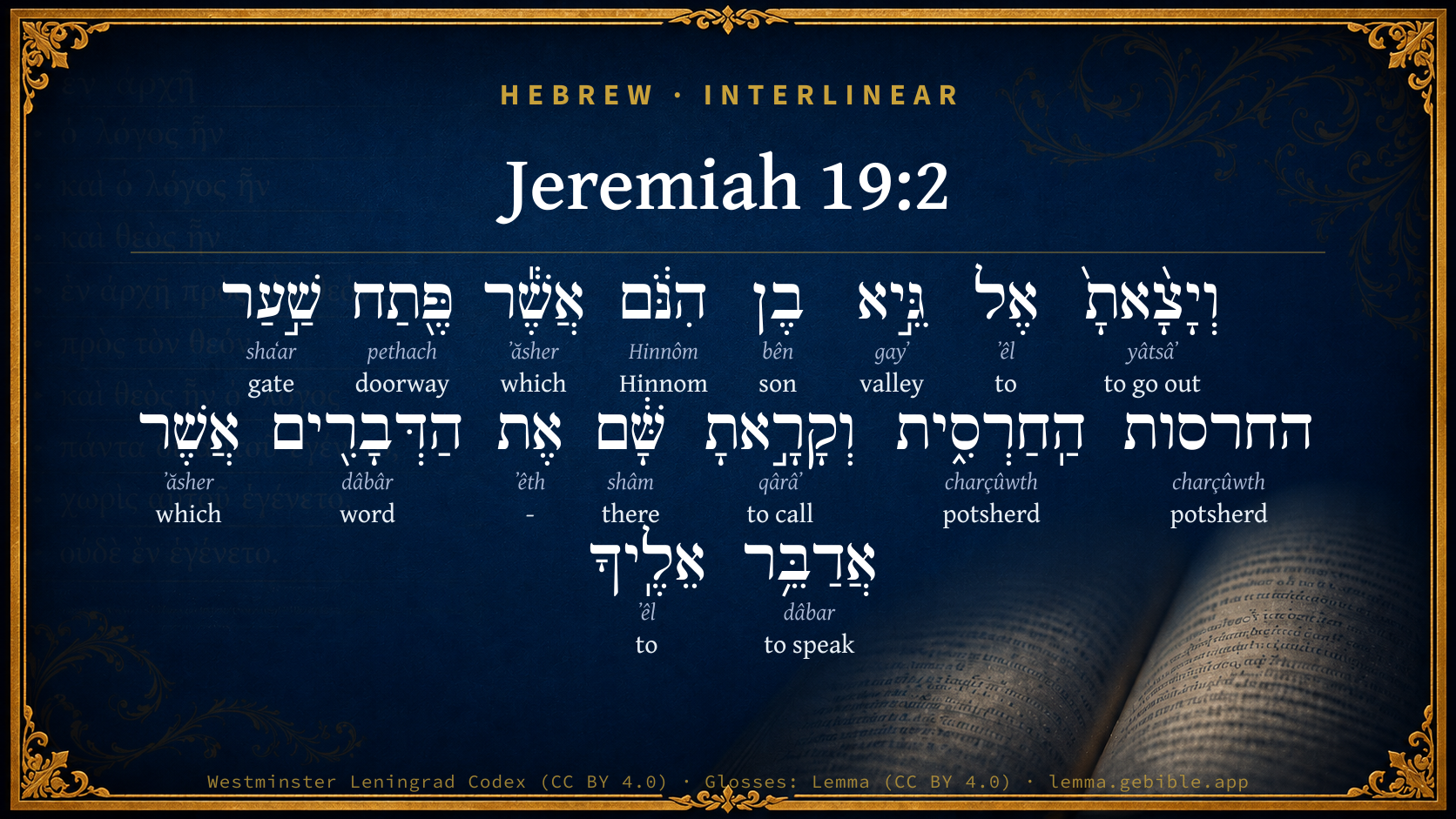
Hebrew (Westminster Leningrad Codex) Jeremiah 19:2 appears in the Hebrew Old Testament. The text above is from the Westminster Leningrad Codex. Each word links to its Strong’s number, a concise gloss, and parsing drawn from the Open Scriptures Hebrew Bible morphology. Click any word for its full Brown-Driver-Briggs (BDB) entry.
Download image
Cite this verse

Jeremiah 19:2 (World English Bible). Public Domain. Lemma interlinear Bible study tool, https://lemma.gebible.app/v/jeremiah/19/2.

Show BibTeX & RIS
BibTeX
RIS
English Translation
and go forth to the valley of the son of Hinnom, which is by the entry of the gate Harsith, and proclaim there the words that I shall tell you;
World English Bible · Public Domain
Highlights
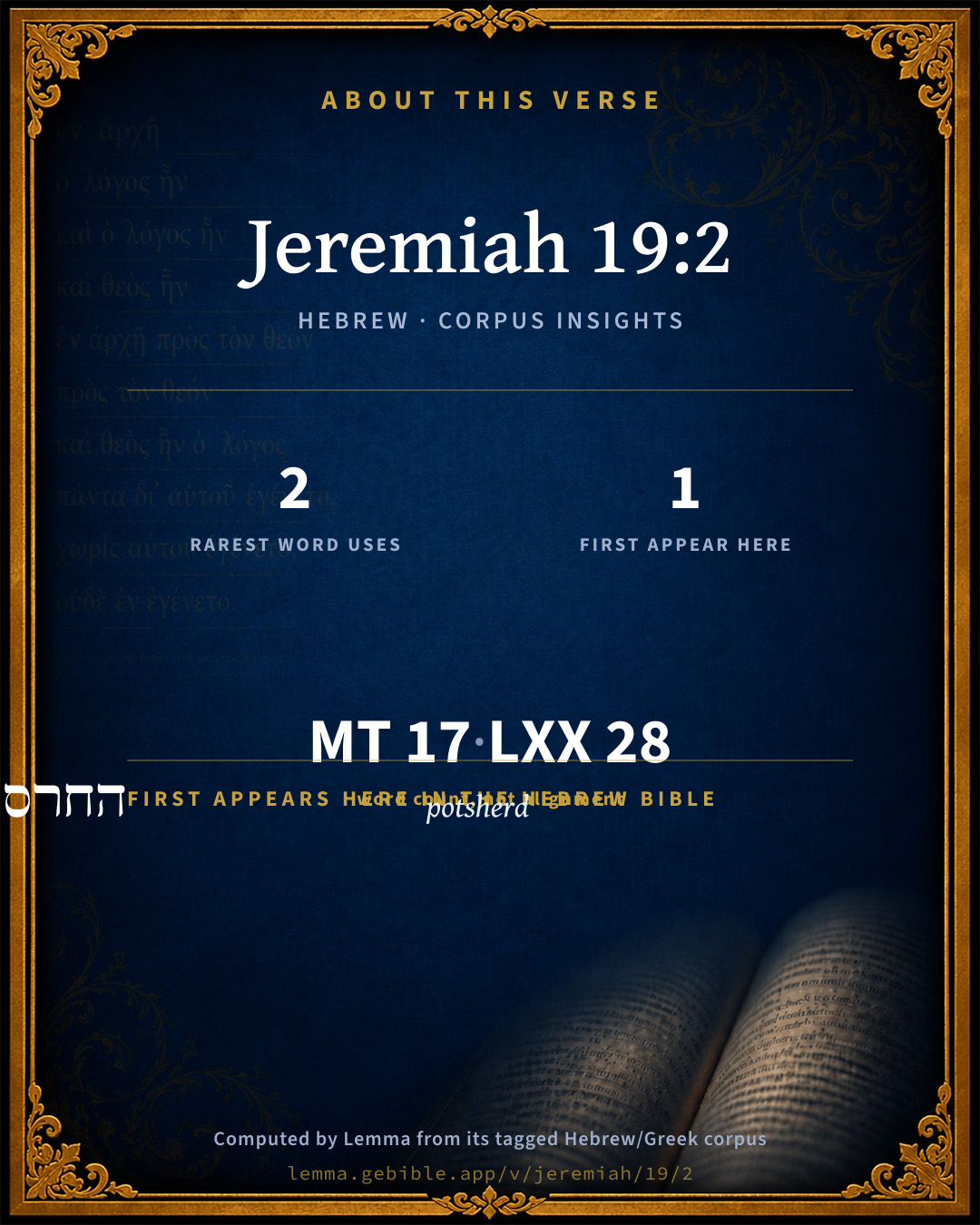
  • 1 first appearance in the Hebrew Bible
Full analysis ↓
Download a study sheet

One document with this verse’s original text, its word-by-word gloss line, the meaning frame, cross-references with their text, attributed commentary, and full source and license credits — printable, and it pastes into notes with its structure intact.

This verse Autodidact and up

Study sheet (.html) Plain text (.txt)

A passage Seminary Student

Up to 50 verses in one chapter. A passage sheet keeps up to 6 commentary sources and 12 cross-references per verse, in the order this page ranks them, and says so on the sheet whenever that leaves anything out. Ask for a single verse and you get the Autodidact verse sheet above.

Everything on this page stays free to read, with no account — the sheet is a download of what is already on screen, not access to it.

Want to remove ads? Support Godless Engineer
Compare translations 3

The same verse in 3 English versions, stacked beneath the original-language interlinear above. Click any original word for its lexicon entry.

Each is an independent rendering of the whole verse — the interlinear is not word-aligned to these translations.

Highlighted words mark where these versions differ — a whole-verse word diff, not a word-by-word alignment.

  • World English Bible Public Domain
    and go forth to the valley of the son of Hinnom, which is by the entry of the gate Harsith, and proclaim there the words that I shall tell you;
  • King James Version Public Domain
    And go forth unto the valley of the son of Hinnom, which is by the entry of the east gate, and proclaim there the words that I shall tell thee,
  • unfoldingWord Literal Text CC BY-SA 4.0
    And go out to the Valley of the Son of Hinnom, which at the entrance of the Potsherd Gate, and proclaim there the words that I will speak to you.

unfoldingWord Literal Text — © unfoldingWord, licensed CC BY-SA 4.0. Word-aligned USFM3 via Door43 (git.door43.org/unfoldingWord/en_ult).

Versions to compare (up to 4)

3 of 4 selected

Show all 18 translations

Every available English version of this verse, each an independent rendering of the whole verse.

  • World English Bible Public Domain
    and go forth to the valley of the son of Hinnom, which is by the entry of the gate Harsith, and proclaim there the words that I shall tell you;
  • Berean Standard Bible Public Domain
    and go out to the Valley of Ben-hinnom near the entrance of the Potsherd Gate. Proclaim there the words I speak to you,
  • Majority Standard Bible Public Domain
    and go out to the Valley of Ben-hinnom near the entrance of the Potsherd Gate. Proclaim there the words I speak to you,
  • King James Version Public Domain
    And go forth unto the valley of the son of Hinnom, which is by the entry of the east gate, and proclaim there the words that I shall tell thee,
  • American Standard Version (1901) Public Domain
    and go forth unto the valley of the son of Hinnom, which is by the entry of the gate Harsith, and proclaim there the words that I shall tell thee;
  • Revised Version (1885) Public Domain
    and go forth unto the valley of the son of Hinnom, which is by the entry of the gate Harsith, and proclaim there the words that I shall tell thee:
  • Geneva Bible (1599) Public Domain
    And goe forth vnto the valley of Ben-hinnom, which is by the entrie of the East gate: and thou shalt preache there the wordes, that I shall tell thee,
  • Douay-Rheims (1899) Public Domain
    And go forth into the valley of the son of Ennom, which is by the entry of the earthen gate: and there thou shalt proclaim the words that I shall tell thee.
  • Young's Literal Translation Public Domain
    and thou hast gone forth unto the valley of the son of Hinnom, that `is' at the opening of the gate of the pottery, and hast proclaimed there the words that I speak unto thee,
  • Literal Standard Version CC BY-SA 4.0
    and you have gone forth to the Valley of the Son of Hinnom, that [is] at the opening of the gate of the pottery, and have proclaimed there the words that I speak to you,
  • Unlocked Literal Bible CC BY-SA 4.0
    Then go out to the Valley of Ben Hinnom at the entry of the Broken Pottery Gate, and there proclaim the words that I will tell you.
  • unfoldingWord Literal Text CC BY-SA 4.0
    And go out to the Valley of the Son of Hinnom, which at the entrance of the Potsherd Gate, and proclaim there the words that I will speak to you.
  • Darby Bible Public Domain
    and go forth unto the valley of the son of Hinnom, which is by the entry of the pottery-gate, and proclaim there the words that I shall tell thee,
  • World Messianic Bible Public Domain
    and go out to the valley of the son of Hinnom, which is by the entry of the gate Harsith, and proclaim there the words that I will tell you.
  • Webster's Bible Public Domain
    And go forth to the valley of the son of Hinnom, which is by the entry of the east gate, and proclaim there the words that I shall tell thee,
  • Free Bible Version CC BY-SA 4.0
    and go through the Broken Pottery Gate to the valley of Ben-hinnom. Announce this message I'm giving you.
  • Bible in Basic English Public Domain
    And go out to the valley of the son of Hinnom, by the way into the door of broken pots, and there say in a loud voice the words which I will give you;
  • JPS Tanakh (1917) Public Domain
    and go forth unto the valley of the son of Hinnom, which is by the entry of the gate Harsith, and proclaim there the words that I shall tell thee;

Literal Standard Version (2020), Covenant Press — licensed CC BY-SA 4.0. Text via the HelloAO Bible API (eBible.org). Unlocked Literal Bible (unfoldingWord) — licensed CC BY-SA 4.0. Text via the HelloAO Bible API (eBible.org). unfoldingWord Literal Text — © unfoldingWord, licensed CC BY-SA 4.0. Word-aligned USFM3 via Door43 (git.door43.org/unfoldingWord/en_ult). Free Bible Version, Dr. Jonathan Gallagher — licensed CC BY-SA 4.0. Text via the HelloAO Bible API (eBible.org).

Word by word

More ways to search: Search by grammar → Find every occurrence → Compare this word →

Practice this passage: Drill this verse → Learn its vocabulary →

החרסות
charçûwth
H2777
“the · potsherd”
Particle, Definite Article + Noun, Common, Feminine, Singular, Absolute
Part of Speech
Particle + Noun
Type
Common
Gender
Feminine
Number
Singular
State
Absolute
Full BDB Definition

Origin: from H2775 (apparently in the sense of a red tile used for scraping)

TWOT: 759c

potsherd
  1. וְיָצָ֨אתָ֙ yâtsâʼ H3318 “and · to go out” Conjunction + Verb, Qal, Sequential Perfect, 2nd Person, Masculine, Singular
  2. אֶל ʼêl H413 “to” Preposition
  3. גֵּ֣יא gayʼ H1516 “valley” Noun, Proper
  4. בֶן bên H1121 “son” Noun, Proper
  5. הִנֹּ֔ם Hinnôm H2011 “Hinnom” Noun, Proper
  6. אֲשֶׁ֕ר ʼăsher H834 “which” Particle, Relative
  7. פֶּ֖תַח pethach H6607 “doorway of” Noun, Common, Masculine, Singular, Construct
  8. שַׁ֣עַר shaʻar H8179 “gate of” Noun, Common, Masculine, Singular, Construct
  9. הַֽחַרְסִ֑ית charçûwth H2777 “the · potsherd” Particle, Definite Article + Noun, Common, Feminine, Singular, Absolute
  10. וְקָרָ֣אתָ qârâʼ H7121 “and · to call” Conjunction + Verb, Qal, Sequential Perfect, 2nd Person, Masculine, Singular
  11. שָּׁ֔ם shâm H8033 “there” Adverb
  12. אֶת ʼêth H853 “-” Particle, Direct Object
  13. הַדְּבָרִ֖ים dâbâr H1697 “the · words” Particle, Definite Article + Noun, Common, Masculine, Plural, Absolute
  14. אֲשֶׁר ʼăsher H834 “which” Particle, Relative
  15. אֲדַבֵּ֥ר dâbar H1696 “to speak” Verb, Piel, Imperfect, 1st Person, Common, Singular
  16. אֵלֶֽיךָ ʼêl H413 “to · you” Preposition + Suffix, Personal, 2nd Person, Masculine, Singular

About this verse

These counts appear in no published source. They are computed here, from the morphology-tagged text and Lemma’s own curated glosses. What Lemma adds →

17
words
14
distinct lemmas
Prophets
section

Notable vocabulary

The rarest word here is החרסות potsherd H2777 — appearing just 2 times in the whole Hebrew Bible.

First appearance in Scripture

This word makes its first canonical appearance in the Hebrew Bible here:

  • החרסות potsherd H2777

Grammatical profile

  • 3 verbs
  • 8 nouns
  • 2 prepositions
  • 1 adverb
  • 3 particles

Verb forms

  • וְיָצָ֨אתָ֙ Qal · Sequential Perfect
  • וְקָרָ֣אתָ Qal · Sequential Perfect
  • אֲדַבֵּ֥ר Piel · Imperfect

Repetition

Words recur within this verse — often emphatic in Hebrew:

  • החרסות potsherd H2777 ×2
  • אֶל to H413 ×2
  • אֲשֶׁ֕ר which H834 ×2

Hebrew & Septuagint length

In the original languages it is 17 Hebrew tokens and 28 Greek tokens — but the two are counted differently (Hebrew bundles its prefixes and suffixes into one token; the Greek is in lemma form), so that isn’t a like-for-like length.

Cross-references

18

Topical passages linked to Jeremiah 19:2 in the Treasury of Scripture Knowledge — connected by theme and wording, ordered by reader-vote popularity; previews shown in the World English Bible.

  • Joshua 15:8 and the border went up by the valley of the son of Hinnom to the side of the Jebusite southward (the same is Jerusalem); and the border went up to the top of the mountain that lies before the valley of Hinnom westward, which is at the uttermost part of the valley of Rephaim northward;
  • 2 Kings 23:10 He defiled Topheth, which is in the valley of the children of Hinnom, that no man might make his son or his daughter to pass through the fire to Molech.
  • 2 Chronicles 28:3 Moreover he burnt incense in the valley of the son of Hinnom, and burnt his children in the fire, according to the abominations of the nations whom Yahweh cast out before the children of Israel.
  • 2 Chronicles 33:6 He also made his children to pass through the fire in the valley of the son of Hinnom; and he practiced sorcery, and used enchantments, and practiced sorcery, and dealt with those who had familiar spirits, and with wizards: he worked much evil in the sight of Yahweh, to provoke him to anger.
  • Jeremiah 7:31–32 They have built the high places of Topheth, which is in the valley of the son of Hinnom, to burn their sons and their daughters in the fire; which I didn't command, neither came it into my mind.
  • Jeremiah 32:35 They built the high places of Baal, which are in the valley of the son of Hinnom, to cause their sons and their daughters to pass through [the fire] to Molech; which I didn't command them, neither did it come into my mind, that they should do this abomination, to cause Judah to sin.
  • Nehemiah 3:29 After them repaired Zadok the son of Immer over against his own house. After him repaired Shemaiah the son of Shecaniah, the keeper of the east gate.
  • Proverbs 1:20–22 Wisdom calls aloud in the street. She utters her voice in the public squares.
  • Jeremiah 1:7 But Yahweh said to me, Don't say, I am a child; for to whoever I shall send you, you shall go, and whatever I shall command you, you shall speak.
  • Jeremiah 3:12 Go, and proclaim these words toward the north, and say, Return, you backsliding Israel, says Yahweh; I will not look in anger on you; for I am merciful, says Yahweh, I will not keep [anger] forever.
  • Jeremiah 7:2 Stand in the gate of Yahweh's house, and proclaim there this word, and say, Hear the word of Yahweh, all you of Judah, who enter in at these gates to worship Yahweh.
  • Jeremiah 11:6 Yahweh said to me, Proclaim all these words in the cities of Judah, and in the streets of Jerusalem, saying, Hear you the words of this covenant, and do them.
  • Jeremiah 26:2 Thus says Yahweh: Stand in the court of Yahweh's house, and speak to all the cities of Judah, which come to worship in Yahweh's house, all the words that I command you to speak to them; don't diminish a word.
  • Ezekiel 3:10–11 Moreover he said to me, Son of man, all my words that I shall speak to you receive in your heart, and hear with your ears.
  • Jonah 3:2 "Arise, go to Nineveh, that great city, and preach to it the message that I give you."
  • Matthew 10:27 What I tell you in the darkness, speak in the light; and what you hear whispered in the ear, proclaim on the housetops.
  • Acts 5:20 "Go stand and speak in the temple to the people all the words of this life."
  • Acts 20:27 for I didn't shrink from declaring to you the whole counsel of God.

Cross-references courtesy of OpenBible.info (CC BY 4.0).

Hebrew and Greek witnesses Masoretic Hebrew ↔ Greek Septuagint

The same verse in the two great witnesses to the Old Testament, shown verse-for-verse.

These are two independent witnesses, not word-aligned to each other, and the Septuagint is shown in lemma (dictionary) form.

Hebrew Jeremiah 19:2 Masoretic · Westminster Leningrad Codex

וְיָצָ֨אתָ֙ אֶל גֵּ֣יא בֶן הִנֹּ֔ם אֲשֶׁ֕ר פֶּ֖תַח שַׁ֣עַר החרסות הַֽחַרְסִ֑ית וְקָרָ֣אתָ שָּׁ֔ם אֶת הַדְּבָרִ֖ים אֲשֶׁר אֲדַבֵּ֥ר אֵלֶֽיךָ

and go forth to the valley of the son of Hinnom, which is by the entry of the gate Harsith, and proclaim there the words that I shall tell you;

World English Bible · Public Domain

Greek LXX Structure differs

In the Septuagint, Jeremiah is about an eighth shorter than the Hebrew and arranges its material differently — the Oracles Against the Nations (Hebrew chapters 46–51) appear in the middle of the Greek book, after 25:13. Because the chapter and verse boundaries do not line up, a verse-for-verse comparison with the Hebrew is not shown.

A verse-for-verse comparison isn’t shown here because the chapters and verses don’t line up. Switch to the LXX edition with the MT / LXX toggle above to read the Greek directly.

On this verse, Ellicott's Commentary for English Readers discusses the Septuagint’s reading. Read the note in Commentary ↓

Hebrew: Westminster Leningrad Codex (CC BY 4.0). Greek: Septuagint (public domain); English from a public-domain English Septuagint. How the Septuagint differs from the Hebrew →

Targum (Aramaic paraphrase)

1

The Targum is the ancient Jewish Aramaic paraphrase of the Hebrew Scriptures — an interpretive translation, not the Hebrew text itself. Onkelos (literal) and Pseudo-Jonathan (expansive) render the Torah, and Jonathan the Prophets. Coverage is partial: where no permissively-licensed English translation exists for a verse, only the Aramaic is shown. This is verse-level text, not a word-by-word alignment to the Hebrew.

  1. Targum Jonathan Prophets (Joshua–Malachi)
    וְתִפּוֹק לְחֵילַת בַּר הִנוֹם דִקְדָם תְרַע קִלְקַלְתָּא וְתִתְנַבֵּי תַמָן יַת פִּתְגָמָא דֶאֱמַלֵיל עִמָךְ:

    (no public-domain English translation for this verse)

    Targum Jonathan — Aramaic: “Mikraot Gedolot” (public domain). English: “Sefaria Community Translation” (CC0 1.0 (public-domain dedication)); “London "Chaldee Paraphrase," 1871” (public domain). Text via Sefaria.

Commentary

Notes on Jeremiah 19:2 from classic Christian and Jewish commentators (each source and its license shown beneath its notes). The classic Christian expositions comment on the surrounding passage and are grouped to its opening verse, so a note may address several verses; the Jewish commentaries on the Tanakh (Rashi and others) are per-verse, so they appear only where the commentator wrote on this verse.

Lemma curates 59 commentaries, every one of them public domain or Creative Commons licensed, each selected and text-cleaned for this edition rather than reprinted as found. About our sources →

Trapp's Complete Commentary

John Trapp

Jer 19:2 And go forth unto the valley of the son of Hinnom, which [is] by the entry of the east gate, and proclaim there the words that I shall tell thee,

Ver. 2. And go forth unto the valley of the son of Hinnom.] See Jer 7:3, that where the Jews had sinned, there they might be sentenced.

Which is by the entry of the east gate.] Or, as others render it, Portam fictilem seu testaceam, the gate of clay or brick, the potters’ gate (because the potters dwelt near to it, and thereby carried forth their potsherds), called also the dung gate, saith the Chaldee paraphrase; an allusion being hereby made both to the pot he carried and to the pieces of it when broken, which should be cast to the dunghill. Inde ad gehennam via erat. This was the way to Tophet, and thither Jeremiah led them, said an expositor, that {a} considering their graves in that valley, according to Jer 7:32, and that their bodies, those earthen vessels, should soon after be broken and carried out as dung into Tophet by the Chaldeans, and their souls into hell by the devils, they might repent, and so prevent such a mischief.

And proclaim there the words that I shall tell thee.] God took his own times to tell his prophets what they should tell the people. The privilege of infallibility, saith a divine, was perpetual to the apostles: Prophetis vero saepius intervallatum, et fere non extra ipsos prophetandi paroxysmos durans; not so to the prophets, but while they were prophesying only for the most part; neither knew they many times what they should prophesy, till the very instant.

{a} A Lapide.

John Trapp, A Commentary or Exposition upon All the Books of the Old and New Testament (1647–1656) — public domain. Text from a community e-Sword module.

Geneva Bible (1599)

Geneva Bible translators

Or, gate of the sun.

Geneva Bible (1599) marginal notes — public domain. Text via Bolls.life.

Jamieson, Fausset & Brown

Robert Jamieson, A. R. Fausset & David Brown

valley of the son of Hinnom--or Tophet, south of Jerusalem, where human victims were offered, and children made to pass through the fire, in honor of Molech.

east gate--Margin, "sun gate," sunrise being in the east. MAURER translates, the "potter's gate." Through it lay the road to the valley of Hinnom (Jos 15:8). The potters there formed vessels for the use of the temple, which was close by (compare Jer 19:10, Jer 19:14; Jer 18:2; Zac 11:13). The same as "the water gate toward the east" (Neh 3:26; Neh 12:37); so called from the brook Kedron. CALVIN translates, as English Version and Margin. "It was monstrous perversity to tread the law under foot in so conspicuous a place, over which the sun daily rising reminded them of the light of God's law."

Jamieson, Fausset & Brown — Commentary Critical and Explanatory on the Whole Bible (1871) — public domain (CC PDM 1.0). Text via the HelloAO Bible API.

John Calvin's Commentaries

And he adds, Enter into the valley of the son of Hinnom, which is at the entrance of the east gate, rendered by some “of the earthen gate,” for which I see no reason; but I leave this to be examined by those who are more versed in the language. It is indeed thought that ש, shin, is changed here into ס, samech; but if we take the word as it is, it means “solar,” for חרס cheras, from which חרסית cherasit, is derived, signifies the sun; and it seems to have been called the solar gate by way of excellency, because it looked toward the rising sun. I do not yet oppose the idea of those who think that the Prophet alludes to חרש, cheresh, of which he had spoken, and that he calls it the east gate, though it was as it were an earthen gate; for the two letters ש, shin, and ס samech, as it is well known, are closely allied. Cry there, he says, the words which I shall speak to thee.

I come now to the subject: God bids his Prophet to get from the potter an earthen vessel, and to do so in the presence of the elders; for it was necessary to have witnesses in a matter so important; and as the public safety of the people was concerned, it was God’s purpose, lest the prophecy should be despised, that there should be present the gravest witnesses, suitable, and, as they say, authorized, or approved; and he calls them the elders of the people and of the priests; and no doubt they were chosen from a great number, even from among the priests who were chief. There were also Levites of the sons of Aaron; but there were then chief priests a large number; but, as they say, it was a turbulent rabble. They were chosen from those first orders who ruled the Church, and Jeremiah calls them the elders of the priests. There were also others chosen from the people who presided over the Church. And we know that there were two public functionaries, or, as they say, a twofold government: the priests were the rulers of the Church with regard to the law, so that their government was spiritual; there were also the elders of the people who managed civil affairs; but there were some things in which they ruled in common. We now then see what the Prophet meant by saying that he was bidden to call witnesses to see what is afterwards stated, and that they were taken partly from the priests and partly from the people.

He says; Enter into the valley of the son of Hinnom. This valley was in the suburbs, and was called תפת Tophet, as we shall hereafter see. It is thought that this name is derived from drums, because they did beat drums when infants were killed, lest their cry should excite any feeling of humanity. But, we shall again say something on the etymology of this word. In this valley they were accustomed to sacrifice and offer their children by casting them into the fire. Many indeed performed this in a different way, by purifying their children and carrying them round the fire, so that they felt only the flame and escaped unhurt. But there were those who wished to shew their zeal above others, whose ambition drove them farther, and they killed their children and then burnt them. But of this matter I have spoken elsewhere, and I shall now only briefly notice it. This opinion is not, what is commonly received; but it seems to me that it may be gathered from many parts of Scripture, that many killed their children, and that some only purified them. However this may have been, God justly abominated the sacrifice; for his will was that sacrifices should be offered only in one place. When any one offered a calf or a lamb in any other place than at Jerusalem, it was a spurious sacrifice; and the Jews ought to have followed what God had prescribed, and not to have done anything presumptuously, for obedience is ever better than any sacrifices.

But here there was a double crime; they left the Temple and sought to obtrude on God sacrifices against his expressed will; and then there was another crime still more atrocious, for they devoted their children to Baalim or to Baal, and not to the only true God. (I pass by now their slaughter and burning.) This then was the reason why the Prophet was commanded to go to this place. How detestable that service was to God appears dear from this, that the prophets give the name of hell to the valley of Hinnom, גיא הנם gia-enom. And we know that at the time of Christ it was the common name for hell; and whenever Christ speaks of Gehenna, he uses the word according to its common acceptation at that time. The word has indeed been corrupted by the Greeks, for it is properly גיא הנם gia-enom. But what does the word mean in the gospel? Hell itself; and whence was its origin? We indeed know how great and how incurable was the madness of those who gave themselves up to their own superstitions; for though the prophets strongly condemned the place, yet the people proceeded in their usual idolatry; it was therefore necessary to give the place a disgraceful name in order to render it more abominable.

It is now added, that the place was by the entrance of the east gate. As it was especially a celebrated gate, and as the sun, rising there, reminded them to behold the light which God had kindled for them in his law, it was a monstrous stupidity proudly to tread, as it were, under foot. the law of God in so renowned a place, and to profane his worship, as though they openly wished to shew that they esteemed as nothing what God had commanded. If any still think that there is an allusion to the word חרש cheresh, before used, I offer no opposition; that is, though this gate was indeed oriental, it was yet as it were an earthen gate.

He says, Cry there, or, proclaim with a clear voice, the words which I shall speak to thee. The Prophet no doubt said this expressly, in order to add more weight to his prophecy. He indeed did nothing but by God’s command; but as his authority was not acknowledged by the Jews, he here testifies for their sakes that he would say nothing but what God himself would command. This preface then confirmed the authority of his prophecy, so that the Jews might not reject what he might say, as though it came from Jeremiah himself.

But a general doctrine may be hence gathered, — that ministers are to bring forward nothing but what they have learnt from God himself. For though Jeremiah was a great man and endued with excellent gifts, yet he was not to bring one word or a syllable as from himself: how great then must be the presumption of those who seek to be superior to him by bringing their inventions, and at the same time demand to be deemed oracles? This passage confirms the doctrine of Peter, who says,

“He who speaks, let him speak the words of God.” (1 Peter 4:11)

John Calvin's Commentaries (1540-1563) — public domain. Text from the Calvin Translation Society English edition (1840s-50s) via the Christian Classics Ethereal Library (ccel.org). Calvin's coverage is partial (roughly two-thirds of the Bible); uncommented books and verses are honest gaps, never fabricated. The 19th-century editor's footnotes and remarks are omitted so the notes are faithfully Calvin's own voice.

Ellicott's Commentary for English Readers

(2) Unto the valley of the son of Hinnom.—The site was chosen as having been the scene of the most hateful form of idolatry to which the people had addicted themselves, perhaps also as connected locally with the potter’s field. (See Note on Jer_7:31; and Mat_27:7.)

By the entry of the east gate.—The Hebrew word is obscure. The Authorised Version adopts a doubtful etymology, connecting the word with the sun (so “sun gate” in the margin) and therefore with the East. Luther, with the Vulgate and most modern scholars, renders it as “the potter’s gate,” or more literally, the gate of pottery. The LXX. treats it as a proper name, and gives “the gate Kharsith.” No such fate appears in the topographical descriptions of Nehemiah 2, 3; and the two gates which led into the valley of Hinnom were the Fountain and the Dung gate (Neh_3:13-15). Hence it has been inferred that this was a small postern gate leading into the valley just at the point where it was filled with rubbish, possibly with broken fragments like those which were now to be added to it. On this supposition the connection both of the name of the gate and its use with the symbolism of the prophet’s act may have determined the command which was thus given him.

A Bible Commentary for English Readers, edited by Charles John Ellicott (1878–1897) — public domain. Text from a community e-Sword module.

The Cambridge Bible for Schools and Colleges

gen. ed. J. J. S. Perowne

2. the valley of the son of Hinnom] See on ch. Jer_7:31.

the gate Harsith] rather, as mg. the gate of potsherds. Apparently so called from the fragments of broken pottery cast here as refuse “or perhaps crushed, as it is now, on a flat rock, with heavy stone rollers, into dust from which a cement is made, used for plastering cisterns. The place where this is now done is near the Birket es-Sultan, a pool at the S. W. of the city, in the upper part of what was probably the ancient ‘Valley of Hinnom.’ ” Dr., who also quotes Pal. Expl. Fund, Quart. Statement for 1904, p. 136. It is thought to be identical with the “dung” gate (Neh_2:13; Neh_3:13 f., Neh_12:31), leading into this valley.

The Cambridge Bible for Schools and Colleges (gen. ed. J. J. S. Perowne; Cambridge University Press, 1878–1918) — public domain. Text from a community e-Sword module.

John Gill's Exposition

And go forth into the valley of the son of Hinnom,.... To whom it formerly belonged, and so it was called as early as Joshua's time, Jos 15:8; from the faith and abomination of the place, and the shocking torments here exercised, "hell", from hence, in the New Testament, is called "Gehenna": here the prophet with the elders were to go, for reasons after mentioned; because here their cruel idolatries were committed, and Jerusalem was to be made like unto it for pollution and bloodshed:

which is by the entry of the east gate; the way to it out of Jerusalem lay through the east gate of the city. The Targum calls it "the dung gate"; through which the filth of the city was carried out, and laid near it, and where lay the potter's sherds; hence some render it the "potsherd" gate (m); or rather it should be the potter's gate; for that reason, because the potter's field and house lay near it, from whence the prophet had his earthen bottle; others call it the "sun gate" (n), because it lay to the sun rising; but seeing the valley of Hinnom was to the south of Jerusalem, this seems rather to be the south gate; and a proper situation this was for the potters to dry and harden their pots. The Septuagint, Syriac, and Arabic versions, leave it untranslated, and call it the gate Harsith or Hadsith:

and proclaim there the words that I shall tell thee; for as yet it was not made known to him what he should do with his bottle, or say to the elders, until he came to the place he was ordered to.

(m) "portae fictilis", Munster, Pagninus. (n) "Portae solaris", Montanus, Piscator, Cocceius; so Ben Melech, and Stockius, p. 389.

John Gill's Exposition of the Whole Bible (1746–1763) — public domain (CC PDM 1.0). Text via the HelloAO Bible API.

Albert Barnes' Notes on the Bible

The valley ... - See Jer 7:31 note.

The east gate - Others render “the pottery gate.” Two gates led into the valley of Hinnom, the Fountain-gate at the southeast corner, and the Dung-gate on the southwest side of Zion; some think that “the east gate” was neither of these, but a small or postern gate, used for throwing out rubbish, the valley having been put to this degrading use from the time that Josiah defiled it 2Ki 23:10. And thus the mean symbol of a proud nation was carried out through a back door to be broken upon the heaps of refuse already cast there.

Albert Barnes' Notes on the Bible (1834–1885) — public domain. Text from a community e-Sword/MySword module.

Haydock's Catholic Bible Commentary

Gate, which must have been to the south-east of Jerusalem, leading to the valley. (Calmet) --- Septuagint, "Charseith gate." (Haydock) --- Here the common people were buried, after the reign of Josias, who contaminated the place where the idol Moloc had been adored.

George Leo Haydock (1774–1849), Haydock's Catholic Family Bible and Commentary, 1859 edition — public domain. Excludes Psalms (Douay-Rheims chapter numbering differs from Protestant) and Deuterocanonical books (Catholic canon only).

Matthew Poole's English Annotations

Go forth unto the valley of the son of Hinnom: we shall hereafter hear why God commanded Jeremiah to go thither, rather than to another place, to break this earthen pot. This valley was a place very near unto Jerusalem, of which one Hinnom was owner in Joshua’s time, Jos 15:8; 18:16. The valley is in Scripture sometimes called Ge-hinnom, from whence came the Greek word Gehenna, used by our Saviour for hell, Mat 5:22, ειδ την γεενναν, because of the hellish torments they there put their children to when they sacrificed them, and of the hellish cries they made.

The east gate; in the Hebrew it is, the sun gate, supposed to be so called, because the sun riseth in the east. This valley is said to have lain very near to this gate; thither Jeremiah is commanded to go, and there to proclaim the following words.

Matthew Poole's English Annotations on the Holy Bible (1683–1685) — public domain. Text from a community e-Sword/MySword module.

Whedon's Commentary on the Bible

Daniel D. Whedon

2. Valley of the son of Hinnom — See on Jer_7:31. This designation of locality is the same with that of the previous chapter, but more specific.

East gate — Margin, sun gate. Both renderings are wrong. It should be sherd gate, an appellation which probably came from the broken fragments of earthenware scattered there. It is uncertain which of the two gates leading from the city into the valley of Hinnom is here meant — the Fountain gate, at the southwest corner, or the Dung gate, at the southeast corner, of Zion.

Daniel D. Whedon (gen. ed.), Commentary on the Old and New Testaments (1874–1909) — public domain. Text from a community e-Sword module.

The Pulpit Commentary

The valley of the son of Hinnom. (see on Jer_7:31) The east gate; rather the potsherd gate, i.e. the gate where potsherds were wont to be thrown. Another possible rendering is "sun gate," of which "east gate" is but a paraphrase. But there is evidently a connection between the name of the gate and the action performed by Jeremiah. The Authorized Version seems to have misled Captain Warren into identifying the valley of Hinnom with that of Kedron. He confirms his view, it is true, by the Arabic nomenclature, which speaks of the Kedron as the Wady Jehinnam a nomenclature, however, which is by no means uniform (see Robinson, "Biblical Researches," 2:396, 403). The situation of the "potsherd gate" must remain uncertain.

The Pulpit Commentary (1880–1919), ed. H.D.M. Spence-Jones & Joseph S. Exell — public domain. Text from a community e-Sword module.

Rashi

Rabbi Shlomo Yitzchaki (Rashi)

the Harsith Gate The Dung Gate, where broken pottery is cast, and Jonathan rendered in this manner תְרַע קִלְקַלְתָּא.

Rashi on the Tanakh — English translations: “The Judaica Press complete Tanach with Rashi, translated by A. J. Rosenberg” (CC BY 4.0); “Pentateuch with Rashi's commentary by M. Rosenbaum and A.M. Silbermann, 1929-1934” (public domain); “The Metsudah Tanach series, Lakewood, N.J” (CC BY 4.0); and “The Book of Joshua, Metsudah Publications, 1997” (CC BY 4.0). Text via Sefaria.

Lesson kit

Teaching starters — assembled from the data on this page, not authored interpretation. Every prompt links to the verse data it draws on. Edit before teaching.

Jeremiah, in the Prophets, opens this verse with 17 words (14 distinct Hebrew lemmas). Its most distinctive word is charçûwth (“potsherd”). A historical commentator’s framing appears above. Read the whole chapter for the surrounding context.

Discussion questions

  1. What does “potsherd” (charçûwth) contribute to the verse as a whole?
  2. This is the first place “potsherd” appears in Scripture (first appears here). What does its debut here establish?
  3. How does Joshua 15:8, which shares this passage’s theme, read alongside this verse?
  4. What does the repetition of “potsherd” (2× in this one verse) do in this verse?
  5. These translations render this verse differently; the difference is in the English rendering, not the original. What questions does that raise?
  6. «וְיָצָ֨אתָ֙» is a Qal Sequential Perfect verb. How does that grammatical form shape the action described?
  7. Compare how Trapp's Complete Commentary and Geneva Bible (1599) read this verse. Where do they agree or differ?

Things to notice

Reading settings

Reading text

Shown beneath each verse's original-language words.

Old Testament
Old Testament edition

Read the OT as the Masoretic Hebrew (MT) or the Greek Septuagint (LXX).

English shown for the Greek Septuagint (in the Hebrew ↔ Greek comparison).

Comparing translations? Open the Compare panel on any verse page to stack up to four side by side.