
Proverbs 9:14

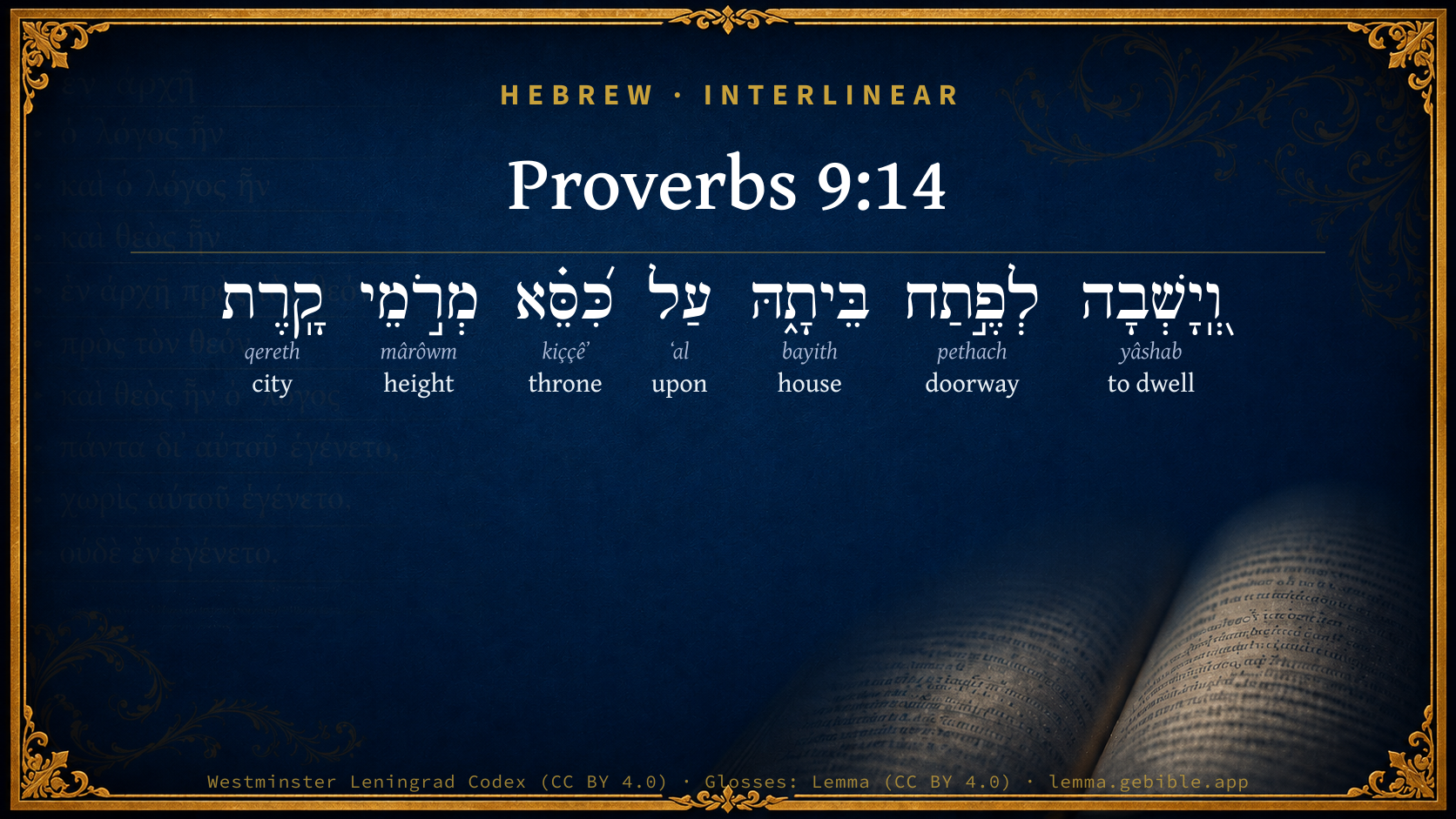
Hebrew (Westminster Leningrad Codex) Proverbs 9:14 appears in the Hebrew Old Testament. The text above is from the Westminster Leningrad Codex. Each word links to its Strong’s number, a concise gloss, and parsing drawn from the Open Scriptures Hebrew Bible morphology. Click any word for its full Brown-Driver-Briggs (BDB) entry.
Download image
Cite this verse

Proverbs 9:14 (World English Bible). Public Domain. Lemma interlinear Bible study tool, https://lemma.gebible.app/v/proverbs/9/14.

Show BibTeX & RIS
BibTeX
RIS
English Translation
She sits at the door of her house, On a seat in the high places of the city,
World English Bible · Public Domain
Download a study sheet

One document with this verse’s original text, its word-by-word gloss line, the meaning frame, cross-references with their text, attributed commentary, and full source and license credits — printable, and it pastes into notes with its structure intact.

This verse Autodidact and up

Study sheet (.html) Plain text (.txt)

A passage Seminary Student

Up to 50 verses in one chapter. A passage sheet keeps up to 6 commentary sources and 12 cross-references per verse, in the order this page ranks them, and says so on the sheet whenever that leaves anything out. Ask for a single verse and you get the Autodidact verse sheet above.

Everything on this page stays free to read, with no account — the sheet is a download of what is already on screen, not access to it.

Want to remove ads? Support Godless Engineer
Compare translations 3

The same verse in 3 English versions, stacked beneath the original-language interlinear above. Click any original word for its lexicon entry.

Each is an independent rendering of the whole verse — the interlinear is not word-aligned to these translations.

Highlighted words mark where these versions differ — a whole-verse word diff, not a word-by-word alignment.

  • World English Bible Public Domain
    She sits at the door of her house, On a seat in the high places of the city,
  • King James Version Public Domain
    For she sitteth at the door of her house, on a seat in the high places of the city,
  • unfoldingWord Literal Text CC BY-SA 4.0
    And she sits at the opening of her house, on a seat the heights of the city,

unfoldingWord Literal Text — © unfoldingWord, licensed CC BY-SA 4.0. Word-aligned USFM3 via Door43 (git.door43.org/unfoldingWord/en_ult).

Versions to compare (up to 4)

3 of 4 selected

Show all 18 translations

Every available English version of this verse, each an independent rendering of the whole verse.

  • World English Bible Public Domain
    She sits at the door of her house, On a seat in the high places of the city,
  • Berean Standard Bible Public Domain
    She sits at the door of her house, on a seat in the heights of the city,
  • Majority Standard Bible Public Domain
    She sits at the door of her house, on a seat in the heights of the city,
  • King James Version Public Domain
    For she sitteth at the door of her house, on a seat in the high places of the city,
  • American Standard Version (1901) Public Domain
    And she sitteth at the door of her house, On a seat in the high places of the city,
  • Revised Version (1885) Public Domain
    And she sitteth at the door of her house, on a seat in the high places of the city,
  • Geneva Bible (1599) Public Domain
    But she sitteth at the doore of her house on a seate in the hie places of the citie,
  • Douay-Rheims (1899) Public Domain
    Sat at the door of her house, upon a seat, in a high place of the city,
  • Young's Literal Translation Public Domain
    And she hath sat at the opening of her house, On a throne -- the high places of the city,
  • Literal Standard Version CC BY-SA 4.0
    And she has sat at the opening of her house, || On a throne—the high places of the city,
  • Unlocked Literal Bible CC BY-SA 4.0
    She sits at the door of her house, on a seat in the highest places of the town.
  • unfoldingWord Literal Text CC BY-SA 4.0
    And she sits at the opening of her house, on a seat the heights of the city,
  • Darby Bible Public Domain
    And she sitteth at the entry of her house, on a seat in the high places of the city,
  • World Messianic Bible Public Domain
    She sits at the door of her house, on a seat in the high places of the city,
  • Webster's Bible Public Domain
    For she sitteth at the door of her house, on a seat in the high places of the city,
  • Free Bible Version CC BY-SA 4.0
    She sits at the door of her house, on a seat in the high places of the town,
  • Bible in Basic English Public Domain
    Seated at the door of her house, in the high places of the town,
  • JPS Tanakh (1917) Public Domain
    And she sitteth at the door of her house, on a seat in the high places of the city,

Literal Standard Version (2020), Covenant Press — licensed CC BY-SA 4.0. Text via the HelloAO Bible API (eBible.org). Unlocked Literal Bible (unfoldingWord) — licensed CC BY-SA 4.0. Text via the HelloAO Bible API (eBible.org). unfoldingWord Literal Text — © unfoldingWord, licensed CC BY-SA 4.0. Word-aligned USFM3 via Door43 (git.door43.org/unfoldingWord/en_ult). Free Bible Version, Dr. Jonathan Gallagher — licensed CC BY-SA 4.0. Text via the HelloAO Bible API (eBible.org).

Word by word

More ways to search: Search by grammar → Find every occurrence → Compare this word →

Practice this passage: Drill this verse → Learn its vocabulary →

About this verse

These counts appear in no published source. They are computed here, from the morphology-tagged text and Lemma’s own curated glosses. What Lemma adds →

7
words
7
distinct lemmas
Wisdom
section

Notable vocabulary

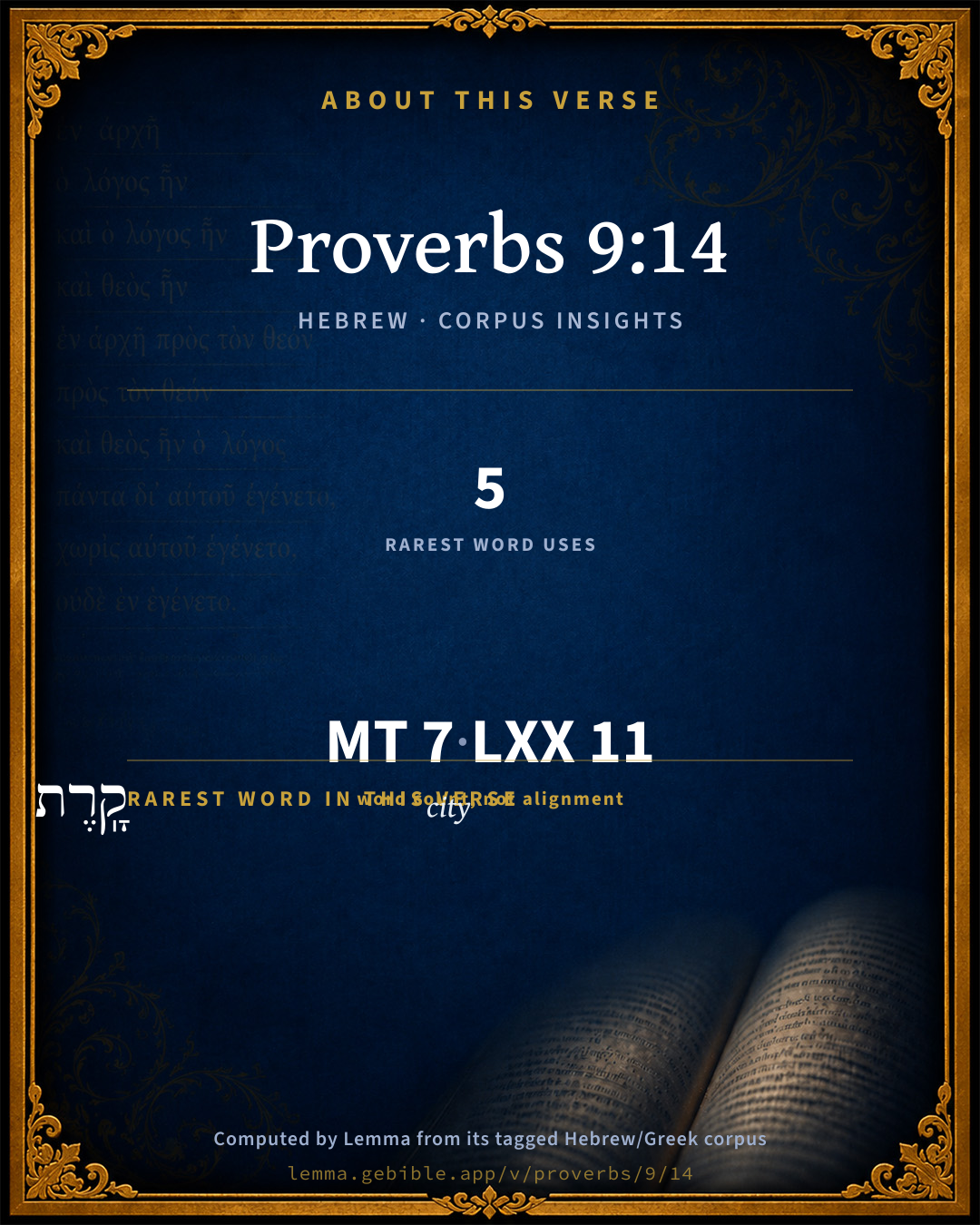
The rarest word here is קָֽרֶת city H7176 — appearing just 5 times in the whole Hebrew Bible.

Shared distinctive vocabulary

קָֽרֶת city H7176 occurs in 5 verses of the Hebrew Bible. Also found in:

Grammatical profile

  • 1 verb
  • 5 nouns
  • 1 preposition

Verb forms

  • וְֽ֭יָשְׁבָה Qal · Perfect

Hebrew & Septuagint length

In English translation the verse runs 18 words from the Hebrew and 15 from the Septuagint (LXX English) — closely comparable.

A rough comparison of the two English renderings, which tokenize alike — not a word-level alignment.

Word counts can differ between the Hebrew and the Greek without any difference in meaning — e.g. the Hebrew direct-object marker אֵת has no separate Greek word, and Greek often adds the article ὁ.

In the original languages it is 7 Hebrew tokens and 11 Greek tokens — but the two are counted differently (Hebrew bundles its prefixes and suffixes into one token; the Greek is in lemma form), so that isn’t a like-for-like length.

Cross-references

2

Topical passages linked to Proverbs 9:14 in the Treasury of Scripture Knowledge — connected by theme and wording, ordered by reader-vote popularity; previews shown in the World English Bible.

  • Proverbs 9:3 She has sent out her maidens. She cries from the highest places of the city:
  • Proverbs 7:10–12 Behold, there a woman met him with the attire of a prostitute, And with crafty intent.

Cross-references courtesy of OpenBible.info (CC BY 4.0).

Hebrew and Greek witnesses Masoretic Hebrew ↔ Greek Septuagint

The same verse in the two great witnesses to the Old Testament, shown verse-for-verse.

These are two independent witnesses, not word-aligned to each other, and the Septuagint is shown in lemma (dictionary) form.

Hebrew Proverbs 9:14 Masoretic · Westminster Leningrad Codex

וְֽ֭יָשְׁבָה לְפֶ֣תַח בֵּיתָ֑הּ עַל כִּ֝סֵּ֗א מְרֹ֣מֵי קָֽרֶת

She sits at the door of her house, On a seat in the high places of the city,

World English Bible · Public Domain

Greek LXX Proverbs 9:14 Septuagint · lemma form

καταἵζω ἐπί θύρα ὁ ἑαυτοῦ οἶκος ἐπί δίφρος ἐμφανῶς ἐν πλατύς

She sits at the doors of her house, on a seat openly in the streets,

LXX2012 (modern English Septuagint) · Public Domain

Hebrew: Westminster Leningrad Codex (CC BY 4.0). Greek: Septuagint (public domain); English from LXX2012 (modern English Septuagint) (Public Domain). How the Septuagint differs from the Hebrew →

Commentary

Notes on Proverbs 9:14 from classic Christian and Jewish commentators (each source and its license shown beneath its notes). The classic Christian expositions comment on the surrounding passage and are grouped to its opening verse, so a note may address several verses; the Jewish commentaries on the Tanakh (Rashi and others) are per-verse, so they appear only where the commentator wrote on this verse.

Lemma curates 59 commentaries, every one of them public domain or Creative Commons licensed, each selected and text-cleaned for this edition rather than reprinted as found. About our sources →

Trapp's Complete Commentary

John Trapp

Pro 9:14 For she sitteth at the door of her house, on a seat in the high places of the city,

Ver. 14. For she sitteth at the door.] In a harlot’s habit, to see and be seen; the guise and garb of harlots. Cicero wittily compareth the Greek tongue to an ambitious strumpet, quae multo luxu superfluat, which overlasheth in too much bravery; but the Latin tongue to an honest and modest matron, cui nihil deest quod ad honestum pertineat mundiciem, that wants nothing pertaining to a necessary neatness. Such a like comparison between wisdom and folly is here made by Solomon.

John Trapp, A Commentary or Exposition upon All the Books of the Old and New Testament (1647–1656) — public domain. Text from a community e-Sword module.

The Biblical Illustrator

Joseph S. Exell

Pro_9:14

For she sitteth at the door of her house.

The ministry of temptation

I. As conducted by depraved woman. A foolish woman is here the emblem of wickedness in the world.

1. She is ignorant. Blind to spiritual realities and claims. She is in the kingdom of darkness.

2. She is clamorous. Full of noise and excitement; bearing down all objections to her entreaties.

3. She is audacious. Modesty, which is the glory of a womans nature, has left her.

4. She is persuasive. She admits that her pleasures are wrong, and on that account more delectable.

II. As directed to the inexperienced in life. To whom does she especially direct her entreaties? Not to the mature saint stalwart in virtue. She calls passengers, the simple ones.

III. As tending to a most miserable destination. The ministry of temptation is very successful as conducted by depraved woman.

1. This woman obtained guests.

2. Her guests were ruined.

3. Her guests were ruined contrary to their intention. (Homilist.)

The pleasures of sin

One of the foul spirits that assail and possess men is singled out and delineated, and this one represents a legion in the background. This is no fancy picture. It is drawn from life. The plague is as rampant in our streets as it is represented to be in the Proverbs. Mankind have sat for the picture: there is no mistake in the outline, there is no exaggeration in the colouring. Let no youth ever once, or for a moment, go where he would be ashamed to be found by his father and his mother. This woman is the figure of all evil--the devil, the world, the flesh, whatever form they may assume and whatever weapons they may employ. The one evil spirit, dragged forth from the legion and exposed, is intended not to conceal, but to open up the generic character of the company. In this life every human being is placed between two rival invitations, and every human being in this life yields to the one or to the other. The power of sin lies in its pleasure. If stolen waters were not sweet, none would steal the waters. This is part of the mystery in which our being is involved by the fall. Our appetite is diseased. In man fallen there is a diseased relish for that which destroys. There is an appetite in our nature which finds sweetness in sin. And the appetite grows by what it feeds on. It is only in the mouth that the stolen water is sweet; afterwards it is bitter. One part of the youths danger lies in his ignorance: He knoweth not that the dead are there. (W. Arnot, D. D.)

The Biblical Illustrator, edited by Joseph S. Exell (c. 1880s–1900s) — public domain. Text from a community e-Sword module.

Joseph Benson's Commentary

Pro 9:14-15. She sitteth at the door of her house — Which denotes her idleness and impudence, and her diligence in watching for occasions of sin. To call passengers — Who were going innocently and directly about their own business, without any unchaste design.

Joseph Benson's Commentary on the Old and New Testaments (1811–1818) — public domain. Text from a community e-Sword module.

Tyndale Open Study Notes

Tyndale Open Resources

9:14 On the heights overlooking the city was the traditional location for a temple. Folly personifies false gods and goddesses that compete for the affection and loyalty of God’s people (contrast 9:2-3).

Tyndale Open Study Notes — © Tyndale Open Resources, licensed CC BY-SA 4.0. Text via the HelloAO Bible API.

Jamieson, Fausset & Brown

Robert Jamieson, A. R. Fausset & David Brown

on a seat--literally, "throne," takes a prominent place, impudently and haughtily.

Jamieson, Fausset & Brown — Commentary Critical and Explanatory on the Whole Bible (1871) — public domain (CC PDM 1.0). Text via the HelloAO Bible API.

Adam Clarke's Commentary

Verse 14. For she sitteth at the door of her house] Her conduct here marks at once her folly, impudence, and poverty. See above on Pr 7:6, &c., where the reader will find a similar character.

Adam Clarke's Commentary on the Bible (1810–1826) — public domain. Text from a community e-Sword/MySword module.

Ellicott's Commentary for English Readers

(14) She sitteth at the door of her house.—She does not care, like Wisdom, to send forth her maidens “to seek and to save that which was lost” (Luk_19:10); she contents herself with sitting at ease, just outside her own door, and calling to the passers-by.

A Bible Commentary for English Readers, edited by Charles John Ellicott (1878–1897) — public domain. Text from a community e-Sword module.

John Gill's Exposition

For she sitteth at the door of her house, Idle and inactive, looking out for her prey; not active and laborious, as Wisdom, building her house, killing her beasts, furnishing her table, and sending out her maidens to call in her guests; but exposing herself in the most public manner, and being at the utmost ease, sitting as a queen; see Rev 18:7; and as it follows,

on a seat, or "throne" (p); the same seat, or throne, power, and authority, which the dragon gave to the beast, or antichrist, placed at Rome, where this woman reigns; see Rev 13:2;

in the high places of the city; the city of Rome, and its jurisdiction, the high places of which are their temples, or churches; where this foolish woman is noisy and clamorous, proclaims her folly, and endeavours to seduce and raw persons to her superstition and idolatry. "Merome", the word for "high places", has some affinity with Rome, and comes from the same root (q).

(p) "super solium", Montanus, Junius & Tremellius; "super solio", Piscator, Michaelis, Schultens; "in thronum", Cocceius. (q) From "altus"; hence that of Virgil--"altae moenia Romae", Aeneid. l. 1. v. 7.

John Gill's Exposition of the Whole Bible (1746–1763) — public domain (CC PDM 1.0). Text via the HelloAO Bible API.

Albert Barnes' Notes on the Bible

Contrast with Pro 9:1, etc. The foolish woman has her house, but it is no stately palace with seven pillars, like the home of Wisdom. No train of maidens wait on her, and invite her guests, but she herself sits at the door, her position as prominent as that of Wisdom, counterfeiting her voice, making the same offer to the same class (compare Pro 9:16 with Pro 9:4).

Albert Barnes' Notes on the Bible (1834–1885) — public domain. Text from a community e-Sword/MySword module.

Matthew Poole's English Annotations

Which notes her idleness and impudence, and diligence in watching for occasions of sin.

Matthew Poole's English Annotations on the Holy Bible (1683–1685) — public domain. Text from a community e-Sword/MySword module.

The Pulpit Commentary

She sitteth at the door of her house. She, like Wisdom, has a house of her own, and imitates her in inviting guests to enter. She does not send forth her maidens; she does not stand in the streets and proclaim her mission. Vice has an easier task; all she has to do is to sit and beckon and use a few seductive words. Her house is not supported by seven pillars, built on the grace of God and upheld by the gifts of the Holy Spirit. like that of Wisdom (ver. 1); it is an ordinary habitation of no stately proportions. but its meanness impedes not the uses to which she puts it, her own charms causing her victims to disregard her environments. On a seat in the high pluses of the city. Her house is in the highest and most conspicuous part of the city, and she sits before her door in reckless immodesty, plying her shameful trade. (comp. Gen_38:14 Jer_3:2) The mimicry of her rival again appears, for Wisdom "crieth upon the highest places of the city" (ver. 3).

The Pulpit Commentary (1880–1919), ed. H.D.M. Spence-Jones & Joseph S. Exell — public domain. Text from a community e-Sword module.

John Wesley's Explanatory Notes

At the door - Watching for occasions of sin.

John Wesley, Explanatory Notes Upon the Whole Bible (1754–1765) — public domain. Text via the GEBible commentary corpus.

Lesson kit

Teaching starters — assembled from the data on this page, not authored interpretation. Every prompt links to the verse data it draws on. Edit before teaching.

Proverbs, in the Wisdom, opens this verse with 7 words (7 distinct Hebrew lemmas). Its most distinctive word is qereth (“city”). A historical commentator’s framing appears above. Read the whole chapter for the surrounding context.

Discussion questions

  1. What does “city” (qereth) contribute to the verse as a whole?
  2. How does Job 29:7, which shares the word «city», read alongside this verse?
  3. These translations render this verse differently; the difference is in the English rendering, not the original. What questions does that raise?
  4. «וְֽ֭יָשְׁבָה» is a Qal Perfect verb. How does that grammatical form shape the action described?
  5. Compare how Trapp's Complete Commentary and The Biblical Illustrator read this verse. Where do they agree or differ?

Things to notice

Reading settings

Reading text

Shown beneath each verse's original-language words.

Old Testament
Old Testament edition

Read the OT as the Masoretic Hebrew (MT) or the Greek Septuagint (LXX).

English shown for the Greek Septuagint (in the Hebrew ↔ Greek comparison).

Comparing translations? Open the Compare panel on any verse page to stack up to four side by side.