
Ezekiel 41:11

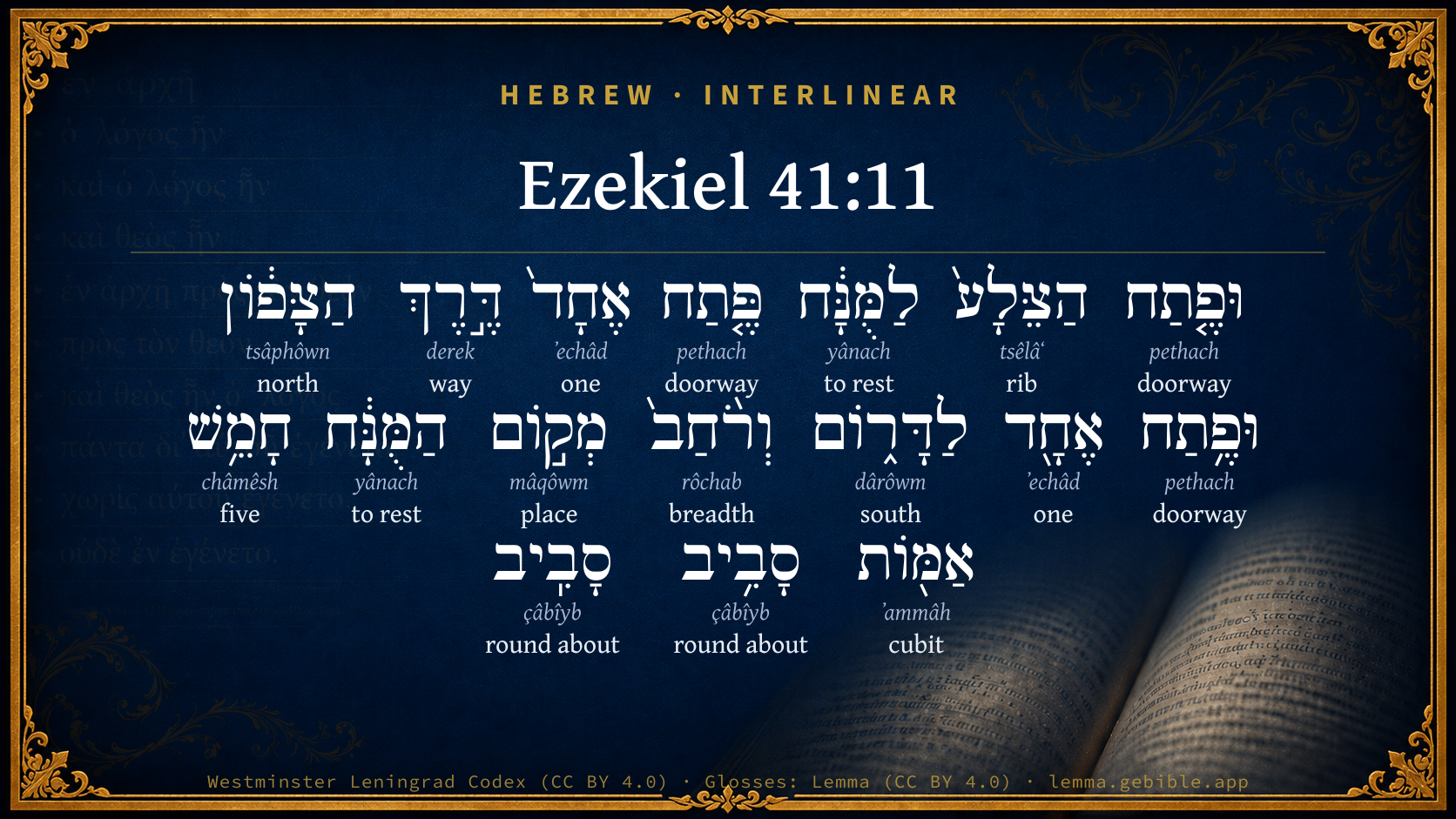
Hebrew (Westminster Leningrad Codex) Ezekiel 41:11 appears in the Hebrew Old Testament. The text above is from the Westminster Leningrad Codex. Each word links to its Strong’s number, a concise gloss, and parsing drawn from the Open Scriptures Hebrew Bible morphology. Click any word for its full Brown-Driver-Briggs (BDB) entry.
Download image
Cite this verse

Ezekiel 41:11 (World English Bible). Public Domain. Lemma interlinear Bible study tool, https://lemma.gebible.app/v/ezekiel/41/11.

Show BibTeX & RIS
BibTeX
RIS
English Translation
The doors of the side-chambers were toward [the place] that was left, one door toward the north, and another door toward the south: and the breadth of the place that was left was five cubits round about.
World English Bible · Public Domain
Download a study sheet

One document with this verse’s original text, its word-by-word gloss line, the meaning frame, cross-references with their text, attributed commentary, and full source and license credits — printable, and it pastes into notes with its structure intact.

This verse Autodidact and up

Study sheet (.html) Plain text (.txt)

A passage Seminary Student

Up to 50 verses in one chapter. A passage sheet keeps up to 6 commentary sources and 12 cross-references per verse, in the order this page ranks them, and says so on the sheet whenever that leaves anything out. Ask for a single verse and you get the Autodidact verse sheet above.

Everything on this page stays free to read, with no account — the sheet is a download of what is already on screen, not access to it.

Want to remove ads? Support Godless Engineer
Compare translations 3

The same verse in 3 English versions, stacked beneath the original-language interlinear above. Click any original word for its lexicon entry.

Each is an independent rendering of the whole verse — the interlinear is not word-aligned to these translations.

Highlighted words mark where these versions differ — a whole-verse word diff, not a word-by-word alignment.

  • World English Bible Public Domain
    The doors of the side-chambers were toward [the place] that was left, one door toward the north, and another door toward the south: and the breadth of the place that was left was five cubits round about.
  • King James Version Public Domain
    And the doors of the side chambers were toward the place that was left, one door toward the north, and another door toward the south: and the breadth of the place that was left was five cubits round about.
  • unfoldingWord Literal Text CC BY-SA 4.0
    There were doors into the side rooms from another open space—one doorway was on the north side, and the other on the south side. The width of this open area was five cubits all around.

unfoldingWord Literal Text — © unfoldingWord, licensed CC BY-SA 4.0. Word-aligned USFM3 via Door43 (git.door43.org/unfoldingWord/en_ult).

Versions to compare (up to 4)

3 of 4 selected

Show all 18 translations

Every available English version of this verse, each an independent rendering of the whole verse.

  • World English Bible Public Domain
    The doors of the side-chambers were toward [the place] that was left, one door toward the north, and another door toward the south: and the breadth of the place that was left was five cubits round about.
  • Berean Standard Bible Public Domain
    The side rooms opened into this area, with one entrance on the north and another on the south. The open area was five cubits wide all around.
  • Majority Standard Bible Public Domain
    The side rooms opened into this area, with one entrance on the north and another on the south. The open area was five cubits wide all around.
  • King James Version Public Domain
    And the doors of the side chambers were toward the place that was left, one door toward the north, and another door toward the south: and the breadth of the place that was left was five cubits round about.
  • American Standard Version (1901) Public Domain
    And the doors of the side-chambers were toward `the place' that was left, one door toward the north, and another door toward the south: and the breadth of the place that was left was five cubits round about.
  • Revised Version (1885) Public Domain
    And the doors of the side-chambers were toward the place that was left, one door toward the north, and another door toward the south: and the breadth of the place that was left was five cubits round about.
  • Geneva Bible (1599) Public Domain
    And the doores of the chambers were toward the place that remained, one doore toward the North, and another doore toward the South, and the breadth of the place that remained, was fiue cubites round about.
  • Douay-Rheims (1899) Public Domain
    And the door of the side chambers was turned towards the place of prayer: one door was toward the north, and another door was toward the south: and the breadth of the place for prayer, was five cubits round about.
  • Young's Literal Translation Public Domain
    And the opening of the side-chamber `is' to the place left, one opening northward, and one opening southward, and the breadth of the place that is left `is' five cubits all round about.
  • Literal Standard Version CC BY-SA 4.0
    And the opening of the side-chamber [is] to the remaining [space], one opening northward and one opening southward, and the breadth of the remaining space [is] five cubits all around.
  • Unlocked Literal Bible CC BY-SA 4.0
    There were doors into the side rooms from another open space—one doorway was on the north side, and the other on the south side. The width of this open area was five cubits all around.
  • unfoldingWord Literal Text CC BY-SA 4.0
    There were doors into the side rooms from another open space—one doorway was on the north side, and the other on the south side. The width of this open area was five cubits all around.
  • Darby Bible Public Domain
    And the entry of the side-chambers was toward what was left free, one entry toward the north, and one entry toward the south; and the width of the space left free was five cubits round about.
  • World Messianic Bible Public Domain
    The doors of the side rooms were toward an open area that was left, one door toward the north, and another door toward the south. The width of the open area was five cubits all around.
  • Webster's Bible Public Domain
    And the doors of the side-chambers were towards the place that was left, one door towards the north, and another door towards the south: and the breadth of the place that was left was five cubits around.
  • Free Bible Version CC BY-SA 4.0
    The doors of the side rooms opened into this area, with one entrance to the north and another one to the south. The open space was five cubits wide on each side.
  • Bible in Basic English Public Domain
    And the free space had doors opening from the side-rooms, one door on the north and one door on the south: and the free space was five cubits wide all round.
  • JPS Tanakh (1917) Public Domain
    And the doors of the side-chambers were toward the place that was left, one door toward the north, and another door toward the south; and the breadth of the place that was left was five cubits round about.

Literal Standard Version (2020), Covenant Press — licensed CC BY-SA 4.0. Text via the HelloAO Bible API (eBible.org). Unlocked Literal Bible (unfoldingWord) — licensed CC BY-SA 4.0. Text via the HelloAO Bible API (eBible.org). unfoldingWord Literal Text — © unfoldingWord, licensed CC BY-SA 4.0. Word-aligned USFM3 via Door43 (git.door43.org/unfoldingWord/en_ult). Free Bible Version, Dr. Jonathan Gallagher — licensed CC BY-SA 4.0. Text via the HelloAO Bible API (eBible.org).

Word by word

More ways to search: Search by grammar → Find every occurrence → Compare this word →

Practice this passage: Drill this verse → Learn its vocabulary →

לַדָּר֑וֹם
dârôwm
H1864
“to/for the · south”
Preposition, Determined + Noun, Common, Masculine, Singular, Absolute
Part of Speech
Preposition + Noun
Type
Common
Gender
Masculine
Number
Singular
State
Absolute
Full BDB Definition

Origin: of uncertain derivation

TWOT: 454d

south
  1. וּפֶ֤תַח pethach H6607 “and · doorway of” Conjunction + Noun, Common, Masculine, Singular, Construct
  2. הַצֵּלָע֙ tsêlâʻ H6763 “the · rib” Particle, Definite Article + Noun, Common, Both, Singular, Absolute
  3. לַמֻּנָּ֔ח yânach H3240 “to/for the · rested” Preposition, Determined + Verb, Hophal, Participle Passive, Masculine, Singular, Absolute
  4. פֶּ֤תַח pethach H6607 “doorway” Noun, Common, Masculine, Singular, Absolute
  5. אֶחָד֙ ʼechâd H259 “one” Adjective, Cardinal number, Masculine, Singular, Absolute
  6. דֶּ֣רֶךְ derek H1870 “way of” Noun, Common, Both, Singular, Construct
  7. הַצָּפ֔וֹן tsâphôwn H6828 “the · north” Particle, Definite Article + Noun, Common, Feminine, Singular, Absolute
  8. וּפֶ֥תַח pethach H6607 “and · doorway” Conjunction + Noun, Common, Masculine, Singular, Absolute
  9. אֶחָ֖ד ʼechâd H259 “one” Adjective, Cardinal number, Masculine, Singular, Absolute
  10. וְרֹ֨חַב֙ rôchab H7341 “and · breadth of” Conjunction + Noun, Common, Masculine, Singular, Construct
  11. מְק֣וֹם mâqôwm H4725 “place of” Noun, Common, Masculine, Singular, Construct
  12. הַמֻּנָּ֔ח yânach H3240 “the · rested” Particle, Definite Article + Verb, Hophal, Participle Passive, Masculine, Singular, Absolute
  13. חָמֵ֥שׁ châmêsh H2568 “five” Adjective, Cardinal number, Feminine, Singular, Absolute
  14. אַמּ֖וֹת ʼammâh H520 “cubits” Noun, Common, Feminine, Plural, Absolute
  15. סָבִ֥יב çâbîyb H5439 “round about” Noun, Common, Both, Singular, Absolute
  16. סָבִֽיב çâbîyb H5439 “round about” Noun, Common, Both, Singular, Absolute

About this verse

These counts appear in no published source. They are computed here, from the morphology-tagged text and Lemma’s own curated glosses. What Lemma adds →

17
words
12
distinct lemmas
Prophets
section

Notable vocabulary

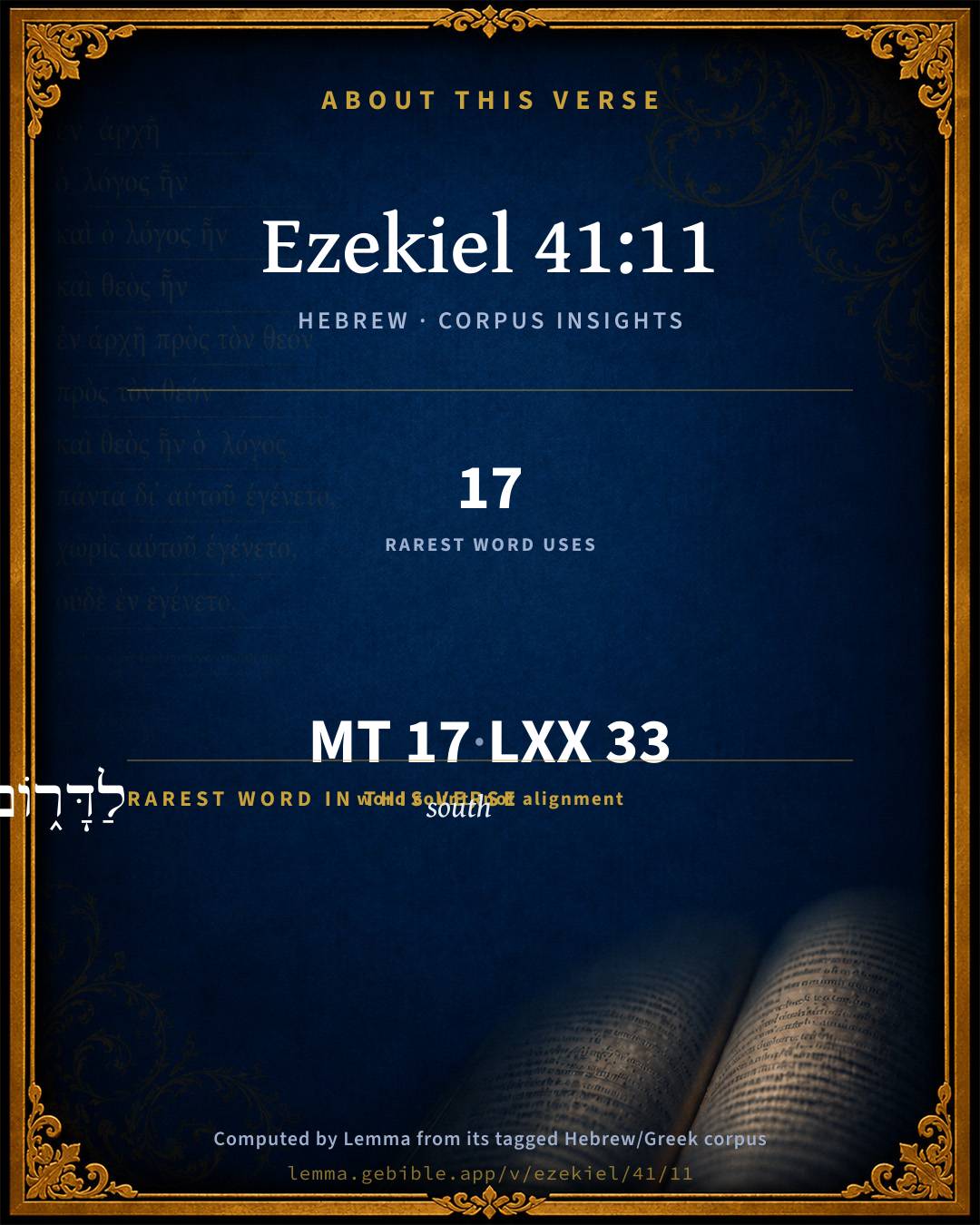
The rarest word here is לַדָּר֑וֹם south H1864 — appearing just 17 times in the whole Hebrew Bible.

Shared distinctive vocabulary

לַדָּר֑וֹם south H1864 occurs in 14 verses of the Hebrew Bible. Also found in:

Grammatical profile

  • 2 verbs
  • 12 nouns
  • 3 adjectives

Verb forms

  • לַמֻּנָּ֔ח Hophal · Participle Passive
  • הַמֻּנָּ֔ח Hophal · Participle Passive

Repetition

Words recur within this verse — often emphatic in Hebrew:

  • וּפֶ֤תַח doorway H6607 ×3
  • לַמֻּנָּ֔ח to rest H3240 ×2
  • אֶחָד֙ one H259 ×2
  • סָבִ֥יב round about H5439 ×2

Hebrew & Septuagint length

In English translation the verse runs 37 words from the Hebrew and 39 from the Septuagint (LXX English) — closely comparable.

A rough comparison of the two English renderings, which tokenize alike — not a word-level alignment.

Word counts can differ between the Hebrew and the Greek without any difference in meaning — e.g. the Hebrew direct-object marker אֵת has no separate Greek word, and Greek often adds the article ὁ.

In the original languages it is 17 Hebrew tokens and 33 Greek tokens — but the two are counted differently (Hebrew bundles its prefixes and suffixes into one token; the Greek is in lemma form), so that isn’t a like-for-like length.

Cross-references

2

Topical passages linked to Ezekiel 41:11 in the Treasury of Scripture Knowledge — connected by theme and wording, ordered by reader-vote popularity; previews shown in the World English Bible.

  • Ezekiel 41:9 The thickness of the wall, which was for the side-chambers, on the outside, was five cubits: and that which was left was the place of the side-chambers that belonged to the house.
  • Ezekiel 42:4 Before the chambers was a walk of ten cubits' breadth inward, a way of one cubit; and their doors were toward the north.

Cross-references courtesy of OpenBible.info (CC BY 4.0).

Hebrew and Greek witnesses Masoretic Hebrew ↔ Greek Septuagint

The same verse in the two great witnesses to the Old Testament, shown verse-for-verse.

These are two independent witnesses, not word-aligned to each other, and the Septuagint is shown in lemma (dictionary) form.

Hebrew Ezekiel 41:11 Masoretic · Westminster Leningrad Codex

וּפֶ֤תַח הַצֵּלָע֙ לַמֻּנָּ֔ח פֶּ֤תַח אֶחָד֙ דֶּ֣רֶךְ הַצָּפ֔וֹן וּפֶ֥תַח אֶחָ֖ד לַדָּר֑וֹם וְרֹ֨חַב֙ מְק֣וֹם הַמֻּנָּ֔ח חָמֵ֥שׁ אַמּ֖וֹת סָבִ֥יב סָבִֽיב

The doors of the side-chambers were toward [the place] that was left, one door toward the north, and another door toward the south: and the breadth of the place that was left was five cubits round about.

World English Bible · Public Domain

Greek LXX Ezekiel 41:11 Septuagint · lemma form

καί ὁ θύρα ὁ ἐξέδρα ἐπί ὁ ἀπόλοιπος ὁ θύρα ὁ εἷς ὁ πρός βορέας καί ὁ θύρα ὁ εἷς πρός νότος καί ὁ εὖρος ὁ φῶς ὁ ἀπόλοιπος πηχύς πέντε πλάτος κυκλόθεν

And the doors of the chambers were toward the space left by the one door that looked northward, and there was one door southward; and the breadth of the remaining open space was five cubits in extent round about.

LXX2012 (modern English Septuagint) · Public Domain

Hebrew: Westminster Leningrad Codex (CC BY 4.0). Greek: Septuagint (public domain); English from LXX2012 (modern English Septuagint) (Public Domain). How the Septuagint differs from the Hebrew →

Targum (Aramaic paraphrase)

1

The Targum is the ancient Jewish Aramaic paraphrase of the Hebrew Scriptures — an interpretive translation, not the Hebrew text itself. Onkelos (literal) and Pseudo-Jonathan (expansive) render the Torah, and Jonathan the Prophets. Coverage is partial: where no permissively-licensed English translation exists for a verse, only the Aramaic is shown. This is verse-level text, not a word-by-word alignment to the Hebrew.

  1. Targum Jonathan Prophets (Joshua–Malachi)
    וְתַרְעָא דִמְחִיצְתָּא לַאֲתַר שְׁבִיק תַּרְעָא חַד פְּתִיחַ לְאוֹרַח צִפּוּנָא וְתַרְעָא חַד פְּתִיחַ לְדָרוֹמָא וּפּוּתְיָא דַאֲתַר שְׁבִיק חֲמֵשׁ אַמִין סְחוֹר סְחוֹר:

    (no public-domain English translation for this verse)

    Targum Jonathan — Aramaic: “Mikraot Gedolot” (public domain). English: “Sefaria Community Translation” (CC0 1.0 (public-domain dedication)); “London "Chaldee Paraphrase," 1871” (public domain). Text via Sefaria.

Commentary

Notes on Ezekiel 41:11 from classic Christian and Jewish commentators (each source and its license shown beneath its notes). The classic Christian expositions comment on the surrounding passage and are grouped to its opening verse, so a note may address several verses; the Jewish commentaries on the Tanakh (Rashi and others) are per-verse, so they appear only where the commentator wrote on this verse.

Lemma curates 59 commentaries, every one of them public domain or Creative Commons licensed, each selected and text-cleaned for this edition rather than reprinted as found. About our sources →

Trapp's Complete Commentary

John Trapp

Eze 41:11 And the doors of the side chambers [were] toward [the place that was] left, one door toward the north, and another door toward the south: and the breadth of the place that was left [was] five cubits round about.

Ver. 11. Toward the place that was left.] Which served the faithful, saith Jerome, for an oratory, whither they went to pray.

John Trapp, A Commentary or Exposition upon All the Books of the Old and New Testament (1647–1656) — public domain. Text from a community e-Sword module.

Adam Clarke's Commentary

Verse 11. And the doors] See the plan, aa. bb. See Clarke on Eze 48:35.

Adam Clarke's Commentary on the Bible (1810–1826) — public domain. Text from a community e-Sword/MySword module.

Ellicott's Commentary for English Readers

(11) The doors of the side chambers.—These doors opened upon the platform, that for the series on the north side to the north, and for the other to the south. There was but one door on each side, so that the series of chambers must have been entered one from another.

We may now sum up the measurements of the Temple with its chambers and surrounding space. The wall, 6 cubits; the chambers, 4; their outer wall, 5; the platform beyond, 5; the space beyond this, 20 (6 + 4 + 5 + 5 + 20 = 40). This was on each side, and therefore is to be doubled, making 80 cubits; to this add the 20 cubits of the inner width of the Temple, and we have exactly the 100 cubits, the width of the inner court. In the same way the length: here the porch is considered as belonging to the court, and with it the front wall of the Temple, the thickness of which is included in the length of the porch. Beginning then at the inside of the outer walls, we have the inner length of Temple, 60 cubits; rear wall, 6; chambers, 4; outer wall, 5; platform, 5; space, 20; in all, 100 cubits. thus making an exact square.

A Bible Commentary for English Readers, edited by Charles John Ellicott (1878–1897) — public domain. Text from a community e-Sword module.

The Cambridge Bible for Schools and Colleges

gen. ed. J. J. S. Perowne

11. The verse states plainly that the place that was left, i.e. the margin of platform unoccupied by buildings, was 5 cubits broad, Fig. 2, E. and that the doors of the side-chambers opened upon it, one on the N. and another on the S. side, Fig. 2, g. It is evident that the side-chambers could have doors nowhere else, for their wall on one side was the wall of the house, in which doors could not be permitted; and the measurements seem to shew that the margin of raised basement did not go round the house on the west. In Solomon’s temple there was probably only one door, on the S. side, 1Ki_6:8.

The Cambridge Bible for Schools and Colleges (gen. ed. J. J. S. Perowne; Cambridge University Press, 1878–1918) — public domain. Text from a community e-Sword module.

John Gill's Exposition

And the doors of the side chambers were towards the place that was left,.... These opened to the void space before them; that is, those of the lower storey; the others must open to the winding staircase that led down to it:

one door toward the north, and another door toward the south; which is not to be understood as if each chamber had two doors; but either of the two doors, which opened at the top of the staircase to the north and south; or of the doors of those chambers, which were on the north, and opened towards it; and of those that were on the south, that opened to that: indeed the Misnic doctors say (d) that each chamber had three doors; one to the chamber on the right; another to the chamber on the left; and a third to the upper chamber: and in the north east corner were five doors; one to the chamber on the right; and one to the upper chamber; a third to the winding stairs; a fourth to the little gate; and the fifth to the temple; these signify the free entrance of men into the churches of Christ in the latter day, whose gates shall be opened to let in the righteous nation; and shall stand open continually, that the forces of the Gentiles and their kings may be brought, Isa 26:2 and in the New Jerusalem there are gates, east, west, north, and south, even twelve of them, and at them twelve angels; and which gates shall not be shut day nor night, Rev 21:12,

and the breadth of the place that was left was five cubits round about; the void space that was left before the side chambers; see Eze 41:9.

(d) Misn. Middot, c. 4. sect. 3.

John Gill's Exposition of the Whole Bible (1746–1763) — public domain (CC PDM 1.0). Text via the HelloAO Bible API.

Albert Barnes' Notes on the Bible

The doors of the side-chambers opened on to the passage or corridor, between the chambers and the temple-wall.

Albert Barnes' Notes on the Bible (1834–1885) — public domain. Text from a community e-Sword/MySword module.

Haydock's Catholic Bible Commentary

Prayer, or "separated;" munnach, (Haydock) the inner house, ver. 9.

George Leo Haydock (1774–1849), Haydock's Catholic Family Bible and Commentary, 1859 edition — public domain. Excludes Psalms (Douay-Rheims chapter numbering differs from Protestant) and Deuterocanonical books (Catholic canon only).

Matthew Poole's English Annotations

The doors of the lowest row opened into this void paved space. Beside the particular doors to each chamber, there were two, one on the north, where was a fair staircase, which did lead up to every story, and above these to the top of the temple. And so another like this on the south, excepting that this south staircase led not up to the top of all, as that north staircase did.

Matthew Poole's English Annotations on the Holy Bible (1683–1685) — public domain. Text from a community e-Sword/MySword module.

The Pulpit Commentary

The place that was left has been differently explained (see above on ver. 9); but on any hypothesis the side chambers opened on the free space towards the north and towards the south, g.s. one row of chambers was entered by a door from the south, another by a door from the north. The corridor into which the chambers opened whether between them and the house (Ewald, Currey) or between them and an outside wall (Kliefoth, Hengstenberg, Keil) was five cubits broad. Thus the whole breadth of the temple court can be obtained.

I The breadth of the court

1. Breadth of the house 20 cubits

2. Breadth of wall, 6 2 cubits = 12 cubits

3. Breadth of chambers, 4 2 cubits = 8 cubits

4. Breadth of chamber wall, 5 2 cubits = 10 cubits

5. Breadth of corridor, 5 2 cubits = 10 cubits

6. Breadth of free space, 20 2 cubits = 40 cubits Total 100 cubits

II The length of the court

1. The length of the house ... 60 cubits

2. The temple wall 6 cubits

3. The chambers 4 cubits

4. The chamber wall 5 cubits

5. The corridor 5 cubits

6. The space towards the west 20 cubits Total ... 100 cubits

The "house" was thus one hundred cubits square. The perch of the house was reckoned as belonging to the inner court. (Eze_40:48)

The Pulpit Commentary (1880–1919), ed. H.D.M. Spence-Jones & Joseph S. Exell — public domain. Text from a community e-Sword module.

John Wesley's Explanatory Notes

The doors - The doors of the lowest row opened into this void paved space.

John Wesley, Explanatory Notes Upon the Whole Bible (1754–1765) — public domain. Text via the GEBible commentary corpus.

Rashi

Rabbi Shlomo Yitzchaki (Rashi)

And the entrance of the cell was toward the clear space And the entrances of the outside cells were open to the left over clear area in the corner, as I explained.

Rashi on the Tanakh — English translations: “The Judaica Press complete Tanach with Rashi, translated by A. J. Rosenberg” (CC BY 4.0); “Pentateuch with Rashi's commentary by M. Rosenbaum and A.M. Silbermann, 1929-1934” (public domain); “The Metsudah Tanach series, Lakewood, N.J” (CC BY 4.0); and “The Book of Joshua, Metsudah Publications, 1997” (CC BY 4.0). Text via Sefaria.

Lesson kit

Teaching starters — assembled from the data on this page, not authored interpretation. Every prompt links to the verse data it draws on. Edit before teaching.

Ezekiel, in the Prophets, opens this verse with 17 words (12 distinct Hebrew lemmas). Its most distinctive word is dârôwm (“south”). A historical commentator’s framing appears above. Read the whole chapter for the surrounding context.

Discussion questions

  1. What does “south” (dârôwm) contribute to the verse as a whole?
  2. Deuteronomy 33:23 shares the word «south» with this verse. How do the two illuminate each other?
  3. “doorway” occurs 3× in this one verse. What is the effect of the repetition?
  4. The translations on this page render this verse differently — a whole-verse word diff, not a word-by-word alignment. What might account for the different wordings?
  5. The verb «לַמֻּנָּ֔ח» is Hophal Participle Passive. How does its form color the action?
  6. Reading how Trapp's Complete Commentary and Adam Clarke's Commentary read this verse, where do the two commentators agree and where do they part?

Things to notice

Reading settings

Reading text

Shown beneath each verse's original-language words.

Old Testament
Old Testament edition

Read the OT as the Masoretic Hebrew (MT) or the Greek Septuagint (LXX).

English shown for the Greek Septuagint (in the Hebrew ↔ Greek comparison).

Comparing translations? Open the Compare panel on any verse page to stack up to four side by side.