
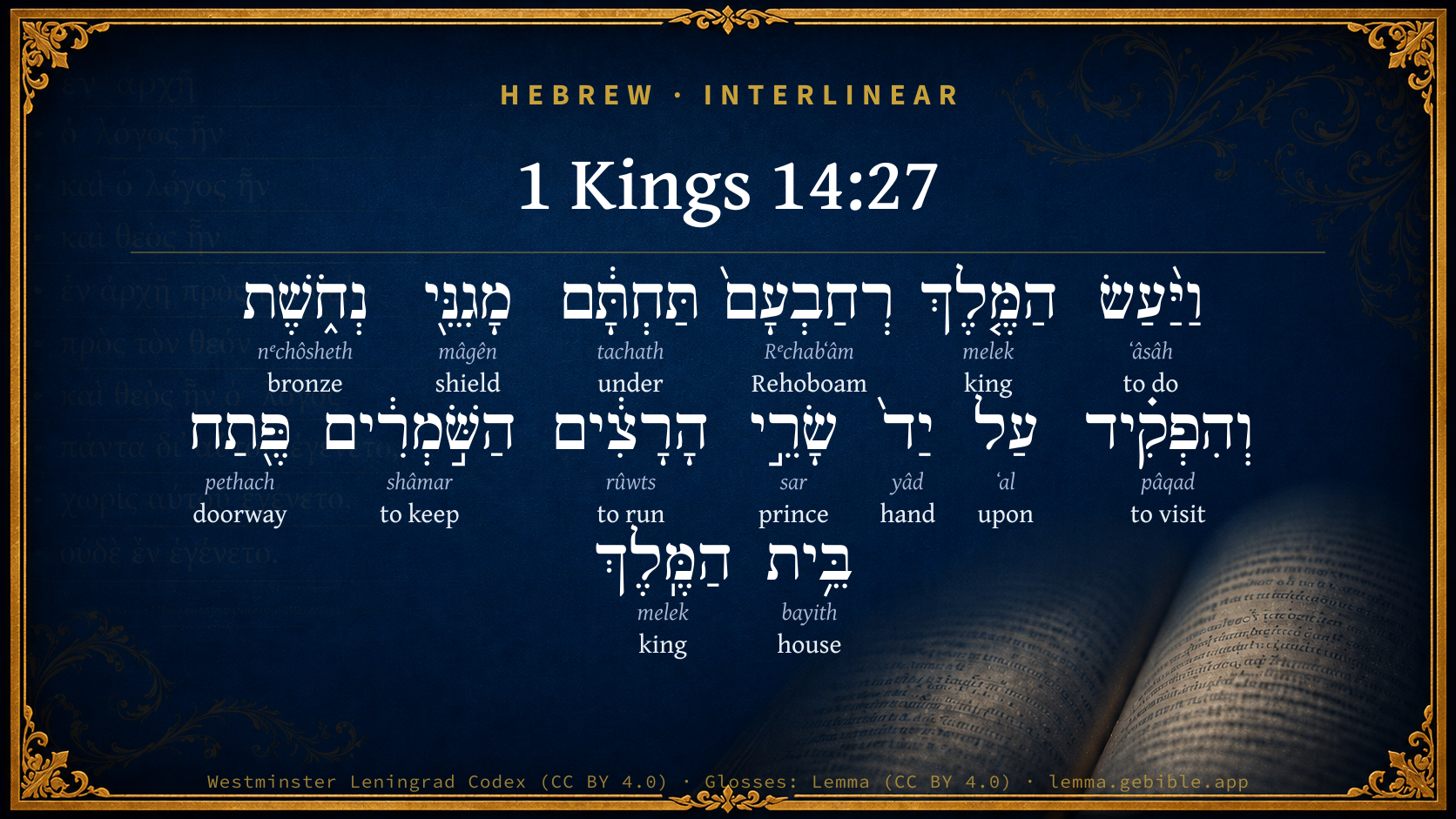
1 Kings 14:27

Hebrew (Westminster Leningrad Codex) 1 Kings 14:27 appears in the Hebrew Old Testament. The text above is from the Westminster Leningrad Codex. Each word links to its Strong’s number, a concise gloss, and parsing drawn from the Open Scriptures Hebrew Bible morphology. Click any word for its full Brown-Driver-Briggs (BDB) entry.
Download image
Cite this verse

1 Kings 14:27 (World English Bible). Public Domain. Lemma interlinear Bible study tool, https://lemma.gebible.app/v/1-kings/14/27.

Show BibTeX & RIS
BibTeX
RIS
English Translation
King Rehoboam made in their place shields of brass, and committed them to the hands of the captains of the guard, who kept the door of the king's house.
World English Bible · Public Domain
Download a study sheet

One document with this verse’s original text, its word-by-word gloss line, the meaning frame, cross-references with their text, attributed commentary, and full source and license credits — printable, and it pastes into notes with its structure intact.

This verse Autodidact and up

Study sheet (.html) Plain text (.txt)

A passage Seminary Student

Up to 50 verses in one chapter. A passage sheet keeps up to 6 commentary sources and 12 cross-references per verse, in the order this page ranks them, and says so on the sheet whenever that leaves anything out. Ask for a single verse and you get the Autodidact verse sheet above.

Everything on this page stays free to read, with no account — the sheet is a download of what is already on screen, not access to it.

Want to remove ads? Support Godless Engineer
Compare translations 3

The same verse in 3 English versions, stacked beneath the original-language interlinear above. Click any original word for its lexicon entry.

Each is an independent rendering of the whole verse — the interlinear is not word-aligned to these translations.

Highlighted words mark where these versions differ — a whole-verse word diff, not a word-by-word alignment.

  • World English Bible Public Domain
    King Rehoboam made in their place shields of brass, and committed them to the hands of the captains of the guard, who kept the door of the king's house.
  • King James Version Public Domain
    And king Rehoboam made in their stead brazen shields, and committed them unto the hands of the chief of the guard, which kept the door of the king's house.
  • unfoldingWord Literal Text CC BY-SA 4.0
    And King Rehoboam made shields of bronze in their place, and he committed them to the hand of the commanders of the runners, the ones keeping the entrance of the house of the king.

unfoldingWord Literal Text — © unfoldingWord, licensed CC BY-SA 4.0. Word-aligned USFM3 via Door43 (git.door43.org/unfoldingWord/en_ult).

Versions to compare (up to 4)

3 of 4 selected

Show all 18 translations

Every available English version of this verse, each an independent rendering of the whole verse.

  • World English Bible Public Domain
    King Rehoboam made in their place shields of brass, and committed them to the hands of the captains of the guard, who kept the door of the king's house.
  • Berean Standard Bible Public Domain
    Then King Rehoboam made bronze shields in their place and committed them to the care of the captains of the guard on duty at the entrance to the royal palace.
  • Majority Standard Bible Public Domain
    Then King Rehoboam made bronze shields in their place and committed them to the care of the captains of the guard on duty at the entrance to the royal palace.
  • King James Version Public Domain
    And king Rehoboam made in their stead brazen shields, and committed them unto the hands of the chief of the guard, which kept the door of the king's house.
  • American Standard Version (1901) Public Domain
    And king Rehoboam made in their stead shields of brass, and committed them to the hands of the captains of the guard, who kept the door of the king's house.
  • Revised Version (1885) Public Domain
    And king Rehoboam made in their stead shields of brass, and committed them to the hands of the captains of the guard, which kept the door of the king’s house.
  • Geneva Bible (1599) Public Domain
    And King Rehoboam made for them brasen shieldes, and committed them vnto ye hands of the chiefe of the garde, which wayted at the doore of the Kings house.
  • Douay-Rheims (1899) Public Domain
    And Roboam made shields of brass instead of them, and delivered them into the. hand of the captains of the shieldbearers, and of them that kept watch before the gate of the king's house.
  • Young's Literal Translation Public Domain
    And king Rehoboam maketh in their stead shields of brass, and hath made `them' a charge on the hand of the heads of the runners, those keeping the opening of the house of the king,
  • Literal Standard Version CC BY-SA 4.0
    And King Rehoboam makes shields of bronze in their stead, and has made [them] a charge on the hand of the heads of the runners, those keeping the opening of the house of the king,
  • Unlocked Literal Bible CC BY-SA 4.0
    King Rehoboam made shields of bronze in their place and entrusted them into the hands of the commanders of the guard, who guarded the doors to the king's house.
  • unfoldingWord Literal Text CC BY-SA 4.0
    And King Rehoboam made shields of bronze in their place, and he committed them to the hand of the commanders of the runners, the ones keeping the entrance of the house of the king.
  • Darby Bible Public Domain
    And king Rehoboam made in their stead brazen shields, and committed them to the hands of the chief of the couriers who kept the entrance of the king's house.
  • World Messianic Bible Public Domain
    King Rehoboam made shields of bronze in their place, and committed them to the hands of the captains of the guard, who kept the door of the king’s house.
  • Webster's Bible Public Domain
    And king Rehoboam made in their stead brazen shields, and committed them to the hands of the chief of the guard, who kept the door of the king's house.
  • Free Bible Version CC BY-SA 4.0
    So King Rehoboam made bronze shields to replace them and handed them over to the captains of the guard to look after. They stood on duty at the entrance to the royal palace.
  • Bible in Basic English Public Domain
    So in their place King Rehoboam had other body-covers made of brass, and gave them into the care of the captains of the armed men who were stationed at the door of the king's house.
  • JPS Tanakh (1917) Public Domain
    And king Rehoboam made in their stead shields of brass, and committed them to the hands of the captains of the guard, who kept the door of the king's house.

Literal Standard Version (2020), Covenant Press — licensed CC BY-SA 4.0. Text via the HelloAO Bible API (eBible.org). Unlocked Literal Bible (unfoldingWord) — licensed CC BY-SA 4.0. Text via the HelloAO Bible API (eBible.org). unfoldingWord Literal Text — © unfoldingWord, licensed CC BY-SA 4.0. Word-aligned USFM3 via Door43 (git.door43.org/unfoldingWord/en_ult). Free Bible Version, Dr. Jonathan Gallagher — licensed CC BY-SA 4.0. Text via the HelloAO Bible API (eBible.org).

Word by word

More ways to search: Search by grammar → Find every occurrence → Compare this word →

Practice this passage: Drill this verse → Learn its vocabulary →

רְחַבְעָם֙
Rᵉchabʻâm
H7346
“Rehoboam”
Noun, Proper
Part of Speech
Noun
Type
Proper
Full BDB Definition

Origin: from H7337 and H5971

TWOT: None

Rehoboam = "a people has enlarged" - son of Solomon and the 1st king of Judah after the split up of the kingdom of Israel
  1. וַיַּ֨עַשׂ ʻâsâh H6213 “and · to do” Conjunction + Verb, Qal, Sequential Imperfect, 3rd Person, Masculine, Singular
  2. הַמֶּ֤לֶךְ melek H4428 “the · king” Particle, Definite Article + Noun, Common, Masculine, Singular, Absolute
  3. תַּחְתָּ֔ם tachath H8478 “under · them” Preposition + Suffix, Personal, 3rd Person, Masculine, Plural
  4. מָגִנֵּ֖י mâgên H4043 “shields of” Noun, Common, Both, Plural, Construct
  5. נְחֹ֑שֶׁת nᵉchôsheth H5178 “bronze” Noun, Common, Feminine, Singular, Absolute
  6. וְהִפְקִ֗יד pâqad H6485 “and · to visit” Conjunction + Verb, Hiphil, Perfect, 3rd Person, Masculine, Singular
  7. עַל ʻal H5921 “upon” Preposition
  8. יַד֙ yâd H3027 “hand of” Noun, Common, Both, Singular, Construct
  9. שָׂרֵ֣י sar H8269 “princes of” Noun, Common, Masculine, Plural, Construct
  10. הָרָצִ֔ים rûwts H7323 “the · running” Particle, Definite Article + Verb, Qal, Participle Active, Masculine, Plural, Absolute
  11. הַשֹּׁ֣מְרִ֔ים shâmar H8104 “the · keeping” Particle, Definite Article + Verb, Qal, Participle Active, Masculine, Plural, Absolute
  12. פֶּ֖תַח pethach H6607 “doorway of” Noun, Common, Masculine, Singular, Construct
  13. בֵּ֥ית bayith H1004 “house of” Noun, Common, Masculine, Singular, Construct
  14. הַמֶּֽלֶךְ melek H4428 “the · king” Particle, Definite Article + Noun, Common, Masculine, Singular, Absolute

About this verse

These counts appear in no published source. They are computed here, from the morphology-tagged text and Lemma’s own curated glosses. What Lemma adds →

15
words
14
distinct lemmas
Historical
section

Shared distinctive vocabulary

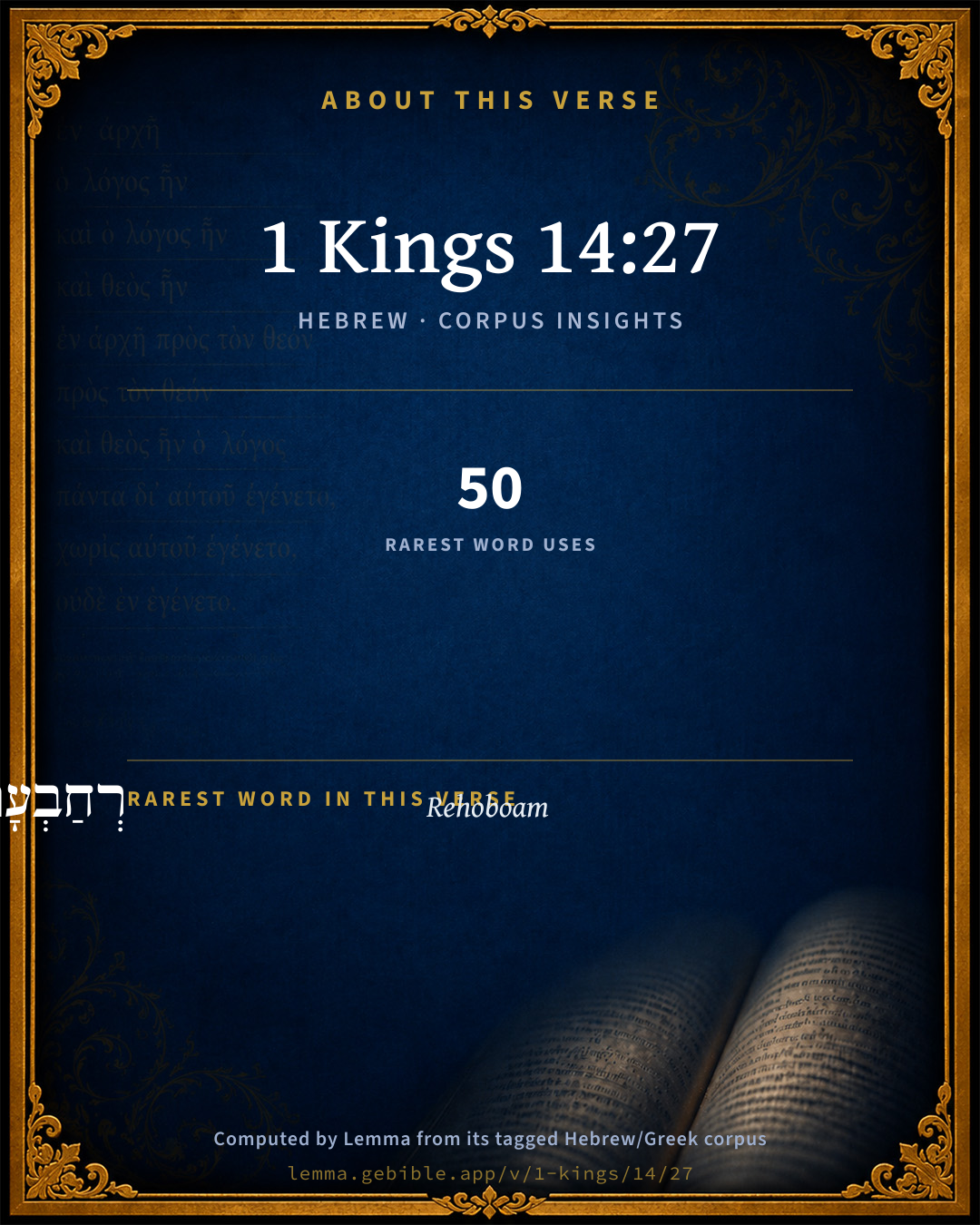
רְחַבְעָם֙ Rehoboam H7346 occurs in 41 verses of the Hebrew Bible. Also found in:

Grammatical profile

  • 4 verbs
  • 9 nouns
  • 2 prepositions

Verb forms

  • וַיַּ֨עַשׂ Qal · Sequential Imperfect
  • וְהִפְקִ֗יד Hiphil · Perfect
  • הָרָצִ֔ים Qal · Participle Active
  • הַשֹּׁ֣מְרִ֔ים Qal · Participle Active

Repetition

A word recurs within this verse — often emphatic in Hebrew:

  • הַמֶּ֤לֶךְ king H4428 ×2

Hebrew & Septuagint length

In English translation the verse runs 29 words from the Hebrew and 43 from the Septuagint (LXX English) — the Septuagint runs noticeably longer here. See the side-by-side →

A rough comparison of the two English renderings, which tokenize alike — not a word-level alignment.

Word counts can differ between the Hebrew and the Greek without any difference in meaning — e.g. the Hebrew direct-object marker אֵת has no separate Greek word, and Greek often adds the article ὁ.

Cross-references

7

Topical passages linked to 1 Kings 14:27 in the Treasury of Scripture Knowledge — connected by theme and wording, ordered by reader-vote popularity; previews shown in the World English Bible.

  • 1 Samuel 8:11 He said, This will be the manner of the king who shall reign over you: he will take your sons, and appoint them to him, for his chariots, and to be his horsemen; and they shall run before his chariots;
  • 1 Samuel 22:17 The king said to the guard who stood about him, Turn, and kill the priests of Yahweh; because their hand also is with David, and because they knew that he fled, and didn't disclose it to me. But the servants of the king wouldn't put forth their hand to fall on the priests of Yahweh.
  • 2 Samuel 15:1 It happened after this, that Absalom prepared him a chariot and horses, and fifty men to run before him.
  • 1 Kings 14:1 At that time Abijah the son of Jeroboam fell sick.
  • 1 Kings 14:5 Yahweh said to Ahijah, Behold, the wife of Jeroboam comes to inquire of you concerning her son; for he is sick: thus and thus shall you tell her; for it will be, when she comes in, that she will feign herself to be another woman.
  • 1 Kings 18:46 and the hand of Yahweh was on Elijah; and he girded up his loins, and ran before Ahab to the entrance of Jezreel.
  • Lamentations 4:1–2 How is the gold become dim! [how] is the most pure gold changed! The stones of the sanctuary are poured out at the head of every street.

Cross-references courtesy of OpenBible.info (CC BY 4.0).

Hebrew and Greek witnesses Masoretic Hebrew ↔ Greek Septuagint

The same verse in the two great witnesses to the Old Testament, shown verse-for-verse.

Here the Septuagint runs noticeably longer than the Hebrew — LXX2012 (modern English Septuagint) 43 words vs World English Bible 29. A rough length comparison of the two English translations, not a word-level alignment — read both below.

These are two independent witnesses, not word-aligned to each other, and the Septuagint is shown in lemma (dictionary) form.

Hebrew 1 Kings 14:27 Masoretic · Westminster Leningrad Codex

וַיַּ֨עַשׂ הַמֶּ֤לֶךְ רְחַבְעָם֙ תַּחְתָּ֔ם מָגִנֵּ֖י נְחֹ֑שֶׁת וְהִפְקִ֗יד עַל יַד֙ שָׂרֵ֣י הָרָצִ֔ים הַשֹּׁ֣מְרִ֔ים פֶּ֖תַח בֵּ֥ית הַמֶּֽלֶךְ

King Rehoboam made in their place shields of brass, and committed them to the hands of the captains of the guard, who kept the door of the king's house.

World English Bible · Public Domain

Greek LXX 1 Kings 14:27 Septuagint · lemma form
And king Roboam made brazen shields instead of them; and the chiefs of the golden shields which Solomon had made, and the chiefs of the body guard, who kept the gate of the house of the king, were placed in charge over them.

LXX2012 (modern English Septuagint) · Public Domain

Hebrew: Westminster Leningrad Codex (CC BY 4.0). Greek: Septuagint (public domain); English from LXX2012 (modern English Septuagint) (Public Domain). How the Septuagint differs from the Hebrew →

Targum (Aramaic paraphrase)

1

The Targum is the ancient Jewish Aramaic paraphrase of the Hebrew Scriptures — an interpretive translation, not the Hebrew text itself. Onkelos (literal) and Pseudo-Jonathan (expansive) render the Torah, and Jonathan the Prophets. Coverage is partial: where no permissively-licensed English translation exists for a verse, only the Aramaic is shown. This is verse-level text, not a word-by-word alignment to the Hebrew.

  1. Targum Jonathan Prophets (Joshua–Malachi)
    וַעֲבַד מַלְכָּא רְחַבְעָם חִלוּפֵיהוֹן מְגִנֵי נְחָשָׁא וּמַנֵי עַל רַבָּנֵי רָהֲטַיָא דְנַטְרִין תְּרַע בֵּית מַלְכָּא:

    (no public-domain English translation for this verse)

    Targum Jonathan — Aramaic: “Mikraot Gedolot” (public domain). English: “Sefaria Community Translation” (CC0 1.0 (public-domain dedication)); “London "Chaldee Paraphrase," 1871” (public domain). Text via Sefaria.

Commentary

Notes on 1 Kings 14:27 from classic Christian and Jewish commentators (each source and its license shown beneath its notes). The classic Christian expositions comment on the surrounding passage and are grouped to its opening verse, so a note may address several verses; the Jewish commentaries on the Tanakh (Rashi and others) are per-verse, so they appear only where the commentator wrote on this verse.

Lemma curates 59 commentaries, every one of them public domain or Creative Commons licensed, each selected and text-cleaned for this edition rather than reprinted as found. About our sources →

Trapp's Complete Commentary

John Trapp

1Ki 14:27 And king Rehoboam made in their stead brasen shields, and committed [them] unto the hands of the chief of the guard, which kept the door of the king’s house.

Ver. 27. Brazen shields.] "The faithful city" was now "become a harlot"; no wonder therefore that her "silver was become dross," {Isa 1:21-22} her gold brass.

John Trapp, A Commentary or Exposition upon All the Books of the Old and New Testament (1647–1656) — public domain. Text from a community e-Sword module.

The Biblical Illustrator

Joseph S. Exell

1Ki_14:27

King Rehoboam made in their stead brazen shields.

Shields of gold and bronze

Solomon in his reign decorated his court of justice, called the house of the forest of Lebanon, with three hundred shields of beaten gold. These shields of gold hung there until his son Rehoboams reign, when Shishak, King of Egypt, came up and pillaged Jerusalem. When he had taken these golden shields away, Rehoboam made for their empty places shields of brass or copper; and whatever trouble he may have taken to secure the shields of gold, he committed his brazen shields to the care of a trusty guard. And when the king went into the house of the Lord, the guard bare them, and brought them back into the guard-chamber.

1. The kingdom of Israel was a figure of that real kingdom which every man possesses--himself, with some good or evil principle regnant over its thoughts and desires, its life and aims. And this kingdom may be like the kingdom of Solomon, a realm regulated by a noble and wise power, and rich in the resources of a good and capable nature. Its protecting and inspiring principles may be as pure and as beautiful as shields of gold; justice and innocence, mercy and truth set up like shining shields within its inmost sanctuary. But if human life has any lesson more sad than another it is that which teaches that men often depart from their purest and best principles, and permit lower and less noble motives to guide them. Many men begin life with a real desire to become useful and a blessing to the world, who afterwards become mere seekers after wealth or pleasure. The bright, generous youth grows into the hard and selfish man; the frank, sympathetic, and lovable spirit shrivels up into the narrow, suspicious, grasping, and unloving seeker after self. A process of transmutation goes on, but not of baser metal into gold, but of gold into copper or bronze. This incident is a picture of this decline from high principle to something less noble and unselfish; it is the emblem of that change too common with us, from gold to brass.

2. There is one side of Rehoboams energy in making shields of copper that pathetically resembles our own sometimes--that which displays the haste and eagerness with which men hasten to conceal the loss of their highest feelings; how strenuously they strive to preserve the appearance of principle, of magnanimity, and of honour, when they have lost their essential spirit; how strictly they adhere to the forms of godliness when often its life is entirely gone! Burnished bronze is substituted for pure gold, and it often looks like gold and passes for it, but it lacks the true ring and the unsullied lustre of the genuine metal none the less. Yet it is important for us to learn that the substitution of copper for gold is a right thing when our gold is gone, if we do not deceive ourselves into the belief that our bronze is gold, for the loss of inward innocence and purity of motive can, at least, be partly atoned for by the steady pursuit of outward goodness and righteousness. It is sad, indeed, to depart from the best principles that we possess, but it is far more sorrowful not to repair our loss by the pursuit of some lesser good. Sometimes goodness seems instinctive, and we cannot do wrong, because it fills us with an unconquerable horror; but when such feelings fail, it is wise to resist evil from much lower motives rather than yield ourselves willingly to sin. If we cannot hearken to the voice of love, it is well for us to listen to the word of command; if full desire should fail to move us to do right, then it is wise to use the compulsion of law and obedience.

3. Many of our deepest and purest feelings do not seem able to bear the stress of this hard world. We quickly lose many of the sweetest and holiest feelings that were stored in our hearts in childhood; the teachableness, the peacefulness and humility, the sense of the Divine nearness, and our dependence upon our Heavenly Father; our reverence for truth and goodness, and our instinctive love of the right, are apt to fade away beneath the harsh light of this world of sin; but if our shields of gold should go, there is wisdom in making shields of copper; fitting up our minds with harder and lower principles; determining to obey the law of God; determining, at least, to keep our conduct pure; our hands, if not our hearts, clean; and doing our duty faithfully amongst men. It is Shishak, King of Egypt, the worldly principle, the principle of this life and its comforts, that robs us of our golden shields. We become engrossed with our earthly life, with its physical pleasures and pains, with its present hopes and disappointments, and the higher forces and influences lose their authority over us; what is better then, to use in preserving our religion, than those lower, but most needful, principles that bid us control our earthly and outward lives by a Divine law and force, that make religion a duty we owe to God, to ourselves, to our fellow-men, and unswerving fidelity to right our fixed course, because we must suffer and perish by any other way?

4. Men often make the mistake of giving up altogether their faith, their religion, their early principles and hopes, because they lose their charm, because they seem remote from their worldly daily life; but this is losing their shields altogether; they are depriving themselves entirely of what they might possess under another form; they should seek to make these things at least a check upon their lives, and follow what is right and good from a sense of duty if not from love. It is strange how precious such things become when we cling to them thus; it is easy indeed to lose the habit of prayer, which was once a pleasure to us; or the habit of attendance at the house of prayer, which was once a joy, when some fresh and more worldly influences come upon us; but it is remarkable how soon prayer and worship become a joy again, when we persevere in their use, and persist against our will in their practice. It is easy to lose our golden shields, but if we make for ourselves shields of copper, and guard them steadfastly and carefully, they will at length be transmuted into fine gold, for it is ever he that doeth the works that knows, and finds, and loves the doctrine. The pathway back to purity of heart is by purity of life; to the love of Gods commandments by obedience to them; to faith, and joy, and trust in heavenly things by steadfast duty to their laws in all we do below; and the method by which God restores to us our treasures of gold is by making us faithful over our treasures of bronze, for he that is faithful over a few things shall be ruler over many things. (W. F. Stonestreet.)

The Biblical Illustrator, edited by Joseph S. Exell (c. 1880s–1900s) — public domain. Text from a community e-Sword module.

Joseph Benson's Commentary

1Ki 14:27. Rehoboam made in their stead brazen shields — This was an emblem of the diminution of his glory. Sin makes the gold become dim: it changes the most fine gold, and turns it into brass. And committed them into the hands of the chief of the guard — Hebrew, שׂרי הרצים, saree haratsim, the rulers, or chiefs, of the runners, so called, because they ran, some before and others behind the king, and were what we now call a body-guard.

Joseph Benson's Commentary on the Old and New Testaments (1811–1818) — public domain. Text from a community e-Sword module.

Ellicott's Commentary for English Readers

(27) In their stead.—The notice of this substitution is not only a curious point of accurate detail, but perhaps intended as a symbolic representation of the change which had passed upon Judah, by which only the semblance of its old glory remained, and its “fine gold had become brass.”

A Bible Commentary for English Readers, edited by Charles John Ellicott (1878–1897) — public domain. Text from a community e-Sword module.

The Cambridge Bible for Schools and Colleges

gen. ed. J. J. S. Perowne

27. brasen shields] R.V. ‘shields of brass’ (or, rather, ‘bronze’) which is the form in 2Ch_12:10, and which represents the original more precisely.

chief of the guard] The margin of A.V. gives Heb. runners. We see from this that the Cherethites (or Cretans) and Pelethites, of David and Solomon, had disappeared, and that Rehoboam had only native troops, and those much more meanly armed.

The Cambridge Bible for Schools and Colleges (gen. ed. J. J. S. Perowne; Cambridge University Press, 1878–1918) — public domain. Text from a community e-Sword module.

John Gill's Exposition

And it was so, when the king went into the house of the Lord,.... The temple; for though he had fallen into idolatry, he had not wholly forsaken the worship of God in the temple, and perhaps by the late humbling providence he might be stirred up to attend there more frequently:

that the guard bare them: before him, partly for pomp and grandeur, and partly to keep in awe such as were inclined to mutiny and sedition:

and brought them back into the guard chamber; when the king returned, the place where the guard lodged and slept by turns.

John Gill's Exposition of the Whole Bible (1746–1763) — public domain (CC PDM 1.0). Text via the HelloAO Bible API.

Haydock's Catholic Bible Commentary

Hand. Symmachus, "the place where the courtiers" (guards) stood, (Haydock) in the hall; (Calmet) or he made the guards carry these shields before him, ver. 28. (Haydock)

George Leo Haydock (1774–1849), Haydock's Catholic Family Bible and Commentary, 1859 edition — public domain. Excludes Psalms (Douay-Rheims chapter numbering differs from Protestant) and Deuterocanonical books (Catholic canon only).

Matthew Poole's English Annotations

Whereas the golden shields, as being more precious, were kept in a certain place.

Matthew Poole's English Annotations on the Holy Bible (1683–1685) — public domain. Text from a community e-Sword/MySword module.

Whedon's Commentary on the Bible

Daniel D. Whedon

27. Brazen shields — “An expressive emblem of the degeneracy of Judah. How soon the mention of the profusion of gold in the age of Solomon is succeeded by this mention of brass in its place! ‘How is the gold become dim! How is the most fine gold changed!’” — Wordsworth.

Daniel D. Whedon (gen. ed.), Commentary on the Old and New Testaments (1874–1909) — public domain. Text from a community e-Sword module.

The Pulpit Commentary

And king Rehoboam made in their stead brazen shields lit., shields of brass or copper; a striking token of the decadence of the kingdom; cf. 1Ki_9:28 1Ki_10:22. "He changed his father"s religion, as his shields, from gold to brass" (Hall) I, and comttted Heb. appointed them unto the hands of the chief of the guard Heb. commanders of the runners, (see on 1Ki_1:38) which kept the door of the king"s house. Cf. 2Ki_11:6. The functions of the bodyguard were very varied. A primary duty was, obviously, to supply sentinels and attendants for the palace.

The Pulpit Commentary (1880–1919), ed. H.D.M. Spence-Jones & Joseph S. Exell — public domain. Text from a community e-Sword module.

John Wesley's Explanatory Notes

Brazen shields - This was an emblem of the diminution of his glory. Sin makes the gold become dim, it changes the most fine gold and turns it into brass.

John Wesley, Explanatory Notes Upon the Whole Bible (1754–1765) — public domain. Text via the GEBible commentary corpus.

unfoldingWord translationNotes

Door43 World Missions Community

King Rehoboam made shields

Here "King Rehoboam" represents the persons who worked for him to make the shields. AT: "King Rehoboam's workers made shields" (See: Metonymy)

in their place

"in place of the shields of gold"

entrusted them into the hands of the commanders

Here "hands" represents care or responsibility. AT: "made them the responsibility of the commanders" (See: Metonymy)

who guarded the doors to the king's house

Here "doors" represents the entrance. AT: "who guarded the entrance to the king's house" (See: Metonymy)

the guards would carry them

"the guards would carry the shields of bronze"

translationWords

king

bronze

trust

hand

commander

unfoldingWord translationNotes — © Distant Shores Media and the Door43 World Missions Community, licensed CC BY-SA 4.0. Source: git.door43.org/Door43/en_tn.

Lesson kit

Teaching starters — assembled from the data on this page, not authored interpretation. Every prompt links to the verse data it draws on. Edit before teaching.

1 Kings, in the Historical, opens this verse with 15 words (14 distinct Hebrew lemmas). Its most distinctive word is Rᵉchabʻâm (“Rehoboam”). The Greek Septuagint runs longer here. A historical commentator’s framing appears above. Read the whole chapter for the surrounding context.

Discussion questions

  1. The word Rᵉchabʻâm carries the sense “Rehoboam.” How does it shape the verse?
  2. How does 1 Kings 11:43, which shares the word «Rehoboam», read alongside this verse?
  3. What does the repetition of “king” (2× in this one verse) do in this verse?
  4. The Septuagint runs longer here than the Hebrew. What might account for the difference?
  5. The translations on this page render this verse differently — a whole-verse word diff, not a word-by-word alignment. What might account for the different wordings?
  6. «וַיַּ֨עַשׂ» is a Qal Sequential Imperfect verb. How does that grammatical form shape the action described?
  7. Compare how Trapp's Complete Commentary and The Biblical Illustrator read this verse. Where do they agree or differ?

Things to notice

Reading settings

Reading text

Shown beneath each verse's original-language words.

Old Testament
Old Testament edition

Read the OT as the Masoretic Hebrew (MT) or the Greek Septuagint (LXX).

English shown for the Greek Septuagint (in the Hebrew ↔ Greek comparison).

Comparing translations? Open the Compare panel on any verse page to stack up to four side by side.