
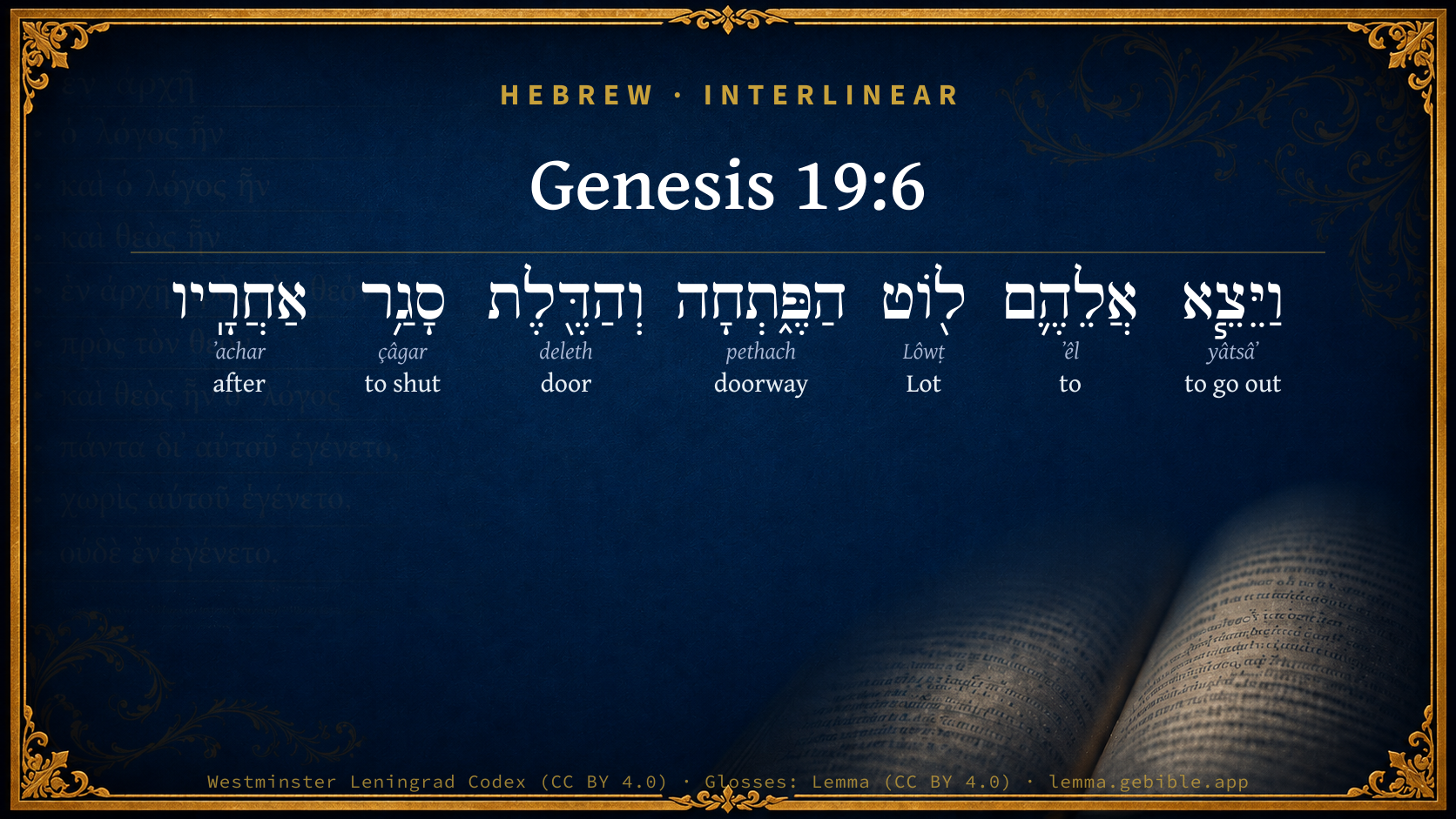
Genesis 19:6

Hebrew (Westminster Leningrad Codex) Genesis 19:6 appears in the Hebrew Old Testament. The text above is from the Westminster Leningrad Codex. Each word links to its Strong’s number, a concise gloss, and parsing drawn from the Open Scriptures Hebrew Bible morphology. Click any word for its full Brown-Driver-Briggs (BDB) entry.
Download image
Cite this verse

Genesis 19:6 (World English Bible). Public Domain. Lemma interlinear Bible study tool, https://lemma.gebible.app/v/genesis/19/6.

Show BibTeX & RIS
BibTeX
RIS
English Translation
Lot went out to them to the door, and shut the door after him.
World English Bible · Public Domain
Highlights
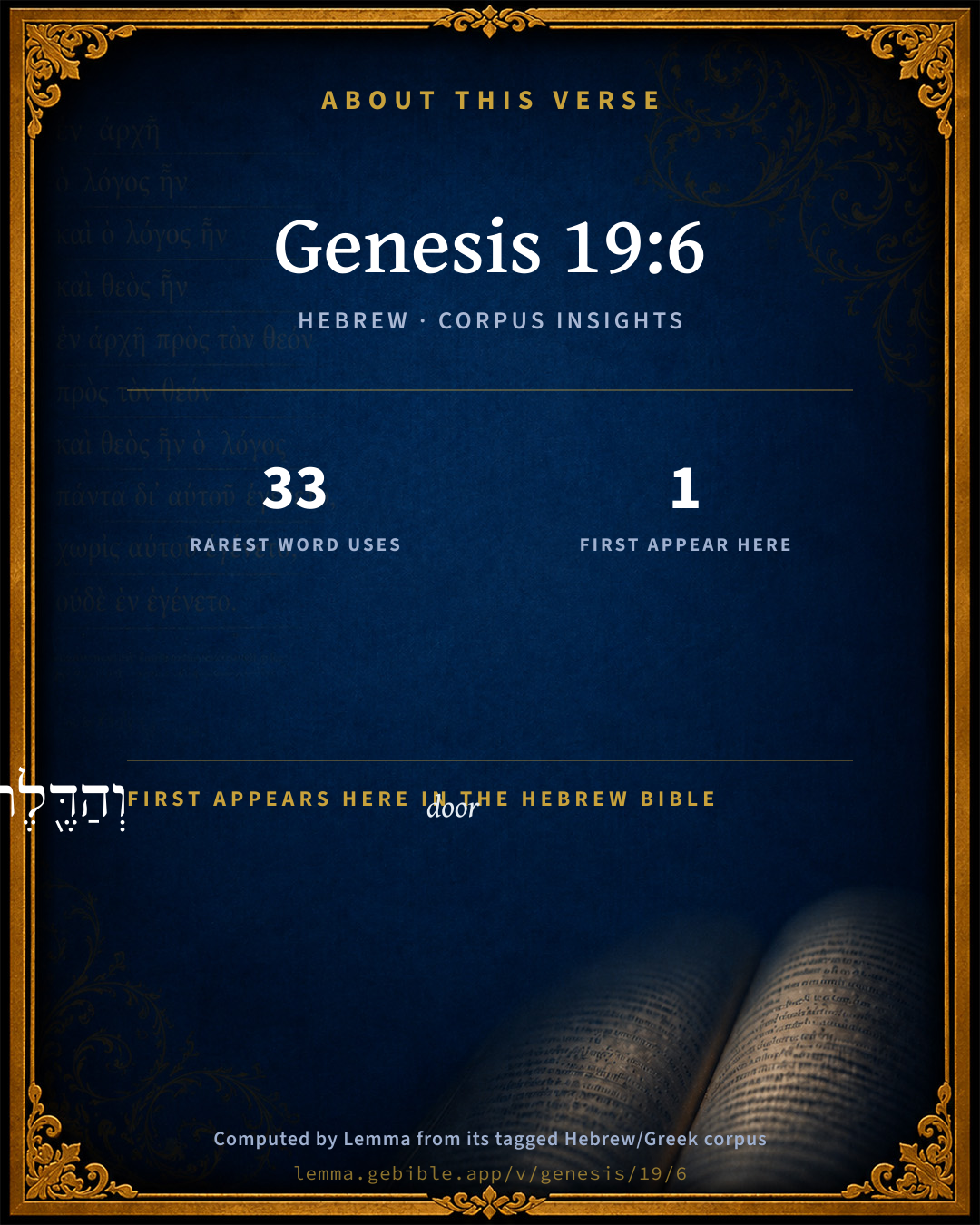
  • 1 first appearance in the Hebrew Bible
Full analysis ↓
Download a study sheet

One document with this verse’s original text, its word-by-word gloss line, the meaning frame, cross-references with their text, attributed commentary, and full source and license credits — printable, and it pastes into notes with its structure intact.

This verse Autodidact and up

Study sheet (.html) Plain text (.txt)

A passage Seminary Student

Up to 50 verses in one chapter. A passage sheet keeps up to 6 commentary sources and 12 cross-references per verse, in the order this page ranks them, and says so on the sheet whenever that leaves anything out. Ask for a single verse and you get the Autodidact verse sheet above.

Everything on this page stays free to read, with no account — the sheet is a download of what is already on screen, not access to it.

Want to remove ads? Support Godless Engineer
Compare translations 3

The same verse in 3 English versions, stacked beneath the original-language interlinear above. Click any original word for its lexicon entry.

Each is an independent rendering of the whole verse — the interlinear is not word-aligned to these translations.

Highlighted words mark where these versions differ — a whole-verse word diff, not a word-by-word alignment.

  • World English Bible Public Domain
    Lot went out to them to the door, and shut the door after him.
  • King James Version Public Domain
    And Lot went out at the door unto them, and shut the door after him,
  • unfoldingWord Literal Text CC BY-SA 4.0
    Then Lot went out to them at the entrance and shut the door behind him,

unfoldingWord Literal Text — © unfoldingWord, licensed CC BY-SA 4.0. Word-aligned USFM3 via Door43 (git.door43.org/unfoldingWord/en_ult).

Versions to compare (up to 4)

3 of 4 selected

Show all 18 translations

Every available English version of this verse, each an independent rendering of the whole verse.

  • World English Bible Public Domain
    Lot went out to them to the door, and shut the door after him.
  • Berean Standard Bible Public Domain
    Lot went outside to meet them, shutting the door behind him.
  • Majority Standard Bible Public Domain
    Lot went outside to meet them, shutting the door behind him.
  • King James Version Public Domain
    And Lot went out at the door unto them, and shut the door after him,
  • American Standard Version (1901) Public Domain
    And Lot went out unto them to the door, and shut the door after him.
  • Revised Version (1885) Public Domain
    And Lot went out unto them to the door, and shut the door after him.
  • Geneva Bible (1599) Public Domain
    Then Lot went out at the doore vnto them, and shut the doore after him,
  • Douay-Rheims (1899) Public Domain
    Lot went out to them, and shut the door after him, and said:
  • Young's Literal Translation Public Domain
    And Lot goeth out unto them, to the opening, and the door hath shut behind him,
  • Literal Standard Version CC BY-SA 4.0
    And Lot goes out to them, to the opening, and the door has shut behind him,
  • Unlocked Literal Bible CC BY-SA 4.0
    So Lot went out the door to them and shut the door after himself.
  • unfoldingWord Literal Text CC BY-SA 4.0
    Then Lot went out to them at the entrance and shut the door behind him,
  • Darby Bible Public Domain
    And Lot went out to them to the entrance, and shut the door after him,
  • World Messianic Bible Public Domain
    Lot went out to them through the door, and shut the door after himself.
  • Webster's Bible Public Domain
    And Lot went out at the door to them, and shut the door after him,
  • Free Bible Version CC BY-SA 4.0
    Lot went out to talk to them in the doorway, closing the door behind him.
  • Bible in Basic English Public Domain
    And Lot went out to them in the doorway, shutting the door after him.
  • JPS Tanakh (1917) Public Domain
    And Lot went out unto them to the door, and shut the door after him.

Literal Standard Version (2020), Covenant Press — licensed CC BY-SA 4.0. Text via the HelloAO Bible API (eBible.org). Unlocked Literal Bible (unfoldingWord) — licensed CC BY-SA 4.0. Text via the HelloAO Bible API (eBible.org). unfoldingWord Literal Text — © unfoldingWord, licensed CC BY-SA 4.0. Word-aligned USFM3 via Door43 (git.door43.org/unfoldingWord/en_ult). Free Bible Version, Dr. Jonathan Gallagher — licensed CC BY-SA 4.0. Text via the HelloAO Bible API (eBible.org).

Word by word

More ways to search: Search by grammar → Find every occurrence → Compare this word →

Practice this passage: Drill this verse → Learn its vocabulary →

About this verse

These counts appear in no published source. They are computed here, from the morphology-tagged text and Lemma’s own curated glosses. What Lemma adds →

7
words
7
distinct lemmas
Pentateuch
section

First appearance in Scripture

This word makes its first canonical appearance in the Hebrew Bible here:

  • וְהַדֶּ֖לֶת door H1817

Shared distinctive vocabulary

ל֖וֹט Lot H3876 occurs in 30 verses of the Hebrew Bible. Also found in:

Grammatical profile

  • 2 verbs
  • 3 nouns
  • 2 prepositions

Verb forms

  • וַיֵּצֵ֧א Qal · Sequential Imperfect
  • סָגַ֥ר Qal · Perfect

Hebrew & Septuagint length

In English translation the verse runs 14 words from the Hebrew and 16 from the Septuagint (LXX English) — closely comparable.

A rough comparison of the two English renderings, which tokenize alike — not a word-level alignment.

Word counts can differ between the Hebrew and the Greek without any difference in meaning — e.g. the Hebrew direct-object marker אֵת has no separate Greek word, and Greek often adds the article ὁ.

Cross-references

1

Topical passages linked to Genesis 19:6 in the Treasury of Scripture Knowledge — connected by theme and wording, ordered by reader-vote popularity; previews shown in the World English Bible.

  • Judges 19:23 The man, the master of the house, went out to them, and said to them, No, my brothers, please don't act so wickedly; seeing that this man is come into my house, don't do this folly.

Cross-references courtesy of OpenBible.info (CC BY 4.0).

Hebrew and Greek witnesses Masoretic Hebrew ↔ Greek Septuagint

The same verse in the two great witnesses to the Old Testament, shown verse-for-verse.

These are two independent witnesses, not word-aligned to each other, and the Septuagint is shown in lemma (dictionary) form.

Hebrew Genesis 19:6 Masoretic · Westminster Leningrad Codex

וַיֵּצֵ֧א אֲלֵהֶ֛ם ל֖וֹט הַפֶּ֑תְחָה וְהַדֶּ֖לֶת סָגַ֥ר אַחֲרָֽיו

Lot went out to them to the door, and shut the door after him.

World English Bible · Public Domain

Greek LXX Genesis 19:6 Septuagint · lemma form

ἐκἔρχομαι δέ λωτ πρός αὐτός πρός ὁ πρόθυρον ὁ δέ θύρα προςοἴγνυμι ὀπίσω αὐτός

And Lot went out to them to the porch, and he shut the door after him,

LXX2012 (modern English Septuagint) · Public Domain

On this verse, The Pulpit Commentary discusses the Septuagint’s reading. Read the note in Commentary ↓

Hebrew: Westminster Leningrad Codex (CC BY 4.0). Greek: Septuagint (public domain); English from LXX2012 (modern English Septuagint) (Public Domain). How the Septuagint differs from the Hebrew →

Targum (Aramaic paraphrase)

2

The Targum is the ancient Jewish Aramaic paraphrase of the Hebrew Scriptures — an interpretive translation, not the Hebrew text itself. Onkelos (literal) and Pseudo-Jonathan (expansive) render the Torah, and Jonathan the Prophets. Coverage is partial: where no permissively-licensed English translation exists for a verse, only the Aramaic is shown. This is verse-level text, not a word-by-word alignment to the Hebrew.

  1. Targum Onkelos Torah (Genesis–Deuteronomy)
    וּנְפַק לְוָתְהוֹן לוֹט לְתַרְעָא וְדָשָׁא אֲחַד בַּתְרוֹהִי

    (no public-domain English translation for this verse)

    Targum Onkelos — Aramaic: “Onkelos Genesis” (public domain); “Onkelos Exodus” (public domain); “Onkelos Leviticus” (public domain); “Onkelos Numbers” (public domain); “Onkelos Deuteronomy” (public domain). English: “Sefaria Community Translation” (CC0 1.0 (public-domain dedication)); “J.W. Etheridge. The Targums of Onkelos and Jonathan Ben Uzziel on the Pentateuch. London: Longmans, Green, 1862” (public domain). Text via Sefaria.

  2. Targum Pseudo-Jonathan Torah (Genesis–Deuteronomy)
    וּנְפַק לְוַתְהוֹם לוֹט לְתַרְעָא וְדָשָׁא אָחַד בַּתְרוֹי

    And Lot went out to them to the gate, and shut the door after him.

    Targum Pseudo-Jonathan — Aramaic: “Targum Jonathan on Genesis” (public domain); “Targum Jonathan on Exodus” (public domain); “Targum Jonathan on Leviticus” (public domain); “Targum Jonathan on Numbers” (public domain); “Targum Jonathan on Deuteronomy” (public domain). English: “The Targum of Jonathan ben Uzziel, trans. J. W. Etheridge, London, 1862” (public domain). Text via Sefaria.

Commentary

Notes on Genesis 19:6 from classic Christian and Jewish commentators (each source and its license shown beneath its notes). The classic Christian expositions comment on the surrounding passage and are grouped to its opening verse, so a note may address several verses; the Jewish commentaries on the Tanakh (Rashi and others) are per-verse, so they appear only where the commentator wrote on this verse.

Lemma curates 59 commentaries, every one of them public domain or Creative Commons licensed, each selected and text-cleaned for this edition rather than reprinted as found. About our sources →

Trapp's Complete Commentary

John Trapp

Gen 19:6 And Lot went out at the door unto them, and shut the door after him,

Ver. 6. Lot went out.] So he exposed himself, to save his strangers, hoping to save them from that abominable violence. The right of strangers is so holy, that there was scarce ever any nation so barbarous that would violate the same. When Stephen Gardiner had in his power the renowned clerk Peter Martyr, then teaching at Oxford, he would not keep him to punish him; but when he should go his way, as it is reported, gave him wherewith to bear his charges. But these Sodomites had not so much humanity left in them. They had put off the man, and were become dogs and worse. {Deu 23:18} Am I a dog? saith Abner; {2Sa 3:8} that is, so given as dogs be to lust. Lot was the world’s miracle, who kept himself fresh in Sodom’s salt waters.

John Trapp, A Commentary or Exposition upon All the Books of the Old and New Testament (1647–1656) — public domain. Text from a community e-Sword module.

Tyndale Open Study Notes

Tyndale Open Resources

19:6-9 Lot opposed homosexuality and rape and rebuked their wicked plans, but he was hypocritically willing to sacrifice his daughters to fend off the townsmen’s vice. Lot had originally pitched his tent next to Sodom; now Sodom controlled his life.

Tyndale Open Study Notes — © Tyndale Open Resources, licensed CC BY-SA 4.0. Text via the HelloAO Bible API.

John Calvin's Commentaries

6. And Lot went out at the door unto them. It appears from the fact that Lot went out and exposed himself to danger, how faithfully he observed the sacred right of hospitality. It was truly a rare virtue, that he preferred the safety and honor of the guests whom he had once undertaken to protect, to his own life: yet this degree of magnanimity is required from the children of God, that where duty and fidelity are concerned, they should not spare themselves. And although he was already grievously injured by the besieging of his house; he yet endeavors, by gentle words, to soothe ferocious minds, while he suppliantly entreats them to lay aside their wickedness, and addresses them by the title of brethren. Now it appears, how savage was their cruelty, and how violent the rage of their lust, when they were in no degree moved by such extraordinary mildness. But the description of a rage so brutal, tends to teach us that punishment was not inflicted upon them, until they had proceeded to the last stage of wickedness. And let us remember, that the reprobate, when they have been blinded by the just judgment of God, rush, as with devoted minds, through every kind of crime, and leave nothing undone, until they render themselves altogether hateful and detestable to God and men.

John Calvin's Commentaries (1540-1563) — public domain. Text from the Calvin Translation Society English edition (1840s-50s) via the Christian Classics Ethereal Library (ccel.org). Calvin's coverage is partial (roughly two-thirds of the Bible); uncommented books and verses are honest gaps, never fabricated. The 19th-century editor's footnotes and remarks are omitted so the notes are faithfully Calvin's own voice.

John Gill's Exposition

And Lot went out at the door unto them,.... At the door of his house:

and shut the door after him; the door of the passage to his house, the courtyard door, for another word is here used; unless the one was properly the door, and the other a hatch: however, this precaution of shutting it was used to prevent the men of Sodom rushing in, and taking away the men by violence; and that Lot might have some opportunity of trying what he could do by arguments, to prevail upon them to desist from their attempt.

John Gill's Exposition of the Whole Bible (1746–1763) — public domain (CC PDM 1.0). Text via the HelloAO Bible API.

The Pulpit Commentary

Vers. 6-8. And Lot went out at the door unto them, literally, at the doorway, or opening (pethach, from pathach, to open; cf. pateo, Latin; proquron, LXX); in which the gate or hanging door (deleth, from dalai, to be pendulous) swings, and which it closes (vide Gesenius, p. 201)and shut the door (deleth, ut supra; qura, LXX) after him, to protect his visitors, which he also sought to accomplish by personal exhortationand said, I pray you, brethren, do not so wickedly and also by an infamous proposal which nothing can extenuate and the utmost charity finds difficult to reconcile any pretence of piety on the part of. Behold now, I have two daughters which have not known man; i.e. unmarried, (cf. Gen_4:1) though, according to some, already betrothed to two Sodomites (Ver. 14)let me, I pray you, bring them out unto you, and do ye to them as is good in your eyes. The usual apologies that in sacrificing his daughters to the Sodomites instead of giving up his guests to their unnatural lust. Lot

(1) selected the lesser of two sins (Ambrose);

(2) thereby protected his guests and discharged the duties of hospitality incumbent on him (Chrysostom);

(3) believed his daughters would not be desired by the Sodomites, either because of their well-known betrothal (Rosenm or because of the unnatural lust of the Sodomites (Lunge);

(4) acted through mental perturbation (Augustine) are insufficient to excuse the wickedness of one who in attempting to prevent one sin was himself guilty of another (Delitzsch), who in seeking to be a faithful friend forgot to be an affectionate father (Kalisch), and who, though bound to defend his guests at the risk of his own life, was not at liberty to purchase their safety by the sacrifice of his daughters ("Speakers Commentary"). Only unto these men laeh; an archaic form of hL,aeh; a proof of the antiquity of the Pentateuch (cf. Ver. 25; 26:3, 4; Lev_18:27; Deu_4:42 Deu_7:22 Deu_19:11) do nothing (i.e. offer to them neither violence nor dishonor); for therefore (vide Gen_18:5) came they under the shadow of my roof in order to find protection.

The Pulpit Commentary (1880–1919), ed. H.D.M. Spence-Jones & Joseph S. Exell — public domain. Text from a community e-Sword module.

Keil & Delitzsch

C. F. Keil & F. Delitzsch

Lot went out to them, shut the door behind him to protect his guests, and offered to give his virgin daughters up to them. "Only to these men (האל, an archaism for האלּה rof, occurs also in Gen 19:25; Gen 26:3-4; Lev 18:27, and Deu 4:42; Deu 7:22; Deu 19:11; and אל for אלּה in Ch1 20:8) do nothing, for therefore (viz., to be protected from injury) have they come under the shadow of my roof." In his anxiety, Lot was willing to sacrifice to the sanctity of hospitality his duty as a father, which ought to have been still more sacred, "and committed the sin of seeking to avert sin by sin." Even if he expected that his daughters would suffer no harm, as they were betrothed to Sodomites (Gen 19:14), the offer was a grievous violation of his paternal duty. But this offer only heightened the brutality of the mob. "Stand back" (make way, Isa 49:20), they said; "the man, who came as a foreigner, is always wanting to play the judge" (probably because Lot had frequently reproved them for their licentious conduct, Pe2 2:7, Pe2 2:8): "not will we deal worse with thee than with them." With these words they pressed upon him, and approached the door to break it in. The men inside, that is to say, the angels, then pulled Lot into the house, shut the door, and by miraculous power smote the people without with blindness (סנורים here and Kg2 6:18 for mental blindness, in which the eye sees, but does not see the right object), as a punishment for their utter moral blindness, and an omen of the coming judgment.

Keil & Delitzsch — Biblical Commentary on the Old Testament (1861–1891) — public domain (CC PDM 1.0). Text via the HelloAO Bible API. (Old Testament only.)

unfoldingWord translationNotes

Door43 World Missions Community

after himself

"behind him" or "after he went through"

I beg you, my brothers

"I plead with you, my brothers"

my brothers

Lot spoke in a friendly way to the men of the city hoping that they would listen to him. AT: "my friends" (See: Idiom)

do not act so wickedly

"do not do something so wicked" or "do not do such a wicked thing"

Look

"Pay attention" or "Look here"

have not slept with

"have not engaged in sex with." Your language may have a more polite way of saying this. AT: "have not known" (See: Euphemism)

whatever is good in your eyes

"whatever you desire" or "whatever you think is right"

under the shadow of my roof

The two men were guests in Lot's home, so he needed to protect them. The word "roof" is a synecdoche for the whole house and a metaphor for Lot protecting them. AT: "into my house, and God expects me to protect them" (See: Synecdoche and Metaphor)

translationWords

Lot

brother

evil

had relations with

shadow

unfoldingWord translationNotes — © Distant Shores Media and the Door43 World Missions Community, licensed CC BY-SA 4.0. Source: git.door43.org/Door43/en_tn.

Radak

Rabbi David Kimhi (Radak)

ויצא....סגר אחריו, either the person within the house locked the door from the inside, or Lot locked the door from the outside.

Radak on the Tanakh — English translations: “Sefaria Community Translation” (CC0 1.0 (public-domain dedication)); “Eliyahu Munk, HaChut Hameshulash” (CC BY 4.0); “Rabbi Mike Feuer, Jerusalem Anthology” (CC BY 4.0); and “R. David Kimhi on the first book of Psalms, Translated by R.G. Finch, London, 1919” (public domain). Text via Sefaria.

Lesson kit

Teaching starters — assembled from the data on this page, not authored interpretation. Every prompt links to the verse data it draws on. Edit before teaching.

Genesis, in the Pentateuch, opens this verse with 7 words (7 distinct Hebrew lemmas). Its most distinctive word is Lôwṭ (“Lot”). A historical commentator’s framing appears above. Read the whole chapter for the surrounding context.

Discussion questions

  1. How does “Lot” (Lôwṭ) shape what this verse is saying?
  2. The word “door” first appears here in Scripture. What is being introduced at this debut?
  3. Genesis 11:27 shares the word «Lot» with this verse. How do the two illuminate each other?
  4. These translations render this verse differently; the difference is in the English rendering, not the original. What questions does that raise?
  5. The verb «וַיֵּצֵ֧א» is Qal Sequential Imperfect. How does its form color the action?
  6. Reading how Trapp's Complete Commentary and Tyndale Open Study Notes read this verse, where do the two commentators agree and where do they part?

Things to notice

  • 1 word makes its first canonical appearance in Scripture here.
  • These translations choose different wording for 3 words in this verse.
  • 7 distinct Hebrew lemmas span 7 words in this verse.

Reading settings

Reading text

Shown beneath each verse's original-language words.

Old Testament
Old Testament edition

Read the OT as the Masoretic Hebrew (MT) or the Greek Septuagint (LXX).

English shown for the Greek Septuagint (in the Hebrew ↔ Greek comparison).

Comparing translations? Open the Compare panel on any verse page to stack up to four side by side.