
Ezekiel 40:38

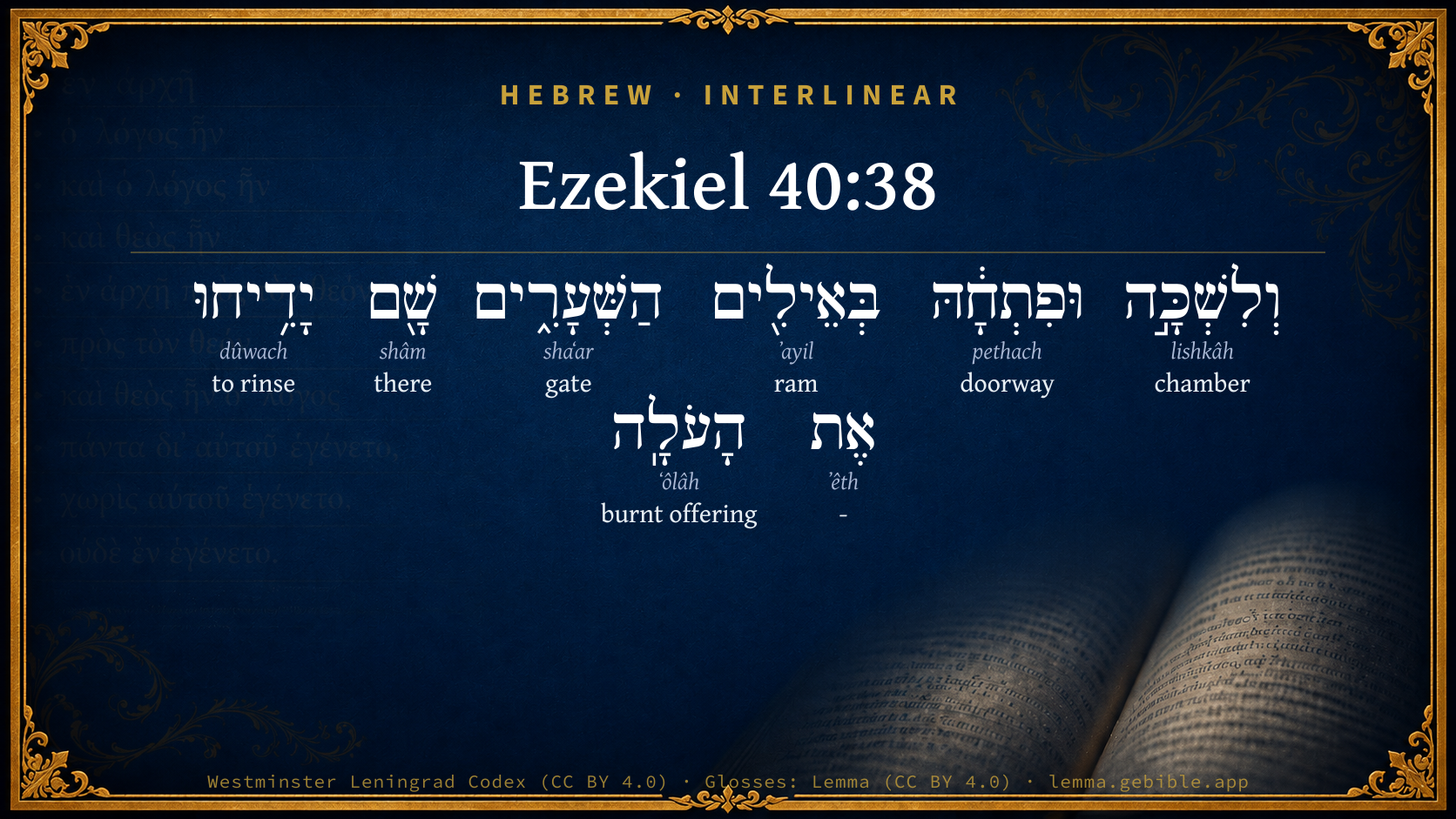
Hebrew (Westminster Leningrad Codex) Ezekiel 40:38 appears in the Hebrew Old Testament. The text above is from the Westminster Leningrad Codex. Each word links to its Strong’s number, a concise gloss, and parsing drawn from the Open Scriptures Hebrew Bible morphology. Click any word for its full Brown-Driver-Briggs (BDB) entry.
Download image
Cite this verse

Ezekiel 40:38 (World English Bible). Public Domain. Lemma interlinear Bible study tool, https://lemma.gebible.app/v/ezekiel/40/38.

Show BibTeX & RIS
BibTeX
RIS
English Translation
A chamber with the door of it was by the posts at the gates; there they washed the burnt offering.
World English Bible · Public Domain
Download a study sheet

One document with this verse’s original text, its word-by-word gloss line, the meaning frame, cross-references with their text, attributed commentary, and full source and license credits — printable, and it pastes into notes with its structure intact.

This verse Autodidact and up

Study sheet (.html) Plain text (.txt)

A passage Seminary Student

Up to 50 verses in one chapter. A passage sheet keeps up to 6 commentary sources and 12 cross-references per verse, in the order this page ranks them, and says so on the sheet whenever that leaves anything out. Ask for a single verse and you get the Autodidact verse sheet above.

Everything on this page stays free to read, with no account — the sheet is a download of what is already on screen, not access to it.

Want to remove ads? Support Godless Engineer
Compare translations 3

The same verse in 3 English versions, stacked beneath the original-language interlinear above. Click any original word for its lexicon entry.

Each is an independent rendering of the whole verse — the interlinear is not word-aligned to these translations.

Highlighted words mark where these versions differ — a whole-verse word diff, not a word-by-word alignment.

  • World English Bible Public Domain
    A chamber with the door of it was by the posts at the gates; there they washed the burnt offering.
  • King James Version Public Domain
    And the chambers and the entries thereof were by the posts of the gates, where they washed the burnt offering.
  • unfoldingWord Literal Text CC BY-SA 4.0
    There was a room with a door by each of the inner gateways. This was where they rinsed the burnt offerings.

unfoldingWord Literal Text — © unfoldingWord, licensed CC BY-SA 4.0. Word-aligned USFM3 via Door43 (git.door43.org/unfoldingWord/en_ult).

Versions to compare (up to 4)

3 of 4 selected

Show all 18 translations

Every available English version of this verse, each an independent rendering of the whole verse.

  • World English Bible Public Domain
    A chamber with the door of it was by the posts at the gates; there they washed the burnt offering.
  • Berean Standard Bible Public Domain
    There was a chamber with a doorway by the portico in each of the inner gateways. There the burnt offering was to be washed.
  • Majority Standard Bible Public Domain
    There was a chamber with a doorway by the portico in each of the inner gateways. There the burnt offering was to be washed.
  • King James Version Public Domain
    And the chambers and the entries thereof were by the posts of the gates, where they washed the burnt offering.
  • American Standard Version (1901) Public Domain
    And a chamber with the door thereof was by the posts at the gates; there they washed the burnt-offering.
  • Revised Version (1885) Public Domain
    And a chamber with the door thereof was by the posts at the gates; there they washed the burnt offering.
  • Geneva Bible (1599) Public Domain
    And euery chamber, and the entrie thereof was vnder the postes of the gates: there they washed the burnt offring.
  • Douay-Rheims (1899) Public Domain
    And at every chamber was a door in the forefronts of the gates: there they washed the holocaust.
  • Young's Literal Translation Public Domain
    And the chamber and its opening `is' by the posts of the gates, there they purge the burnt-offering.
  • Literal Standard Version CC BY-SA 4.0
    And the chamber and its opening [is] by the posts of the gates, there they purge the burnt-offering.
  • Unlocked Literal Bible CC BY-SA 4.0
    There was a room with a door by each of the inner gateways. This was where they rinsed the burnt offerings.
  • unfoldingWord Literal Text CC BY-SA 4.0
    There was a room with a door by each of the inner gateways. This was where they rinsed the burnt offerings.
  • Darby Bible Public Domain
    And there was a cell and its entry by the posts of the gates; there they rinsed the burnt-offering.
  • World Messianic Bible Public Domain
    A room with its door was by the posts at the gates. They washed the burnt offering there.
  • Webster's Bible Public Domain
    And the chambers and its entries were by the posts of the gates, where they washed the burnt-offering.
  • Free Bible Version CC BY-SA 4.0
    A room with a doorway stood beside by the porch of the inner gateways. This was where the burnt offering was washed.
  • Bible in Basic English Public Domain
    And there was a room with a door in the covered way of the doorway, where the burned offering was washed.
  • JPS Tanakh (1917) Public Domain
    And a chamber with the entry thereof was by the posts at the gates; there was the burnt-offering to be washed.

Literal Standard Version (2020), Covenant Press — licensed CC BY-SA 4.0. Text via the HelloAO Bible API (eBible.org). Unlocked Literal Bible (unfoldingWord) — licensed CC BY-SA 4.0. Text via the HelloAO Bible API (eBible.org). unfoldingWord Literal Text — © unfoldingWord, licensed CC BY-SA 4.0. Word-aligned USFM3 via Door43 (git.door43.org/unfoldingWord/en_ult). Free Bible Version, Dr. Jonathan Gallagher — licensed CC BY-SA 4.0. Text via the HelloAO Bible API (eBible.org).

Word by word

More ways to search: Search by grammar → Find every occurrence → Compare this word →

Practice this passage: Drill this verse → Learn its vocabulary →

About this verse

These counts appear in no published source. They are computed here, from the morphology-tagged text and Lemma’s own curated glosses. What Lemma adds →

8
words
8
distinct lemmas
Prophets
section

Notable vocabulary

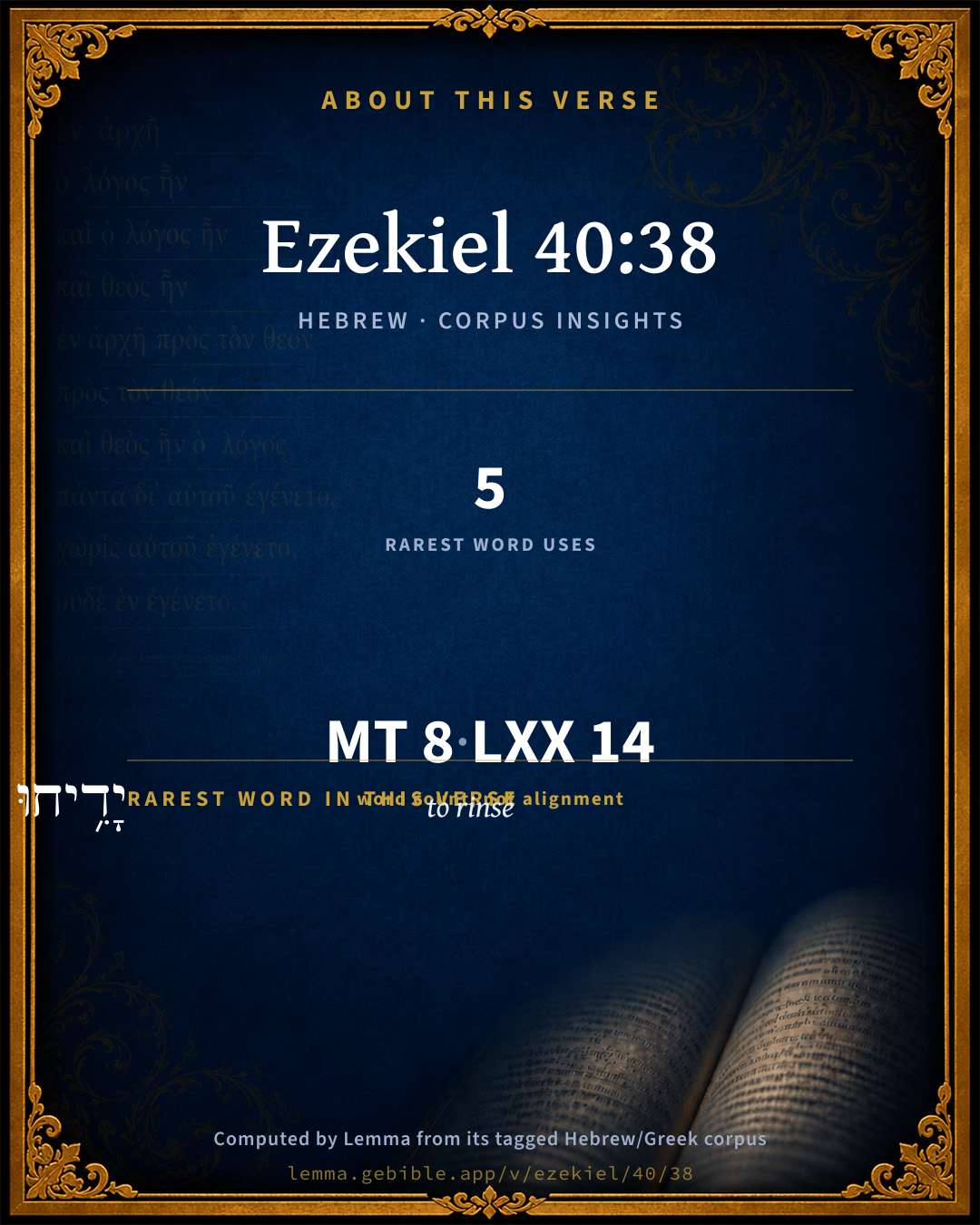
The rarest word here is יָדִ֥יחוּ to rinse H1740 — appearing just 5 times in the whole Hebrew Bible.

Shared distinctive vocabulary

יָדִ֥יחוּ to rinse H1740 occurs in 4 verses of the Hebrew Bible. Also found in:

Grammatical profile

  • 1 verb
  • 5 nouns
  • 1 adverb
  • 1 particle

Verb forms

  • יָדִ֥יחוּ Hiphil · Imperfect

Hebrew & Septuagint length

In English translation the verse runs 20 words from the Hebrew and 16 from the Septuagint (LXX English) — closely comparable.

A rough comparison of the two English renderings, which tokenize alike — not a word-level alignment.

Word counts can differ between the Hebrew and the Greek without any difference in meaning — e.g. the Hebrew direct-object marker אֵת has no separate Greek word, and Greek often adds the article ὁ.

In the original languages it is 8 Hebrew tokens and 14 Greek tokens — but the two are counted differently (Hebrew bundles its prefixes and suffixes into one token; the Greek is in lemma form), so that isn’t a like-for-like length.

Cross-references

9

Topical passages linked to Ezekiel 40:38 in the Treasury of Scripture Knowledge — connected by theme and wording, ordered by reader-vote popularity; previews shown in the World English Bible.

  • 2 Chronicles 4:6 He made also ten basins, and put five on the right hand, and five on the left, to wash in them; such things as belonged to the burnt-offering they washed in them; but the sea was for the priests to wash in.
  • Leviticus 1:9 but its innards and its legs he shall wash with water. The priest shall burn the whole on the altar, for a burnt offering, an offering made by fire, of a sweet savor to Yahweh.
  • Leviticus 8:21 He washed the innards and the legs with water; and Moses burned the whole ram on the altar. It was a burnt offering for a sweet savor. It was an offering made by fire to Yahweh; as Yahweh commanded Moses.
  • 1 Kings 6:8 The door for the middle side-chambers was in the right side of the house: and they went up by winding stairs into the middle [story], and out of the middle into the third.
  • Ezekiel 40:12 and a border before the lodges, one cubit [on this side], and a border, one cubit on that side; and the lodges, six cubits on this side, and six cubits on that side.
  • Ezekiel 40:17 Then brought he me into the outer court; and, behold, there were chambers and a pavement, made for the court round about: thirty chambers were on the pavement.
  • Ezekiel 41:10–11 Between the chambers was a breadth of twenty cubits round about the house on every side.
  • Ezekiel 42:13 Then said he to me, The north chambers and the south chambers, which are before the separate place, they are the holy chambers, where the priests who are near to Yahweh shall eat the most holy things: there shall they lay the most holy things, and the meal-offering, and the sin-offering, and the trespass-offering; for the place is holy.
  • Hebrews 10:22 let's draw near with a true heart in fullness of faith, having our hearts sprinkled from an evil conscience, and having our body washed with pure water,

Cross-references courtesy of OpenBible.info (CC BY 4.0).

Hebrew and Greek witnesses Masoretic Hebrew ↔ Greek Septuagint

The same verse in the two great witnesses to the Old Testament, shown verse-for-verse.

These are two independent witnesses, not word-aligned to each other, and the Septuagint is shown in lemma (dictionary) form.

Hebrew Ezekiel 40:38 Masoretic · Westminster Leningrad Codex

וְלִשְׁכָּ֣ה וּפִתְחָ֔הּ בְּאֵילִ֖ים הַשְּׁעָרִ֑ים שָׁ֖ם יָדִ֥יחוּ אֶת הָעֹלָֽה

A chamber with the door of it was by the posts at the gates; there they washed the burnt offering.

World English Bible · Public Domain

Greek LXX Ezekiel 40:38 Septuagint · lemma form

ὁ παστοφόριον αὐτός καί ὁ θύρωμα αὐτός καί ὁ αιλαμμω αὐτός ἐπί ὁ πύλη

Its chambers and its door-ways, and its porches at the second gate served as a drain,

LXX2012 (modern English Septuagint) · Public Domain

On this verse, Whedon's Commentary on the Bible discusses the Septuagint’s reading. Read the note in Commentary ↓

Hebrew: Westminster Leningrad Codex (CC BY 4.0). Greek: Septuagint (public domain); English from LXX2012 (modern English Septuagint) (Public Domain). How the Septuagint differs from the Hebrew →

Targum (Aramaic paraphrase)

1

The Targum is the ancient Jewish Aramaic paraphrase of the Hebrew Scriptures — an interpretive translation, not the Hebrew text itself. Onkelos (literal) and Pseudo-Jonathan (expansive) render the Torah, and Jonathan the Prophets. Coverage is partial: where no permissively-licensed English translation exists for a verse, only the Aramaic is shown. This is verse-level text, not a word-by-word alignment to the Hebrew.

  1. Targum Jonathan Prophets (Joshua–Malachi)
    וְלִשְׁכָּתָא וּפִתְחָא בְּאֵילַיָא דְתַרְעַיָא תַּמָן מְתַקְנִין יַת עֲלָתָא:

    (no public-domain English translation for this verse)

    Targum Jonathan — Aramaic: “Mikraot Gedolot” (public domain). English: “Sefaria Community Translation” (CC0 1.0 (public-domain dedication)); “London "Chaldee Paraphrase," 1871” (public domain). Text via Sefaria.

Commentary

Notes on Ezekiel 40:38 from classic Christian and Jewish commentators (each source and its license shown beneath its notes). The classic Christian expositions comment on the surrounding passage and are grouped to its opening verse, so a note may address several verses; the Jewish commentaries on the Tanakh (Rashi and others) are per-verse, so they appear only where the commentator wrote on this verse.

Lemma curates 59 commentaries, every one of them public domain or Creative Commons licensed, each selected and text-cleaned for this edition rather than reprinted as found. About our sources →

Trapp's Complete Commentary

John Trapp

Eze 40:38 And the chambers and the entries thereof [were] by the posts of the gates, where they washed the burnt offering.

Ver. 38. Where they washed the burnt offering.] All must be pure and clean in God’s service.

“ Pura Deus mens est, ”& c.

This washing of the burnt offering prefigured baptism, saith Polanus, as did the tables, {Eze 40:39} the Lord’s Supper, wherein Christ the Lamb of God is slain in our sight.

John Trapp, A Commentary or Exposition upon All the Books of the Old and New Testament (1647–1656) — public domain. Text from a community e-Sword module.

Joseph Benson's Commentary

Eze 40:38. And the chambers were by the gates where they washed the burnt-offerings — The chambers, mentioned Eze 40:36, were near the entrance of the north gate, where they washed the legs and entrails of the burnt-offerings; and marble tables were placed there for that purpose. According to this exposition, the word gates in the plural stands for gate in the singular. But Dr. Lightfoot says, they washed the sacrifices on the south side, as well as on the north side of the court of the priests, when the sacrifices were more numerous than the north side could well contain: he therefore understands the word gates as comprehending here both the north and south gate, and confirms this interpretation from the placing of the lavers which were designed for that use, and were set five on the right side of the house, and five on the left, 1Ki 7:39.

Joseph Benson's Commentary on the Old and New Testaments (1811–1818) — public domain. Text from a community e-Sword module.

Whedon's Commentary on the Bible

Daniel D. Whedon

38-43. The description of these chambers of sacrifice must always remain obscure. Was there a chamber and tables of offering at each of the three gates of the inner court, or only at the north gate, which seems to be described in the text, or only at the east or principal gateway, where certainly burnt offerings and peace offerings were prepared for the prince? (lxvi, 2.) The LXX. is probably correct in reading “gate” instead of gates (Eze_40:38), and the R.V. in reading “chamber” instead of chambers. The eastern gate would seem the most natural place for such sacrifices, yet because Eze_40:40 seems to refer, without a possibility of mistake, to the northern gate (compare also Lev_1:11; Lev_6:18; Lev_7:2), and because in one place Ezekiel distinctly refers to the north gate as the “altar gate” (viii, 5), we conclude that but one place of offering is here described and that it is situated at the northern gate. There were eight slaughtering tables — four within the entry or porch of the gate, and four without — and also, it seems, four additional tables of stone on which were laid the heavy instruments with which the burnt offerings, etc., were slain. Perhaps for this reason they were called tables “for the burnt offering” (Eze_40:42). They can hardly be the same tables referred to in Eze_40:39. One suspects the phrase “for the burnt offering” to be an interpolation. The “hooks” referred to were either fastened up “within” the entry to receive the slaughtered beasts (Targum) or the word must be translated “ledges” (R.V., margin), and be thought of as a projecting border around the tables. Toy renders, “and borders one handbreadth in width were fixed within on the tables round about for the flesh of the offering.”

Daniel D. Whedon (gen. ed.), Commentary on the Old and New Testaments (1874–1909) — public domain. Text from a community e-Sword module.

Keil & Delitzsch

C. F. Keil & F. Delitzsch

The Cells and Arrangements for the Sacrificial Worship by and in the Inner Court

Eze 40:38. And a cell with its door was by the pillars at the gates; there they had to wash the burnt-offering. Eze 40:39. And in the porch of the gate were two tables on this side and two tables on that, to slay thereon the burnt-offering, the sin-offering, and the trespass-offering. Eze 40:40. And at the shoulder outside, to one going up to the opening of the gate toward the north, stood two tables; and at the other shoulder, by the porch of the gate, two tables. Eze 40:41. Four tables on this side and four tables on that side, at the shoulder of the gate; eight tables on which they were to slaughter. Eze 40:42. And four tables by the steps, hewn stone, a cubit and a half long, and a cubit and a half broad, and a cubit high; upon these they were to lay the instruments with which they slaughtered the burnt-offerings and other sacrifices. Eze 40:43. And the double pegs, a span long, were fastened round about the house; but the flesh of the sacrifice was placed upon the tables. Eze 40:44. And outside the inner gate were two cells in the inner court, one at the shoulder of the north gate, with its front side toward the south; one at the shoulder of the south gate, with the front toward the north. Eze 40:45. And he said to me, This cell, whose front is toward the south, is for the priests who attend to the keeping of the house; Eze 40:46. And the cell whose front is toward the north is for the priests who attend to the keeping of the altar. They are the sons of Zadok, who draw near to Jehovah of the sons of Levi, to serve Him. Eze 40:47. And he measured the court, the length a hundred cubits, and the breadth a hundred cubits in the square, and the altar stood before the house. - The opinions of modern commentators differ greatly as to the situation of the cells mentioned in Eze 40:38, since Bttcher and Hitzig had adjusted a text to suit their own liking, founded upon the Septuagint and upon decidedly erroneous suppositions. The dispute, whether בּאילים is to be rendered in or by the אילים, may be easily set at rest by the simple consideration that the אילים in front of the porch of the gate were pillars of two cubits long and the same broad (Eze 40:9), in which it was impossible that a room could be constructed. Hence the לשׁכּה could only be by (near) the pillars of the gate. To בּאילים there is also added השּׁערים (by the gates)in loose coordination (vid., Ewald, 293e), not for the purpose of describing the position of the pillars more minutely, which would be quite superfluous after Eze 40:9, but to explain the plural אילים, and extend it to the pillars of all the three inner gates, so that we have to assume that there was a לשׁכּה by the pillars of all these gates (Plate I O). This is also demanded by the purpose of these cells, viz., "for the cleansing or washing of the burnt-offering." As the sacrifices were not taken through one gate alone, but through all the gates, the Sabbath-offering of the prince being carried, according to Eze 46:1-2, through the east gate, which was closed during the week, and only opened on the Sabbath, there must have been a cell, not by the north gate alone (Bttcher, Hvernick), or by the east gate only (Ewald, Hitzig), but by every gate, for the cleansing of the burnt-offering. Hvernick, Hitzig, and others are wrong in supposing that העולה is a synecdochical designation applied to every kind of animal sacrifice. This is precluded not only by the express mention of the burnt-offerings, sin-offerings, and trespass-offerings (Eze 40:39), and by the use of the word קרבּן in this sense in Eze 40:43, but chiefly by the circumstance that neither the Old Testament nor the Talmud makes any allusion to the washing of every kind of flesh offered in sacrifice, but that they merely speak of the washing of the entrails and legs of the animals sacrificed as burnt-offerings (Lev 1:9), for which purpose the basins upon the mechonoth in Solomon's temple were used (Ch2 4:6, where the term רחץ used in Lev 1:9 is interpreted by the apposition את־מעשׂה העולה י). A room at every gate (not by every pillar) was sufficient for this purpose. If there had been a לשׁכּה of this kind on each side of the gate, as many have assumed on symmetrical grounds, this would have been mentioned, just as in the case of the slaughtering-tables (Eze 40:39-42). The text furnishes no information as to the side of the doorway on which it stood, whether by the right or the left pillars. On the ground plan we have placed the one at the east gate, on the right side, and those by the north and south gates on the western side (Plate I O O O).

Moreover, according to Eze 40:39-41, there were twice two tables on each side, eight therefore in all, which served for slaughtering. Two pairs stood "in the porch of the gate," i.e., in the inner space of the porch, one pair on this side, the other pair on that, i.e., on the right and left sides to a person entering the porch, probably near the wall (see Plate II II f f). The expression לשׁחוט אליהם, to slaughter at the tables (Eze 40:39 and Eze 40:40), stands for "to use when slaughtering" - that is, for the purpose of laying the slaughtered flesh upon. This is apparent from the fact itself in Eze 40:39. For the slaughtering was not performed within the front porch, but outside, and somewhere near it. The front porch of the gate-building was not a slaughter-house, but the place where those who entered the gate could assemble. The only purpose, therefore, for which the tables standing here could be used was to place the sacrificial flesh upon when it was prepared for the altar, that the priests might take it thence and lay it upon the altar. בּאלם השּׁער is to be understood as signifying the inner space of the porch; this is required by the antithesis in Eze 40:40, where two pair of tables outside the porch are mentioned. Two of these stood "by the shoulder outside to one going up to the gate opening, the northern" (Plate II II d d). The meaning of these not very intelligible words is apparent from the second half of the verse, which adds the correlative statement as to the two opposite tables. When it is said of these tables that they stood by the other shoulder (אל־הכּתף ) which the porch of the gate had, not only is לפּתח השּׁער of the first hemistich more precisely defined hereby as the gate-porch, but החּפונה is also rendered intelligible, namely, that as it corresponds to האחרת, it is an adjective belonging to אל הכּתף, "at the northern shoulder outside to a person going up the steps to the opening of the gate" (מחוּצה, the outer side, in contrast to the inside of the porch, בּאלּם, Eze 40:39). The shoulder of the gate, or rather of the porch of the gate, is the side of it, and that the outer side. Consequently these four tables stood by the outer sides of the porch, two by the right wall and two by the left. In Eze 40:41, what has already been stated concerning the position of the tables mentioned in Eze 40:39 and Eze 40:40 is summed up: Four tables stood on each side of the porch, two inside, and two against the outer wall, eight tables in all, which were used for slaughtering purposes. There is nothing strange in לכתף as an abbreviated expression for לכּתף אשׁר לאלם השּׁער in Eze 40:40, as want of clearness was not to be feared after Eze 40:40. In addition to these there were four other tables (וארבּעה, and four, Eze 40:42) of stone, from which it may be inferred that the four already mentioned were of wood. The four stone tables stood לעולה, i.e., at (near) the flight of steps (cf. לפי קרת, at the entrance to the city, Pro 8:3), and were of hewn square stones, as no doubt the steps also were (see Plate II II e e). It yields no sense whatever to render לעולה "for the burnt-offering" (lxx and others); and the expression עלות in Eze 40:26 thoroughly warrants our translating עולה, a flight of steps or staircase). These stone tables served as flesh-benches, on which the slaughtering tools were laid. אליהם וינּיחוּ belong together, the ו being inserted "as if at the commencement of a new sentence after a pause in the thought" (cf. Pro 23:24; Pro 30:28; Gen 50:9, Bttcher). It is not expressly stated, indeed, that these four tables were distributed on the two sides of the steps; but this may be inferred with certainty from the position of the other tables. Moreover, the twelve tables mentioned were not merely to be found at one of the gate-porches, but by all three of the inner fates, as was the case with the washing-cells (Eze 40:38), for sacrificial animals were taken to the altar and slaughtered at every gate; so that what is stated in Eze 40:39-42 with reference to one porch, namely, the porch of the east gate, to judge from הצּפונה in Eze 40:40, is applicable to the porches of the south and north gates also.

In Eze 40:43 another provision for the slaughtering of the sacrificial animals is mentioned, concerning which the opinions of the older translators and commentators are greatly divided. but the only explanation that can be sustained, so far as both the usage of the language and the facts are concerned, is that adopted by the Chaldee, viz., וענקלין נפקין פשׁך חד קביעין בעמּוּדי בּית , et uncini egrediebantur (longitudine) unius palmi defixi in columnis domus macelli, to which not only Bצttcher, but Roediger (Ges. Thes. p. 1470) and Dietrich (Lex.) have given their adhesion. For שׁפתּים, from שׁפת, to set or stand (act.), signifies stakes or pegs (in Psa 68:14, the folds constructed of stakes), here pegs a span long on the wall, into which they were inserted, and from which they projected to the length of a span. In the dual it stands for double pegs, forked pegs, upon which the carcases of the beasts were hung of the purpose of flaying, as Dav. Kimchi has interpreted the words of the Chaldee. The article indicates the kind, viz., the pegs required for the process of slaughtering. This explanation is also in harmony with the verb מוּכנים, Hophal of כוּן, fastened, which by no means suits the rendering originated by the lxx, viz., ledges round the edge or the rim of the table. The only remaining difficulty is the word בּבּית, which Bttcher interprets as signifying "in the interior of the gate-porch and pillars" (Roediger, in interiore parte, nempe in ea atrii parte, ubi hostiae mactandae essent), on the just ground that the interior of the front porch could not be the place for slaughtering, but that this could only be done outside, either in front of or near the porch. But even in interiore parte atrii is not really suitable, and at all events is too indefinite for מוּכנים. It would therefore be probably more correct to render it "fastened against the house," i.e., to the outer walls of the gate-porch buildings, so that בּית would stand for buildings in the sense of בּניה, although I cannot cite any passage as a certain proof of the correctness of this rendering. But this does not render the explanation itself a doubtful one, as it would be still more difficult to interpret בּבּית if שׁפתּים were explained in any other way. סביב סביב refers to the three outer sides of the porch. The description of the slaughtering apparatus closes in Eze 40:43 with the words, "and upon the tables (mentioned in Eze 40:39-42) came the flesh of the offering." קרבּן, the general word for sacrificial offerings, as in Lev 1:2 ff.

In Eze 40:44-46 we have a description of cells for the officiating priests, and in Eze 40:45 and Eze 40:46 two such cells are plainly mentioned according to their situation and purpose (vid., Plate I F F). But it is impossible to bring the Masoretic text of Eze 40:44 into harmony with this, without explaining it in an arbitrary manner. For, in the first place, the reference there is to לשׁכות שׁרים, cells of the singers; whereas these cells, according to Eze 40:45 and Eze 40:46, were intended for the priests who performed the service in the temple-house and at the altar of burnt-offering. The attempt of both the earlier and the more recent supporters of the Masoretic text to set aside this discrepancy, by arguing that the priests who had to attend to the service in the temple and at the altar, according to Eze 40:45 and Eze 40:46, were singers, is overturned by the fact that in the Old Testament worship a sharp distinction is made between the Levitical singers and the priests, i.e., the Aaronites who administered the priesthood; and Ezekiel does not abolish this distinction in the vision of the temple, but sharpens it still further by the command, that none but the sons of Zadok are to attend to the priestly service at the sanctuary, while the other descendants of Aaron, i.e., the Aaronites who sprang from Ithamar, are only to be employed in watching at the gate of the house, and other non-priestly occupations (Eze 44:10 ff.). Consequently Ezekiel could not identify the priests with the singers, or call the cells intended for the officiating priests singers' cells. Moreover, only two cells, or cell-buildings, are mentioned in Eze 40:45 and Eze 40:46, and their position is described in the same words as that of the cells mentioned in Eze 40:44, so that there can be no doubt as to the identity of the former and the latter cells. In Eze 40:44 the supposed singers' cells are placed at the north gate, with the front toward the south, which only applies, according to Eze 40:45, to the one cell intended for the priests who attended to the service in the holy place; and again, in Eze 40:44, another cell is mentioned at the east gate, with the front toward the north, which was set apart, according to Eze 40:46, for the priests who attended to the altar service. Consequently, according to our Masoretic text of the 44th verse, there would be first singers' cells (in the plural), and then one cell, at least three cells therefore; whereas, according to Eze 40:45 and Eze 40:46, there were only two. And lastly, the אחד in Eze 40:44 can only be understood by our taking it in the sense of "another," in opposition to the usage of the language. For these reasons we are compelled to alter שׁרים into שׁתים, and אשׁר into אחת, after the lxx, and probably also הקּדים into הדּרום, and in consequence of this to adopt the pointing לשׁכות, and to read פּניה instead of פּניהם. Further alterations are not requisite or indicated by the lxx, as the rest of the deviations in their text are to be explained from their free handling of the original.

According to the text with these alterations, even in Eze 40:44 there are only two cells mentioned. They were situated "outside the inner gate." This definition is ambiguous, for you are outside the inner gate not only before entering the gate, i.e., while in the outer court, but also after having passed through it and entered the inner court. Hence there follows the more precise definition, "in the inner court." If, then, we read אחת for אשׁר, there follows, in prefect accordance with the fact, a more precise statement as to the situation of both the one and the other of these cells, אחת and אחד corresponding to one another. The second אחד, instead of אחת, which is grammatically the more correct, is to be attributed to a constructio ad sensum, as the לשׁכות were not separate rooms, but buildings with several chambers. One cell stood by the shoulder (side) of the north gate, with the front (פנים) toward the south; the other at the shoulder of the south gate, with the front toward the north. They stood opposite to one another, therefore, with their fronts facing each other. Instead of the south gate, however, the Masoretic text has שׁער הקּדים, the east gate; and Eze 40:46 contains nothing that would be expressly at variance with this, so that הקּדים could be defended in case of need. But only in case of need - that is to say, if we follow Kliefoth in assuming that it stood on the left of the gateway to persons entering through the east gate, and explaining the fact that its front turned toward the north, on the ground that the priests who resided in it were charged with the duty of inspecting the sacrifices brought through the east gate, or watching the bringing in of the sacrifices, so that this cell was simply a watchman's cell after all. But this assumption is founded upon a misinterpretation of the formula שׁמר משׁמרת , to keep the keeping of the altar. This formula does not mean to watch and see that nothing unlawful was taken to the altar, but refers to the altar service itself, the observance of everything devolving upon the servants of the altar in the performance of the sacrificial worship, or the offering of the sacrifices upon the altar according to the precepts of the law. If, then, this duty was binding upon the priests who resided in this cell, it would have been very unsuitable for the front of the cell to be turned toward the north, in which case it would have been absolutely impossible to see the altar from the front of the cell. This unsuitability can only be removed by the supposition that the cell was built at the south gate, with the front toward the north, i.e., looking directly toward the altar. For this reason we must also regard הקּדים as a corruption of הדּרום, and look for this second cell at the south gate, so that it stood opposite to the one built at the north gate. - All that remains doubtful is, whether these two cells were on the east or the west side of the south and north gates, a point concerning which we have no information given in the text. In our sketch we have placed them on the west side (vid., Plate I f), so that they stood in front of the altar and the porch-steps. The concluding words of Eze 40:46, in which המּה refers to the priests mentioned in Eze 40:45 and Eze 40:46, state that in the new sanctuary only priests of the sons of Zadok were to take charge of the service at the altar and in the holy place; and this is still further expanded in Eze 44:10 ff. - Finally, in Eze 40:47 the description of the courts is concluded with the account of the measure of the inner court, a hundred cubits long and the same in breadth, according to which it formed a perfect square surrounded by a wall, according to Eze 42:10. The only other observation made is, that it was within this space that the altar of burnt-offering stood, the description of which is given afterwards in Eze 43:13 ff. (see Plate I H).

Keil & Delitzsch — Biblical Commentary on the Old Testament (1861–1891) — public domain (CC PDM 1.0). Text via the HelloAO Bible API. (Old Testament only.)

Tyndale Open Study Notes

Tyndale Open Resources

40:38-43 The sacrificial animals were slaughtered and prepared in rooms beside the gateways into the inner courtyard. This detail highlights the primary function of this new Temple as a place of sacrifice. The animals had to be washed and cut into pieces before they could be offered on the altar. • This new Temple in Ezekiel’s vision was radically focused on sacrifices that atoned for sin. By contrast, the Temple in Jerusalem was both a center for sacrifice and a house for prayer (see 1 Kgs 8:27-30, 52-53; Isa 56:6-8; Matt 21:13).

Tyndale Open Study Notes — © Tyndale Open Resources, licensed CC BY-SA 4.0. Text via the HelloAO Bible API.

Jamieson, Fausset & Brown

Robert Jamieson, A. R. Fausset & David Brown

chambers . . . entries--literally, "a chamber and its door."

by the posts--that is, at or close by the posts or columns.

where they washed the burnt offering--This does not apply to all the gates but only to the north gate. For Lev 1:11 directs the sacrifices to be killed north of the altar; and Eze 8:5 calls the north gate, "the gate of the altar." And Eze 40:40 particularly mentions the north gate.

Jamieson, Fausset & Brown — Commentary Critical and Explanatory on the Whole Bible (1871) — public domain (CC PDM 1.0). Text via the HelloAO Bible API.

Ellicott's Commentary for English Readers

(38) And the chambers and the entries thereof.—These words in the original are in the singular, and have no article. The word for chamber is an entirely different one from that used in the former part of the chapter (Eze_40:10; Eze_40:12-13). The verse should be translated, “And a cell with its door by the posts of the gates; there they washed the burnt offering.” All the arrangements for sacrificing are here described in connection with the north gate, although in Eze_46:2 it is said that at certain festivals the prince shall enter by the east gate, and there worship while the priests prepare his offerings. In the law it was required (Lev_1:11; Lev_6:25; Lev_7:2) that all sacrifices should be slain in the court at the north side of the altar. Here the slaying is done at the north gate, but within the outer court. The reason appears to be that in the law each offerer was to slay his own victim, but here (Eze_44:11) the sacrifice is to be slain by the Levites, and it was therefore desirable that it should be done in the presence of the offerer and the people, i.e., in the outer court. There was also a further reason in the convenience of disposing of the flesh of the victims. Only the whole burnt offerings and the fat and the kidneys of the others required to be taken to the altar in the inner court; while all the flesh of the sin offerings and the priests’ portion of the peace offerings was to be carried to the priests’ cooking place (F, Plan II.) to which a walk led from this point. The rest of the flesh of the peace offerings was taken to the people’s cooking places (E) in the corners of the outer court.

A Bible Commentary for English Readers, edited by Charles John Ellicott (1878–1897) — public domain. Text from a community e-Sword module.

The Cambridge Bible for Schools and Colleges

gen. ed. J. J. S. Perowne

38. Read: and a chamber, and the entry thereof (was) in the porch of the gate. The plur. gates can hardly be right. It is not probable that slaughtering took place at more than one gate. LXX. reads gate (sing.) and also porch for posts, cf. Eze_40:37. The chamber whose entry was from the porch must have been contiguous to the porch, but is not further described.

where they washed] Not the usual word Lev_1:9. Both words Isa_4:4; 2Ch_4:6. LXX. thinks here of a drain or runnel for carrying off the sacrificial blood.

38–43. Sacrificial appointments connected with the inner gate.

The verses are in some respects obscure. The text of LXX. differs in some points, but is hardly consistent with itself. The arrangements for slaughtering spoken of are of course connected with the inner gateway, but points not clear are: (1) which gateway, the N. or the E.? And (2) the position of the tables, Eze_40:40; were they situated in the inner court at the long sides of the gateway, or in the outer court in front of the gateway, on either side of the steps leading up to it?

The Cambridge Bible for Schools and Colleges (gen. ed. J. J. S. Perowne; Cambridge University Press, 1878–1918) — public domain. Text from a community e-Sword module.

John Gill's Exposition

Four tables were on this side, and four tables were on that side, by the side of the gate,.... These are the same tables repeated, to observe more diligently the situation and use of them; there were four on the right hand, two between the little chambers in the porch, and two on the outside of the inmost gate; and there were four on the left hand, two between the little chambers there, and two on the other side of the said gate:

eight tables, whereupon they slew their sacrifices; the four tables last mentioned were for the same use as the four first; See Gill on Eze 40:39.

John Gill's Exposition of the Whole Bible (1746–1763) — public domain (CC PDM 1.0). Text via the HelloAO Bible API.

Albert Barnes' Notes on the Bible

The chambers - Render it: and chambers, not yet described. They were north of the altar, by the “posts” or pillars in front and along the sides of the gate-building. There were several gates in the gate-building.

Albert Barnes' Notes on the Bible (1834–1885) — public domain. Text from a community e-Sword/MySword module.

Haydock's Catholic Bible Commentary

Gates. Hebrew is very obscure. The holocausts were slain on the north side of the altar, Leviticus i. 11.

George Leo Haydock (1774–1849), Haydock's Catholic Family Bible and Commentary, 1859 edition — public domain. Excludes Psalms (Douay-Rheims chapter numbering differs from Protestant) and Deuterocanonical books (Catholic canon only).

Matthew Poole's English Annotations

The chambers; either the six, three on one side, and three on the other, as before in the gates of the outer court, or else chambers built on purpose for the uses here specified, as some conjecture.

The entries; the doors, as well as the chambers, were by the pillars probably adjoining to them. Though some have thought the north gate was that alone where they washed the burnt-offering, yet others conceive it was done at the east gate too, if not at the south also; and the plural number warrants us to look for another gate beside the north, when it is said these chambers were by the posts of the gates, plural. God commanded that the legs and entrails of this burnt-offering should be washed, Lev 1:13; now here they did that, and whether these chambers were built for this use only, or put to this to other holy uses, is not greatly material to inquire.

Matthew Poole's English Annotations on the Holy Bible (1683–1685) — public domain. Text from a community e-Sword/MySword module.

The Pulpit Commentary

Vers. 38-43The arrangements for sacrifice. Three things demand attention the cells for washing, the tables for slaughtering, and the hooks.

The chambers. As the verse explains, these were different from the guard-rooms in the gates (vers. 7, 21) and the chambers on the pavement (ver. 17), although the same Hebrew word is employed to designate the latter. The cells under consideration were expressly designed for washing "the inwards and the legs" of the victims brought for sacrifice. (Lev_1:9) Whether such a cell stood at each of the three gates, as the plural seems to indicate, although described only in connection with the north (Keil, Kliefoth, Plumptre), or merely at one gate, and that the north because, according to the Law, (Lev_1:11 Lev_6:18 Lev_7:2) on the north side of the altar burnt, sin, and trespass offerings were to be killed (Havernick, Hengstenberg) or the east, which is alluded to in vet, s. 39, 40 (Hitzig, Ewald, Smend), is controverted, though the former view seems the preferable, seeing that, according to Eze_46:1, Eze_46:2, the priests were to prepare burnt offerings and peace offerings for the prince at the posts of the east gate. The situation of the cells is stated to have been by (or, beside) the posts of (i.e. at) the gates (see on ver. 14), but on which side of the gates, whether near the right or left pillar, no information is furnished. Keil and Kliefoth place those at the south and north gates on the west side; that at the east gate Keil locates on its north side, Kliefoth placing one in the side wall at each side of the gate.

Vers. 38-47Sacrifice essential to human worship.

The entrances and vestibules of the new temple were planned on a magnificent scale. The mind of the worshipper would be naturally impressed both with the greatness of the Proprietor and with the transcendent importance of the use to which it was devoted. But by what methods will the Sovereign Majesty of heaven be approached? More and more this question oppresses a reflecting man. As he gains the central courts of the temple the answer is clear. Sin is the great separator between man and his Maker. Reconciliation can only be effected by sacrifice. At the altar of burnt offering God will meet with penitent men, and confer on them his mercy. "Without shedding of blood there is no remission of sin.

I SACRIFICE IS THE TRYSTING-PLACE BETWEEN MAN AND GOD. "The altar was before the house." From the first days of man"s fall the mercy of God allowed access for man to the presence of his Maker; yet access not free and unrestrained, as in the pristine state of innocence. Access to God"s favor could now be found only at the altar of sacrifice. Hence Cain"s suit failed because he brought only the fruits of the ground. Abel was accepted because his faith was loyal to the Divine command, and because he felt the evil of sin. Such sacrifice of animal life could be in no respect proper compensation for moral rebellion against God. Yet it was to man a revelation that God would accept substitution, and it served as a matter-of-fact prophecy, that in due time God would provide an efficacious sacrifice. It was as much for man"s welfare as for the maintenance of Divine rule, that God would henceforth meet his fallen creature, and give heed to his prayer, only at the sacrificial altar.

II SACRIFICE SERVES MANY AND VITAL PURPOSES IN MAN"S SALVATION. In the temple sacrifices were of various kinds, and were presented with great variety of ceremony. There was the sin offering, the trespass offering, the wave offering, etc. These were designed to meet the several wants of men. They expressed gratitude for benefit received; submission to the will of God; confession of past sin; acknowledgment that our sin deserved death; acquiescence in God"s plan for forgiveness; a new act of covenant with God; complete devotion of self to the service of Jehovah. The future, as well as the past, was considered. The minds of men must be fitly impressed with the terrific evil of sin and with the excellence that comes out of self-sacrifice. God"s stupendous gift wakens our profoundest love. We aspire to act as he acts, and so rise into the better life. Condescension is the road to eminence.

III SACRIFICE DEMANDS A VARIETY OF HUMAN SERVICE. There were porters to keep the gates and to prevent base intruders. There were men to slay the animals, and men to wash the flesh. There were men in charge of the building, and men in charge of the altar. Some kinds of service were repulsive to the senses; some kinds were joyous and exhilarating. In God"s temple there is some service which every loyal subject of Jehovah can render. The least endowed may perform some useful mission. As in nature every dewdrop has its effect, and the tiniest insect performs a useful task, so it is also in the kingdom of grace. The tears of the babe Moses changed the fortunes of the world. The child Samuel was teacher to the high" priest of Israel. A lad in the crowd possessed the barley loaves which served as the foundation of the Savior"s miracle. Provision was made in the temple for great variety of servants. The service of God is not arduous. "They also serve who only stand and wait.

IV SACRIFICE SHOULD BE ACCOMPANIED BY A SERVICE OF SONG. "Without the inner gate were the chambers of the singers." Sacrifice may commence with sorrow; it also ends with joy. "Blessed are they that mourn" here; "they shall be comforted." Music well befits temple-worship. Here, if anywhere, the souls of men should go forth in swelling tides of gladness. Before Jesus and his companions went to Gethsemane they sang a hymn. In the inner dungeon at midnight, with feet bound in the stocks, Paul and Silas sang to God their praise. If joy thrills afresh the hearts of angels when one sinner on earth repents, it is meet that joy should also fill God"s temple on earth. D.

The Pulpit Commentary (1880–1919), ed. H.D.M. Spence-Jones & Joseph S. Exell — public domain. Text from a community e-Sword module.

unfoldingWord translationNotes

Door43 World Missions Community

by each of the inner gateways

"in each of the inner gates"

they rinsed the burnt offerings

Possible meanings for "they" are 1) the people who were bringing offerings or 2) the priests who killed the animals.

the burnt offerings

the animals that would be killed and burned as offerings

There were two tables on each side of each portico

there were four tables—two on each side of each portico

the burnt offering was slaughtered

This can be stated in active form. AT: "they killed the burnt offering" or "they killed the animals that they would burn as an offering" (See: Active or Passive)

translationWords

burnt offering

slaughter

sin offering

guilt offering

unfoldingWord translationNotes — © Distant Shores Media and the Door43 World Missions Community, licensed CC BY-SA 4.0. Source: git.door43.org/Door43/en_tn.

Rashi

Rabbi Shlomo Yitzchaki (Rashi)

And a chamber was beside the Northern Gate in the Israelites’ Court.

and its entrance [The entrance] of the chamber faced the posts of the gate.

in [line with] the pillars of the gates In this chapter, there are verses that call the sides of the gates אֵילִים, meselins in Old French, posts, pillars.

there they would rinse the burnt offering the burnt offering, that was slaughtered in the north.

they would rinse the burnt offering they would wash the innards.

Rashi on the Tanakh — English translations: “The Judaica Press complete Tanach with Rashi, translated by A. J. Rosenberg” (CC BY 4.0); “Pentateuch with Rashi's commentary by M. Rosenbaum and A.M. Silbermann, 1929-1934” (public domain); “The Metsudah Tanach series, Lakewood, N.J” (CC BY 4.0); and “The Book of Joshua, Metsudah Publications, 1997” (CC BY 4.0). Text via Sefaria.

Lesson kit

Teaching starters — assembled from the data on this page, not authored interpretation. Every prompt links to the verse data it draws on. Edit before teaching.

Ezekiel, in the Prophets, opens this verse with 8 words (8 distinct Hebrew lemmas). Its most distinctive word is dûwach (“to rinse”). A historical commentator’s framing appears above. Read the whole chapter for the surrounding context.

Discussion questions

  1. How does “to rinse” (dûwach) shape what this verse is saying?
  2. 2 Chronicles 4:6 shares the word «to rinse» with this verse. How do the two illuminate each other?
  3. These translations render this verse differently; the difference is in the English rendering, not the original. What questions does that raise?
  4. The verb «יָדִ֥יחוּ» is Hiphil Imperfect. How does its form color the action?
  5. Reading how Trapp's Complete Commentary and Joseph Benson's Commentary read this verse, where do the two commentators agree and where do they part?

Things to notice

Reading settings

Reading text

Shown beneath each verse's original-language words.

Old Testament
Old Testament edition

Read the OT as the Masoretic Hebrew (MT) or the Greek Septuagint (LXX).

English shown for the Greek Septuagint (in the Hebrew ↔ Greek comparison).

Comparing translations? Open the Compare panel on any verse page to stack up to four side by side.