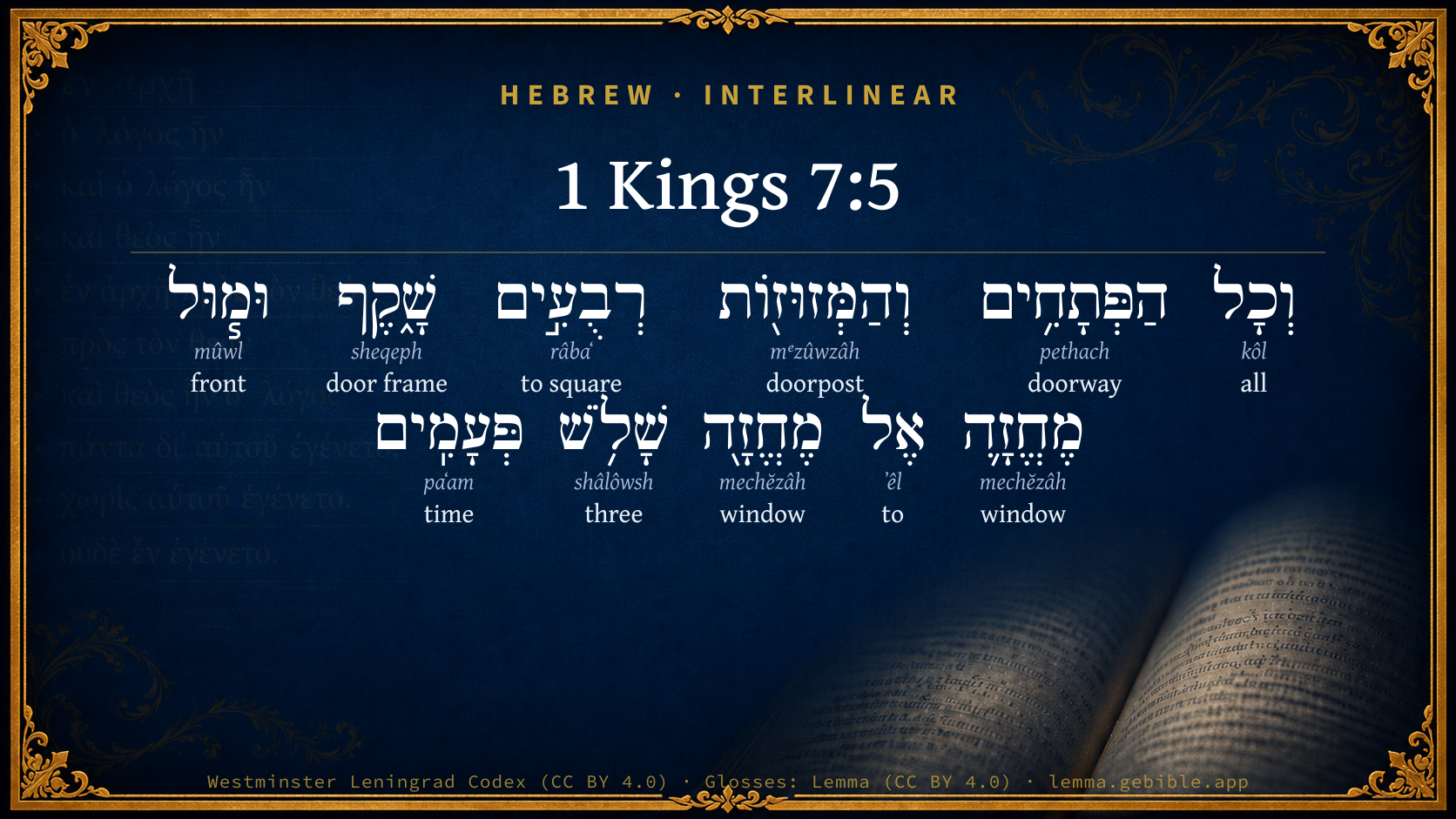
1 Kings 7:5

Hebrew (Westminster Leningrad Codex) 1 Kings 7:5 appears in the Hebrew Old Testament. The text above is from the Westminster Leningrad Codex. Each word links to its Strong’s number, a concise gloss, and parsing drawn from the Open Scriptures Hebrew Bible morphology. Click any word for its full Brown-Driver-Briggs (BDB) entry.
Download image
Cite this verse

1 Kings 7:5 (World English Bible). Public Domain. Lemma interlinear Bible study tool, https://lemma.gebible.app/v/1-kings/7/5.

Show BibTeX & RIS
BibTeX
RIS
English Translation
All the doors and posts were made square with beams: and window was over against window in three ranks.
World English Bible · Public Domain
Highlights
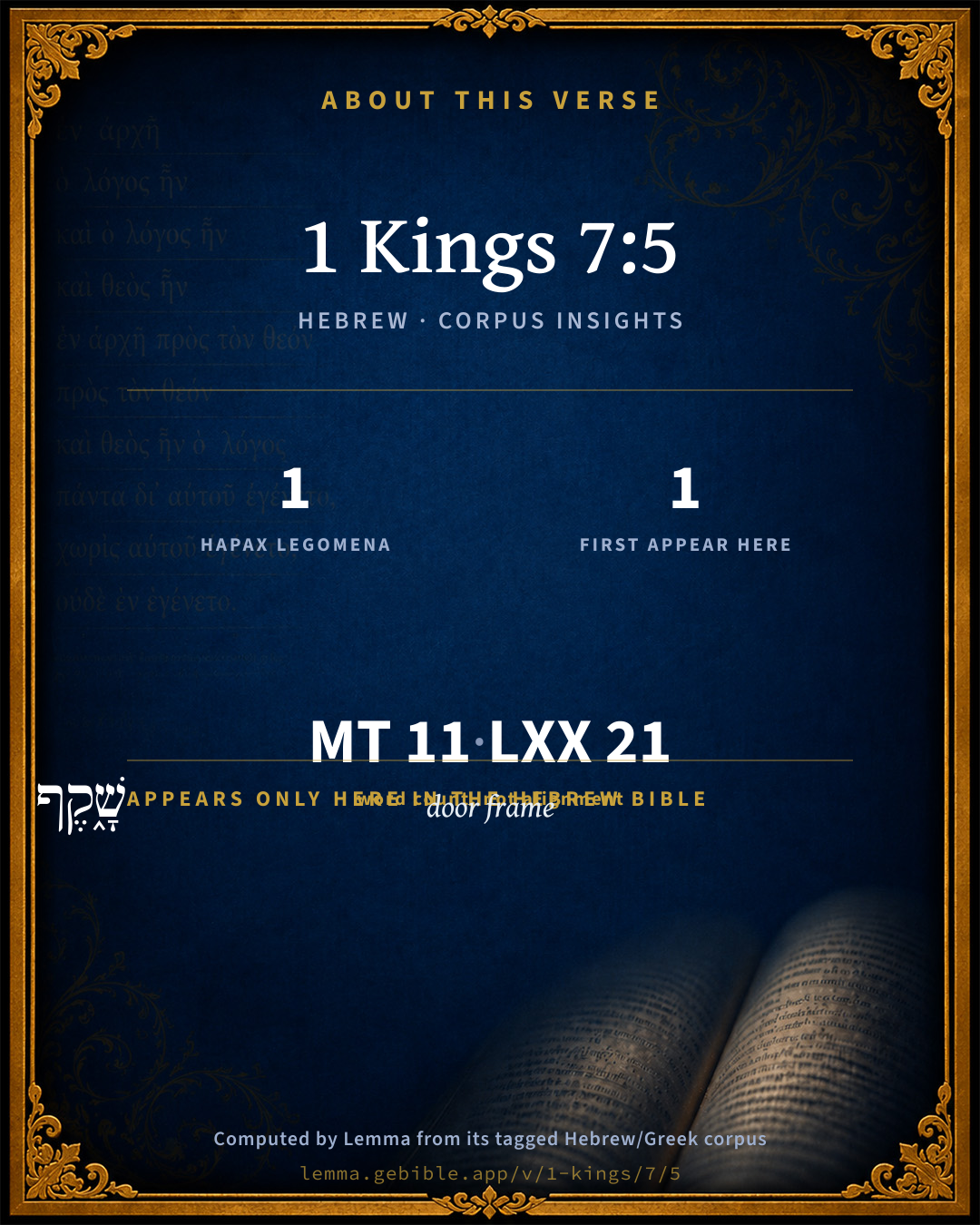
  • 1 hapax legomenon — only here in the Hebrew Bible
  • 1 first appearance in the Hebrew Bible
Full analysis ↓
Download a study sheet

One document with this verse’s original text, its word-by-word gloss line, the meaning frame, cross-references with their text, attributed commentary, and full source and license credits — printable, and it pastes into notes with its structure intact.

This verse Autodidact and up

Study sheet (.html) Plain text (.txt)

A passage Seminary Student

Up to 50 verses in one chapter. A passage sheet keeps up to 6 commentary sources and 12 cross-references per verse, in the order this page ranks them, and says so on the sheet whenever that leaves anything out. Ask for a single verse and you get the Autodidact verse sheet above.

Everything on this page stays free to read, with no account — the sheet is a download of what is already on screen, not access to it.

Want to remove ads? Support Godless Engineer
Compare translations 3

The same verse in 3 English versions, stacked beneath the original-language interlinear above. Click any original word for its lexicon entry.

Each is an independent rendering of the whole verse — the interlinear is not word-aligned to these translations.

Highlighted words mark where these versions differ — a whole-verse word diff, not a word-by-word alignment.

  • World English Bible Public Domain
    All the doors and posts were made square with beams: and window was over against window in three ranks.
  • King James Version Public Domain
    And all the doors and posts were square, with the windows: and light was against light in three ranks.
  • unfoldingWord Literal Text CC BY-SA 4.0
    And all of the entrances and doorposts square frame, and window directly opposite to window three tiers.

unfoldingWord Literal Text — © unfoldingWord, licensed CC BY-SA 4.0. Word-aligned USFM3 via Door43 (git.door43.org/unfoldingWord/en_ult).

Versions to compare (up to 4)

3 of 4 selected

Show all 18 translations

Every available English version of this verse, each an independent rendering of the whole verse.

  • World English Bible Public Domain
    All the doors and posts were made square with beams: and window was over against window in three ranks.
  • Berean Standard Bible Public Domain
    All the doorways had rectangular frames, with the openings facing one another in three tiers.
  • Majority Standard Bible Public Domain
    All the doorways had rectangular frames, with the openings facing one another in three tiers.
  • King James Version Public Domain
    And all the doors and posts were square, with the windows: and light was against light in three ranks.
  • American Standard Version (1901) Public Domain
    And all the doors and posts were made square with beams: and window was over against window in three ranks.
  • Revised Version (1885) Public Domain
    And all the doors and posts were square in prospect: and light was over against light in three ranks.
  • Geneva Bible (1599) Public Domain
    And all the doores, and the side postes with the windowes were foure square, and windowe was ouer against windowe in three rankes.
  • Douay-Rheims (1899) Public Domain
    And looking one upon another, with equal space between the pillars, and over the pillars were square beams in- all things equal.
  • Young's Literal Translation Public Domain
    And all the openings and the side-posts `are' square -- windows; and sight `is' over-against sight three times.
  • Literal Standard Version CC BY-SA 4.0
    And all the openings and the doorposts [are of] square frame; and window [is] toward window three times.
  • Unlocked Literal Bible CC BY-SA 4.0
    All the doors and posts were made square with beams, and window was opposite window in three sets.
  • unfoldingWord Literal Text CC BY-SA 4.0
    And all of the entrances and doorposts square frame, and window directly opposite to window three tiers.
  • Darby Bible Public Domain
    And all the doors and posts were square, with an architrave; and window was against window in three ranks.
  • World Messianic Bible Public Domain
    All the doors and posts were made square with beams; and window was facing window in three ranks.
  • Webster's Bible Public Domain
    And all the doors and posts were square, with the windows: and light was against light in three ranks.
  • Free Bible Version CC BY-SA 4.0
    All the doorways and door casings had rectangular frames, the openings facing each other in sets of three.
  • Bible in Basic English Public Domain
    And all the doors and windows had square frames, with the windows facing one another in three lines.
  • JPS Tanakh (1917) Public Domain
    And all the doors with their posts were square in the frame; and light was over against light in three ranks.

Literal Standard Version (2020), Covenant Press — licensed CC BY-SA 4.0. Text via the HelloAO Bible API (eBible.org). Unlocked Literal Bible (unfoldingWord) — licensed CC BY-SA 4.0. Text via the HelloAO Bible API (eBible.org). unfoldingWord Literal Text — © unfoldingWord, licensed CC BY-SA 4.0. Word-aligned USFM3 via Door43 (git.door43.org/unfoldingWord/en_ult). Free Bible Version, Dr. Jonathan Gallagher — licensed CC BY-SA 4.0. Text via the HelloAO Bible API (eBible.org).

Word by word

More ways to search: Search by grammar → Find every occurrence → Compare this word →

Practice this passage: Drill this verse → Learn its vocabulary →

שָׁ֑קֶף
sheqeph
H8260
“door frame”
Noun, Common, Masculine, Singular, Absolute
Part of Speech
Noun
Type
Common
Gender
Masculine
Number
Singular
State
Absolute
Full BDB Definition

Origin: from H8259

TWOT: 2458a

framework, casing (of doors), door, lintel
  1. וְכָל kôl H3605 “and · all of” Conjunction + Noun, Common, Masculine, Singular, Construct
  2. הַפְּתָחִ֥ים pethach H6607 “the · doorways” Particle, Definite Article + Noun, Common, Masculine, Plural, Absolute
  3. וְהַמְּזוּז֖וֹת mᵉzûwzâh H4201 “and · the · doorposts” Conjunction + Particle, Definite Article + Noun, Common, Feminine, Plural, Absolute
  4. רְבֻעִ֣ים râbaʻ H7251 “squared” Verb, Qal, Participle Passive, Masculine, Plural, Absolute
  5. וּמ֧וּל mûwl H4136 “and · front” Conjunction + Preposition
  6. מֶחֱזָ֛ה mechĕzâh H4237 “window” Noun, Common, Feminine, Singular, Absolute
  7. אֶל ʼêl H413 “to” Preposition
  8. מֶחֱזָ֖ה mechĕzâh H4237 “window” Noun, Common, Feminine, Singular, Absolute
  9. שָׁלֹ֥שׁ shâlôwsh H7969 “three” Adjective, Cardinal number, Feminine, Singular, Absolute
  10. פְּעָמִֽים paʻam H6471 “times” Noun, Common, Feminine, Plural, Absolute

About this verse

These counts appear in no published source. They are computed here, from the morphology-tagged text and Lemma’s own curated glosses. What Lemma adds →

11
words
10
distinct lemmas
Historical
section

Notable vocabulary

1 hapax legomenon — a word that appears only here in the entire Hebrew Bible:

  • שָׁ֑קֶף door frame H8260

First appearance in Scripture

This word makes its first canonical appearance in the Hebrew Bible here:

  • שָׁ֑קֶף door frame H8260

Shared distinctive vocabulary

מֶחֱזָ֛ה window H4237 occurs in 2 verses of the Hebrew Bible. Also found in:

Grammatical profile

  • 1 verb
  • 7 nouns
  • 1 adjective
  • 2 prepositions

Verb forms

  • רְבֻעִ֣ים Qal · Participle Passive

Repetition

A word recurs within this verse — often emphatic in Hebrew:

  • מֶחֱזָ֛ה window H4237 ×2

Hebrew & Septuagint length

In the original languages it is 11 Hebrew tokens and 21 Greek tokens — but the two are counted differently (Hebrew bundles its prefixes and suffixes into one token; the Greek is in lemma form), so that isn’t a like-for-like length.

Hebrew and Greek witnesses Masoretic Hebrew ↔ Greek Septuagint

The same verse in the two great witnesses to the Old Testament, shown verse-for-verse.

These are two independent witnesses, not word-aligned to each other, and the Septuagint is shown in lemma (dictionary) form.

Hebrew 1 Kings 7:5 Masoretic · Westminster Leningrad Codex

וְכָל הַפְּתָחִ֥ים וְהַמְּזוּז֖וֹת רְבֻעִ֣ים שָׁ֑קֶף וּמ֧וּל מֶחֱזָ֛ה אֶל מֶחֱזָ֖ה שָׁלֹ֥שׁ פְּעָמִֽים

All the doors and posts were made square with beams: and window was over against window in three ranks.

World English Bible · Public Domain

Greek LXX 1 Kings 7:5 Septuagint · lemma form

καί ποιέω δύο δίκτυον περικαλύπτω ὁ ἐπίθεμα ὁ στῦλος καί δίκτυον ὁ ἐπίθεμα ὁ εἷς καί δίκτυον ὁ ἐπίθεμα ὁ δεύτερος

No English rendering of this Greek verse — the small residue in the structurally divergent books.

On this verse, Whedon's Commentary on the Bible discusses the Septuagint’s reading. Read the note in Commentary ↓

Hebrew: Westminster Leningrad Codex (CC BY 4.0). Greek: Septuagint (public domain); English from a public-domain English Septuagint. How the Septuagint differs from the Hebrew →

Targum (Aramaic paraphrase)

1

The Targum is the ancient Jewish Aramaic paraphrase of the Hebrew Scriptures — an interpretive translation, not the Hebrew text itself. Onkelos (literal) and Pseudo-Jonathan (expansive) render the Torah, and Jonathan the Prophets. Coverage is partial: where no permissively-licensed English translation exists for a verse, only the Aramaic is shown. This is verse-level text, not a word-by-word alignment to the Hebrew.

  1. Targum Jonathan Prophets (Joshua–Malachi)
    וְכָל תַּרְעַיָא וְסִפַּיָא מְרַבְּעִין וַחֲפָן כְּלֵנְסָא וּמְקָבֵיל זְוִי לָקֳבֵיל זְוִי תְּלַת זִמְנִין:

    (no public-domain English translation for this verse)

    Targum Jonathan — Aramaic: “Mikraot Gedolot” (public domain). English: “Sefaria Community Translation” (CC0 1.0 (public-domain dedication)); “London "Chaldee Paraphrase," 1871” (public domain). Text via Sefaria.

Commentary

Notes on 1 Kings 7:5 from classic Christian and Jewish commentators (each source and its license shown beneath its notes). The classic Christian expositions comment on the surrounding passage and are grouped to its opening verse, so a note may address several verses; the Jewish commentaries on the Tanakh (Rashi and others) are per-verse, so they appear only where the commentator wrote on this verse.

Lemma curates 59 commentaries, every one of them public domain or Creative Commons licensed, each selected and text-cleaned for this edition rather than reprinted as found. About our sources →

Trapp's Complete Commentary

John Trapp

1Ki 7:5 And all the doors and posts [were] square, with the windows: and light [was] against light [in] three ranks.

Ver. 5. With the windows.] All were square: and so this house was, ad elegantiam, amaenitatem et recreationem tota comparata, very pleasant.

John Trapp, A Commentary or Exposition upon All the Books of the Old and New Testament (1647–1656) — public domain. Text from a community e-Sword module.

The Cambridge Bible for Schools and Colleges

gen. ed. J. J. S. Perowne

5. And all the doors and posts were square, with the windows] It is not easy to say how the last word of the Hebrew should be rendered. It is akin to that rendered ‘windows’ by the A.V. in 1Ki_7:4. Hence a like meaning has been assigned to it here. But there is nothing in the original to represent ‘with the.’ The R.V. used prospects in the previous verse, and so gives here were square in prospects, adding in the margin ‘were made square with beams.’ Taking these ‘beams’ to signify, as before, the ‘framework’ of the doorways, the sense would be ‘were set square in the framework,’ i.e. of the doorways.

The Cambridge Bible for Schools and Colleges (gen. ed. J. J. S. Perowne; Cambridge University Press, 1878–1918) — public domain. Text from a community e-Sword module.

John Gill's Exposition

And he made a porch of pillars,.... At the west end of the house:

and the length thereof was fifty cubits; answerable to the breadth of the house:

and the breadth thereof thirty cubits: which, added to the length of the house, made it one hundred and thirty:

and the porch was before them; the four rows of cedar pillars of the house, Kg1 7:2 this porch was either for his guards to keep watch in; or for his courtiers to walk in, sheltered from rain or the like; or perhaps only for grandeur and magnificence:

and the other pillars and the thick beam were before them; the pillars of the porch, on which were laid beams of cedar for a storey over them, and so on; these were before and right against, and answered to the pillars of the house.

John Gill's Exposition of the Whole Bible (1746–1763) — public domain (CC PDM 1.0). Text via the HelloAO Bible API.

Albert Barnes' Notes on the Bible

All the doors and posts - The doorways, and the posts which formed them, seem to be intended. These were square at top, not arched or rounded. In Assyrian buildings arched doorways were not uncommon. The doorways also, like the windows, exactly faced one another.

Albert Barnes' Notes on the Bible (1834–1885) — public domain. Text from a community e-Sword/MySword module.

Matthew Poole's English Annotations

He speaks either, first, of the same lights mentioned 1Ki 7:4, it being the manner of the Hebrews to repeat the same things; or rather, of the smaller windows or lights, which were over the several doors, as the manner of many buildings is.

Matthew Poole's English Annotations on the Holy Bible (1683–1685) — public domain. Text from a community e-Sword/MySword module.

Whedon's Commentary on the Bible

Daniel D. Whedon

5. All the doors — Which led from one of these chambers to another. (d d in cut.)

And posts — מזוזת, posts, is undoubtedly a copyist’s error, and for it we should read, as did the Septuagint translators, מחזות, apertures, described in the preceding verse.

Were square, with the windows — Here, again, the translation is erroneous. שׁק does not mean windows, but a layer of beams; that is, a beam framework. Render: And all the doors and the apertures were of squared beamwork. They were built in square form, and not arched.

Daniel D. Whedon (gen. ed.), Commentary on the Old and New Testaments (1874–1909) — public domain. Text from a community e-Sword module.

The Pulpit Commentary

And all the doors and posts For tzOWzm posts, Thenius would read twOzhm, outlooks, after ver. 4, which seems a natural emendation, especially as the LXX has cwrai. We should then get the sense of "doors and windows" were square of beam. The word translated "windows" in ver. 4; the proper rendering is beam, and the meaning apparently is that all these openings were square in shape. Nothing is said about the height of the rooms, and as the commentators are not agreed whether there was one story or three, that can obviously be only matter of conjecture. Rawlinson, who thinks of but one hall, with three rows of windows, supposes, after Houbigant, that one row was placed in a wall which ran down the middle of the apartment. Such an arrangement, he observes, was found by Layard at Nimrud.

The Pulpit Commentary (1880–1919), ed. H.D.M. Spence-Jones & Joseph S. Exell — public domain. Text from a community e-Sword module.

John Wesley's Explanatory Notes

Windows - He speaks, of smaller windows or lights, which were over the several doors.

John Wesley, Explanatory Notes Upon the Whole Bible (1754–1765) — public domain. Text via the GEBible commentary corpus.

Scofield Reference Notes

C. I. Scofield

doors

Or, spaces and pillars were square in prospect.

The Scofield Reference Bible (1917 edition), notes by C. I. Scofield — public domain. Text from a community e-Sword module.

Rashi

Rabbi Shlomo Yitzchaki (Rashi)

And all the entrances and doorposts. Because, generally, a king’s [summer] home is made with many entrances because of the air, and it was therefore called “a forest house” because it was like a forest.

Were square as was the window. [Targum] Yonoson translated, “square and covered the beams,” [i.e.,] the entrances were covered with thin boards, that were square as other entrances of houses, and they were not made with a curved arch similar to the entrances of a great hall.

And each window faced [the other window]. And the front of one edge was installed facing the other edge. The top of the board was towards the top of the other board, three times for each beam, but I do not know how.

Rashi on the Tanakh — English translations: “The Judaica Press complete Tanach with Rashi, translated by A. J. Rosenberg” (CC BY 4.0); “Pentateuch with Rashi's commentary by M. Rosenbaum and A.M. Silbermann, 1929-1934” (public domain); “The Metsudah Tanach series, Lakewood, N.J” (CC BY 4.0); and “The Book of Joshua, Metsudah Publications, 1997” (CC BY 4.0). Text via Sefaria.

Lesson kit

Teaching starters — assembled from the data on this page, not authored interpretation. Every prompt links to the verse data it draws on. Edit before teaching.

1 Kings, in the Historical, opens this verse with 11 words (10 distinct Hebrew lemmas). Its most distinctive word is sheqeph (“door frame”). A historical commentator’s framing appears above. Read the whole chapter for the surrounding context.

Discussion questions

  1. What does “door frame” (sheqeph) contribute to the verse as a whole?
  2. 1 word here appears nowhere else in the Hebrew Bible. Why might the author reach for such rare wording?
  3. This is the first place “door frame” appears in Scripture (first appears here). What does its debut here establish?
  4. How does 1 Kings 7:4, which shares the word «window», read alongside this verse?
  5. What does the repetition of “window” (2× in this one verse) do in this verse?
  6. The translations on this page render this verse differently — a whole-verse word diff, not a word-by-word alignment. What might account for the different wordings?
  7. «רְבֻעִ֣ים» is a Qal Participle Passive verb. How does that grammatical form shape the action described?
  8. Compare how Trapp's Complete Commentary and The Cambridge Bible for Schools and Colleges read this verse. Where do they agree or differ?

Things to notice

  • 1 word in this verse appears nowhere else in the Hebrew Bible.
  • 1 word makes its first canonical appearance in Scripture here.
  • This verse counts 11 Hebrew ↔ 21 Greek words.
  • These translations choose different wording for 16 words in this verse.
  • “window” occurs 2× in this single verse.

Reading settings

Reading text

Shown beneath each verse's original-language words.

Old Testament
Old Testament edition

Read the OT as the Masoretic Hebrew (MT) or the Greek Septuagint (LXX).

English shown for the Greek Septuagint (in the Hebrew ↔ Greek comparison).

Comparing translations? Open the Compare panel on any verse page to stack up to four side by side.