
Jeremiah 26:10

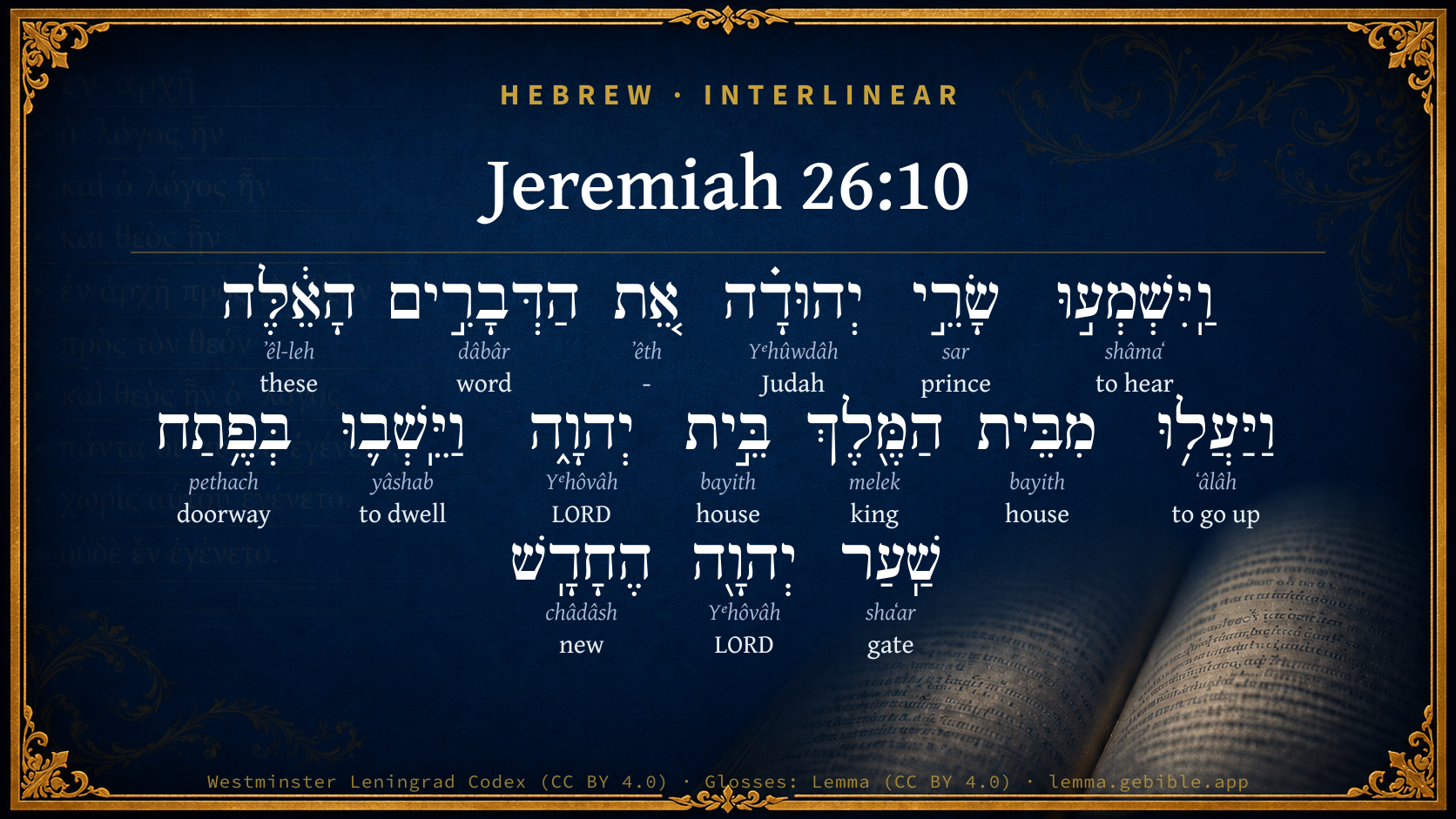
Hebrew (Westminster Leningrad Codex) Jeremiah 26:10 appears in the Hebrew Old Testament. The text above is from the Westminster Leningrad Codex. Each word links to its Strong’s number, a concise gloss, and parsing drawn from the Open Scriptures Hebrew Bible morphology. Click any word for its full Brown-Driver-Briggs (BDB) entry.
Download image
Cite this verse

Jeremiah 26:10 (World English Bible). Public Domain. Lemma interlinear Bible study tool, https://lemma.gebible.app/v/jeremiah/26/10.

Show BibTeX & RIS
BibTeX
RIS
English Translation
When the princes of Judah heard these things, they came up from the king's house to the house of Yahweh; and they sat in the entry of the new gate of Yahweh's [house].
World English Bible · Public Domain
Download a study sheet

One document with this verse’s original text, its word-by-word gloss line, the meaning frame, cross-references with their text, attributed commentary, and full source and license credits — printable, and it pastes into notes with its structure intact.

This verse Autodidact and up

Study sheet (.html) Plain text (.txt)

A passage Seminary Student

Up to 50 verses in one chapter. A passage sheet keeps up to 6 commentary sources and 12 cross-references per verse, in the order this page ranks them, and says so on the sheet whenever that leaves anything out. Ask for a single verse and you get the Autodidact verse sheet above.

Everything on this page stays free to read, with no account — the sheet is a download of what is already on screen, not access to it.

Want to remove ads? Support Godless Engineer
Compare translations 3

The same verse in 3 English versions, stacked beneath the original-language interlinear above. Click any original word for its lexicon entry.

Each is an independent rendering of the whole verse — the interlinear is not word-aligned to these translations.

Highlighted words mark where these versions differ — a whole-verse word diff, not a word-by-word alignment.

  • World English Bible Public Domain
    When the princes of Judah heard these things, they came up from the king's house to the house of Yahweh; and they sat in the entry of the new gate of Yahweh's [house].
  • King James Version Public Domain
    When the princes of Judah heard these things, then they came up from the king's house unto the house of the LORD, and sat down in the entry of the new gate of the LORD's house.
  • unfoldingWord Literal Text CC BY-SA 4.0
    And the officials of Judah heard these things, and they went up from the house of the king the house of Yahweh, and they sat down in the entrance of the New Gate of Yahweh.

unfoldingWord Literal Text — © unfoldingWord, licensed CC BY-SA 4.0. Word-aligned USFM3 via Door43 (git.door43.org/unfoldingWord/en_ult).

Versions to compare (up to 4)

3 of 4 selected

Show all 18 translations

Every available English version of this verse, each an independent rendering of the whole verse.

  • World English Bible Public Domain
    When the princes of Judah heard these things, they came up from the king's house to the house of Yahweh; and they sat in the entry of the new gate of Yahweh's [house].
  • Berean Standard Bible Public Domain
    When the officials of Judah heard these things, they went up from the king’s palace to the house of the LORD and sat there at the entrance of the New Gate.
  • Majority Standard Bible Public Domain
    When the officials of Judah heard these things, they went up from the king’s palace to the house of the LORD and sat there at the entrance of the New Gate.
  • King James Version Public Domain
    When the princes of Judah heard these things, then they came up from the king's house unto the house of the LORD, and sat down in the entry of the new gate of the LORD's house.
  • American Standard Version (1901) Public Domain
    And when the princes of Judah heard these things, they came up from the king's house unto the house of Jehovah; and they sat in the entry of the new gate of Jehovah's `house'.
  • Revised Version (1885) Public Domain
    And when the princes of Judah heard these things, they came up from the king’s house unto the house of the LORD; and they sat in the entry of the new gate of the LORD’S house.
  • Geneva Bible (1599) Public Domain
    And when the princes of Iudah heard of these things, they came vp from the Kings house into the House of the Lord, and sate downe in the entrie of the new gate of the Lords House.
  • Douay-Rheims (1899) Public Domain
    And the princes of Juda heard these words: and they went up from the king's house into the house of the Lord, and sat in the entry of the new gate of the house of the Lord.
  • Young's Literal Translation Public Domain
    And the heads of Judah hear these things, and they go up from the house of the king `to' the house of Jehovah, and sit in the opening of the new gate of Jehovah.
  • Literal Standard Version CC BY-SA 4.0
    And the heads of Judah hear these things, and they go up from the house of the king [to] the house of YHWH, and sit in the opening of the New Gate of YHWH.
  • Unlocked Literal Bible CC BY-SA 4.0
    Then the officials of Judah heard these words and went up from the king's house to Yahweh's house. They sat in the gateway at the New Gate of Yahweh's house.
  • unfoldingWord Literal Text CC BY-SA 4.0
    And the officials of Judah heard these things, and they went up from the house of the king the house of Yahweh, and they sat down in the entrance of the New Gate of Yahweh.
  • Darby Bible Public Domain
    And the princes of Judah heard these things; and they went up from the king's house unto the house of Jehovah, and sat in the entry of the new gate of Jehovah.
  • World Messianic Bible Public Domain
    When the princes of Judah heard these things, they came up from the king’s house to the LORD’s house; and they sat in the entry of the new gate of the LORD’s house.
  • Webster's Bible Public Domain
    When the princes of Judah heard these things, then they came up from the king's house to the house of the LORD, and sat down in the entry of the new gate of the LORD'S house.
  • Free Bible Version CC BY-SA 4.0
    When the leaders of Judah heard what happened they came from the king's palace to the Lord's Temple and sat at the entrance of the New Gate of the Temple to judge the case.
  • Bible in Basic English Public Domain
    And the rulers of Judah, hearing of these things, came up from the king's house to the house of the Lord, and took their seats by the new door of the Lord's house.
  • JPS Tanakh (1917) Public Domain
    When the princes of Judah heard these things, they came up from the king's house unto the house of the LORD; and they sat in the entry of the new gate of the LORD'S house.

Literal Standard Version (2020), Covenant Press — licensed CC BY-SA 4.0. Text via the HelloAO Bible API (eBible.org). Unlocked Literal Bible (unfoldingWord) — licensed CC BY-SA 4.0. Text via the HelloAO Bible API (eBible.org). unfoldingWord Literal Text — © unfoldingWord, licensed CC BY-SA 4.0. Word-aligned USFM3 via Door43 (git.door43.org/unfoldingWord/en_ult). Free Bible Version, Dr. Jonathan Gallagher — licensed CC BY-SA 4.0. Text via the HelloAO Bible API (eBible.org).

Word by word

More ways to search: Search by grammar → Find every occurrence → Compare this word →

Practice this passage: Drill this verse → Learn its vocabulary →

הֶחָדָֽשׁ
châdâsh
H2319
“the · new”
Particle, Definite Article + Adjective, Adjective, Masculine, Singular, Absolute
Part of Speech
Particle + Adjective
Type
Adjective
Gender
Masculine
Number
Singular
State
Absolute
Full BDB Definition

Origin: from H2318

TWOT: 613a

new, new thing, fresh
  1. וַֽיִּשְׁמְע֣וּ shâmaʻ H8085 “and · to hear” Conjunction + Verb, Qal, Sequential Imperfect, 3rd Person, Masculine, Plural
  2. שָׂרֵ֣י sar H8269 “princes of” Noun, Common, Masculine, Plural, Construct
  3. יְהוּדָ֗ה Yᵉhûwdâh H3063 “Judah” Noun, Proper
  4. אֵ֚ת ʼêth H853 “-” Particle, Direct Object
  5. הַדְּבָרִ֣ים dâbâr H1697 “the · words” Particle, Definite Article + Noun, Common, Masculine, Plural, Absolute
  6. הָאֵ֔לֶּה ʼêl-leh H428 “the · these” Particle, Definite Article + Pronoun, Demonstrative, Common, Plural
  7. וַיַּעֲל֥וּ ʻâlâh H5927 “and · to go up” Conjunction + Verb, Qal, Sequential Imperfect, 3rd Person, Masculine, Plural
  8. מִבֵּית bayith H1004 “from · house of” Preposition + Noun, Common, Masculine, Singular, Construct
  9. הַמֶּ֖לֶךְ melek H4428 “the · king” Particle, Definite Article + Noun, Common, Masculine, Singular, Absolute
  10. בֵּ֣ית bayith H1004 “house of” Noun, Common, Masculine, Singular, Construct
  11. יְהוָ֑ה Yᵉhôvâh H3068 “LORD” Noun, Proper
  12. וַיֵּֽשְׁב֛וּ yâshab H3427 “and · to dwell” Conjunction + Verb, Qal, Sequential Imperfect, 3rd Person, Masculine, Plural
  13. בְּפֶ֥תַח pethach H6607 “in/at · doorway of” Preposition + Noun, Common, Masculine, Singular, Construct
  14. שַֽׁעַר shaʻar H8179 “gate of” Noun, Common, Masculine, Singular, Construct
  15. יְהוָ֖ה Yᵉhôvâh H3068 “LORD” Noun, Proper

About this verse

These counts appear in no published source. They are computed here, from the morphology-tagged text and Lemma’s own curated glosses. What Lemma adds →

16
words
14
distinct lemmas
Prophets
section

Shared distinctive vocabulary

הֶחָדָֽשׁ new H2319 occurs in 48 verses of the Hebrew Bible. Also found in:

Grammatical profile

  • 3 verbs
  • 10 nouns
  • 1 adjective
  • 1 pronoun
  • 1 particle

Verb forms

  • וַֽיִּשְׁמְע֣וּ Qal · Sequential Imperfect
  • וַיַּעֲל֥וּ Qal · Sequential Imperfect
  • וַיֵּֽשְׁב֛וּ Qal · Sequential Imperfect

Repetition

Words recur within this verse — often emphatic in Hebrew:

  • מִבֵּית house H1004 ×2
  • יְהוָ֑ה LORD H3068 ×2

Cross-references

11

Topical passages linked to Jeremiah 26:10 in the Treasury of Scripture Knowledge — connected by theme and wording, ordered by reader-vote popularity; previews shown in the World English Bible.

  • Jeremiah 36:10 Then read Baruch in the book the words of Jeremiah in the house of Yahweh, in the chamber of Gemariah the son of Shaphan, the scribe, in the upper court, at the entry of the new gate of Yahweh's house, in the ears of all the people.
  • 2 Kings 15:35 However the high places were not taken away: the people still sacrificed and burned incense in the high places. He built the upper gate of the house of Yahweh.
  • Jeremiah 26:16–17 Then said the princes and all the people to the priests and to the prophets: This man is not worthy of death; for he has spoken to us in the name of Yahweh our God.
  • Jeremiah 26:24 But the hand of Ahikam the son of Shaphan was with Jeremiah, that they should not give him into the hand of the people to put him to death.
  • Jeremiah 34:19 the princes of Judah, and the princes of Jerusalem, the eunuchs, and the priests, and all the people of the land, who passed between the parts of the calf;
  • Jeremiah 36:12–19 he went down into the king's house, into the scribe's chamber: and, behold, all the princes were sitting there, [to wit], Elishama the scribe, and Delaiah the son of Shemaiah, and Elnathan the son of Achbor, and Gemariah the son of Shaphan, and Zedekiah the son of Hananiah, and all the princes.
  • Jeremiah 36:25 Moreover Elnathan and Delaiah and Gemariah had made intercession to the king that he would not burn the scroll; but he would not hear them.
  • Jeremiah 37:14–16 Then said Jeremiah, It is false; I am not falling away to the Chaldeans. But he didn't listen to him; so Irijah laid hold on Jeremiah, and brought him to the princes.
  • Jeremiah 38:4–6 Then the princes said to the king, Let this man, we pray you, be put to death; because he weakens the hands of the men of war who remain in this city, and the hands of all the people, in speaking such words to them: for this man doesn't seek the welfare of this people, but the hurt.
  • Ezekiel 22:6 Behold, the princes of Israel, everyone according to his power, have been in you to shed blood.
  • Ezekiel 22:27 Her princes in the midst of it are like wolves ravening the prey, to shed blood, [and] to destroy souls, that they may get dishonest gain.

Cross-references courtesy of OpenBible.info (CC BY 4.0).

Hebrew and Greek witnesses Masoretic Hebrew ↔ Greek Septuagint

The same verse in the two great witnesses to the Old Testament, shown verse-for-verse.

These are two independent witnesses, not word-aligned to each other, and the Septuagint is shown in lemma (dictionary) form.

Hebrew Jeremiah 26:10 Masoretic · Westminster Leningrad Codex

וַֽיִּשְׁמְע֣וּ שָׂרֵ֣י יְהוּדָ֗ה אֵ֚ת הַדְּבָרִ֣ים הָאֵ֔לֶּה וַיַּעֲל֥וּ מִבֵּית הַמֶּ֖לֶךְ בֵּ֣ית יְהוָ֑ה וַיֵּֽשְׁב֛וּ בְּפֶ֥תַח שַֽׁעַר יְהוָ֖ה הֶחָדָֽשׁ

When the princes of Judah heard these things, they came up from the king's house to the house of Yahweh; and they sat in the entry of the new gate of Yahweh's [house].

World English Bible · Public Domain

Greek LXX Structure differs

In the Septuagint, Jeremiah is about an eighth shorter than the Hebrew and arranges its material differently — the Oracles Against the Nations (Hebrew chapters 46–51) appear in the middle of the Greek book, after 25:13. Because the chapter and verse boundaries do not line up, a verse-for-verse comparison with the Hebrew is not shown.

A verse-for-verse comparison isn’t shown here because the chapters and verses don’t line up. Switch to the LXX edition with the MT / LXX toggle above to read the Greek directly.

On this verse, The Cambridge Bible for Schools and Colleges discusses the Septuagint’s reading. Read the note in Commentary ↓

Hebrew: Westminster Leningrad Codex (CC BY 4.0). Greek: Septuagint (public domain); English from a public-domain English Septuagint. How the Septuagint differs from the Hebrew →

Targum (Aramaic paraphrase)

1

The Targum is the ancient Jewish Aramaic paraphrase of the Hebrew Scriptures — an interpretive translation, not the Hebrew text itself. Onkelos (literal) and Pseudo-Jonathan (expansive) render the Torah, and Jonathan the Prophets. Coverage is partial: where no permissively-licensed English translation exists for a verse, only the Aramaic is shown. This is verse-level text, not a word-by-word alignment to the Hebrew.

  1. Targum Jonathan Prophets (Joshua–Malachi)
    וּשְׁמָעוּ רַבְרְבֵי יְהוּדָה יַת פִּתְגָמַיָא הָאִלֵין וּסְלִיקוּ מִבֵּית מַלְכָּא לְבֵית מַקְדְשָׁא דַייָ וְתִיבוּ בְּמַעֲלָנָא דִתְרַע בֵּית מַקְדְשָׁא דַייָ מַדִינְחָאָה:

    (no public-domain English translation for this verse)

    Targum Jonathan — Aramaic: “Mikraot Gedolot” (public domain). English: “Sefaria Community Translation” (CC0 1.0 (public-domain dedication)); “London "Chaldee Paraphrase," 1871” (public domain). Text via Sefaria.

Commentary

Notes on Jeremiah 26:10 from classic Christian and Jewish commentators (each source and its license shown beneath its notes). The classic Christian expositions comment on the surrounding passage and are grouped to its opening verse, so a note may address several verses; the Jewish commentaries on the Tanakh (Rashi and others) are per-verse, so they appear only where the commentator wrote on this verse.

Lemma curates 59 commentaries, every one of them public domain or Creative Commons licensed, each selected and text-cleaned for this edition rather than reprinted as found. About our sources →

Trapp's Complete Commentary

John Trapp

Jer 26:10 When the princes of Judah heard these things, then they came up from the king’s house unto the house of the LORD, and sat down in the entry of the new gate of the LORD’S [house].

Ver. 10. When the princes of Judah heard those things.] Pii viri sunt quibus doluit populi impietas; good men they were, saith Oecolampadius. They might be so, some of them at least; and it was well done of them here to pass an impartial sentence for the innocent prophet against the priests and people. But Pilate did so for a while for our Saviour; and these princes soon after turned Jeremiah’s cruel enemies {Jer 37:15} for his plain dealing. {Jer 34:1-7}

And sat down in the entry of the new gate.] The east gate, saith the Chaldee paraphrast; called the new gate because repaired by Jotham, {2Ki 15:35} saith Lyra.

John Trapp, A Commentary or Exposition upon All the Books of the Old and New Testament (1647–1656) — public domain. Text from a community e-Sword module.

Tyndale Open Study Notes

Tyndale Open Resources

26:10-15 Court trials were customarily held at a gateway to the city. City gateways at this time were covered and multi-chambered. In this location, where the commerce of the city went in and out, the elders of the city would congregate where they could be called upon to apply their wisdom to legal conflicts. In this case, the officials were fair; they gave each party an opportunity to present its side of the quarrel.

Tyndale Open Study Notes — © Tyndale Open Resources, licensed CC BY-SA 4.0. Text via the HelloAO Bible API.

Geneva Bible (1599)

Geneva Bible translators

So called, because it was repaired by Jotham, 2 Kings 15:35.

Geneva Bible (1599) marginal notes — public domain. Text via Bolls.life.

Jamieson, Fausset & Brown

Robert Jamieson, A. R. Fausset & David Brown

princes--members of the Council of State or Great Council, which took cognizance of such offenses.

heard--the clamor of the popular tumult.

came up--from the king's house to the temple, which stood higher than the palace.

sat--as judges, in the gate, the usual place of trying such cases.

new gate--originally built by Jotham ("the higher gate," Kg2 15:35) and now recently restored.

Jamieson, Fausset & Brown — Commentary Critical and Explanatory on the Whole Bible (1871) — public domain (CC PDM 1.0). Text via the HelloAO Bible API.

Adam Clarke's Commentary

Verse 10. The princes of Judah] The king's court; his cabinet counsellors.

Adam Clarke's Commentary on the Bible (1810–1826) — public domain. Text from a community e-Sword/MySword module.

John Calvin's Commentaries

We have said that the princes were roused by a popular clamor; nor is there a doubt but; that the king had sent them to quell the commotion. It must be especially noticed, that they were engaged in other matters, as it was seldom the case that courtiers spent their time in hearing the prophets. It is indeed true, that the occupations of those are sacred, who have the care of the commonwealth, who dispense justice, and who have to provide for the public safety; but it behoves them so to divide their time, that they may be able to consecrate some portion of it to God. But courtiers think themselves exempted by a sort of privilege, when yet the truth is more necessary for them than even for the common people; for not only the duty of the head of a family lies on each of them, but the Lord has also set them over a whole people. If, then, private men have need of being daily taught, that they may faithfully rule and guide themselves and their families, what ought to be done by those rulers who are as it were the fathers of the commonwealth? But as I have already said, such men usually exempt themselves from the yoke of the faithful.

Hence then it was, that none of the princes were present, when Jeremiah had been commanded to proclaim his message, not only on the day when few came to the Temple, but when they came from all the cities of Judah to sacrifice at Jerusalem. It was, indeed, a very shameful sign of gross contempt, that no one of the king’s counsellors appeared in the Temple, when there were present, from remote places, those whom religion and the desire to sacrifice had brought there. But he says that they came to know the cause of the commotion; for it is said, that they sat at the new gate, which some say was eastward; and they conjecture that it was called new, because it had been renewed; the king’s palace was also towards the east, and the eastern gate was his tribunal. I am disposed to embrace this opinion, that they sat at the eastern gate. It now follows, —

John Calvin's Commentaries (1540-1563) — public domain. Text from the Calvin Translation Society English edition (1840s-50s) via the Christian Classics Ethereal Library (ccel.org). Calvin's coverage is partial (roughly two-thirds of the Bible); uncommented books and verses are honest gaps, never fabricated. The 19th-century editor's footnotes and remarks are omitted so the notes are faithfully Calvin's own voice.

Ellicott's Commentary for English Readers

(10) When the princes of Judah heard these things . . .—The princes appear not to have been present when the words were spoken. The report was carried to them as they sat in council with the king, and they came down to the Temple and took their place, to watch and listen what would come next. They went apparently by what was known as the king’s entry into the Temple (2Ki_16:18), the high gate which had been built by Jotham (2Ch_27:3), from which they could command a view of the crowds in the Temple court. (See Note on Jer_22:2). One of them, in all probability, was Ahikam, the son of Shaphan (Jer_26:24). As in Jer_36:19; Jer_36:25, the princes are less bitterly hostile than the priests.

A Bible Commentary for English Readers, edited by Charles John Ellicott (1878–1897) — public domain. Text from a community e-Sword module.

The Cambridge Bible for Schools and Colleges

gen. ed. J. J. S. Perowne

10. the princes of Judah … came up from the king’s house] The powers of these persons are not clear. Evidently, however, their employment about the court and the constantly increasing weakness of the monarchy would help them to the acquisition of such authority as we find them here exercising.

came up] See on Jer_22:1.

the new gate] probably the same as the “upper gate” of ch. Jer_20:2, where see note.

of the Lord’s house] The MT. omits “house.” Possibly we should reject both substantives. They are unnecessary after Jer_26:9. LXX MSS., agreeing as to “house,” are divided with regard to “the Lord.”

The Cambridge Bible for Schools and Colleges (gen. ed. J. J. S. Perowne; Cambridge University Press, 1878–1918) — public domain. Text from a community e-Sword module.

John Gill's Exposition

When the princes of Judah heard these things,.... The tumult there was in the temple; these were the princes of the blood, or the nobles of the realm, particularly the courtiers, and who were of the king's privy council; or else the great sanhedrim, consisting of seventy persons, and were the chief court of judicature:

then they came up from the king's house to the house of the Lord; from the royal palace where they resided; by which it should seem that they were the king's courtiers, and counsellors, and officers of state; unless in those times the sanhedrim sat there; from hence they came up to the temple, where Jeremiah and the priests, &c. were, which, being built on a hill, was higher than the king's palace; and therefore are said to "come up" to it:

and sat down in the entry of the new gate of the Lord's house; as a court of judicature, to hear and try the cause between the prophet and his accusers. This gate of the temple is thought to be the higher gate, which Jotham built, Kg2 15:35. The Targum calls it the eastern gate; and so Kimchi says it was; and that it was called the new gate, according to the Rabbins, because there they renewed the constitutions and traditions; though he thinks the better reason is, because newly repaired, or some new building was added to it. Jarchi also says it was the eastern gate; and gives this reason for its being called new; that when Jehoiakim was carried captive, and some of the vessels of the temple, Nebuchadnezzar's army broke the eastern gate, which Zedekiah afterwards repaired, and made new; but if so, it is here called new by a prolepsis; or this account was written after that time.

John Gill's Exposition of the Whole Bible (1746–1763) — public domain (CC PDM 1.0). Text via the HelloAO Bible API.

Albert Barnes' Notes on the Bible

The princes of Judah - The priests could scourge a man etc., but could not then try him for his life, as the Sanhedrim subsequently did until the Romans deprived them of the power.

The new gate - That built by Jotham 2Ki 15:35, and probably a usual place for trials.

Albert Barnes' Notes on the Bible (1834–1885) — public domain. Text from a community e-Sword/MySword module.

Matthew Poole's English Annotations

When the nobles and other civil magistrates heard of the tumult, occasioned by Jeremiah’s unpleasing prophecy, they came from the king’s court, where the nobles and great officers in nations usually are, to the temple; and sat down at the entry of the new gate in the Lord’s house. Some think it was called the new gate because repaired by Jotham, 2Ki 15:35; 2Ch 27:3. Some say it was the eastern, others that it was the western gate. It was certainly the place where their sanhedrim, who were to judge of false prophets, were wont to sit.

Matthew Poole's English Annotations on the Holy Bible (1683–1685) — public domain. Text from a community e-Sword/MySword module.

Whedon's Commentary on the Bible

Daniel D. Whedon

10. Princes of Judah — Probably the judicial officers who were about the palace — the germ of the sanhedrin of later times. They evidently had the power of life and death.

The new gate — Cannot be identified. The Targum says, “east gate.” It was built by Jotham, (2Ki_15:35,) and, according to Jer_36:10, was by the inner court.

Daniel D. Whedon (gen. ed.), Commentary on the Old and New Testaments (1874–1909) — public domain. Text from a community e-Sword module.

The Pulpit Commentary

The princes. The term will include the members of the various branches of the royal family, who acted as judges, (see on Jer_21:12) and the "elders," or heads of families (see ver. 17). Without the presence of the former, Jeremiah could only have had a mock-trial. Came up, etc.. (see on Jer_22:1) Of the Lord"s house; better simply, of the Lord. The gate is the same which is referred at Jer_20:2.

The Pulpit Commentary (1880–1919), ed. H.D.M. Spence-Jones & Joseph S. Exell — public domain. Text from a community e-Sword module.

John Wesley's Explanatory Notes

When - When the nobles, and other civil magistrates, heard of the tumult, they came from the king's court, where the nobles and great officers of nations usually are, to the temple. At the entry - It was the place where their sanhedrim, who were to judge of false prophets, were wont to sit.

John Wesley, Explanatory Notes Upon the Whole Bible (1754–1765) — public domain. Text via the GEBible commentary corpus.

unfoldingWord translationNotes

Door43 World Missions Community

the New Gate

the name of the gate through which people went into the temple

you heard with your own ears

"you heard"

this house and this city

"the people who worship in Yahweh's temple and those who live in the city of Jerusalem"

translationWords

kingdom of Judah

gate

die

Yahweh

unfoldingWord translationNotes — © Distant Shores Media and the Door43 World Missions Community, licensed CC BY-SA 4.0. Source: git.door43.org/Door43/en_tn.

Rashi

Rabbi Shlomo Yitzchaki (Rashi)

And the princes of Judah heard that the false prophets and the priests had seized Jeremiah.

at the entrance of the new gate of the Lord Others annotated: When Jehoiachin went in exile and some of the vessels of the house of our God went with him, Nebuchadnezzar’s army breached the eastern gate, and Zedekiah subsequently repaired it and renewed it. It is therefore called ‘new.’

Rashi on the Tanakh — English translations: “The Judaica Press complete Tanach with Rashi, translated by A. J. Rosenberg” (CC BY 4.0); “Pentateuch with Rashi's commentary by M. Rosenbaum and A.M. Silbermann, 1929-1934” (public domain); “The Metsudah Tanach series, Lakewood, N.J” (CC BY 4.0); and “The Book of Joshua, Metsudah Publications, 1997” (CC BY 4.0). Text via Sefaria.

Lesson kit

Teaching starters — assembled from the data on this page, not authored interpretation. Every prompt links to the verse data it draws on. Edit before teaching.

Jeremiah, in the Prophets, opens this verse with 16 words (14 distinct Hebrew lemmas). Its most distinctive word is châdâsh (“new”). A historical commentator’s framing appears above. Read the whole chapter for the surrounding context.

Discussion questions

  1. The word châdâsh carries the sense “new.” How does it shape the verse?
  2. Exodus 1:8 shares the word «new» with this verse. How do the two illuminate each other?
  3. “house” occurs 2× in this one verse. What is the effect of the repetition?
  4. The translations on this page render this verse differently — a whole-verse word diff, not a word-by-word alignment. What might account for the different wordings?
  5. The verb «וַֽיִּשְׁמְע֣וּ» is Qal Sequential Imperfect. How does its form color the action?
  6. Reading how Trapp's Complete Commentary and Tyndale Open Study Notes read this verse, where do the two commentators agree and where do they part?

Things to notice

Reading settings

Reading text

Shown beneath each verse's original-language words.

Old Testament
Old Testament edition

Read the OT as the Masoretic Hebrew (MT) or the Greek Septuagint (LXX).

English shown for the Greek Septuagint (in the Hebrew ↔ Greek comparison).

Comparing translations? Open the Compare panel on any verse page to stack up to four side by side.