
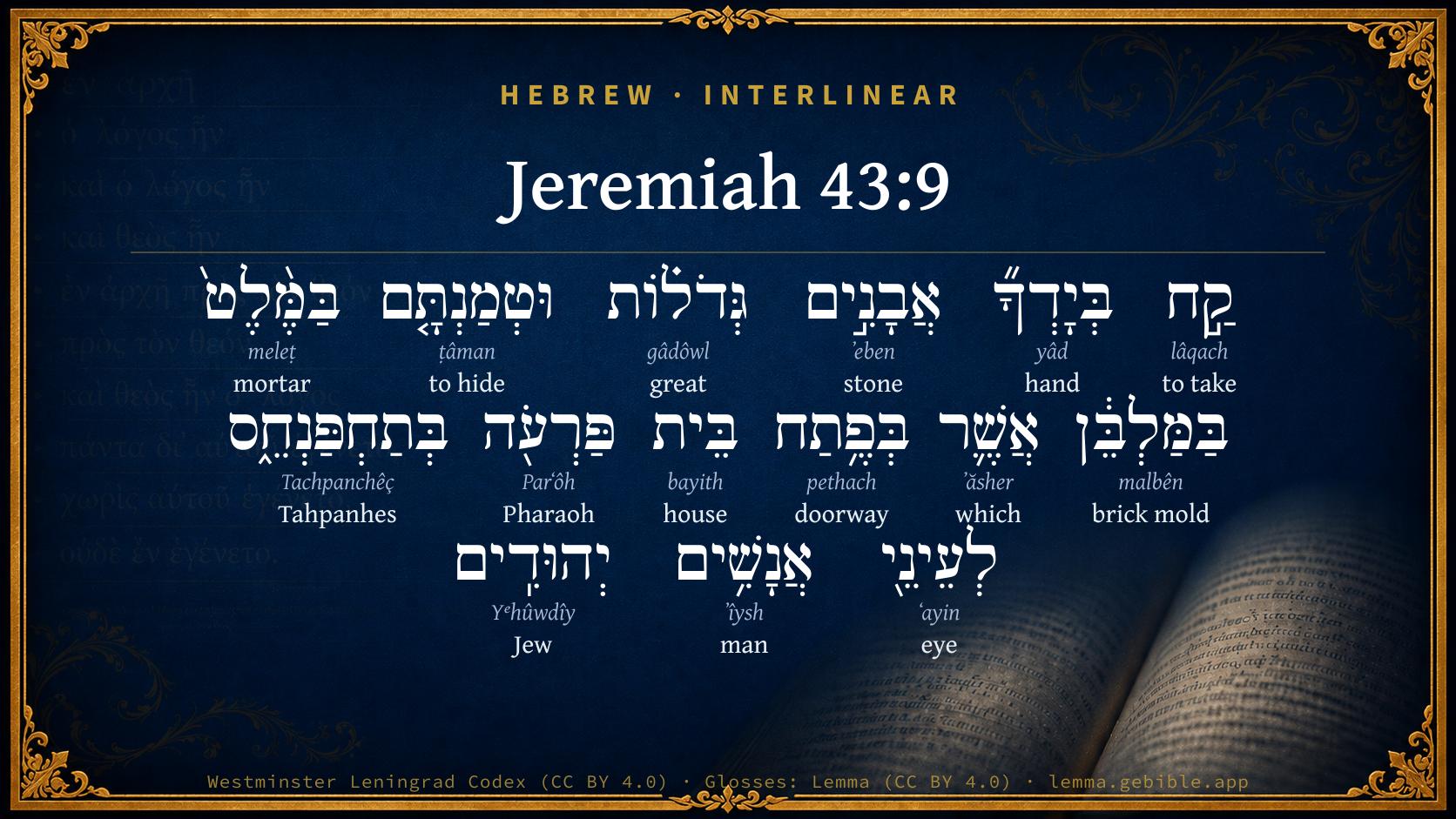
Jeremiah 43:9

Hebrew (Westminster Leningrad Codex) Jeremiah 43:9 appears in the Hebrew Old Testament. The text above is from the Westminster Leningrad Codex. Each word links to its Strong’s number, a concise gloss, and parsing drawn from the Open Scriptures Hebrew Bible morphology. Click any word for its full Brown-Driver-Briggs (BDB) entry.
Download image
Cite this verse

Jeremiah 43:9 (World English Bible). Public Domain. Lemma interlinear Bible study tool, https://lemma.gebible.app/v/jeremiah/43/9.

Show BibTeX & RIS
BibTeX
RIS
English Translation
Take great stones in your hand, and hide them in mortar in the brick work, which is at the entry of Pharaoh's house in Tahpanhes, in the sight of the men of Judah;
World English Bible · Public Domain
Highlights
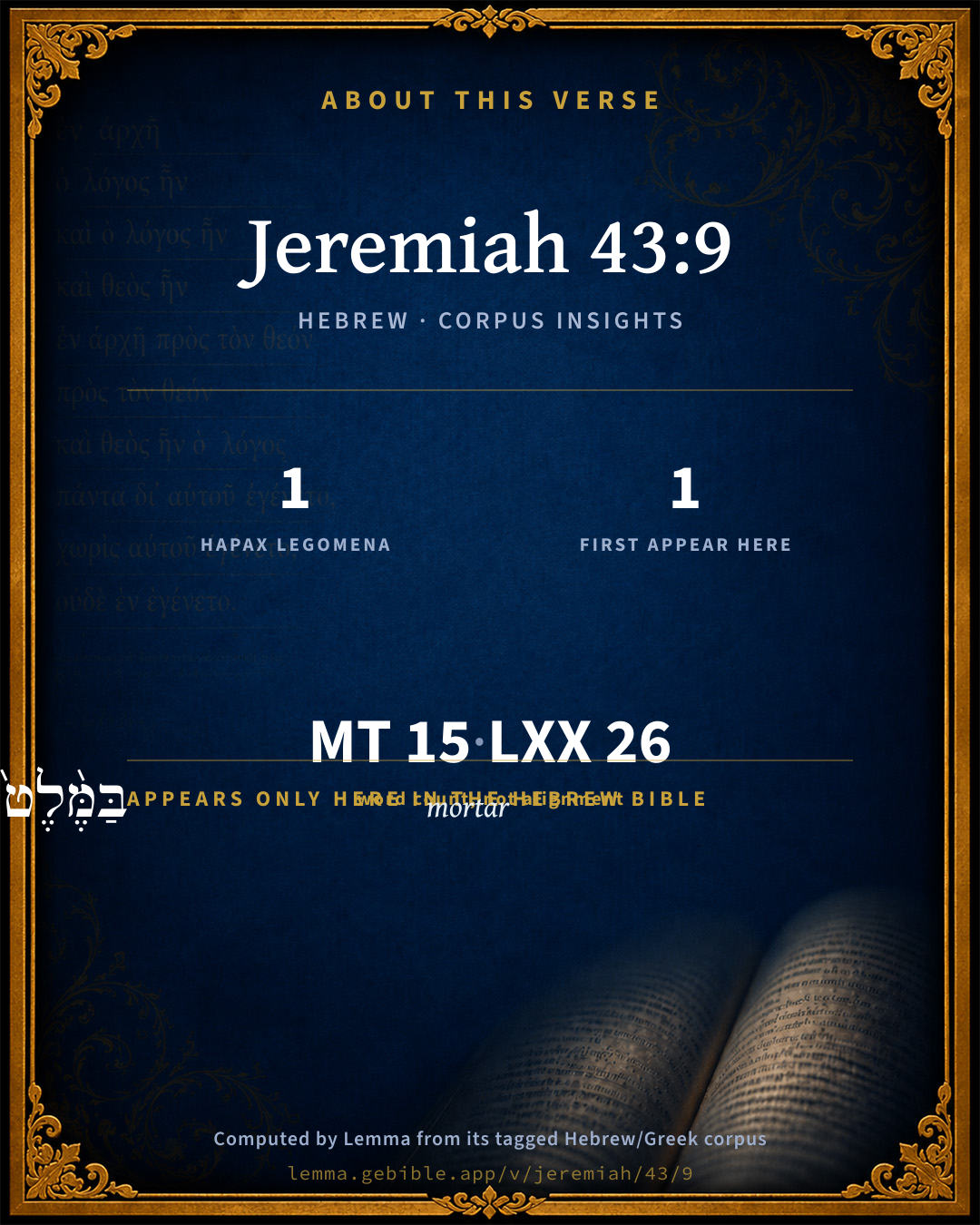
  • 1 hapax legomenon — only here in the Hebrew Bible
  • 1 first appearance in the Hebrew Bible
Full analysis ↓
Download a study sheet

One document with this verse’s original text, its word-by-word gloss line, the meaning frame, cross-references with their text, attributed commentary, and full source and license credits — printable, and it pastes into notes with its structure intact.

This verse Autodidact and up

Study sheet (.html) Plain text (.txt)

A passage Seminary Student

Up to 50 verses in one chapter. A passage sheet keeps up to 6 commentary sources and 12 cross-references per verse, in the order this page ranks them, and says so on the sheet whenever that leaves anything out. Ask for a single verse and you get the Autodidact verse sheet above.

Everything on this page stays free to read, with no account — the sheet is a download of what is already on screen, not access to it.

Want to remove ads? Support Godless Engineer
Compare translations 3

The same verse in 3 English versions, stacked beneath the original-language interlinear above. Click any original word for its lexicon entry.

Each is an independent rendering of the whole verse — the interlinear is not word-aligned to these translations.

Highlighted words mark where these versions differ — a whole-verse word diff, not a word-by-word alignment.

  • World English Bible Public Domain
    Take great stones in your hand, and hide them in mortar in the brick work, which is at the entry of Pharaoh's house in Tahpanhes, in the sight of the men of Judah;
  • King James Version Public Domain
    Take great stones in thine hand, and hide them in the clay in the brickkiln, which is at the entry of Pharaoh's house in Tahpanhes, in the sight of the men of Judah;
  • unfoldingWord Literal Text CC BY-SA 4.0
    “Take some large stones in your hand, and, in the sight of the people of Judah, hide them in the mortar in the pavement at the entrance to Pharaoh’s house in Tahpanhes.”

unfoldingWord Literal Text — © unfoldingWord, licensed CC BY-SA 4.0. Word-aligned USFM3 via Door43 (git.door43.org/unfoldingWord/en_ult).

Versions to compare (up to 4)

3 of 4 selected

Show all 18 translations

Every available English version of this verse, each an independent rendering of the whole verse.

  • World English Bible Public Domain
    Take great stones in your hand, and hide them in mortar in the brick work, which is at the entry of Pharaoh's house in Tahpanhes, in the sight of the men of Judah;
  • Berean Standard Bible Public Domain
    “In the sight of the Jews, pick up some large stones and bury them in the clay of the brick pavement at the entrance to Pharaoh’s palace at Tahpanhes.
  • Majority Standard Bible Public Domain
    “In the sight of the Jews, pick up some large stones and bury them in the clay of the brick pavement at the entrance to Pharaoh’s palace at Tahpanhes.
  • King James Version Public Domain
    Take great stones in thine hand, and hide them in the clay in the brickkiln, which is at the entry of Pharaoh's house in Tahpanhes, in the sight of the men of Judah;
  • American Standard Version (1901) Public Domain
    Take great stones in thy hand, and hide them in mortar in the brickwork, which is at the entry of Pharaoh's house in Tahpanhes, in the sight of the men of Judah;
  • Revised Version (1885) Public Domain
    Take great stones in thine hand, and hide them in mortar in the brickwork, which is at the entry of Pharaoh’s house in Tahpanhes, in the sight of the men of Judah;
  • Geneva Bible (1599) Public Domain
    Take great stones in thine hand, and hide them in the claie in the bricke kill, which is at the entrie of Pharaohs house in Tanpanhes in ye sight of the men of Iudah,
  • Douay-Rheims (1899) Public Domain
    Take great stones in thy hand, and thou shalt hide them in the vault that is under the brick wall at the gate of Pharao's house in Taphnis: in the sight of the men of Juda.
  • Young's Literal Translation Public Domain
    `Take in thy hand great stones, and thou hast hidden them, in the clay, in the brick-kiln, that `is' at the opening of the house of Pharaoh in Tahpanhes, before the eyes of the men of Judah,
  • Literal Standard Version CC BY-SA 4.0
    “Take great stones in your hand, and you have hidden them in the clay in the brick-kiln, that [is] at the opening of the house of Pharaoh in Tahpanhes, before the eyes of the men of Judah,
  • Unlocked Literal Bible CC BY-SA 4.0
    “Take some large stones in your hand, and, in the sight of the people of Judah, hide them in the mortar in the pavement at the entrance to Pharaoh's house in Tahpanhes.”
  • unfoldingWord Literal Text CC BY-SA 4.0
    “Take some large stones in your hand, and, in the sight of the people of Judah, hide them in the mortar in the pavement at the entrance to Pharaoh’s house in Tahpanhes.”
  • Darby Bible Public Domain
    Take great stones in thy hand, and hide them in the clay in the brick-kiln, which is at the entry of Pharaoh's house in Tahpanhes, in the sight of the Jews,
  • World Messianic Bible Public Domain
    “Take great stones in your hand and hide them in mortar in the brick work which is at the entry of Pharaoh’s house in Tahpanhes, in the sight of the men of Judah.
  • Webster's Bible Public Domain
    Take great stones in thy hand, and hide them in the clay in the brick-kiln, which is at the entry of Pharaoh's house in Tahpanhes, in the sight of the men of Judah;
  • Free Bible Version CC BY-SA 4.0
    As the people of Judah watch, get some large stones and set them into the cement of the brick pavement in the entrance way to Pharaoh's palace at Tahpanhes.
  • Bible in Basic English Public Domain
    Take in your hand some great stones, and put them in a safe place in the paste in the brickwork which is at the way into Pharaoh's house in Tahpanhes, before the eyes of the men of Judah;
  • JPS Tanakh (1917) Public Domain
    'Take great stones in thy hand, and hide them in the mortar in the framework, which is at the entry of Pharaoh's house in Tahpanhes, in the sight of the men of Judah;

Literal Standard Version (2020), Covenant Press — licensed CC BY-SA 4.0. Text via the HelloAO Bible API (eBible.org). Unlocked Literal Bible (unfoldingWord) — licensed CC BY-SA 4.0. Text via the HelloAO Bible API (eBible.org). unfoldingWord Literal Text — © unfoldingWord, licensed CC BY-SA 4.0. Word-aligned USFM3 via Door43 (git.door43.org/unfoldingWord/en_ult). Free Bible Version, Dr. Jonathan Gallagher — licensed CC BY-SA 4.0. Text via the HelloAO Bible API (eBible.org).

Word by word

More ways to search: Search by grammar → Find every occurrence → Compare this word →

Practice this passage: Drill this verse → Learn its vocabulary →

בַּמֶּ֨לֶט֙
meleṭ
H4423
“in/at the · mortar”
Preposition, Determined + Noun, Common, Masculine, Singular, Absolute
Part of Speech
Preposition + Noun
Type
Common
Gender
Masculine
Number
Singular
State
Absolute
Full BDB Definition

Origin: from H4422

TWOT: 1198a

mortar, cement, clay (flooring)
  1. קַ֣ח lâqach H3947 “take” Verb, Qal, Imperative, 2nd Person, Masculine, Singular
  2. בְּיָדְךָ֞ yâd H3027 “in/at · hand · your” Preposition + Noun, Common, Both, Singular, Construct + Suffix, Personal, 2nd Person, Masculine, Singular
  3. אֲבָנִ֣ים ʼeben H68 “stones” Noun, Common, Feminine, Plural, Absolute
  4. גְּדֹל֗וֹת gâdôwl H1419 “great” Adjective, Adjective, Feminine, Plural, Absolute
  5. וּטְמַנְתָּ֤ם ṭâman H2934 “and · to hide · them” Conjunction + Verb, Qal, Sequential Perfect, 2nd Person, Masculine, Singular + Suffix, Personal, 3rd Person, Masculine, Plural
  6. בַּמַּלְבֵּ֔ן malbên H4404 “in/at the · brick mold” Preposition, Determined + Noun, Common, Masculine, Singular, Absolute
  7. אֲשֶׁ֛ר ʼăsher H834 “which” Particle, Relative
  8. בְּפֶ֥תַח pethach H6607 “in/at · doorway of” Preposition + Noun, Common, Masculine, Singular, Construct
  9. בֵּית bayith H1004 “house of” Noun, Common, Masculine, Singular, Construct
  10. פַּרְעֹ֖ה Parʻôh H6547 “Pharaoh” Noun, Proper
  11. בְּתַחְפַּנְחֵ֑ס Tachpanchêç H8471 “in/at · Tahpanhes” Preposition + Noun, Proper
  12. לְעֵינֵ֖י ʻayin H5869 “to/for · eyes of” Preposition + Noun, Common, Both, Dual, Construct
  13. אֲנָשִׁ֥ים ʼîysh H376 “men” Noun, Common, Masculine, Plural, Absolute
  14. יְהוּדִֽים Yᵉhûwdîy H3064 “Jews” Noun, Gentilic, Masculine, Plural, Absolute

About this verse

These counts appear in no published source. They are computed here, from the morphology-tagged text and Lemma’s own curated glosses. What Lemma adds →

15
words
15
distinct lemmas
Prophets
section

Notable vocabulary

1 hapax legomenon — a word that appears only here in the entire Hebrew Bible:

  • בַּמֶּ֨לֶט֙ mortar H4423

First appearance in Scripture

This word makes its first canonical appearance in the Hebrew Bible here:

  • בַּמֶּ֨לֶט֙ mortar H4423

Shared distinctive vocabulary

בַּמַּלְבֵּ֔ן brick mold H4404 occurs in 3 verses of the Hebrew Bible. Also found in:

Grammatical profile

  • 2 verbs
  • 11 nouns
  • 1 adjective
  • 1 particle

Verb forms

  • קַ֣ח Qal · Imperative
  • וּטְמַנְתָּ֤ם Qal · Sequential Perfect

Hebrew & Septuagint length

In the original languages it is 15 Hebrew tokens and 26 Greek tokens — but the two are counted differently (Hebrew bundles its prefixes and suffixes into one token; the Greek is in lemma form), so that isn’t a like-for-like length.

Cross-references

14

Topical passages linked to Jeremiah 43:9 in the Treasury of Scripture Knowledge — connected by theme and wording, ordered by reader-vote popularity; previews shown in the World English Bible.

  • Jeremiah 18:2–12 Arise, and go down to the potter's house, and there I will cause you to hear my words.
  • Jeremiah 19:1–15 Thus said Yahweh, Go, and buy a potter's earthen bottle, and [take] of the elders of the people, and of the elders of the priests;
  • Jeremiah 51:63–64 It shall be, when you have made an end of reading this book, that you shall bind a stone to it, and cast it into the midst of the Euphrates:
  • Exodus 1:14 and they made their lives bitter with hard service, in mortar and in brick, and in all manner of service in the field, all their service, in which they ruthlessly made them serve.
  • 2 Samuel 12:31 He brought forth the people who were therein, and put them under saws, and under harrows of iron, and under axes of iron, and made them pass through the brick kiln: and thus did he to all the cities of the children of Ammon. David and all the people returned to Jerusalem.
  • 1 Kings 11:29–31 It happened at that time, when Jeroboam went out of Jerusalem, that the prophet Ahijah the Shilonite found him in the way; now [Ahijah] had clad himself with a new garment; and they two were alone in the field.
  • Isaiah 20:1–4 In the year that Tartan came to Ashdod, when Sargon the king of Assyria sent him, and he fought against Ashdod and took it;
  • Jeremiah 13:1–11 Thus says Yahweh to me, Go, and buy you a linen belt, and put it on your loins, and don't put it in water.
  • Ezekiel 4:1–5:17 You also, son of man, take a tile, and lay it before you, and portray on it a city, even Jerusalem:
  • Ezekiel 12:3–16 Therefore, you son of man, prepare you stuff for removing, and remove by day in their sight; and you shall remove from your place to another place in their sight: it may be they will consider, though they are a rebellious house.
  • Hosea 12:10 I have also spoken to the prophets, And I have multiplied visions; And by the ministry of the prophets I have used parables.
  • Nahum 3:14 Draw water for the siege. Strengthen your fortresses. Go into the clay, and tread the mortar. Make the brick kiln strong.
  • Acts 21:11 Coming to us, and taking Paul's belt, he bound his own feet and hands, and said, "Thus says the Holy Spirit: 'So will the Jews at Jerusalem bind the man who owns this belt, and will deliver him into the hands of the Gentiles.'"
  • Revelation 18:21 A mighty angel took up a stone like a great millstone and cast it into the sea, saying, "Thus with violence will Babylon, the great city, be thrown down, and will be found no more at all.

Cross-references courtesy of OpenBible.info (CC BY 4.0).

Hebrew and Greek witnesses Masoretic Hebrew ↔ Greek Septuagint

The same verse in the two great witnesses to the Old Testament, shown verse-for-verse.

These are two independent witnesses, not word-aligned to each other, and the Septuagint is shown in lemma (dictionary) form.

Hebrew Jeremiah 43:9 Masoretic · Westminster Leningrad Codex

קַ֣ח בְּיָדְךָ֞ אֲבָנִ֣ים גְּדֹל֗וֹת וּטְמַנְתָּ֤ם בַּמֶּ֨לֶט֙ בַּמַּלְבֵּ֔ן אֲשֶׁ֛ר בְּפֶ֥תַח בֵּית פַּרְעֹ֖ה בְּתַחְפַּנְחֵ֑ס לְעֵינֵ֖י אֲנָשִׁ֥ים יְהוּדִֽים

Take great stones in your hand, and hide them in mortar in the brick work, which is at the entry of Pharaoh's house in Tahpanhes, in the sight of the men of Judah;

World English Bible · Public Domain

Greek LXX Structure differs

In the Septuagint, Jeremiah is about an eighth shorter than the Hebrew and arranges its material differently — the Oracles Against the Nations (Hebrew chapters 46–51) appear in the middle of the Greek book, after 25:13. Because the chapter and verse boundaries do not line up, a verse-for-verse comparison with the Hebrew is not shown.

A verse-for-verse comparison isn’t shown here because the chapters and verses don’t line up. Switch to the LXX edition with the MT / LXX toggle above to read the Greek directly.

On this verse, Ellicott's Commentary for English Readers discusses the Septuagint’s reading. Read the note in Commentary ↓

Hebrew: Westminster Leningrad Codex (CC BY 4.0). Greek: Septuagint (public domain); English from a public-domain English Septuagint. How the Septuagint differs from the Hebrew →

Targum (Aramaic paraphrase)

1

The Targum is the ancient Jewish Aramaic paraphrase of the Hebrew Scriptures — an interpretive translation, not the Hebrew text itself. Onkelos (literal) and Pseudo-Jonathan (expansive) render the Torah, and Jonathan the Prophets. Coverage is partial: where no permissively-licensed English translation exists for a verse, only the Aramaic is shown. This is verse-level text, not a word-by-word alignment to the Hebrew.

  1. Targum Jonathan Prophets (Joshua–Malachi)
    סַב עִמָךְ אַבְנִין רַבְרְבָן וְתִטַמְרִינוּן בִּטְפֵיל בִּנְיָנָא דִי בִּתְרַע בֵּית פַּרְעֹה בְּתַחְפַּנְחֵס לְעֵינֵי גַבְרִין יְהוּדָאִין:

    (no public-domain English translation for this verse)

    Targum Jonathan — Aramaic: “Mikraot Gedolot” (public domain). English: “Sefaria Community Translation” (CC0 1.0 (public-domain dedication)); “London "Chaldee Paraphrase," 1871” (public domain). Text via Sefaria.

Commentary

Notes on Jeremiah 43:9 from classic Christian and Jewish commentators (each source and its license shown beneath its notes). The classic Christian expositions comment on the surrounding passage and are grouped to its opening verse, so a note may address several verses; the Jewish commentaries on the Tanakh (Rashi and others) are per-verse, so they appear only where the commentator wrote on this verse.

Lemma curates 59 commentaries, every one of them public domain or Creative Commons licensed, each selected and text-cleaned for this edition rather than reprinted as found. About our sources →

Trapp's Complete Commentary

John Trapp

Jer 43:9 Take great stones in thine hand, and hide them in the clay in the brickkiln, which [is] at the entry of Pharaoh’s house in Tahpanhes, in the sight of the men of Judah;

Ver. 9. Take great stones in thine hand.] Bricks, wherewith Egypt abounded, as being much of it muddy by reason of the inundation of the river Nile; hence also their chief city was called Pelusium, or Daphnis Pelusiae. See Jer 43:7. It is ordinary with Jeremiah to join paradigms with his prophecies, as here, that they might be the more evident, and take the deeper impression.

John Trapp, A Commentary or Exposition upon All the Books of the Old and New Testament (1647–1656) — public domain. Text from a community e-Sword module.

Geneva Bible (1599)

Geneva Bible translators

Which signified that Nebuchadnezzar should come even to the gates of Pharaoh, where were his brick kilns for his buildings.

Geneva Bible (1599) marginal notes — public domain. Text via Bolls.life.

Jamieson, Fausset & Brown

Robert Jamieson, A. R. Fausset & David Brown

stones--to be laid as the foundation beneath Nebuchadnezzar's throne (Jer 43:10).

clay--mortar.

brick-kiln--Bricks in that hot country are generally dried in the sun, not burned. The palace of Pharaoh was being built or repaired at this time; hence arose the mortar and brick-kiln at the entry. Of the same materials as that of which Pharaoh's house was built, the substructure of Nebuchadnezzar's throne should be constructed. By a visible symbol implying that the throne of the latter shall be raised on the downfall of the former. Egypt at that time contended with Babylon for the empire of the East.

Jamieson, Fausset & Brown — Commentary Critical and Explanatory on the Whole Bible (1871) — public domain (CC PDM 1.0). Text via the HelloAO Bible API.

Adam Clarke's Commentary

Verse 9. Take great stones] This discourse seems to have been delivered about a year after the destruction of Jerusalem. They pretended that they dared not stay in Judea for fear of the Chaldeans. The prophet here assures them that Nebuchadnezzar shall come to Egypt, extend his conquests in that kingdom, and place his tent over the very place where these stones were laid up, and destroy them. How these prophecies were fulfilled, see at the end of Jer 44:30.

Adam Clarke's Commentary on the Bible (1810–1826) — public domain. Text from a community e-Sword/MySword module.

John Calvin's Commentaries

He was then commanded to take great stones, and to hide them in the clay, or cement, in a brick-kiln, that is, in a kiln where bricks were burnt, or in a place where they were usually made, or where materials were taken to form them. And this place was not far from the palace of the king in the city of Taphnees, as the Prophet expressly declares; nay, he says that it was nigh the gate. As, then, this place was near the palace, the Prophet was bidden to hide there the stones, and in the sight of the Jews. This was the symbol. Now, it is shewn for what end God would have the stones to be fixed in the clay or cement; for if the stones were only rolled there with great labor by the Prophet, there would have been no instruction; and all signs we know are unmeaning and without any importance without the word. It is God’s word, then, that in a manner gives life to signs, and applies them for the benefit and instruction of men. Therefore God’s command is added, that he was to speak to the Jews: Thou shalt say to them, Thus saith Jehovah. He brings in God as the speaker, that the threatening might be more effectual, as it has been stated elsewhere; for if he had only related the words of God, he could not have thus arrested their attention, which was very tardy. This, then, is the reason why he speaks in the person of God himself.

John Calvin's Commentaries (1540-1563) — public domain. Text from the Calvin Translation Society English edition (1840s-50s) via the Christian Classics Ethereal Library (ccel.org). Calvin's coverage is partial (roughly two-thirds of the Bible); uncommented books and verses are honest gaps, never fabricated. The 19th-century editor's footnotes and remarks are omitted so the notes are faithfully Calvin's own voice.

Ellicott's Commentary for English Readers

(9) Take great stones in thine hand, and hide them in the clay in the brickkiln.—Better, in the mortar on the platform. There seems something incongruous in the idea of a brickkiln, or a place for baking bricks, at the entrance of a royal palace; nor is it easy to see why Nebuchadrezzar should have chosen it as a place for his throne. It seems better, with Hitzig, Furst, and others, to take the Hebrew word, which occurs only here and in 2Sa_12:31 and Nah_3:14, as meaning a structure of brick, a dais or raised pavement, like the Gabbatha or Pavement on which Pilate sat (Joh_19:13), in front of the entrance of the palace, on which the king naturally placed his throne when he sat in judgment or received petitions. Assyrian and Babylonian monuments present many instances of kings thus seated. As making his prediction more vivid, the prophet places stones in the mortar or cement (not “clay”) with which the mass was covered, and conceals them apparently with a fresh coat of mortar. There they were to remain till his prediction should be fulfilled. The symbolic act was of the same type as the breaking of the potter’s vessel in Jer_19:10, and the yoke worn on the prophet’s shoulders (Jer_27:2), and Ezekiel’s digging through the wall (Eze_12:7). It may be noted that our version follows Luther in translating “brickkiln.” The LXX. evades the difficulty by taking refuge in vague terms” in the vestibule (πρόθυρα), in the gate of the house,” and the Vulgate gives “in the crypt which is under the brick walls.”

A Bible Commentary for English Readers, edited by Charles John Ellicott (1878–1897) — public domain. Text from a community e-Sword module.

The Cambridge Bible for Schools and Colleges

gen. ed. J. J. S. Perowne

9. hide them in mortar in the brickwork] mg. lay them with mortar in the pavement (or square). The MT. is questionable here. The words for “in the mortar” and “in the brickwork” resemble each other, the first occurring nowhere else. The LXX read simply “in the fore-court,” which is not justified by the Hebrew as we have it. Aq. Symm. Theod. have “in secret,” omitting one of the consonants of the Hebrew word for “in mortar,” and this probably gives us the true meaning, viz. secretly, in the brickwork. The incident (so Erbt and Co.) perhaps occurred at night. This is not inconsistent with the words “in the sight of the men of Judah,” for cp. Eze_12:7.

in the brickwork] If we keep the text as it stands, the word, which elsewhere means a brick-mould, may here mean something quadrangular (see mg.). It is perhaps “the large oblong brick pavement close to the palace fort built by Psammetichus I (b.c. 664–610), which was excavated by Prof. Petrie at Tell Defneh in 1886.” Dr., p. 258, who adds references to Petrie and Maspero.

The Cambridge Bible for Schools and Colleges (gen. ed. J. J. S. Perowne; Cambridge University Press, 1878–1918) — public domain. Text from a community e-Sword module.

John Gill's Exposition

Take great stones in thine hand,.... In both his hands, as big as he could carry:

and hide them in the clay in the brick kiln; there was much clay in Egypt, through the overflowing of the Nile, and particularly at this place Tahpanhes, which had its name of Pelusiae from hence; and here was a brick kiln; not a place where bricks were burnt, but where they were foraged; and so here was the clay of which they were made, and in which these stones were to be hid:

which is at the entry of Pharaoh's house in Tahpanhes; this brick kiln stood not directly at the entrance into the king's palace, but at the door of a wall of a park or garden, which belonged to the palace, from whence there was an open way to it; here the stones were to be laid. Since a brick kiln so near a king's palace seems not agreeable, Gussetius (h) thinks signifies a poplar walk, from a poplar tree, whose shade is very grateful, Hos 4:13; to which the courtiers betook themselves at certain times, and walked in for pleasure;

in the sight of the men of Judah; not in the sight of the Egyptians, who would not understand the design of it, nor were they to be instructed by it; but in the sight of the Jews, who would at once imagine that something was intended, being used to such symbols, and would inquire the meaning of it; and which is explained in Jer 43:10.

(h) Ebr. Comment. p. 470.

John Gill's Exposition of the Whole Bible (1746–1763) — public domain (CC PDM 1.0). Text via the HelloAO Bible API.

Albert Barnes' Notes on the Bible

Brickkiln - Possibly, a pavement of brick. Jeremiah was to take a few large stones, such, nevertheless, as he could carry in his hand, and build with them, in the propylaea before the royal palace, something that would serve to represent the dais upon which the seat of kings was usually placed. By hiding them in the clay is meant plastering them over with mortar.

Albert Barnes' Notes on the Bible (1834–1885) — public domain. Text from a community e-Sword/MySword module.

Haydock's Catholic Bible Commentary

Wall; kiln, or court. (Hebrew) Justice was administered at the gate, and the magnificent throne of Solomon was placed in the court or porch, 3 Kings x. 18. (Calmet) --- The prophet preaches by facts, laying great stones in the chief city, chap. xix. 10. (Worthington)

George Leo Haydock (1774–1849), Haydock's Catholic Family Bible and Commentary, 1859 edition — public domain. Excludes Psalms (Douay-Rheims chapter numbering differs from Protestant) and Deuterocanonical books (Catholic canon only).

Matthew Poole's English Annotations

God commandeth the prophet to take these

stones, and to place them

in the clay, & c., for a sign of what we shall meet with expounded in the next verse: it is plain from hence that the king of Egypt, called Pharaoh, either resided, or at least had a royal palace, in Tahpanhes; Jeremiah is directed to fix these stones at the entrance into this palace. This hath made interpreters divided about the true sense of the word which is here translated a

brick-kiln. That the word so signifies is out of doubt, and is so translated, 2Sa 12:31. All that troubleth some is, that they fancy there should not be a brick-kiln so near the king’s palace; but possibly those learned men do not enough consider the difference of times and places. Great princes’ sons and daughters do not use in our age to keep sheep, which yet we know Jacob’s sons and Laban’s daughters did; the grandeur of princes was not so great but it might admit of as plain a thing as this. Others say the palaces of their princes were very vast, so that the brick-kiln might be at a distance from the entry into the dwelling-house, though it was at the entry of the place called by the name of the palace. Others think it might be a house used not for making, but polishing earthenware. But the greatest offensiveness of such kilns with us is from the smoke, of which they had none, drying their bricks in the sun. But it is a nicety not worth so many guesses.

Matthew Poole's English Annotations on the Holy Bible (1683–1685) — public domain. Text from a community e-Sword/MySword module.

Whedon's Commentary on the Bible

Daniel D. Whedon

PREDICTION REGARDING EGYPT, Jer_43:8-13.

9. Hide them in the clay in the brickkiln — The object of this symbolical action is perfectly plain; but to understand the action itself is exceedingly difficult. The great doubt is, as to the sense of the word translated “brickkiln.” The word is used in two other places, neither one of which sheds a very certain light upon the word. In 2Sa_12:31, it is said of David that “he made them (the Ammonites) to pass through the brickkiln.” In Nah_3:14, the people are exhorted to prepare for the siege, and this language is employed: “Go into clay, and tread the mortar, make strong the brickkiln.” Each one of these passages has its special difficulty, and so they cannot be appealed to with much confidence as settling the meaning of the word. Furst gives to the word in 2Sa_12:31, (Kethib,) the sense of a heathen deity; and this, though conjectural rather than ascertained, is possibly right. He gives to the word in Nah_3:14, the sense of “brick,” such as would be used in closing up the breaches of the walls, and this sense perfectly fits the passage. In this place he gives the word the sense of “a brick-shaped quadrangle,” and understands it to be a pavement of brick or tile in front of the palace. This comes very nearly to the sense of the leading versions, the Vulgate rendering, “a brick wall,” the Syriac “a brick mould,” and the LXX “the propylaea.” Taking this sense, Jeremiah was instructed to take stones and conceal them in clay or mortar on the pavement in front of the palace. The clay represented the fragile power of the Egyptians, which would now fail; the stones the more enduring power of the Babylonians. The place was a suitable one for this act. That the prophet would be permitted to place stones and mortar in such a place for such a purpose is not incredible — certainly not impossible. The place was suitable, indicating the establishing of a royal power. The clay was the material out of which the palace itself was built. Pharaoh’s dominion was as the crumbling clay; Nebuchadrezzar’s was symbolized by the more enduring stones.

There is but one other view of this passage entitled to consideration. Neumann prefers the sense “brickkiln,” and explains the difficulty that it should be found in front of the palace, on the supposition that it was there to supply material for the construction of the palace, and had not yet been removed. This view is approved by Keil and Nagelsbach. But, to say the least, while it is a possible, it is certainly not a probable, conjecture; and even if the sense “brickkiln” were established, the hiding in the clay in the brickkiln is hard to understand.

Daniel D. Whedon (gen. ed.), Commentary on the Old and New Testaments (1874–1909) — public domain. Text from a community e-Sword module.

The Pulpit Commentary

Take great stones, etc. A strange symbolic act of Jeremiah"s is here described. "We must not suppose, arguing from our Western and precise notions, that he would be at all necessarily interfered with. In fact, he would have a twofold security, as a prophet of God to those who acknowledged him as such, and in the opinion of others as insane, and, according to Eastern ideas, thus especially under Divine promptings in his acts" (Streane). He is directed to take great stones and embed them in the mortar (not "clay") in the brick pavement at the entry of the palace. When the events predicted came to pass, these stones would testify that Jeremiah had predicted them. The word rendered "brick pavement" is of doubtful meaning. In Nah_3:14 it signifies "brick kiln."

The Pulpit Commentary (1880–1919), ed. H.D.M. Spence-Jones & Joseph S. Exell — public domain. Text from a community e-Sword module.

Rashi

Rabbi Shlomo Yitzchaki (Rashi)

and hide them in the mortar Heb. במלט. This ‘mem’ is a defective radical in the word, like מקום, a place, מעמד, a stand, מעשה, a deed, and its root is לט, cf. “he wrapped (וילט) his face” (I Kings 19:13). Envelop them in the mortar in the framework. in the mortar (Envolopemant in O.F)

Rashi on the Tanakh — English translations: “The Judaica Press complete Tanach with Rashi, translated by A. J. Rosenberg” (CC BY 4.0); “Pentateuch with Rashi's commentary by M. Rosenbaum and A.M. Silbermann, 1929-1934” (public domain); “The Metsudah Tanach series, Lakewood, N.J” (CC BY 4.0); and “The Book of Joshua, Metsudah Publications, 1997” (CC BY 4.0). Text via Sefaria.

Lesson kit

Teaching starters — assembled from the data on this page, not authored interpretation. Every prompt links to the verse data it draws on. Edit before teaching.

Jeremiah, in the Prophets, opens this verse with 15 words (15 distinct Hebrew lemmas). Its most distinctive word is meleṭ (“mortar”). A historical commentator’s framing appears above. Read the whole chapter for the surrounding context.

Discussion questions

  1. How does “mortar” (meleṭ) shape what this verse is saying?
  2. 1 word here appears nowhere else in the Hebrew Bible. Why might the author reach for such rare wording?
  3. This is the first place “mortar” appears in Scripture (first appears here). What does its debut here establish?
  4. How does 2 Samuel 12:31, which shares the word «brick mold», read alongside this verse?
  5. The translations on this page render this verse differently — a whole-verse word diff, not a word-by-word alignment. What might account for the different wordings?
  6. «קַ֣ח» is a Qal Imperative verb. How does that grammatical form shape the action described?
  7. Compare how Trapp's Complete Commentary and Geneva Bible (1599) read this verse. Where do they agree or differ?

Things to notice

Reading settings

Reading text

Shown beneath each verse's original-language words.

Old Testament
Old Testament edition

Read the OT as the Masoretic Hebrew (MT) or the Greek Septuagint (LXX).

English shown for the Greek Septuagint (in the Hebrew ↔ Greek comparison).

Comparing translations? Open the Compare panel on any verse page to stack up to four side by side.